
Stress and Trauma for Humanitarian Workers Helping Ourselves

- Slides: 37
Stress and Trauma for Humanitarian Workers Helping Ourselves and Others. Payap University 7 February 2020 Kelly O’Donnell, Psy. D MCAresources@gmail. com
Managing Stress and Trauma Lessons learned from the humanitarian sector • Review some historical highlights, research, and tools • Listen to some humanitarian “voices” • Identify resources and strategies for your work/life and organizations (and a simple plan to review and apply them) Notes: 1. Questions to help you interact with the material are in blue highlights. 2. This presentation is not as “linear and sequential” as my Western-wired brain would want it to be.
Humanitarian Workers—Organizations Wellbeing and Effectiveness • Unbreakable? Recognizing Humanitarian Stress and Trauma Global Geneva magazine, October 2017 (two page overview) • Helping the Helpers--50 Resources for Humanitarian Workers Global Integration Update, October 2017 • Field Consultations: Risk-Resilience-Relevance-Relationships Member Care Update, December 2015 • Voices and Videos: Lessons from the Humanitarian Trenches Member Care Update, March 2015 • Creative Tools for Member Care-Healing Member Care Update, October 2014 • Member Care Tools for Ourselves and Others Member Care Update, January 2013
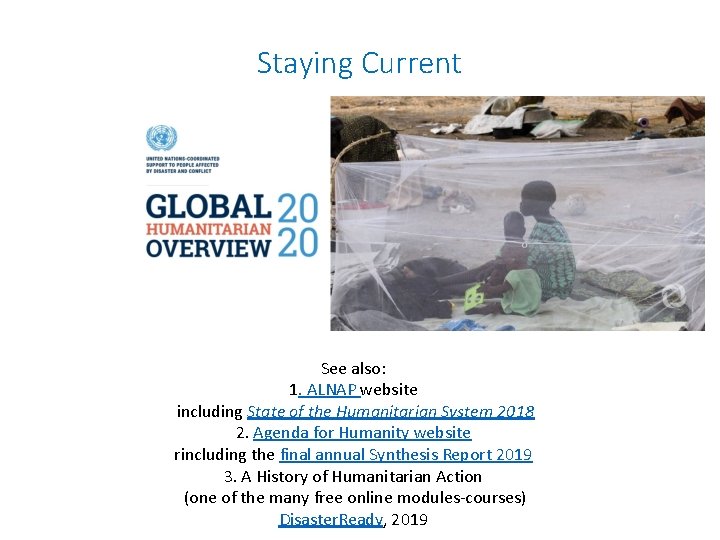
Staying Current See also: 1. ALNAP website including State of the Humanitarian System 2018 2. Agenda for Humanity website rincluding the final annual Synthesis Report 2019 3. A History of Humanitarian Action (one of the many free online modules-courses) Disaster. Ready, 2019
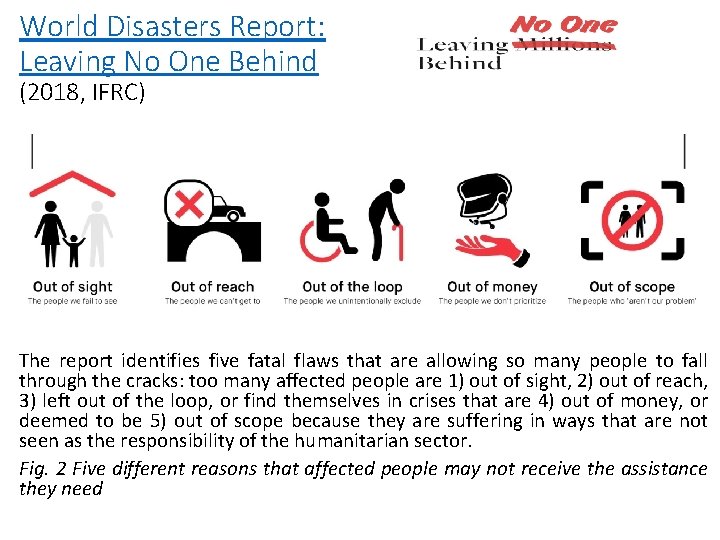
World Disasters Report: Leaving No One Behind (2018, IFRC) The report identifies five fatal flaws that are allowing so many people to fall through the cracks: too many affected people are 1) out of sight, 2) out of reach, 3) left out of the loop, or find themselves in crises that are 4) out of money, or deemed to be 5) out of scope because they are suffering in ways that are not seen as the responsibility of the humanitarian sector. Fig. 2 Five different reasons that affected people may not receive the assistance they need
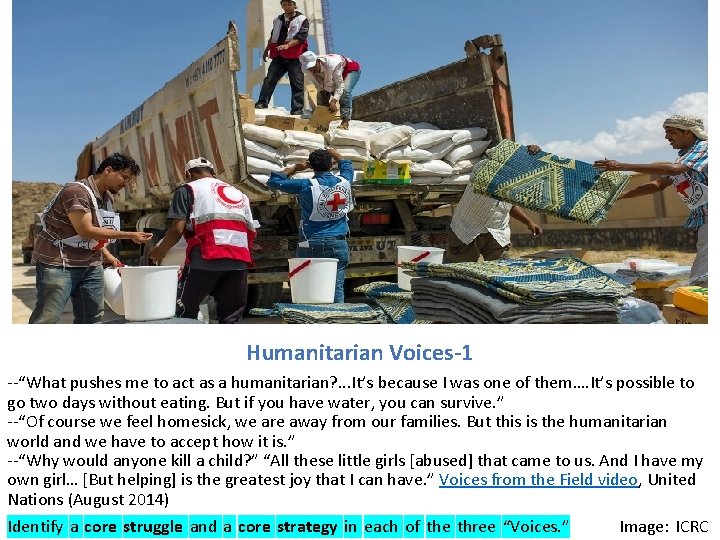
. Humanitarian Voices-1 --“What pushes me to act as a humanitarian? . . . It’s because I was one of them…. It’s possible to go two days without eating. But if you have water, you can survive. ” --“Of course we feel homesick, we are away from our families. But this is the humanitarian world and we have to accept how it is. ” --“Why would anyone kill a child? ” “All these little girls [abused] that came to us. And I have my own girl… [But helping] is the greatest joy that I can have. ” Voices from the Field video, United Nations (August 2014) Identify a core struggle and a core strategy in each of the three “Voices. ” Image: ICRC
Mental Health Issues—Humanitarian Workers Lots of variation in research, but consistently: --higher incidences of depression, anxiety, PTSD, harmful use of alcohol and burnout --differences also between different groups such as “international vs national staff” • To get a good feel for the type of research being done--and needed: Factors associated with common mental health problems of humanitarian workers in South Sudan, PLo. S One. 2018; 13(10): e 0205333. Published online 2018 Oct 31. doi: 10. 1371/journal. pone. 0205333 • And…how many humanitarian workers are there? Well…it depends…. ALNAP stats for humanitarian workers and RC-RC Movement stats for volunteers…. etc.
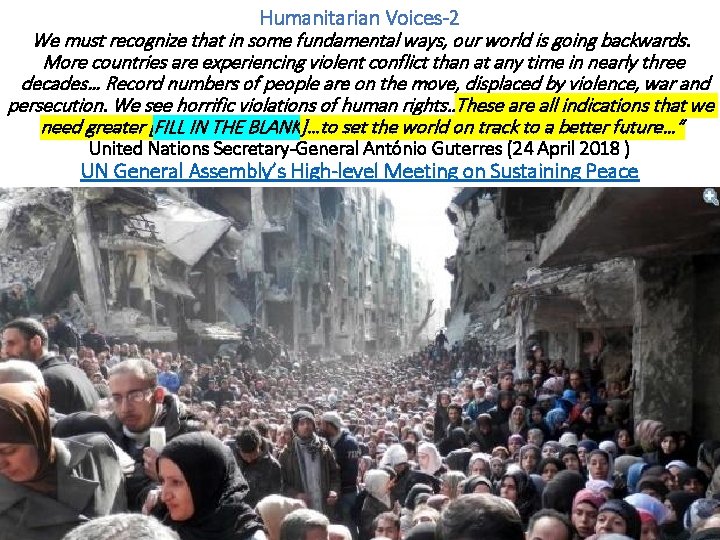
Humanitarian Voices-2 We must recognize that in some fundamental ways, our world is going backwards. More countries are experiencing violent conflict than at any time in nearly three decades… Record numbers of people are on the move, displaced by violence, war and persecution. We see horrific violations of human rights…These are all indications that we need greater [FILL IN THE BLANK]…to set the world on track to a better future…” United Nations Secretary-General António Guterres (24 April 2018 ) UN General Assembly’s High-level Meeting on Sustaining Peace
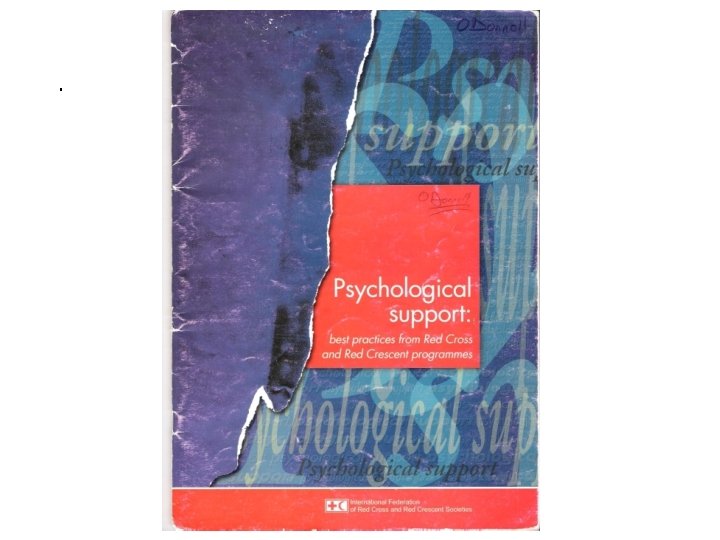
International Federation of the RC-RC • In the aftermath of a number of disasters in the early 1990 s, the necessity and importance of addressing the psychological needs of victims were amply demonstrated. This led to the establishment of the psychological support programme (PSP) of the International Federation in May 1991…. • However, a series of conflict situations brought to light another category of people psychologically affected by disasters: relief workers. Many Red Cross and Red Crescent delegates who had worked in relief operations (Rwanda and Somalia, for example) came back feeling lost, isolated, depressed and completely exhausted and suffering from nightmares and flashbacks. They often found it difficult to talk about their feelings of helplessness and horror to family, friends and colleagues who could not fully understand what they had been through or were not interested. • It became increasingly apparent, therefore, that delegates needed specialized psychological debriefings. (Psychological Support Programme for Delegates, Psychological Support: Best Practices from Red Cross and Red Crescent Programmes, 2001, p. 18).
IFRC Three “revelations” from humanitarian experience: • The distinction between psychological needs and other priorities in relief operations is an artificial one, as psychological needs permeate and affect all other aspects such as shelter, food distribution, and basic health care. Provision of traditional relief aid is, therefore, not sufficient. • Neglecting emotional reactions may result in passive victims rather than active survivors. [has this ever happened to you? ] • Early and adequate psychological support can prevent distress and suffering from developing into something more severe, and will help the people affected cope better and return more rapidly to normal functioning (p. 5).
Humanitarian Voices-3 Mc. Leod, H. (1998) Staying sane and healthy in an insane job: How one relief worker kept her wits. Together, 16 -21. World Vision International (p. 16) “I’ve managed my stress levels pretty well in the past. But we saw some really horrible things in the places where I worked. I’ve seen rotting bodies. I’ve seen people who died of dysentery and cholera in the camps. How do you process that? … That’s not the norm. We’re not prepared for that…it pushed me to my limit in terms of trying to manage those experiences while in the middle of it. As a result of those experiences I attended stress management and stress debriefing courses which helped me a lot…”
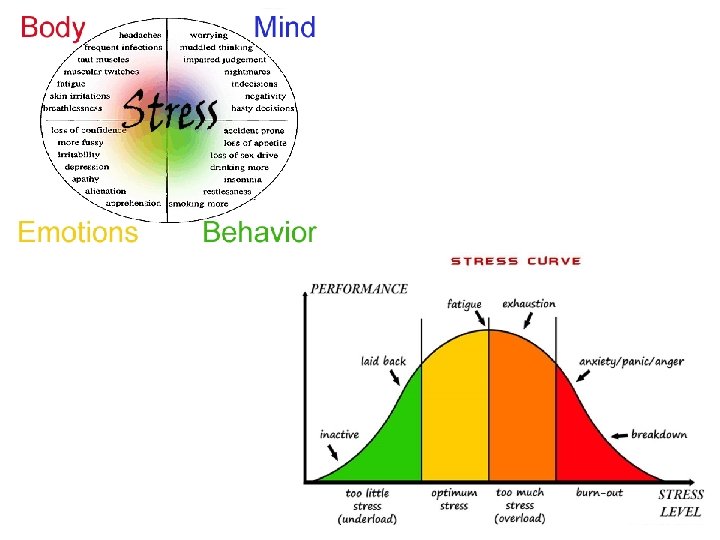
Stress • Stress can be defined as any demand or change that the human system (mind, body, spirit) is required to meet and respond to. Stress is a part of normal life and without challenges and physical demands, life could become boring. Stress becomes distress (or traumatic stress) when it lasts too long, occurs too often, or is too severe. • Lisa Mc. Kay, Headington Institute. Understanding and Coping with Traumatic Stress (2007) • . The stress response (e. g. via stressors that are perceived as threatening) activates the autonomic nervous system, increasing the amount of adrenaline in the blood and the flow of blood to muscles. The resulting state of heightened anxiety, influences the characteristic response that everyone has experienced at one time or another: fight (confront), flight (withdraw), or freeze (don’t move). And also “faint-feign-fade”?
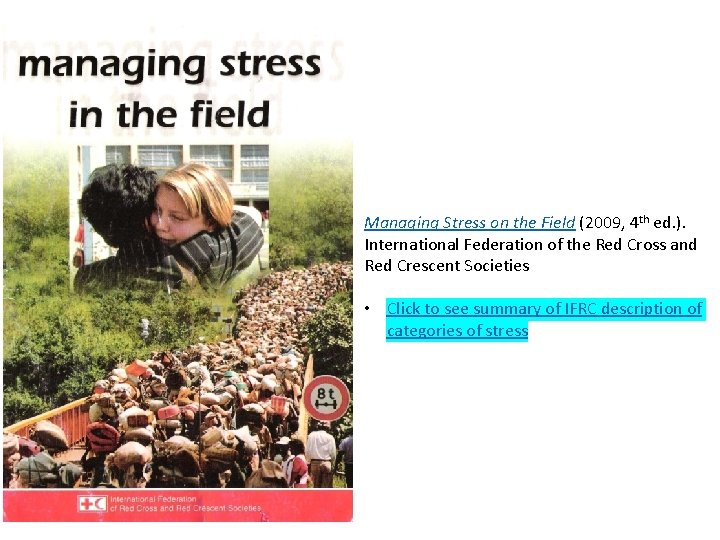
. Managing Stress on the Field (2009, 4 th ed. ). International Federation of the Red Cross and Red Crescent Societies • Click to see summary of IFRC description of categories of stress
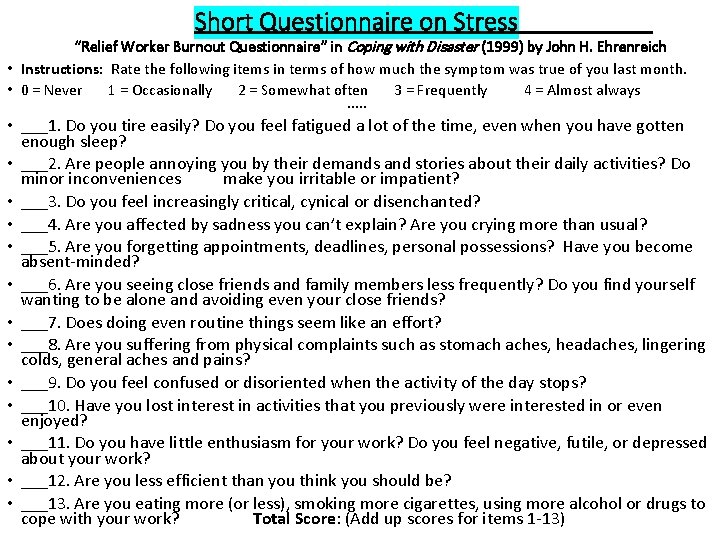
Short Questionnaire on Stress “Relief Worker Burnout Questionnaire” in Coping with Disaster (1999) by John H. Ehrenreich • Instructions: Rate the following items in terms of how much the symptom was true of you last month. • 0 = Never 1 = Occasionally 2 = Somewhat often 3 = Frequently 4 = Almost always ***** • ___1. Do you tire easily? Do you feel fatigued a lot of the time, even when you have gotten enough sleep? • ___2. Are people annoying you by their demands and stories about their daily activities? Do minor inconveniences make you irritable or impatient? • ___3. Do you feel increasingly critical, cynical or disenchanted? • ___4. Are you affected by sadness you can’t explain? Are you crying more than usual? • ___5. Are you forgetting appointments, deadlines, personal possessions? Have you become absent-minded? • ___6. Are you seeing close friends and family members less frequently? Do you find yourself wanting to be alone and avoiding even your close friends? • ___7. Does doing even routine things seem like an effort? • ___8. Are you suffering from physical complaints such as stomach aches, headaches, lingering colds, general aches and pains? • ___9. Do you feel confused or disoriented when the activity of the day stops? • ___10. Have you lost interest in activities that you previously were interested in or even enjoyed? • ___11. Do you have little enthusiasm for your work? Do you feel negative, futile, or depressed about your work? • ___12. Are you less efficient than you think you should be? • ___13. Are you eating more (or less), smoking more cigarettes, using more alcohol or drugs to cope with your work? Total Score: (Add up scores for items 1 -13)
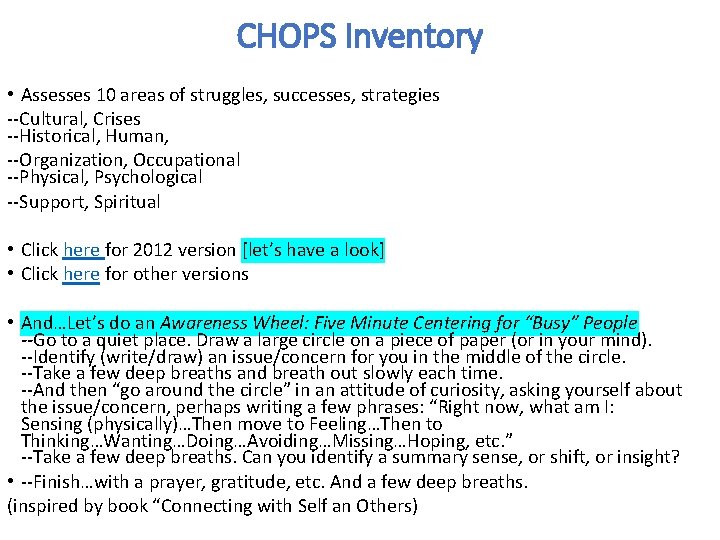
CHOPS Inventory • Assesses 10 areas of struggles, successes, strategies --Cultural, Crises --Historical, Human, --Organization, Occupational --Physical, Psychological --Support, Spiritual • Click here for 2012 version [let’s have a look] • Click here for other versions • And…Let’s do an Awareness Wheel: Five Minute Centering for “Busy” People --Go to a quiet place. Draw a large circle on a piece of paper (or in your mind). --Identify (write/draw) an issue/concern for you in the middle of the circle. --Take a few deep breaths and breath out slowly each time. --And then “go around the circle” in an attitude of curiosity, asking yourself about the issue/concern, perhaps writing a few phrases: “Right now, what am I: Sensing (physically)…Then move to Feeling…Then to Thinking…Wanting…Doing…Avoiding…Missing…Hoping, etc. ” --Take a few deep breaths. Can you identify a summary sense, or shift, or insight? • --Finish…with a prayer, gratitude, etc. And a few deep breaths. (inspired by book “Connecting with Self an Others)
Headington Assessment Tools • How Stressed Are You? • Selfcare and Lifestyle Balance Inventory • Are You Showing Signs of Burnout?
Headington Institute Learning Modules • Mc. Kay, L. (2009) Family matters: Self-care for family members of humanitarian workers. Pasadena, CA: Headington Institute. Available at: • headington-institute. org/files/family-mattersmoduletemplate 2_edited_85407. pdf • Mc. Kay, L. (2010) Spirituality and humanitarian work: Maintaining your vitality. Pasadena, CA: Headington Institute. Available at: • headington-institute. org/files/spiritualitymoduletemplate 2_ready_74911. pdf • Mc. Kay, L. (2011) Building resilient managers in humanitarian organizations: Strengthening key organizational structures and personal skills that promote resilience in challenging environments. London: People in Aid. London: Mc. Kay. Available at: peopleinaid. org/pool/files/pubs/resilience(2). pdf
PTSD • ‘Post-Traumatic Stress Disorder’ (PTSD) can occur after exposure to extreme stressors (including ongoing or intermittent exposure) where there is the threat to oneself or others of death, serious injury or violence. It is accompanied by intense fear and feelings of helplessness, with distressing recollections, dreams or flashbacks along with hyper-vigilance and avoidance of anything that reminds one of the stressor. These symptoms usually occur within one month of experiencing the traumatic event, although ‘delayed expression’ of symptoms can also occur. These can include depression, anxiety, grief, and substance abuse. See PTSD summary here also—Mayo Clinic See types of PTSD by National Center for PTSD
Responses to Potentially Traumatic Experiences People can often have strong reactions following a traumatic event. These reactions are usually temporary. Some of the common reactions during the first hours after an event may be: • Shock, disbelief, feeling of being overwhelmed • Strong emotional reaction or detachment • Confusion, difficulty in making decisions • Physical reactions: nausea, dizziness, intense fatigue, sleeping difficulties, muscle tremors Additional reactions during the first days and weeks may be: • Persistent, intrusive recollections (flashbacks) of the incident, nightmares • Tendency to avoid certain aspects of the incident (places, thoughts, emotions, activities) • Hyper-alertness accompanied by a startle reflex, quick temper and sleeping problems
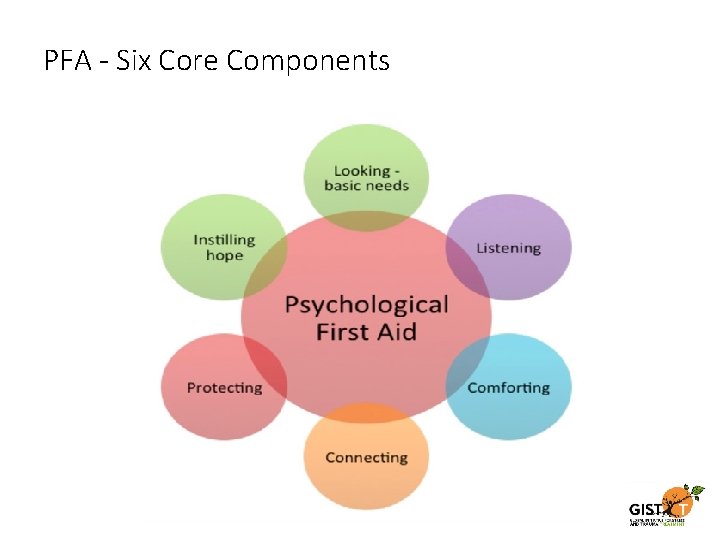
PFA - Six Core Components
Resilience The ability to engage with and grow through life’s challenges and adversities. It involves character strengths, social support, coping skills, and core beliefs/values including life purpose and spiritual meaning. [anything else? ] Resilience is necessary to face the challenges in crisis situations and to maintain one’s health and effectiveness. Eriksson et al. researched stress, trauma, and burnout for World Vision field staff from over 30 countries. Their findings emphasize the need for resilience: “Staff need to have healthy personal resilience in order to survive and in order to continue contributing to the critical work of their organizations. . . for each of the mental health risk adjustment measures (depression, post-traumatic stress disorder, and burnout) 30 -50% of staff scored in the moderate to high-risk range. This is a significant number of people who are working and 'surviving' while experiencing considerable emotional distress. These staff may not be incapacitated by these symptoms presently, but we cannot deny the effects that depression, burnout, and PTSD can have on relationships, work, and personal health. An NGO's commitment to people includes the welfare of beneficiaries around the world, but it also includes the well-being of staff who commit their lives to serving and saving others. ” • Eriksson, C. , Bjorck, J. and Abernethy, A. (2003) Occupational stress, trauma and adjustment in expatriate humanitarian workers. In John Fawcett (1995) Stress and trauma handbook: Strategies for thriving in demanding environments. Monrovia, CA USA: World Vision (p. 95)
Humanitarian Voices--4 • I’m a humanitarian worker living in a location in Africa that is in prime need of help/missions. I’ve experienced many types of stress as I have worked in various mission programs. The most sustained tension that I have experienced has been related to the urgency and the amount of work to be done in a potentially explosive social and political environment. The challenge here is not only to produce expected results quickly, under tense and sometimes risky circumstances. The challenge is also to deal with the constant worry about the security and health of those within my immediate world and where I, my family, and friends fall within that world. Viola Mukasa, quoted in Care and Support of Local Staff in Christian Humanitarian Ministry, John Fawcett, 2002, in Doing Member Care Well: Perspectives and Practices from Around the World
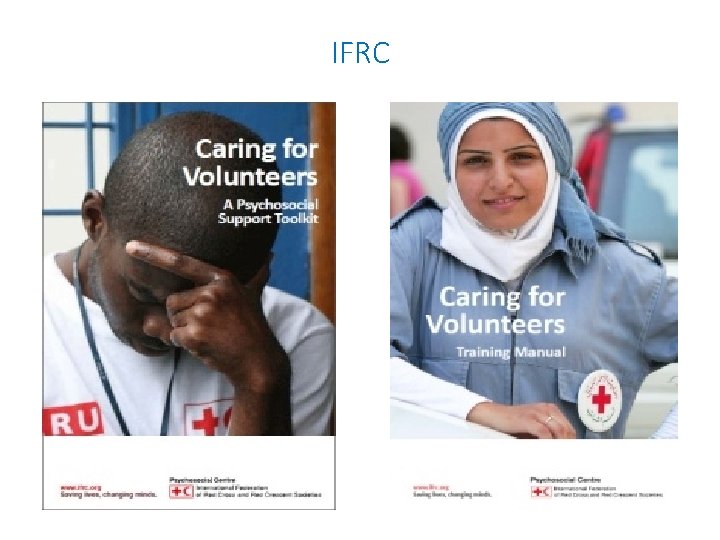
IFRC
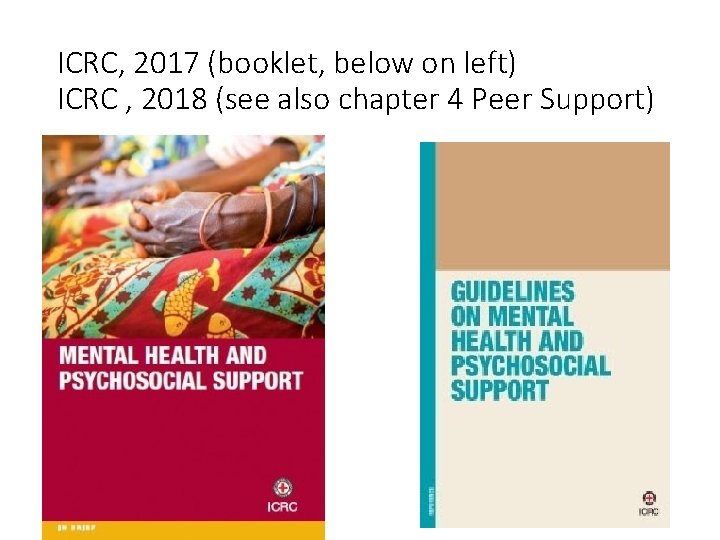
ICRC, 2017 (booklet, below on left) ICRC , 2018 (see also chapter 4 Peer Support)
. Humanitarian Voices --5 “…the most stressful events in humanitarian work have to do with the organisational culture, management style and operational objectives of an NGO or agency rather than external security risks or poor environmental factors. Aid workers, basically, have a pretty shrewd idea what they are getting into when they enter this career, and dirty clothes, gunshots at night and lack of electricity do not surprise them. Intra-and inter-agency politics, inconsistent management styles, lack of team work and unclear or conflicting organizational objectives, however, combine to create a background of chronic stress and pressure that over time wears people down and can lead to burnout and even physical collapse. ” [would you agree with this summary statement about stress…and a later one in which social realtonships-suport between staff is the greatest protective factor? ] John Fawcett, Stress and Trauma Handbook: Strategies for Flourishing in Demanding Environments (2003, World Vision, p. 6).
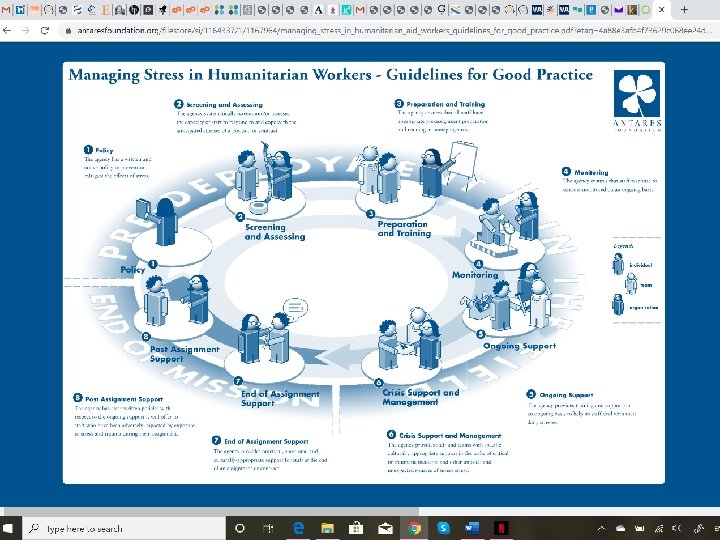
People are central to the achievement of our mission. (Guiding Principle, PIA ) The Code was published in 1997, revised 2003 Principle 7: Health, Safety and Security. The security, good health, and safety of our staff are a prime responsibility of our organization. • Written policies are available to staff on security, individual health, care and support, health and safety. Program plans include written assessment of security, travel and health risks specific to the country or region, reviewed at appropriate intervals. • Before an international assignment, all staff receive health clearance. In addition, they and accompanying dependents receive verbal and written briefing on all risks relevant to the role to be undertaken, and the measures in place to mitigate those risks, including insurance… Briefings are updated when new equipment, procedures, or risks are identified. All staff have a debriefing or exit interview at the end of any contract or assignment. Health checks, personal counseling, and careers advice are available. Managers are trained to ensure these services are provided.
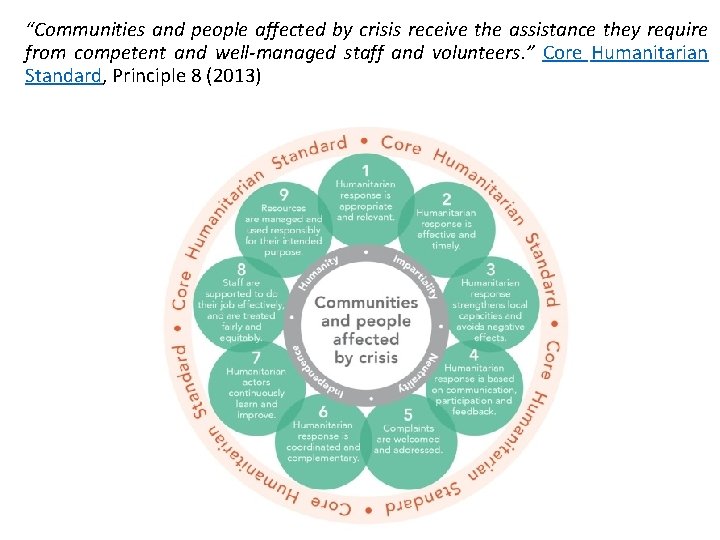
“Communities and people affected by crisis receive the assistance they require from competent and well-managed staff and volunteers. ” Core Humanitarian Standard, Principle 8 (2013)
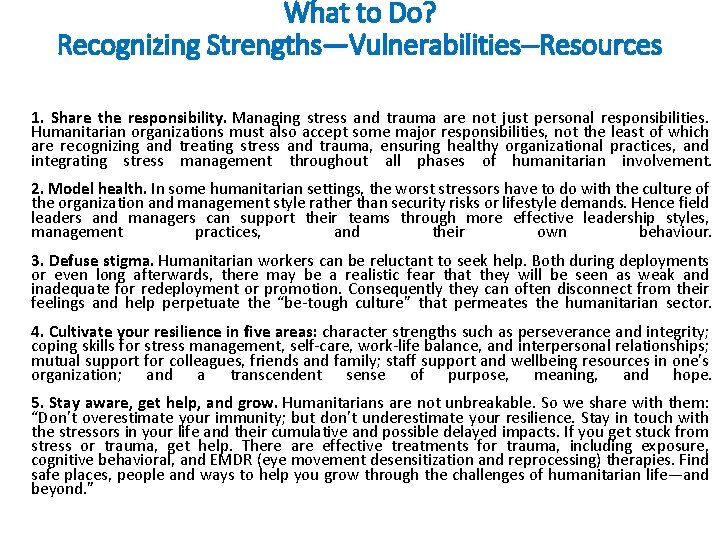
What to Do? Recognizing Strengths—Vulnerabilities--Resources 1. Share the responsibility. Managing stress and trauma are not just personal responsibilities. Humanitarian organizations must also accept some major responsibilities, not the least of which are recognizing and treating stress and trauma, ensuring healthy organizational practices, and integrating stress management throughout all phases of humanitarian involvement. 2. Model health. In some humanitarian settings, the worst stressors have to do with the culture of the organization and management style rather than security risks or lifestyle demands. Hence field leaders and managers can support their teams through more effective leadership styles, management practices, and their own behaviour. 3. Defuse stigma. Humanitarian workers can be reluctant to seek help. Both during deployments or even long afterwards, there may be a realistic fear that they will be seen as weak and inadequate for redeployment or promotion. Consequently they can often disconnect from their feelings and help perpetuate the “be-tough culture” that permeates the humanitarian sector. 4. Cultivate your resilience in five areas: character strengths such as perseverance and integrity; coping skills for stress management, self-care, work-life balance, and interpersonal relationships; mutual support for colleagues, friends and family; staff support and wellbeing resources in one’s organization; and a transcendent sense of purpose, meaning, and hope. 5. Stay aware, get help, and grow. Humanitarians are not unbreakable. So we share with them: “Don’t overestimate your immunity; but don’t underestimate your resilience. Stay in touch with the stressors in your life and their cumulative and possible delayed impacts. If you get stuck from stress or trauma, get help. There are effective treatments for trauma, including exposure, cognitive behavioral, and EMDR (eye movement desensitization and reprocessing) therapies. Find safe places, people and ways to help you grow through the challenges of humanitarian life—and beyond. ”
Stress and Trauma for Humanitarian Workers Helping Ourselves and Others. Thank you! Kelly O’Donnell, Psy. D MCAresources@gmail. com