
Stress and relaxation Fiona Sturrock Educational Psychologist West



- Slides: 28
Stress and relaxation Fiona Sturrock Educational Psychologist West Lothian Educational Psychology Service Pupil Support Worker Conference 22. 08. 16 DATA LABEL: PUBLIC
Stress is … �a normal part of life �beneficial* �exciting* �good for our performance*, e. g. interview, exam * In moderation DATA LABEL: PUBLIC
What changes when we experience stress? physical sensations thoughts & feelings DATA LABEL: PUBLIC actions & behaviour
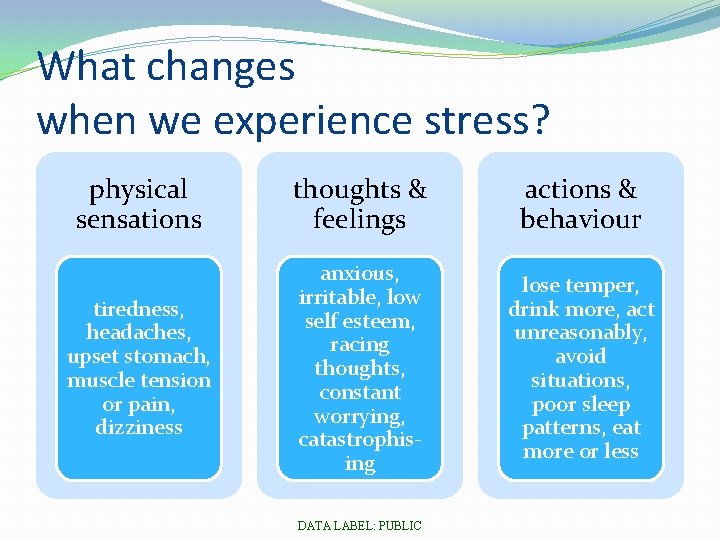
What changes when we experience stress? physical sensations thoughts & feelings actions & behaviour tiredness, headaches, upset stomach, muscle tension or pain, dizziness anxious, irritable, low self esteem, racing thoughts, constant worrying, catastrophising lose temper, drink more, act unreasonably, avoid situations, poor sleep patterns, eat more or less DATA LABEL: PUBLIC
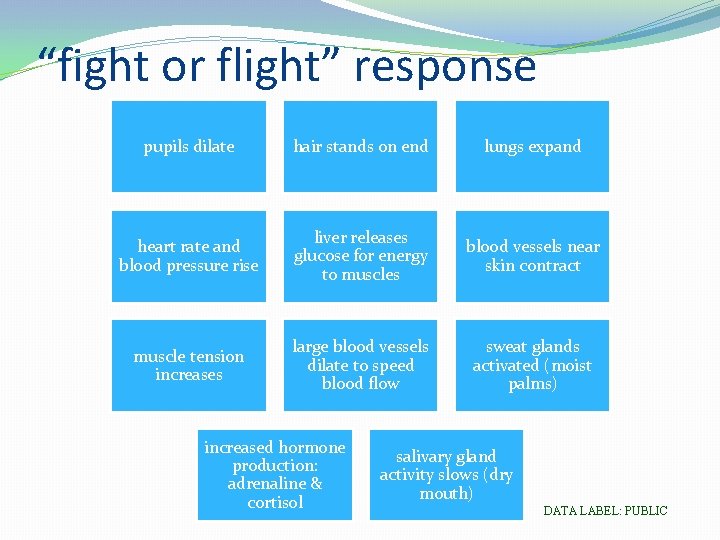
“fight or flight” response pupils dilate hair stands on end lungs expand heart rate and blood pressure rise liver releases glucose for energy to muscles blood vessels near skin contract muscle tension increases large blood vessels dilate to speed blood flow sweat glands activated (moist palms) increased hormone production: adrenaline & cortisol salivary gland activity slows (dry mouth) DATA LABEL: PUBLIC
What causes stress at work? DATA LABEL: PUBLIC
What causes stress for pupils? DATA LABEL: PUBLIC
Can we choose how we respond? Inner peace begins the moment you choose not to allow another person or event to control your emotions (from http: //tinybuddha. com/category/fun-and-inspiring/) Think about: �How can external events be controlled to reduce stress? �Can we choose to respond differently to events? (“positive reframing”) DATA LABEL: PUBLIC
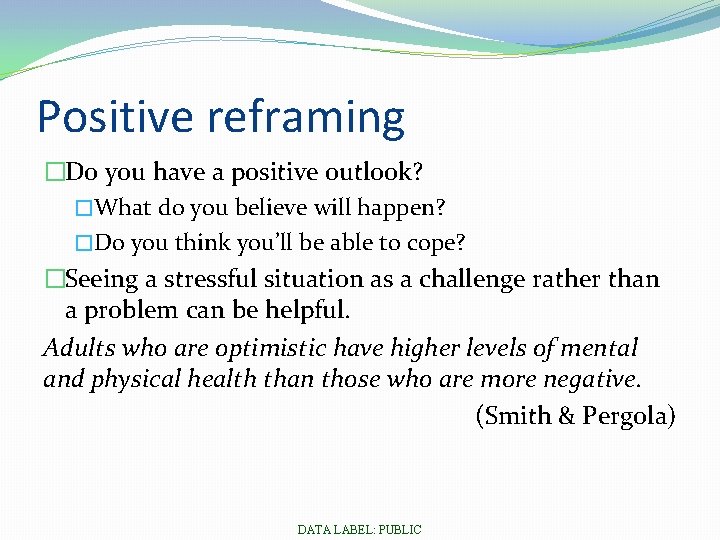
Positive reframing �Do you have a positive outlook? �What do you believe will happen? �Do you think you’ll be able to cope? �Seeing a stressful situation as a challenge rather than a problem can be helpful. Adults who are optimistic have higher levels of mental and physical health than those who are more negative. (Smith & Pergola) DATA LABEL: PUBLIC
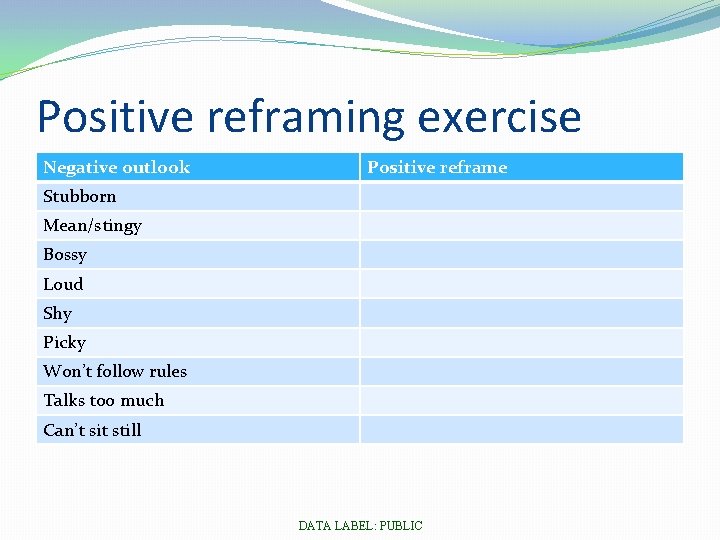
Positive reframing exercise Negative outlook Positive reframe Stubborn Mean/stingy Bossy Loud Shy Picky Won’t follow rules Talks too much Can’t sit still DATA LABEL: PUBLIC
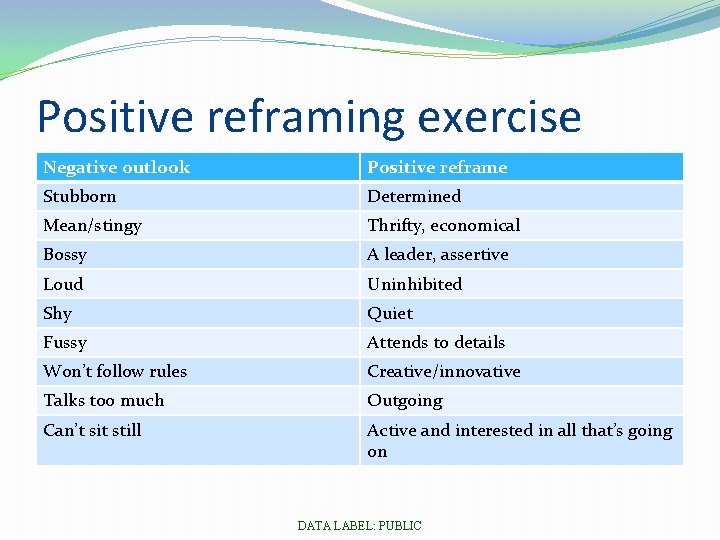
Positive reframing exercise Negative outlook Positive reframe Stubborn Determined Mean/stingy Thrifty, economical Bossy A leader, assertive Loud Uninhibited Shy Quiet Fussy Attends to details Won’t follow rules Creative/innovative Talks too much Outgoing Can’t sit still Active and interested in all that’s going on DATA LABEL: PUBLIC
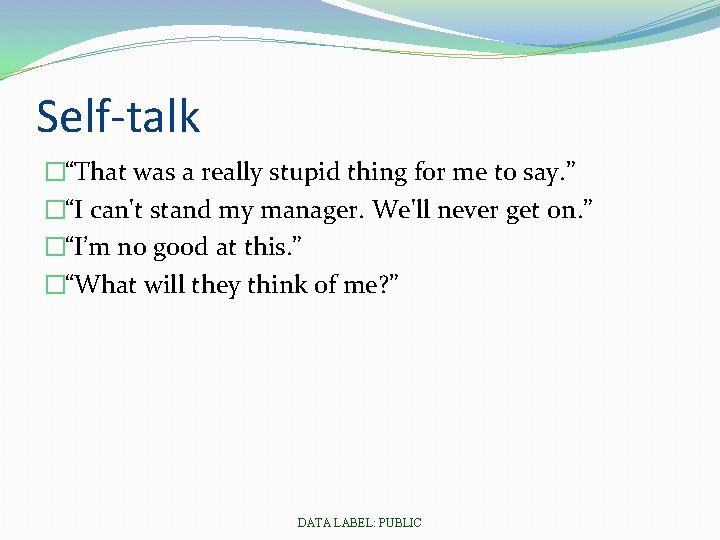
Self-talk �“That was a really stupid thing for me to say. ” �“I can't stand my manager. We'll never get on. ” �“I’m no good at this. ” �“What will they think of me? ” DATA LABEL: PUBLIC
Positive self-talk �“I don't feel comfortable with her, but I'll give it a try. ” �“I've done this before, I know I can do it again. I'll just stay focussed on what I need to do. ” �“It only lasts a wee while. This will be over soon. ” �“We can work this out. ” �“I'll feel great when this is over!” �“This problem is not going to get me down. ” �“I'll do the best I can. ” �“I can get help if I need it. ” �“If I start to get tense, I can relax. ” DATA LABEL: PUBLIC
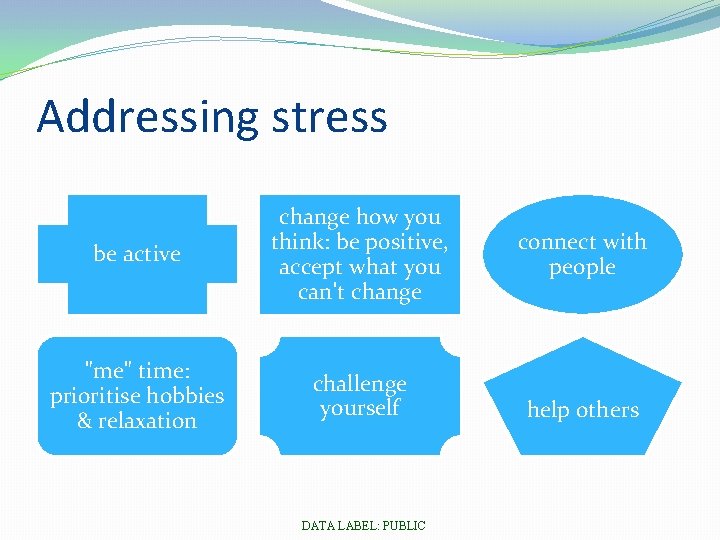
Addressing stress be active change how you think: be positive, accept what you can't change "me" time: prioritise hobbies & relaxation challenge yourself DATA LABEL: PUBLIC connect with people help others
Breathing techniques �These can address and reverse the physical “fight or flight” response whilst focussing the mind on something else �There are different ways of developing breathing techniques which help with relaxation (e. g. yoga, tai chi) �One example is “ 4 -7 -8 breathing” DATA LABEL: PUBLIC
DATA LABEL: PUBLIC
Muscle relaxation �involves engaging muscle groups then relaxing them, one group at a time: “progressive muscle relaxation” �can be adapted for children using appropriate visual imagery to make it more interesting for them, either as a complete progressive muscle relaxation or as smaller individual exercises DATA LABEL: PUBLIC
DATA LABEL: PUBLIC
Visualisation �Visualisation techniques can also be used with children/young people, e. g. imagining a “safe place” DATA LABEL: PUBLIC
DATA LABEL: PUBLIC
Mindfulness The future hasn’t happened yet and the past is gone. So I think the only moment we have is right here and now, and I try to make the best of those moments, the moments that I’m in. Annie Lennox, quoted at www. handsonscotland. co. uk DATA LABEL: PUBLIC
Being present in this moment �Becoming aware of “right now” without distraction �Noticing our thoughts, accepting them, letting them go �Being non-judgemental DATA LABEL: PUBLIC
What are the benefits? �Strategy to reduce worry about the future or past �Has been used to address stress and some studies also report positive benefits for mood, focus/memory, cardiovascular disease, boosting immune system �In education: improvements in attention, social skills, anxiety �Can be especially beneficial for pupils who have difficulties with emotional regulation (easily upset, angry, anxious, …) DATA LABEL: PUBLIC
Quiet time focussing on breath Become aware of your breathing. Focus on the feeling of coolness at your nose when you breathe in and the feeling of warmth as you breathe out. Say 'one' as you breathe in and 'one' as you breathe out. Then say 'two' as you breathe in and 'two' as you breathe out, and so on, up to five. Then start back at 'one' again. Thoughts will come into your head. That’s ok, just know that they are thoughts and just push them gently away and go back to counting your breath, beginning with one. From www. handsonscotland. co. uk DATA LABEL: PUBLIC
Walking mindfully This can be useful for children who find it difficult to sit still. It helps them become more aware of their body. Ask the children to walk around a room. Ask them to lift one foot at a time slowly and carefully as if walking on eggshells or walking in slow motion. Ask them to place their foot down smoothly and slowly. Then ask them to take a step with the other foot the same distance ahead. Ask them to feel every muscle in their legs while they walk and every shift in body weight. Ask them to feel their hands and arms in space. You can ask them to move a bit faster, then more slowly again. Tell them that, if they begin to think about other things, they should gently allow these thoughts to pass, then return their attention to their body. From www. handsonscotland. co. uk DATA LABEL: PUBLIC
Helpful mindfulness apps (recommended by colleagues) �Smiling Mind – has sections for children and classroom practice (Australian) �Insight Timer �Mindfulness Daily – e. g. could be used in class for a couple of minutes of quiet breathing �Pause DATA LABEL: PUBLIC
What next? �Consider how you might use today’s information �Use it for your own relaxation? �Use it with pupils? �In groups or individually? �Which pupils, when, how? �Further information – see handout DATA LABEL: PUBLIC
Thank you! DATA LABEL: PUBLIC