
STRENGTHS LIMITATIONS OF ALL EIGHT EVIDENCE TYPES Data
- Slides: 9
STRENGTHS & LIMITATIONS OF ALL EIGHT EVIDENCE TYPES
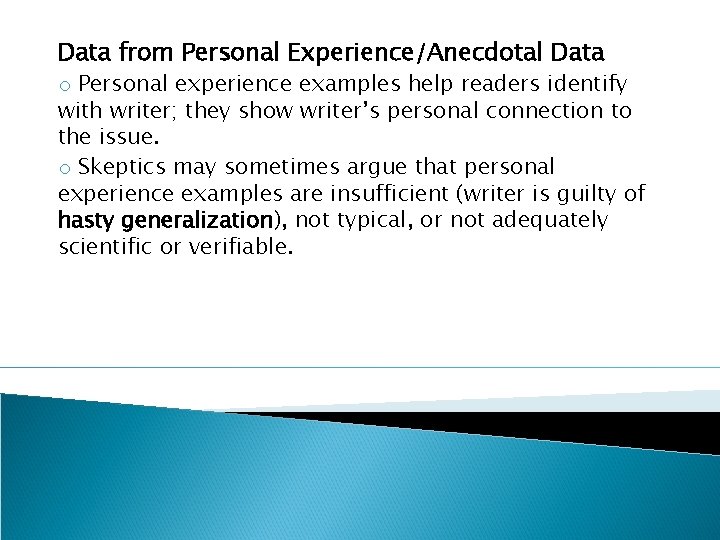
Data from Personal Experience/Anecdotal Data o Personal experience examples help readers identify with writer; they show writer’s personal connection to the issue. o Skeptics may sometimes argue that personal experience examples are insufficient (writer is guilty of hasty generalization), not typical, or not adequately scientific or verifiable.
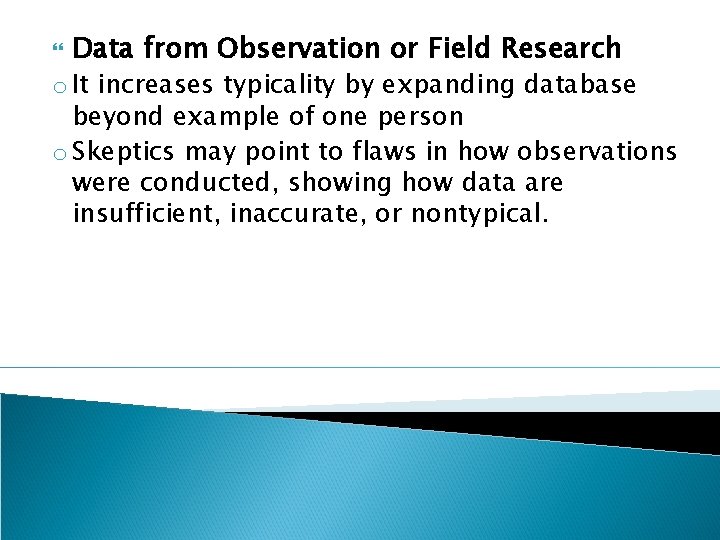
Data from Observation or Field Research o It increases typicality by expanding database beyond example of one person o Skeptics may point to flaws in how observations were conducted, showing how data are insufficient, inaccurate, or nontypical.
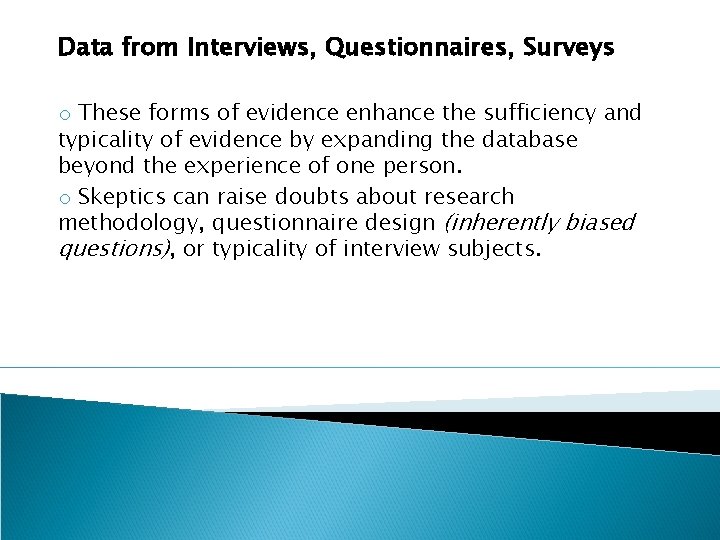
Data from Interviews, Questionnaires, Surveys o These forms of evidence enhance the sufficiency and typicality of evidence by expanding the database beyond the experience of one person. o Skeptics can raise doubts about research methodology, questionnaire design (inherently biased questions), or typicality of interview subjects.
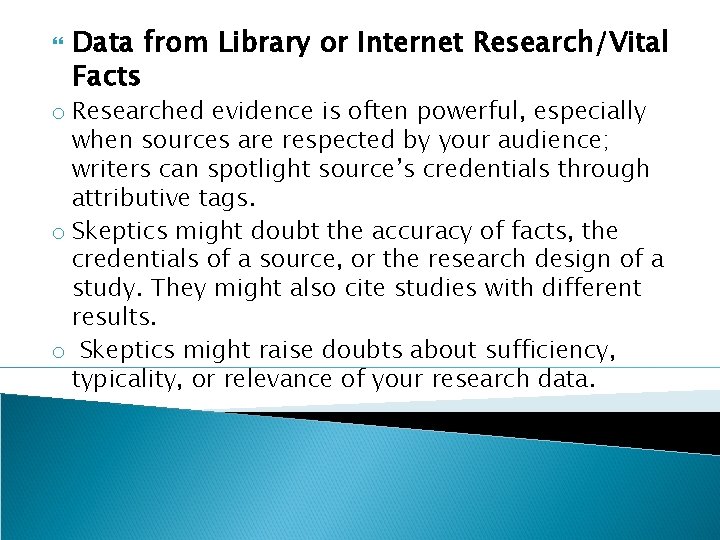
Data from Library or Internet Research/Vital Facts o Researched evidence is often powerful, especially when sources are respected by your audience; writers can spotlight source’s credentials through attributive tags. o Skeptics might doubt the accuracy of facts, the credentials of a source, or the research design of a study. They might also cite studies with different results. o Skeptics might raise doubts about sufficiency, typicality, or relevance of your research data.
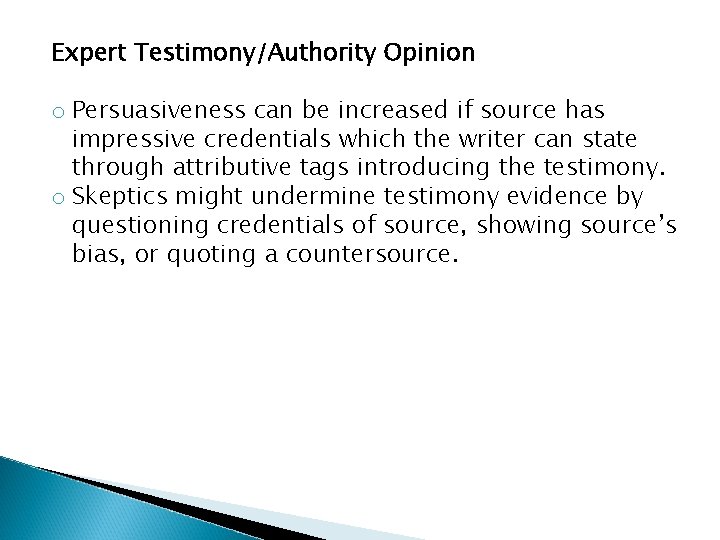
Expert Testimony/Authority Opinion o Persuasiveness can be increased if source has impressive credentials which the writer can state through attributive tags introducing the testimony. o Skeptics might undermine testimony evidence by questioning credentials of source, showing source’s bias, or quoting a countersource.
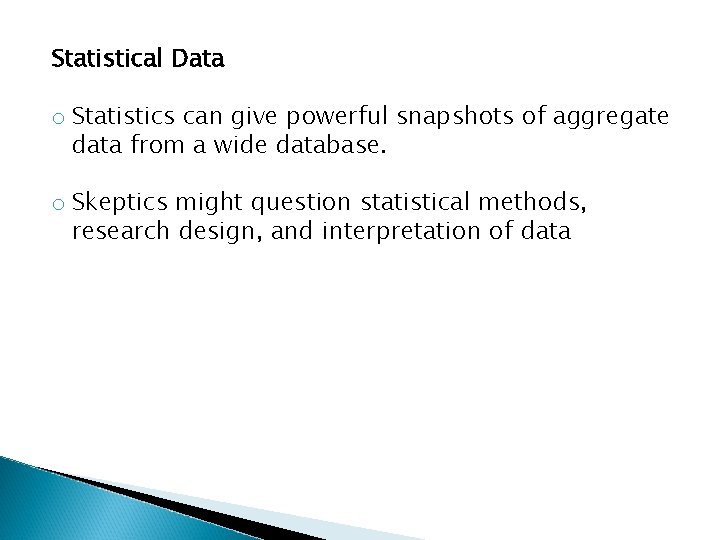
Statistical Data o Statistics can give powerful snapshots of aggregate data from a wide database. o Skeptics might question statistical methods, research design, and interpretation of data
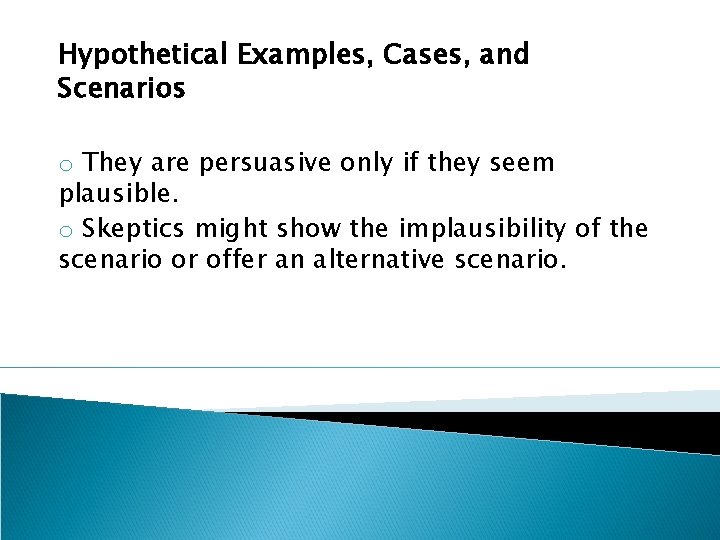
Hypothetical Examples, Cases, and Scenarios o They are persuasive only if they seem plausible. o Skeptics might show the implausibility of the scenario or offer an alternative scenario.
Reasoned Sequence of Ideas o These sequences are often used in causal arguments to show causes are linked to effects or in definitional or values arguments to show links among ideas. o Their effectiveness depends on the audience’s acceptance of each link in the sequence of ideas. o Skeptics might raise objections at any link in the sequence, often by pointing to different values or outlining different consequences.