
Strengths and Weaknesses of Research Designs Design Description
- Slides: 11
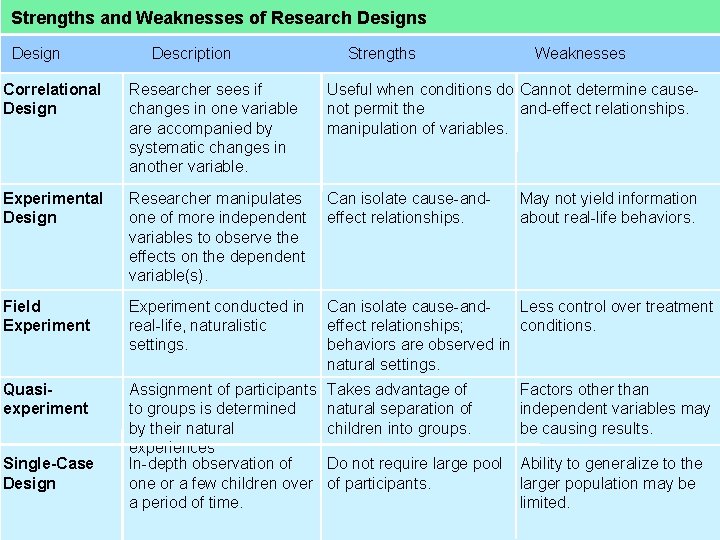
Strengths and Weaknesses of Research Designs Design Description Strengths Weaknesses Correlational Design Researcher sees if changes in one variable are accompanied by systematic changes in another variable. Useful when conditions do Cannot determine causenot permit the and-effect relationships. manipulation of variables. Experimental Design Researcher manipulates one of more independent variables to observe the effects on the dependent variable(s). Can isolate cause-andeffect relationships. Field Experiment conducted in real-life, naturalistic settings. Can isolate cause-and. Less control over treatment effect relationships; conditions. behaviors are observed in natural settings. Quasiexperiment Assignment of participants to groups is determined by their natural experiences In-depth observation of one or a few children over a period of time. Takes advantage of natural separation of children into groups. Factors other than independent variables may be causing results. Do not require large pool of participants. Ability to generalize to the larger population may be limited. Single-Case Design May not yield information about real-life behaviors.
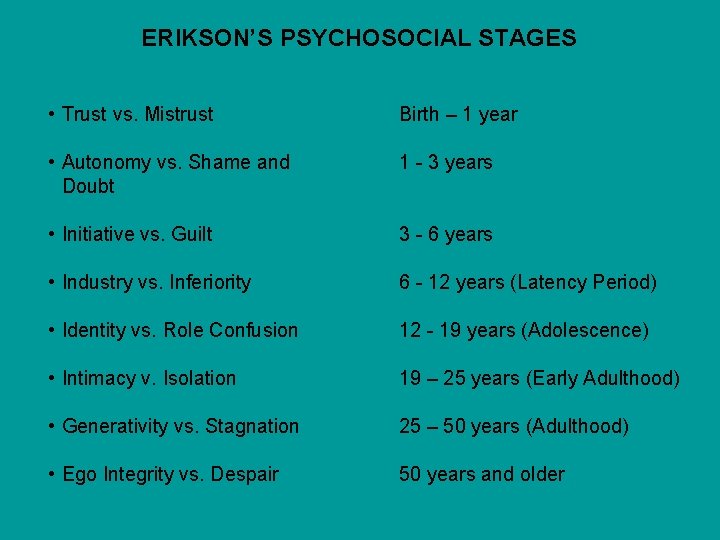
ERIKSON’S PSYCHOSOCIAL STAGES • Trust vs. Mistrust Birth – 1 year • Autonomy vs. Shame and Doubt 1 - 3 years • Initiative vs. Guilt 3 - 6 years • Industry vs. Inferiority 6 - 12 years (Latency Period) • Identity vs. Role Confusion 12 - 19 years (Adolescence) • Intimacy v. Isolation 19 – 25 years (Early Adulthood) • Generativity vs. Stagnation 25 – 50 years (Adulthood) • Ego Integrity vs. Despair 50 years and older
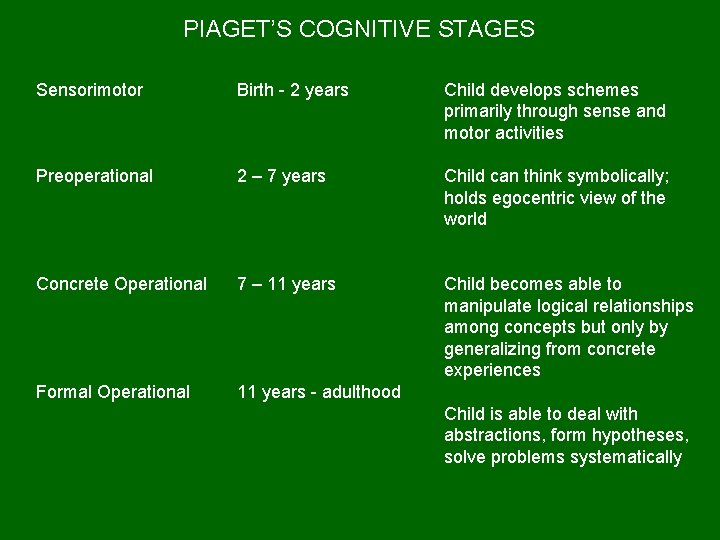
PIAGET’S COGNITIVE STAGES Sensorimotor Birth - 2 years Child develops schemes primarily through sense and motor activities Preoperational 2 – 7 years Child can think symbolically; holds egocentric view of the world Concrete Operational 7 – 11 years Child becomes able to manipulate logical relationships among concepts but only by generalizing from concrete experiences Formal Operational 11 years - adulthood Child is able to deal with abstractions, form hypotheses, solve problems systematically
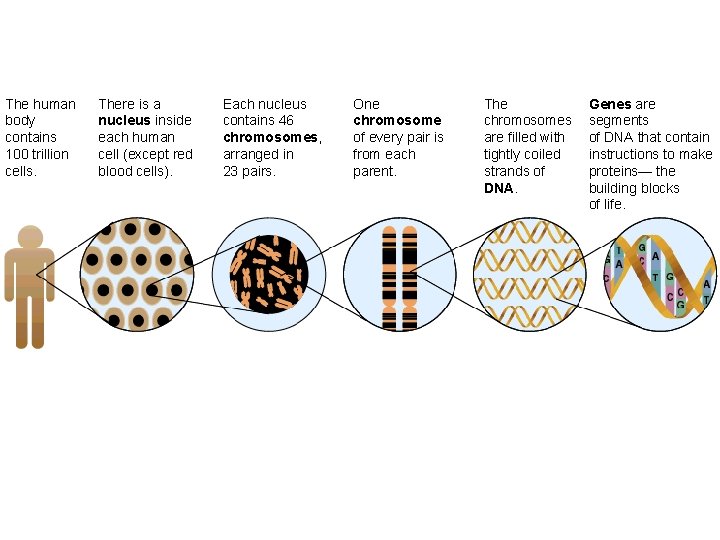
The human body contains 100 trillion cells. There is a nucleus inside each human cell (except red blood cells). Each nucleus contains 46 chromosomes, arranged in 23 pairs. One chromosome of every pair is from each parent. The chromosomes are filled with tightly coiled strands of DNA. Genes are segments of DNA that contain instructions to make proteins— the building blocks of life.
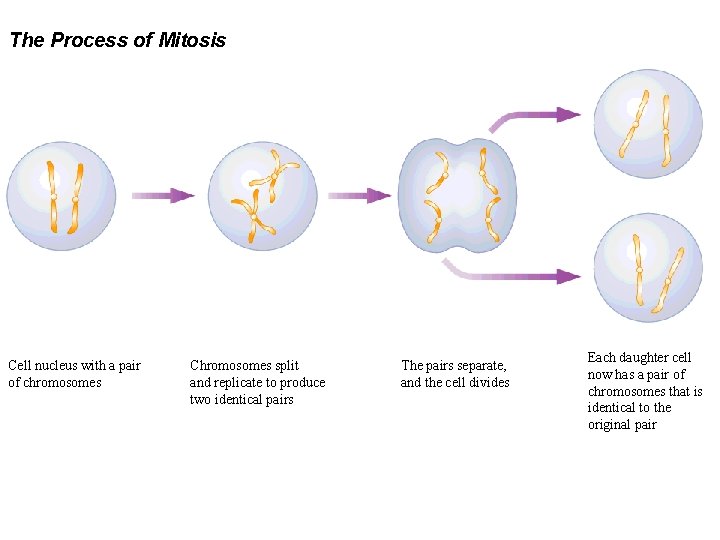
The Process of Mitosis Cell nucleus with a pair of chromosomes Chromosomes split and replicate to produce two identical pairs The pairs separate, and the cell divides Each daughter cell now has a pair of chromosomes that is identical to the original pair
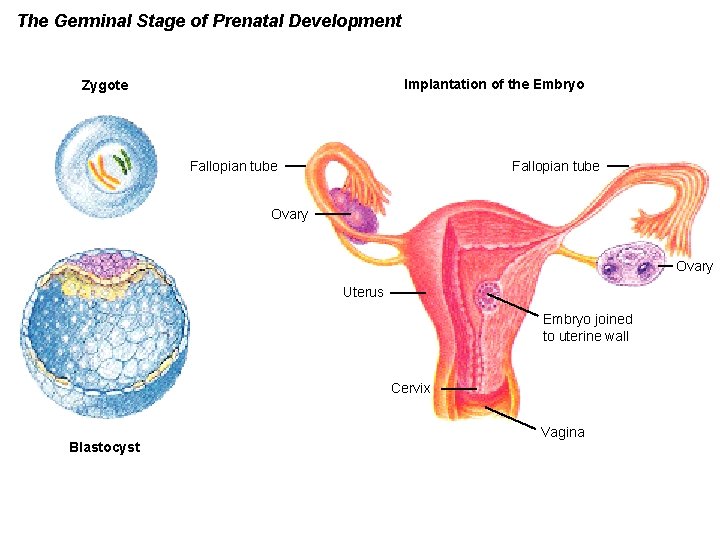
The Germinal Stage of Prenatal Development Implantation of the Embryo Zygote Fallopian tube Ovary Uterus Embryo joined to uterine wall Cervix Blastocyst Vagina
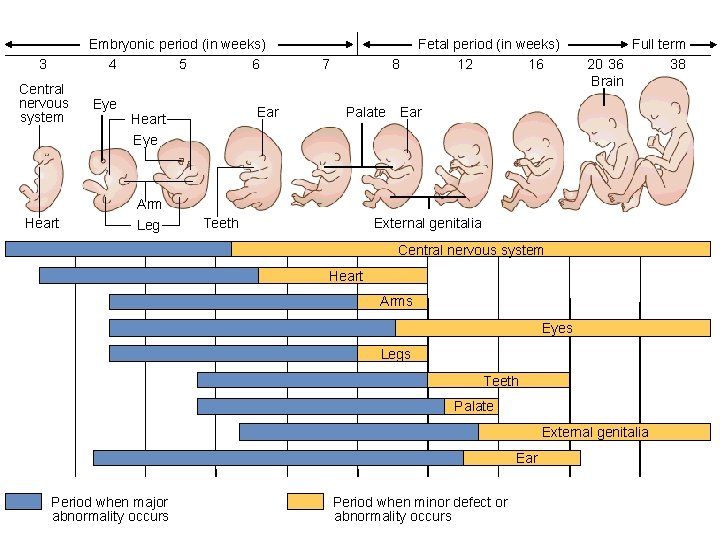
Embryonic period (in weeks) 4 5 6 3 Central nervous system Eye Ear Heart 7 8 Fetal period (in weeks) 12 16 Full term 20 36 38 Brain Palate Ear Eye Heart Arm Leg Teeth External genitalia Central nervous system Heart Arms Eyes Legs Teeth Palate External genitalia Ear Period when major abnormality occurs Period when minor defect or abnormality occurs
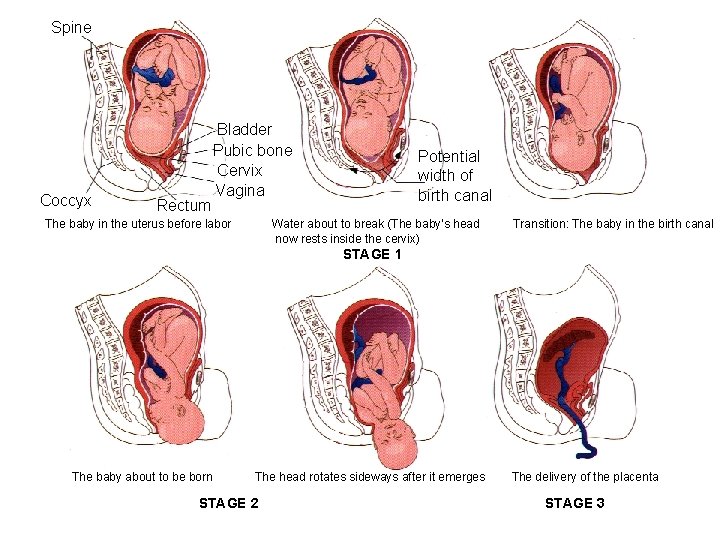
Spine Coccyx Rectum Bladder Pubic bone Cervix Vagina Potential width of birth canal Water about to break (The baby's head now rests inside the cervix) The baby in the uterus before labor Transition: The baby in the birth canal STAGE 1 The baby about to be born The head rotates sideways after it emerges STAGE 2 The delivery of the placenta STAGE 3
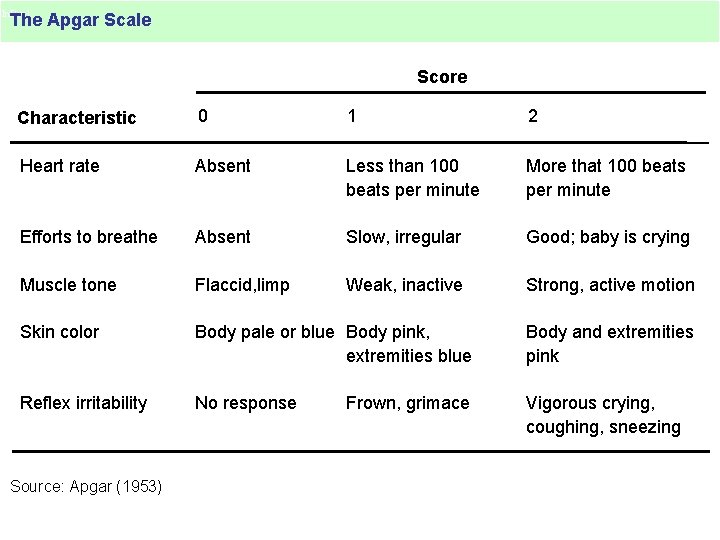
In. Rev 1 The Apgar Scale Score Characteristic 0 1 2 Heart rate Absent Less than 100 beats per minute More that 100 beats per minute Efforts to breathe Absent Slow, irregular Good; baby is crying Muscle tone Flaccid, limp Weak, inactive Strong, active motion Skin color Body pale or blue Body pink, extremities blue Body and extremities pink Reflex irritability No response Vigorous crying, coughing, sneezing Source: Apgar (1953) Frown, grimace
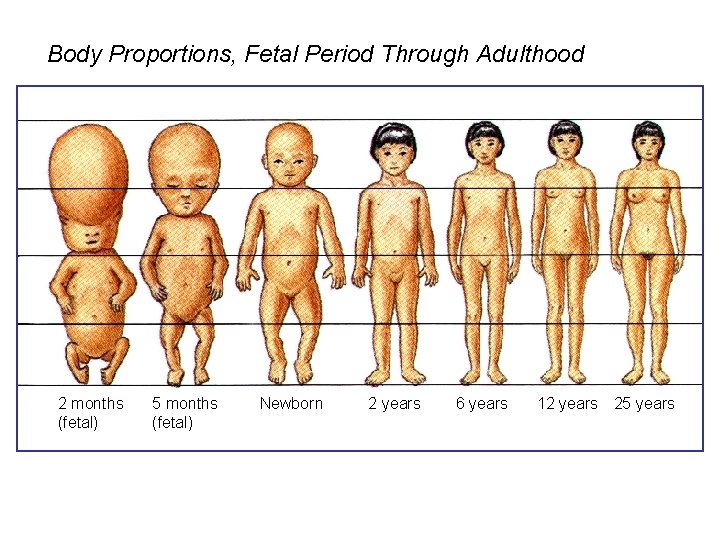
Body Proportions, Fetal Period Through Adulthood 2 months (fetal) 5 months (fetal) Newborn 2 years 6 years 12 years 25 years
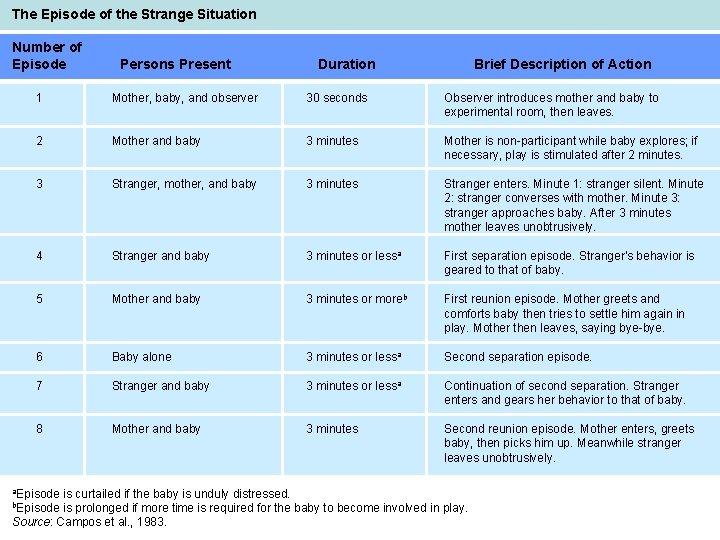
The Episode of the Strange Situation Number of Episode Persons Present Duration Brief Description of Action 1 Mother, baby, and observer 30 seconds Observer introduces mother and baby to experimental room, then leaves. 2 Mother and baby 3 minutes Mother is non-participant while baby explores; if necessary, play is stimulated after 2 minutes. 3 Stranger, mother, and baby 3 minutes Stranger enters. Minute 1: stranger silent. Minute 2: stranger converses with mother. Minute 3: stranger approaches baby. After 3 minutes mother leaves unobtrusively. 4 Stranger and baby 3 minutes or lessa First separation episode. Stranger's behavior is geared to that of baby. 5 Mother and baby 3 minutes or moreb First reunion episode. Mother greets and comforts baby then tries to settle him again in play. Mother then leaves, saying bye-bye. 6 Baby alone 3 minutes or lessa Second separation episode. 7 Stranger and baby 3 minutes or lessa Continuation of second separation. Stranger enters and gears her behavior to that of baby. 8 Mother and baby 3 minutes Second reunion episode. Mother enters, greets baby, then picks him up. Meanwhile stranger leaves unobtrusively. a. Episode is curtailed if the baby is unduly distressed. is prolonged if more time is required for the baby to become involved in play. Source: Campos et al. , 1983. b. Episode