
STRENGTHS AND CHALLENGES OF CHILDREN WITH A DISABILITY
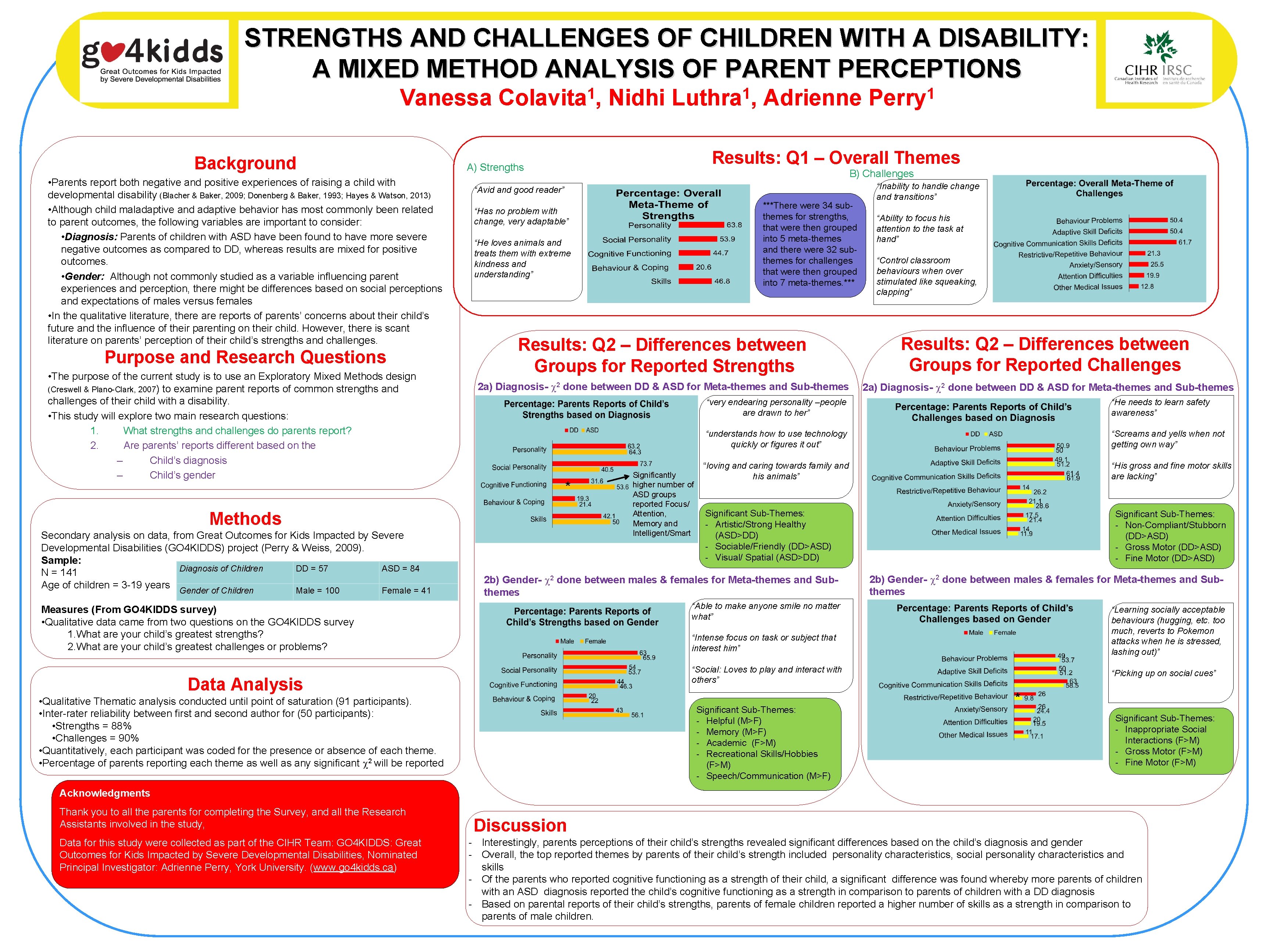
STRENGTHS AND CHALLENGES OF CHILDREN WITH A DISABILITY: A MIXED METHOD ANALYSIS OF PARENT PERCEPTIONS Vanessa Background 1 Colavita , 1 York A) Strengths • Parents report both negative and positive experiences of raising a child with developmental disability (Blacher & Baker, 2009; Donenberg & Baker, 1993; Hayes & Watson, 2013) • Although child maladaptive and adaptive behavior has most commonly been related to parent outcomes, the following variables are important to consider: • Diagnosis: Parents of children with ASD have been found to have more severe negative outcomes as compared to DD, whereas results are mixed for positive outcomes. • Gender: Although not commonly studied as a variable influencing parent experiences and perception, there might be differences based on social perceptions and expectations of males versus females • In the qualitative literature, there are reports of parents’ concerns about their child’s future and the influence of their parenting on their child. However, there is scant literature on parents’ perception of their child’s strengths and challenges. Purpose and Research Questions • The purpose of the current study is to use an Exploratory Mixed Methods design (Creswell & Plano-Clark, 2007) to examine parent reports of common strengths and challenges of their child with a disability. • This study will explore two main research questions: 1. What strengths and challenges do parents report? 2. Are parents’ reports different based on the – Child’s diagnosis – Child’s gender Gender of Children Male = 100 Female = 41 Adrienne 1 Perry University Results: Q 1 – Overall Themes B) Challenges “Avid and good reader” ***There were 34 subthemes for strengths, that were then grouped into 5 meta-themes and there were 32 subthemes for challenges that were then grouped into 7 meta-themes. *** “Has no problem with change, very adaptable” “He loves animals and treats them with extreme kindness and understanding” Results: Q 2 – Differences between Groups for Reported Strengths 2 a) Diagnosis- 2 done between DD & ASD for Meta-themes and Sub-themes * Methods Secondary analysis on data, from Great Outcomes for Kids Impacted by Severe Developmental Disabilities (GO 4 KIDDS) project (Perry & Weiss, 2009). Sample: Diagnosis of Children DD = 57 ASD = 84 N = 141 Age of children = 3 -19 years Nidhi 1 Luthra , Significantly higher number of ASD groups reported Focus/ Attention, Memory and Intelligent/Smart “Inability to handle change and transitions” “Ability to focus his attention to the task at hand” “Control classroom behaviours when over stimulated like squeaking, clapping” Results: Q 2 – Differences between Groups for Reported Challenges 2 a) Diagnosis- 2 done between DD & ASD for Meta-themes and Sub-themes “very endearing personality –people are drawn to her” “He needs to learn safety awareness” “understands how to use technology quickly or figures it out” “Screams and yells when not getting own way” “loving and caring towards family and his animals” “His gross and fine motor skills are lacking” Significant Sub-Themes: - Artistic/Strong Healthy (ASD>DD) - Sociable/Friendly (DD>ASD) - Visual/ Spatial (ASD>DD) Significant Sub-Themes: - Non-Compliant/Stubborn (DD>ASD) - Gross Motor (DD>ASD) - Fine Motor (DD>ASD) 2 b) Gender- 2 done between males & females for Meta-themes and Subthemes “Able to make anyone smile no matter what” “Learning socially acceptable behaviours (hugging, etc. too much, reverts to Pokemon attacks when he is stressed, lashing out)” Measures (From GO 4 KIDDS survey) • Qualitative data came from two questions on the GO 4 KIDDS survey 1. What are your child’s greatest strengths? 2. What are your child’s greatest challenges or problems? “Intense focus on task or subject that interest him” “Social: Loves to play and interact with others” Data Analysis • Qualitative Thematic analysis conducted until point of saturation (91 participants). • Inter-rater reliability between first and second author for (50 participants): • Strengths = 88% • Challenges = 90% • Quantitatively, each participant was coded for the presence or absence of each theme. • Percentage of parents reporting each theme as well as any significant 2 will be reported Significant Sub-Themes: - Helpful (M>F) - Memory (M>F) - Academic (F>M) - Recreational Skills/Hobbies (F>M) - Speech/Communication (M>F) “Picking up on social cues” * Significant Sub-Themes: - Inappropriate Social Interactions (F>M) - Gross Motor (F>M) - Fine Motor (F>M) Acknowledgments Thank you to all the parents for completing the Survey, and all the Research Assistants involved in the study, Data for this study were collected as part of the CIHR Team: GO 4 KIDDS: Great Outcomes for Kids Impacted by Severe Developmental Disabilities, Nominated Principal Investigator: Adrienne Perry, York University. (www. go 4 kidds. ca) Discussion - Interestingly, parents perceptions of their child’s strengths revealed significant differences based on the child’s diagnosis and gender - Overall, the top reported themes by parents of their child’s strength included personality characteristics, social personality characteristics and skills - Of the parents who reported cognitive functioning as a strength of their child, a significant difference was found whereby more parents of children with an ASD diagnosis reported the child’s cognitive functioning as a strength in comparison to parents of children with a DD diagnosis - Based on parental reports of their child’s strengths, parents of female children reported a higher number of skills as a strength in comparison to parents of male children.
- Slides: 1