
Strengthening Tribal Foundational Public Health Services TRIBAL FPHS
Strengthening Tribal Foundational Public Health Services TRIBAL FPHS SUMMIT D e c e m b e r 1 1 , 2019 Presented by Marilyn Scott, Vice- Chair Upper Skagit Tribe Andrew Shogren, Health Director, Suquamish Tribe American Indian Health Commission for Washington State
Purpose Seeking direction from Tribal Leaders on next steps for Tribal Foundational Public Health Services Addressing known gaps: • Definitions of Tribal Foundational Public Health Services • Model Tribal Public Health Codes Developmental work: • Documentation of existing capabilities and capacity • Identification of gaps and needs
Public Health and Sovereignty • Public Health is a core government function • Tribes exercise their sovereignty when they establish, control, operate, and deliver public health services SOVEREIGNTY
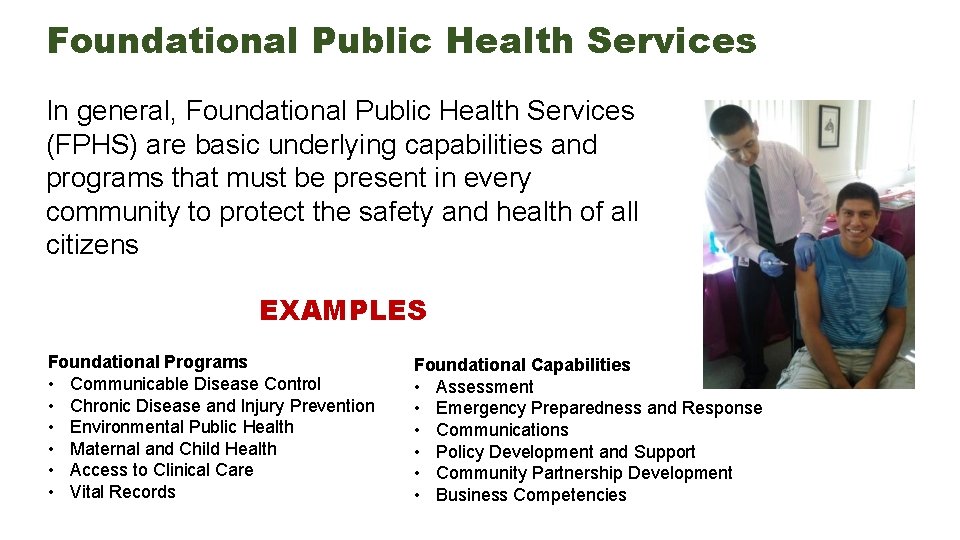
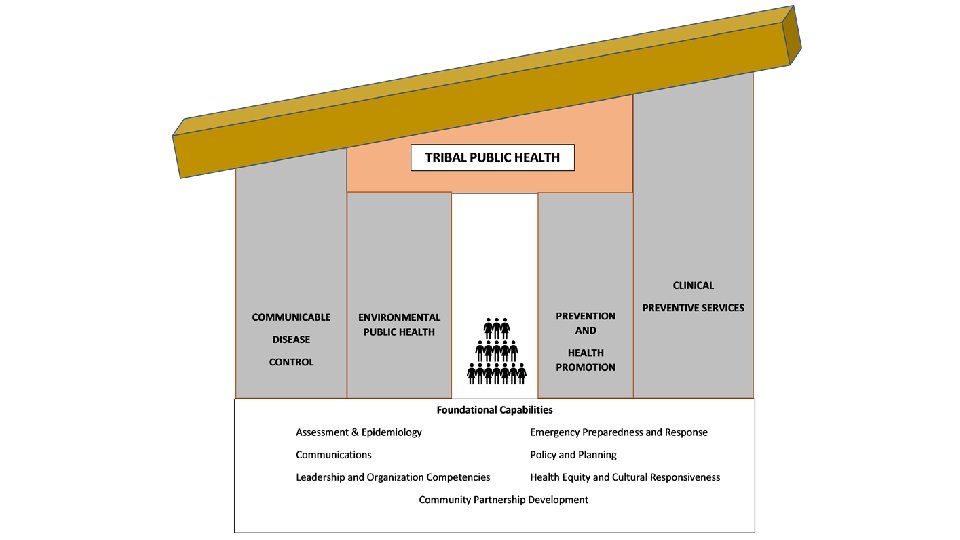
Foundational Public Health Services In general, Foundational Public Health Services (FPHS) are basic underlying capabilities and programs that must be present in every community to protect the safety and health of all citizens EXAMPLES Foundational Programs • Communicable Disease Control • Chronic Disease and Injury Prevention • Environmental Public Health • Maternal and Child Health • Access to Clinical Care • Vital Records Foundational Capabilities • Assessment • Emergency Preparedness and Response • Communications • Policy Development and Support • Community Partnership Development • Business Competencies
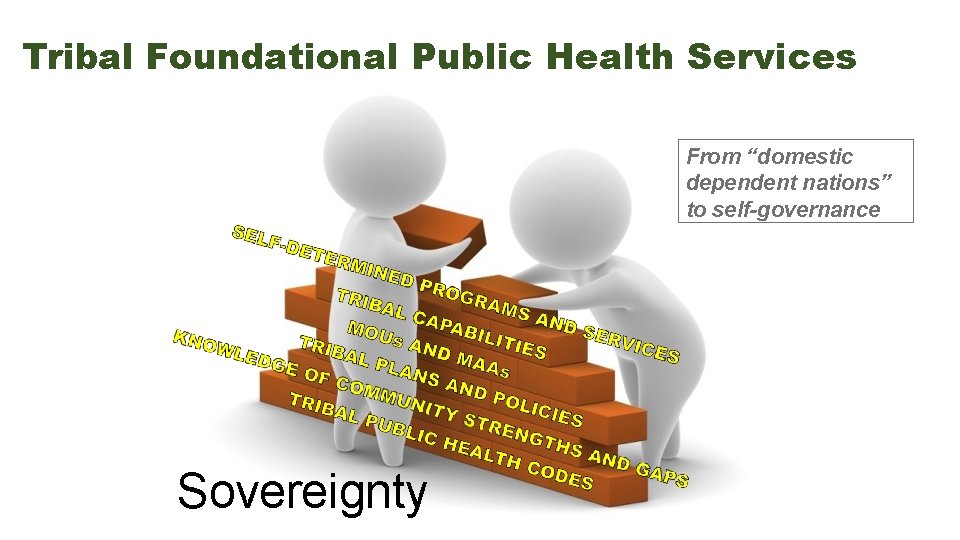
Tribal Foundational Public Health Services From “domestic dependent nations” to self-governance Sovereignty
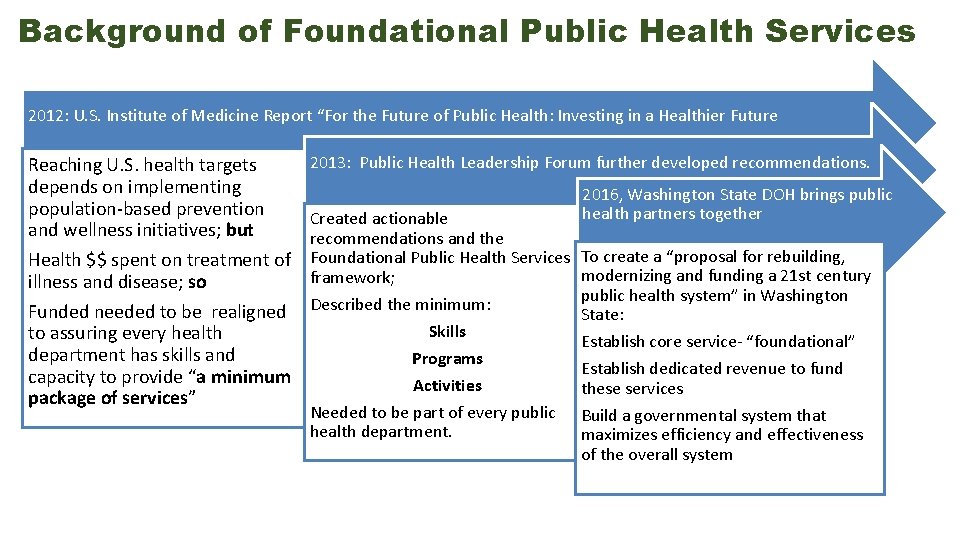
Background of Foundational Public Health Services 2012: U. S. Institute of Medicine Report “For the Future of Public Health: Investing in a Healthier Future Reaching U. S. health targets depends on implementing population-based prevention and wellness initiatives; but Health $$ spent on treatment of illness and disease; so Funded needed to be realigned to assuring every health department has skills and capacity to provide “a minimum package of services” 2013: Public Health Leadership Forum further developed recommendations. Created actionable recommendations and the Foundational Public Health Services framework; Described the minimum: Skills Programs Activities Needed to be part of every public health department. 2016, Washington State DOH brings public health partners together To create a “proposal for rebuilding, modernizing and funding a 21 st century public health system” in Washington State: Establish core service- “foundational” Establish dedicated revenue to fund these services Build a governmental system that maximizes efficiency and effectiveness of the overall system
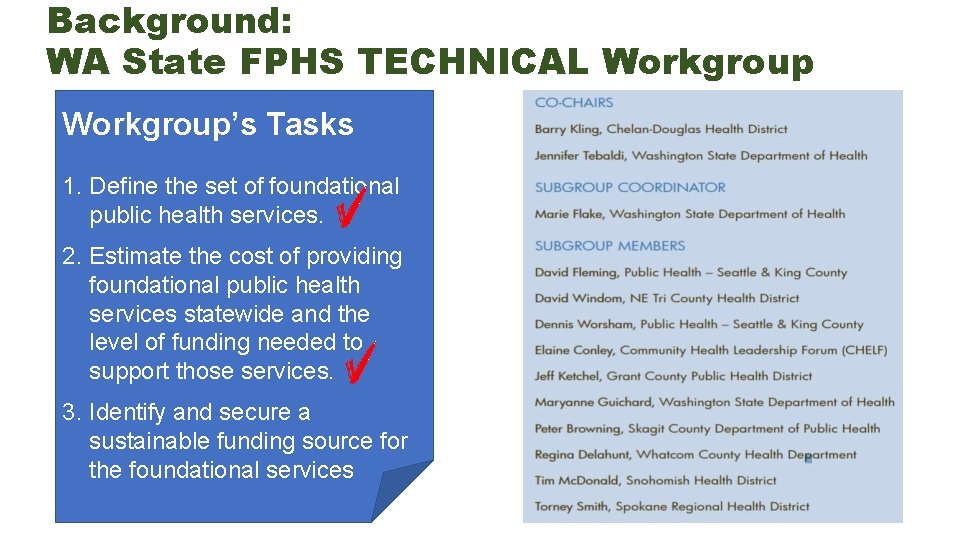
Background: WA State FPHS TECHNICAL Workgroup’s Tasks 1. Define the set of foundational public health services. 2. Estimate the cost of providing foundational public health services statewide and the level of funding needed to support those services. 3. Identify and secure a sustainable funding source for the foundational services

Background: Foundational Public Health Services
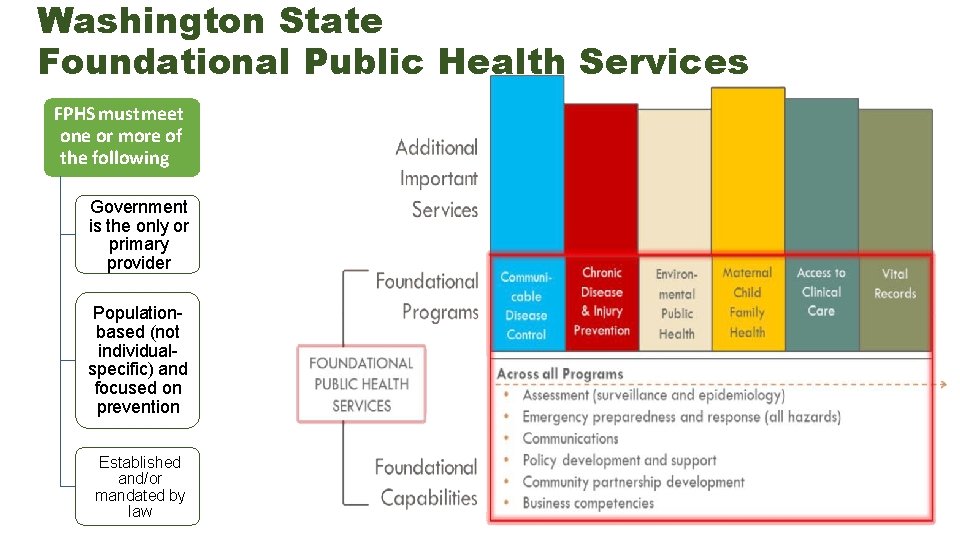
Washington State Foundational Public Health Services FPHS must meet one or more of the following Government is the only or primary provider Populationbased (not individualspecific) and focused on prevention Established and/or mandated by law
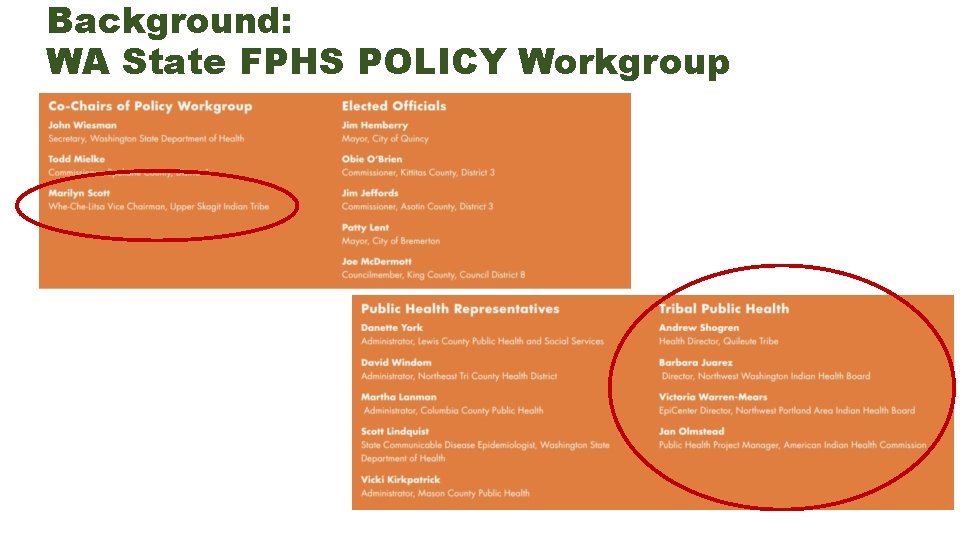
Background: WA State FPHS POLICY Workgroup
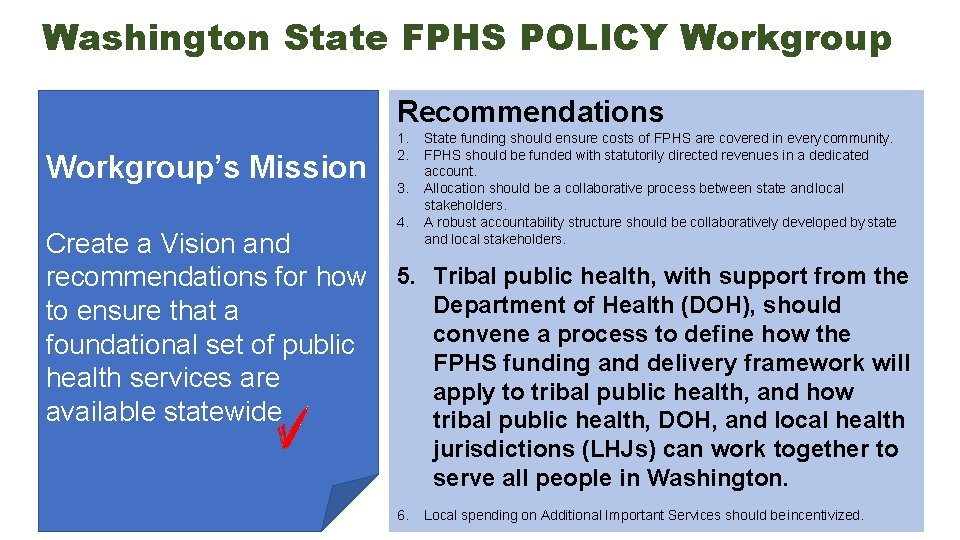
Washington State FPHS POLICY Workgroup Recommendations Workgroup’s Mission Create a Vision and recommendations for how to ensure that a foundational set of public health services are available statewide 1. 2. 3. 4. State funding should ensure costs of FPHS are covered in every community. FPHS should be funded with statutorily directed revenues in a dedicated account. Allocation should be a collaborative process between state and local stakeholders. A robust accountability structure should be collaboratively developed by state and local stakeholders. 5. Tribal public health, with support from the Department of Health (DOH), should convene a process to define how the FPHS funding and delivery framework will apply to tribal public health, and how tribal public health, DOH, and local health jurisdictions (LHJs) can work together to serve all people in Washington. 6. Local spending on Additional Important Services should be incentivized.
Understanding the current landscape of FPHS within Indian Health Services Indian Health Service (IHS) services are largely limited to direct patient care, leaving little, if any, funding available for public health initiatives such as disease prevention, education, research for disease, injury prevention, and promotion of healthy lifestyles. This means that Indian Country continues to lag far behind other communities in basic resources and services. Our communities are therefore more vulnerable to increased health risks and sickness. The State of Public Health in Indian Country, National Indian Health Board, April 6, 2017 (https: //www. nihb. org/docs/04222017/Public%20 Health%20 in%20 Indian%20 Country%20%20 Fact%20 Sheet%2 0 and%20 legislative%20 priorites. pdf )
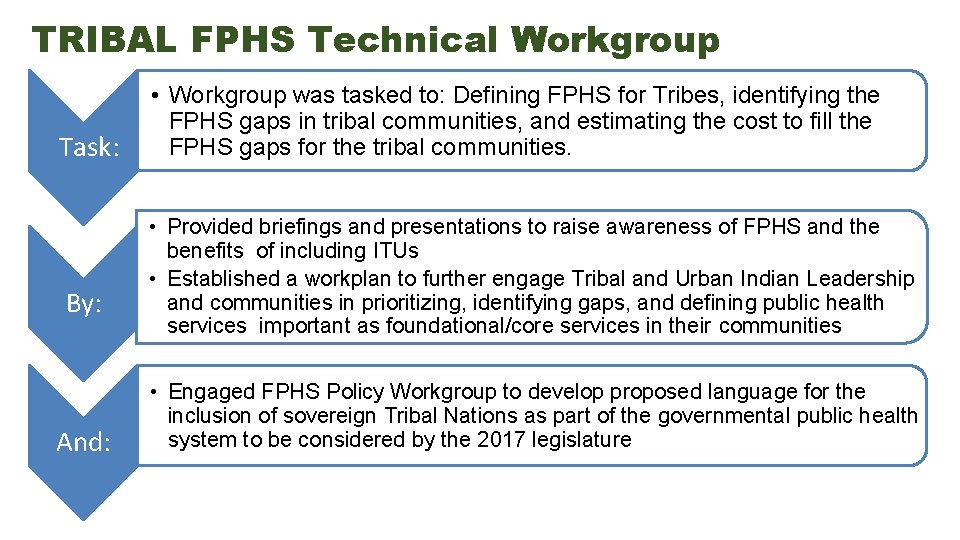
TRIBAL FPHS Technical Workgroup Task: By: And: • Workgroup was tasked to: Defining FPHS for Tribes, identifying the FPHS gaps in tribal communities, and estimating the cost to fill the FPHS gaps for the tribal communities. • Provided briefings and presentations to raise awareness of FPHS and the benefits of including ITUs • Established a workplan to further engage Tribal and Urban Indian Leadership and communities in prioritizing, identifying gaps, and defining public health services important as foundational/core services in their communities • Engaged FPHS Policy Workgroup to develop proposed language for the inclusion of sovereign Tribal Nations as part of the governmental public health system to be considered by the 2017 legislature
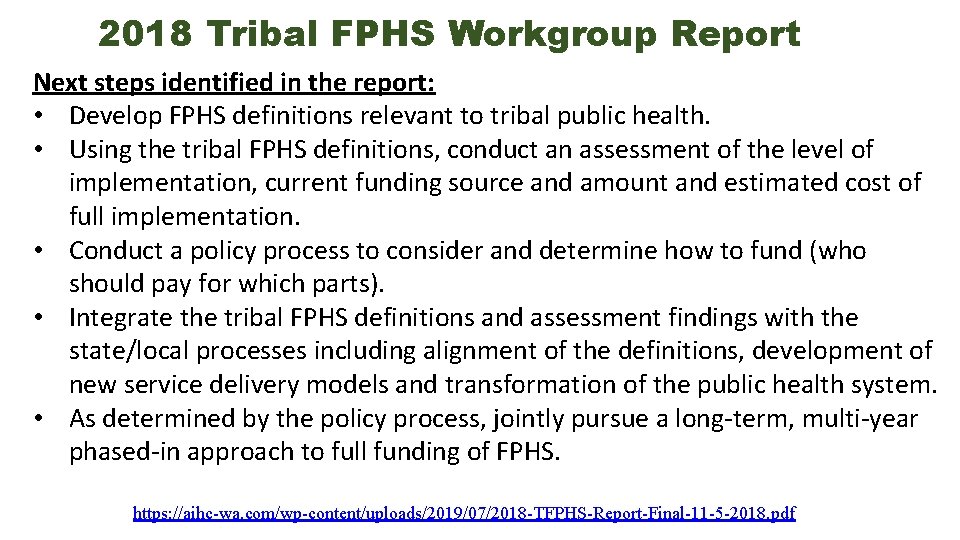
2018 Tribal FPHS Workgroup Report Next steps identified in the report: • Develop FPHS definitions relevant to tribal public health. • Using the tribal FPHS definitions, conduct an assessment of the level of implementation, current funding source and amount and estimated cost of full implementation. • Conduct a policy process to consider and determine how to fund (who should pay for which parts). • Integrate the tribal FPHS definitions and assessment findings with the state/local processes including alignment of the definitions, development of new service delivery models and transformation of the public health system. • As determined by the policy process, jointly pursue a long-term, multi-year phased-in approach to full funding of FPHS. https: //aihc-wa. com/wp-content/uploads/2019/07/2018 -TFPHS-Report-Final-11 -5 -2018. pdf
Pulling Together for Wellness Framework: • The Pulling Together for Wellness (PTW) framework is co-designed with Tribal and Urban Indian Leadership in Washington state. This approach frames the work using indigenous values and perspective. • Develop Tribal FPHS definitions by using language, programs and disciplines from Indian Country. • Keeps the Tribal work from having to “fit into” the non-Tribal work, by developing it in a decolonized manner.
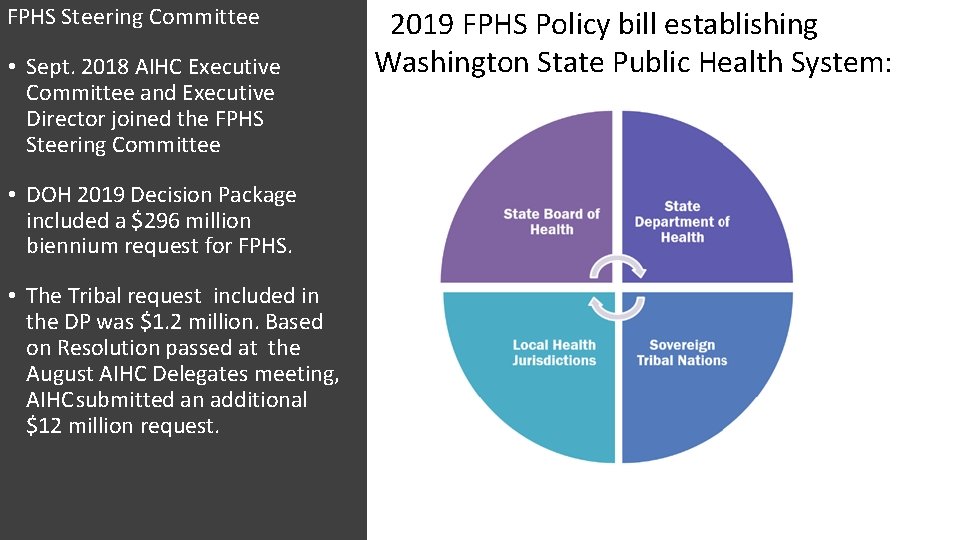
FPHS Steering Committee • Sept. 2018 AIHC Executive Committee and Executive Director joined the FPHS Steering Committee • DOH 2019 Decision Package included a $296 million biennium request for FPHS. • The Tribal request included in the DP was $1. 2 million. Based on Resolution passed at the August AIHC Delegates meeting, AIHC submitted an additional $12 million request. 22019 FPHS Policy bill establishing Washington State Public Health System:
Work to Date: TRIBAL Foundational Public Health Services In late 2017, as part of the AIHC’s work to support planning efforts for Medicaid Transformation in Washington State, the AIHC gathered Services Profiles from Indian/Tribal/Urban Health Programs (I/T/Us) submitted Tribal Services Profiles to AIHC to document the breadth of services provided by each Tribe and urban Indian health program. https: //aihc-wa. com/aihc-regional-meetings-tribal-services-profiles/
Tribal FPHS work to date: Mutual Aid Agreements (MAA) -Developed the MAA for Tribes and Local Health Jurisdictions in Washington State, work to get MAA signed statewide Cross Jurisdictional Coordination-Provided training to tribes and local health jurisdictions regarding mechanisms for distribution of medical countermeasures (MCM) to tribes during public health emergencies
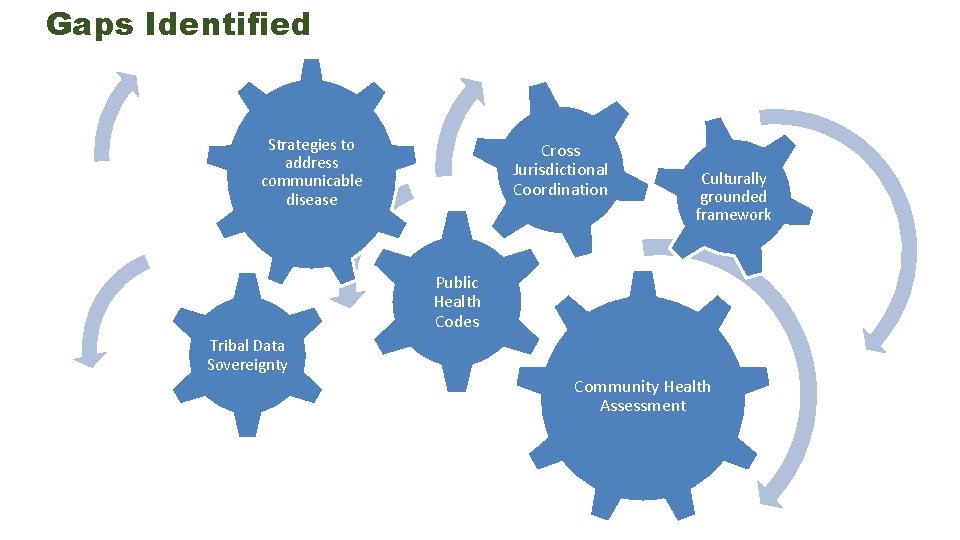
Gaps Identified Strategies to address communicable disease Cross Jurisdictional Coordination Culturally grounded framework Public Health Codes Tribal Data Sovereignty Community Health Assessment
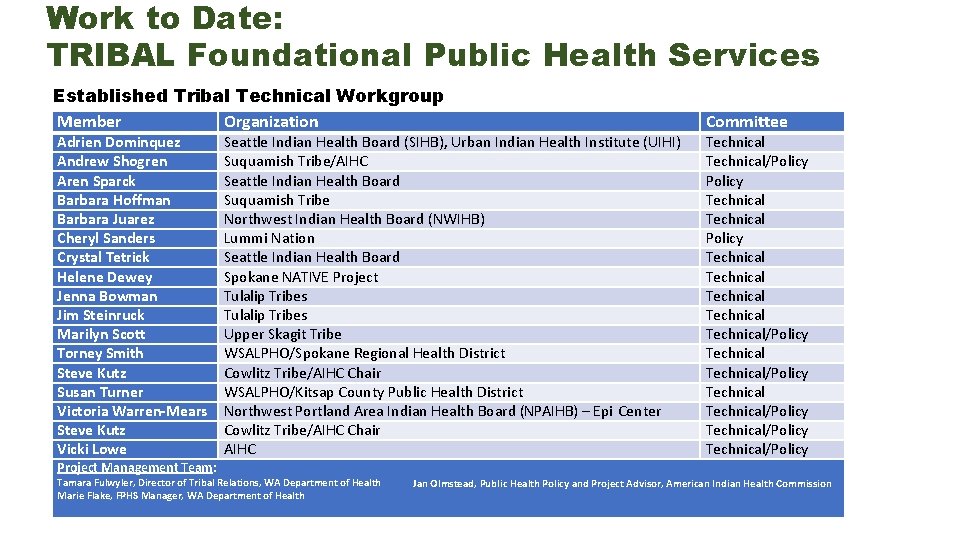
Work to Date: TRIBAL Foundational Public Health Services Established Tribal Technical Workgroup Member Organization Adrien Dominquez Andrew Shogren Aren Sparck Barbara Hoffman Barbara Juarez Cheryl Sanders Crystal Tetrick Helene Dewey Jenna Bowman Jim Steinruck Marilyn Scott Torney Smith Steve Kutz Susan Turner Victoria Warren-Mears Steve Kutz Vicki Lowe Project Management Team: Seattle Indian Health Board (SIHB), Urban Indian Health Institute (UIHI) Suquamish Tribe/AIHC Seattle Indian Health Board Suquamish Tribe Northwest Indian Health Board (NWIHB) Lummi Nation Seattle Indian Health Board Spokane NATIVE Project Tulalip Tribes Upper Skagit Tribe WSALPHO/Spokane Regional Health District Cowlitz Tribe/AIHC Chair WSALPHO/Kitsap County Public Health District Northwest Portland Area Indian Health Board (NPAIHB) – Epi Center Cowlitz Tribe/AIHC Chair AIHC Tamara Fulwyler, Director of Tribal Relations, WA Department of Health Marie Flake, FPHS Manager, WA Department of Health Committee Technical/Policy Technical Technical Technical/Policy Technical/Policy Jan Olmstead, Public Health Policy and Project Advisor, American Indian Health Commission
Next Steps for 2019 -2020 Priorities • Defining Tribal Foundation Public Health Services in Washington State • Develop Model Tribal Public Health Codes • Provide technical assistance to Tribes to adopt Public health codes • Four regional meetings- for tribal definitions and public health codes • Consensus on priorities to address gaps • Identify funding for Washington State Tribes and Urban Indian Health Programs to fully participate in the FPHS. 30
- Slides: 22