
STRENGTHENING THE REGULATORY FRAMEWORK FOR COUNTRIES EMBARKING NUCLEAR
STRENGTHENING THE REGULATORY FRAMEWORK FOR COUNTRIES EMBARKING NUCLEAR POWER Gustavo Caruso Section Head Regulatory Activities Section Department of Nuclear Safety and Security

2

3
Strong Nuclear Safety Infrastructure Needs • Emerging optimistic and ambitious development of nuclear energy plans for the • Different situations require customized approaches • Countries with optimistic plans for the future • Countries with realistic near term plans to enter nuclear • Countries expanding their fleet • Countries extending plant life or decommissioning • Needs are different, but the prevention of accidents must be a priority for all 4
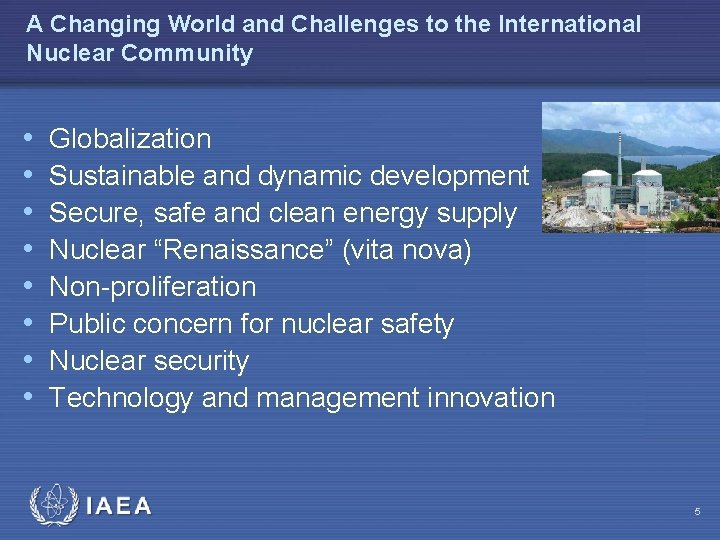
A Changing World and Challenges to the International Nuclear Community • • Globalization Sustainable and dynamic development Secure, safe and clean energy supply Nuclear “Renaissance” (vita nova) Non-proliferation Public concern for nuclear safety Nuclear security Technology and management innovation 5
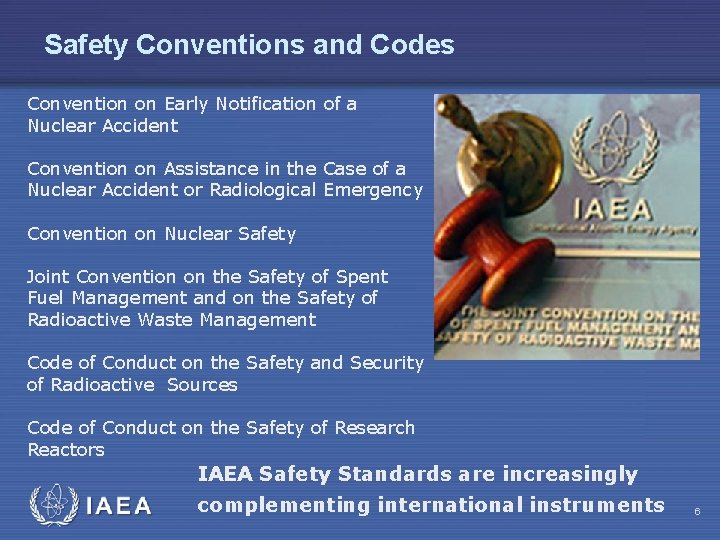
Safety Conventions and Codes Convention on Early Notification of a Nuclear Accident Convention on Assistance in the Case of a Nuclear Accident or Radiological Emergency Convention on Nuclear Safety Joint Convention on the Safety of Spent Fuel Management and on the Safety of Radioactive Waste Management Code of Conduct on the Safety and Security of Radioactive Sources Code of Conduct on the Safety of Research Reactors IAEA Safety Standards are increasingly complementing international instruments 6
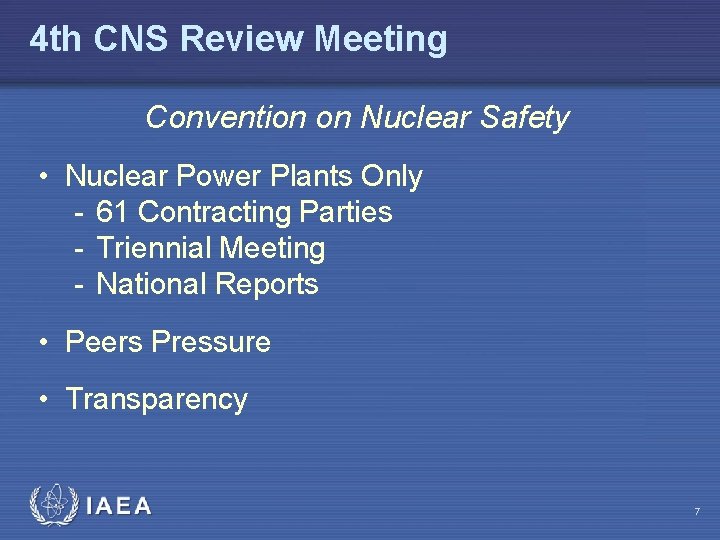
4 th CNS Review Meeting Convention on Nuclear Safety • Nuclear Power Plants Only - 61 Contracting Parties - Triennial Meeting - National Reports • Peers Pressure • Transparency 7

4 th CNS Review Meeting Global conclusions and observations (con’t) • For new NPPs • Necessity to establish the safety infrastructure well in advance • Countries starting a nuclear programme should join CNS • Relevant experience with IRRS missions • References to safety standards 8

9

IAEA Safety Standards and Services • IAEA has statutory obligation to develop international standards of safety Article III. A. 6 of Statutes: • To establish or adopt standards of safety for the protection of health and minimization of danger to life and property • To provide for the application of these standards 10
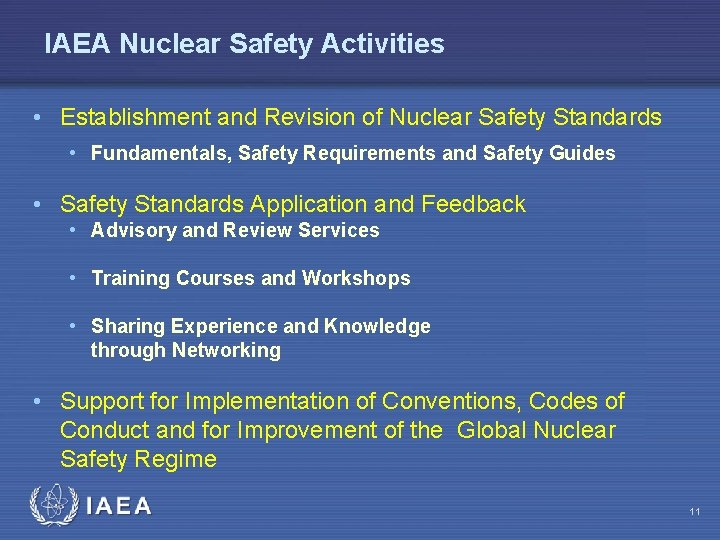
IAEA Nuclear Safety Activities • Establishment and Revision of Nuclear Safety Standards • Fundamentals, Safety Requirements and Safety Guides • Safety Standards Application and Feedback • Advisory and Review Services • Training Courses and Workshops • Sharing Experience and Knowledge through Networking • Support for Implementation of Conventions, Codes of Conduct and for Improvement of the Global Nuclear Safety Regime 11
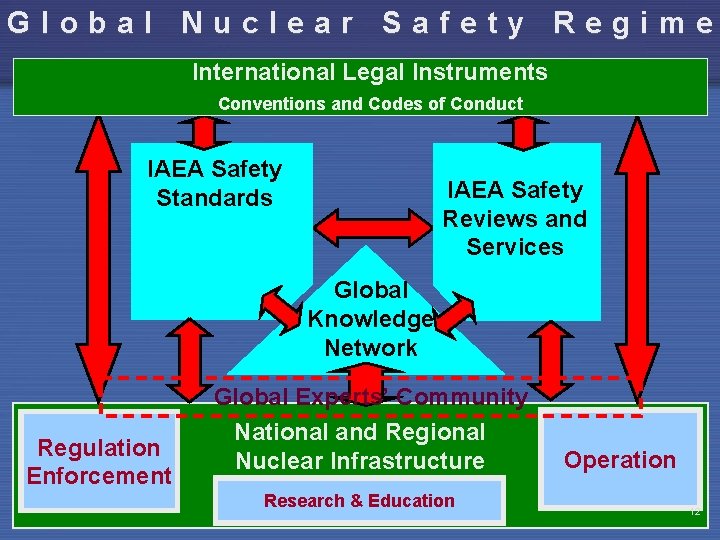
Global Nuclear Safety Regime International Legal Instruments Conventions and Codes of Conduct IAEA Safety Standards IAEA Safety Reviews and Services Global Knowledge Network Regulation Enforcement Global Experts’ Community National and Regional Nuclear Infrastructure Research & Education Operation 12

Strong Nuclear Safety Infrastructure Needs Developing a NP programme means 10 to 15 y planning and development before operation and a “ 100 y commitment” Three Major Phases • Consideration before decision • Preparatory work for the construction • Activities to implement a first NPP “Considerations to Launch a Nuclear Power Programme” “Nuclear Safety Infrastructure for a National Power Programme” INSAG-22 –NEW 13
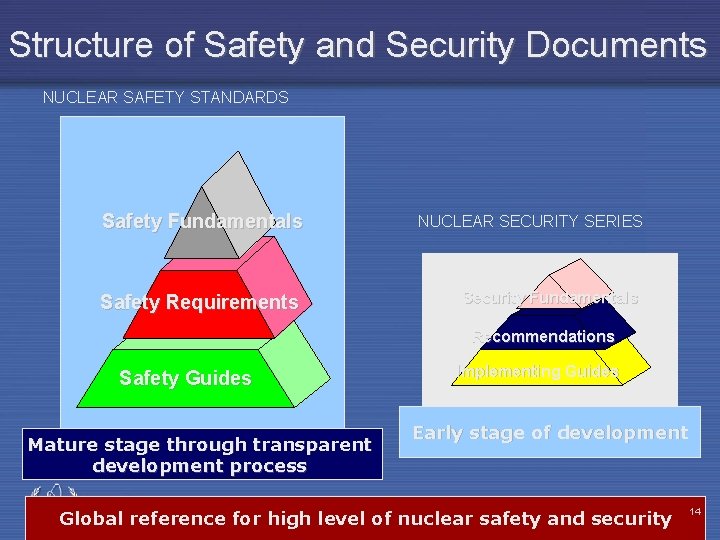
Structure of Safety and Security Documents NUCLEAR SAFETY STANDARDS Safety Fundamentals NUCLEAR SECURITY SERIES Safety Requirements Security Fundamentals Recommendations Safety Guides Mature stage through transparent development process Implementing Guides Early stage of development Global reference for high level of nuclear safety and security 14
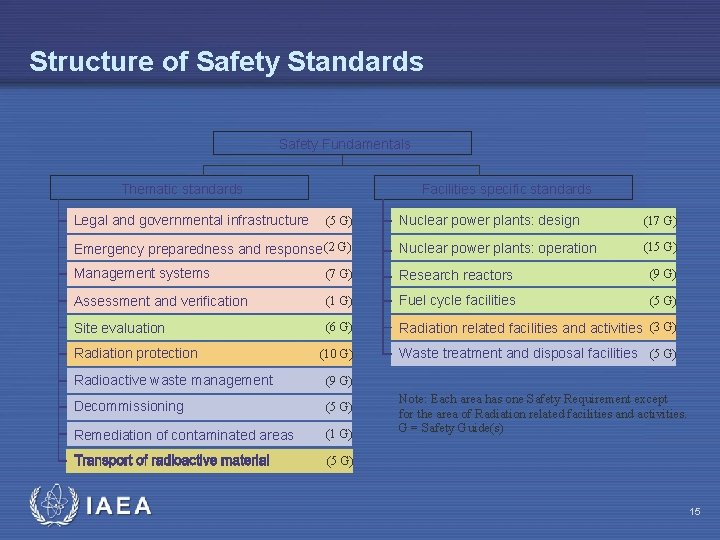
Structure of Safety Standards Safety Fundamentals Thematic standards Legal and governmental infrastructure Facilities specific standards Nuclear power plants: design (17 G) Emergency preparedness and response (2 G) Nuclear power plants: operation (15 G) Management systems (7 G) Research reactors (9 G) Assessment and verification (1 G) Fuel cycle facilities (5 G) Site evaluation (6 G) Radiation related facilities and activities (3 G) (10 G) Waste treatment and disposal facilities (5 G) Radiation protection (5 G) Radioactive waste management (9 G) Decommissioning (5 G) Remediation of contaminated areas (1 G) Note: Each area has one Safety Requirement except for the area of Radiation related facilities and activities. G = Safety Guide(s) (5 G) 15
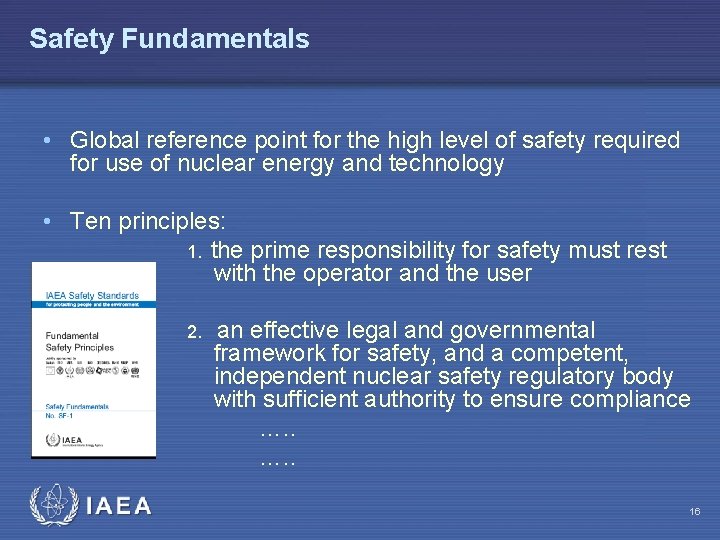
Safety Fundamentals • Global reference point for the high level of safety required for use of nuclear energy and technology • Ten principles: 1. the prime responsibility for safety must rest with the operator and the user 2. an effective legal and governmental framework for safety, and a competent, independent nuclear safety regulatory body with sufficient authority to ensure compliance …. . 16
Safety Requirements GOVERNAMENTAL AND REGULATORY FRAMEWORK FOR SAFETY 17
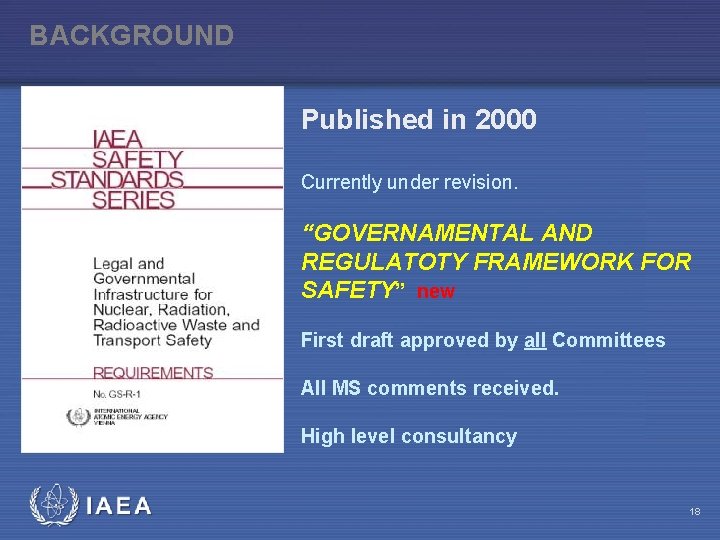
BACKGROUND Published in 2000 Currently under revision. “GOVERNAMENTAL AND REGULATOTY FRAMEWORK FOR SAFETY” new First draft approved by all Committees All MS comments received. High level consultancy 18

New Safety Guides (on going): Licensing process for Nuclear installations 19
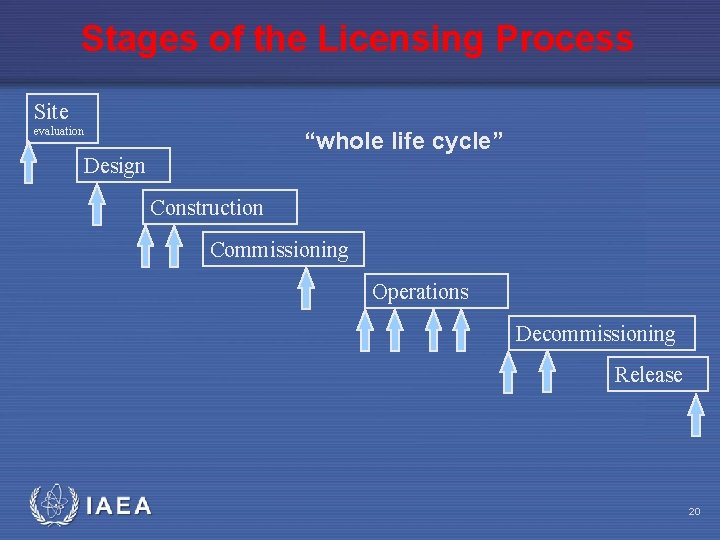
Stages of the Licensing Process Site evaluation “whole life cycle” Design Construction Commissioning Operations Decommissioning Release 20
New Safety Guides (on going): Establishing a National Nuclear Installations Safety Infrastructure 21
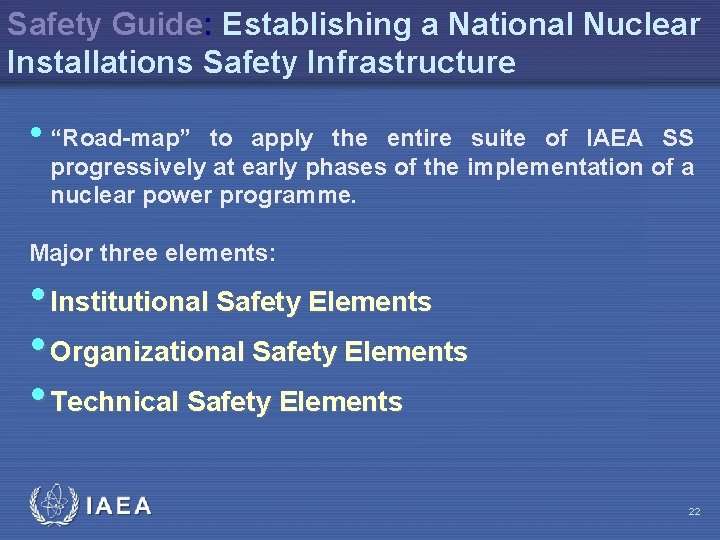
Safety Guide: Establishing a National Nuclear Installations Safety Infrastructure • “Road-map” to apply the entire suite of IAEA SS progressively at early phases of the implementation of a nuclear power programme. Major three elements: • Institutional Safety Elements • Organizational Safety Elements • Technical Safety Elements 22

23
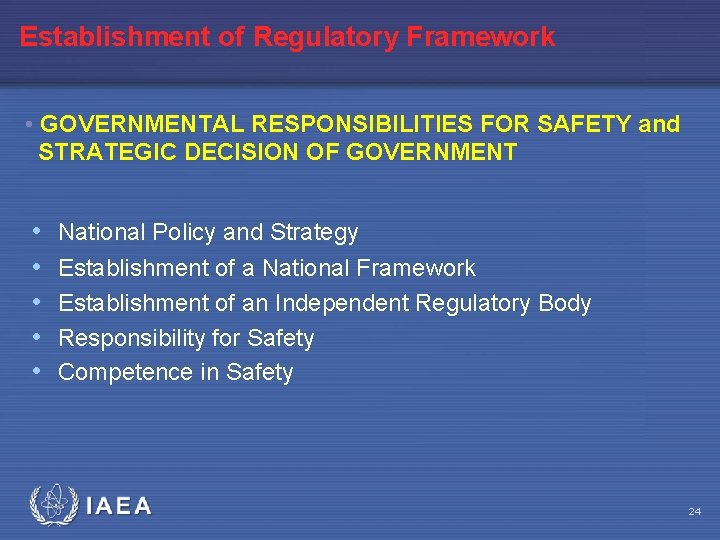
Establishment of Regulatory Framework • GOVERNMENTAL RESPONSIBILITIES FOR SAFETY and STRATEGIC DECISION OF GOVERNMENT • • • National Policy and Strategy Establishment of a National Framework Establishment of an Independent Regulatory Body Responsibility for Safety Competence in Safety 24
Establishment of Regulatory Framework • INTERACTION WITH THE GLOBAL SAFETY REGIME • International arrangements for cooperation • • Legally Binding International Instruments – Conventions International Safety Standards Multinational and Bilateral Arrangements for Cooperation International Peer Reviews • Exchange of Operating and Regulatory Experience • National and International • Lessons learned application 25

Establishment of Regulatory Framework • REGULATORY BODY - GENERAL REQUIREMENTS • • • Organizational Structure and Allocation of Resources Effective Independence Coordination of Regulatory Responsibilities Management System Staffing and Competence of the Regulatory Body Advisory Bodies and Support Organisations Relations between the Regulatory Body and the Licensee Relations Regulatory Body and Interested Parties Regulatory Stability 26
Establishment of Regulatory Framework • FUNCTIONS OF THE REGULATORY BODY • • • Authorization/Licensing Review and Assessment Inspection Enforcement Regulations and Guides Information and Public Communication GS-R-1 27
• REGULATORY INDEPENDENCE: The government shall, through its national legal system, establish and maintain a regulatory body whose task is to regulate facilities and activities for achievement of safety. The government shall ensure that the regulatory body is effectively independent in its safety related decision making and possesses an adequate measure of functional separation from entities having interests or responsibilities that could unduly influence regulatory decision making. The government shall ensure that the regulatory body is given the legal authority, competence and resources necessary to fulfil its statutory obligation to regulate facilities and activities. GS-R-1 28
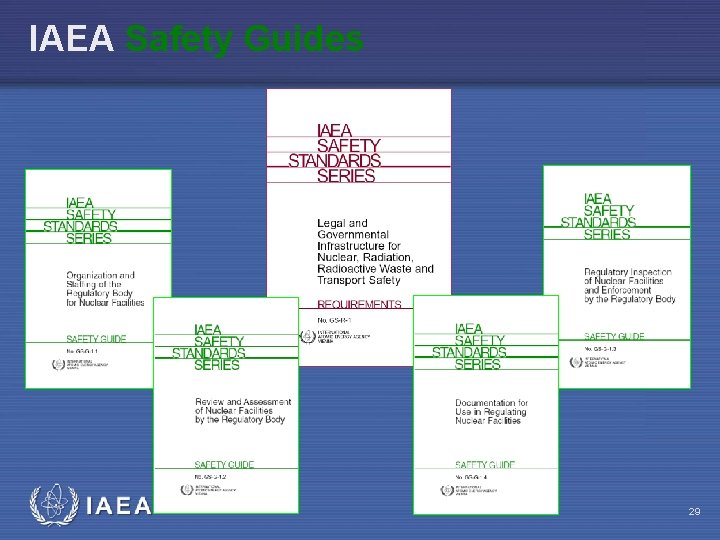
IAEA Safety Guides 29
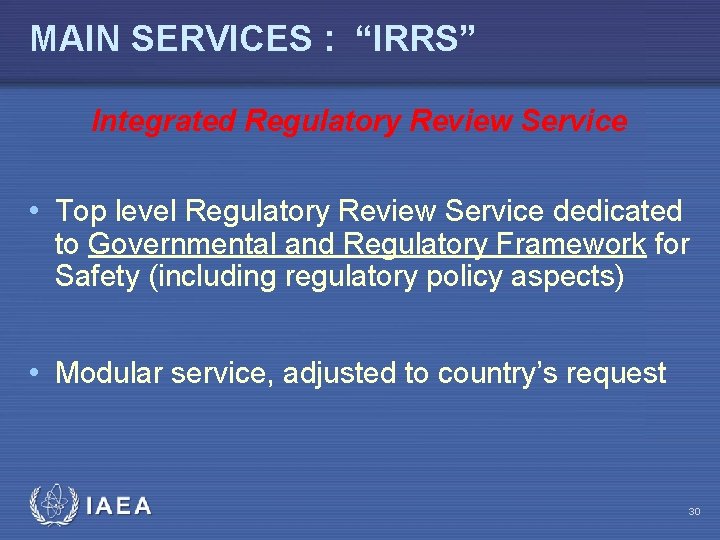
MAIN SERVICES : “IRRS” Integrated Regulatory Review Service • Top level Regulatory Review Service dedicated to Governmental and Regulatory Framework for Safety (including regulatory policy aspects) • Modular service, adjusted to country’s request 30

31
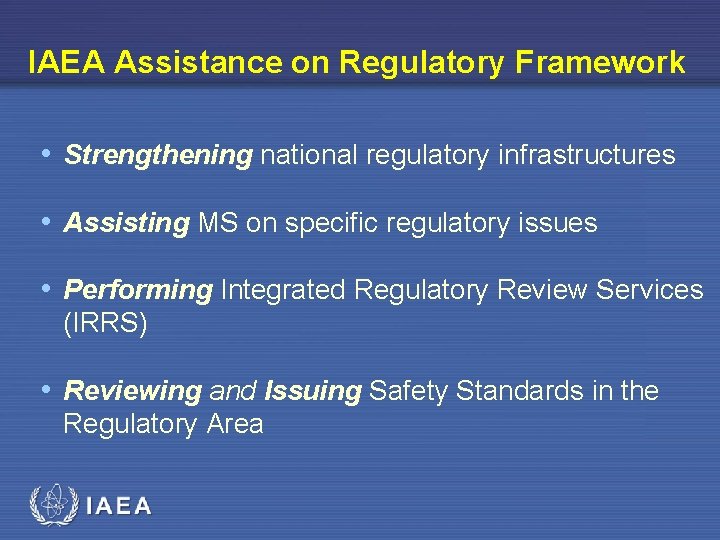
IAEA Assistance on Regulatory Framework • Strengthening national regulatory infrastructures • Assisting MS on specific regulatory issues • Performing Integrated Regulatory Review Services (IRRS) • Reviewing and Issuing Safety Standards in the Regulatory Area
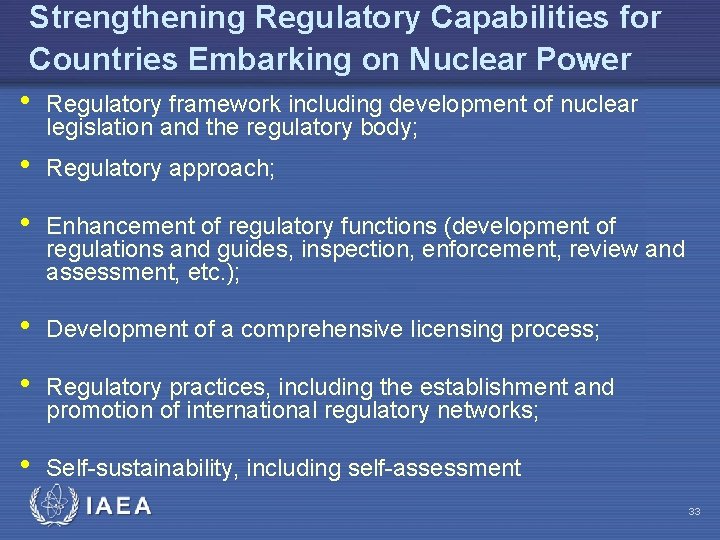
Strengthening Regulatory Capabilities for Countries Embarking on Nuclear Power • Regulatory framework including development of nuclear legislation and the regulatory body; • Regulatory approach; • Enhancement of regulatory functions (development of regulations and guides, inspection, enforcement, review and assessment, etc. ); • Development of a comprehensive licensing process; • Regulatory practices, including the establishment and promotion of international regulatory networks; • Self-sustainability, including self-assessment 33
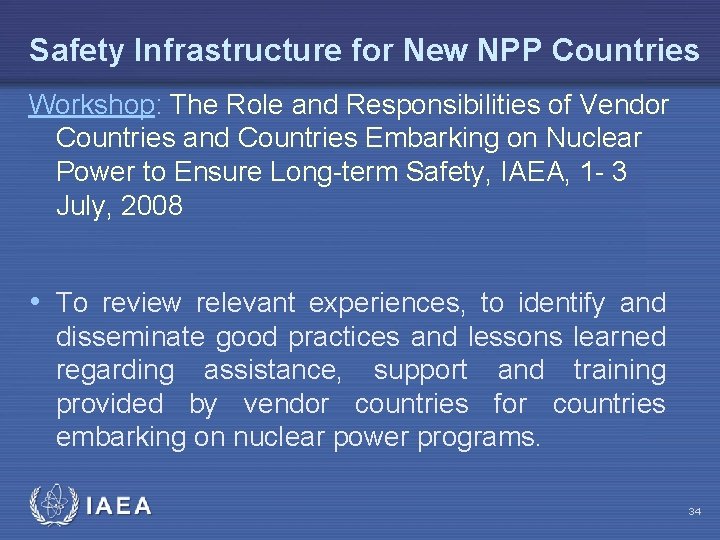
Safety Infrastructure for New NPP Countries Workshop: The Role and Responsibilities of Vendor Countries and Countries Embarking on Nuclear Power to Ensure Long-term Safety, IAEA, 1 - 3 July, 2008 • To review relevant experiences, to identify and disseminate good practices and lessons learned regarding assistance, support and training provided by vendor countries for countries embarking on nuclear power programs. 34
Role and Responsibilities of Vendor Countries and Countries Embarking on Nuclear Power to Ensure Long-term Safety • CHINA (Buyer) & FRANCE (Vendor) • PAKISTAN (Buyer) & CHINA (Vendor) • FINLAND, IRAN (Buyer) & RUSSIA (Vendor) • MEXICO (Buyer), SPAIN (Buyer) & USA (Vendor) • ROMANIA (Buyer) & CANADA (Vendor) • INSAG and IAEA (NS, NE and OLA) presentations 35
Role and Responsibilities of Vendor Countries and Countries Embarking on Nuclear Power to Ensure Long-term Safety • Nuclear safety is a national responsibility • International leverage should be enhanced through IAEA actions, bilateral or multilateral arrangements, MDEP initiative, etc. • Newcomers should include the package of Treaties, Conventions to join the nuclear community. • Moral responsibilities of Vendor countries and should report to all (CNS) about steps and actions establishing contracts and transferring nuclear technology to nuclear newcomers. 36
Role and Responsibilities of Vendor Countries and Countries Embarking on Nuclear Power to Ensure Long-term Safety • Continue with IAEA Safety guides development for countries embarking on nuclear power programmes and mechanisms to reinforce the Global Safety Regime. • Systematic IAEA tailored review services, IRRS and pre-OSART for countries embarking on nuclear power, as prerequisite at different stages. • This type of Workshop should be repeated on regular basis, 1 -2 y • Next, November, 2009, nuclear newcomers will present their particular situation, difficulties and challenges developing their safety infrastructure to embark on nuclear power. 37

38
Final remarks • Governmental and Regulatory Framework need strong support • Tasks necessary to establish an effective independent regulatory body need to be carried out by the Member State. • Licensing process needs to be defined at the early stage • “How safe is safe enough? ” is a national responsibility, the regulatory approach is the key element • Efforts coordinated are essential in order to be consistent, comprehensive and effective. 39
International Atomic Energy Agency …Thank you for your attention g. caruso@iaea. org 40
- Slides: 40