
Strengthening the measurement of adolescent health programmes Assessing
- Slides: 21
Strengthening the measurement of adolescent health programmes: Assessing the quality, coverage and cost of health service provision to adolescents From Research to Practice: Training in Reproductive Health Research Measuring costs related to the provision of health services for young people Karin Stenberg Department of Child and Adolescent Health and Development 16 March 2007
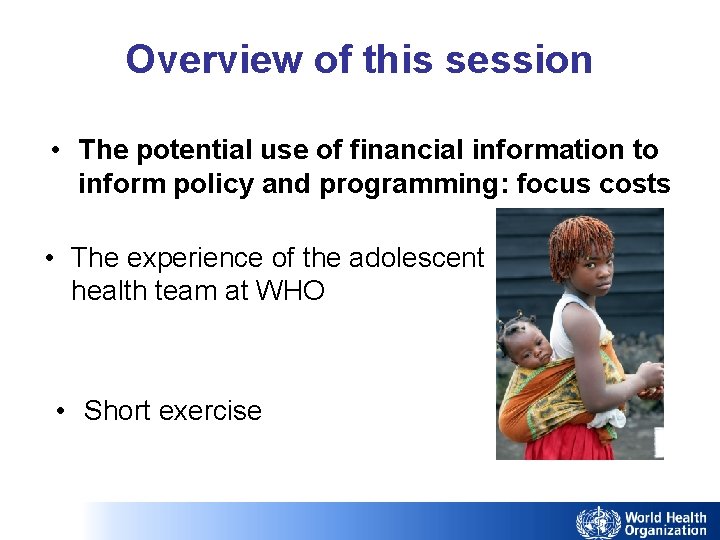
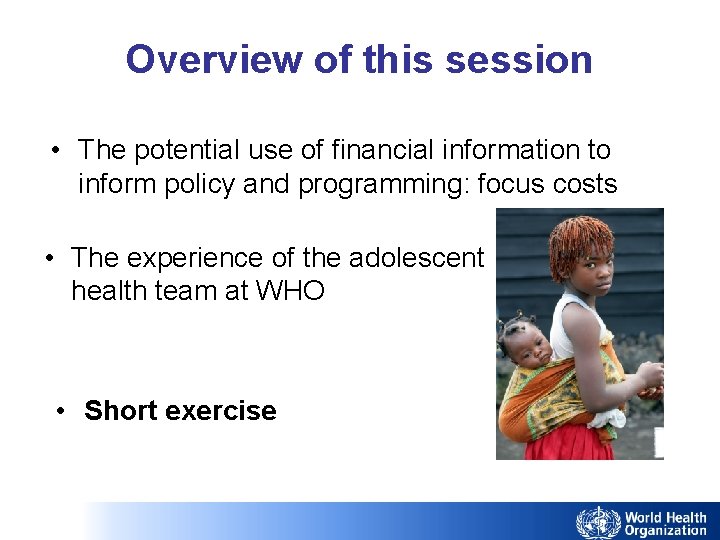
Overview of this session • The potential use of financial information to inform policy and programming: focus costs • The experience of the adolescent health team at WHO • Short exercise
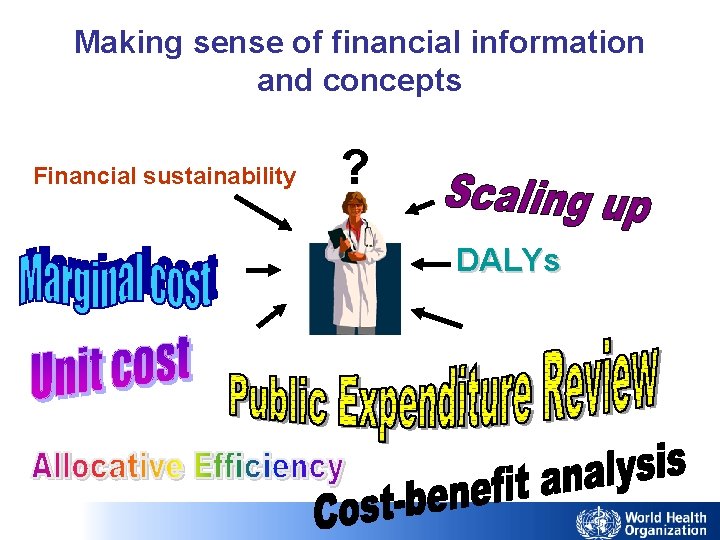
Making sense of financial information and concepts Financial sustainability ? DALYs
Questions that Economists ask and that they can help answer • Are people and society getting the best value for money? • Are resources allocated efficiently to reach priority health outcomes? • What is the comparative advantage of different providers in getting best value for money? • What is the best way of using public resources to target vulnerable populations incl. the poor?
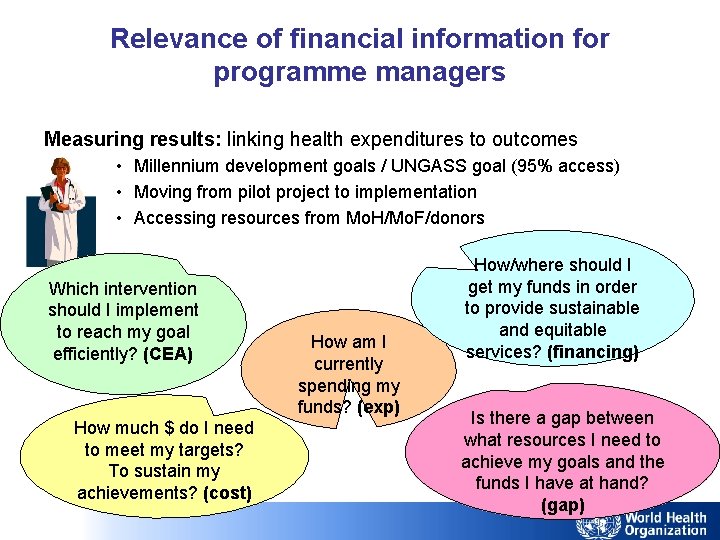
Relevance of financial information for programme managers Measuring results: linking health expenditures to outcomes • Millennium development goals / UNGASS goal (95% access) • Moving from pilot project to implementation • Accessing resources from Mo. H/Mo. F/donors Which intervention should I implement to reach my goal efficiently? (CEA) How much $ do I need to meet my targets? To sustain my achievements? (cost) How am I currently spending my funds? (exp) How/where should I get my funds in order to provide sustainable and equitable services? (financing) Is there a gap between what resources I need to achieve my goals and the funds I have at hand? (gap)
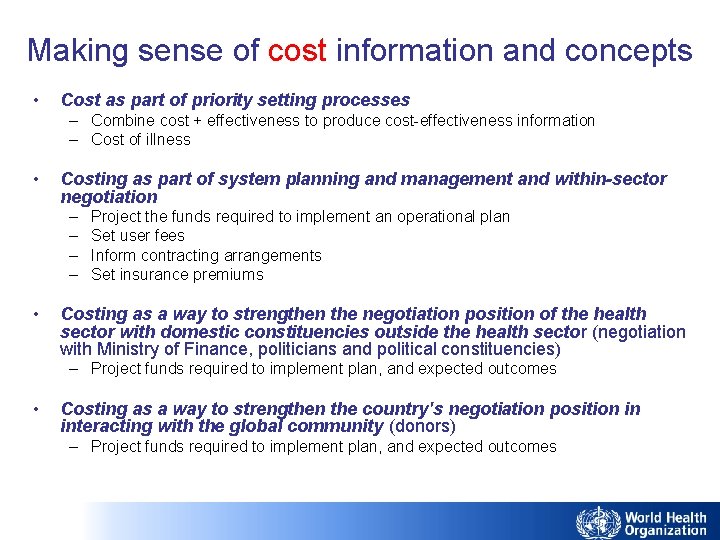
Making sense of cost information and concepts • Cost as part of priority setting processes – Combine cost + effectiveness to produce cost-effectiveness information – Cost of illness • Costing as part of system planning and management and within-sector negotiation – – • Project the funds required to implement an operational plan Set user fees Inform contracting arrangements Set insurance premiums Costing as a way to strengthen the negotiation position of the health sector with domestic constituencies outside the health sector (negotiation with Ministry of Finance, politicians and political constituencies) – Project funds required to implement plan, and expected outcomes • Costing as a way to strengthen the country's negotiation position in interacting with the global community (donors) – Project funds required to implement plan, and expected outcomes
Overview of this session • The potential use of financial information to inform policy and programming: focus costs • The experience of the adolescent health team at WHO • Short exercise
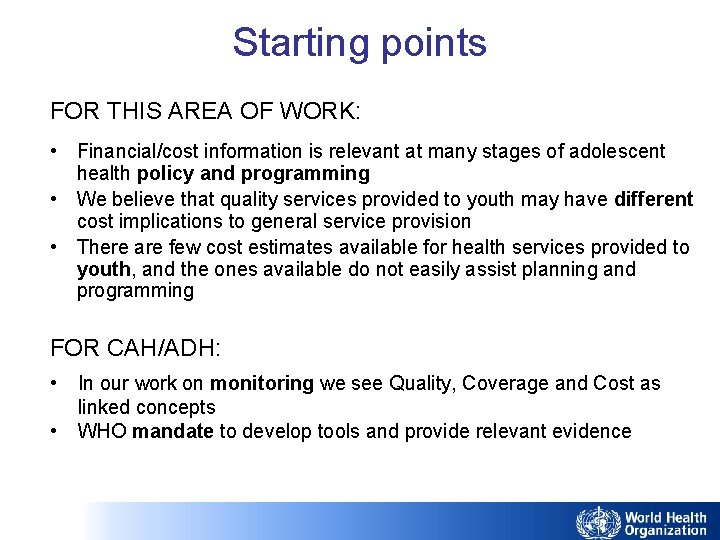
Starting points FOR THIS AREA OF WORK: • Financial/cost information is relevant at many stages of adolescent health policy and programming • We believe that quality services provided to youth may have different cost implications to general service provision • There are few cost estimates available for health services provided to youth, and the ones available do not easily assist planning and programming FOR CAH/ADH: • • In our work on monitoring we see Quality, Coverage and Cost as linked concepts WHO mandate to develop tools and provide relevant evidence
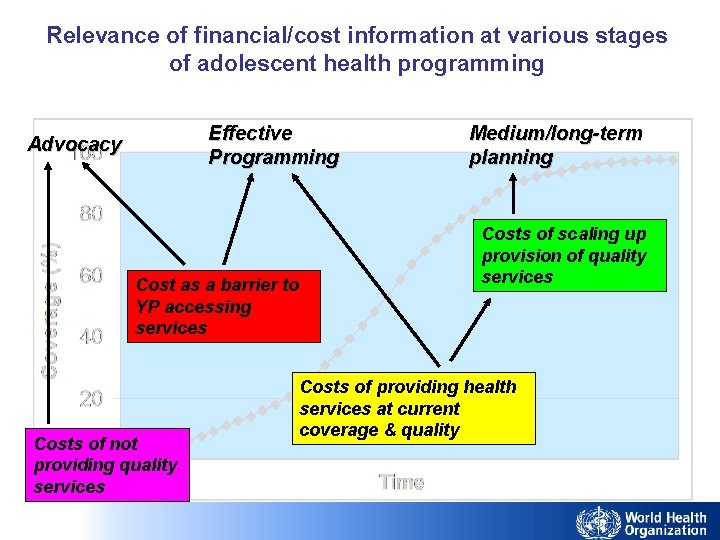
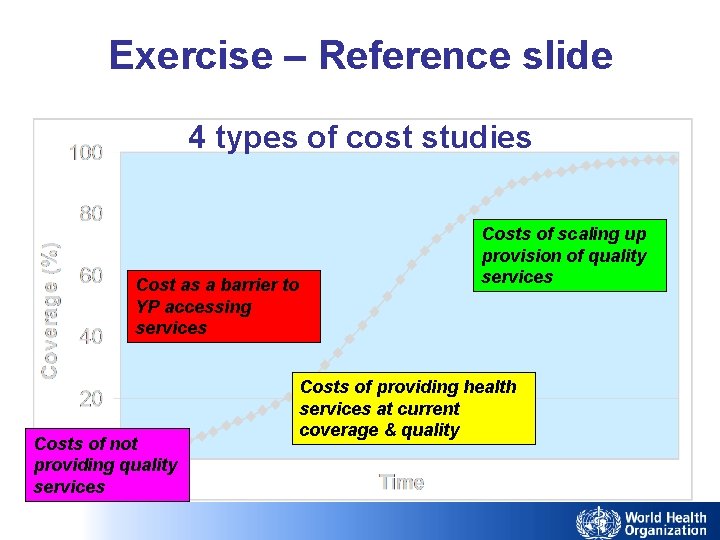
Relevance of financial/cost information at various stages of adolescent health programming Effective Programming Advocacy Cost as a barrier to YP accessing services Costs of not providing quality services Medium/long-term planning Costs of scaling up provision of quality services Costs of providing health services at current coverage & quality
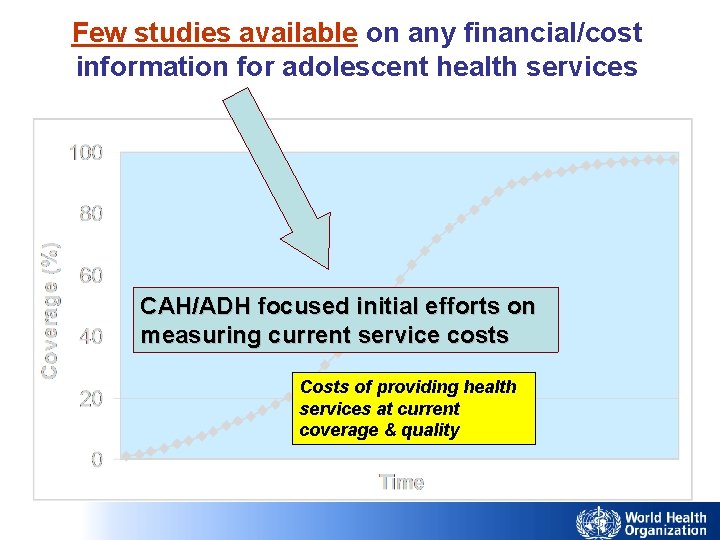
Few studies available on any financial/cost information for adolescent health services CAH/ADH focused initial efforts on measuring current service costs Costs of providing health services at current coverage & quality
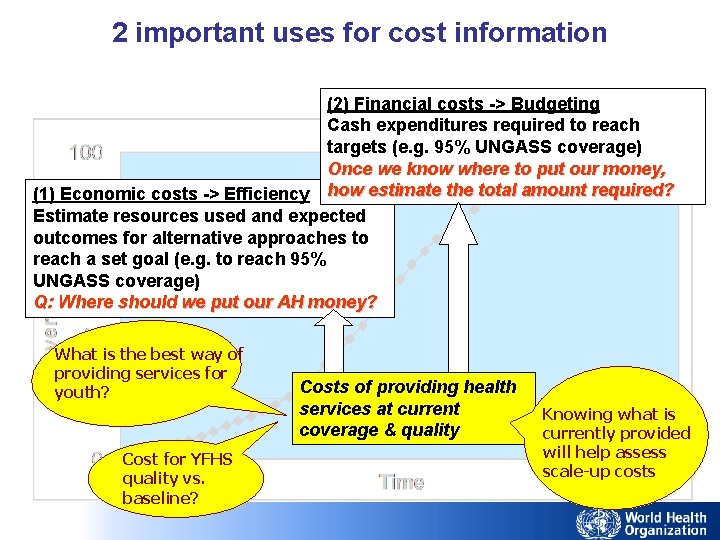
2 important uses for cost information (2) Financial costs -> Budgeting Cash expenditures required to reach targets (e. g. 95% UNGASS coverage) Once we know where to put our money, (1) Economic costs -> Efficiency how estimate the total amount required? Estimate resources used and expected outcomes for alternative approaches to reach a set goal (e. g. to reach 95% UNGASS coverage) Q: Where should we put our AH money? What is the best way of providing services for youth? Cost for YFHS quality vs. baseline? Costs of providing health services at current coverage & quality Knowing what is currently provided will help assess scale-up costs
Objectives and type of results produced by the cost assessment tools developed • To estimate the total resource requirement at facility level for providing priority interventions to adolescents or young people, through AFHS/YFHS. • To estimate the cost per client for provision of priority interventions to adolescents, as well as adults, to allow for cost comparison across age groups and different delivery mechanisms. • To estimate the cost of particular activities important to AFHS/YFHS, such as outreach, training of health workers and the use of peer workers. • To estimate the cost increase of AFHS/YFHS with a higher level of quality of health service provision, compared to facilities with lower quality level of health service provision to youth.
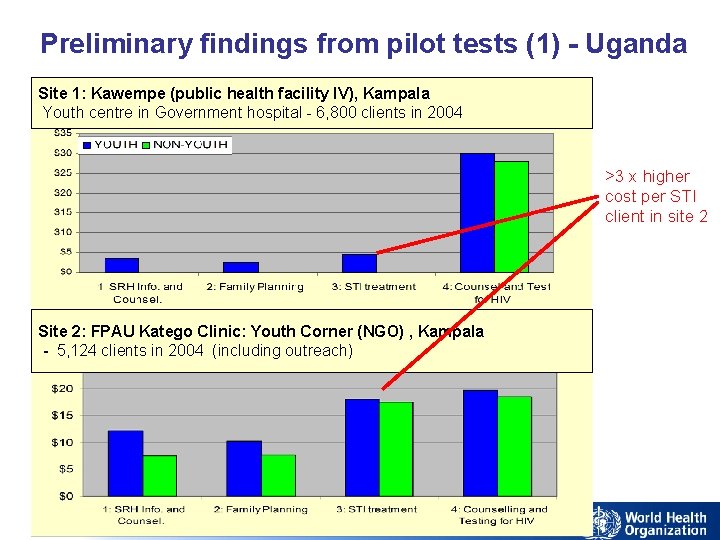
Preliminary findings from pilot tests (1) - Uganda Site 1: Kawempe (public health facility IV), Kampala Youth centre in Government hospital - 6, 800 clients in 2004 >3 x higher cost per STI client in site 2 Site 2: FPAU Katego Clinic: Youth Corner (NGO) , Kampala - 5, 124 clients in 2004 (including outreach)
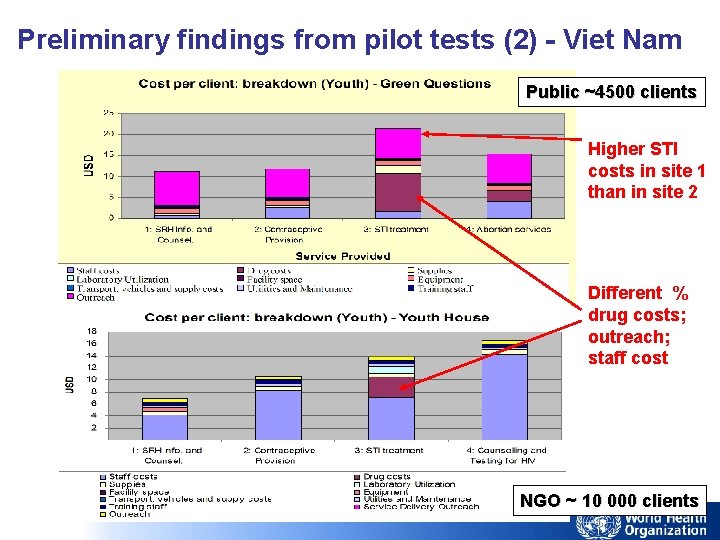
Preliminary findings from pilot tests (2) - Viet Nam Public ~4500 clients Higher STI costs in site 1 than in site 2 Different % drug costs; outreach; staff cost NGO ~ 10 000 clients
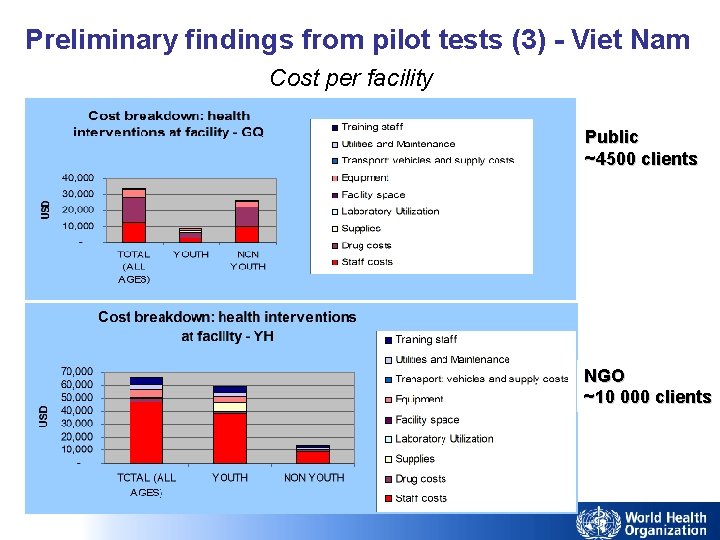
Preliminary findings from pilot tests (3) - Viet Nam Cost per facility Public ~4500 clients NGO ~10 000 clients
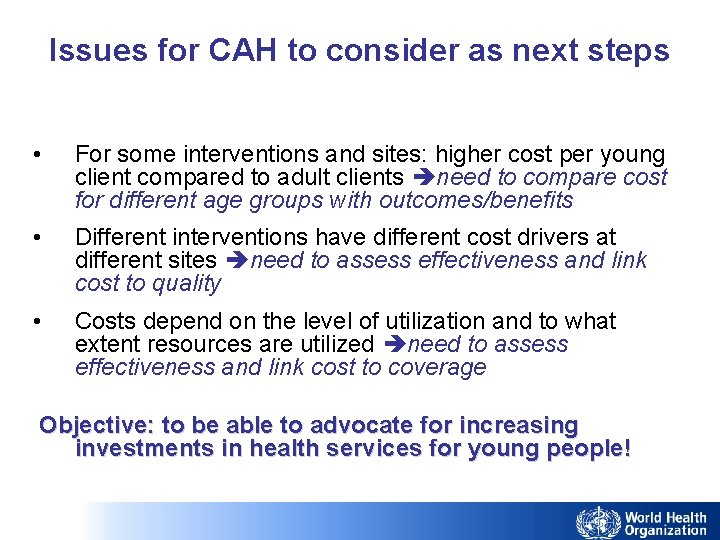
Issues for CAH to consider as next steps • For some interventions and sites: higher cost per young client compared to adult clients need to compare cost for different age groups with outcomes/benefits • Different interventions have different cost drivers at different sites need to assess effectiveness and link cost to quality • Costs depend on the level of utilization and to what extent resources are utilized need to assess effectiveness and link cost to coverage Objective: to be able to advocate for increasing investments in health services for young people!
Overview of this session • The potential use of financial information to inform policy and programming: focus costs • The experience of the adolescent health team at WHO • Short exercise
Exercise - Scene setting • You are a staff member of Ministry of Health in charge of adolescent health, with specific focus on sexual and reproductive health and HIV prevention. • You are concerned about the current state of health services provided to adolescents • You want to undertake a study to provide information that can help you assess the current information and strengthen programming • You are considering four types of studies (DFID has agreed to support funding the study and WHO will provide technical assistance)
Exercise - Your task • Describe briefly what kind of study you would undertake and for what purpose. • Be prepared to provide answers to the following questions: – What is the rationale for undertaking the study given the context? – What type of data do you propose to collect? – How would costs be linked to quality and coverage in your study? – What would be the expected results of the study and what kind of policy message do you expect to take to your Director?
Exercise – Reference slide 4 types of cost studies Cost as a barrier to YP accessing services Costs of not providing quality services Costs of scaling up provision of quality services Costs of providing health services at current coverage & quality