
Strengthening One Health Coordination Using ParticipatoryBased Tabletop Exercises
Strengthening One Health Coordination Using Participatory-Based Tabletop Exercises Todd Noel Carrie Mc. Neil DVM MPH Sandia National Laboratories is a multi-program laboratory managed and operated by Sandia Corporation, a wholly owned subsidiary of Lockheed Martin Corporation, for the U. S. Department of Energy’s National Nuclear Security Administration under contract DE-AC 0494 AL 85000. SAND XXXX-XXXX
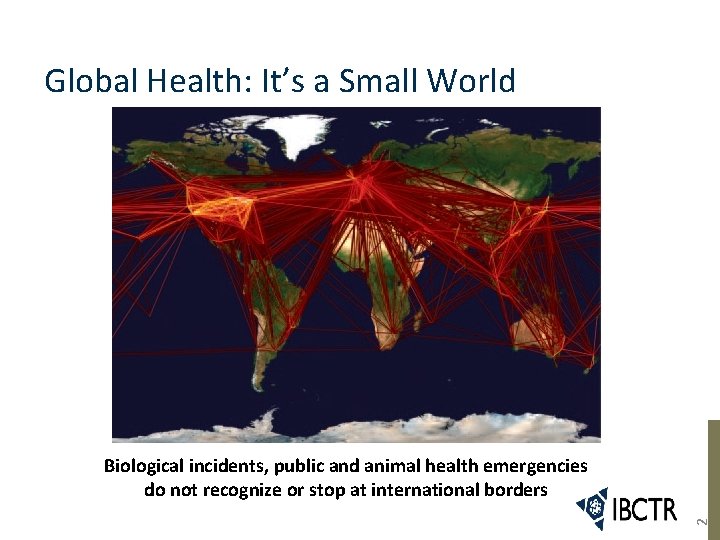
Global Health: It’s a Small World http: //www. onehealthinitiative. com/ 2 Biological incidents, public and animal health emergencies do not recognize or stop at international borders
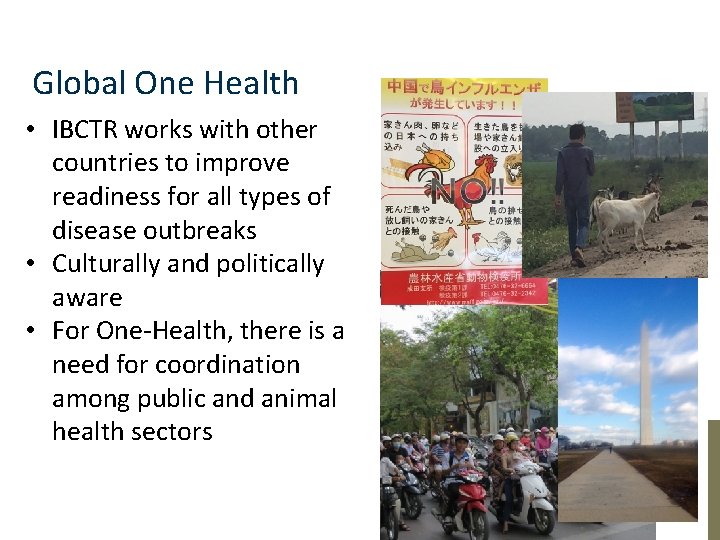
Global One Health • IBCTR works with other countries to improve readiness for all types of disease outbreaks • Culturally and politically aware • For One-Health, there is a need for coordination among public and animal health sectors
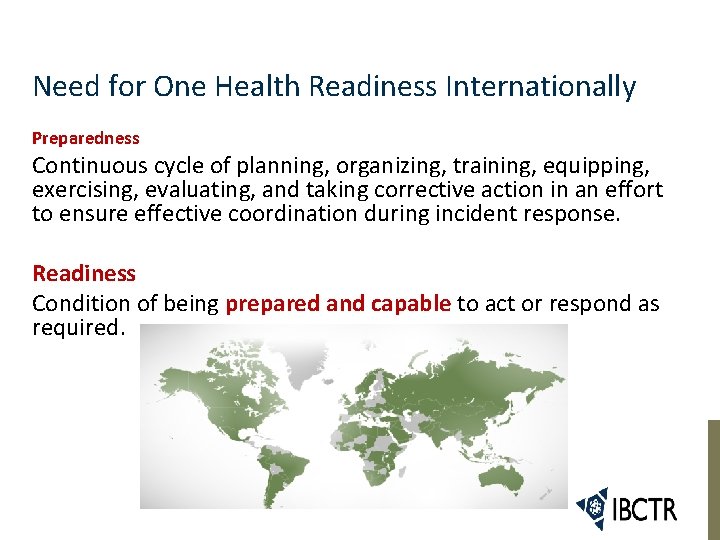
Need for One Health Readiness Internationally Preparedness Continuous cycle of planning, organizing, training, equipping, exercising, evaluating, and taking corrective action in an effort to ensure effective coordination during incident response. Readiness Condition of being prepared and capable to act or respond as required.
Tabletop Exercises (TTX) • A tabletop exercise is an activity in which key personnel assigned emergency management roles and responsibilities are gathered to discuss various simulated emergency situations. • Examples o Officials from Ministries of Health and Agriculture to evaluate roles, responsibilities, and communication in a fictitious outbreak of a disease transmitted between animals and people o Laboratory lead and head of security in a scenario involving an attempted theft during work hours.
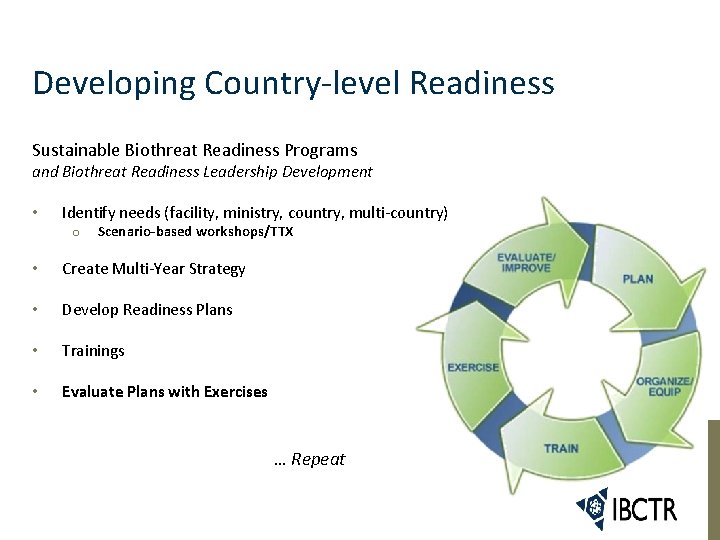
Developing Country-level Readiness Sustainable Biothreat Readiness Programs and Biothreat Readiness Leadership Development • Identify needs (facility, ministry, country, multi-country) o Scenario-based workshops/TTX • Create Multi-Year Strategy • Develop Readiness Plans • Trainings • Evaluate Plans with Exercises … Repeat
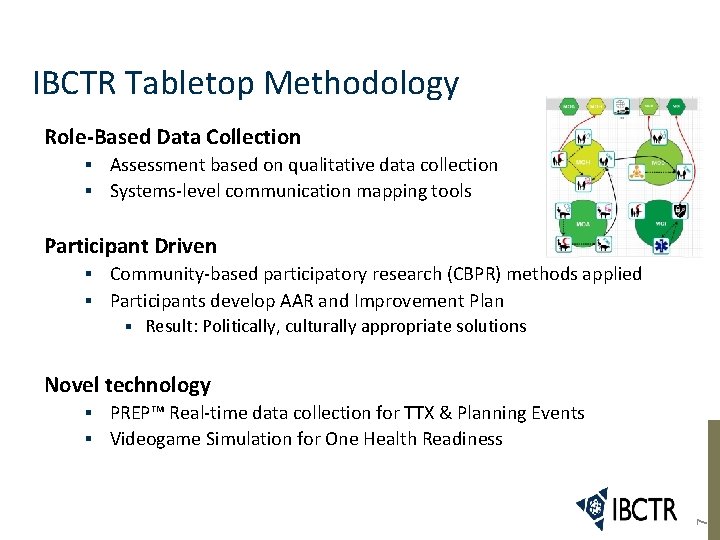
IBCTR Tabletop Methodology Role-Based Data Collection § Assessment based on qualitative data collection § Systems-level communication mapping tools Participant Driven § Community-based participatory research (CBPR) methods applied § Participants develop AAR and Improvement Plan § Result: Politically, culturally appropriate solutions Novel technology 7 § PREP™ Real-time data collection for TTX & Planning Events § Videogame Simulation for One Health Readiness
PREP™: Portal for Readiness Exercises & Planning • PREP is an online platform that provides simple, easy-to-use templates & tools for emergency managers, health, & security professionals to design and conduct: o Tabletop exercises and drills o Strategic and operational planning workshops • Features o o o o Multi-Lingual capabilities Automatic, immediate report development In-exercise communication and email notifications Secure data collection Flexible adaptable templates Video Game activity Remote and in-person usability
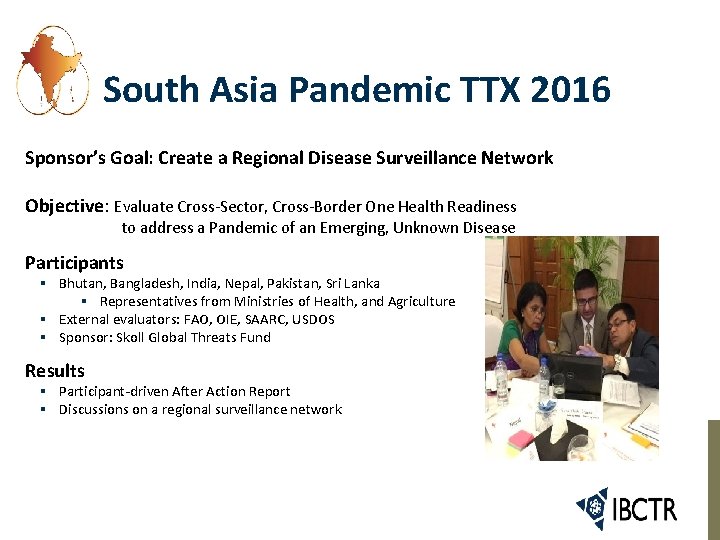
South Asia Pandemic TTX 2016 Sponsor’s Goal: Create a Regional Disease Surveillance Network Objective: Evaluate Cross-Sector, Cross-Border One Health Readiness to address a Pandemic of an Emerging, Unknown Disease Participants § Bhutan, Bangladesh, India, Nepal, Pakistan, Sri Lanka § Representatives from Ministries of Health, and Agriculture § External evaluators: FAO, OIE, SAARC, USDOS § Sponsor: Skoll Global Threats Fund Results § Participant-driven After Action Report § Discussions on a regional surveillance network
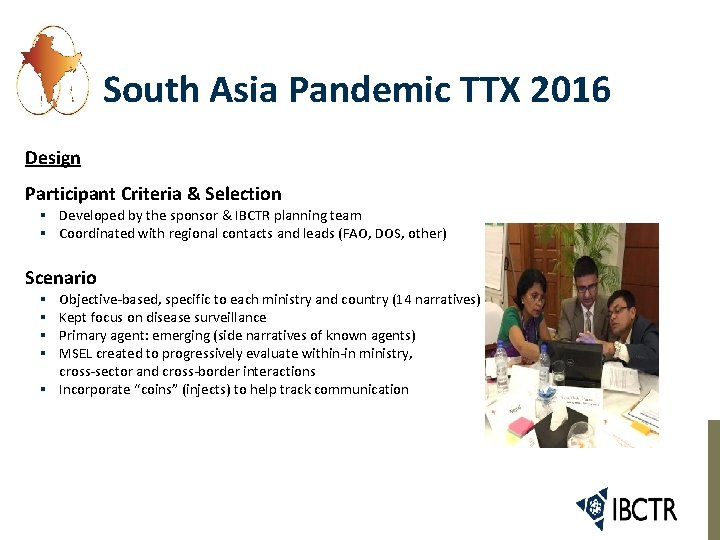
South Asia Pandemic TTX 2016 Design Participant Criteria & Selection § Developed by the sponsor & IBCTR planning team § Coordinated with regional contacts and leads (FAO, DOS, other) Scenario Objective-based, specific to each ministry and country (14 narratives) Kept focus on disease surveillance Primary agent: emerging (side narratives of known agents) MSEL created to progressively evaluate within-in ministry, cross-sector and cross-border interactions § Incorporate “coins” (injects) to help track communication § §
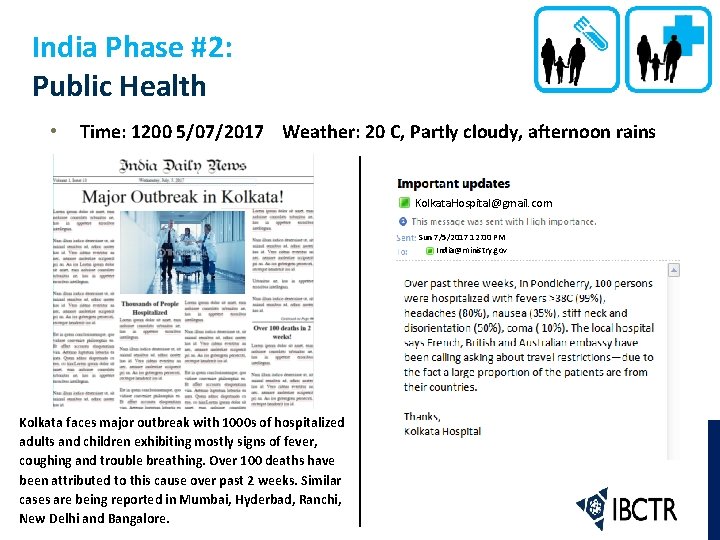
India Phase #2: Public Health • Time: 1200 5/07/2017 Weather: 20 C, Partly cloudy, afternoon rains Kolkata. Hospital@gmail. com Sun 7/5/2017 12: 00 PM India@ministry. gov Kolkata faces major outbreak with 1000 s of hospitalized adults and children exhibiting mostly signs of fever, coughing and trouble breathing. Over 100 deaths have been attributed to this cause over past 2 weeks. Similar cases are being reported in Mumbai, Hyderbad, Ranchi, New Delhi and Bangalore.
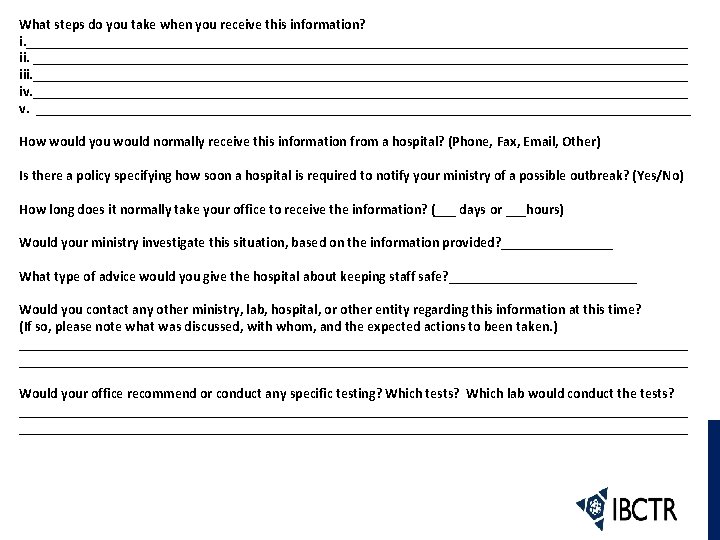
What steps do you take when you receive this information? i. ________________________________________________ ii. ______________________________________________________________________________________________ iv. ______________________________________________________________________________________________ How would you would normally receive this information from a hospital? (Phone, Fax, Email, Other) Is there a policy specifying how soon a hospital is required to notify your ministry of a possible outbreak? (Yes/No) How long does it normally take your office to receive the information? (___ days or ___hours) Would your ministry investigate this situation, based on the information provided? ________ What type of advice would you give the hospital about keeping staff safe? ______________ Would you contact any other ministry, lab, hospital, or other entity regarding this information at this time? (If so, please note what was discussed, with whom, and the expected actions to been taken. ) ________________________________________________________________________________________________ Would your office recommend or conduct any specific testing? Which tests? Which lab would conduct the tests? ________________________________________________________________________________________________
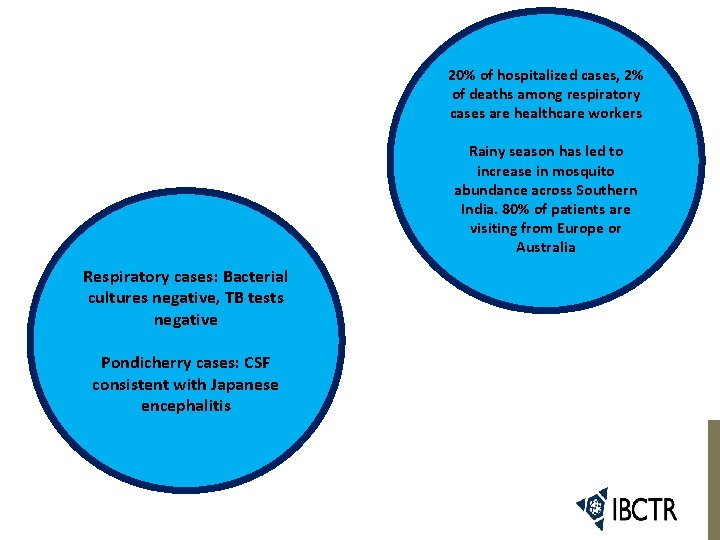
20% of hospitalized cases, 2% of deaths among respiratory cases are healthcare workers Rainy season has led to increase in mosquito abundance across Southern India. 80% of patients are visiting from Europe or Australia Respiratory cases: Bacterial cultures negative, TB tests negative Pondicherry cases: CSF consistent with Japanese encephalitis
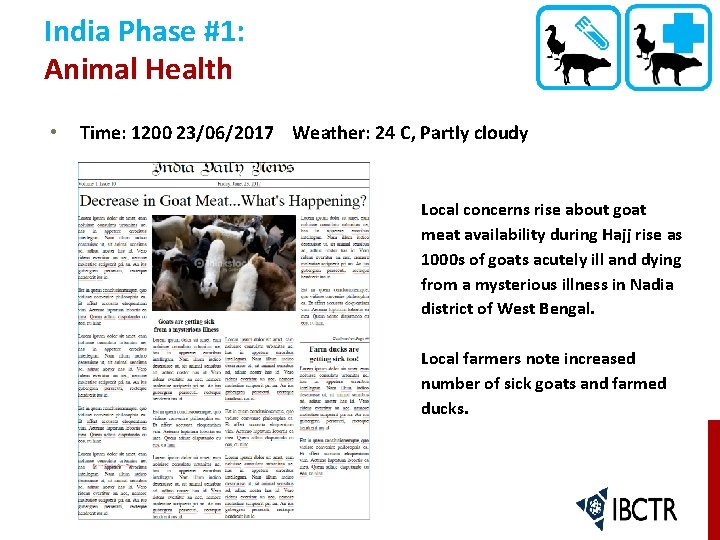
India Phase #1: Animal Health • Time: 1200 23/06/2017 Weather: 24 C, Partly cloudy Local concerns rise about goat meat availability during Hajj rise as 1000 s of goats acutely ill and dying from a mysterious illness in Nadia district of West Bengal. Local farmers note increased number of sick goats and farmed ducks.
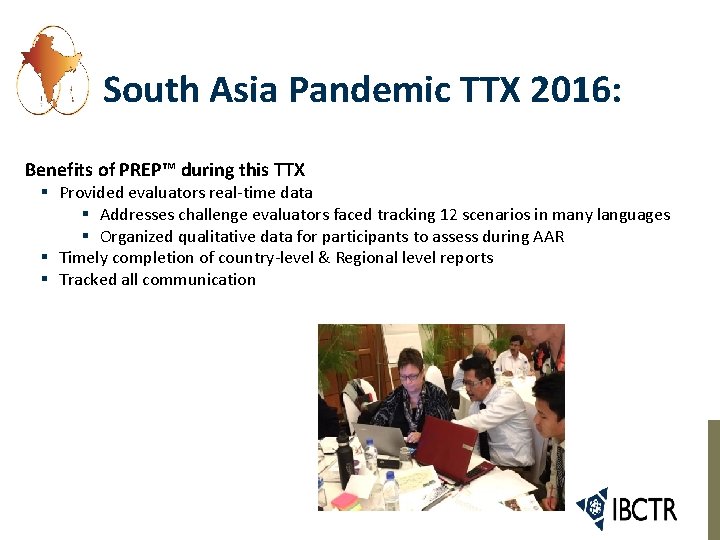
South Asia Pandemic TTX 2016: Benefits of PREP™ during this TTX § Provided evaluators real-time data § Addresses challenge evaluators faced tracking 12 scenarios in many languages § Organized qualitative data for participants to assess during AAR § Timely completion of country-level & Regional level reports § Tracked all communication
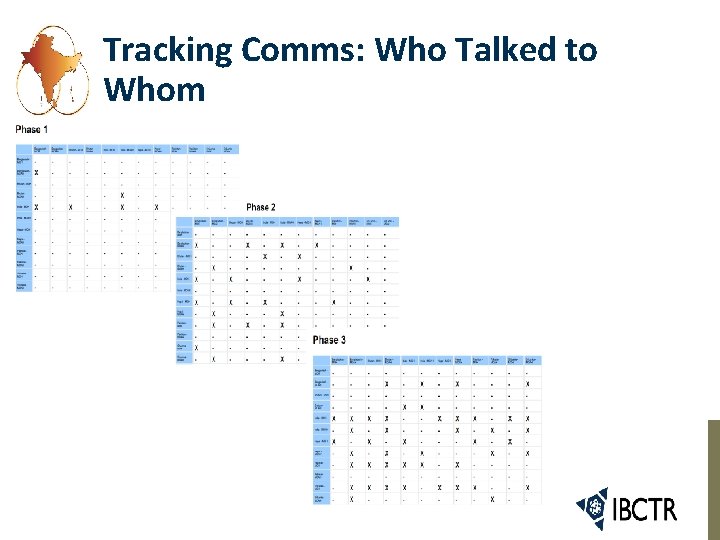
Tracking Comms: Who Talked to Whom
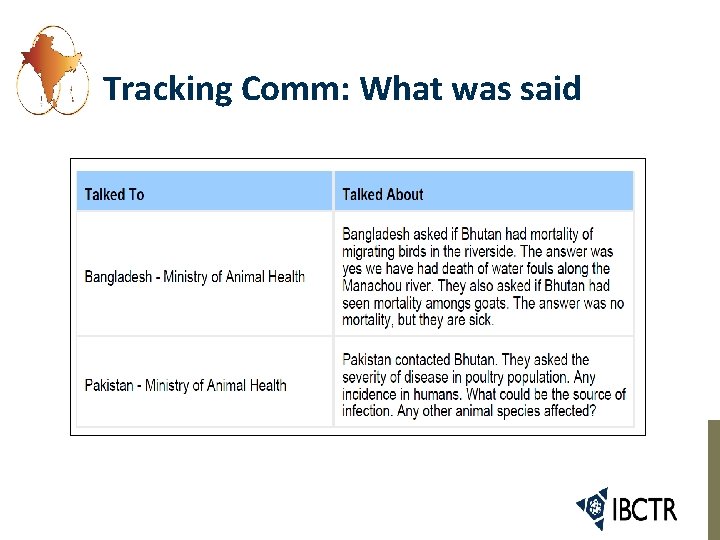
Tracking Comm: What was said
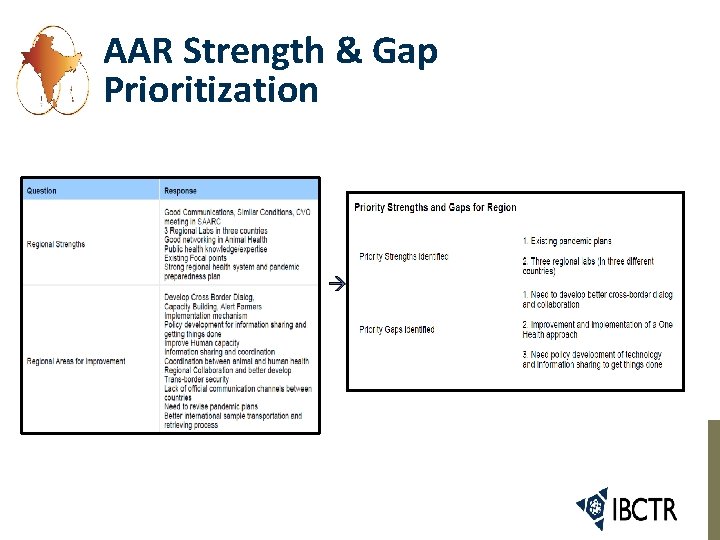
AAR Strength & Gap Prioritization
Follow-up Activities for South Asia TTX Remote Web-based TTX—Fall 2016 A follow-up “phase 5” where cases re-emerge o Scenarios written to address gaps identified in first TTX o All 12 functional roles (25 people from 6 countries) played o Communication tracked using email-based notifications Remote Web-based After Action of Real Events—Spring 2017 o Using Pro-Med, we identified true outbreaks with potential cross -border, cross-sector coordination o Questions focused on coordination during these real events
Demonstration How PREP™ can be used to o Design an exercise o Conduct an exercise o Create a multiyear strategy o Videogame
Concluding Remarks ICBTR TTX Methodology provides a unique approach for participant-led evaluation of One Health readiness Development and implementation of PREP™ has proven it to be: o Simple, easy-to-use format to conduct & design exercises and planning sessions o Effective means for real-time participant-driven data collection o Complex enough to capture systems-level coordination, multiple data streams and consolidate into concise, timely reports Next steps o Continue sustainable capacity building with Biothreat Readiness Leadership o Integrate in dynamic scenarios based on models o Any thoughts?
Questions?
- Slides: 22