
Strengthening International Science for the Benefit of Society
Strengthening International Science for the Benefit of Society Goverdhan Mehta, ICSU President
ICSU: a long history • Founded in 1931, but roots back to 1899 • A membership organization with: 103 National Members (mostly Academies) 29 International Scientific Unions • Establishes interdisciplinary bodies; sponsors programs in key areas of global concern • Limited finances but unique worldwide access to intellectual resources 10 November, 2005 World Science Forum, Budapest 2

ICSU mission ICSU mobilizes the knowledge and resources of the international science community to: • Identify and address major issues of importance to science and society • Facilitate interaction of scientists across disciplines and among nations • Promote participation of all scientists regardless of race, citizenship, language, political stance or gender • Stimulate constructive dialogue between the scientific community, governments, civil society and the private sector 10 November, 2005 World Science Forum, Budapest 3
The ICSU Vision “A world where science is used for the benefit of all, excellence in science is valued and scientific knowledge is effectively linked to policy-making. In such a world, universal and equitable access to scientific data and information is a reality and all countries have the scientific capacity to use these …. ” 10 November, 2005 World Science Forum, Budapest 4
The ICSU Vision “A world where science is used for the benefit of all, excellence in science is valued and scientific knowledge is effectively linked to policy-making. In such a world, universal and equitable access to scientific data and information is a reality and all countries have the scientific capacity to use these …. ” 10 November, 2005 World Science Forum, Budapest 5
“It’s not what the vision is, it’s what the vision does…. ” - Peter Senge ICSU Strategic Plan 2006 -2011 • Process: 6 yrs of intense evaluation, review, planning and dialogue with scientists across the world • Priority setting: Science driven prioritization of societally important issues • Product(s): A total of 13 separate expert reviews, reports and statements www. icsu. org Implementation strategy GA charge to EB & CSPR 10 November, 2005 World Science Forum, Budapest 6
Science- beyond discovery Addressing human needs and concerns Broader engagement underpins science of the future to meet new global challenges and increased societal expectations In the 21 st century, need for a more inclusive view of science 10 November, 2005 World Science Forum, Budapest 7
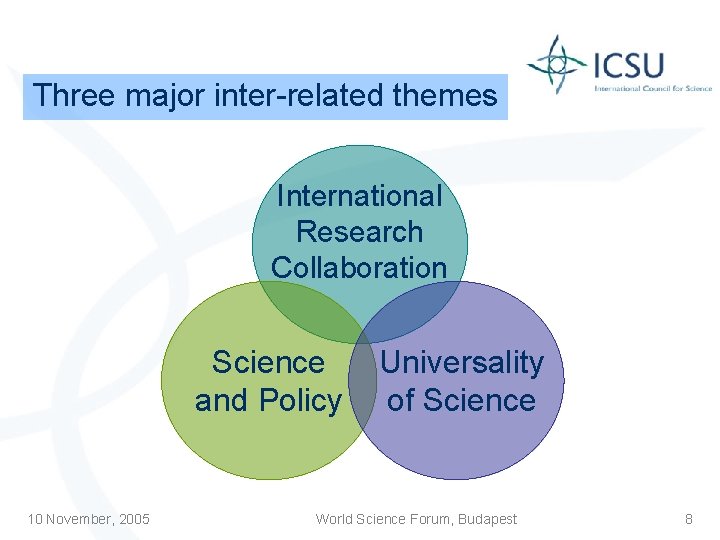
Three major inter-related themes International Research Collaboration Science and Policy 10 November, 2005 Universality of Science World Science Forum, Budapest 8
International Research Collaboration • Linking research, monitoring, and assessments with focus on global environmental change • International Polar Year 2007 -2008 • Natural and Human-Induced Environmental Hazards and Disasters • Science for Sustainable Development • Science for Human Health • Sustainable Energy 10 November, 2005 World Science Forum, Budapest 9
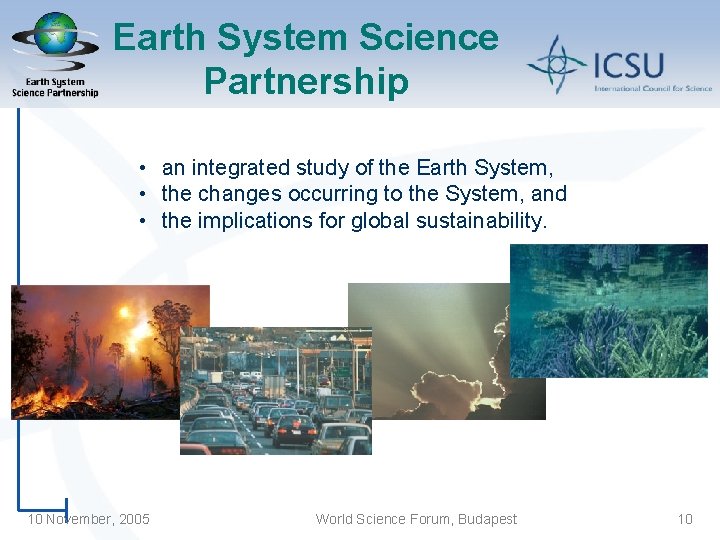
Earth System Science Partnership • an integrated study of the Earth System, • the changes occurring to the System, and • the implications for global sustainability. 10 November, 2005 World Science Forum, Budapest 10

A successful, timely, science based engagement The four global change programmes provide the framework for the science on which IPCC assessments are built. 10 November, 2005 World Science Forum, Budapest 11
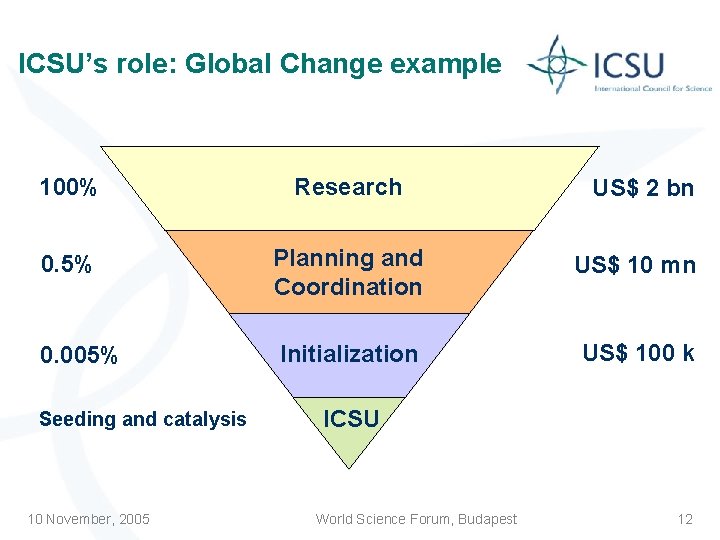
ICSU’s role: Global Change example 100% Research 0. 5% Planning and Coordination US$ 10 mn 0. 005% Initialization US$ 100 k Seeding and catalysis 10 November, 2005 US$ 2 bn ICSU World Science Forum, Budapest 12
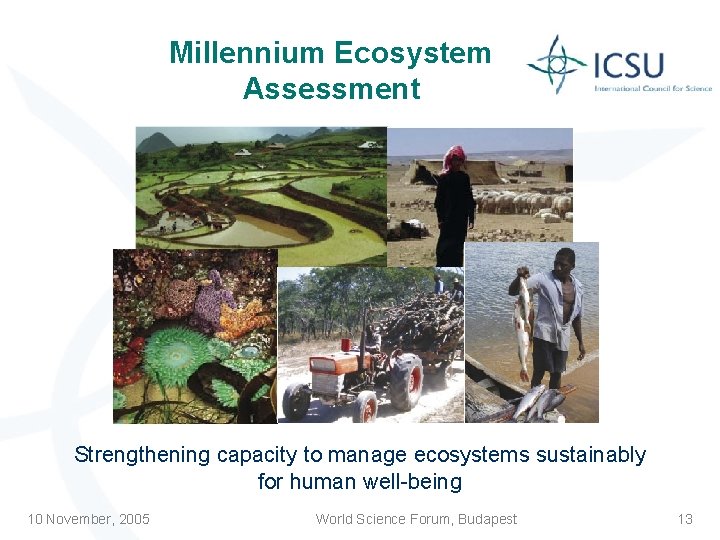
Millennium Ecosystem Assessment Strengthening capacity to manage ecosystems sustainably for human well-being 10 November, 2005 World Science Forum, Budapest 13
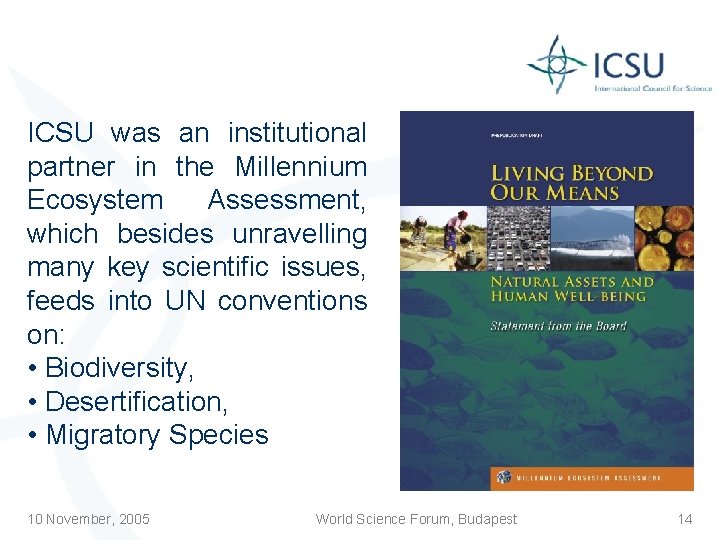
ICSU was an institutional partner in the Millennium Ecosystem Assessment, which besides unravelling many key scientific issues, feeds into UN conventions on: • Biodiversity, • Desertification, • Migratory Species 10 November, 2005 World Science Forum, Budapest 14
International Research Collaboration • Linking research, monitoring, and assessments with focus on global environmental change • International Polar Year 2007 -2008 • Natural and Human-Induced Environmental Hazards and Disasters • Science for Sustainable Development • Science for Human Health • Sustainable Energy 10 November, 2005 World Science Forum, Budapest 15
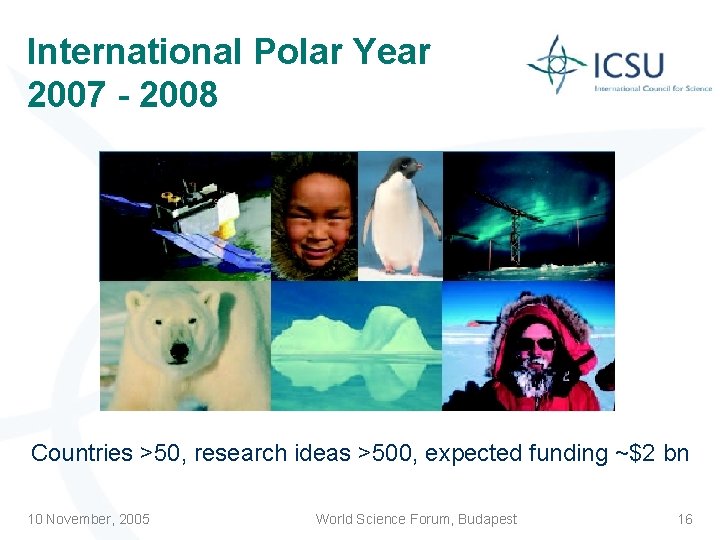
International Polar Year 2007 - 2008 Countries >50, research ideas >500, expected funding ~$2 bn 10 November, 2005 World Science Forum, Budapest 16
International Research Collaboration • Linking research, monitoring, and assessments with focus on global environmental change • International Polar Year 2007 -2008 • Natural and Human-Induced Hazards and Disasters • Science for Sustainable Development • Science for Human Health • Sustainable Energy 10 November, 2005 World Science Forum, Budapest 17
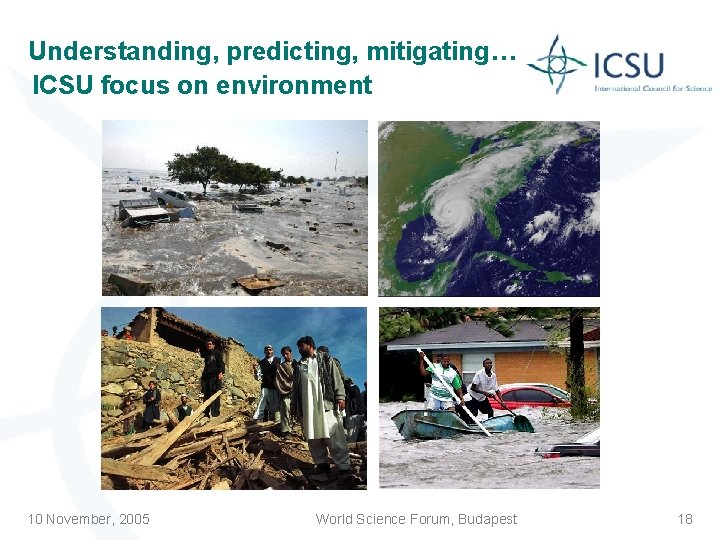
Understanding, predicting, mitigating… ICSU focus on environment 10 November, 2005 World Science Forum, Budapest 18
International Research Collaboration • Linking research, monitoring, and assessments with focus on global environmental change • International Polar Year 2007 -2008 • Natural and Human-Induced Environmental Hazards and Disasters • Science for Sustainable Development • Science for Human Health • Sustainable Energy 10 November, 2005 World Science Forum, Budapest 19
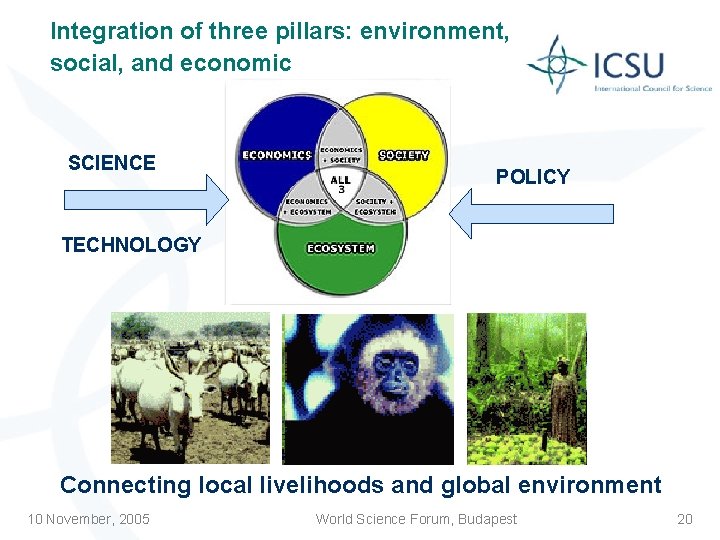
Integration of three pillars: environment, social, and economic SCIENCE POLICY TECHNOLOGY Connecting local livelihoods and global environment 10 November, 2005 World Science Forum, Budapest 20
Sustainable development 1. Departure point- “Our Common Journey” and builds upon the WSSD process 2. Making science policy relevant; participatory approaches with other stakeholders; bridging the knowledge divide, S & T capacity building for SD 3. Initiative on Science and Technology for Sustainability (ISTS)-consortium approach-TWAS, UNESCO… 10 November, 2005 World Science Forum, Budapest 21
International Research Collaboration • Linking research, monitoring, and assessments with focus on global environmental change • International Polar Year 2007 -2008 • Natural and Human-Induced Environmental Hazards and Disasters • Science for Sustainable Development • Science for Human Health and Well-being • Sustainable Energy 10 November, 2005 World Science Forum, Budapest 22
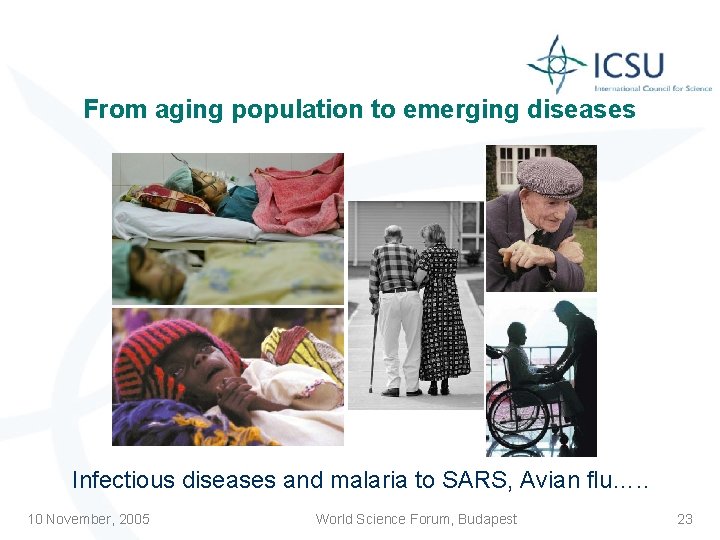
From aging population to emerging diseases Infectious diseases and malaria to SARS, Avian flu…. . 10 November, 2005 World Science Forum, Budapest 23
International Research Collaboration • Linking research, monitoring, and assessments with focus on global environmental change • International Polar Year 2007 -2008 • Natural and Human-Induced Environmental Hazards and Disasters • Science for Sustainable Development • Science for Human Health • Sustainable Energy 10 November, 2005 World Science Forum, Budapest 24
Common features • Complex scientific challenges • New knowledge and new approaches necessary • Trans-disciplinary: natural and social sciences need to work together • Many stakeholders outside of science involved • Politically (and commercially) sensitive • Raise issues of equity and openness • Critical links between local and global challenges and solutions 10 November, 2005 World Science Forum, Budapest 25
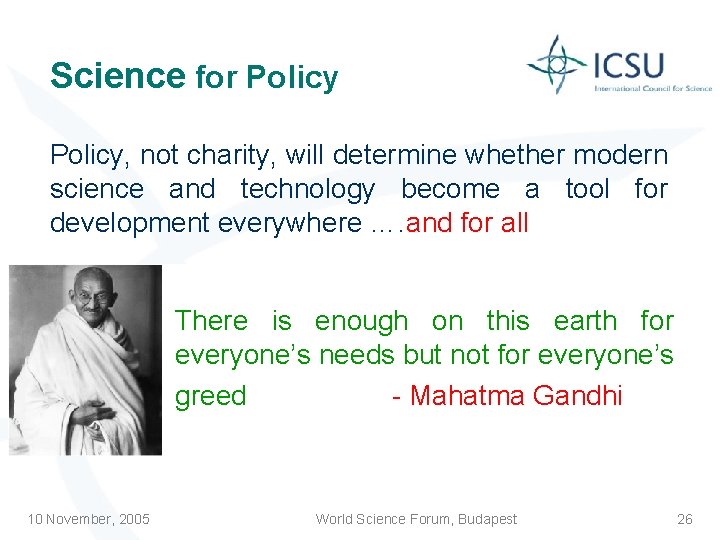
Science for Policy, not charity, will determine whether modern science and technology become a tool for development everywhere …. and for all There is enough on this earth for everyone’s needs but not for everyone’s greed - Mahatma Gandhi 10 November, 2005 World Science Forum, Budapest 26
“There is hardly any social problem on which science cannot make some contribution” -D. K. Price, Scientific Estate Science for policy and Policy for Science is never sufficient to solve a problem completely; it is, however, always necessary. 10 November, 2005 World Science Forum, Budapest 27
Promoting Science for Policy • Ensure that international research programmes address key policy issues • Participate in major international assessments • Produce authoritative statements • Speak as the voice of international science in policy fora 10 November, 2005 World Science Forum, Budapest 28
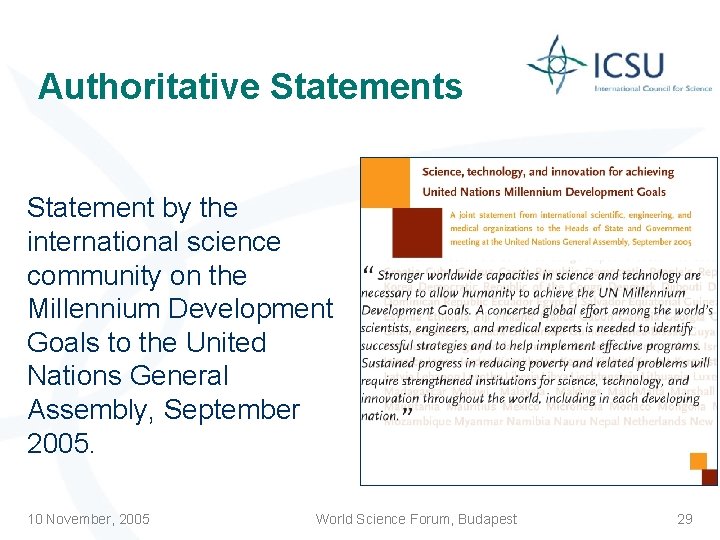
Authoritative Statements Statement by the international science community on the Millennium Development Goals to the United Nations General Assembly, September 2005. 10 November, 2005 World Science Forum, Budapest 29
Universality of Science • The Principle of Universality of Science – Freedom and Responsibility in science • Reaching out to all countries: – Access to Data and Information – Regional Offices – Capacity Building 10 November, 2005 World Science Forum, Budapest 30
The Principle of Universality of Science ICSU Statute 5: • Founding principle of ICSU • Stipulates non-discrimination and equity in the conduct of science • Shared responsibility for all scientists in promoting and upholding the principle • Freedoms also imply responsibilities 10 November, 2005 World Science Forum, Budapest 31
Equitable Access to Scientific Information • Policies: – Full and open access to scientific data – Universal and equitable access to scientific publications • Mechanisms, eg International Network for the Availability of Scientific Publications (INASP) • Coordination and partnerships– develop a multistakeholder Scientific Data and Information Forum (Sci. Di. F) 10 November, 2005 World Science Forum, Budapest 32
ICSU Regional Offices • ICSU Regional Office for Africa inaugurated in September this year • Further Offices to follow soon in the Arab Region, Asia/Pacific and Latin America/Caribbean Aim: To ensure that the voice of developing countries influences the international agenda setting and that scientists from the South are fully involved in the research 10 November, 2005 World Science Forum, Budapest 33
S & T Capacity Building The widening gap in …… human resource capacity & S & T infrastructure are the most critical in the new knowledge based competitive world………and many of the asymmetries are directly related to it Distribution of S & T capacities is even more lopsided than that of economic power 10 November, 2005 World Science Forum, Budapest 34
A basic paradigm……… World is asymmetric, not only in socio-economic arena but more so in S & T capacities 10 November, 2005 World Science Forum, Budapest 35
Strategic Partners • The UN System, including: – UNESCO – UNEP and its Science Initiative – Commission for Sustainable Development (CSD) CSD – WMO, Climate Change, IPY, Natural Hazards • The Academy of Sciences for the Developing World (TWAS) TWAS • The technological community (WFEO, CAETS) CAETS 10 November, 2005 World Science Forum, Budapest 36
Partnerships: A necessity -neither a luxury nor a political compulsion- for facing the global S & T challenges of the 21 st century Sustainable energy - new sources Climate change - global warming Health - emerging diseases- AIDS, SARS, obesity Natural hazards -tsunamis, earthquakes, hurricanes Environment - biodiversity conservation, extinctions Knowledge divide – ICT penetration Population stabilization – 9 bn by 2025! Sustainable development – a new way of life 10 November, 2005 World Science Forum, Budapest 37
In Conclusion • Strengthening science for the benefit of society • Promote the use of cutting edge science to address global challenges, stimulate innovation and for informed decision making • Towards a fine balance between freedom and responsibility in the pursuit of Science • Explore new mechanisms to share scientific knowledge and its understanding with stakeholders in society 10 November, 2005 World Science Forum, Budapest 38
- Slides: 38