
Strength Training By Kevin Williams Factors Influencing Strength
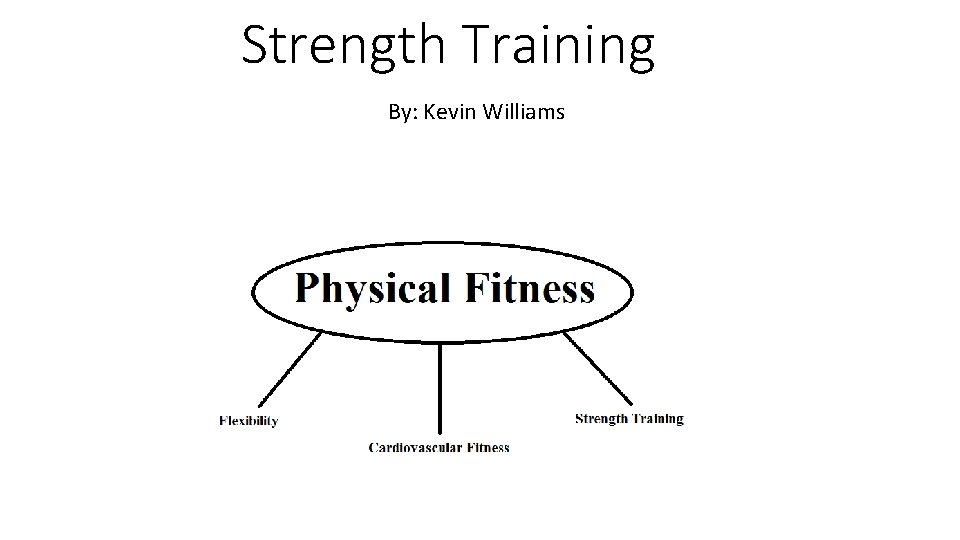
Strength Training By: Kevin Williams
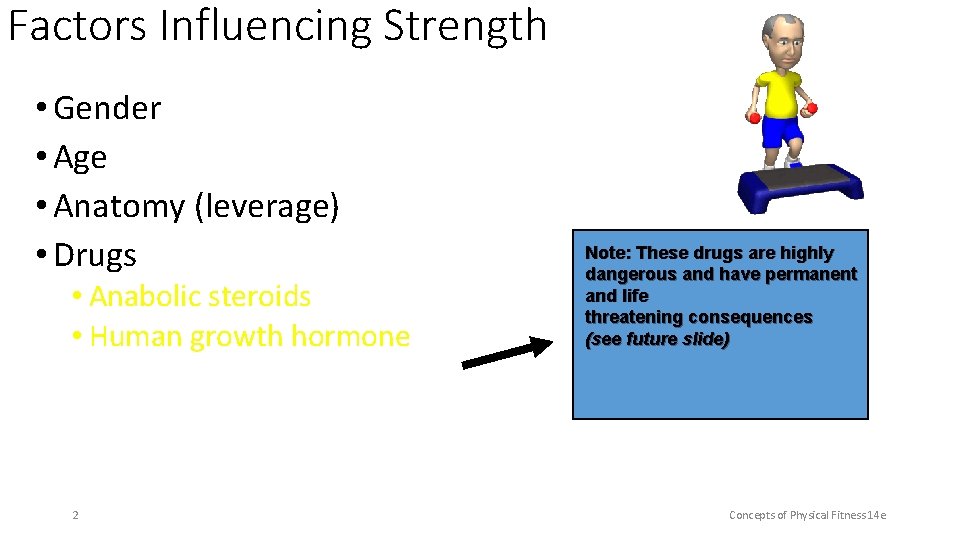
Factors Influencing Strength • Gender • Age • Anatomy (leverage) • Drugs • Anabolic steroids • Human growth hormone 2 Note: These drugs are highly dangerous and have permanent and life threatening consequences (see future slide) Concepts of Physical Fitness 14 e
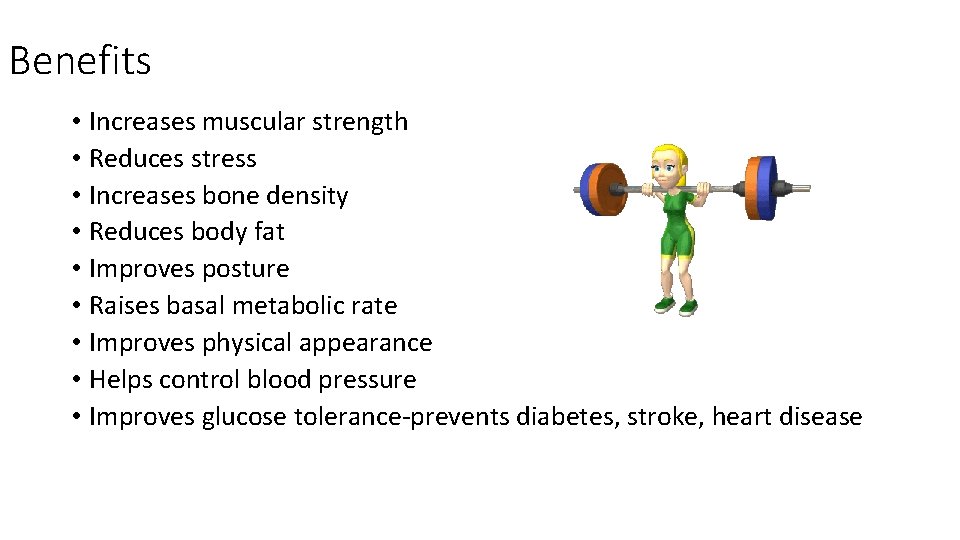
Benefits • Increases muscular strength • Reduces stress • Increases bone density • Reduces body fat • Improves posture • Raises basal metabolic rate • Improves physical appearance • Helps control blood pressure • Improves glucose tolerance-prevents diabetes, stroke, heart disease
• Flexion- flex or decrease the angle of the joint • Extension- extend or increase the angle of a joint • Reps- number of times action is completed without stopping • Set- group of reps completed -example: bicep curl -3 sets of 10 reps • Spotter-always lift with a partner for safety and to prevent injury • Rest-20 -30 seconds of rest between each exercise-switch with partner
Muscular Endurance *light weight-more reps • The ability of a muscle group to continue muscle movement over a length of time. To improve your muscular endurance, try activities that you use your muscles continuously such as walking, jogging, bicycling, or dancing. Also, exercises such as curlups, squat jumps and mountain climbers help too!
Muscular Strength/Power *Heavy weight-less reps • Strength- is the ability of the muscle to exert force during an activity. To improve your Strength, try performing body weight exercises such as push ups, sit ups and pull-ups or use resistance such as weights or bands as you lift the weight for a set number of repetitions. Also, activities such as wrestling and gymnastics helps your muscular strength too! • Power- the ability to perform a task quickly and forcefully; strength x speed To improve your Power, try a variety of “explosive” activities such as plyometrics, track and field and dance. Also, activities such as football, gymnastics and tennis helps your Power level too!
Goals • Build muscle-6 -8 reps with heavier weight (legs lower reps 46) • Tone or maintain level of fitness-10 -12 reps with lighter weight
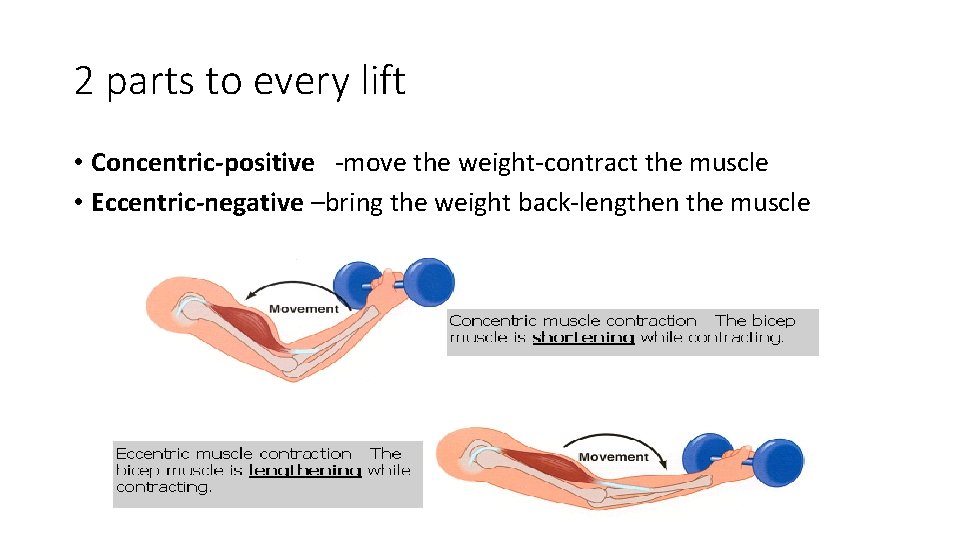
2 parts to every lift • Concentric-positive -move the weight-contract the muscle • Eccentric-negative –bring the weight back-lengthen the muscle

• Single joint exercise-one joint involved in exercise-Biceps curls, leg extensions • Compound movement-two joints involved in the exercise-squats, deadlifts, barbell rows, barbell and dumbbell presses, and pull-ups.

• Overload Principle-more exercise than before at a higher intensity -increase FITT/mix it up-change type of exercise • Strength Training Progressive Overload-increase weight, increase number of reps, increase number of sets, increase number of days for training, decrease the amount of rest between sets. (should be done individually not altogether- progressive)

• Muscular Strength and Endurance FITT Principle
Diminishing Return-use it or lose it Types of workouts • Circuit Training- many different exercises done with little rest in between • Interval Training –high intensity exercise to raise heart rate, followed by rest to lower heart rate ( sprint: rest: sprint or sprint: push-ups: sprint) Strength and Metabolism • Strength training increases muscle mass • Muscle is metabolically active • Each additional pound of muscle tissue may increase resting metabolism by up to 35 calories per day
Volume-overall work done (weight x reps) Tempo-how fast weight is moved Rule of 500 • 3, 500 calories to burn 1 lb of fat To lose: reduce 500 calories per day/3, 500 calories per week-lose 1 lb of fat To gain: add 200 -250 calories of fresh fruits and vegetables and lean proteins to your diet and drink plenty of water
Before/After Workout nutrition: • Carbs are necessary before and after a workout. Protein is needed after a workout to build tissue. Before, carbs provide energy to sustain the workout. Eat a high carb meal at least 2 hours before a workout. After the workout, eat both proteins and carbs. Carbs raise the insulin level and in turn stimulate new muscle growth and repair and protein builds tissue. Drink plenty of water. Chocolate milk and some sports drinks lower in sugar • are also a great way to stay hydrated. Stay away from soda. Examples of snacks: • Fruits -apples, oranges, bananas, berries • Vegetables-carrot sticks, cucumber slices, pepper slices • Proteins-protein bar, almonds, chicken, cereal bar (granola)
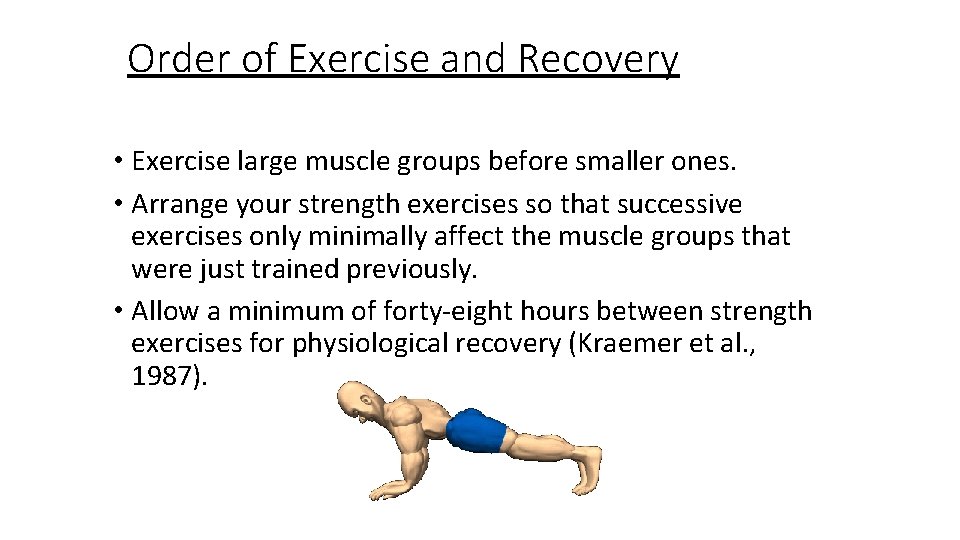
Order of Exercise and Recovery • Exercise large muscle groups before smaller ones. • Arrange your strength exercises so that successive exercises only minimally affect the muscle groups that were just trained previously. • Allow a minimum of forty-eight hours between strength exercises for physiological recovery (Kraemer et al. , 1987).

12 Major Muscle Groups • • • Biceps-upper arm below shoulder Triceps-back of biceps Deltoids- shoulder muscle Trapezius-upper back, behind shoulder Pectorals- upper chest muscles: think push ups Abdominals-stomach muscles Obliques -sides Latissimus dorsi lower back Gluteus Maximus-think squats Hamstrings- back of thigh Quadriceps- thigh Gastrocnemius- calf muscle
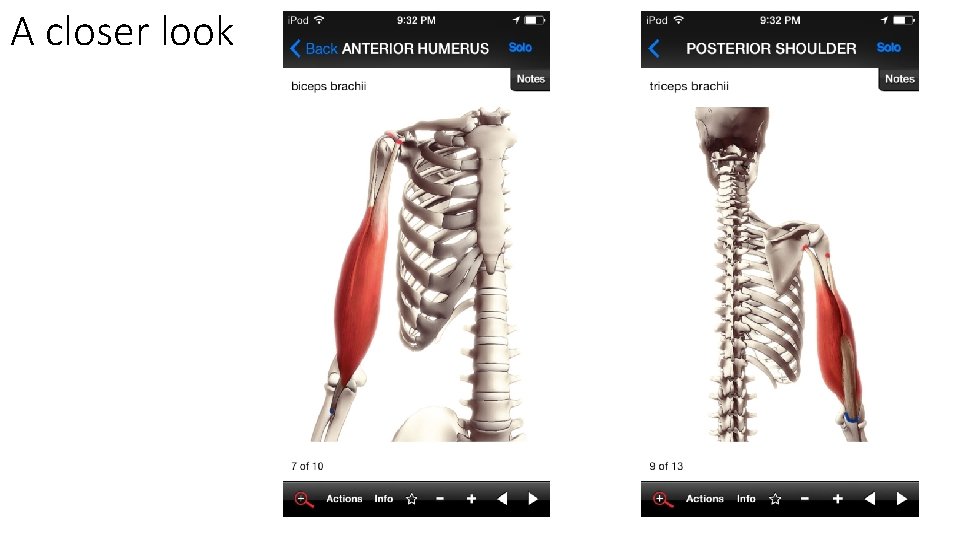
A closer look
Do’s and Don’ts DOs Do use spotters when you try the major lifts. Do keep your back straight when lifting. Do use proper lifting technique when moving weights around the room. Do wear shoes with good traction. Do make sure the equipment you use is in good condition. DON'Ts Don't hyperventilate (breathe in and out fast) or hold your breath when you lift heavy weights. You may faint and lose control of the weights. Breathe out when you lift. Don't continue lifting if you feel pain. Stop the painful exercise for a few days, or try it with less weight. Don't exercise any set of muscles more than 3 times a week. Don't "cheat" on your technique to lift heavier weights Don't lift heavy weights without spotters. Don't lift more than you know you can lift safely.
Free weights • When you lift a free weight, you are doing much more than just lifting the weight. You are also stabilizing the weight, or keeping it from moving in any other direction. • Versatile – Free weights can be used for a variety of exercises for the entire body • Functional movement – With free weights, you're able to move the body through the normal range of motion as well as through a variety of planes • Strength gains – Because you're supporting your own body, you can work on specific muscles while involving smaller stabilizer muscles
Machines • Supportive – Most machines provide support, which is great for people who need help when learning new exercises. • Easy to use – Because most machines work on a fixed path and have instructions and diagrams posted, it's easier to use good form. • Timely – It usually doesn't take as much time to change weights on machines as it would for many free weight exercises. • Less intimidating – Trying to figure out what to do with a bunch of dumbbells can seem impossible.
Building Strength Question What are some myths about strength training?
Building Strength Answer • Myth: Weight training can make females look too bulky and unattractive. • Fact: The majority of females will look better because of more muscle and less body fat. • It is more difficult for females to look bulky or musclebound, as females have less testosterone (a male hormone responsible for increases in muscle size) than males.
Building Strength Answer (continued) • Myth: Strength training makes you muscle- bound. • Fact: Proper training, including flexibility exercises, improves functioning.
Building Strength Answer (continued) • Myth: Protein drinks and high-protein foods are essential to gain strength. • Fact: A well-balanced diet that includes high-protein foods should be sufficient to help you achieve gains in strength.
Building Strength Answer (continued) • Myth: Muscle will turn to fat if you stop strength training. • Fact: Muscle will not turn to fat. If strength training is stopped, the size of your muscles will decrease, your strength will decrease, and you are at higher risk of health problems later on in life.
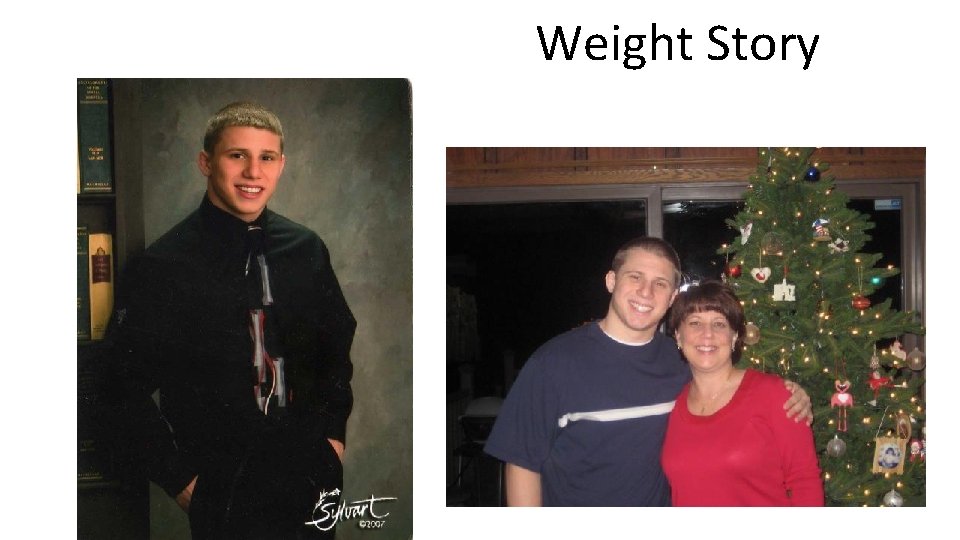
Weight Story
- Slides: 26