
STRENGTH TRAINING 101 Based on the American College
STRENGTH TRAINING 101 Based on the American College of Sports Medicine Position Stand The Art and Science of Picking Things Up and Putting Them Down-MAJ V. Mc. Nulty, USACHPPM
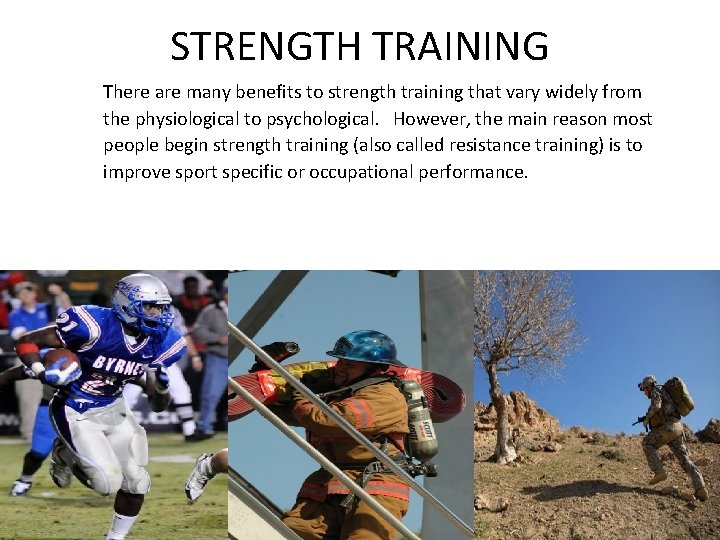
STRENGTH TRAINING There are many benefits to strength training that vary widely from the physiological to psychological. However, the main reason most people begin strength training (also called resistance training) is to improve sport specific or occupational performance.
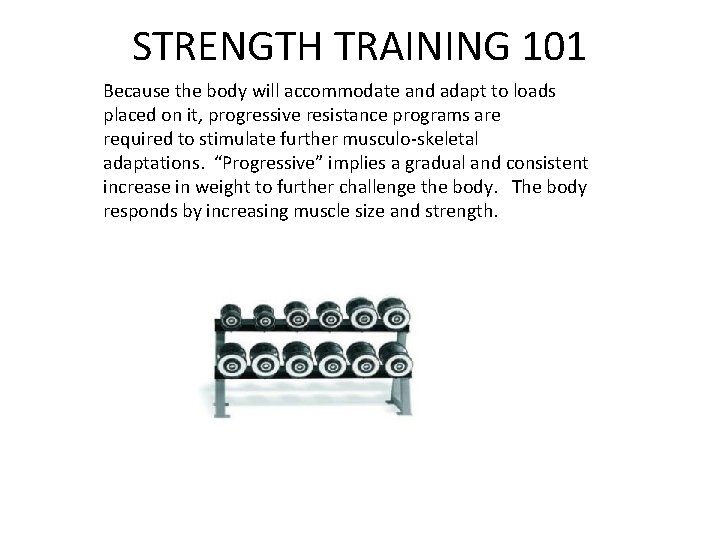
STRENGTH TRAINING 101 Because the body will accommodate and adapt to loads placed on it, progressive resistance programs are required to stimulate further musculo-skeletal adaptations. “Progressive” implies a gradual and consistent increase in weight to further challenge the body. The body responds by increasing muscle size and strength.
STRENGTH TRAINING 101 What is Progressive Resistance? Progressive resistance is a systematic and gradual increase of weight (also referred to as “intensity”) as the body begins to adapt to the loads placed upon it. A good rule of thumb is to increase weight 2 -10% when you can lift 1 -2 reps over the desired number. This concept is not new, in fact, it is actually thousands of years old. The greek fable “Milo and the Bull” celebrates a storied athlete whose great strength was attributed to receiving a bull calf as a youngster that he would hoist on his back daily to check its weight. As the bull calf grew, so did Milo’s strength.
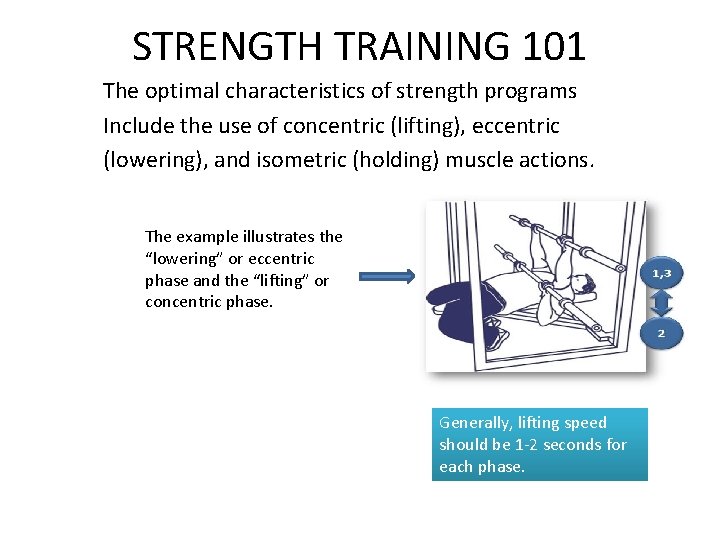
STRENGTH TRAINING 101 The optimal characteristics of strength programs Include the use of concentric (lifting), eccentric (lowering), and isometric (holding) muscle actions. The example illustrates the “lowering” or eccentric phase and the “lifting” or concentric phase. Generally, lifting speed should be 1 -2 seconds for each phase.
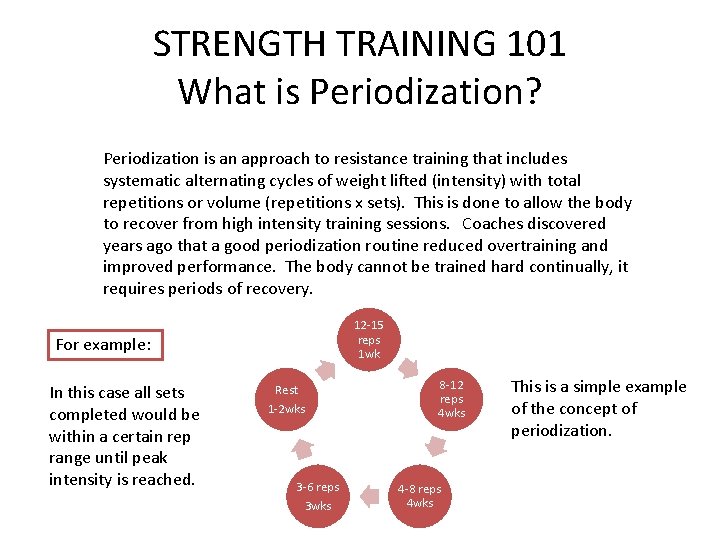
STRENGTH TRAINING 101 What is Periodization? Periodization is an approach to resistance training that includes systematic alternating cycles of weight lifted (intensity) with total repetitions or volume (repetitions x sets). This is done to allow the body to recover from high intensity training sessions. Coaches discovered years ago that a good periodization routine reduced overtraining and improved performance. The body cannot be trained hard continually, it requires periods of recovery. 12 -15 reps 1 wk For example: In this case all sets completed would be within a certain rep range until peak intensity is reached. Rest 1 -2 wks 3 -6 reps 3 wks 8 -12 reps 4 wks 4 -8 reps 4 wks This is a simple example of the concept of periodization.
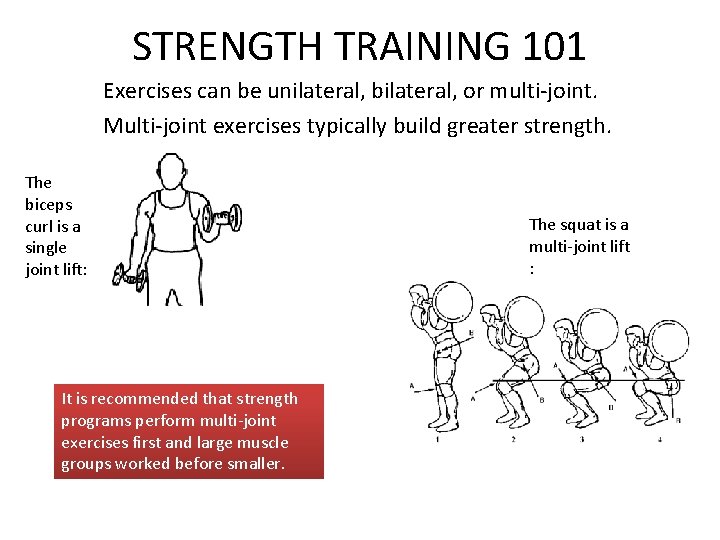
STRENGTH TRAINING 101 Exercises can be unilateral, bilateral, or multi-joint. Multi-joint exercises typically build greater strength. The biceps curl is a single joint lift: It is recommended that strength programs perform multi-joint exercises first and large muscle groups worked before smaller. The squat is a multi-joint lift :
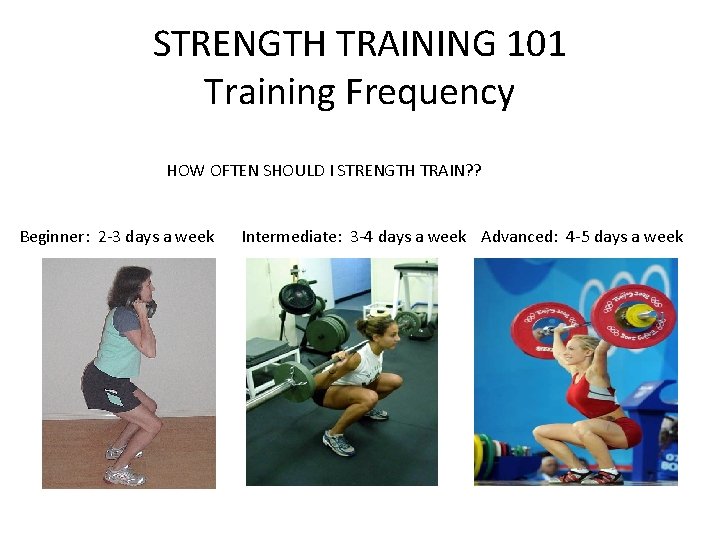
STRENGTH TRAINING 101 Training Frequency HOW OFTEN SHOULD I STRENGTH TRAIN? ? Beginner: 2 -3 days a week Intermediate: 3 -4 days a week Advanced: 4 -5 days a week
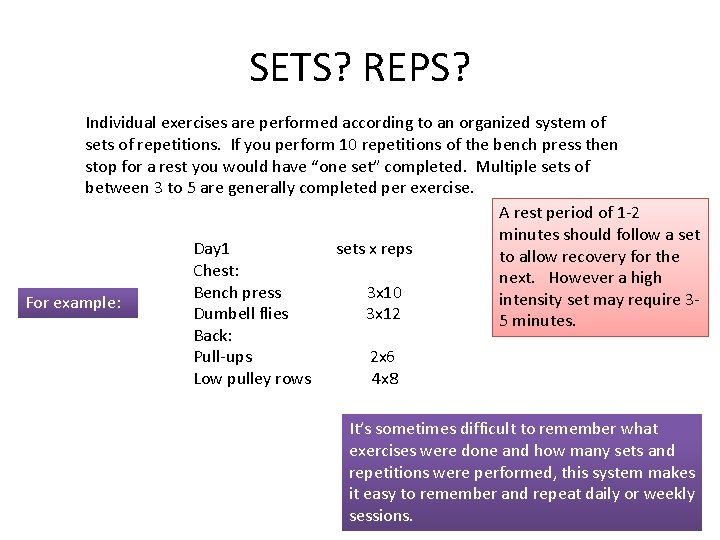
SETS? REPS? Individual exercises are performed according to an organized system of sets of repetitions. If you perform 10 repetitions of the bench press then stop for a rest you would have “one set” completed. Multiple sets of between 3 to 5 are generally completed per exercise. A rest period of 1 -2 minutes should follow a set Day 1 sets x reps to allow recovery for the Chest: next. However a high Bench press 3 x 10 intensity set may require 3 For example: Dumbell flies 3 x 12 5 minutes. Back: Pull-ups 2 x 6 Low pulley rows 4 x 8 It’s sometimes difficult to remember what exercises were done and how many sets and repetitions were performed, this system makes it easy to remember and repeat daily or weekly sessions.
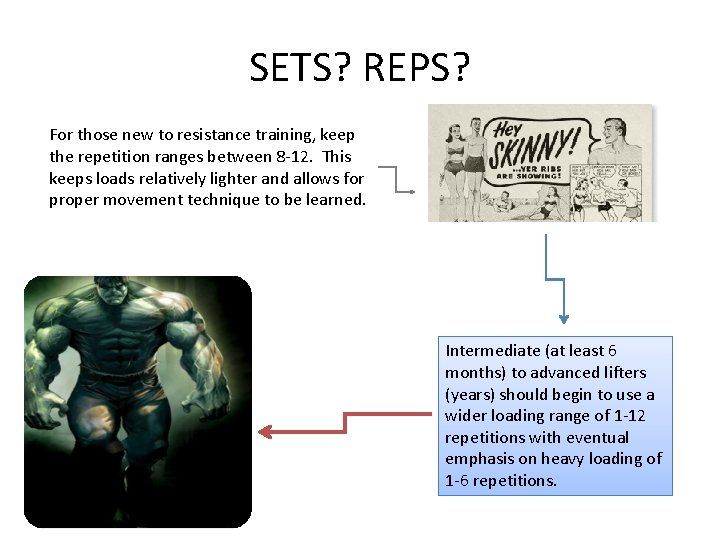
SETS? REPS? For those new to resistance training, keep the repetition ranges between 8 -12. This keeps loads relatively lighter and allows for proper movement technique to be learned. Intermediate (at least 6 months) to advanced lifters (years) should begin to use a wider loading range of 1 -12 repetitions with eventual emphasis on heavy loading of 1 -6 repetitions.
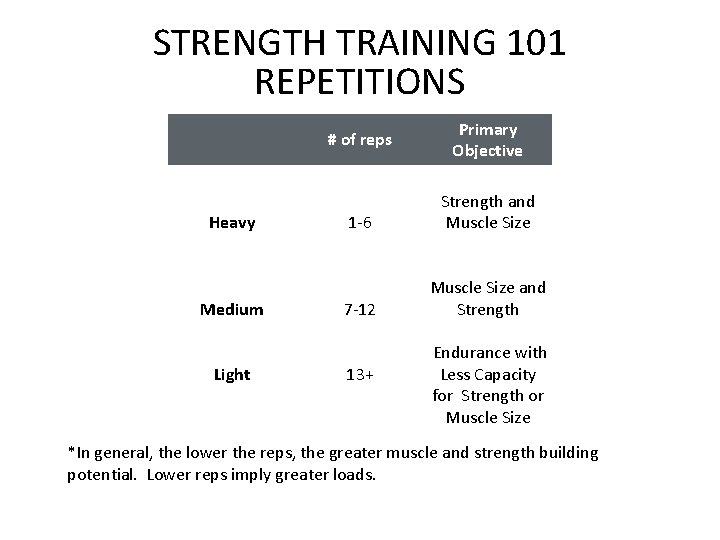
STRENGTH TRAINING 101 REPETITIONS # of reps Heavy Medium Light Primary Objective 1 -6 Strength and Muscle Size 7 -12 Muscle Size and Strength 13+ Endurance with Less Capacity for Strength or Muscle Size *In general, the lower the reps, the greater muscle and strength building potential. Lower reps imply greater loads.
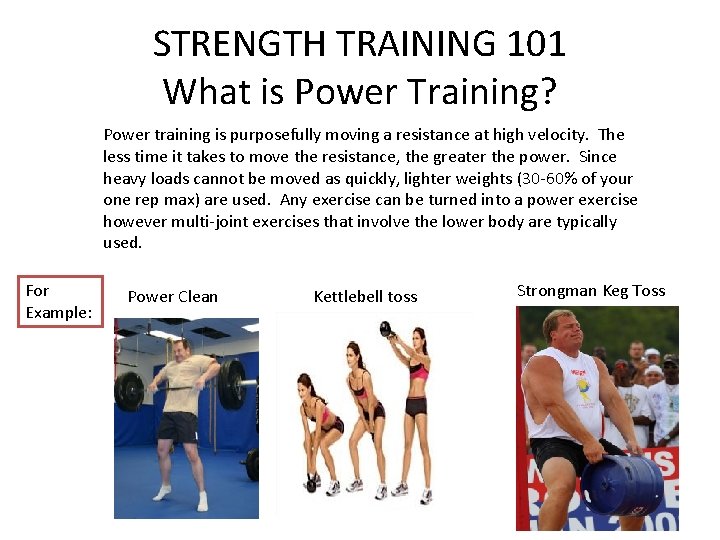
STRENGTH TRAINING 101 What is Power Training? Power training is purposefully moving a resistance at high velocity. The less time it takes to move the resistance, the greater the power. Since heavy loads cannot be moved as quickly, lighter weights (30 -60% of your one rep max) are used. Any exercise can be turned into a power exercise however multi-joint exercises that involve the lower body are typically used. For Example: Power Clean Kettlebell toss Strongman Keg Toss
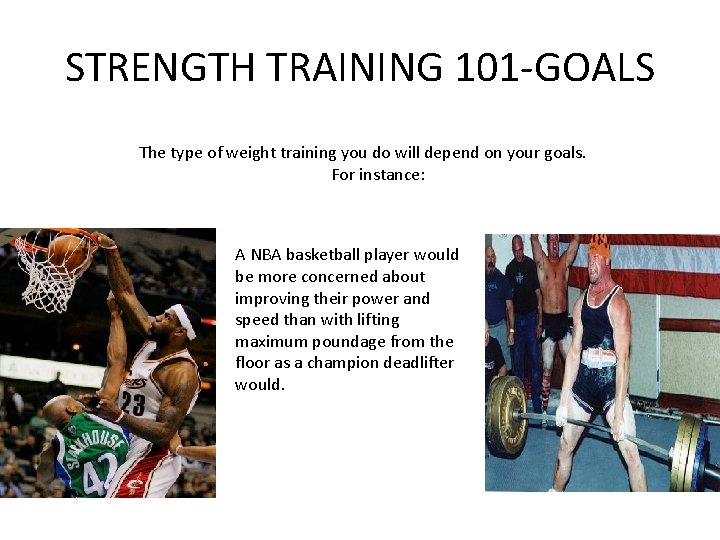
STRENGTH TRAINING 101 -GOALS The type of weight training you do will depend on your goals. For instance: A NBA basketball player would be more concerned about improving their power and speed than with lifting maximum poundage from the floor as a champion deadlifter would.
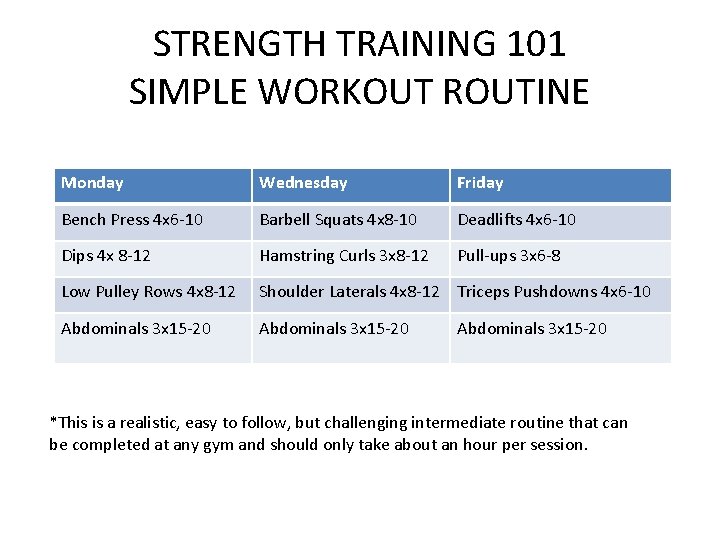
STRENGTH TRAINING 101 SIMPLE WORKOUT ROUTINE Monday Wednesday Friday Bench Press 4 x 6 -10 Barbell Squats 4 x 8 -10 Deadlifts 4 x 6 -10 Dips 4 x 8 -12 Hamstring Curls 3 x 8 -12 Pull-ups 3 x 6 -8 Low Pulley Rows 4 x 8 -12 Shoulder Laterals 4 x 8 -12 Triceps Pushdowns 4 x 6 -10 Abdominals 3 x 15 -20 *This is a realistic, easy to follow, but challenging intermediate routine that can be completed at any gym and should only take about an hour per session.
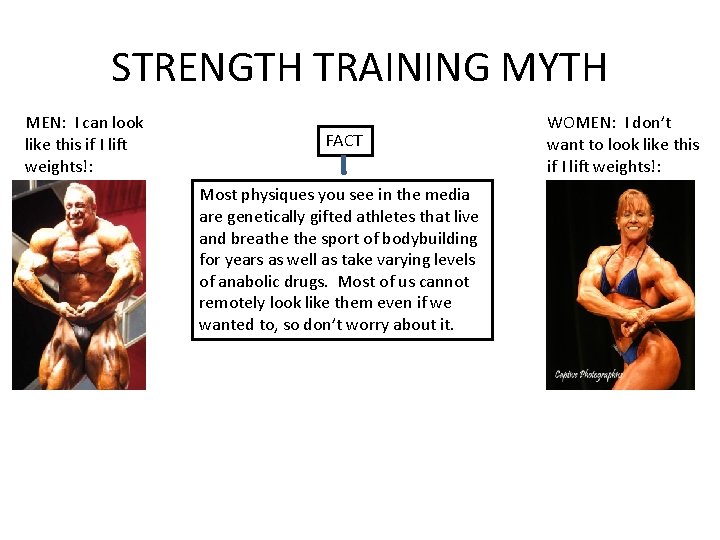
STRENGTH TRAINING MYTH MEN: I can look like this if I lift weights!: FACT Most physiques you see in the media are genetically gifted athletes that live and breathe sport of bodybuilding for years as well as take varying levels of anabolic drugs. Most of us cannot remotely look like them even if we wanted to, so don’t worry about it. WOMEN: I don’t want to look like this if I lift weights!:
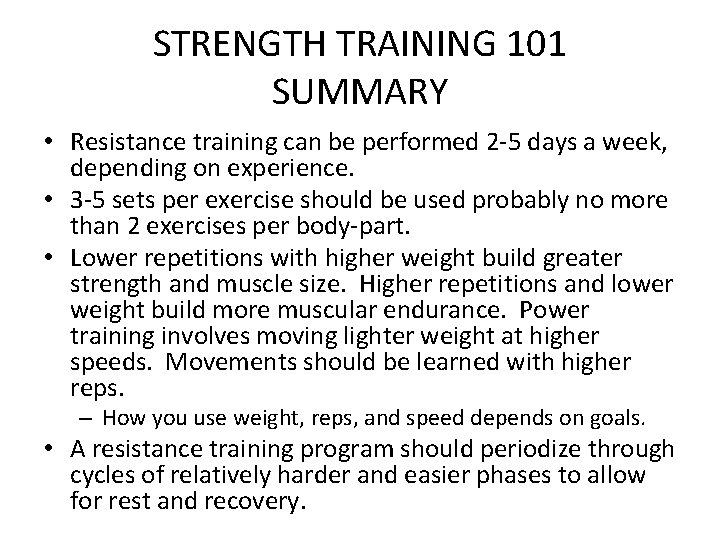
STRENGTH TRAINING 101 SUMMARY • Resistance training can be performed 2 -5 days a week, depending on experience. • 3 -5 sets per exercise should be used probably no more than 2 exercises per body-part. • Lower repetitions with higher weight build greater strength and muscle size. Higher repetitions and lower weight build more muscular endurance. Power training involves moving lighter weight at higher speeds. Movements should be learned with higher reps. – How you use weight, reps, and speed depends on goals. • A resistance training program should periodize through cycles of relatively harder and easier phases to allow for rest and recovery.
STRENGTH TRAINNING 101 USEFUL AND FREE RESOURCES www. tmuscle. com Commercial site with great resources for bodybuilding and strength athletes. Not for government computer viewing. http: //www. nsca. com National Strength and Conditioning Association http: //www. acsm. org American College of Sports Medicine
- Slides: 17