
Strength of Materials LTP 3 0 3 April
- Slides: 34
Strength of Materials L-T-P: 3 -0 -3 April 2020 Module 03: Deflection of Beams Lecture: 05 to 10 Course co-ordinator: Dr. M A Mokhtar 9999914381 drasjadmokhtar@gmail. com
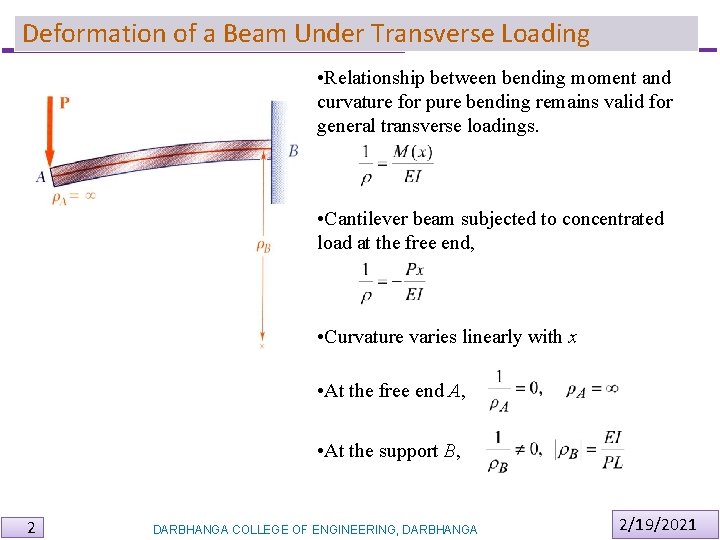
Deformation of a Beam Under Transverse Loading • Relationship between bending moment and curvature for pure bending remains valid for general transverse loadings. • Cantilever beam subjected to concentrated load at the free end, • Curvature varies linearly with x • At the free end A, • At the support B, 2 DARBHANGA COLLEGE OF ENGINEERING, DARBHANGA 2/19/2021
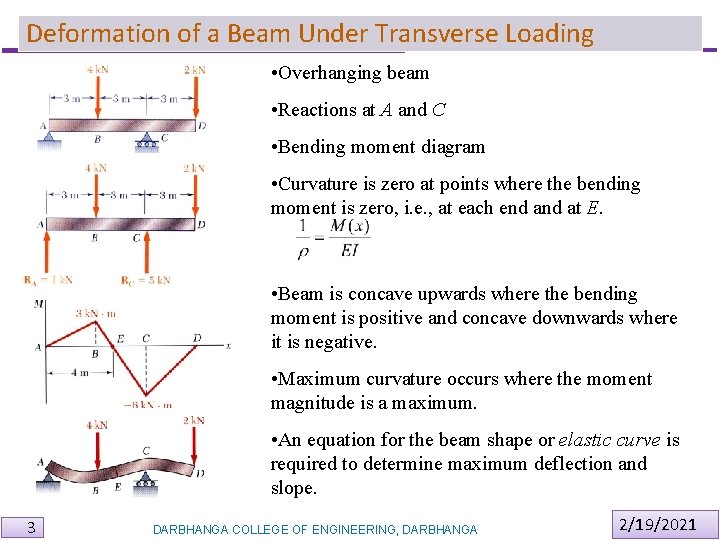
Deformation of a Beam Under Transverse Loading • Overhanging beam • Reactions at A and C • Bending moment diagram • Curvature is zero at points where the bending moment is zero, i. e. , at each end at E. • Beam is concave upwards where the bending moment is positive and concave downwards where it is negative. • Maximum curvature occurs where the moment magnitude is a maximum. • An equation for the beam shape or elastic curve is required to determine maximum deflection and slope. 3 DARBHANGA COLLEGE OF ENGINEERING, DARBHANGA 2/19/2021
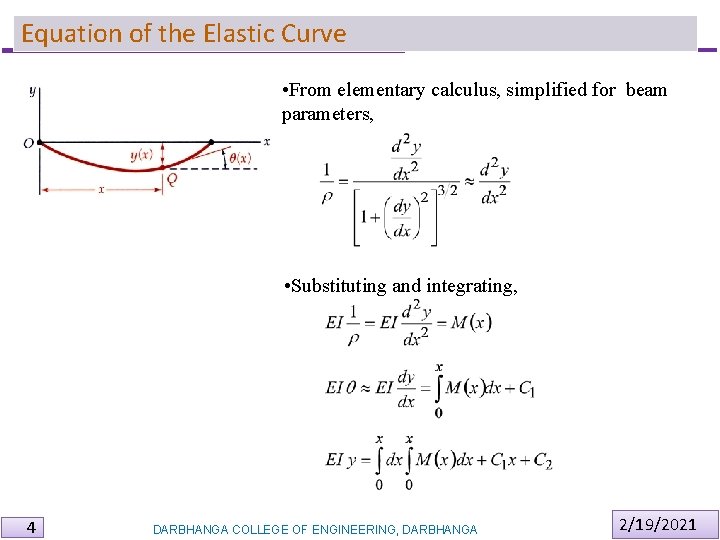
Equation of the Elastic Curve • From elementary calculus, simplified for beam parameters, • Substituting and integrating, 4 DARBHANGA COLLEGE OF ENGINEERING, DARBHANGA 2/19/2021
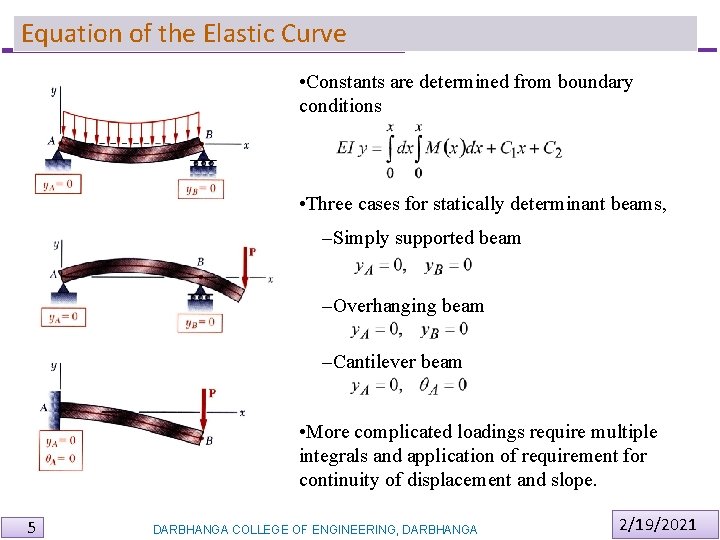
Equation of the Elastic Curve • Constants are determined from boundary conditions • Three cases for statically determinant beams, –Simply supported beam –Overhanging beam –Cantilever beam • More complicated loadings require multiple integrals and application of requirement for continuity of displacement and slope. 5 DARBHANGA COLLEGE OF ENGINEERING, DARBHANGA 2/19/2021
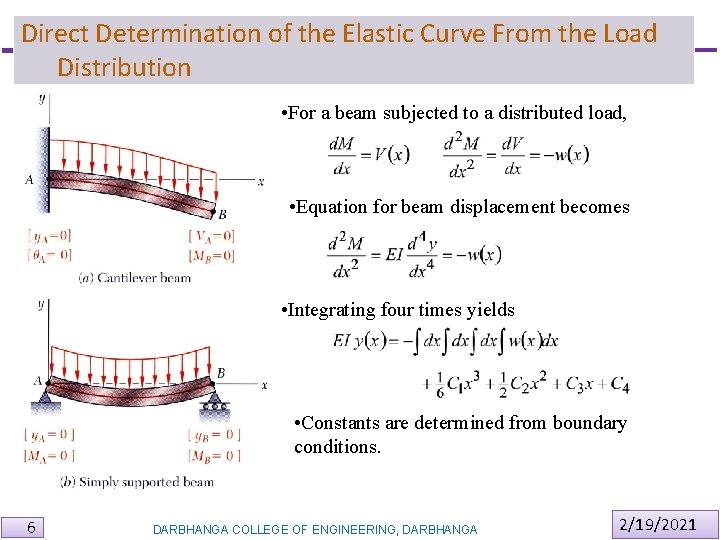
Direct Determination of the Elastic Curve From the Load Distribution • For a beam subjected to a distributed load, • Equation for beam displacement becomes • Integrating four times yields • Constants are determined from boundary conditions. 6 DARBHANGA COLLEGE OF ENGINEERING, DARBHANGA 2/19/2021
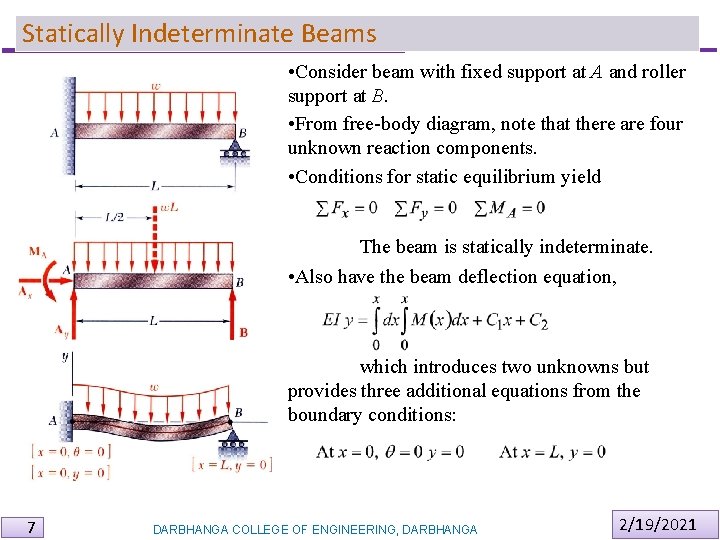
Statically Indeterminate Beams • Consider beam with fixed support at A and roller support at B. • From free-body diagram, note that there are four unknown reaction components. • Conditions for static equilibrium yield The beam is statically indeterminate. • Also have the beam deflection equation, which introduces two unknowns but provides three additional equations from the boundary conditions: 7 DARBHANGA COLLEGE OF ENGINEERING, DARBHANGA 2/19/2021
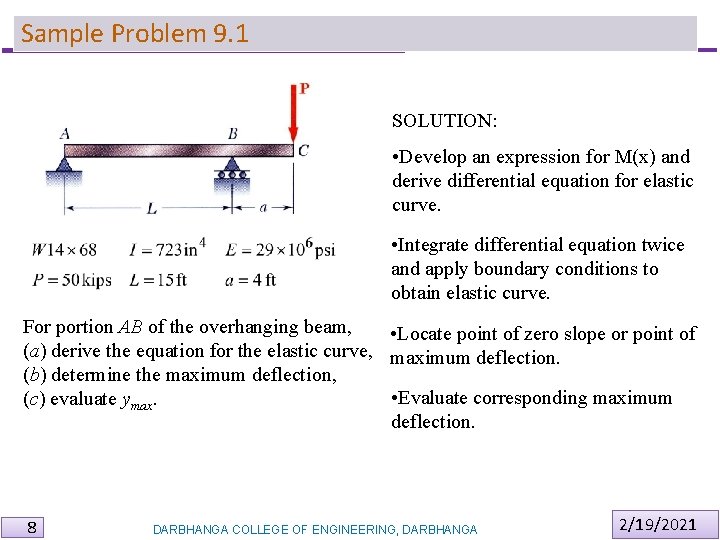
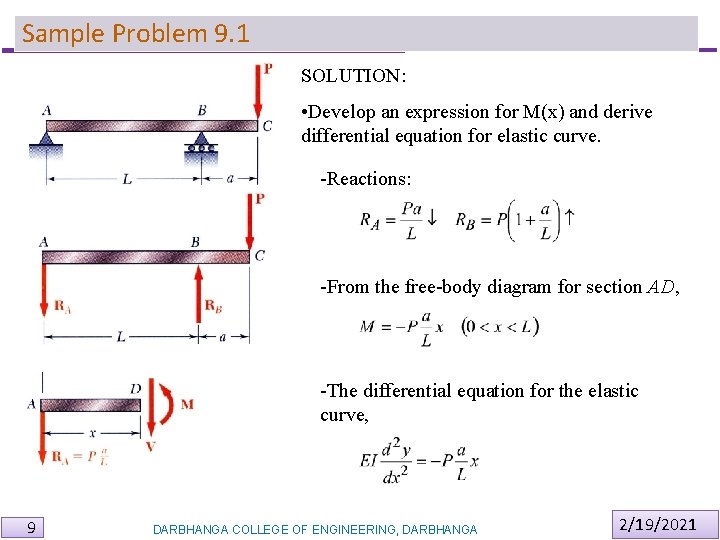
Sample Problem 9. 1 SOLUTION: • Develop an expression for M(x) and derive differential equation for elastic curve. • Integrate differential equation twice and apply boundary conditions to obtain elastic curve. For portion AB of the overhanging beam, • Locate point of zero slope or point of (a) derive the equation for the elastic curve, maximum deflection. (b) determine the maximum deflection, • Evaluate corresponding maximum (c) evaluate ymax. deflection. 8 DARBHANGA COLLEGE OF ENGINEERING, DARBHANGA 2/19/2021
Sample Problem 9. 1 SOLUTION: • Develop an expression for M(x) and derive differential equation for elastic curve. -Reactions: -From the free-body diagram for section AD, -The differential equation for the elastic curve, 9 DARBHANGA COLLEGE OF ENGINEERING, DARBHANGA 2/19/2021
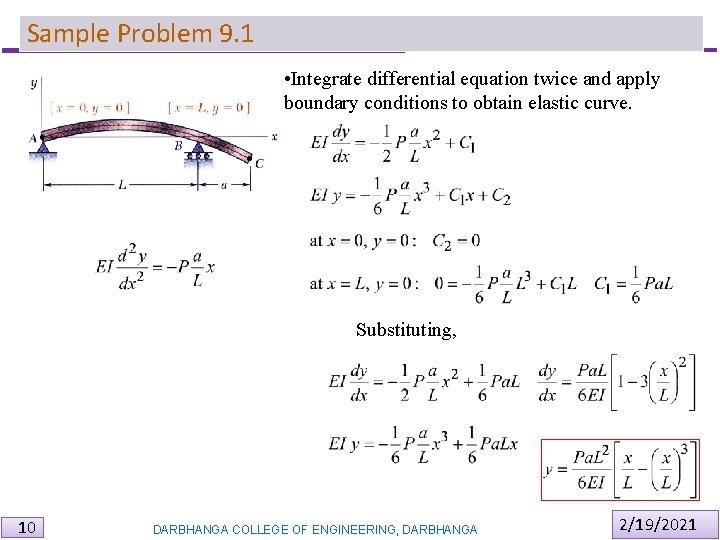
Sample Problem 9. 1 • Integrate differential equation twice and apply boundary conditions to obtain elastic curve. Substituting, 10 DARBHANGA COLLEGE OF ENGINEERING, DARBHANGA 2/19/2021
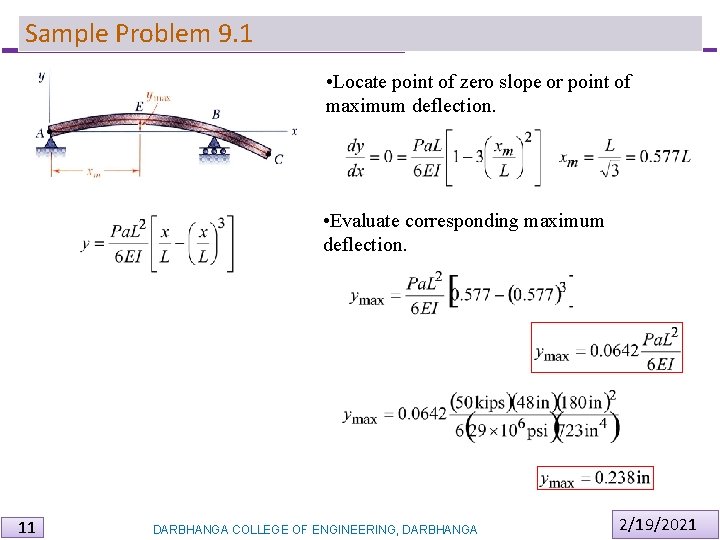
Sample Problem 9. 1 • Locate point of zero slope or point of maximum deflection. • Evaluate corresponding maximum deflection. 11 DARBHANGA COLLEGE OF ENGINEERING, DARBHANGA 2/19/2021
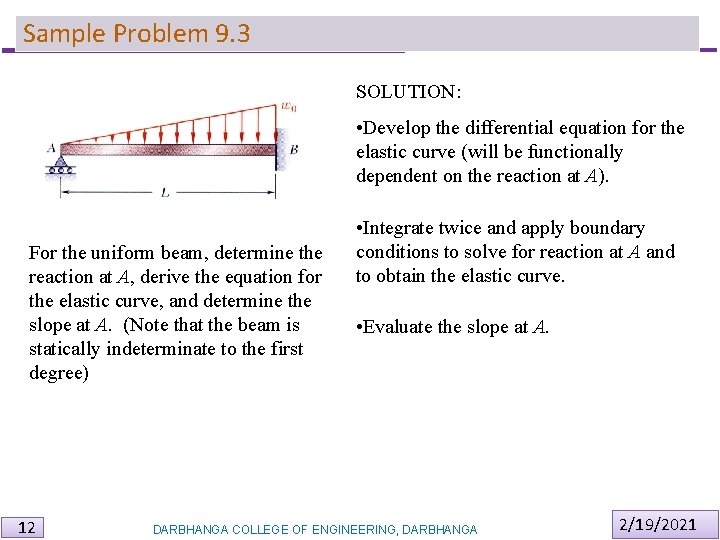
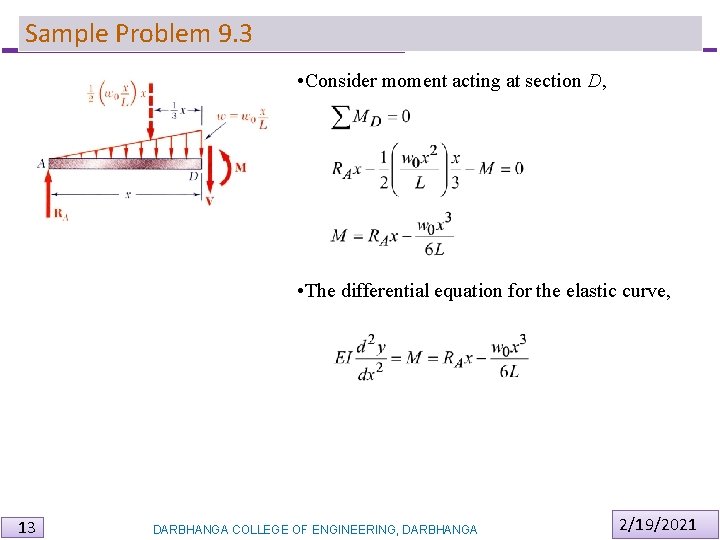
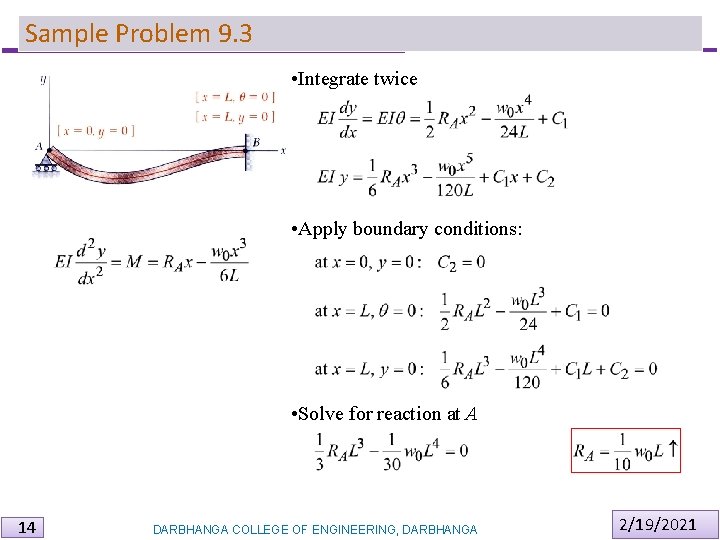
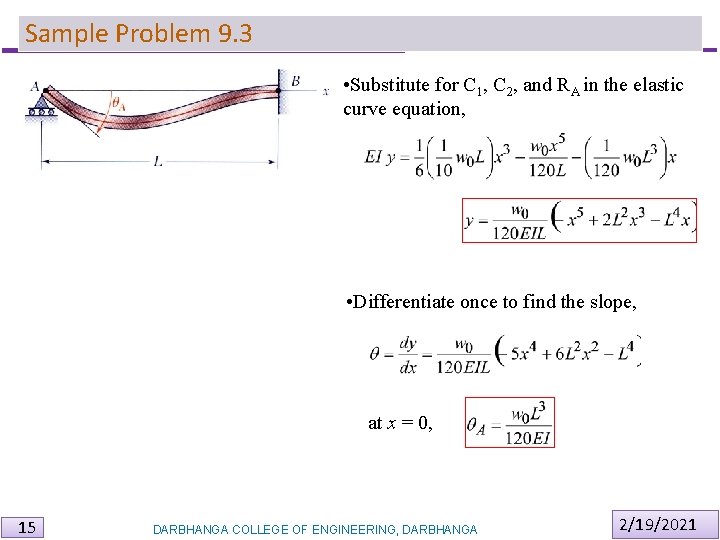
Sample Problem 9. 3 SOLUTION: • Develop the differential equation for the elastic curve (will be functionally dependent on the reaction at A). For the uniform beam, determine the reaction at A, derive the equation for the elastic curve, and determine the slope at A. (Note that the beam is statically indeterminate to the first degree) 12 • Integrate twice and apply boundary conditions to solve for reaction at A and to obtain the elastic curve. • Evaluate the slope at A. DARBHANGA COLLEGE OF ENGINEERING, DARBHANGA 2/19/2021
Sample Problem 9. 3 • Consider moment acting at section D, • The differential equation for the elastic curve, 13 DARBHANGA COLLEGE OF ENGINEERING, DARBHANGA 2/19/2021
Sample Problem 9. 3 • Integrate twice • Apply boundary conditions: • Solve for reaction at A 14 DARBHANGA COLLEGE OF ENGINEERING, DARBHANGA 2/19/2021
Sample Problem 9. 3 • Substitute for C 1, C 2, and RA in the elastic curve equation, • Differentiate once to find the slope, at x = 0, 15 DARBHANGA COLLEGE OF ENGINEERING, DARBHANGA 2/19/2021
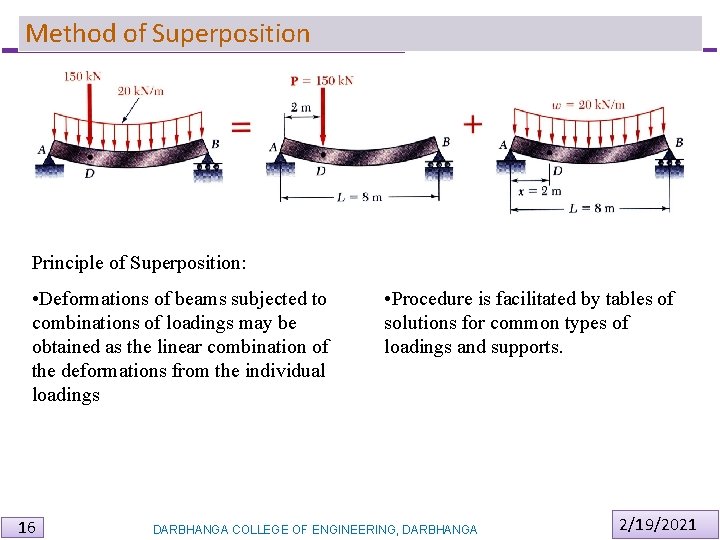
Method of Superposition Principle of Superposition: • Deformations of beams subjected to combinations of loadings may be obtained as the linear combination of the deformations from the individual loadings 16 • Procedure is facilitated by tables of solutions for common types of loadings and supports. DARBHANGA COLLEGE OF ENGINEERING, DARBHANGA 2/19/2021
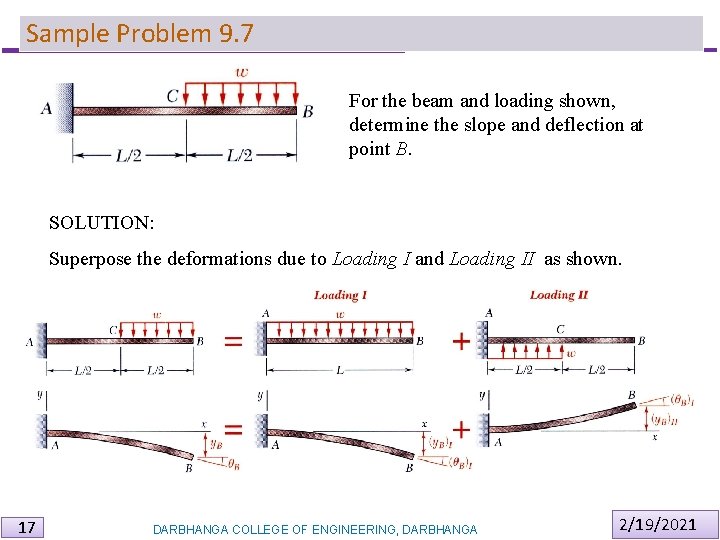
Sample Problem 9. 7 For the beam and loading shown, determine the slope and deflection at point B. SOLUTION: Superpose the deformations due to Loading I and Loading II as shown. 17 DARBHANGA COLLEGE OF ENGINEERING, DARBHANGA 2/19/2021
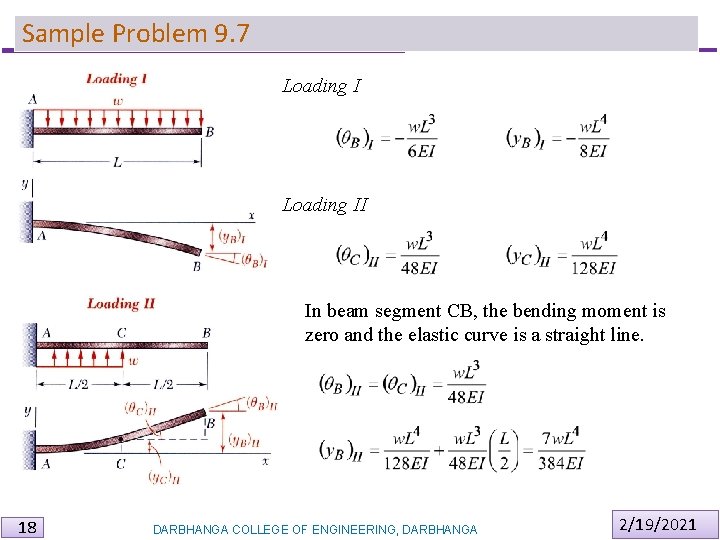
Sample Problem 9. 7 Loading II In beam segment CB, the bending moment is zero and the elastic curve is a straight line. 18 DARBHANGA COLLEGE OF ENGINEERING, DARBHANGA 2/19/2021
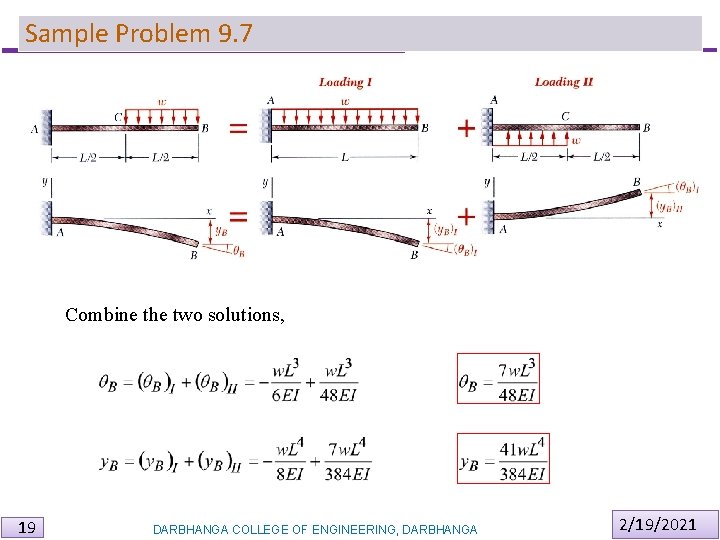
Sample Problem 9. 7 Combine the two solutions, 19 DARBHANGA COLLEGE OF ENGINEERING, DARBHANGA 2/19/2021
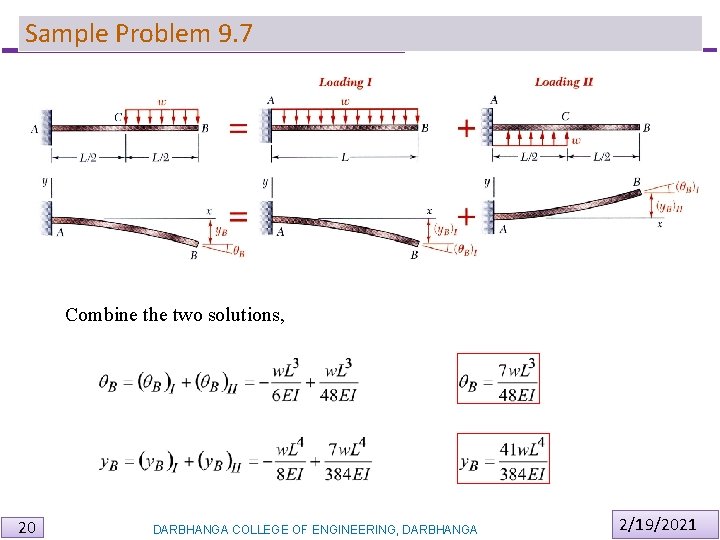
Sample Problem 9. 7 Combine the two solutions, 20 DARBHANGA COLLEGE OF ENGINEERING, DARBHANGA 2/19/2021
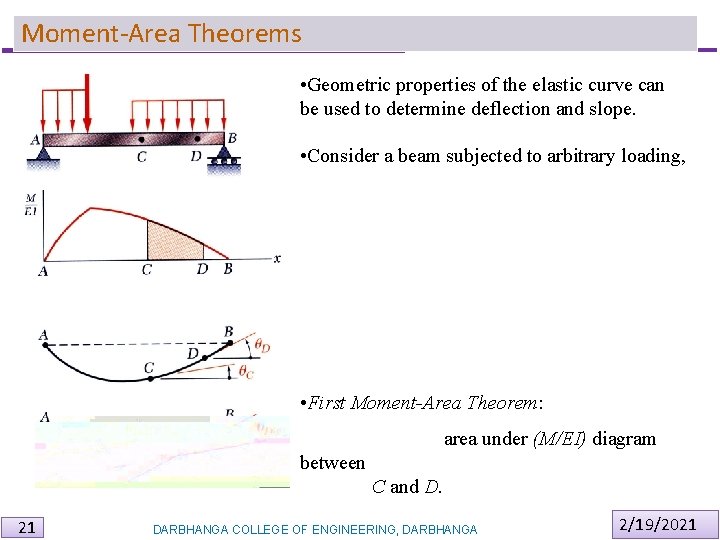
Moment-Area Theorems • Geometric properties of the elastic curve can be used to determine deflection and slope. • Consider a beam subjected to arbitrary loading, • First Moment-Area Theorem: area under (M/EI) diagram between C and D. 21 DARBHANGA COLLEGE OF ENGINEERING, DARBHANGA 2/19/2021
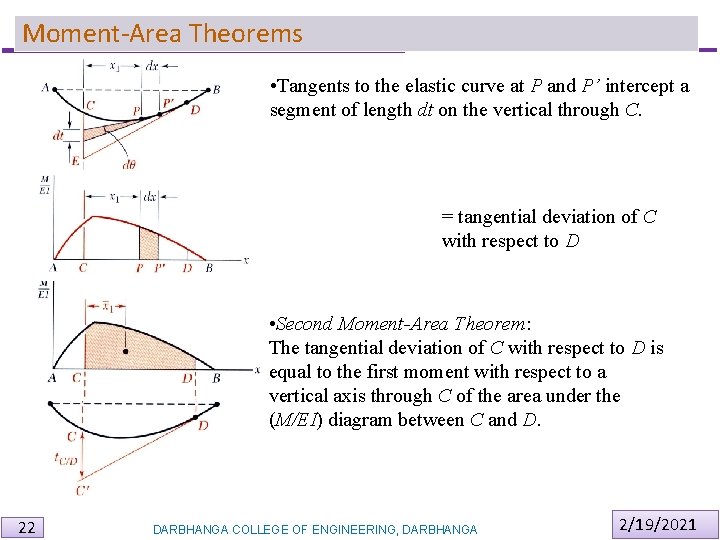
Moment-Area Theorems • Tangents to the elastic curve at P and P’ intercept a segment of length dt on the vertical through C. = tangential deviation of C with respect to D • Second Moment-Area Theorem: The tangential deviation of C with respect to D is equal to the first moment with respect to a vertical axis through C of the area under the (M/EI) diagram between C and D. 22 DARBHANGA COLLEGE OF ENGINEERING, DARBHANGA 2/19/2021
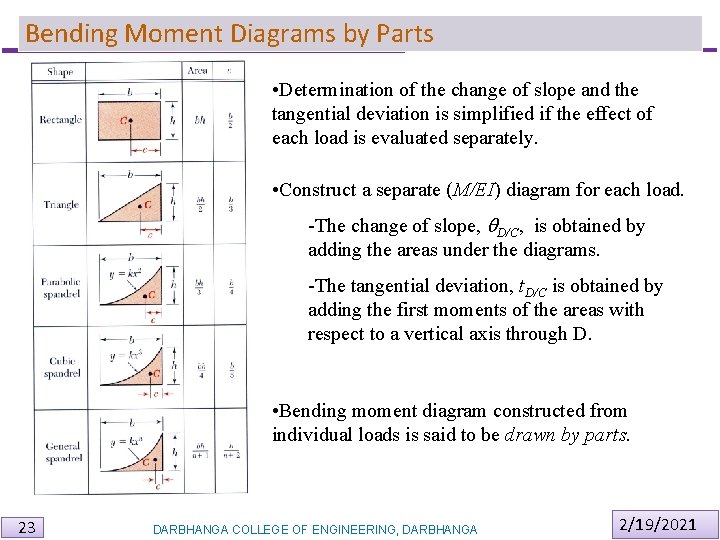
Bending Moment Diagrams by Parts • Determination of the change of slope and the tangential deviation is simplified if the effect of each load is evaluated separately. • Construct a separate (M/EI) diagram for each load. -The change of slope, q. D/C, is obtained by adding the areas under the diagrams. -The tangential deviation, t. D/C is obtained by adding the first moments of the areas with respect to a vertical axis through D. • Bending moment diagram constructed from individual loads is said to be drawn by parts. 23 DARBHANGA COLLEGE OF ENGINEERING, DARBHANGA 2/19/2021
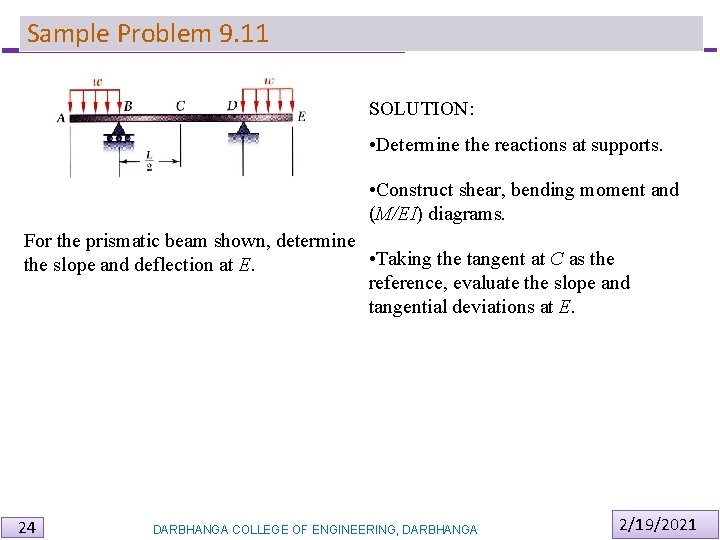
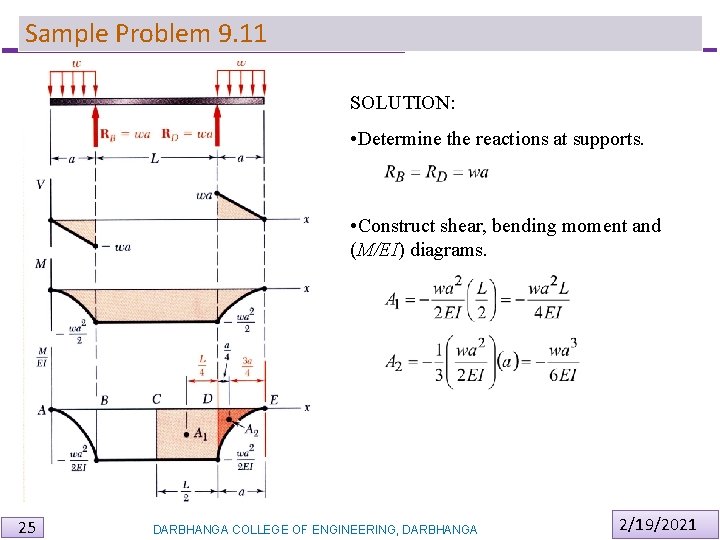
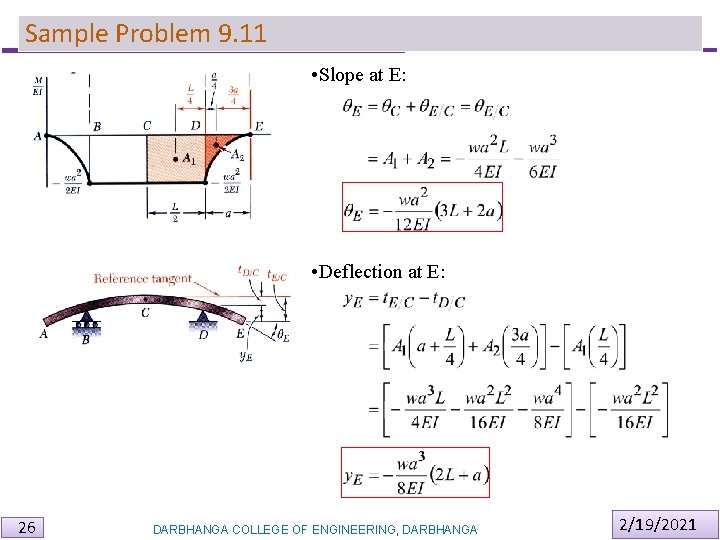
Sample Problem 9. 11 SOLUTION: • Determine the reactions at supports. • Construct shear, bending moment and (M/EI) diagrams. For the prismatic beam shown, determine • Taking the tangent at C as the slope and deflection at E. reference, evaluate the slope and tangential deviations at E. 24 DARBHANGA COLLEGE OF ENGINEERING, DARBHANGA 2/19/2021
Sample Problem 9. 11 SOLUTION: • Determine the reactions at supports. • Construct shear, bending moment and (M/EI) diagrams. 25 DARBHANGA COLLEGE OF ENGINEERING, DARBHANGA 2/19/2021
Sample Problem 9. 11 • Slope at E: • Deflection at E: 26 DARBHANGA COLLEGE OF ENGINEERING, DARBHANGA 2/19/2021
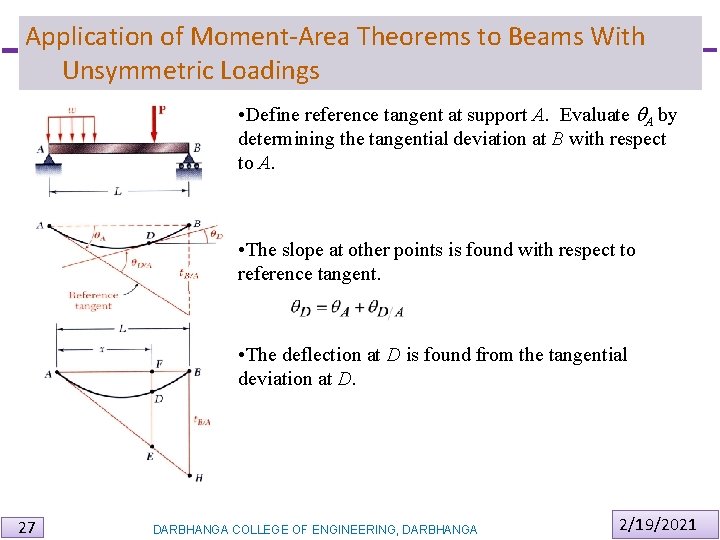
Application of Moment-Area Theorems to Beams With Unsymmetric Loadings • Define reference tangent at support A. Evaluate q. A by determining the tangential deviation at B with respect to A. • The slope at other points is found with respect to reference tangent. • The deflection at D is found from the tangential deviation at D. 27 DARBHANGA COLLEGE OF ENGINEERING, DARBHANGA 2/19/2021
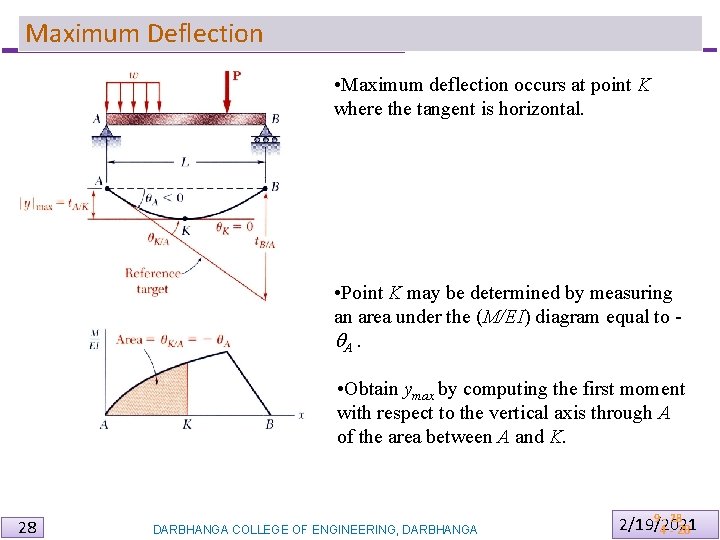
Maximum Deflection • Maximum deflection occurs at point K where the tangent is horizontal. • Point K may be determined by measuring an area under the (M/EI) diagram equal to q. A. • Obtain ymax by computing the first moment with respect to the vertical axis through A of the area between A and K. 28 DARBHANGA COLLEGE OF ENGINEERING, DARBHANGA 9 - 28 2/19/2021 4 - 28
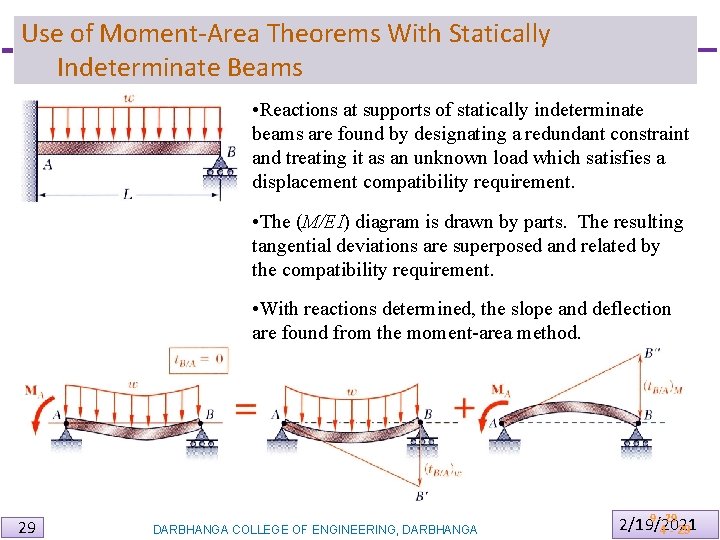
Use of Moment-Area Theorems With Statically Indeterminate Beams • Reactions at supports of statically indeterminate beams are found by designating a redundant constraint and treating it as an unknown load which satisfies a displacement compatibility requirement. • The (M/EI) diagram is drawn by parts. The resulting tangential deviations are superposed and related by the compatibility requirement. • With reactions determined, the slope and deflection are found from the moment-area method. 29 DARBHANGA COLLEGE OF ENGINEERING, DARBHANGA 9 - 29 2/19/2021 4 - 29
30 DARBHANGA COLLEGE OF ENGINEERING, DARBHANGA 2/19/2021 4 - 30
31 DARBHANGA COLLEGE OF ENGINEERING, DARBHANGA 2/19/2021 4 - 31
32 DARBHANGA COLLEGE OF ENGINEERING, DARBHANGA 2/19/2021 4 - 32
33 DARBHANGA COLLEGE OF ENGINEERING, DARBHANGA 2/19/2021 4 - 33
34 DARBHANGA COLLEGE OF ENGINEERING, DARBHANGA 2/19/2021 4 - 34