
Strength of Materials and Structures N 6 Chapter




- Slides: 63
Strength of Materials and Structures N 6
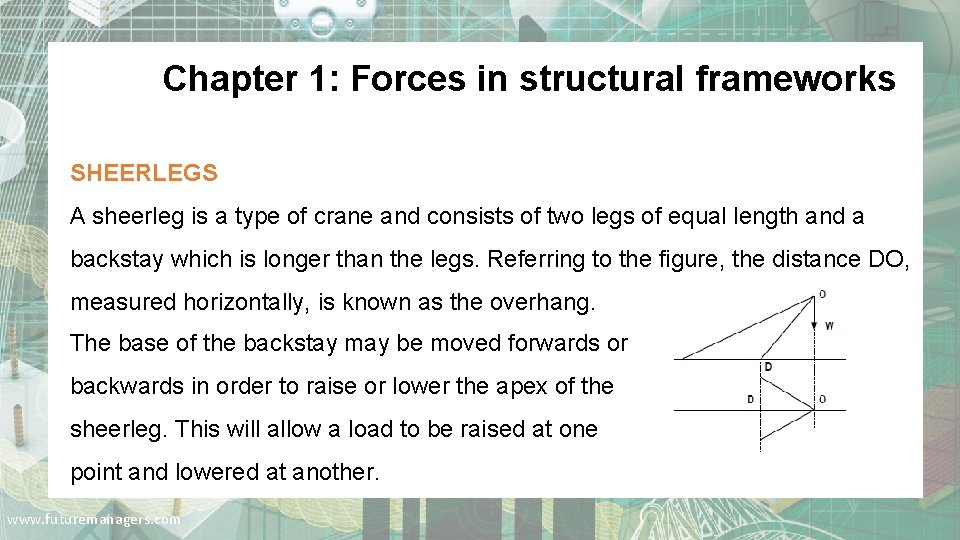
Chapter 1: Forces in structural frameworks SHEERLEGS A sheerleg is a type of crane and consists of two legs of equal length and a backstay which is longer than the legs. Referring to the figure, the distance DO, measured horizontally, is known as the overhang. The base of the backstay may be moved forwards or backwards in order to raise or lower the apex of the sheerleg. This will allow a load to be raised at one point and lowered at another. www. futuremanagers. com
Chapter 1: Forces in structural frameworks (continued) TRIPODS A tripod differs from a sheerleg in that the tripod has three legs whereas a sheerleg only has two legs. A tripod is static with regards to the displacement of the load, therefore a load can only be raised and lowered in the same position. www. futuremanagers. com
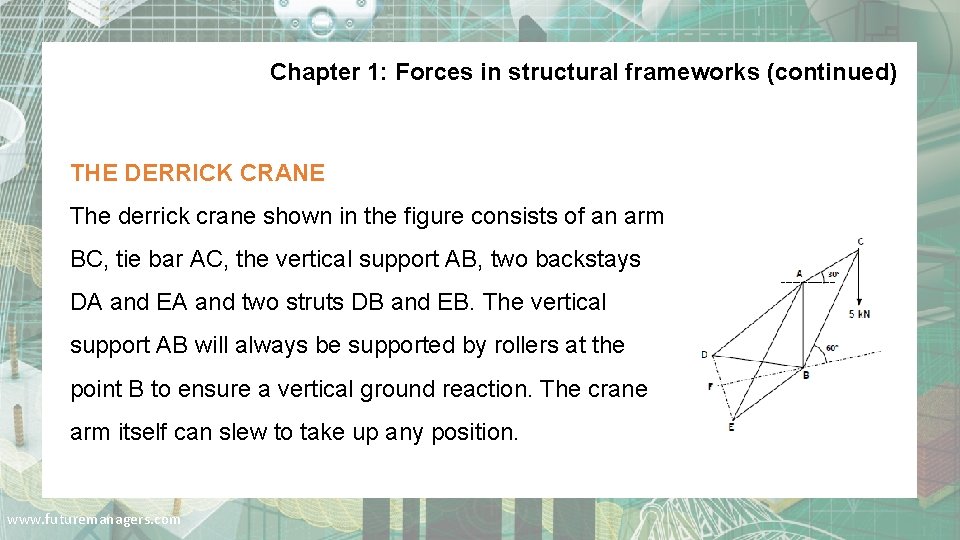
Chapter 1: Forces in structural frameworks (continued) THE DERRICK CRANE The derrick crane shown in the figure consists of an arm BC, tie bar AC, the vertical support AB, two backstays DA and EA and two struts DB and EB. The vertical support AB will always be supported by rollers at the point B to ensure a vertical ground reaction. The crane arm itself can slew to take up any position. www. futuremanagers. com
Chapter 2: Thick cylinders SINGLE CYLINDERS A cylinder is considered to be a thick cylinder if the wall thickness is 1/20 of the outside diameter of the cylinder. When a cylindrical shell is subjected to an internal or external pressure three stresses will develop in the cylinder wall. Three principles stresses are: • Radial compressive stress; • Hoop stress; and • Longitudinal tensile stress. www. futuremanagers. com
Chapter 2: Thick cylinders (continued) COMPOUND THICK CYLINDERS A compound cylinder consists of two cylinders which are shrunk together, e. g. a hub shrunk onto a hollow or solid shaft. When two cylinders are shrunk together the inner diameter of the outer cylinder will not be the same as the outer diameter of the inner cylinder, before they are shrink together. This will cause the outer cylinder to stretch to fit over the inner cylinder and be in a tensile state, and the inner cylinder will be squeezed by the outer cylinder and be in a state of compression. www. futuremanagers. com
Chapter 3: Deflection of beams INTRDUCTION A beam may be strong enough to resist safely the bending moments due to the applied loading and yet not be structurally suitable because its deflection is too great. When a beam is selected to be used under load it must be strong enough to be within the stress limit (bending) and deflection. www. futuremanagers. com
Chapter 3: Deflection of beams (continued) www. futuremanagers. com
Chapter 3: Deflection of beams (continued) www. futuremanagers. com
Chapter 3: Deflection of beams (continued) www. futuremanagers. com
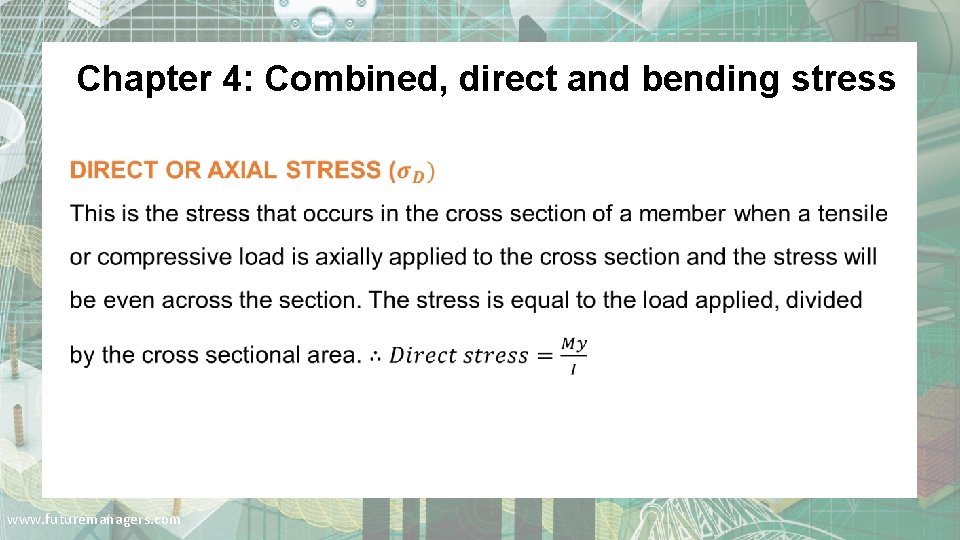
Chapter 4: Combined, direct and bending stress www. futuremanagers. com
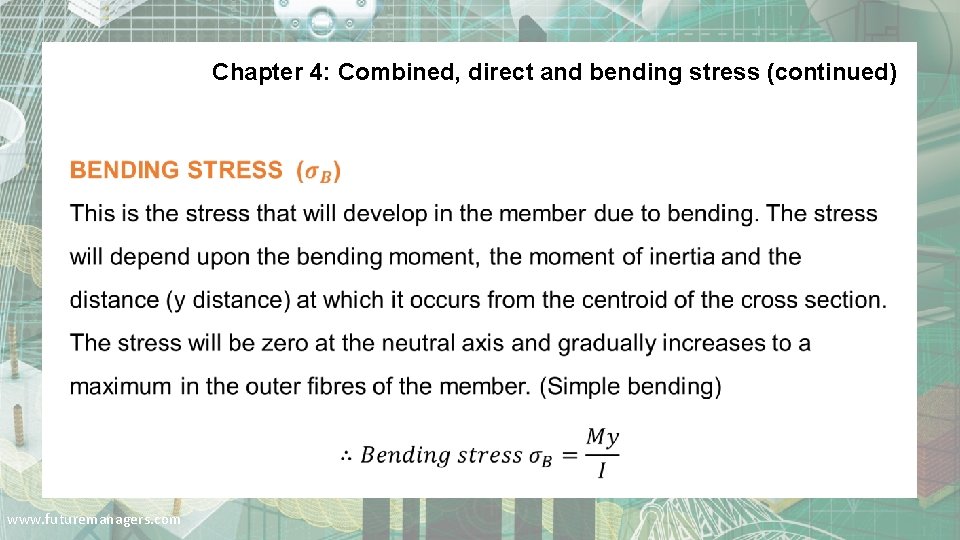
Chapter 4: Combined, direct and bending stress (continued) www. futuremanagers. com
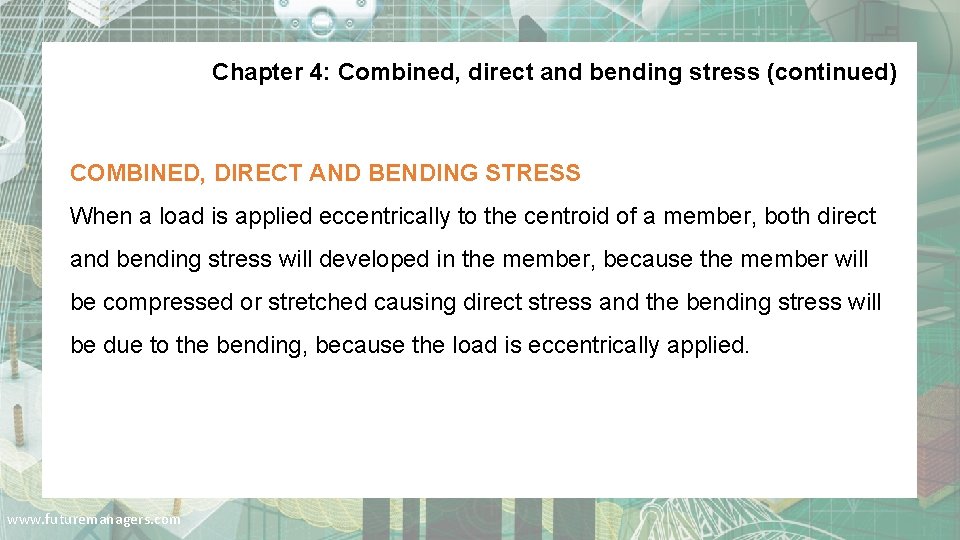
Chapter 4: Combined, direct and bending stress (continued) COMBINED, DIRECT AND BENDING STRESS When a load is applied eccentrically to the centroid of a member, both direct and bending stress will developed in the member, because the member will be compressed or stretched causing direct stress and the bending stress will be due to the bending, because the load is eccentrically applied. www. futuremanagers. com
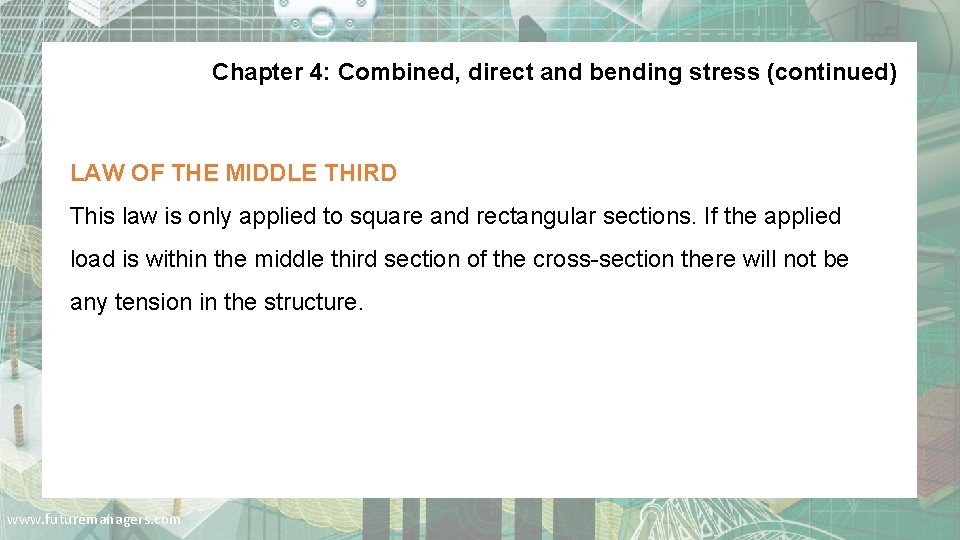
Chapter 4: Combined, direct and bending stress (continued) LAW OF THE MIDDLE THIRD This law is only applied to square and rectangular sections. If the applied load is within the middle third section of the cross-section there will not be any tension in the structure. www. futuremanagers. com
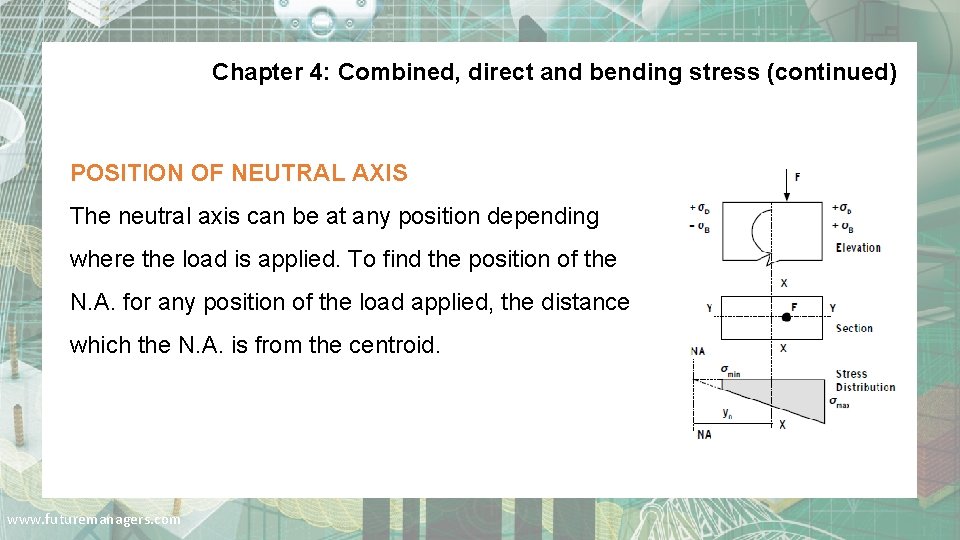
Chapter 4: Combined, direct and bending stress (continued) POSITION OF NEUTRAL AXIS The neutral axis can be at any position depending where the load is applied. To find the position of the N. A. for any position of the load applied, the distance which the N. A. is from the centroid. www. futuremanagers. com
Chapter 5: Retaining walls GRAVITY-DEPENDENT STRUCTURES Any structure will be pulled towards the earth’s centre by the force of gravitational attraction. This downwards force is called the weight of the structure. When a structure is dependent upon its weight for stability, it may be called a gravity dependent structure. www. futuremanagers. com
Chapter 5: Retaining walls (continued) FAILURE CRITERIA Before any calculations can be done to establish the stability of a structure, its modes of failure must be known. The five critical criteria are: 1. Overturning. 2. Tension in the wall. 3. The ground bearing pressure. 4. Sliding of the wall on its base. 5. Rotational slip. www. futuremanagers. com
Chapter 5: Retaining walls (continued) STABILITY CALCULATIONS To determine the stability of a wall for the limits set out above and not to exceed them, the following has to be calculated: 1. The lateral forces (F). 2. The weight of the wall (V). 3. Position of the ground reaction (Resultant position of weight). 4. Ground bearing pressure at toe and heel of wall. 5. Factor of safety. www. futuremanagers. com
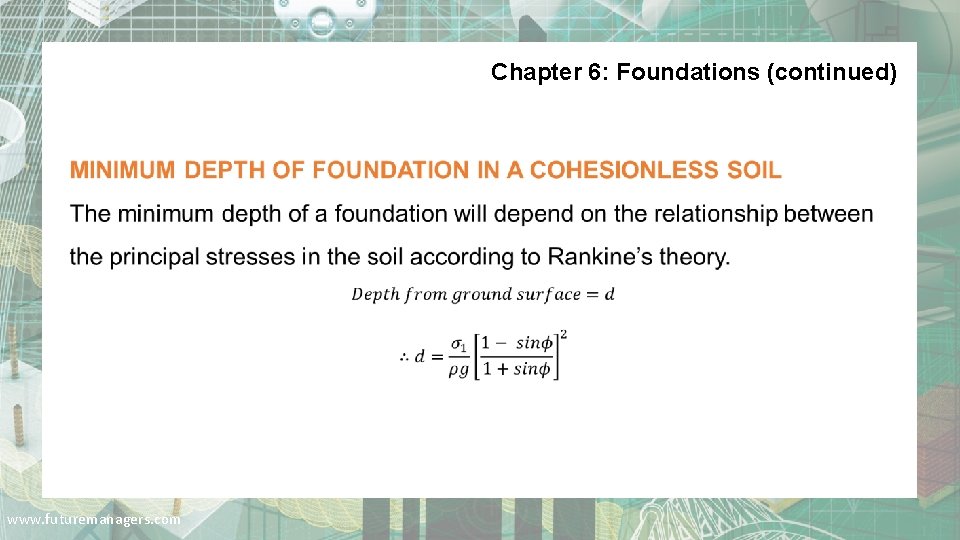
Chapter 6: Foundations DEFINITION The extended base of a wall, column, pier etc. directly supported by or kept in equilibrium by the soil is known as a foundation. www. futuremanagers. com
Chapter 6: Foundations (continued) NECESSITY OF FOUNDATIONS The purpose of a foundation is to distribute the load evenly over a bigger area and to prevent an uneven setting. The base of the wall is normally made wider to increase the stability of the wall by spreading the load over a bigger area so that it can safely handle the pressure and eliminate the forces which could damage the wall. www. futuremanagers. com
Chapter 6: Foundations (continued) FORCES WHICH CAN CAUSE DAMAGE OR FAILURE Th e main causes of damage are those forces which cause unequal settlement. The two reasons why foundations settle unequally are: • Unequal resistance of the soil; and • Unequal loading of the foundation. Other reasons include escaping of soil sideways, sliding of the soil, withdrawal of earth water, atmospheric action, and distributed overturning forces. www. futuremanagers. com
Chapter 6: Foundations (continued) SITE INVESTIGATION The main purpose of a site investigation is: 1. To determine the depth at which a satisfactory bearing stratum occurs. 2. The safe bearing capacity of the stratum. 3. The level of the ground water. 4. To determine whether it will be necessary to provide timbering for the excavations. www. futuremanagers. com
Chapter 6: Foundations (continued) TYPES OF SOILS Broadly, there are three distinct types of soil: 1. Cohesionless or Granular soils such as sands, gravel etc. 2. Cohesive soils such as clay, silts and some organic soils. 3. Rock which can be with weak strata interposed to solid hard rocks. www. futuremanagers. com
Chapter 6: Foundations (continued) TYPES OF FOUNDATIONS Types of foundations include: • Strip foundations; • Pad foundations; • Piled foundations; and • Raft foundations. www. futuremanagers. com
Chapter 6: Foundations (continued) . www. futuremanagers. com
Chapter 6: Foundations (continued) WIDTH AND DEPTH OF FOUNDATIONS The three stages for designing foundations are: 1. Carry out a site investigation. . 2. Decide on the kind of foundation to be used. 3. Design the foundation which has been decided upon. www. futuremanagers. com
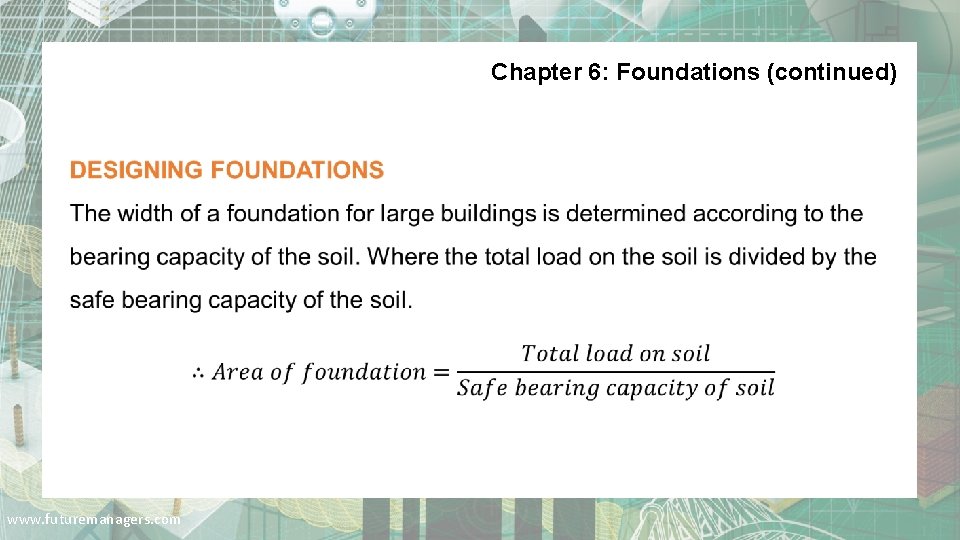
Chapter 6: Foundations (continued) . www. futuremanagers. com
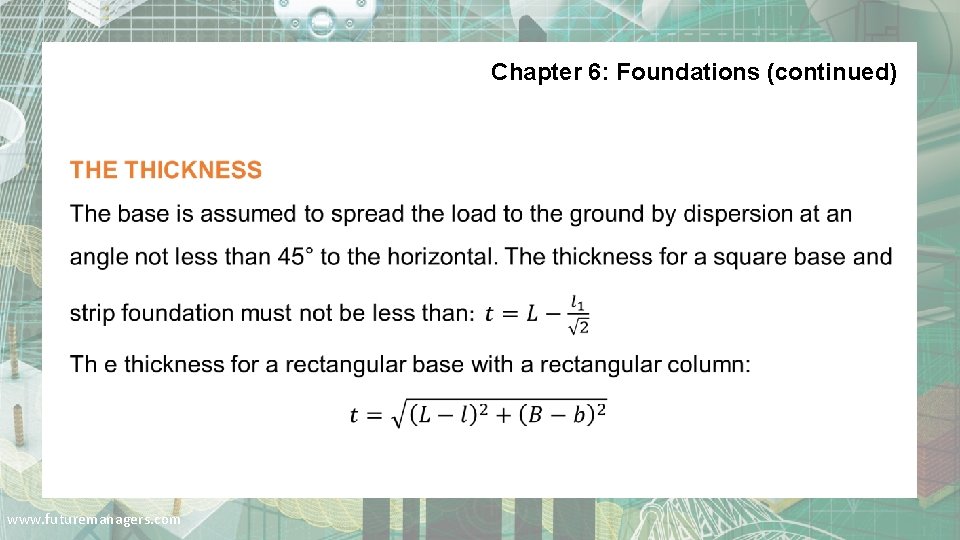
Chapter 6: Foundations (continued) . www. futuremanagers. com
Chapter 6: Foundations (continued) POSITION OF AN ECCENTRIC LOADED COLUMN ON FOUNDATION When a load is eccentric on a column, with the column in the middle of the foundation, it will cause a distribution of. pressure. The most suitable distribution of pressure will be an even distribution for a more stable condition and to achieve the latter the column itself must be placed in an eccentric position on the foundation so that the resultant position of the forces on the column are concentrated through the centre of the foundation. www. futuremanagers. com
Chapter 6: Foundations (continued) GRILLAGE FOUNDATIONS Grillage foundations are foundations reinforced with steel to reduce the depth of the foundation and to evenly distribute the area. This is the reason for the. steel in the foundation and to absorb the tension as well as to give maximum area and minimum depth. The moment of resistance in the I-sections used in the foundation depends upon the type of fixing of the base plate to the top tier. Foundations will always be square. www. futuremanagers. com
Chapter 6: Foundations (continued) . www. futuremanagers. com
Chapter 7: Concrete CEMENT Any material that is used to stick materials together is called cement according to the dictionary which embraces a wide range of materials. Portland cement is used with water to act as the cementing ingredient to bind sand stone together to form concrete. www. futuremanagers. com
Chapter 7: Concrete (continued) AGGREGATES An aggregate is a material mixed with cement and water to form an artificial rock. Sand stone are the normal aggregates used with cement for. concrete. www. futuremanagers. com
Chapter 7: Concrete (continued) WATER The chemical reaction between Portland cement and water is called hydration. Therefore water is important for the binding and curing proses in concrete. . www. futuremanagers. com
Chapter 7: Concrete (continued) COMPACTION OF CONCRETE The process of compaction is complete when no air bubbles are visibly rising to the surface any more. A snub headed object must not be used to compact. the concrete as it will not penetrate the concrete deep enough. Mechanical vibrators must be used. On the other hand too much compaction must not be carried out because that will separate the aggregates. www. futuremanagers. com
Chapter 7: Concrete (continued) AFTER TREATMENT OF CONCRETE - CURING Curing takes place due to the chemical reaction between the water and the cement in the mixing process which will. stop when the concrete is dry. It could happen that the concrete has dried out before the curing process is complete which means that the concrete has not reached its full strength. www. futuremanagers. com
Chapter 7: Concrete (continued) POURING AND MIXING OF CONCRETE Concrete is mixed according to its weight or volume. The ratio to which the cement, sand stone is mixed will depend on what it is needed for. . Concrete can be mixed by hand or using a machine. www. futuremanagers. com
Chapter 7: Concrete (continued) TESTS Different ways to test the concrete include: The slump test to test the workability; and. The compressive test to test the final quality of the concrete. www. futuremanagers. com
Chapter 7: Concrete (continued) TESTS Different ways to test the concrete include: The slump test to test the workability; and. The compressive test to test the final quality of the concrete. www. futuremanagers. com
Chapter 7: Concrete (continued) REINFORCEMENT Concrete is strong in compression but weak in tension and therefore steel is placed in the high tensile areas to take. up the tension in the concrete. The reinforcement must satisfy the following requirements: • It must have a high tensile strength; • Must bond well with the concrete; and • Must be compatible with the concrete especially as far as temperature movements are concerned. www. futuremanagers. com
Chapter 7: Concrete (continued) SHUTTERING Shuttering is used to cast concrete in a predetermined form and to keep the concrete in position until it has set. www. futuremanagers. com .
Chapter 7: Concrete (continued) DESIGN OF REINFORCED CONCRETE BEAMS Reinforced concrete beams can be seen as a design of two materials. Concrete is a material strong in compression but weak in tension. . www. futuremanagers. com
Chapter 7: Concrete (continued) T-BEAMS T-beams are treated the same as rectangular beams to determine the position of the neutral axis. If it is an uneconomical beam moments are taken about. the neutral axis. When the area of the reinforcement or the breadth of the beam are unknown for an economical beam, the stress ratio is used to determine the position of the neutral axis. www. futuremanagers. com
Chapter 8: Tension in cables A SIMPLE CATERNARY A cable suspended between two points with its own weight as load is called a catenary. The total weight of the cable will be its weight per metre times the length of the cable. www. futuremanagers. com
Chapter 8: Tension in cables (continued) A PARABOLIC CATERNARY A parabolic catenary is formed when a cable carries a horizontal uniformly distributed load, for example a suspension bridge. In this case the total. uniformly distributed load is equal to the load per running metre times the length of the bridge between the supports. www. futuremanagers. com
Chapter 9: Combined bending and twisting of shafts INTRODUCTION There are many examples where shafts are subjected to bending moments and torque simultaneously. One example is a shaft with a pulley, driven by V belts or a flat belt. The cause of the bending can be due to: • The weight of the pulley; • Tension in the belt = Tl and T 2; and • The weight of the shaft. www. futuremanagers. com
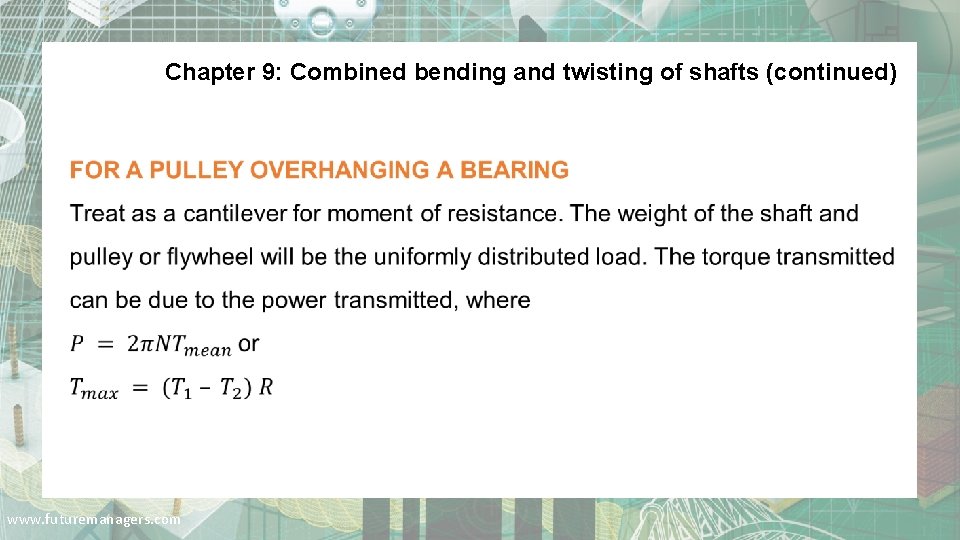
Chapter 9: Combined bending and twisting of shafts (continued) FOR A PULLEY BETWEEN TWO BEARINGS Treat as a simply supported beam for moment of resistance and the force (point load) of the belt will be. Therefore: W = T 1 + T 2 www. futuremanagers. com .
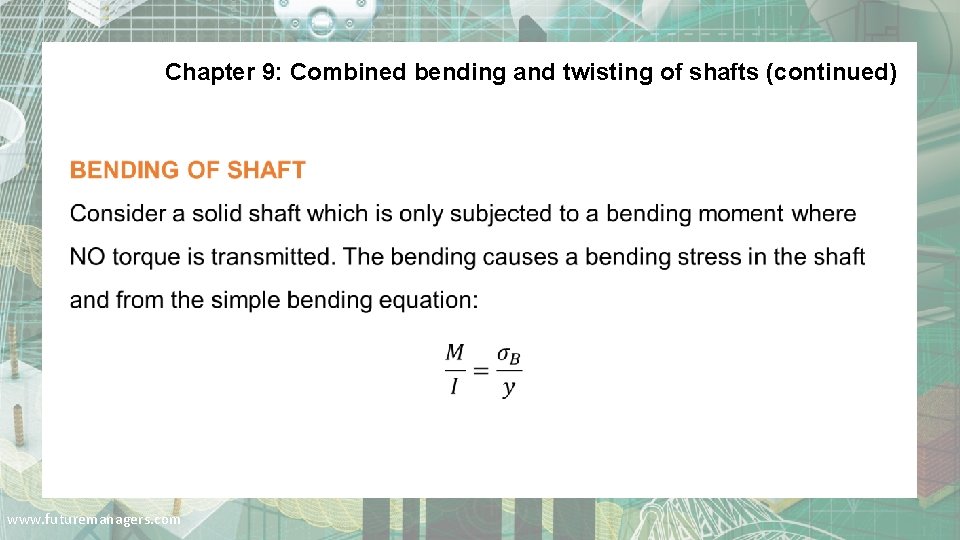
Chapter 9: Combined bending and twisting of shafts (continued) . www. futuremanagers. com
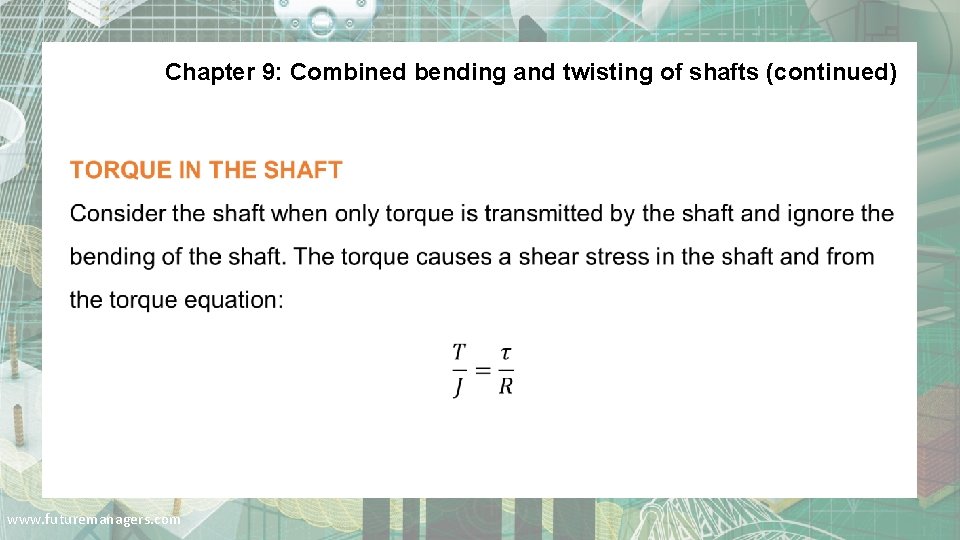
Chapter 9: Combined bending and twisting of shafts (continued) . www. futuremanagers. com
Chapter 9: Combined bending and twisting of shafts (continued) . www. futuremanagers. com
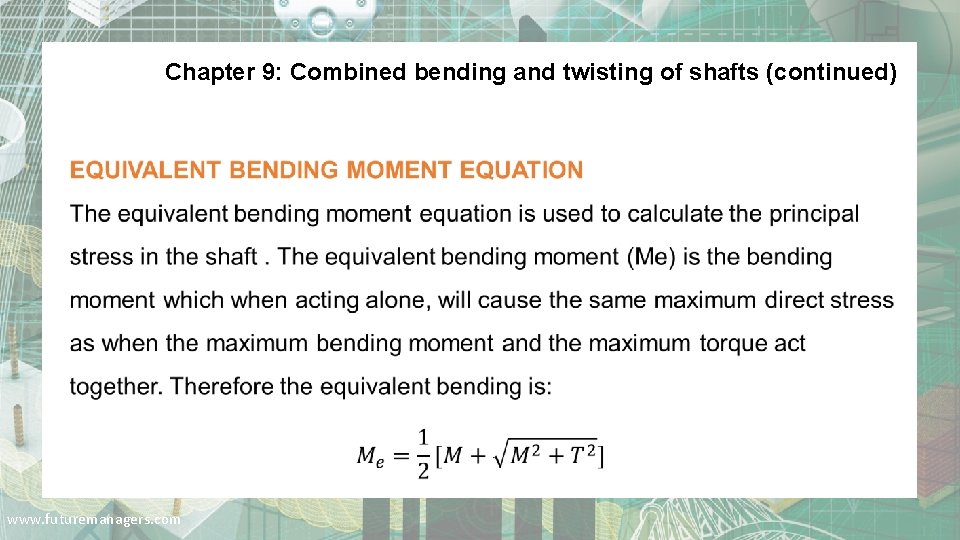
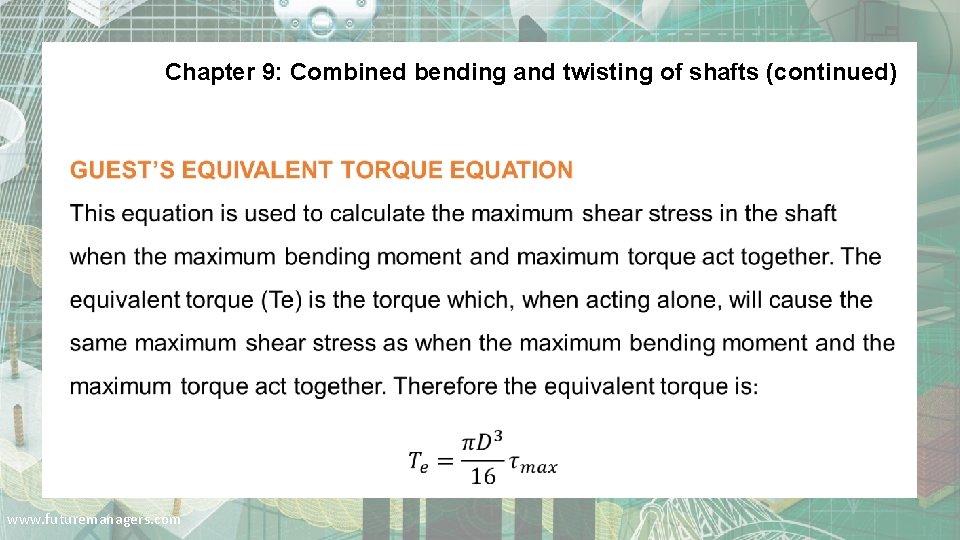
Chapter 9: Combined bending and twisting of shafts (continued) COMBINED BENDING AND TWISTING Stresses are set up in a shaft due to the bending moment and torque acting simultaneously in the shaft. The maximum stresses which will occur in the. shaft will be: 1. Maximum principal stress; and 2. Maximum shear stress. www. futuremanagers. com
Chapter 9: Combined bending and twisting of shafts (continued) . www. futuremanagers. com
Chapter 9: Combined bending and twisting of shafts (continued) . www. futuremanagers. com
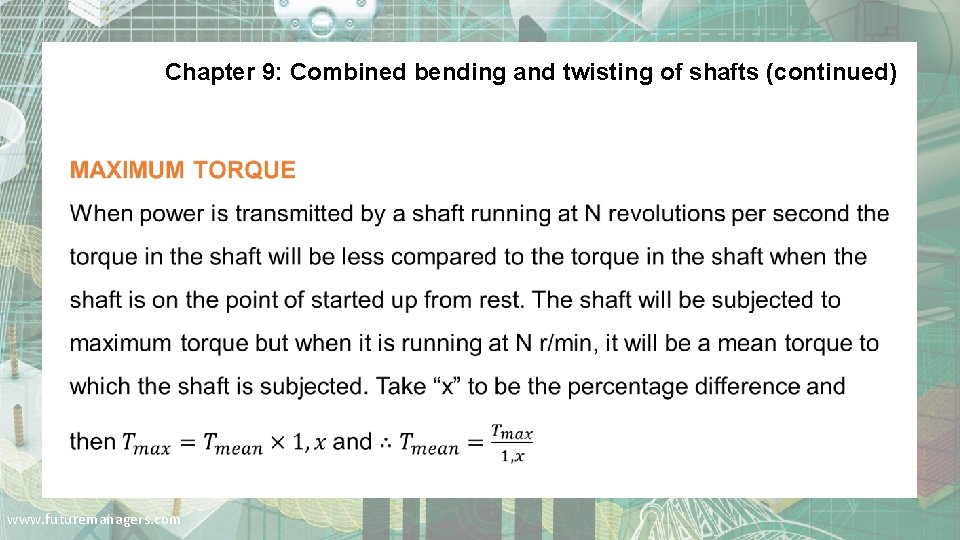
Chapter 9: Combined bending and twisting of shafts (continued) . www. futuremanagers. com
Chapter 10: Testing of ropes, chains and hooks SHORT LINK STEEL CHAIN (GRADE 400) FOR LIFTING A grade 400 chain refers to a chain where the stress will be 400 MPa when the chain is under tension with a load equal to the minimum breaking strength for its size. www. futuremanagers. com
Chapter 10: Testing of ropes, chains and hooks (continued) WROUGHT IRON HOOKS Wrought iron hooks must satisfy the following requirements for manufacturing: • The steel must be fully killed and hand or drop forged and liable to strain. age embrittlement. • The hand or drop forged method must be used to manufacture the hook in one piece and no welding must be carried out on the hook. www. futuremanagers. com
Chapter 10: Testing of ropes, chains and hooks (continued) WIRE ROPES Steel wire ropes are manufactured using a number of wires (not twisted), 17 or 15, which are laid left hand into a strand a number of strands, six or. eight, laid right handed around a hemp rope centre to form the steel wire rope. A rope is classified as a 6 x 17 or 6 x 19, which means it consists of six strands which again consist of 17 or 19 wires. The purpose of the hemp centre is to lubricate the steel rope and to absorb the shock. www. futuremanagers. com
Chapter 11: Quantity surveying THE STANDARD SYSTEM OF MEASURING BUILDER WORK IN SOUTH AFRICA This book is given out by the Association of South African Quantity Surveyors and is simply referred to as “Th e Standard System”. Where “Quantities” forms part of a contract, this must be prepared in accordance with the latest edition except where otherwise stated. www. futuremanagers. com
Chapter 11: Quantity surveying (continued) A BILL OF QUANTITIES A bill of quantities is prepared by a quantity surveyor and contains a list of all the materials needed as well as the labour and services. In this document. everything is broken down and billed under their respective trade headings in a specific order. The quantities are given and the prices are added by the contractor. www. futuremanagers. com
Chapter 11: Quantity surveying (continued) THE PURPOSE OF A BILL OF QUANTITIES The main purpose of a bill of quantities is to obtain a price for all the work and items involved in the building of a project. It is used by the quantity surveyor, . architect, civil engineer, builders and the subcontractors in every trade and the suppliers of the materials needed. It forms part of the tender documents. www. futuremanagers. com
Chapter 11: Quantity surveying (continued) CONTRACT DRAWINGS These are drawings prepared by the architect to a scale of one in a hundred, setting out the full building and showing. all the floors, elevations, special and typical sections. www. futuremanagers. com
Chapter 11: Quantity surveying (continued) WORKING DRAWINGS These are the drawings prepared by the architect for the job and handed to the local authorities for approval and must show all the details on a larger. scale. www. futuremanagers. com
Chapter 11: Quantity surveying (continued) PREPARATION OF BILL OF QUANTITIES The preparation of the bill of quantities begins when the architect’s completed drawings are received. It is done on specially ruled paper which is called. “billing paper”. www. futuremanagers. com