
Strength function from the 113 Cdn reactions Tams



- Slides: 18
Strength function from the 113 Cd(n, ) reactions Tamás Belgya Nuclear Analysis and Radiography Department, Institute for Energy Security and Environmental Safety, Centre for Energy Research H-1525 POB 49, Budapest, Hungary belgya. tamas@energia. mta. hu Co-authors : Dr. SZENTMIKLÓSI, Laszló (Centre for Energy Research, Hungarian Academy of Sciences) Mr. MASSARCZYK, Ralph, Dr. SCHWENGNER, Ronald, Dr. SCHRAMM, Georg , Dr. BIRGERSSON, Evert, Dr. JUNGHANS, Arnd (Helmholtz-Zentrum Dresden-Rossendorf, Institute of Radiation Physics) The ERINDA 2013 Workshop - CERN, Geneva (Switzerland), 1 st to 3 rd October 2013 1
Content • • Introduction Modeling of Budapest detector response Unfolding normal spectra Examples Unfolding 113 Cd(n, ) spectra Gamma. Dex modeling Summary 2
Introduction Collaboration for research of RSF • For better understanding of the radiative strength function the HZD ELBE, EK NAL and Charles Univ. groups initiated a collaboration in the framework of EFNUDAT and ERINDA to perform (n, ) experiments on 1/2 ground state nuclei with mass A and ( , ’) experiments on A+1 (both have to be stable) – In this case the capture state has 1 - and 0 - spin – ( , ’) can excite mainly 1 - states – Unfortunately there are only two stable nuclei pairs with this feature 77 -78 Se and 195196 Pt – There is another not so favored case for which the ground sate spin is 1/2+ – This is the 113 -114 Cd pair, which is the subject of this talk • Analysis of the first set of data – on 77 -78 Se has been finished and is published in PRC – on 195 -196 Pt has been finished and is published in PRC – We concluded that it is possible to simulate the (n, ) and ( , ’) experimental spectra with the same experimental RSF – The TLO based RSF description successfully joins to the EGDR tail 3
Works remained (Jyväskylä) • Modeling of Budapest detector response needs more work • Unfolding of Budapest spectra is to be done • Total capture Xsection at thermal energy • Combined evaluation and modeling of have to be done • Expected outcome is better understanding of the role of M 1 and E 1 transitions and their strength function 4
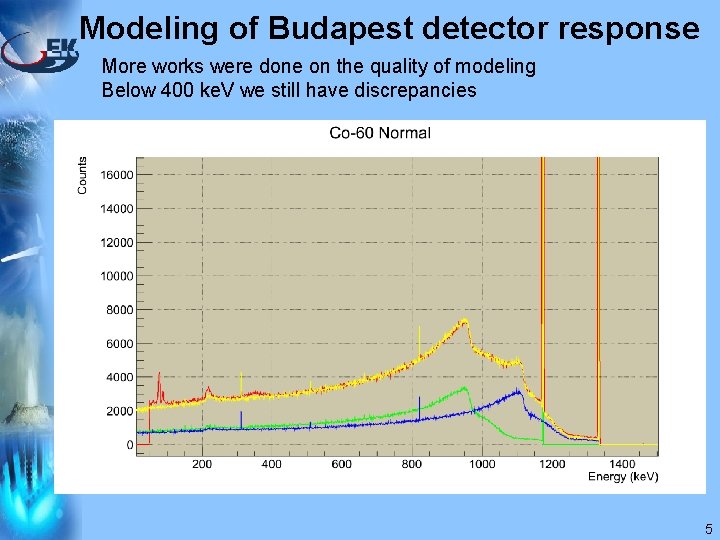
Modeling of Budapest detector response More works were done on the quality of modeling Below 400 ke. V we still have discrepancies 5
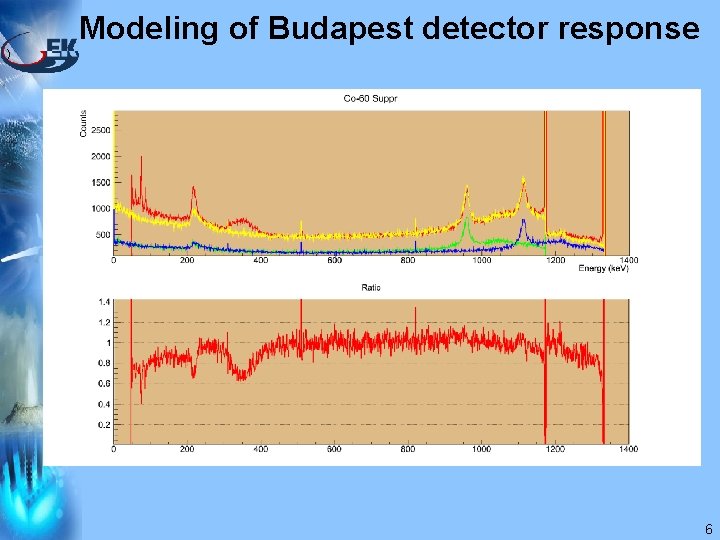
Modeling of Budapest detector response ) 6
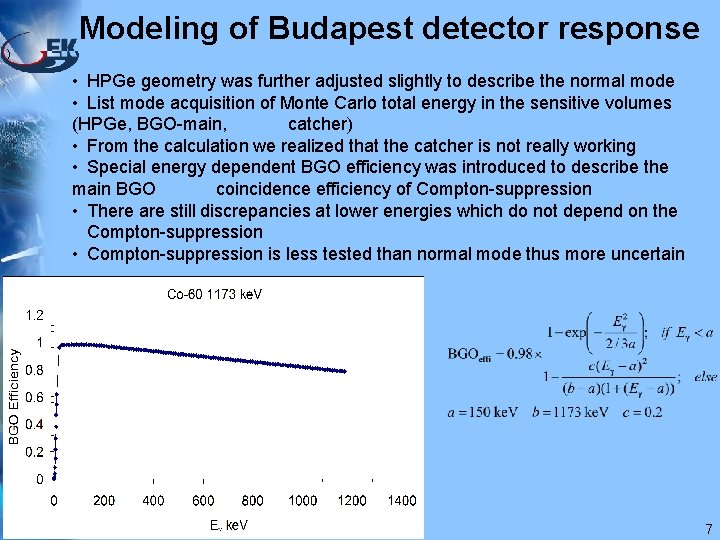
Modeling of Budapest detector response ) • HPGe geometry was further adjusted slightly to describe the normal mode • List mode acquisition of Monte Carlo total energy in the sensitive volumes (HPGe, BGO-main, catcher) • From the calculation we realized that the catcher is not really working • Special energy dependent BGO efficiency was introduced to describe the main BGO coincidence efficiency of Compton-suppression • There are still discrepancies at lower energies which do not depend on the Compton-suppression • Compton-suppression is less tested than normal mode thus more uncertain 7
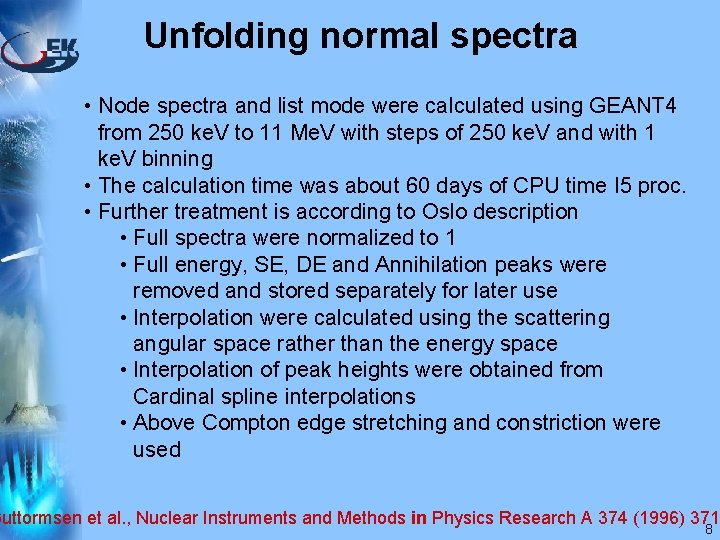
Unfolding normal spectra • Node spectra and list mode were calculated using GEANT 4 from 250 ke. V to 11 Me. V with steps of 250 ke. V and with 1 ke. V binning • The calculation time was about 60 days of CPU time I 5 proc. • Further treatment is according to Oslo description • Full spectra were normalized to 1 • Full energy, SE, DE and Annihilation peaks were removed and stored separately for later use • Interpolation were calculated using the scattering angular space rather than the energy space • Interpolation of peak heights were obtained from Cardinal spline interpolations • Above Compton edge stretching and constriction were used Guttormsen et al. , Nuclear Instruments and Methods in Physics Research A 374 (1996) 371 8
Node spectra 9
Interpolation and calculated GEANT 4 spectra 10
Unfolding of Co-60 spectrum 11
Unfolding of Eu-152 spectrum 12
Unfolding of Urea-D capture spectrum Inv-Q value 90 mb, literature 81. 5(15) mb, H contribution subtracted, C, Cl, B n 13
Unfolding of enriched 113 Cd(n, ) spectrum Measured (red), unfolded (blue) 14
Efficiency corrected 113 Cd(n, ) spectrum Inv-Q value 21640 b, literature 20600(400) b 15
Calculations with Gamma. Dex preliminary Normalization of calculation were done to macth the smooth middle part 16
Summary • Modeling of Budapest detector response reached an acceptable accuracy • Unfolding normal spectra follows the Oslo method • Examples from simple to complex were presented • Unfolding 113 Cd(n, ) spectra shows a broad bump at 2. 5 Me. V • Gamma. Dex modeling is in a preliminary stage 17
Thanks for your attention! 18