
Strength and Ductility in Tension 3 1 A
- Slides: 13
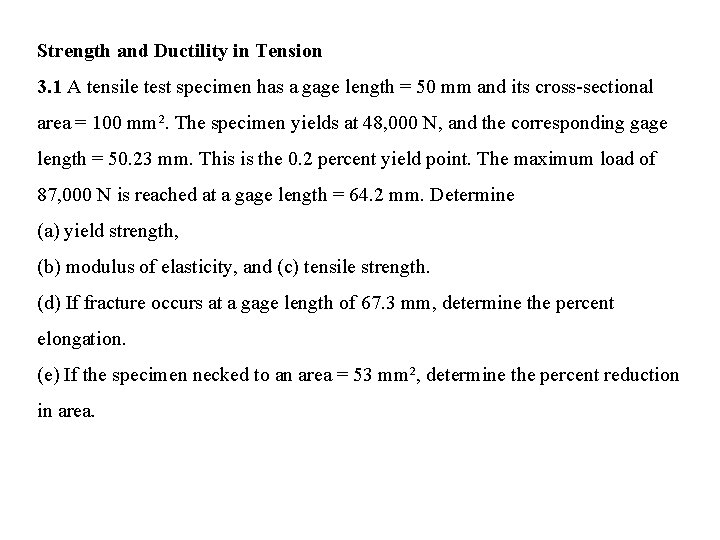
Strength and Ductility in Tension 3. 1 A tensile test specimen has a gage length = 50 mm and its cross-sectional area = 100 mm 2. The specimen yields at 48, 000 N, and the corresponding gage length = 50. 23 mm. This is the 0. 2 percent yield point. The maximum load of 87, 000 N is reached at a gage length = 64. 2 mm. Determine (a) yield strength, (b) modulus of elasticity, and (c) tensile strength. (d) If fracture occurs at a gage length of 67. 3 mm, determine the percent elongation. (e) If the specimen necked to an area = 53 mm 2, determine the percent reduction in area.
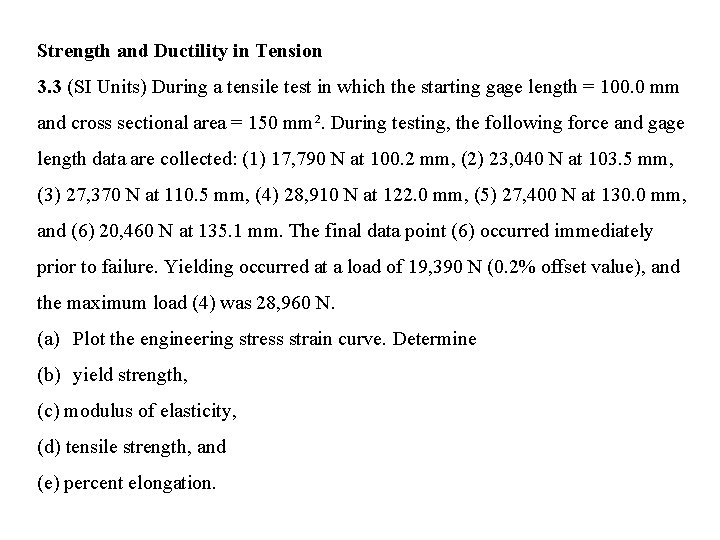
Strength and Ductility in Tension 3. 3 (SI Units) During a tensile test in which the starting gage length = 100. 0 mm and cross sectional area = 150 mm 2. During testing, the following force and gage length data are collected: (1) 17, 790 N at 100. 2 mm, (2) 23, 040 N at 103. 5 mm, (3) 27, 370 N at 110. 5 mm, (4) 28, 910 N at 122. 0 mm, (5) 27, 400 N at 130. 0 mm, and (6) 20, 460 N at 135. 1 mm. The final data point (6) occurred immediately prior to failure. Yielding occurred at a load of 19, 390 N (0. 2% offset value), and the maximum load (4) was 28, 960 N. (a) Plot the engineering stress strain curve. Determine (b) yield strength, (c) modulus of elasticity, (d) tensile strength, and (e) percent elongation.
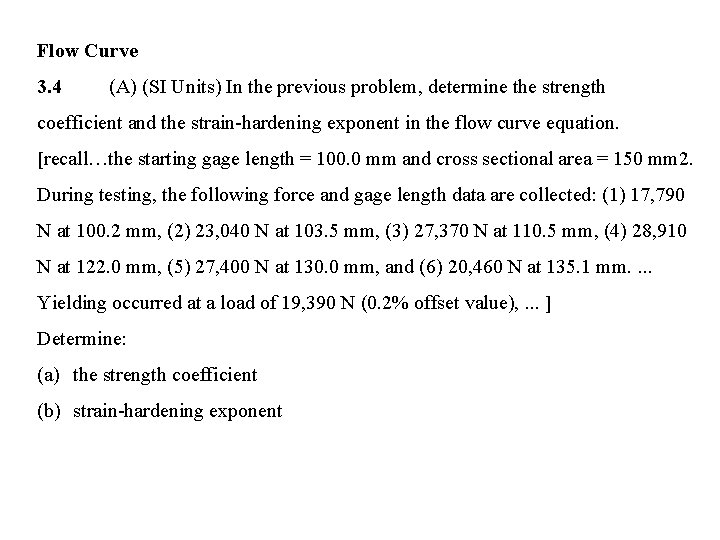
Flow Curve 3. 4 (A) (SI Units) In the previous problem, determine the strength coefficient and the strain-hardening exponent in the flow curve equation. [recall…the starting gage length = 100. 0 mm and cross sectional area = 150 mm 2. During testing, the following force and gage length data are collected: (1) 17, 790 N at 100. 2 mm, (2) 23, 040 N at 103. 5 mm, (3) 27, 370 N at 110. 5 mm, (4) 28, 910 N at 122. 0 mm, (5) 27, 400 N at 130. 0 mm, and (6) 20, 460 N at 135. 1 mm. . Yielding occurred at a load of 19, 390 N (0. 2% offset value), . . . ] Determine: (a) the strength coefficient (b) strain-hardening exponent
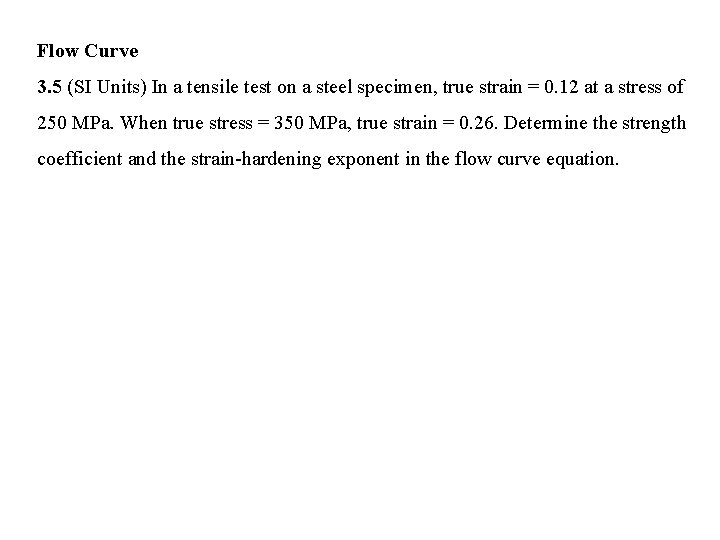
Flow Curve 3. 5 (SI Units) In a tensile test on a steel specimen, true strain = 0. 12 at a stress of 250 MPa. When true stress = 350 MPa, true strain = 0. 26. Determine the strength coefficient and the strain-hardening exponent in the flow curve equation.
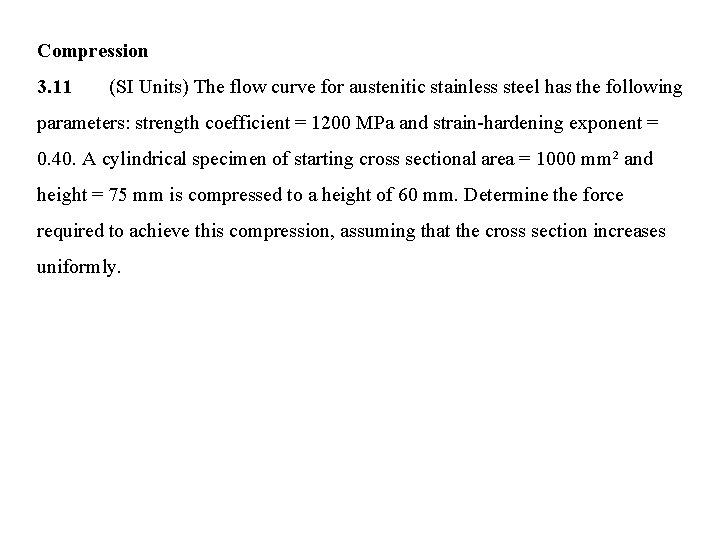
Compression 3. 11 (SI Units) The flow curve for austenitic stainless steel has the following parameters: strength coefficient = 1200 MPa and strain-hardening exponent = 0. 40. A cylindrical specimen of starting cross sectional area = 1000 mm 2 and height = 75 mm is compressed to a height of 60 mm. Determine the force required to achieve this compression, assuming that the cross section increases uniformly.
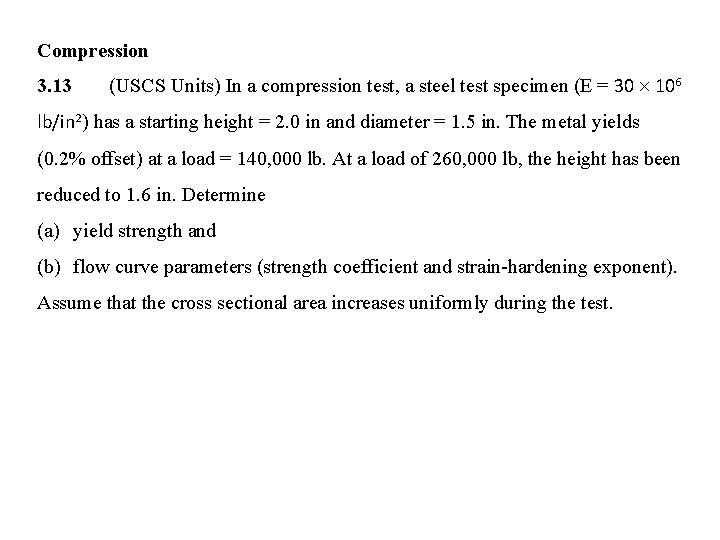
Compression 3. 13 (USCS Units) In a compression test, a steel test specimen (E = 30 106 lb/in 2) has a starting height = 2. 0 in and diameter = 1. 5 in. The metal yields (0. 2% offset) at a load = 140, 000 lb. At a load of 260, 000 lb, the height has been reduced to 1. 6 in. Determine (a) yield strength and (b) flow curve parameters (strength coefficient and strain-hardening exponent). Assume that the cross sectional area increases uniformly during the test.
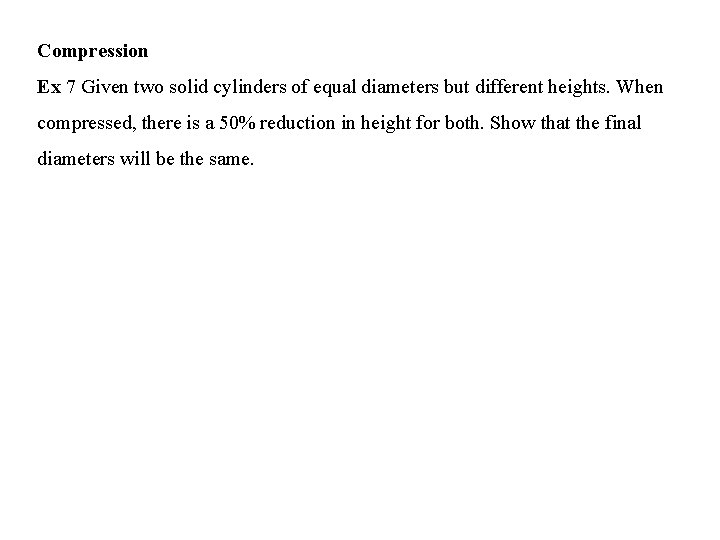
Compression Ex 7 Given two solid cylinders of equal diameters but different heights. When compressed, there is a 50% reduction in height for both. Show that the final diameters will be the same.
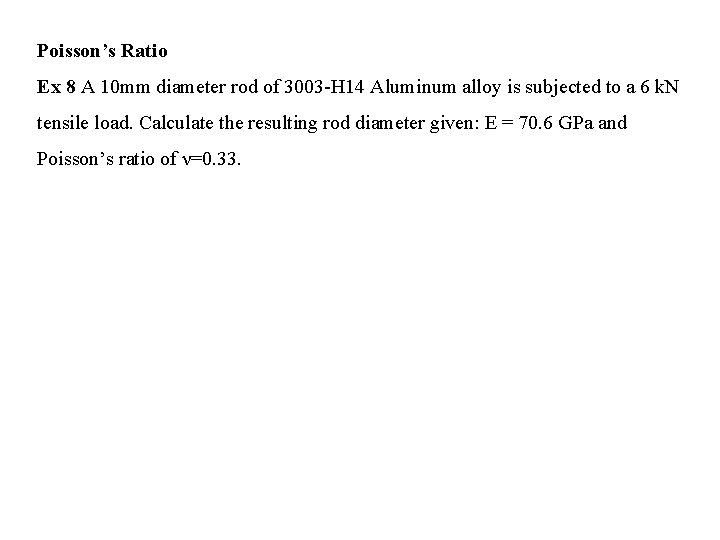
Poisson’s Ratio Ex 8 A 10 mm diameter rod of 3003 -H 14 Aluminum alloy is subjected to a 6 k. N tensile load. Calculate the resulting rod diameter given: E = 70. 6 GPa and Poisson’s ratio of ν=0. 33.
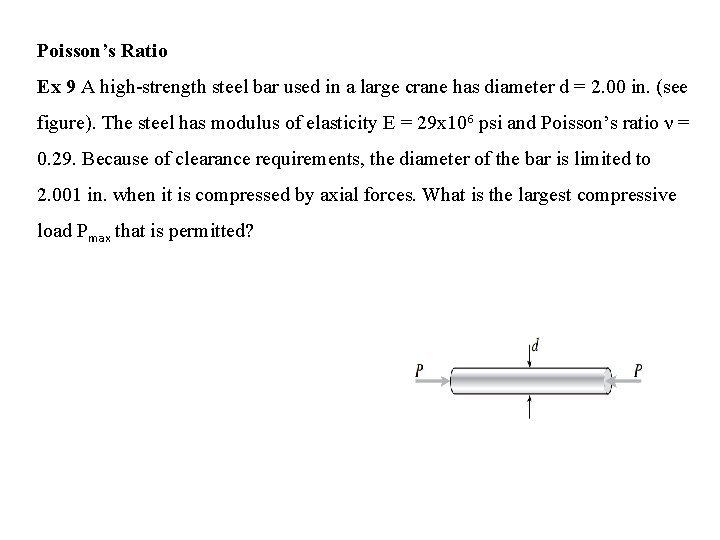
Poisson’s Ratio Ex 9 A high-strength steel bar used in a large crane has diameter d = 2. 00 in. (see figure). The steel has modulus of elasticity E = 29 x 106 psi and Poisson’s ratio ν = 0. 29. Because of clearance requirements, the diameter of the bar is limited to 2. 001 in. when it is compressed by axial forces. What is the largest compressive load Pmax that is permitted?
Bending and Shear 3. 14 (A) (SI Units) A bending test is used on an experimental cemented carbide material. Based on previous testing of the material, its transverse rupture strength = 1000 MPa, what is the anticipated load at which the specimen is likely to fail, given that its width = 15 mm, thickness = 7. 5 mm, and length = 50 mm?
Bending and Shear 3. 15 (SI Units) A torsion test specimen has a radius = 25 mm, wall thickness = 3 mm, and gage length = 50 mm. In testing, a torque of 900 N m results in an angular deflection = 0. 3. Determine (a) the shear stress, (b) shear strain, and (c) shear modulus, assuming the specimen had not yet yielded. (d) If failure of the specimen occurs at a torque = 1200 N m and a corresponding angular deflection = 10 , what is the shear strength of the metal?
Bending and Shear Ex 12 A torque of 6000 ft-lb is applied in a torsion test on a thin walled tubular specimen whose radius = 1. 5 in, wall thickness = 0. 125 in, and gauge length = 2. 0 in. This causes an angular deflection = 1°. Determine (a) shear stress, (b) shear strain (c) shear modulus, assuming the specimen has not yielded. (d) If the specimen fails at a torque = 8000 ft-lb and an angular deflection = 20°, calculate the shear strength of the metal.
Hardness 3. 17 (A) (SI/USCS Units) In a Brinell hardness test, a 1500 -kg load is pressed into a specimen using a 10 -mm-diameter hardened steel ball. The resulting indentation has a diameter = 3. 2 mm. (a) Determine the Brinell hardness number for the metal. (b) If the specimen is steel, estimate the tensile strength of the steel.