
STREAM Trials Andrew Nunn MRC Clinical Trials Unit




- Slides: 14
STREAM Trials Andrew Nunn MRC Clinical Trials Unit at UCL 26 th October 2016 1
STREAM Stage 1 study design • STREAM Stage 1 is a randomised controlled trial of noninferiority design currently being conducted in Ethiopia, South Africa, Vietnam and Mongolia • The control regimen (A) is the locally used WHO 2011 recommended regimen • The study regimen (B) is closely similar to the regimen used in Bangladesh with the exception that high dose moxifloxacin replaces high dose gatifloxacin
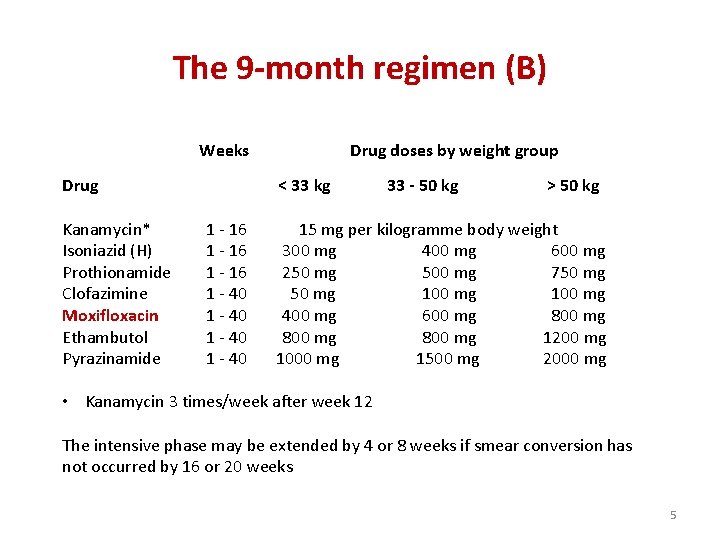
The 9 -month regimen (B) Weeks Drug Kanamycin* Isoniazid (H) Prothionamide Clofazimine Moxifloxacin Ethambutol Pyrazinamide Drug doses by weight group < 33 kg 1 - 16 1 - 40 33 - 50 kg > 50 kg 15 mg per kilogramme body weight 300 mg 400 mg 600 mg 250 mg 500 mg 750 mg 100 mg 400 mg 600 mg 800 mg 1200 mg 1000 mg 1500 mg 2000 mg • Kanamycin 3 times/week after week 12 The intensive phase may be extended by 4 or 8 weeks if smear conversion has not occurred by 16 or 20 weeks 5
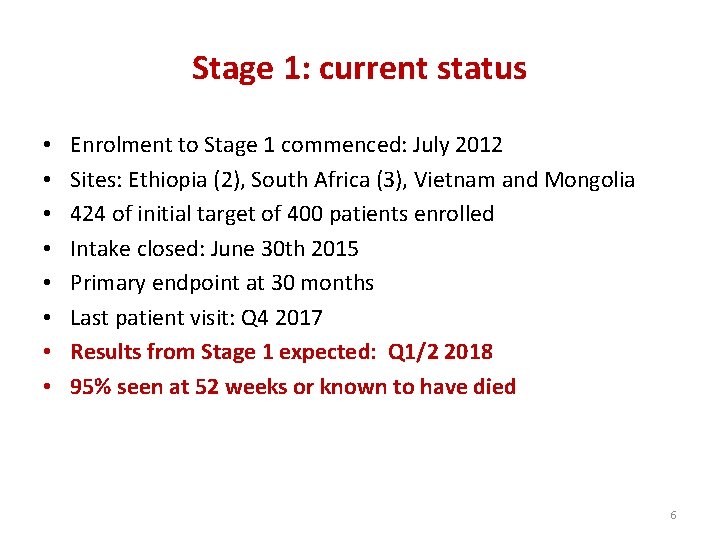
Stage 1: current status • • Enrolment to Stage 1 commenced: July 2012 Sites: Ethiopia (2), South Africa (3), Vietnam and Mongolia 424 of initial target of 400 patients enrolled Intake closed: June 30 th 2015 Primary endpoint at 30 months Last patient visit: Q 4 2017 Results from Stage 1 expected: Q 1/2 2018 95% seen at 52 weeks or known to have died 6
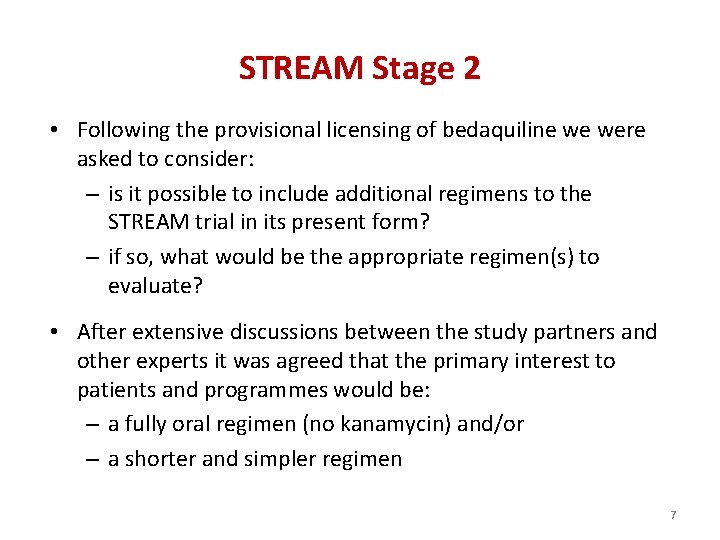
STREAM Stage 2 • Following the provisional licensing of bedaquiline we were asked to consider: – is it possible to include additional regimens to the STREAM trial in its present form? – if so, what would be the appropriate regimen(s) to evaluate? • After extensive discussions between the study partners and other experts it was agreed that the primary interest to patients and programmes would be: – a fully oral regimen (no kanamycin) and/or – a shorter and simpler regimen 7
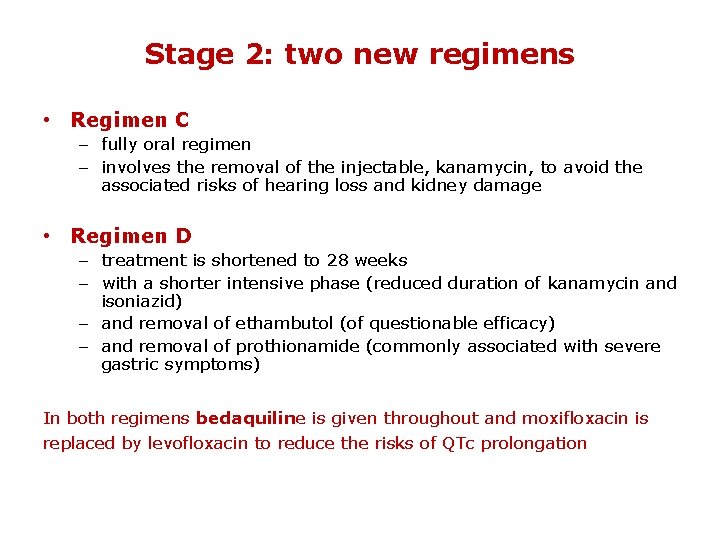
Stage 2: two new regimens • Regimen C – fully oral regimen – involves the removal of the injectable, kanamycin, to avoid the associated risks of hearing loss and kidney damage • Regimen D – treatment is shortened to 28 weeks – with a shorter intensive phase (reduced duration of kanamycin and isoniazid) – and removal of ethambutol (of questionable efficacy) – and removal of prothionamide (commonly associated with severe gastric symptoms) In both regimens bedaquiline is given throughout and moxifloxacin is replaced by levofloxacin to reduce the risks of QTc prolongation
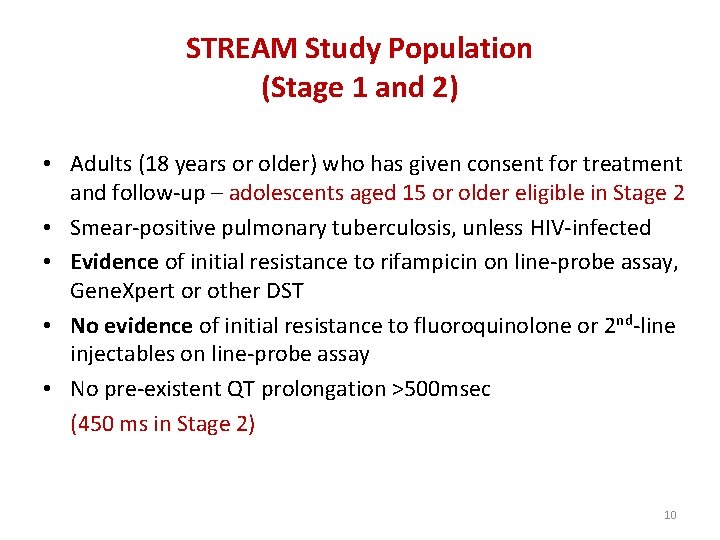
STREAM Study Population (Stage 1 and 2) • Adults (18 years or older) who has given consent for treatment and follow-up – adolescents aged 15 or older eligible in Stage 2 • Smear-positive pulmonary tuberculosis, unless HIV-infected • Evidence of initial resistance to rifampicin on line-probe assay, Gene. Xpert or other DST • No evidence of initial resistance to fluoroquinolone or 2 nd-line injectables on line-probe assay • No pre-existent QT prolongation >500 msec (450 ms in Stage 2) 10
STREAM Stage 2 design • Because it is possible that the control regimen, Regimen B, might not be found to be non-inferior to Regimen A it was decided to continue to enrol patients to Regimen A • Secondary objectives include the comparisons of Regimen C and Regimen D to Regimen A; these will be particularly important if Regimen B is found to be inferior to Regimen A 11
STREAM Stage 2 Design Primary objectives: • To assess whether Regimen C (fully oral), and/or Regimen D (6 months), are as effective as, or are superior to, Regimen B (modified Bangladesh regimen) at 76 weeks (18 months) • Randomisation ratio: 1: 2: 2: 2 (A: B: C: D) • Sample size: 1155 • Long term follow-up to 132 weeks (~2. 5 years) Funding from USAID & Janssen Intention to submit results to FDA for full licensing application
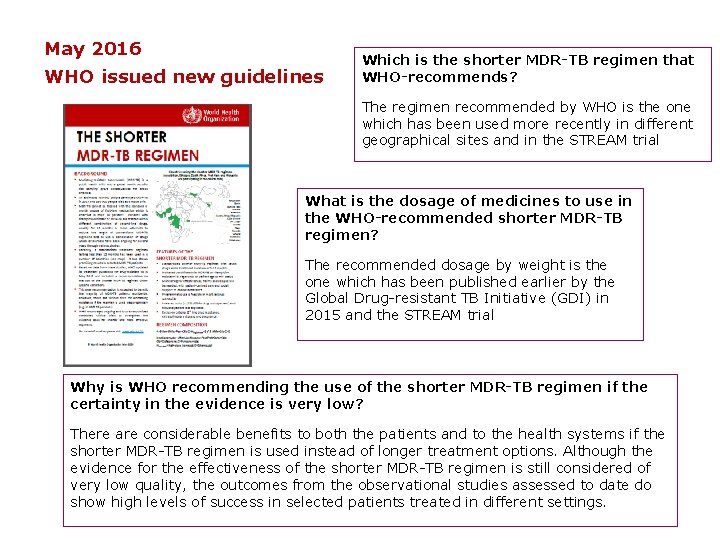
May 2016 WHO issued new guidelines Which is the shorter MDR-TB regimen that WHO-recommends? The regimen recommended by WHO is the one which has been used more recently in different geographical sites and in the STREAM trial What is the dosage of medicines to use in the WHO-recommended shorter MDR-TB regimen? The recommended dosage by weight is the one which has been published earlier by the Global Drug-resistant TB Initiative (GDI) in 2015 and the STREAM trial Why is WHO recommending the use of the shorter MDR-TB regimen if the certainty in the evidence is very low? There are considerable benefits to both the patients and to the health systems if the shorter MDR-TB regimen is used instead of longer treatment options. Although the evidence for the effectiveness of the shorter MDR-TB regimen is still considered of very low quality, the outcomes from the observational studies assessed to date do show high levels of success in selected patients treated in different settings.
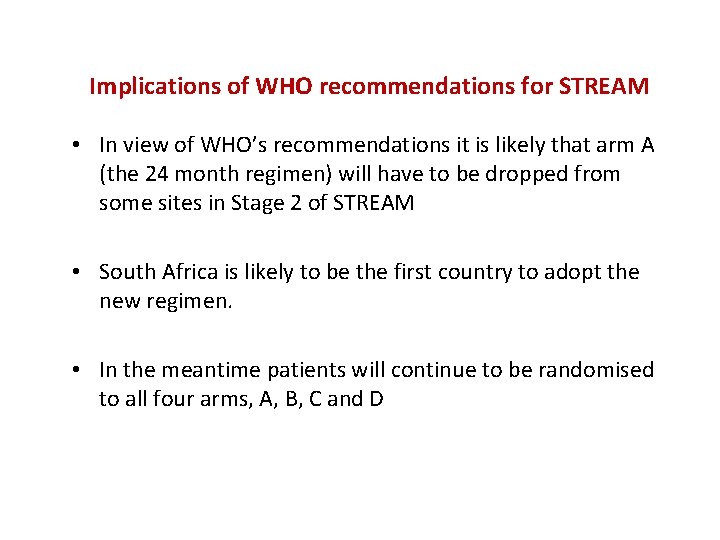
Implications of WHO recommendations for STREAM • In view of WHO’s recommendations it is likely that arm A (the 24 month regimen) will have to be dropped from some sites in Stage 2 of STREAM • South Africa is likely to be the first country to adopt the new regimen. • In the meantime patients will continue to be randomised to all four arms, A, B, C and D
What if? • What if Regimen B is inferior to Regimen A - will there be sufficient patients randomised to Regimen A to compare with C and D? - if not a network meta-analysis will be needed to compare: B with A (Stage 1) C and D with B (Stage 2) In a network meta-analysis three or more treatments are compared using both direct comparisons of interventions within randomised controlled trials and indirect comparisons across trials based on a common comparator.
STREAM Stage 2 April 2016: First patient enrolled (Mongolia) Five sites now open to recruitment (recruitment paused in Ethiopia due to state of emergency) Additional sites planned for Africa, Asia and Eastern Europe
Community Engagement In STREAM Stage 2, Mongolia and South Africa have established regular community engagement activities and CAB meetings Preliminary CE meetings were held in Ethiopia in September 2016 STREAM Community Engagement Plan launched in in Durban in July 2016 (available on TREAT TB website together with video)