
Stream Chemistry Monitoring Students Investigating Conserving Their Streams

- Slides: 20
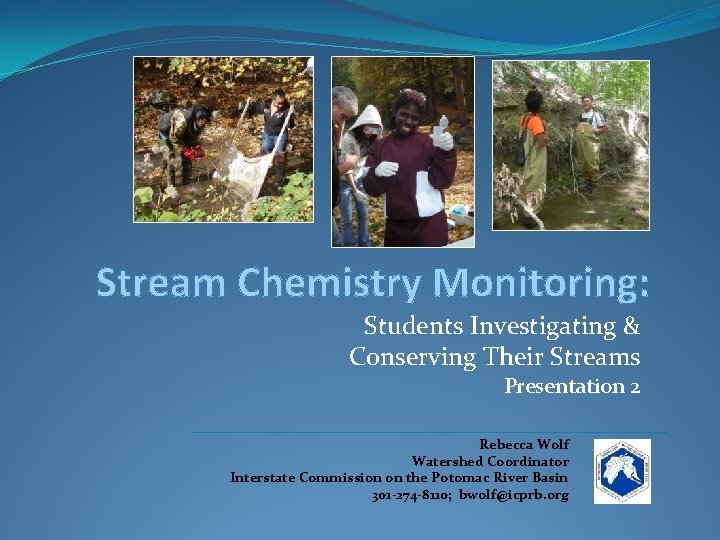
Stream Chemistry Monitoring: Students Investigating & Conserving Their Streams Presentation 2 Rebecca Wolf Watershed Coordinator Interstate Commission on the Potomac River Basin 301 -274 -8110; bwolf@icprb. org
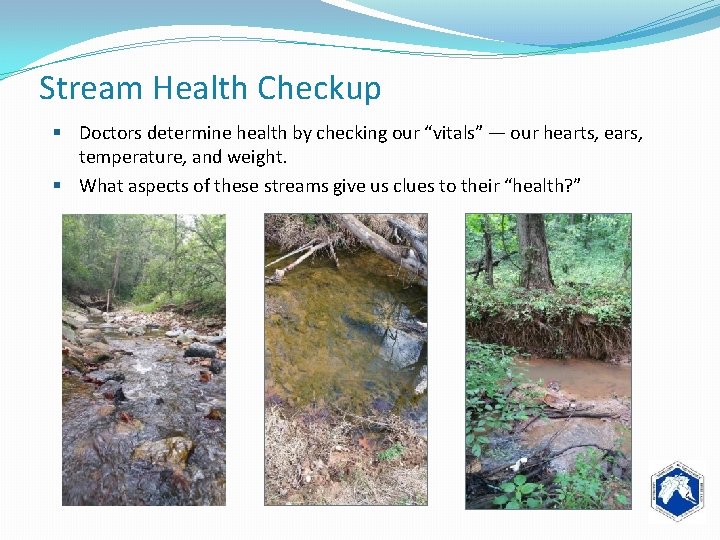
Stream Health Checkup § Doctors determine health by checking our “vitals” ― our hearts, ears, temperature, and weight. § What aspects of these streams give us clues to their “health? ”
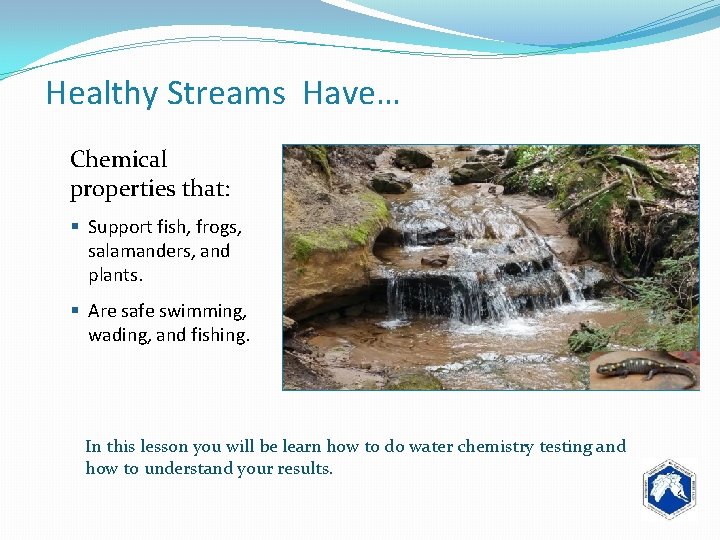
Healthy Streams Have… Chemical properties that: § Support fish, frogs, salamanders, and plants. § Are safe swimming, wading, and fishing. In this lesson you will be learn how to do water chemistry testing and how to understand your results.
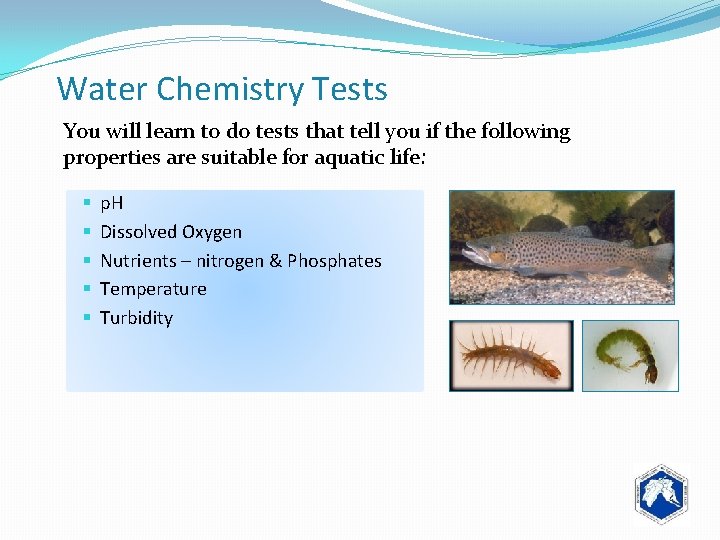
Water Chemistry Tests You will learn to do tests that tell you if the following properties are suitable for aquatic life: § § § p. H Dissolved Oxygen Nutrients – nitrogen & Phosphates Temperature Turbidity
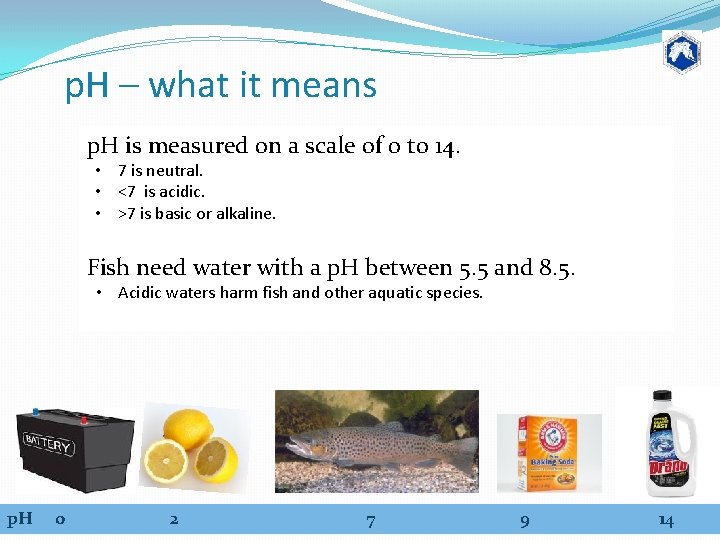
p. H – what it means p. H is measured on a scale of 0 to 14. • 7 is neutral. • <7 is acidic. • >7 is basic or alkaline. Fish need water with a p. H between 5. 5 and 8. 5. • Acidic waters harm fish and other aquatic species. p. H 0 2 7 9 14
p. H and fish health • What is the normal range of p. H for a stream? • At what p. H levels do most adult fish die? • Are these levels acidic or basic (alkaline)? Ph Level
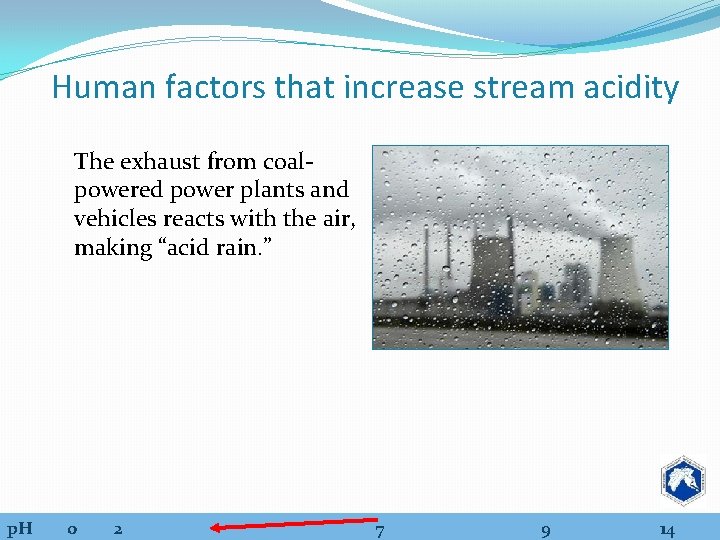
Human factors that increase stream acidity The exhaust from coalpowered power plants and vehicles reacts with the air, making “acid rain. ” p. H 0 2 7 9 14
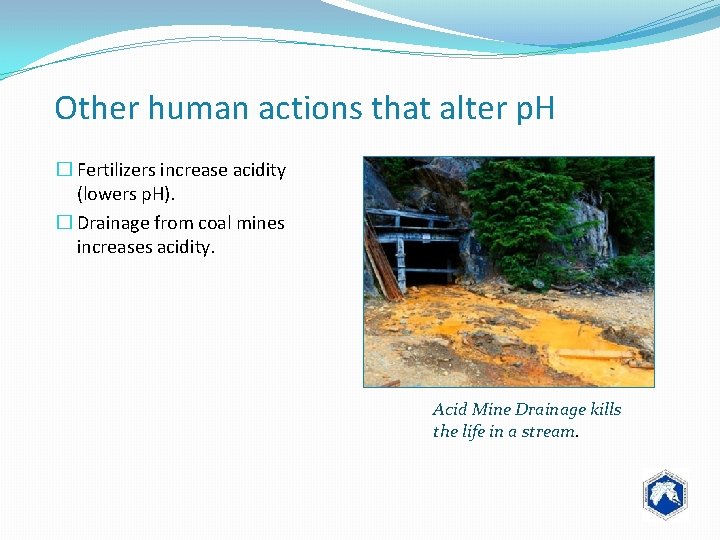
Other human actions that alter p. H � Fertilizers increase acidity (lowers p. H). � Drainage from coal mines increases acidity. Acid Mine Drainage kills the life in a stream.
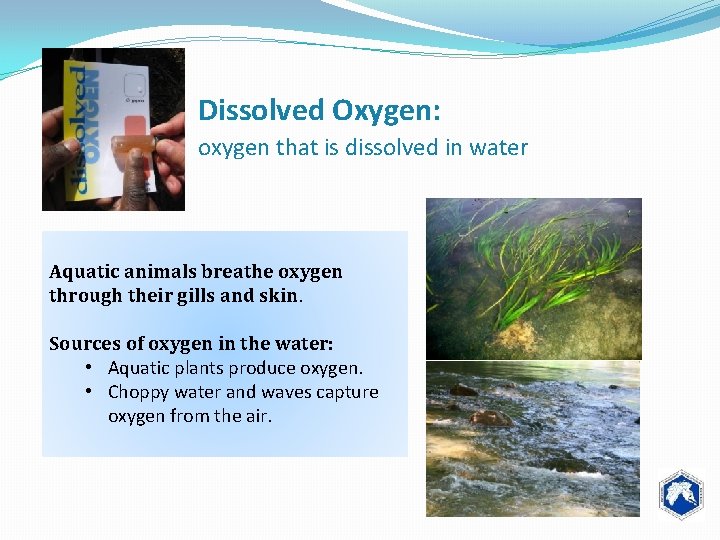
Dissolved Oxygen: oxygen that is dissolved in water Aquatic animals breathe oxygen through their gills and skin. Sources of oxygen in the water: • Aquatic plants produce oxygen. • Choppy water and waves capture oxygen from the air.
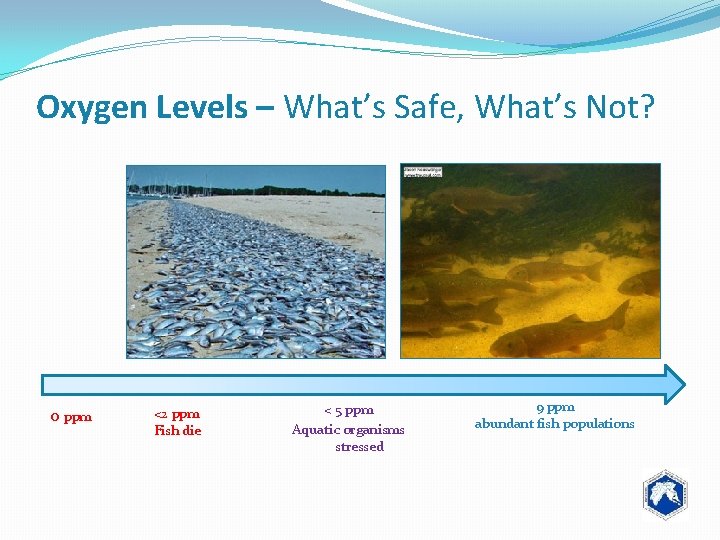
Oxygen Levels – What’s Safe, What’s Not? 0 ppm <2 ppm Fish die < 5 ppm Aquatic organisms stressed 9 ppm abundant fish populations
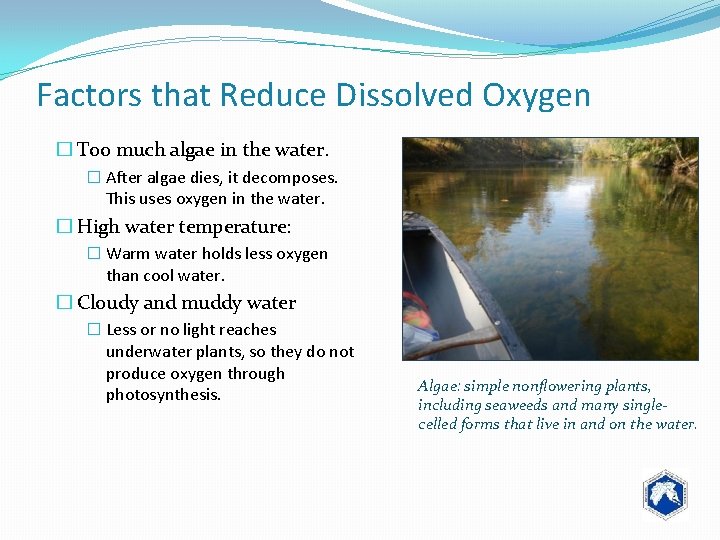
Factors that Reduce Dissolved Oxygen � Too much algae in the water. � After algae dies, it decomposes. This uses oxygen in the water. � High water temperature: � Warm water holds less oxygen than cool water. � Cloudy and muddy water � Less or no light reaches underwater plants, so they do not produce oxygen through photosynthesis. Algae: simple nonflowering plants, including seaweeds and many singlecelled forms that live in and on the water.
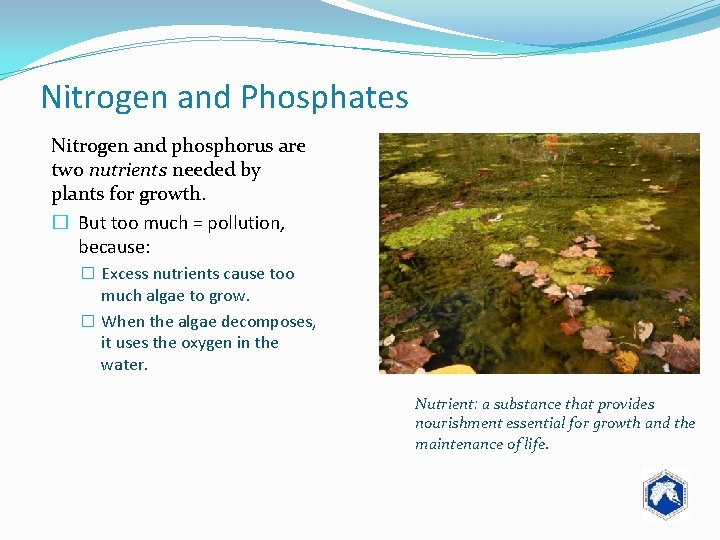
Nitrogen and Phosphates Nitrogen and phosphorus are two nutrients needed by plants for growth. � But too much = pollution, because: � Excess nutrients cause too much algae to grow. � When the algae decomposes, it uses the oxygen in the water. Nutrient: a substance that provides nourishment essential for growth and the maintenance of life.
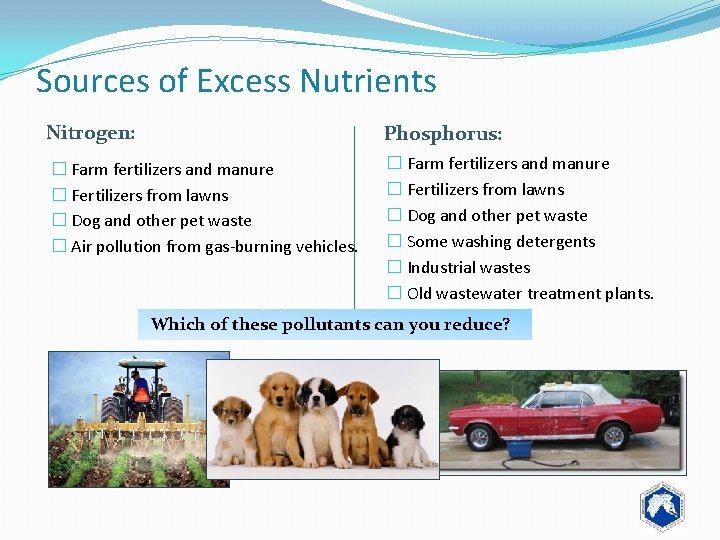
Sources of Excess Nutrients Nitrogen: Phosphorus: � Farm fertilizers and manure � Fertilizers from lawns � Dog and other pet waste � Air pollution from gas-burning vehicles. � Farm fertilizers and manure � Fertilizers from lawns � Dog and other pet waste � Some washing detergents � Industrial wastes � Old wastewater treatment plants. Which of these pollutants can you reduce?
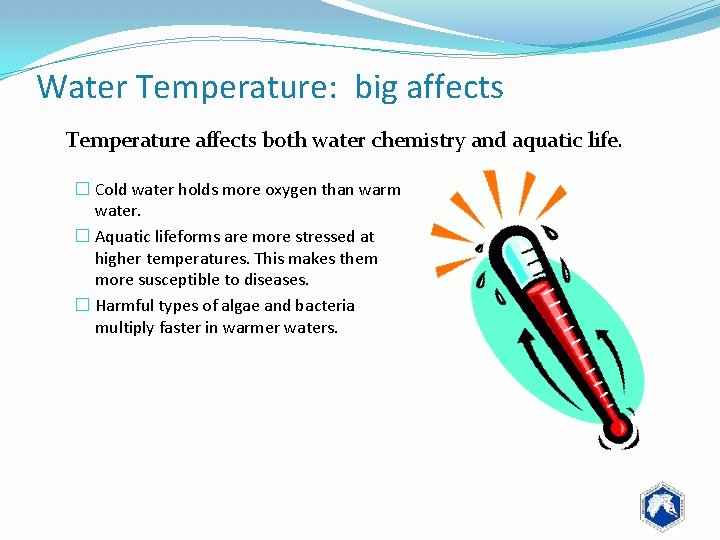
Water Temperature: big affects Temperature affects both water chemistry and aquatic life. � Cold water holds more oxygen than warm water. � Aquatic lifeforms are more stressed at higher temperatures. This makes them more susceptible to diseases. � Harmful types of algae and bacteria multiply faster in warmer waters.
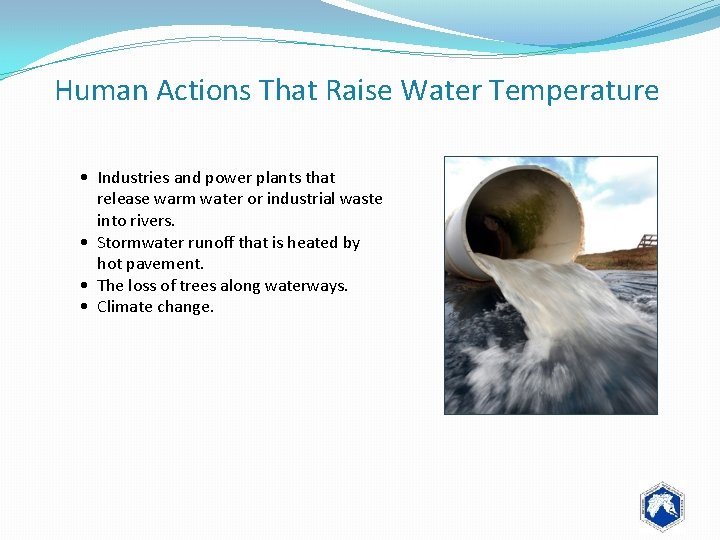
Human Actions That Raise Water Temperature • Industries and power plants that release warm water or industrial waste into rivers. • Stormwater runoff that is heated by hot pavement. • The loss of trees along waterways. • Climate change.
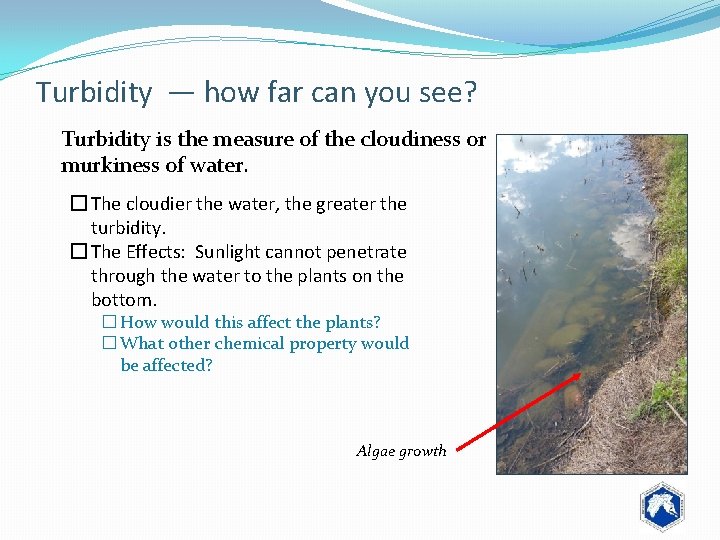
Turbidity ― how far can you see? Turbidity is the measure of the cloudiness or murkiness of water. � The cloudier the water, the greater the turbidity. � The Effects: Sunlight cannot penetrate through the water to the plants on the bottom. � How would this affect the plants? � What other chemical property would be affected? Algae growth
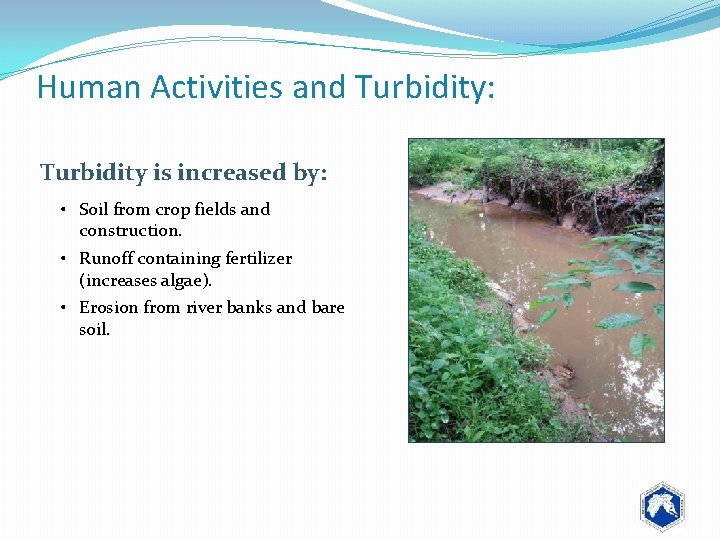
Human Activities and Turbidity: Turbidity is increased by: • Soil from crop fields and construction. • Runoff containing fertilizer (increases algae). • Erosion from river banks and bare soil. 17
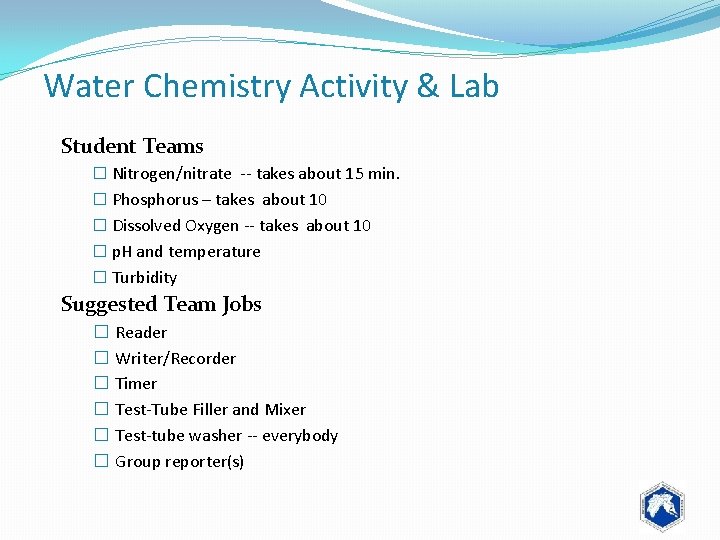
Water Chemistry Activity & Lab Student Teams � Nitrogen/nitrate -- takes about 15 min. � Phosphorus – takes about 10 � Dissolved Oxygen -- takes about 10 � p. H and temperature � Turbidity Suggested Team Jobs � Reader � Writer/Recorder � Timer � Test-Tube Filler and Mixer � Test-tube washer -- everybody � Group reporter(s)
Team Report to the Class �Tell about your chemical or water property. �Tell and show possible sources of pollution near your stream. �Show the chart with your results. �Give your results and thoughts about the results.
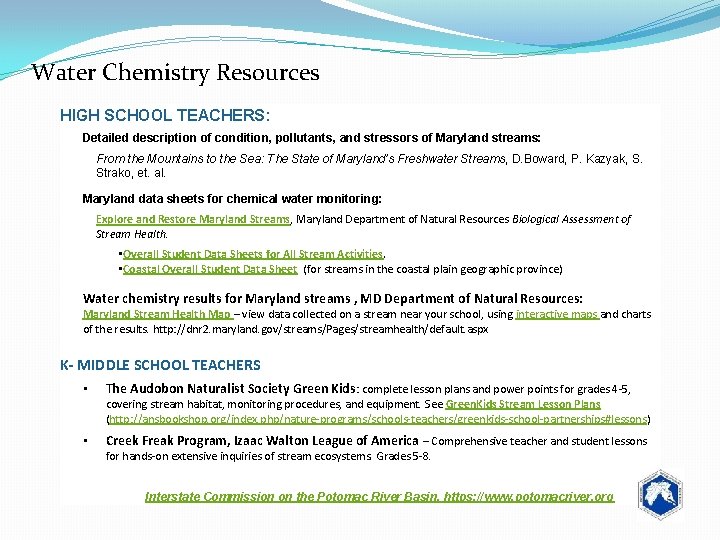
Water Chemistry Resources HIGH SCHOOL TEACHERS: Detailed description of condition, pollutants, and stressors of Maryland streams: From the Mountains to the Sea: The State of Maryland’s Freshwater Streams, D. Boward, P. Kazyak, S. Strako, et. al. Maryland data sheets for chemical water monitoring: Explore and Restore Maryland Streams, Maryland Department of Natural Resources Biological Assessment of Stream Health. • Overall Student Data Sheets for All Stream Activities. • Coastal Overall Student Data Sheet (for streams in the coastal plain geographic province) Water chemistry results for Maryland streams , MD Department of Natural Resources: Maryland Stream Health Map – view data collected on a stream near your school, using interactive maps and charts of the results. http: //dnr 2. maryland. gov/streams/Pages/streamhealth/default. aspx K- MIDDLE SCHOOL TEACHERS • The Audobon Naturalist Society Green Kids: complete lesson plans and power points for grades 4 -5, covering stream habitat, monitoring procedures, and equipment. See Green. Kids Stream Lesson Plans (http: //ansbookshop. org/index. php/nature-programs/schools-teachers/greenkids-school-partnerships#lessons) • Creek Freak Program, Izaac Walton League of America – Comprehensive teacher and student lessons for hands-on extensive inquiries of stream ecosystems. Grades 5 -8. Interstate Commission on the Potomac River Basin, https: //www. potomacriver. org