
STRATIGRAPHY Introduction The term Stratigraphy comes from stratum

- Slides: 15
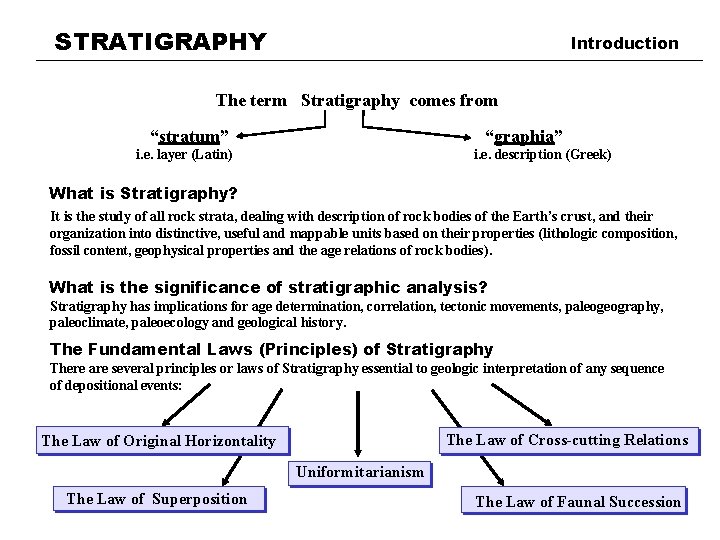
STRATIGRAPHY Introduction The term Stratigraphy comes from “stratum” “graphia” i. e. layer (Latin) i. e. description (Greek) What is Stratigraphy? It is the study of all rock strata, dealing with description of rock bodies of the Earth’s crust, and their organization into distinctive, useful and mappable units based on their properties (lithologic composition, fossil content, geophysical properties and the age relations of rock bodies). What is the significance of stratigraphic analysis? Stratigraphy has implications for age determination, correlation, tectonic movements, paleogeography, paleoclimate, paleoecology and geological history. The Fundamental Laws (Principles) of Stratigraphy There are several principles or laws of Stratigraphy essential to geologic interpretation of any sequence of depositional events: The Law of Cross-cutting Relations The Law of Original Horizontality Uniformitarianism The Law of Superposition The Law of Faunal Succession
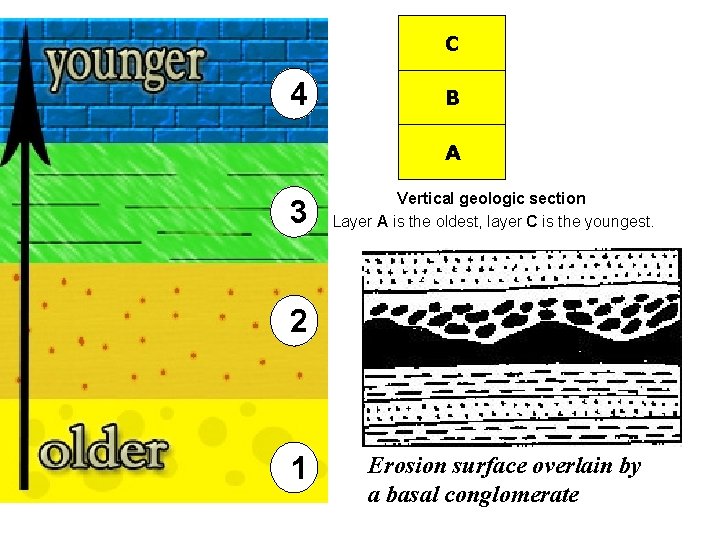
C 4 B A 3 Vertical geologic section Layer A is the oldest, layer C is the youngest. 2 1 Erosion surface overlain by a basal conglomerate
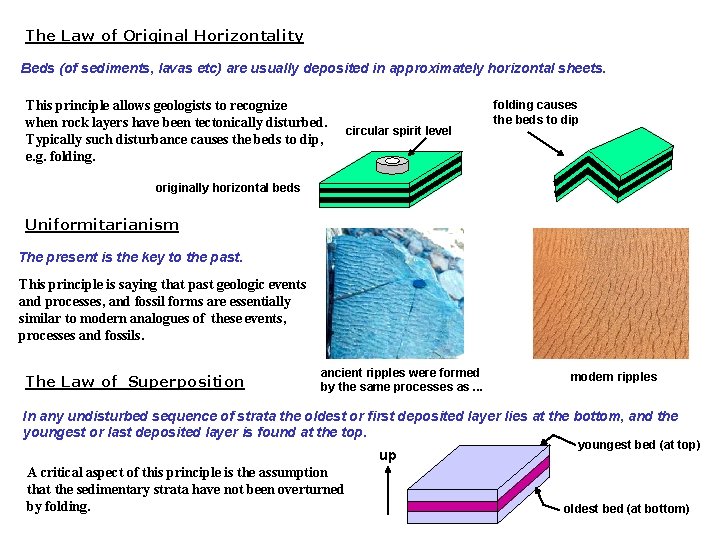
The Law of Original Horizontality Beds (of sediments, lavas etc) are usually deposited in approximately horizontal sheets. This principle allows geologists to recognize when rock layers have been tectonically disturbed. Typically such disturbance causes the beds to dip, e. g. folding. circular spirit level folding causes the beds to dip originally horizontal beds Uniformitarianism The present is the key to the past. This principle is saying that past geologic events and processes, and fossil forms are essentially similar to modern analogues of these events, processes and fossils. The Law of Superposition ancient ripples were formed by the same processes as. . . modern ripples In any undisturbed sequence of strata the oldest or first deposited layer lies at the bottom, and the youngest or last deposited layer is found at the top. up A critical aspect of this principle is the assumption that the sedimentary strata have not been overturned by folding. youngest bed (at top) oldest bed (at bottom)
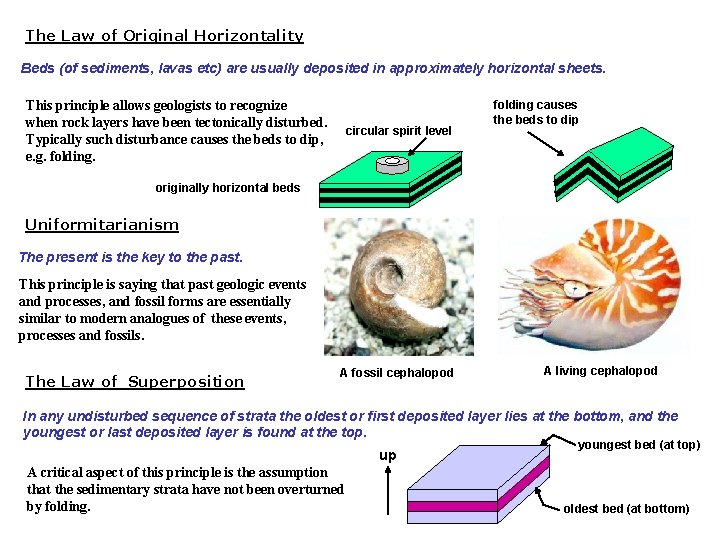
The Law of Original Horizontality Beds (of sediments, lavas etc) are usually deposited in approximately horizontal sheets. This principle allows geologists to recognize when rock layers have been tectonically disturbed. Typically such disturbance causes the beds to dip, e. g. folding. circular spirit level folding causes the beds to dip originally horizontal beds Uniformitarianism The present is the key to the past. This principle is saying that past geologic events and processes, and fossil forms are essentially similar to modern analogues of these events, processes and fossils. The Law of Superposition A fossil cephalopod A living cephalopod In any undisturbed sequence of strata the oldest or first deposited layer lies at the bottom, and the youngest or last deposited layer is found at the top. up A critical aspect of this principle is the assumption that the sedimentary strata have not been overturned by folding. youngest bed (at top) oldest bed (at bottom)
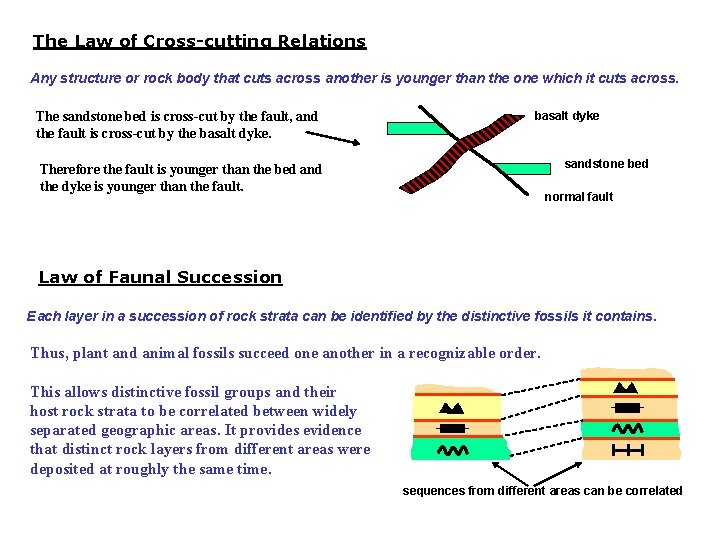
The Law of Cross-cutting Relations Any structure or rock body that cuts across another is younger than the one which it cuts across. The sandstone bed is cross-cut by the fault, and the fault is cross-cut by the basalt dyke sandstone bed Therefore the fault is younger than the bed and the dyke is younger than the fault. normal fault Law of Faunal Succession Each layer in a succession of rock strata can be identified by the distinctive fossils it contains. Thus, plant and animal fossils succeed one another in a recognizable order. This allows distinctive fossil groups and their host rock strata to be correlated between widely separated geographic areas. It provides evidence that distinct rock layers from different areas were deposited at roughly the same time. sequences from different areas can be correlated
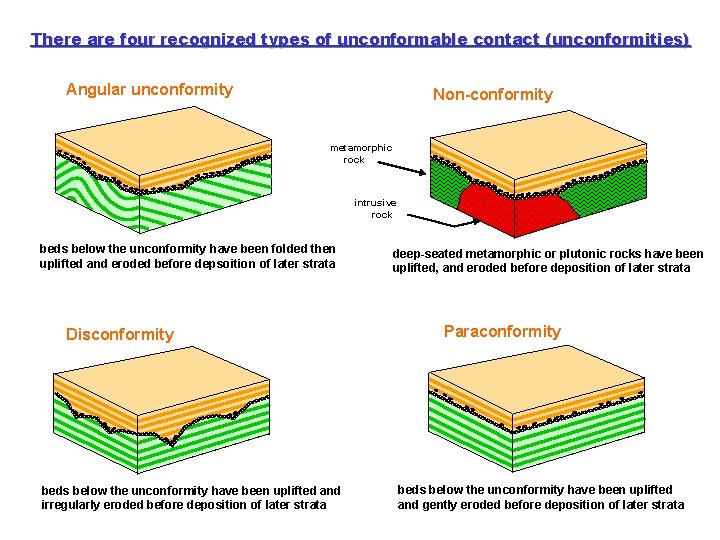
STRATIGRAPHY Stratigraphic contacts Conformability of contacts An important part of lithostratigraphy lies in identifying and understanding the nature of contacts between X 7 6 5 4 3 2 1 vertically superposed layers and laterally adjacent layers 1 2 3 These contacts may be planar or irregular in shape Vertically superposed strata (layers lying one on top of the other) are either conformable or unconformable depending on whether deposition was continuous or not. When there has been continuous (uninterrupted) deposition between two depositional assemblages, we describe their shared contact as conformable The beds are generally deposited as parallel layers, one above the other Unconformable contacts (or unconformities) are those representing surfaces of erosion or non-deposition, separating younger strata from older rocks. The unconformity represents a significant hiatus produced by periods of non-deposition, weathering or erosion, either subaerially or subaqueously, prior to deposition of younger beds.
There are four recognized types of unconformable contact (unconformities) Angular unconformity Non-conformity metamorphic rock intrusive rock beds below the unconformity have been folded then uplifted and eroded before depsoition of later strata Disconformity beds below the unconformity have been uplifted and irregularly eroded before deposition of later strata deep-seated metamorphic or plutonic rocks have been uplifted, and eroded before deposition of later strata Paraconformity beds below the unconformity have been uplifted and gently eroded before deposition of later strata
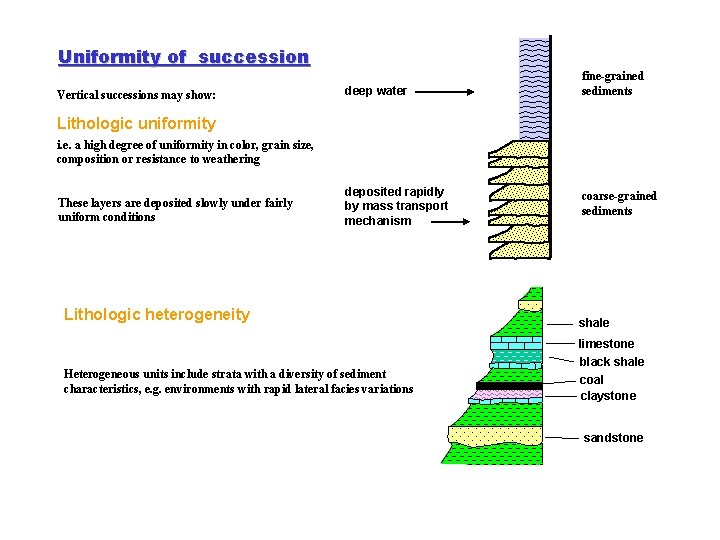
Uniformity of succession Vertical successions may show: deep water fine-grained sediments Lithologic uniformity i. e. a high degree of uniformity in color, grain size, composition or resistance to weathering These layers are deposited slowly under fairly uniform conditions deposited rapidly by mass transport mechanism Lithologic heterogeneity Heterogeneous units include strata with a diversity of sediment characteristics, e. g. environments with rapid lateral facies variations coarse-grained sediments shale limestone black shale coal claystone sandstone
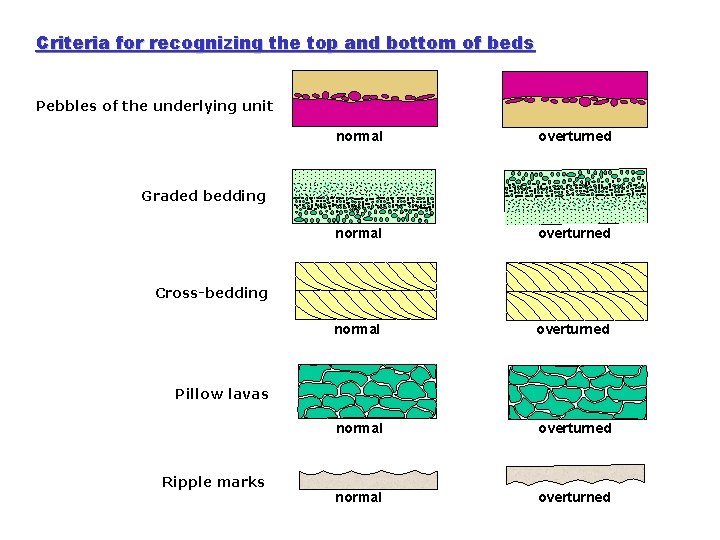
Criteria for recognizing the top and bottom of beds Pebbles of the underlying unit normal overturned normal overturned Graded bedding Cross-bedding Pillow lavas Ripple marks
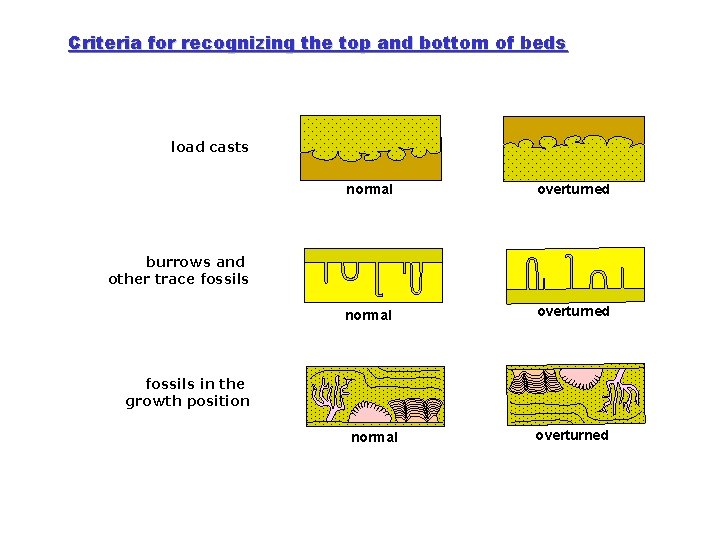
Criteria for recognizing the top and bottom of beds load casts normal overturned burrows and other trace fossils in the growth position normal overturned
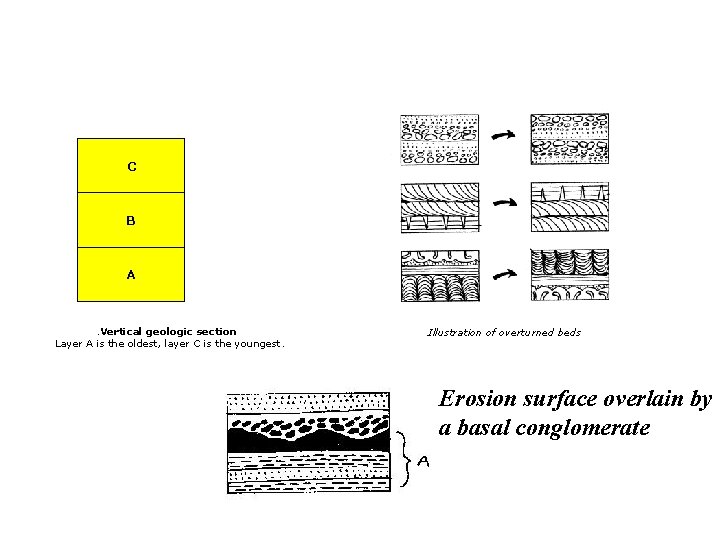
C B A . Vertical geologic section Layer A is the oldest, layer C is the youngest. . Illustration of overturned beds Erosion surface overlain by a basal conglomerate
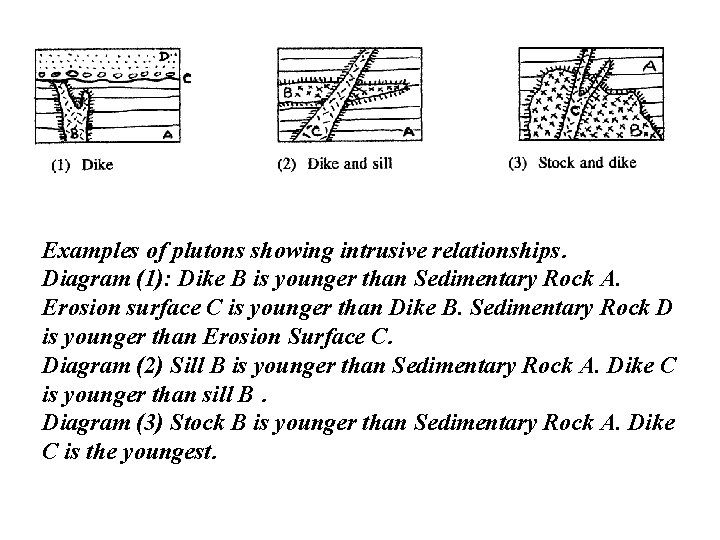
Examples of plutons showing intrusive relationships. Diagram (1): Dike B is younger than Sedimentary Rock A. Erosion surface C is younger than Dike B. Sedimentary Rock D is younger than Erosion Surface C. Diagram (2) Sill B is younger than Sedimentary Rock A. Dike C is younger than sill B. Diagram (3) Stock B is younger than Sedimentary Rock A. Dike C is the youngest.
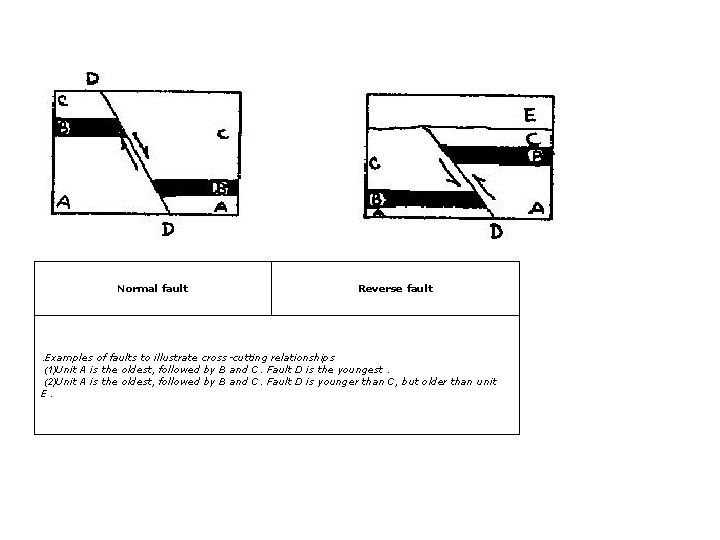
Normal fault Reverse fault . Examples of faults to illustrate cross -cutting relationships (1)Unit A is the oldest, followed by B and C. Fault D is the youngest. (2)Unit A is the oldest, followed by B and C. Fault D is younger than C, but older than unit E.
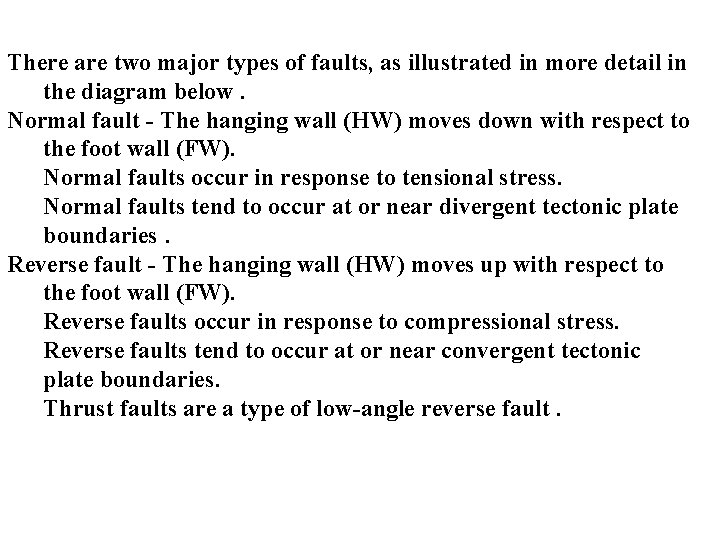
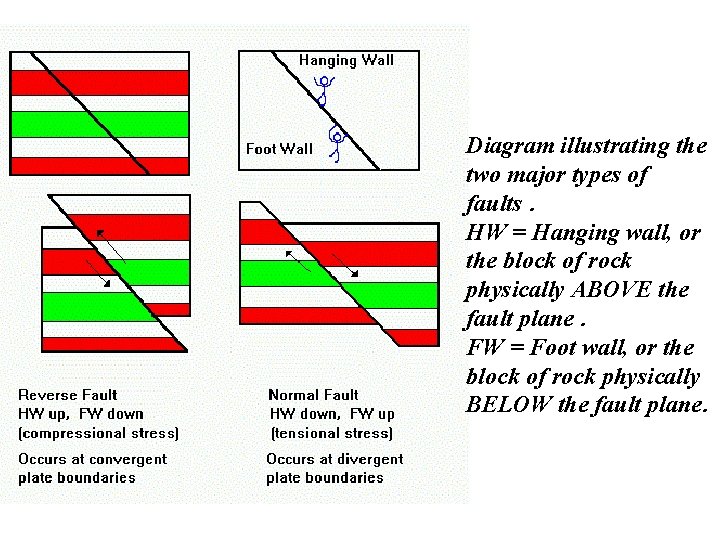
There are two major types of faults, as illustrated in more detail in the diagram below. Normal fault - The hanging wall (HW) moves down with respect to the foot wall (FW). Normal faults occur in response to tensional stress. Normal faults tend to occur at or near divergent tectonic plate boundaries. Reverse fault - The hanging wall (HW) moves up with respect to the foot wall (FW). Reverse faults occur in response to compressional stress. Reverse faults tend to occur at or near convergent tectonic plate boundaries. Thrust faults are a type of low-angle reverse fault.
Diagram illustrating the two major types of faults. HW = Hanging wall, or the block of rock physically ABOVE the fault plane. FW = Foot wall, or the block of rock physically BELOW the fault plane.