
Stratification Confounding Effect modification Third training Module Epi


- Slides: 50
Stratification: Confounding, Effect modification Third training Module Epi. South Madrid, 15 th to 19 th June, 2009 Dr D. Hannoun National Institute of Public Health Algeria Third Training Module, Epi. South: Stratification, 15 th to 19 th June 2009 1/50
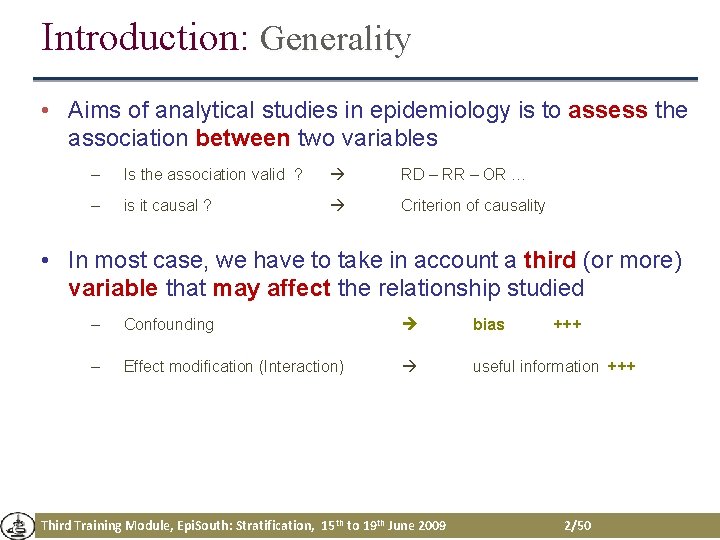
Introduction: Generality • Aims of analytical studies in epidemiology is to assess the association between two variables – Is the association valid ? RD – RR – OR … – is it causal ? Criterion of causality • In most case, we have to take in account a third (or more) variable that may affect the relationship studied – Confounding bias – Effect modification (Interaction) useful information +++ Third Training Module, Epi. South: Stratification, 15 th to 19 th June 2009 +++ 2/50 :
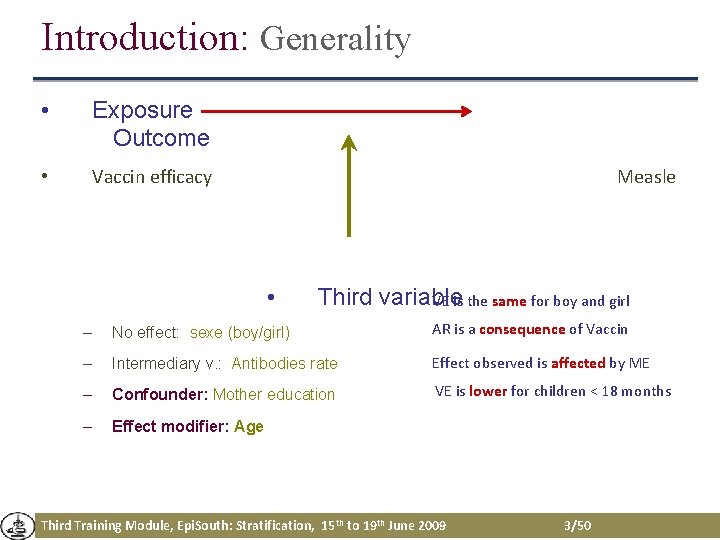
Introduction: Generality • Exposure Outcome • Vaccin efficacy Measle • Third variable VE is the same for boy and girl – No effect: sexe (boy/girl) AR is a consequence of Vaccin – Intermediary v. : Antibodies rate Effect observed is affected by ME – Confounder: Mother education VE is lower for children < 18 months – Effect modifier: Age Third Training Module, Epi. South: Stratification, 15 th to 19 th June 2009 3/50
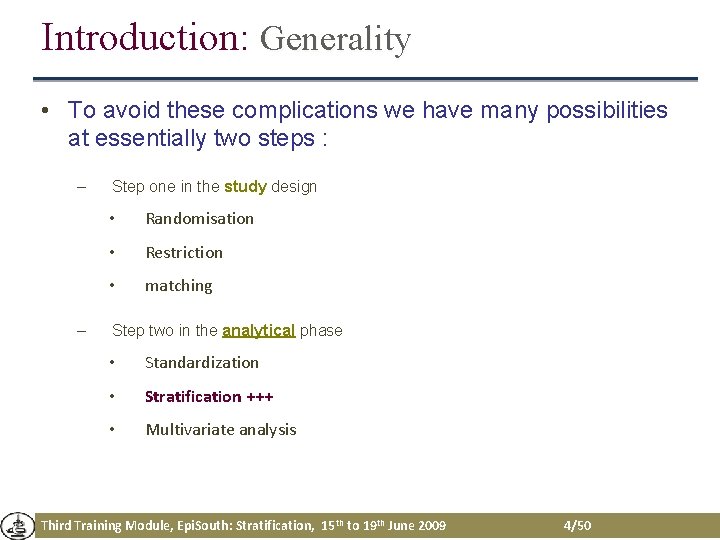
Introduction: Generality • To avoid these complications we have many possibilities at essentially two steps : – – Step one in the study design • Randomisation • Restriction • matching Step two in the analytical phase • Standardization • Stratification +++ • Multivariate analysis Third Training Module, Epi. South: Stratification, 15 th to 19 th June 2009 4/50
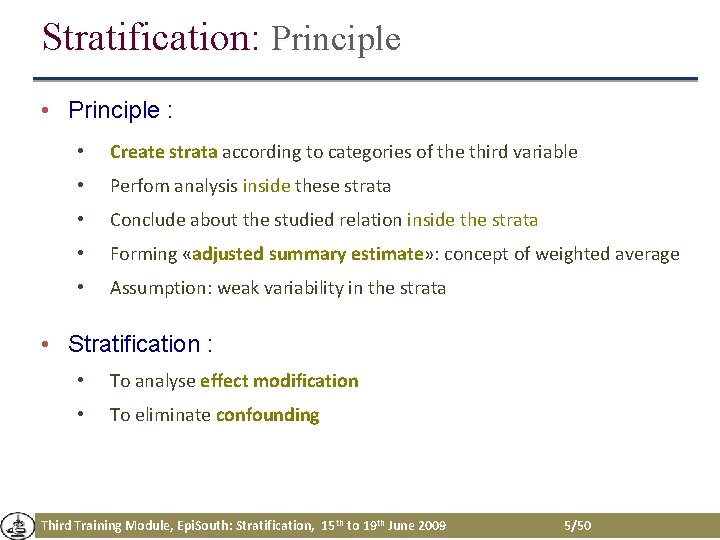
Stratification: Principle • Principle : • Create strata according to categories of the third variable • Perfom analysis inside these strata • Conclude about the studied relation inside the strata • Forming «adjusted summary estimate» : concept of weighted average • Assumption: weak variability in the strata • Stratification : • To analyse effect modification • To eliminate confounding Third Training Module, Epi. South: Stratification, 15 th to 19 th June 2009 5/50
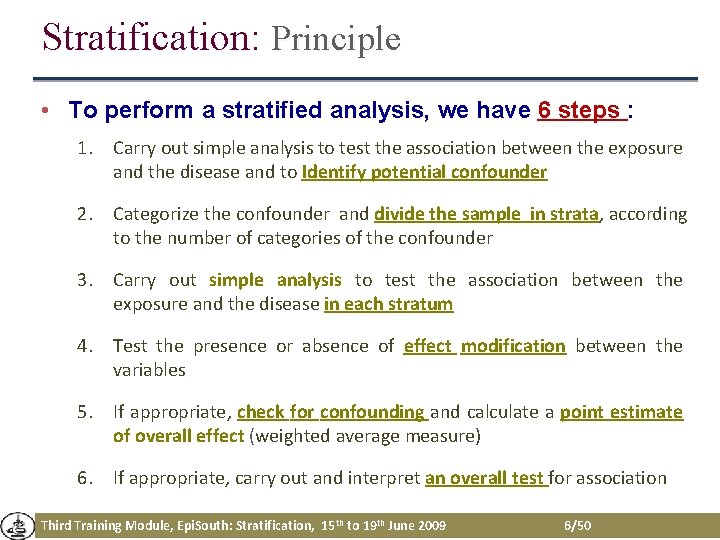
Stratification: Principle • To perform a stratified analysis, we have 6 steps : 1. Carry out simple analysis to test the association between the exposure and the disease and to Identify potential confounder 2. Categorize the confounder and divide the sample in strata, according to the number of categories of the confounder 3. Carry out simple analysis to test the association between the exposure and the disease in each stratum 4. Test the presence or absence of effect modification between the variables 5. If appropriate, check for confounding and calculate a point estimate of overall effect (weighted average measure) 6. If appropriate, carry out and interpret an overall test for association Third Training Module, Epi. South: Stratification, 15 th to 19 th June 2009 6/50
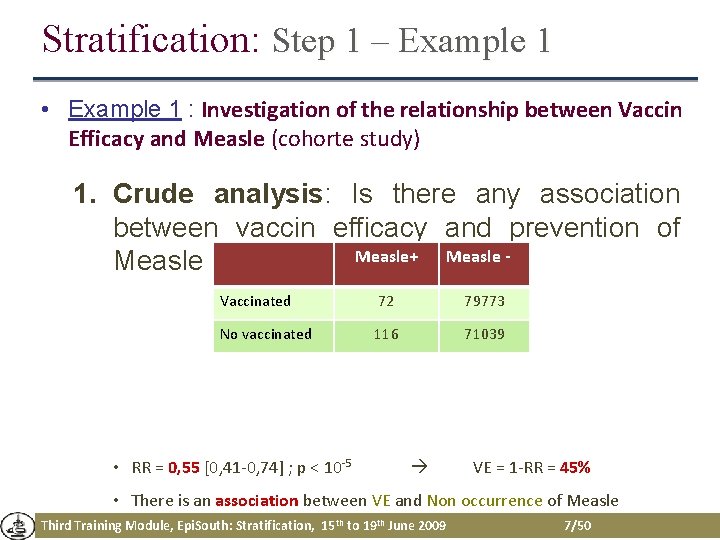
Stratification: Step 1 – Example 1 • Example 1 : Investigation of the relationship between Vaccin Efficacy and Measle (cohorte study) 1. Crude analysis: Is there any association between vaccin efficacy and prevention of Measle+ Measle ? Vaccinated 72 79773 No vaccinated 116 71039 • RR = 0, 55 [0, 41 -0, 74] ; p < 10 -5 VE = 1 -RR = 45% • There is an association between VE and Non occurrence of Measle Third Training Module, Epi. South: Stratification, 15 th to 19 th June 2009 7/50
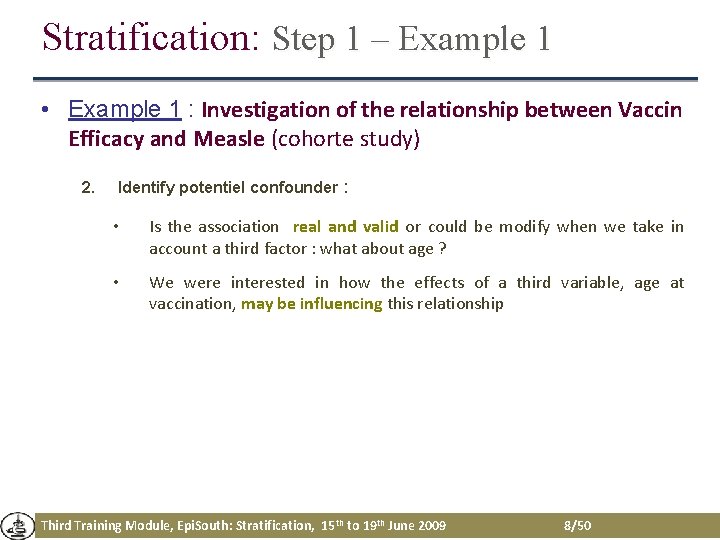
Stratification: Step 1 – Example 1 • Example 1 : Investigation of the relationship between Vaccin Efficacy and Measle (cohorte study) 2. Identify potentiel confounder : • Is the association real and valid or could be modify when we take in account a third factor : what about age ? • We were interested in how the effects of a third variable, age at vaccination, may be influencing this relationship Third Training Module, Epi. South: Stratification, 15 th to 19 th June 2009 8/50
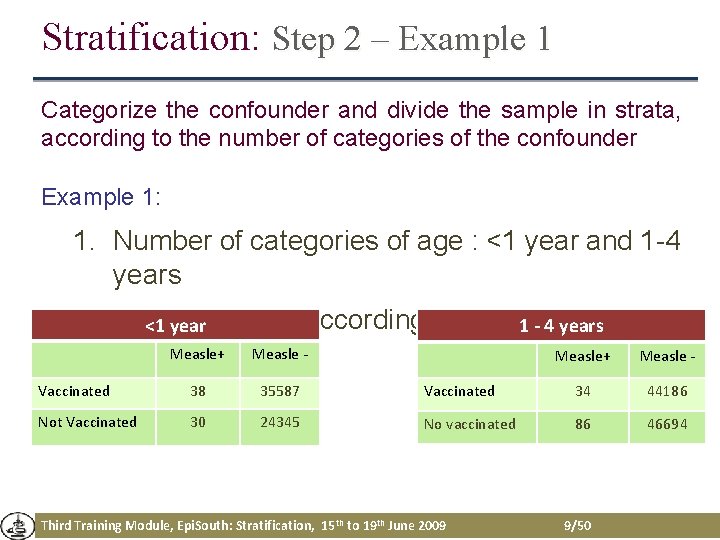
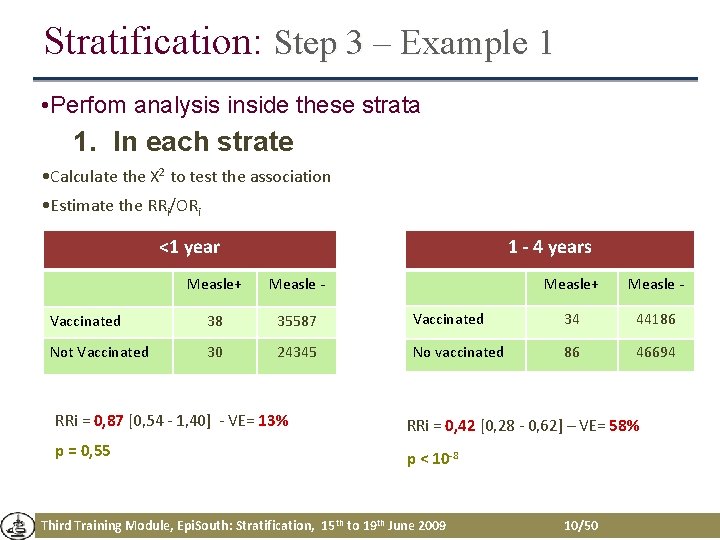
Stratification: Step 2 – Example 1 Categorize the confounder and divide the sample in strata, according to the number of categories of the confounder Example 1: 1. Number of categories of age : <1 year and 1 -4 years 2. Create of <1 year strata according to the 1 - number 4 years Measle+ Measle categories Vaccinated 38 35587 Vaccinated 34 44186 Not Vaccinated 30 24345 No vaccinated 86 46694 Third Training Module, Epi. South: Stratification, 15 th to 19 th June 2009 9/50
Stratification: Step 3 – Example 1 • Perfom analysis inside these strata 1. In each strate • Calculate the X 2 to test the association • Estimate the RRi/ORi <1 year Vaccinated • Not Vaccinated 1 - 4 years Measle+ Measle - 38 35587 30 24345 Measle+ Measle - Vaccinated 34 44186 No vaccinated 86 46694 RRi = 0, 87 [0, 54 - 1, 40] - VE= 13% RRi = 0, 42 [0, 28 - 0, 62] – VE= 58% p = 0, 55 p < 10 -8 Third Training Module, Epi. South: Stratification, 15 th to 19 th June 2009 10/50
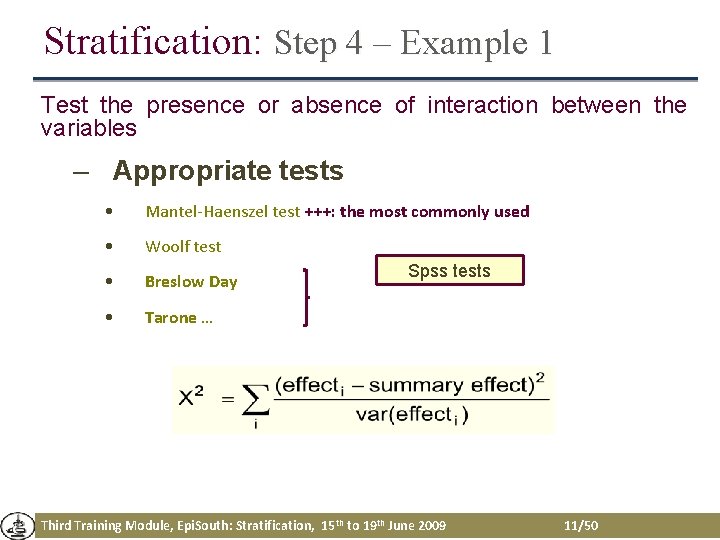
Stratification: Step 4 – Example 1 Test the presence or absence of interaction between the variables – Appropriate tests • Mantel-Haenszel test +++: the most commonly used • Woolf test • Breslow Day • Tarone … Spss tests Third Training Module, Epi. South: Stratification, 15 th to 19 th June 2009 11/50
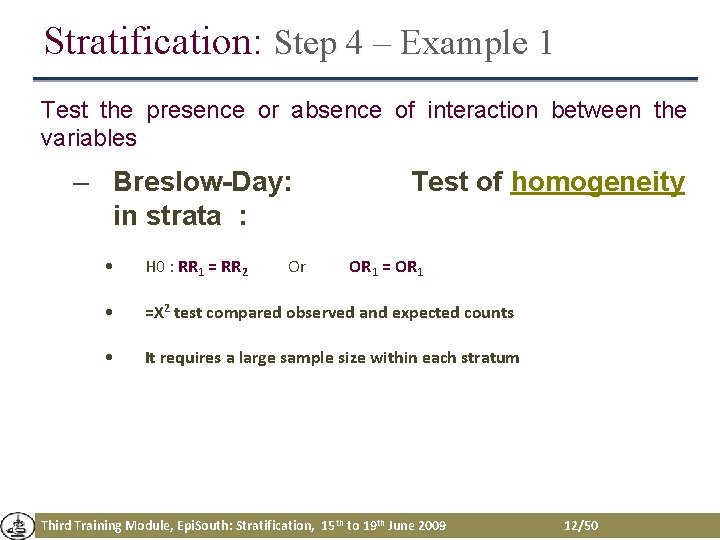
Stratification: Step 4 – Example 1 Test the presence or absence of interaction between the variables – Breslow-Day: in strata : Test of homogeneity • H 0 : RR 1 = RR 2 • =Χ 2 test compared observed and expected counts • It requires a large sample size within each stratum Or OR 1 = OR 1 Third Training Module, Epi. South: Stratification, 15 th to 19 th June 2009 12/50
Stratification: Step 4 – Example 1 Test the presence or absence of interaction between the variables • Two possibilities RR 1 = RR 2 or OR 1 = OR 2 No Interaction: Third variable is Not an effect modifier Next step: Looking for confounding Trying to form adjusted measure RR 1 RR 2 or OR 1 OR 2 Presence of Interaction: Third variable could be effect modifier Stop here: Results only by strate No pooling measure Third Training Module, Epi. South: Stratification, 15 th to 19 th June 2009 13/50
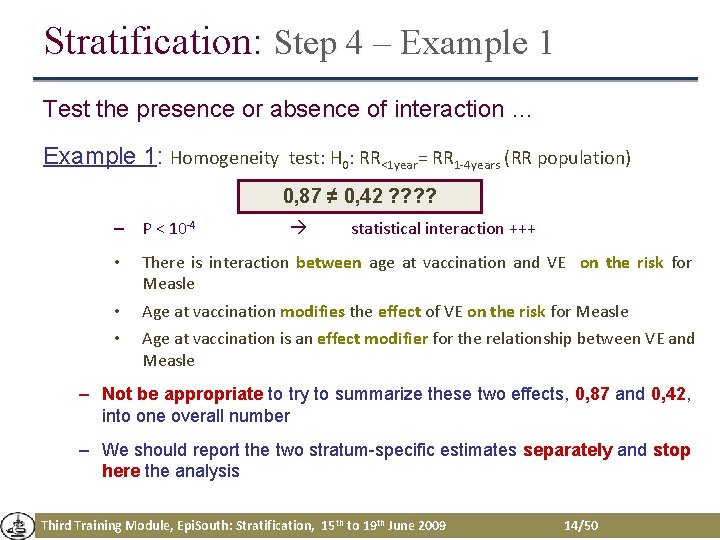
Stratification: Step 4 – Example 1 Test the presence or absence of interaction … Example 1: Homogeneity test: H 0: RR<1 year= RR 1 -4 years (RR population) 0, 87 ≠ 0, 42 ? ? – P < 10 -4 statistical interaction +++ • There is interaction between age at vaccination and VE on the risk for Measle • • Age at vaccination modifies the effect of VE on the risk for Measle Age at vaccination is an effect modifier for the relationship between VE and Measle – Not be appropriate to try to summarize these two effects, 0, 87 and 0, 42, into one overall number – We should report the two stratum-specific estimates separately and stop here the analysis Third Training Module, Epi. South: Stratification, 15 th to 19 th June 2009 14/50
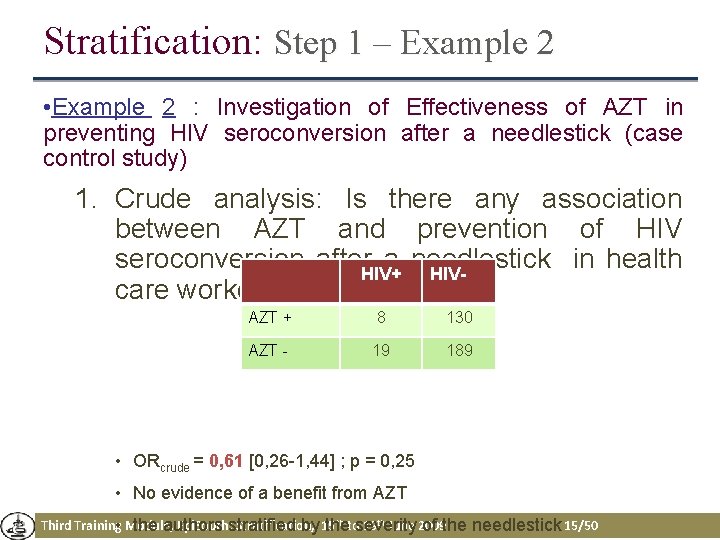
Stratification: Step 1 – Example 2 • Example 2 : Investigation of Effectiveness of AZT in preventing HIV seroconversion after a needlestick (case control study) 1. Crude analysis: Is there any association between AZT and prevention of HIV seroconversion after. HIV+ a needlestick in health HIVcare workers ? AZT + 8 130 AZT - 19 189 • ORcrude = 0, 61 [0, 26 -1, 44] ; p = 0, 25 • No evidence of a benefit from AZT th to 19 th June 2009 Third Training • Module, Epi. South: stratified Stratification, the authors by 15 the severity of the needlestick 15/50
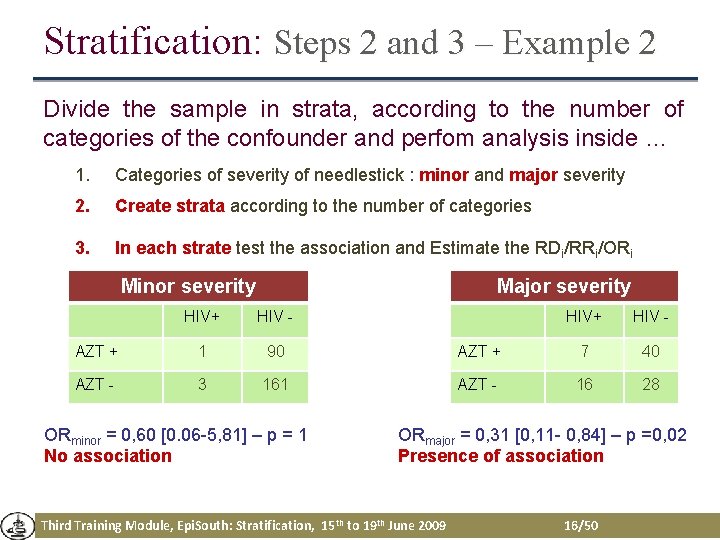
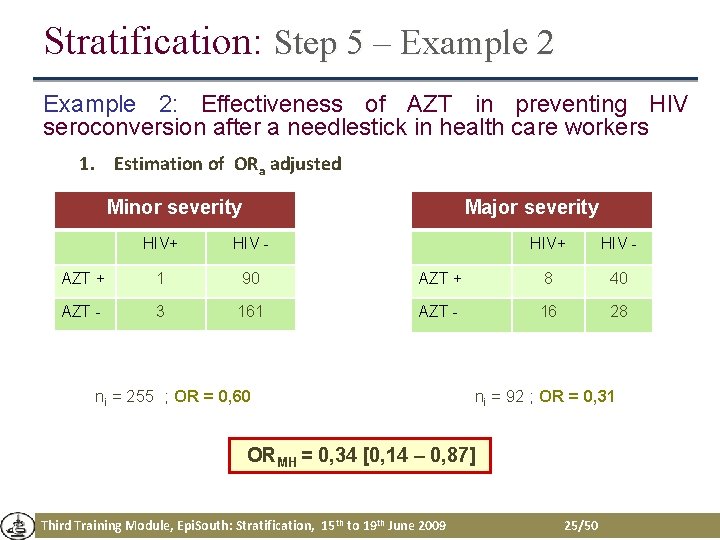
Stratification: Steps 2 and 3 – Example 2 Divide the sample in strata, according to the number of categories of the confounder and perfom analysis inside … 1. Categories of severity of needlestick : minor and major severity 2. Create strata according to the number of categories 3. In each strate test the association and Estimate the RDi/RRi/ORi Minor severity Major severity HIV+ HIV - AZT + 1 90 AZT - 3 161 ORminor = 0, 60 [0. 06 -5, 81] – p = 1 No association HIV+ HIV - AZT + 7 40 AZT - 16 28 ORmajor = 0, 31 [0, 11 - 0, 84] – p =0, 02 Presence of association Third Training Module, Epi. South: Stratification, 15 th to 19 th June 2009 16/50
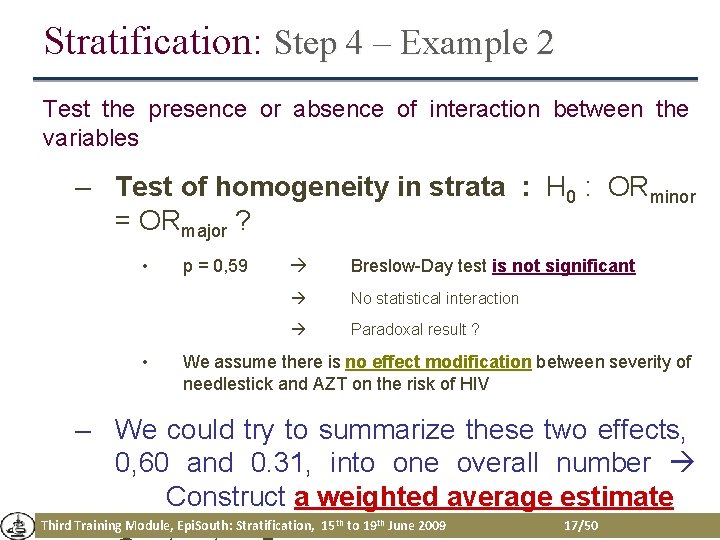
Stratification: Step 4 – Example 2 Test the presence or absence of interaction between the variables – Test of homogeneity in strata : H 0 : ORminor = ORmajor ? • • p = 0, 59 Breslow-Day test is not significant No statistical interaction Paradoxal result ? We assume there is no effect modification between severity of needlestick and AZT on the risk of HIV – We could try to summarize these two effects, 0, 60 and 0. 31, into one overall number Construct a weighted average estimate Third Training Module, Epi. South: Stratification, 15 th to 19 th June 2009 17/50
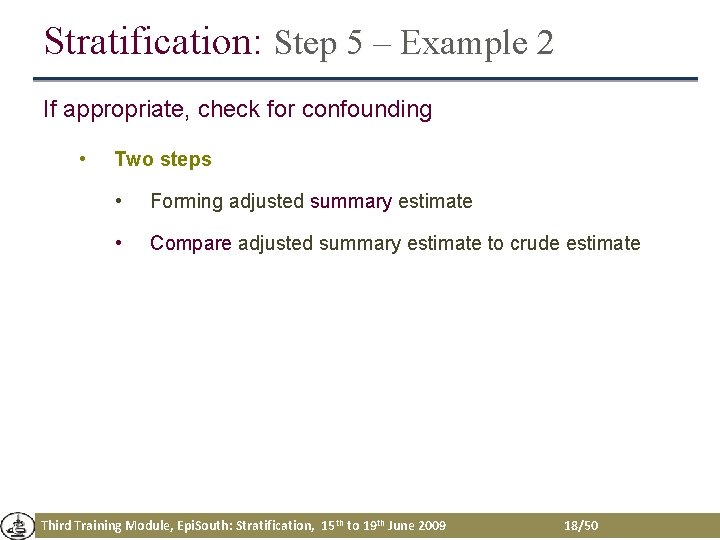
Stratification: Step 5 – Example 2 If appropriate, check for confounding • Two steps • Forming adjusted summary estimate • Compare adjusted summary estimate to crude estimate Third Training Module, Epi. South: Stratification, 15 th to 19 th June 2009 18/50
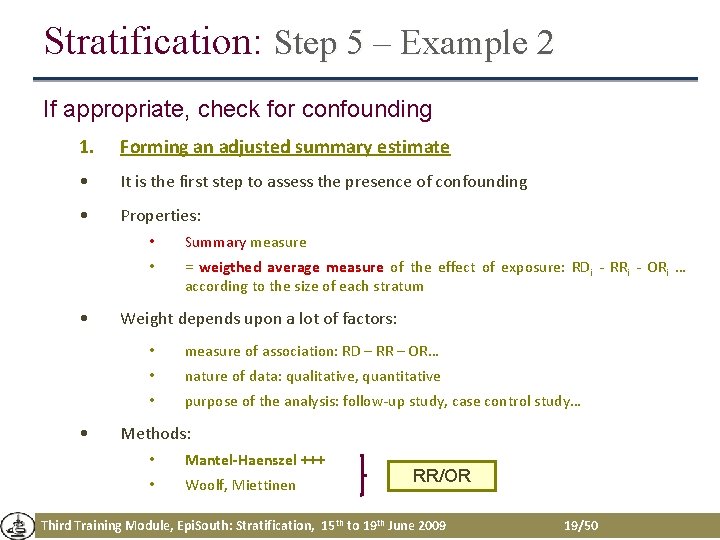
Stratification: Step 5 – Example 2 If appropriate, check for confounding 1. Forming an adjusted summary estimate • It is the first step to assess the presence of confounding • Properties: • • • Summary measure • = weigthed average measure of the effect of exposure: RDi - RRi - ORi … according to the size of each stratum Weight depends upon a lot of factors: • measure of association: RD – RR – OR… • nature of data: qualitative, quantitative • purpose of the analysis: follow-up study, case control study… Methods: • Mantel-Haenszel +++ • Woolf, Miettinen RR/OR Third Training Module, Epi. South: Stratification, 15 th to 19 th June 2009 19/50
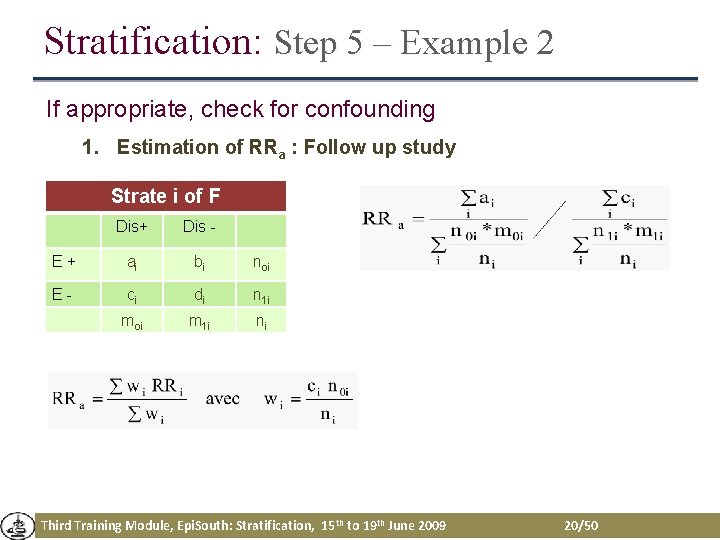
Stratification: Step 5 – Example 2 If appropriate, check for confounding 1. Estimation of RRa : Follow up study Strate i of F Dis+ Dis - E+ ai bi noi E- ci di n 1 i moi m 1 i ni Third Training Module, Epi. South: Stratification, 15 th to 19 th June 2009 20/50
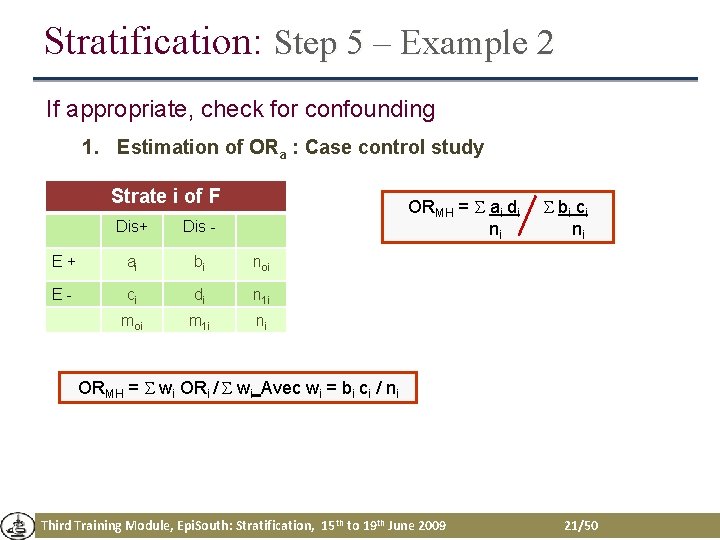
Stratification: Step 5 – Example 2 If appropriate, check for confounding 1. Estimation of ORa : Case control study Strate i of F ORMH = ai di ni Dis+ Dis - E+ ai bi noi E- ci di n 1 i moi m 1 i ni bi c i ni ORMH = wi ORi / wi Avec wi = bi ci / ni Third Training Module, Epi. South: Stratification, 15 th to 19 th June 2009 21/50
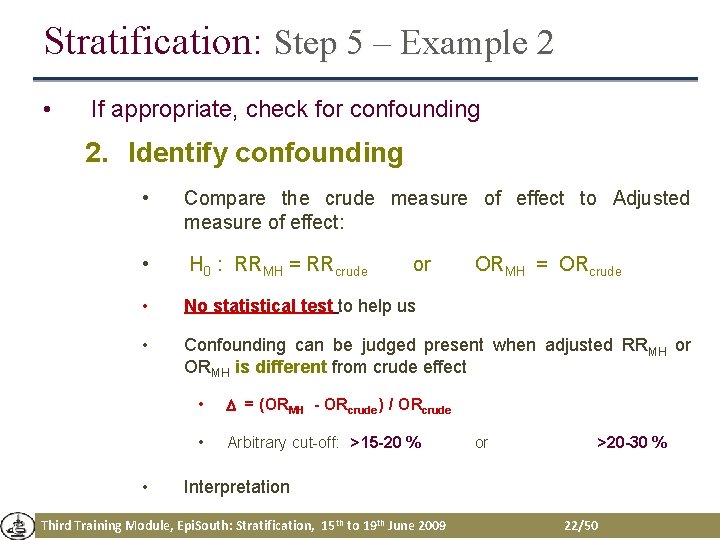
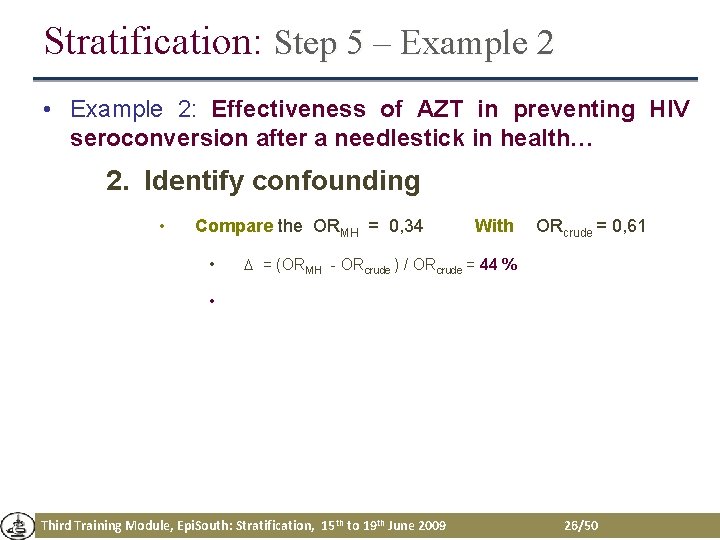
Stratification: Step 5 – Example 2 • If appropriate, check for confounding 2. Identify confounding • Compare the crude measure of effect to Adjusted measure of effect: • H 0 : RRMH = RRcrude or ORMH = ORcrude • No statistical test to help us • Confounding can be judged present when adjusted RRMH or ORMH is different from crude effect • • = (ORMH - ORcrude ) / ORcrude • Arbitrary cut-off: >15 -20 % or >20 -30 % Interpretation Third Training Module, Epi. South: Stratification, 15 th to 19 th June 2009 22/50
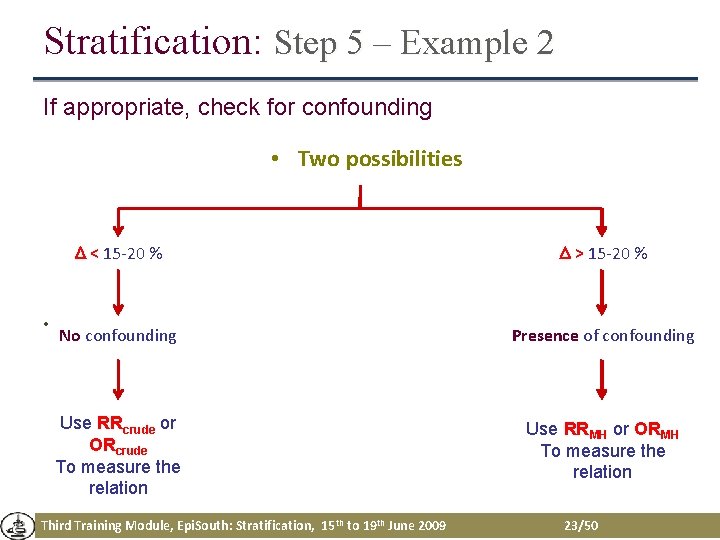
Stratification: Step 5 – Example 2 If appropriate, check for confounding • Two possibilities • < 15 -20 % > 15 -20 % No confounding Presence of confounding Use RRcrude or ORcrude To measure the relation Use RRMH or ORMH To measure the relation Third Training Module, Epi. South: Stratification, 15 th to 19 th June 2009 23/50
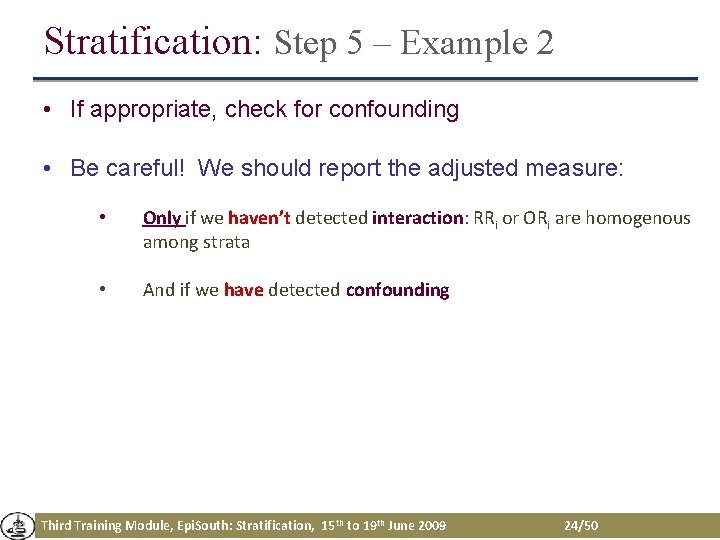
Stratification: Step 5 – Example 2 • If appropriate, check for confounding • Be careful! We should report the adjusted measure: • Only if we haven’t detected interaction: RRi or ORi are homogenous among strata • And if we have detected confounding Third Training Module, Epi. South: Stratification, 15 th to 19 th June 2009 24/50
Stratification: Step 5 – Example 2: Effectiveness of AZT in preventing HIV seroconversion after a needlestick in health care workers 1. Estimation of ORa adjusted Minor severity Major severity HIV+ HIV - AZT + 1 90 AZT - 3 161 HIV+ HIV - AZT + 8 40 AZT - 16 28 ni = 255 ; OR = 0, 60 ni = 92 ; OR = 0, 31 ORMH = 0, 34 [0, 14 – 0, 87] Third Training Module, Epi. South: Stratification, 15 th to 19 th June 2009 25/50
Stratification: Step 5 – Example 2 • Example 2: Effectiveness of AZT in preventing HIV seroconversion after a needlestick in health… 2. Identify confounding • Compare the ORMH = 0, 34 • With ORcrude = 0, 61 = (ORMH - ORcrude ) / ORcrude = 44 % • Third Training Module, Epi. South: Stratification, 15 th to 19 th June 2009 26/50
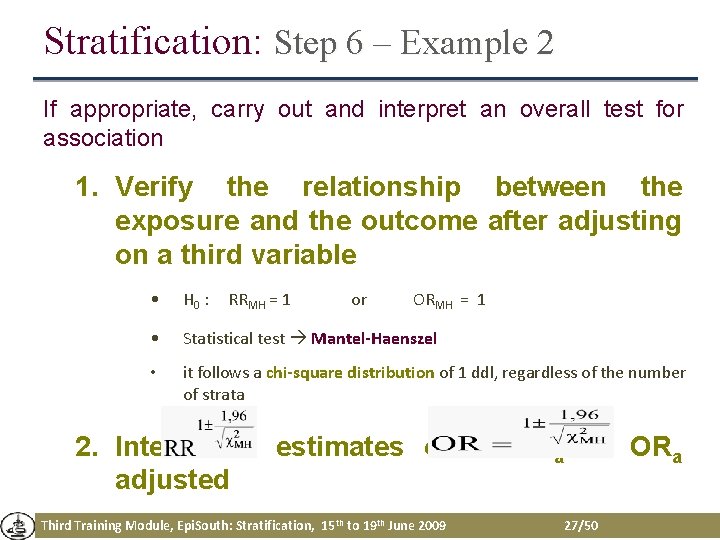
Stratification: Step 6 – Example 2 If appropriate, carry out and interpret an overall test for association 1. Verify the relationship between the exposure and the outcome after adjusting on a third variable • H 0 : • Statistical test Mantel-Haenszel • it follows a chi-square distribution of 1 ddl, regardless of the number of strata RRMH = 1 2. Intervalle adjusted or ORMH = 1 estimates of of RRa or ORa Third Training Module, Epi. South: Stratification, 15 th to 19 th June 2009 27/50
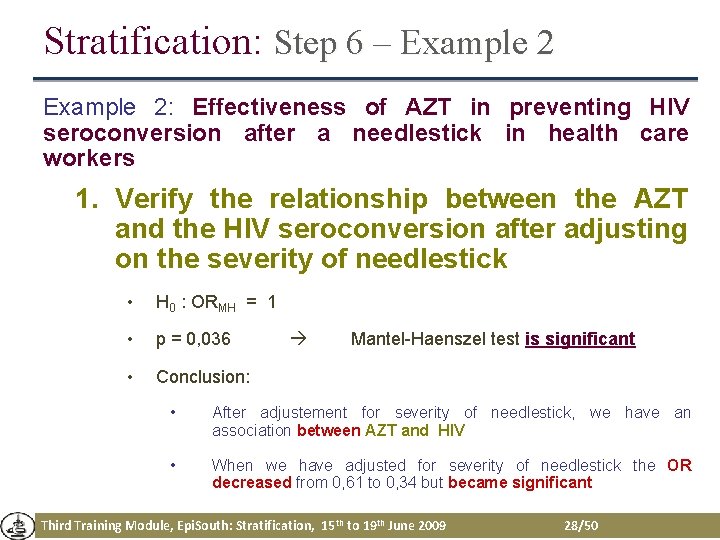
Stratification: Step 6 – Example 2: Effectiveness of AZT in preventing HIV seroconversion after a needlestick in health care workers 1. Verify the relationship between the AZT and the HIV seroconversion after adjusting on the severity of needlestick • H 0 : ORMH = 1 • p = 0, 036 • Conclusion: Mantel-Haenszel test is significant • After adjustement for severity of needlestick, we have an association between AZT and HIV • When we have adjusted for severity of needlestick the OR decreased from 0, 61 to 0, 34 but became significant Third Training Module, Epi. South: Stratification, 15 th to 19 th June 2009 28/50
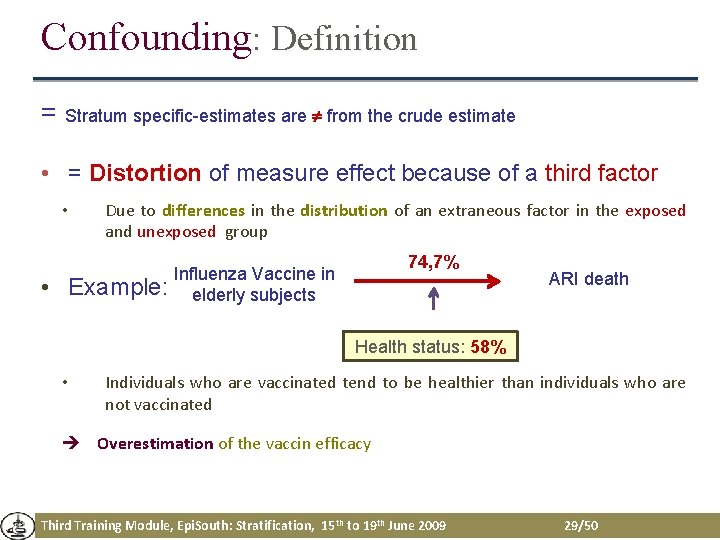
Confounding: Definition = Stratum specific-estimates are from the crude estimate • = Distortion of measure effect because of a third factor • Due to differences in the distribution of an extraneous factor in the exposed and unexposed group • Example: 74, 7% Influenza Vaccine in elderly subjects ARI death Health status: 58% • Individuals who are vaccinated tend to be healthier than individuals who are not vaccinated Overestimation of the vaccin efficacy Third Training Module, Epi. South: Stratification, 15 th to 19 th June 2009 29/50
Confounding: Definition • Be careful! – Confounding is a concept – Factor responsible for confounding is called a confounder or a confounding variable – Confounder factor confounds the association of interest: It confounds an estimate • Examples: 1. Health status confonds the estimation of vaccine efficacy on ARI death 2. Needlestick confonds the estimation of AZT Third Training Module, Epi. South: Stratification, 15 to 19 June 2009 in preventing HIV seroconversion 30/50 th th
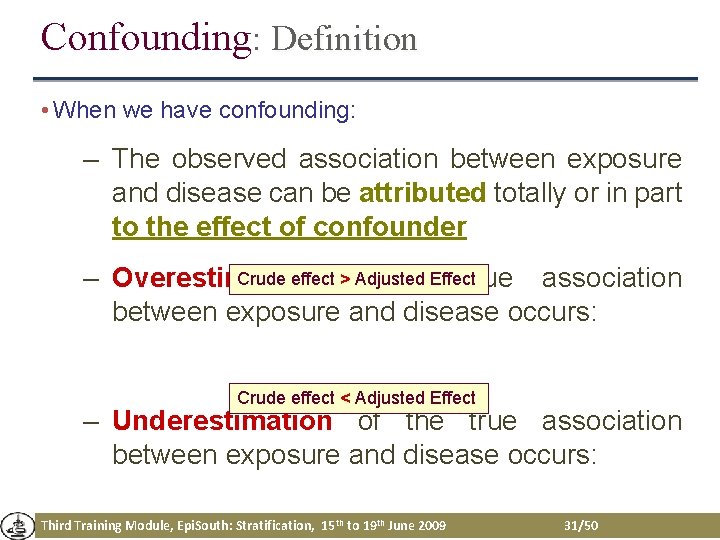
Confounding: Definition • When we have confounding: – The observed association between exposure and disease can be attributed totally or in part to the effect of confounder Crude effect >of Adjusted – Overestimation the. Effecttrue association between exposure and disease occurs: Crude effect < Adjusted Effect – Underestimation of the true association between exposure and disease occurs: Third Training Module, Epi. South: Stratification, 15 th to 19 th June 2009 31/50
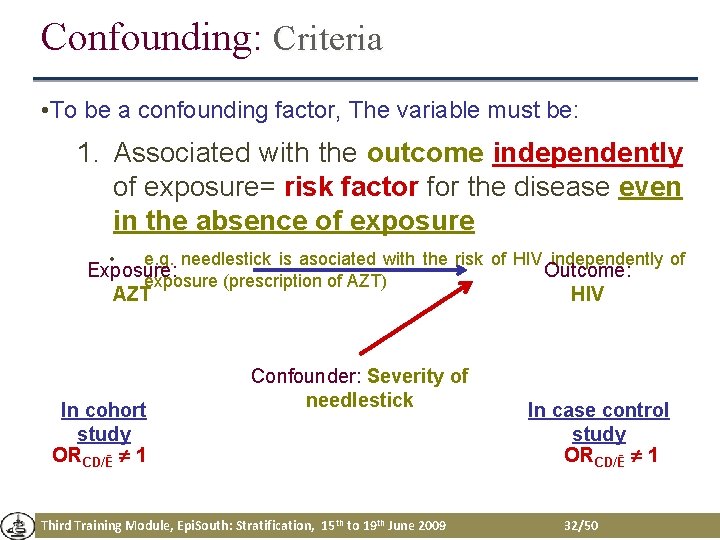
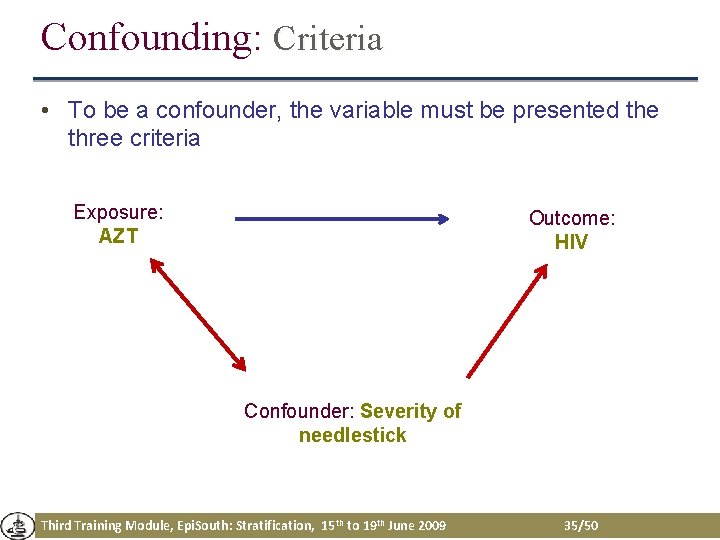
Confounding: Criteria • To be a confounding factor, The variable must be: 1. Associated with the outcome independently of exposure= risk factor for the disease even in the absence of exposure • e. g. needlestick is asociated with the risk of HIV independently of Exposure: exposure (prescription of AZT) AZT In cohort study ORCD/Ē 1 Confounder: Severity of needlestick Third Training Module, Epi. South: Stratification, 15 th to 19 th June 2009 Outcome: HIV In case control study ORCD/Ē 1 32/50
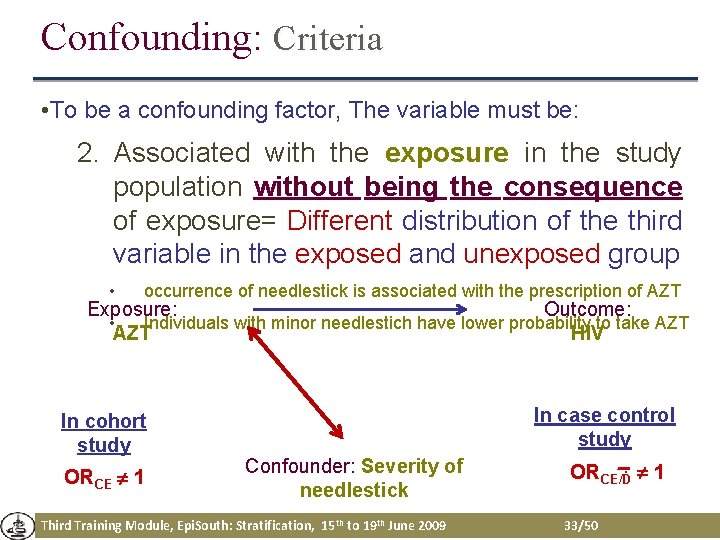
Confounding: Criteria • To be a confounding factor, The variable must be: 2. Associated with the exposure in the study population without being the consequence of exposure= Different distribution of the third variable in the exposed and unexposed group • occurrence of needlestick is associated with the prescription of AZT Exposure: Outcome: • Individuals with minor needlestich have lower probability to take AZT HIV In cohort study ORCE 1 In case control study Confounder: Severity of needlestick Third Training Module, Epi. South: Stratification, 15 th to 19 th June 2009 ORCE/Ḋ 1 33/50
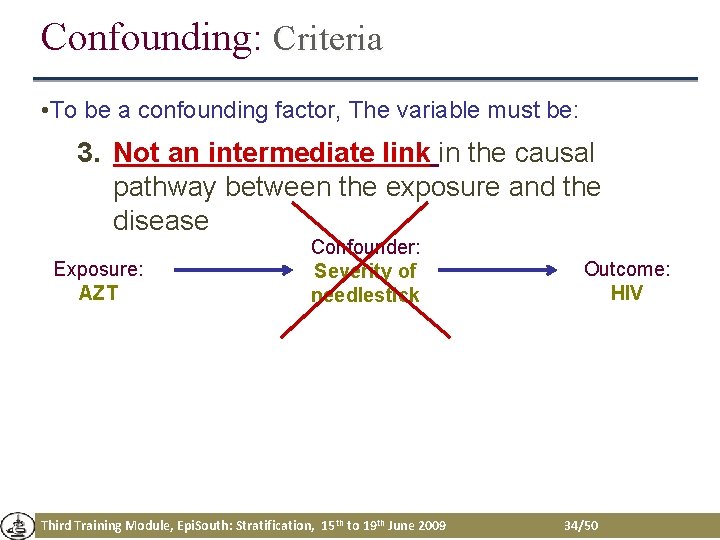
Confounding: Criteria • To be a confounding factor, The variable must be: 3. Not an intermediate link in the causal pathway between the exposure and the disease Exposure: AZT Confounder: Severity of needlestick Third Training Module, Epi. South: Stratification, 15 th to 19 th June 2009 Outcome: HIV 34/50
Confounding: Criteria • To be a confounder, the variable must be presented the three criteria Exposure: AZT Outcome: HIV Confounder: Severity of needlestick Third Training Module, Epi. South: Stratification, 15 th to 19 th June 2009 35/50
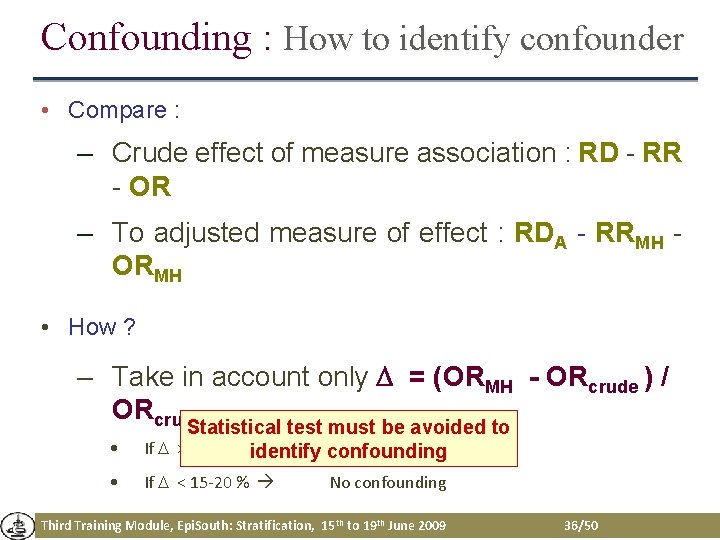
Confounding : How to identify confounder • Compare : – Crude effect of measure association : RD - RR - OR – To adjusted measure of effect : RDA - RRMH ORMH • How ? – Take in account only = (ORMH - ORcrude ) / ORcrude • Statistical test must be avoided to If > 15 -20 % identify Presence of confounding • If < 15 -20 % No confounding Third Training Module, Epi. South: Stratification, 15 th to 19 th June 2009 36/50
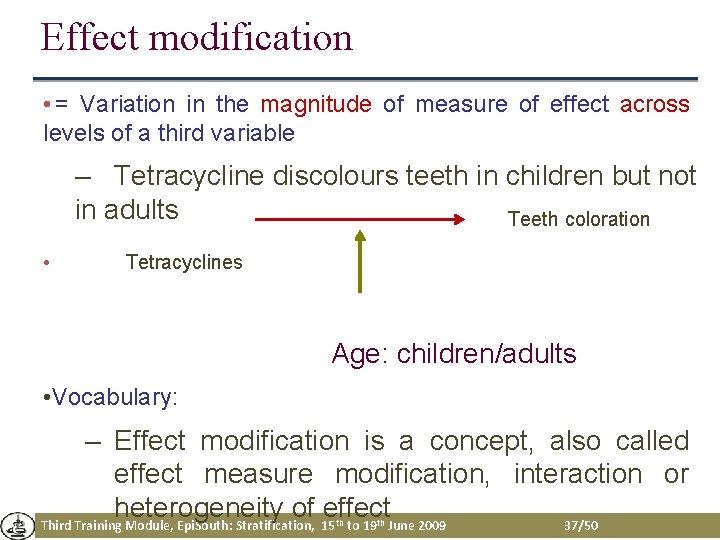
Effect modification • = Variation in the magnitude of measure of effect across levels of a third variable – Tetracycline discolours teeth in children but not in adults Teeth coloration • Tetracyclines Age: children/adults • Vocabulary: – Effect modification is a concept, also called effect measure modification, interaction or heterogeneity of effect Third Training Module, Epi. South: Stratification, 15 to 19 June 2009 37/50 th th
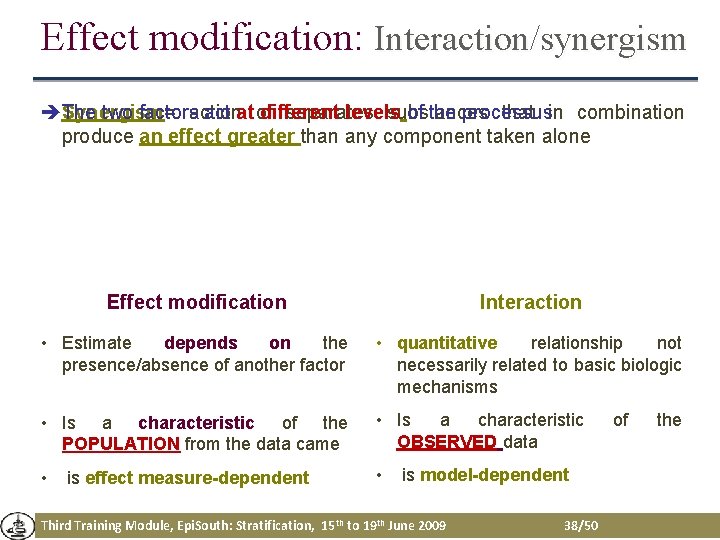
Effect modification: Interaction/synergism The two factorsaction Synergism= act at of different separates levels substances of the processus that in combination produce an effect greater than any component taken alone Effect modification Interaction • Estimate depends on the presence/absence of another factor • quantitative relationship not necessarily related to basic biologic mechanisms • Is a characteristic of the POPULATION from the data came • Is a characteristic OBSERVED data • • is effect measure-dependent is model-dependent Third Training Module, Epi. South: Stratification, 15 th to 19 th June 2009 38/50 of the
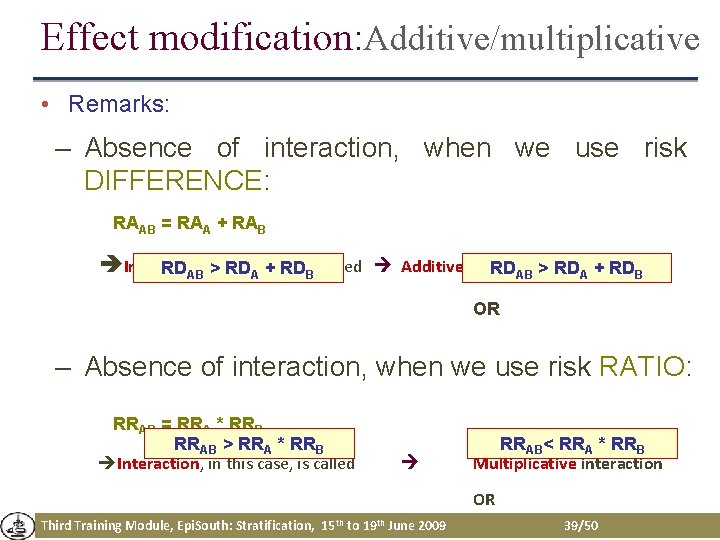
Effect modification: Additive/multiplicative • Remarks: – Absence of interaction, when we use risk DIFFERENCE: RAAB = RAA + RAB Interaction, this. A case, RDAB >in. RD + RDis. B called Additive interaction RDAB > RDA + RDB OR – Absence of interaction, when we use risk RATIO: RRAB = RRA * RRB RRAB > RRA * RRB Interaction, in this case, is called RRAB< RRA * RRB Multiplicative interaction OR Third Training Module, Epi. South: Stratification, 15 th to 19 th June 2009 39/50
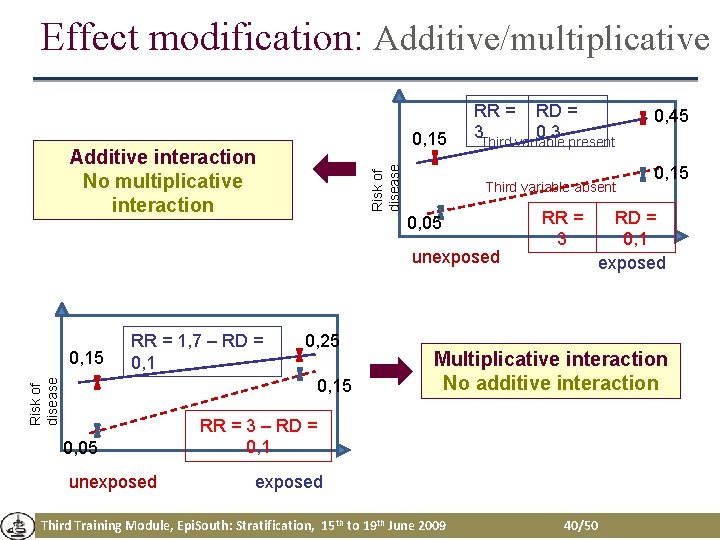
Effect modification: Additive/multiplicative 0, 15 Risk of disease Additive interaction No multiplicative interaction RR = RD = 3 Third variable 0, 3 present Third variable absent 0, 05 unexposed 0, 15 RR = 1, 7 – RD = 0, 1 0, 25 Risk of disease 0, 15 0, 05 unexposed RR = 3 0, 45 0, 15 RD = 0, 1 exposed Multiplicative interaction No additive interaction RR = 3 – RD = 0, 1 exposed Third Training Module, Epi. South: Stratification, 15 th to 19 th June 2009 40/50
Effect modification: Additive/multiplicative • Remarks: – Assessment of interaction depends of the Third Training Module, Epi. South: Stratification, 15 th to 19 th June 2009 41/50
Effect modification : Properties • Effect modification is not a bias but useful information – Identification of subgroups with a lower or higher risk – Targeting public health action – Better understand of the disease: biological mechanism Third Training Module, Epi. South: Stratification, 15 th to 19 th June 2009 42/50
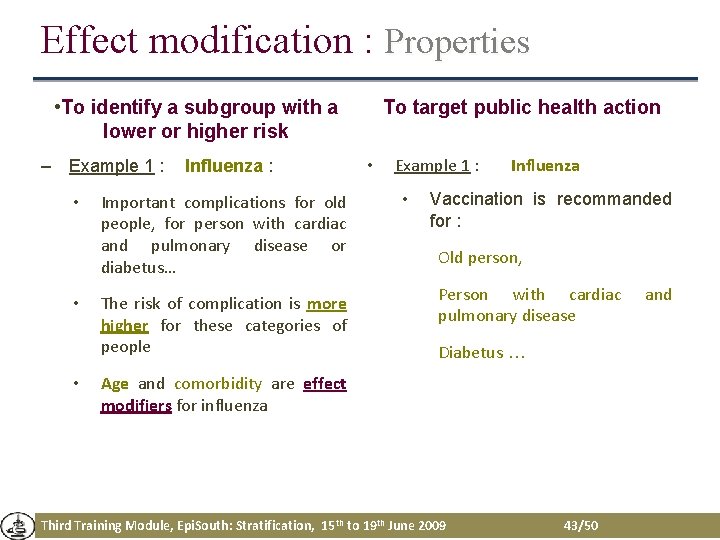
Effect modification : Properties • To identify a subgroup with a lower or higher risk – Example 1 : • • • Influenza : Important complications for old people, for person with cardiac and pulmonary disease or diabetus… The risk of complication is more higher for these categories of people To target public health action • Example 1 : • Influenza Vaccination is recommanded for : Old person, Person with cardiac pulmonary disease Diabetus … Age and comorbidity are effect modifiers for influenza Third Training Module, Epi. South: Stratification, 15 th to 19 th June 2009 43/50 and
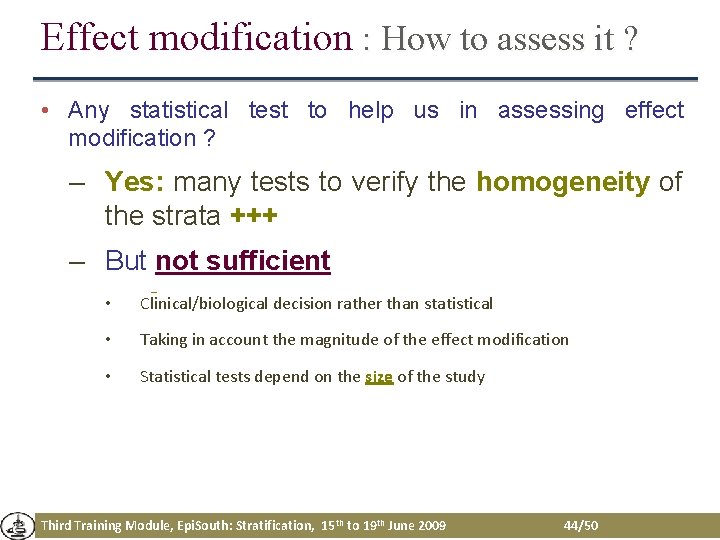
Effect modification : How to assess it ? • Any statistical test to help us in assessing effect modification ? – Yes: many tests to verify the homogeneity of the strata +++ – But not sufficient • Clinical/biological decision rather than statistical • Taking in account the magnitude of the effect modification • Statistical tests depend on the size of the study Third Training Module, Epi. South: Stratification, 15 th to 19 th June 2009 44/50
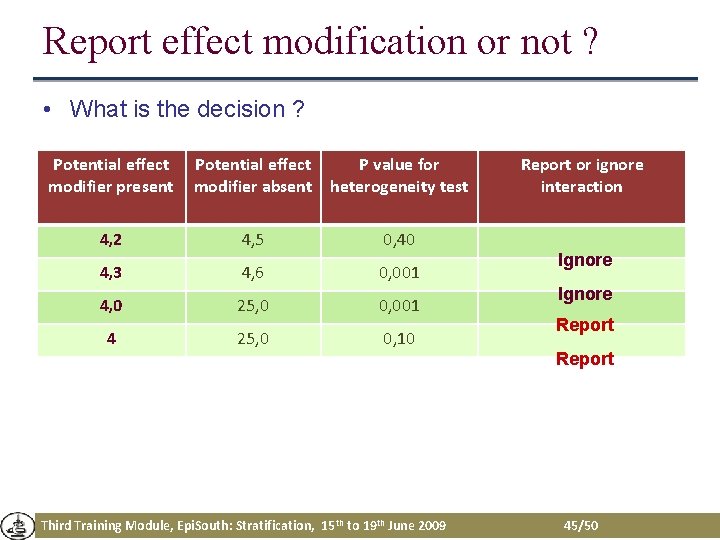
Report effect modification or not ? • What is the decision ? Potential effect modifier present Potential effect P value for modifier absent heterogeneity test 4, 2 4, 5 0, 40 4, 3 4, 6 0, 001 4, 0 25, 0 0, 001 4 25, 0 0, 10 Third Training Module, Epi. South: Stratification, 15 th to 19 th June 2009 Report or ignore interaction Ignore Report 45/50
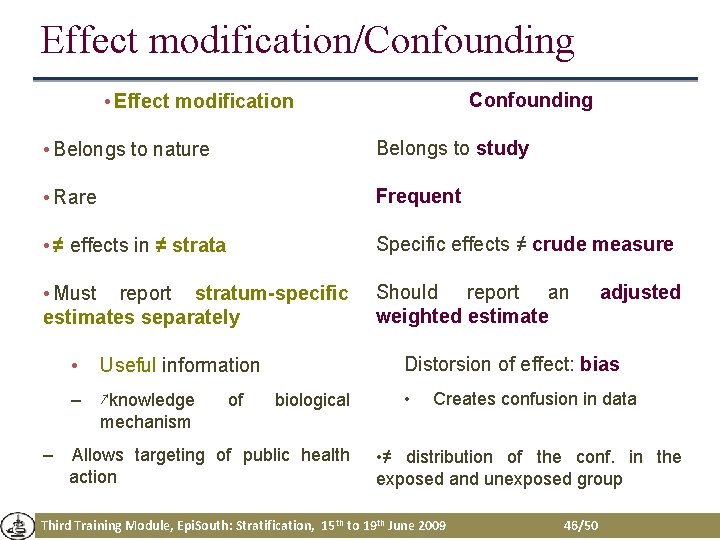
Effect modification/Confounding • Effect modification • Belongs to nature Belongs to study • Rare Frequent • ≠ effects in ≠ strata Specific effects ≠ crude measure • Must report stratum-specific estimates separately Should report an weighted estimate – • Useful information – ↗knowledge mechanism of adjusted Distorsion of effect: bias biological Allows targeting of public health action • Creates confusion in data • ≠ distribution of the conf. in the exposed and unexposed group Third Training Module, Epi. South: Stratification, 15 th to 19 th June 2009 46/50
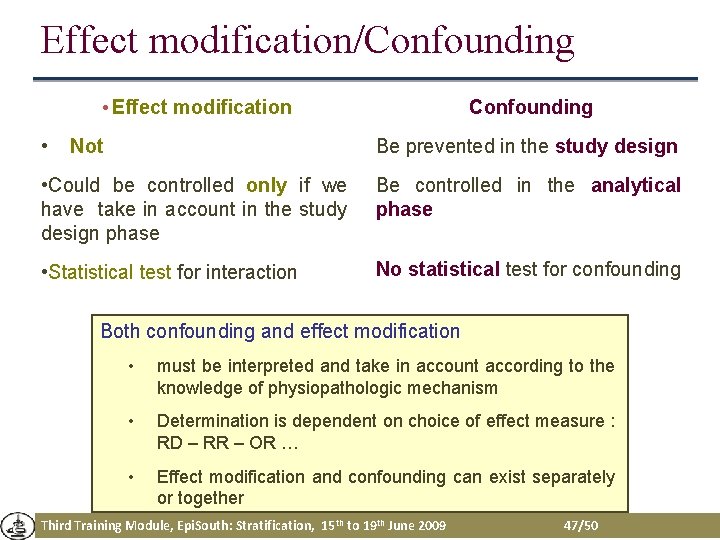
Effect modification/Confounding • Effect modification • Not Confounding Be prevented in the study design • Could be controlled only if we have take in account in the study design phase Be controlled in the analytical phase • Statistical test for interaction No statistical test for confounding Both confounding and effect modification • must be interpreted and take in account according to the knowledge of physiopathologic mechanism • Determination is dependent on choice of effect measure : RD – RR – OR … • Effect modification and confounding can exist separately or together Third Training Module, Epi. South: Stratification, 15 th to 19 th June 2009 47/50
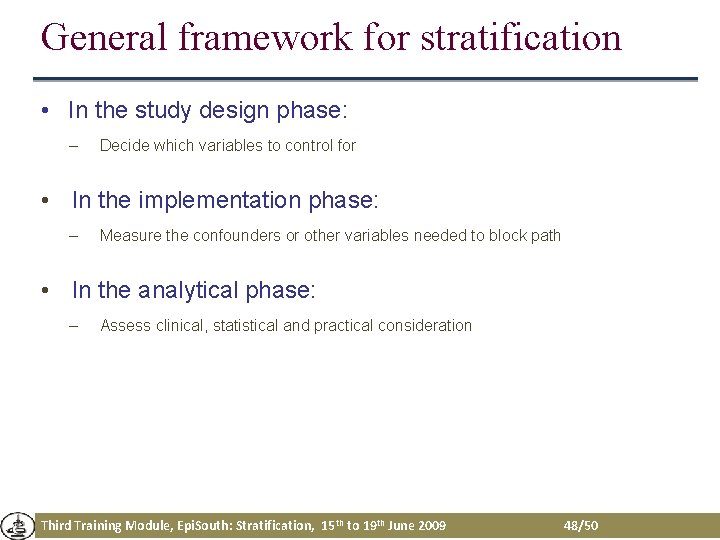
General framework for stratification • In the study design phase: – Decide which variables to control for • In the implementation phase: – Measure the confounders or other variables needed to block path • In the analytical phase: – Assess clinical, statistical and practical consideration Third Training Module, Epi. South: Stratification, 15 th to 19 th June 2009 48/50
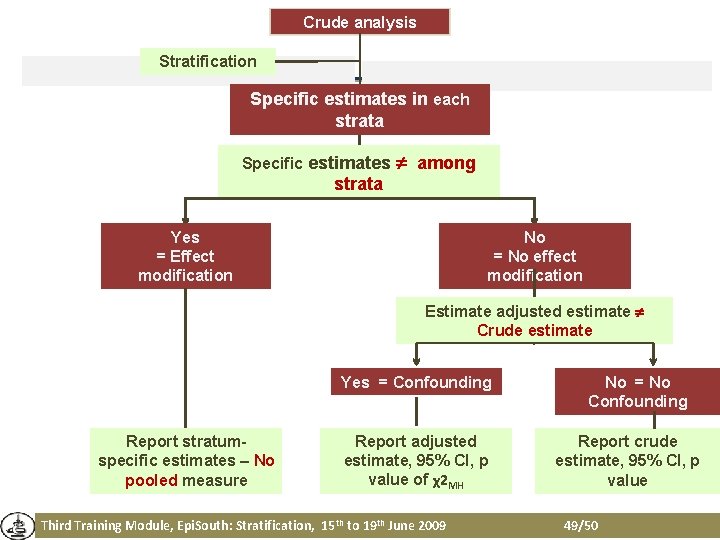
Crude analysis Stratification Specific estimates in each strata Specific estimates among strata Yes = Effect modification No = No effect modification Estimate adjusted estimate Crude estimate Yes = Confounding Report stratumspecific estimates – No pooled measure Report adjusted estimate, 95% CI, p value of χ2 MH Third Training Module, Epi. South: Stratification, 15 th to 19 th June 2009 No = No Confounding Report crude estimate, 95% CI, p value 49/50
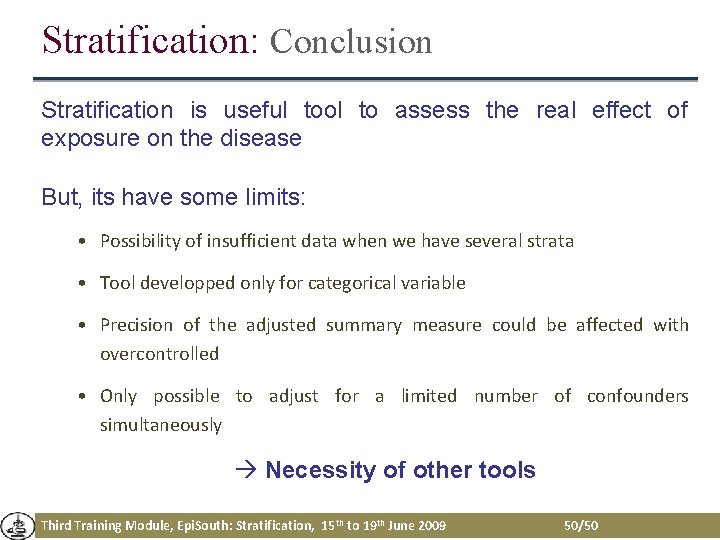
Stratification: Conclusion Stratification is useful tool to assess the real effect of exposure on the disease But, its have some limits: • Possibility of insufficient data when we have several strata • Tool developped only for categorical variable • Precision of the adjusted summary measure could be affected with overcontrolled • Only possible to adjust for a limited number of confounders simultaneously Necessity of other tools Third Training Module, Epi. South: Stratification, 15 th to 19 th June 2009 50/50