
Stratification and Social Mobility in the United States
Stratification and Social Mobility in the United States 8 Sociology in Modules 3 rd edition Richard T. Schaefer Copyright © 2016 Mc. Graw-Hill Education. All rights reserved. No reproduction or distribution without the prior written consent of Mc. Graw-Hill Education.
Systems of Stratification • Social inequality: situation in which members of society have different amounts of wealth, prestige, or power – Stratification: structured ranking of entire groups of people that perpetuates unequal economic rewards and power in a society – Income: salaries and wages – Wealth: inclusive term encompassing all a person’s material assets Slide 2 Copyright © 2016 Mc. Graw-Hill Education. All rights reserved. No reproduction or distribution without the prior written consent of Mc. Graw-Hill Education.
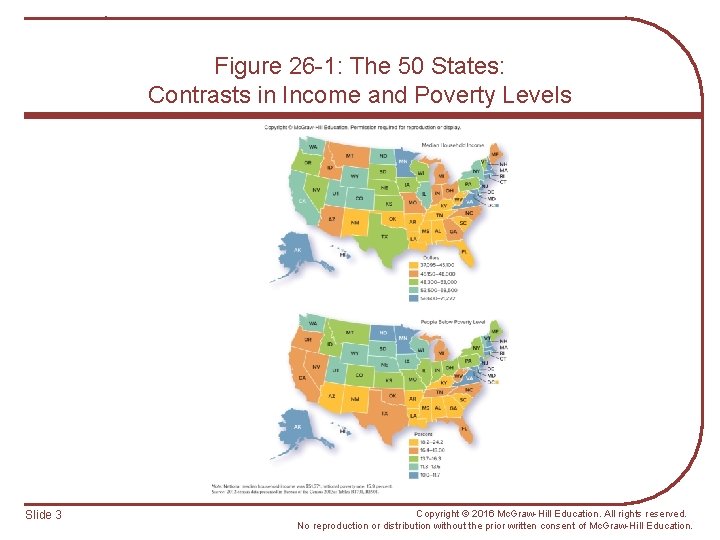
Figure 26 -1: The 50 States: Contrasts in Income and Poverty Levels Slide 3 Copyright © 2016 Mc. Graw-Hill Education. All rights reserved. No reproduction or distribution without the prior written consent of Mc. Graw-Hill Education.

Systems of Stratification • Four general systems of stratification— slavery, castes, estates, and social classes —as ideal types useful for purposes of analysis – Ascribed status: social position assigned to person by society without regard for the person’s unique talents or characteristics – Achieved status: social position that a person attains largely through his or her own efforts Slide 4 Copyright © 2016 Mc. Graw-Hill Education. All rights reserved. No reproduction or distribution without the prior written consent of Mc. Graw-Hill Education.
Four Forms of Stratification • Slavery: individuals owned by other people, who treat them as property • Universal Declaration of Human Rights prohibits slavery in all forms – More people enslaved today than in world history Slide 5 Copyright © 2016 Mc. Graw-Hill Education. All rights reserved. No reproduction or distribution without the prior written consent of Mc. Graw-Hill Education.
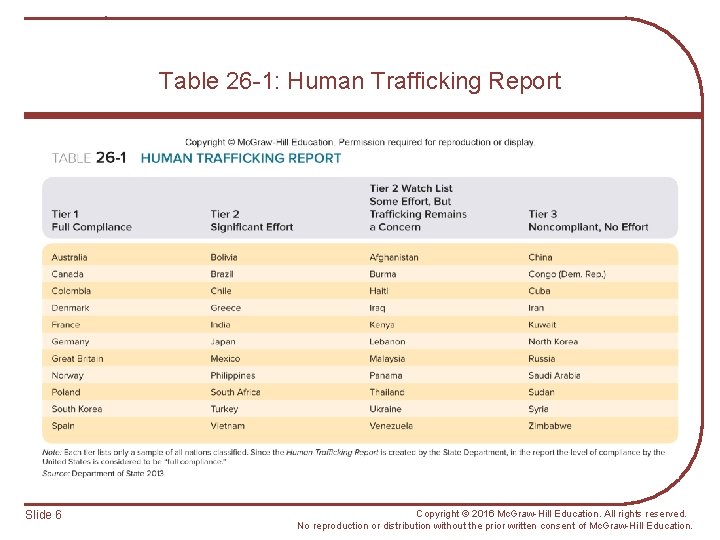
Table 26 -1: Human Trafficking Report Slide 6 Copyright © 2016 Mc. Graw-Hill Education. All rights reserved. No reproduction or distribution without the prior written consent of Mc. Graw-Hill Education.
Castes • Castes: hereditary ranks that are usually religiously dictated and that tend to be fixed and immobile • An ascribed status • Generally associated with Hinduism in India – Varnas Slide 7 Copyright © 2016 Mc. Graw-Hill Education. All rights reserved. No reproduction or distribution without the prior written consent of Mc. Graw-Hill Education.
Estates • Estate system, or feudalism: peasants worked land leased to them in exchange for military protection and other services Slide 8 Copyright © 2016 Mc. Graw-Hill Education. All rights reserved. No reproduction or distribution without the prior written consent of Mc. Graw-Hill Education.
Social Classes • Class system: social ranking based primarily on economic position in which achieved characteristics can influence social mobility • Class standing heavily dependent on family and ascribed factors – Race, ethnicity Slide 9 Copyright © 2016 Mc. Graw-Hill Education. All rights reserved. No reproduction or distribution without the prior written consent of Mc. Graw-Hill Education.
Social Classes • Rossides (1997) uses five-class model to describe U. S. class system: – Upper class – Upper-middle class – Lower-middle class – Working class – Lower class Slide 10 Copyright © 2016 Mc. Graw-Hill Education. All rights reserved. No reproduction or distribution without the prior written consent of Mc. Graw-Hill Education.
Social Classes • Upper and Lower Classes – Upper class: 1% to 2% of U. S. • Very wealthy – Lower class: 20% to 25% of U. S. • Lacks wealth and income and politically weak • Middle Class – Upper-middle class: 10% to 15% of U. S. ; includes professionals – Lower-middle class: 30% to 35%; includes less affluent professionals Slide 11 Copyright © 2016 Mc. Graw-Hill Education. All rights reserved. No reproduction or distribution without the prior written consent of Mc. Graw-Hill Education.
Social Classes • Factors contributing to shrinking size of middle class: – Disappearing opportunities for those with little education – Global competition and advances in technology – Growing dependence on temporary workforce – Rise of new growth industries and nonunion workplaces Slide 12 Copyright © 2016 Mc. Graw-Hill Education. All rights reserved. No reproduction or distribution without the prior written consent of Mc. Graw-Hill Education.
Social Classes • Working Class – 40 to 45% of U. S. population – People who hold regular manual or blue-collar jobs – Some may have income above those of the lower-middle class Slide 13 Copyright © 2016 Mc. Graw-Hill Education. All rights reserved. No reproduction or distribution without the prior written consent of Mc. Graw-Hill Education.
Social Classes • Class Warfare – Occupy Wall Street • Political leaders began to speak of class conflict – Gulf between rich and everyone else in U. S. grew over last 50 years • Rich just as likely as poor to say class conflict exists Slide 14 Copyright © 2016 Mc. Graw-Hill Education. All rights reserved. No reproduction or distribution without the prior written consent of Mc. Graw-Hill Education.
Sociological Perspectives on Stratification • Sociologists hotly debate stratification and social inequality and reach varying conclusions – No theorist stressed significance of class for society more strongly than Karl Marx Slide 15 Copyright © 2016 Mc. Graw-Hill Education. All rights reserved. No reproduction or distribution without the prior written consent of Mc. Graw-Hill Education.
Karl Marx’s View of Class Differentiation • Social relations depend on who controls the primary mode of production – Capitalism: means of production held largely in private hands, and main incentive for economic activity is accumulation of profits – Bourgeoisie: capitalist class; own the means of production – Proletariat: working class Slide 16 Copyright © 2016 Mc. Graw-Hill Education. All rights reserved. No reproduction or distribution without the prior written consent of Mc. Graw-Hill Education.
Karl Marx’s View of Class Differentiation • Class consciousness: subjective awareness of common vested interests and the need for collective political action to bring about change • False consciousness: attitude held by members of class that does not accurately reflect their objective position Slide 17 Copyright © 2016 Mc. Graw-Hill Education. All rights reserved. No reproduction or distribution without the prior written consent of Mc. Graw-Hill Education.
Max Weber’s View of Stratification • No single characteristic totally defines a person’s position within the stratification system – Class: group of people who have similar level of wealth and income – Status group: people who have the same prestige or lifestyle – Power: ability to exercise one’s will over others Slide 18 Copyright © 2016 Mc. Graw-Hill Education. All rights reserved. No reproduction or distribution without the prior written consent of Mc. Graw-Hill Education.
Interactionist Perspective • Interactionists interested in importance of social class in shaping a person’s lifestyle – Veblen: top of the social hierarchy typically convert part of their wealth into conspicuous consumption—purchasing goods not to survive but to flaunt superior wealth and social standing Slide 19 Copyright © 2016 Mc. Graw-Hill Education. All rights reserved. No reproduction or distribution without the prior written consent of Mc. Graw-Hill Education.
Is Stratification Universal? • All societies maintain some form of social inequality among their members • Functionalist Perspective – Social inequality necessary so people will be motivated to fill functionally important positions • Does not explain the wide disparity between rich and poor Slide 20 Copyright © 2016 Mc. Graw-Hill Education. All rights reserved. No reproduction or distribution without the prior written consent of Mc. Graw-Hill Education.
Is Stratification Universal? • Conflict Perspective – Human beings prone to conflict over scarce resources such as wealth, status, and power – Stratification major source of societal tension • Leads to instability and social change – Dominant ideology: set of cultural beliefs and practices that helps to maintain powerful social, economic, and political interests Slide 21 Copyright © 2016 Mc. Graw-Hill Education. All rights reserved. No reproduction or distribution without the prior written consent of Mc. Graw-Hill Education.
Is Stratification Universal? • Lenski’s Viewpoint – As a society advances technologically, it becomes capable of producing surplus of goods – Emergence of surplus resources expands possibilities for inequality – Allocation of surplus goods and services by holders of power and wealth reinforces social inequality Slide 22 Copyright © 2016 Mc. Graw-Hill Education. All rights reserved. No reproduction or distribution without the prior written consent of Mc. Graw-Hill Education.
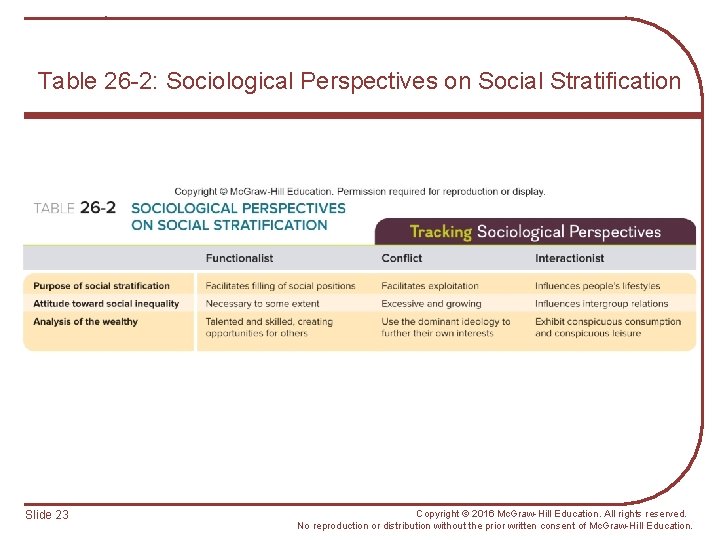
Table 26 -2: Sociological Perspectives on Social Stratification Slide 23 Copyright © 2016 Mc. Graw-Hill Education. All rights reserved. No reproduction or distribution without the prior written consent of Mc. Graw-Hill Education.
Stratification by Social Class • Sociologists generally rely on the objective method to determine a person’s class position • Prestige: respect and admiration an occupation holds in society • Esteem: reputation a specific person has earned within an occupation Slide 24 Copyright © 2016 Mc. Graw-Hill Education. All rights reserved. No reproduction or distribution without the prior written consent of Mc. Graw-Hill Education.
Objective Method of Measuring Social Class • Researcher, not person being classified, identifies the person’s class position • Class largely viewed as a statistical category – Occupation – Education – Income – Place of residence Slide 25 Copyright © 2016 Mc. Graw-Hill Education. All rights reserved. No reproduction or distribution without the prior written consent of Mc. Graw-Hill Education.
Objective Method of Measuring Social Class • Gender and Occupational Prestige – Past studies of social class tended to neglect occupations and incomes of women as determinants of social rank • Multiple Measures – Socioeconomic status (SES): measure of social class based on income, education, and occupation Slide 26 Copyright © 2016 Mc. Graw-Hill Education. All rights reserved. No reproduction or distribution without the prior written consent of Mc. Graw-Hill Education.
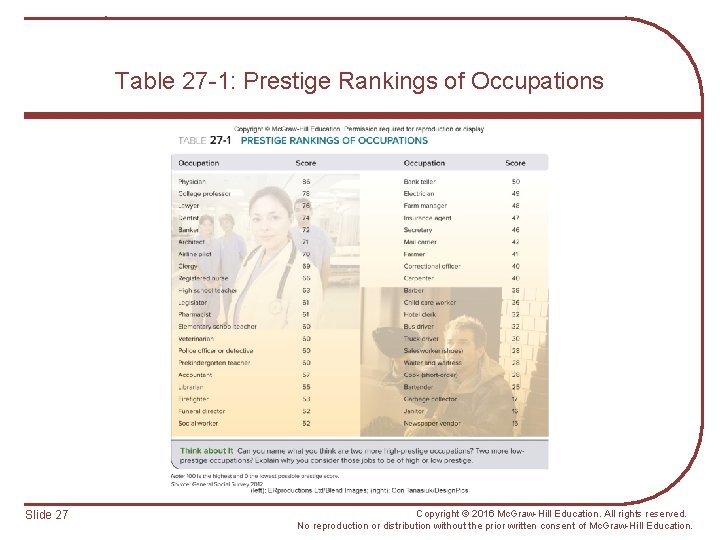
Table 27 -1: Prestige Rankings of Occupations Slide 27 Copyright © 2016 Mc. Graw-Hill Education. All rights reserved. No reproduction or distribution without the prior written consent of Mc. Graw-Hill Education.
Income and Wealth • Income in U. S. distributed unevenly – Modest redistribution of income past 80 years • Redistribution has not always been to the benefit of poor or middle class • Past 30 years of tax policies tended to accentuate trend toward income inequality – Wealth in U. S. much more unevenly distributed than income • White households now have 18 times the median wealth of Latino households and 20 times that of Blacks Slide 28 Copyright © 2016 Mc. Graw-Hill Education. All rights reserved. No reproduction or distribution without the prior written consent of Mc. Graw-Hill Education.
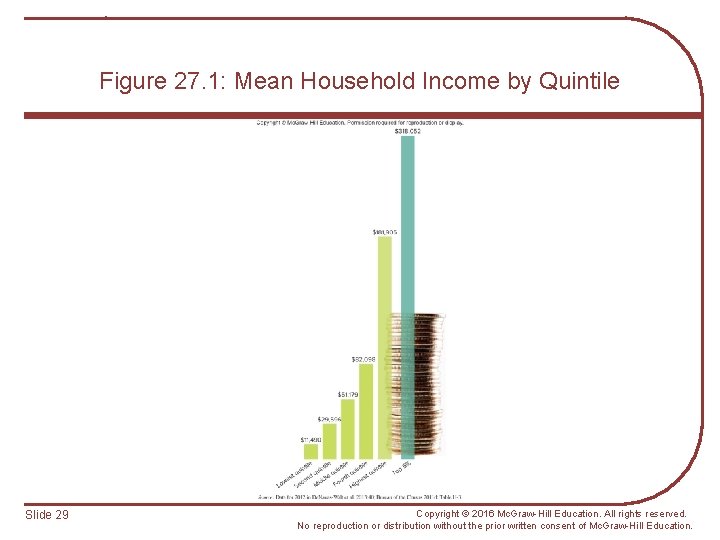
Figure 27. 1: Mean Household Income by Quintile Slide 29 Copyright © 2016 Mc. Graw-Hill Education. All rights reserved. No reproduction or distribution without the prior written consent of Mc. Graw-Hill Education.
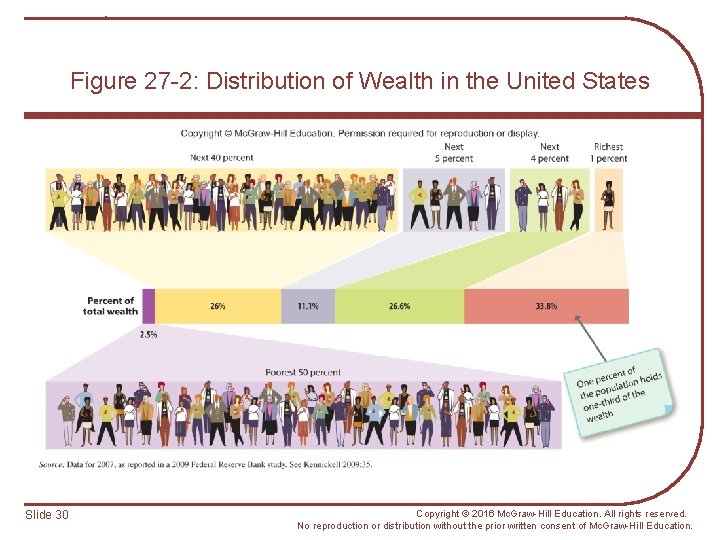
Figure 27 -2: Distribution of Wealth in the United States Slide 30 Copyright © 2016 Mc. Graw-Hill Education. All rights reserved. No reproduction or distribution without the prior written consent of Mc. Graw-Hill Education.
Poverty and Social Mobility • Studying Poverty – Absolute poverty: minimum level of subsistence that no family should live below – Relative poverty: floating standard by which people at the bottom of a society are judged as being disadvantaged in comparison to the nation as a whole Slide 31 Copyright © 2016 Mc. Graw-Hill Education. All rights reserved. No reproduction or distribution without the prior written consent of Mc. Graw-Hill Education.
Studying Poverty • Who Are the Poor? – Many poor adults do work outside the home – Majority live outside of urban slums • Feminization of Poverty – Since World War II, increasing proportion of poor in U. S. have been women • The Underclass – Long-term poor who lack training and skills Slide 32 Copyright © 2016 Mc. Graw-Hill Education. All rights reserved. No reproduction or distribution without the prior written consent of Mc. Graw-Hill Education.
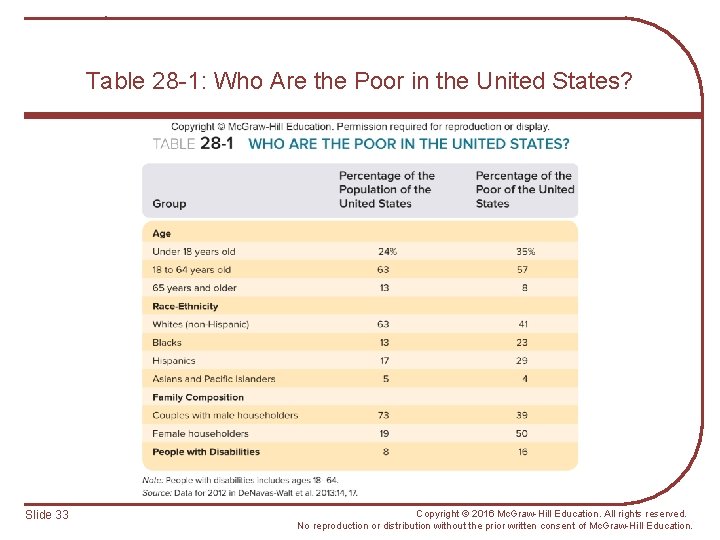
Table 28 -1: Who Are the Poor in the United States? Slide 33 Copyright © 2016 Mc. Graw-Hill Education. All rights reserved. No reproduction or distribution without the prior written consent of Mc. Graw-Hill Education.
Explaining Poverty • Gans: poverty and the poor satisfy positive functions for many non-poor groups – Society’s dirty work performed at low cost – Creates jobs that serve the poor – Upholds conventional social norms – Guarantees higher status of more affluent – Poor absorb costs of social change Slide 34 Copyright © 2016 Mc. Graw-Hill Education. All rights reserved. No reproduction or distribution without the prior written consent of Mc. Graw-Hill Education.
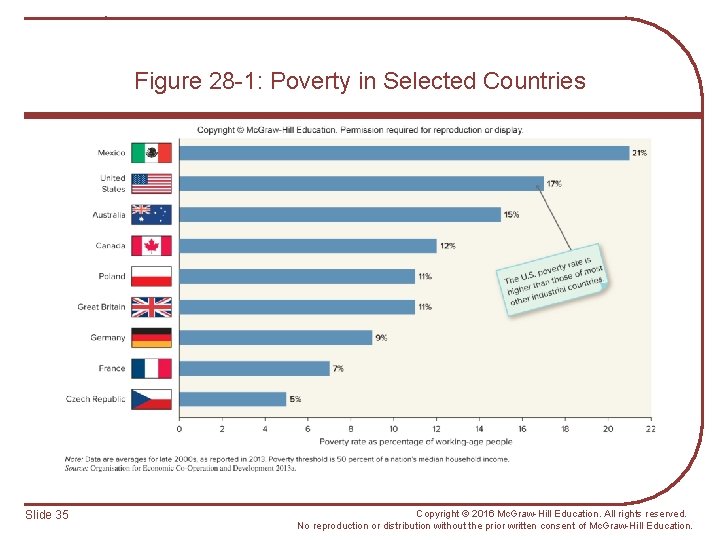
Figure 28 -1: Poverty in Selected Countries Slide 35 Copyright © 2016 Mc. Graw-Hill Education. All rights reserved. No reproduction or distribution without the prior written consent of Mc. Graw-Hill Education.
Life Chances • Max Weber saw class closely related to people’s life chances – Life chances: opportunities to provide material goods, positive living conditions, and favorable life experience • Wealth, status: provide additional ways of coping with problems and disappointments Slide 36 Copyright © 2016 Mc. Graw-Hill Education. All rights reserved. No reproduction or distribution without the prior written consent of Mc. Graw-Hill Education.
Social Mobility • Social mobility: movement of individuals or groups from one position in a society’s stratification system to another Slide 37 Copyright © 2016 Mc. Graw-Hill Education. All rights reserved. No reproduction or distribution without the prior written consent of Mc. Graw-Hill Education.
Open versus Closed Stratification Systems • Open system: position of each individual influenced by the person’s achieved status • Closed system: allows little or no possibility of moving up – Slavery and caste systems Slide 38 Copyright © 2016 Mc. Graw-Hill Education. All rights reserved. No reproduction or distribution without the prior written consent of Mc. Graw-Hill Education.
Types of Social Mobility • Horizontal mobility: movement within same range of prestige • Vertical mobility: movement from one position to another of a different rank • Intergenerational mobility: changes in children’s position relative to their parents • Intragenerational mobility: social position changes within person’s adult life Slide 39 Copyright © 2016 Mc. Graw-Hill Education. All rights reserved. No reproduction or distribution without the prior written consent of Mc. Graw-Hill Education.
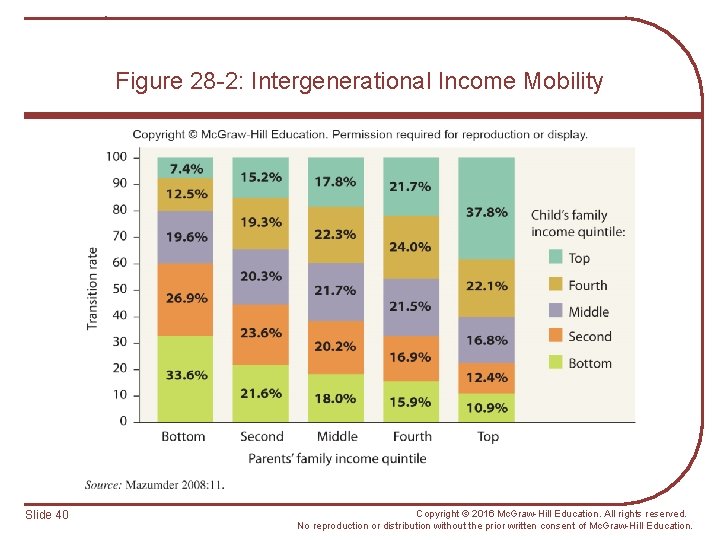
Figure 28 -2: Intergenerational Income Mobility Slide 40 Copyright © 2016 Mc. Graw-Hill Education. All rights reserved. No reproduction or distribution without the prior written consent of Mc. Graw-Hill Education.
Social Mobility in the United States • • Slide 41 Occupational Mobility The Impact of Education The Impact of Race and Ethnicity The Impact of Gender Copyright © 2016 Mc. Graw-Hill Education. All rights reserved. No reproduction or distribution without the prior written consent of Mc. Graw-Hill Education.
Social Policy and Stratification: Minimum Wage Laws • Looking at the Issue – Minimum wage not high enough to support workers – Contributes to a high poverty rate and a larger underclass – Minimum wage shrinks in value over time – Federal minimum wage does not apply to many jobs, such as tip-based jobs Slide 42 Copyright © 2016 Mc. Graw-Hill Education. All rights reserved. No reproduction or distribution without the prior written consent of Mc. Graw-Hill Education.
Social Policy and Stratification: Minimum Wage Laws • Applying Sociology – Conflict theorists: low-wage workers vulnerable in multiple ways, such as lack of enforcement of minimum wage laws • Workers vulnerable to wage theft – Interactionists focus on social contact benefits of low-wage workplace • Many low-wage workers also report extreme alienation Slide 43 Copyright © 2016 Mc. Graw-Hill Education. All rights reserved. No reproduction or distribution without the prior written consent of Mc. Graw-Hill Education.
Social Policy and Stratification: Minimum Wage Laws • Initiating Policy – Difficult for researchers to measure the impact of increases in minimum wage – Opponents charge it will cause higher labor costs and reduction in jobs – Economists cannot agree on variables to be measured – Many advocate for establishment of a living wage, which meets quality of life standards Slide 44 Copyright © 2016 Mc. Graw-Hill Education. All rights reserved. No reproduction or distribution without the prior written consent of Mc. Graw-Hill Education.
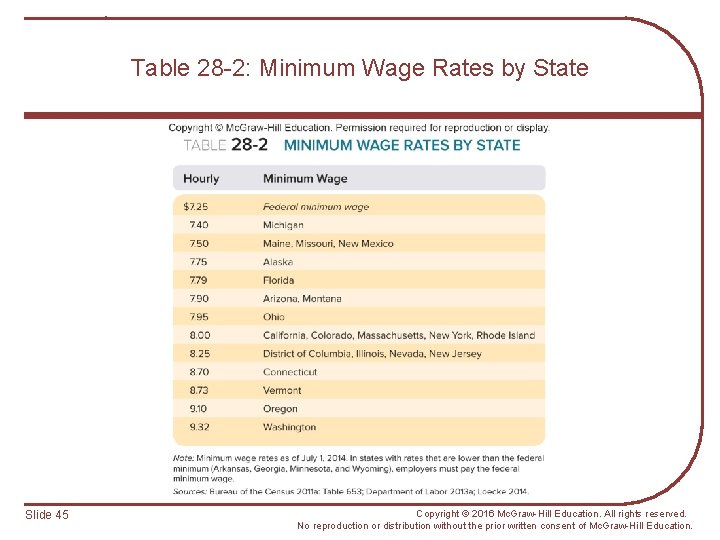
Table 28 -2: Minimum Wage Rates by State Slide 45 Copyright © 2016 Mc. Graw-Hill Education. All rights reserved. No reproduction or distribution without the prior written consent of Mc. Graw-Hill Education.
Research Today 28 -1: Precarious Work – Has the trend toward increasing reliance on precarious work touched your family or friends? Has anyone you know been unemployed longer than six months? – Looking forward to your own career, can you think of a strategy for avoiding precarious work, frequent job loss, and long-term unemployment? Slide 46 Copyright © 2016 Mc. Graw-Hill Education. All rights reserved. No reproduction or distribution without the prior written consent of Mc. Graw-Hill Education.
Sociology on Campus 28 -2: Social Class and Financial Aid – How important are student loans to you and your friends? Without them, would you be able to cover your college expenses? – Aside from a reduction in individual social mobility, what might be the long-term effects of the shortage of need -based financial aid? Relate your answer to the trend toward globalization. Slide 47 Copyright © 2016 Mc. Graw-Hill Education. All rights reserved. No reproduction or distribution without the prior written consent of Mc. Graw-Hill Education.
- Slides: 47