
STRATEGY TO REDUCE CASE BACKLOGS PRESENTATION TO THE
STRATEGY TO REDUCE CASE BACKLOGS PRESENTATION TO THE PORTFOLIO COMMITTEE ON POLICE 14 June 2011, Parliament PROGRAMME 2
Table of contents l l l 2 l Definitions Historical causes External causes Strategic priorities and strategic oriented goals Interventions to reduce case backlogs Total case backlog - 2010/11 Provincial breakdown of backlog cases per class (1 April 2010) Provincial performance breakdown (1 April 2010 – 31 March 2011) Provincial breakdown of backlogs per class (1 April 2011) Priorities for 2011/12 Action plan Current and future steps
Definitions 3 l Backlogs refer to cases where investigations have not been completed over the time period set in terms of the strategic plan. l Completion refers to processes which the ICD can control and influence such as visiting of a scene, attendance of post mortem and obtaining affidavits. l Finalisation refers to a process of completion and include technical reports such as post mortem, ballistic, DNA analysis etc and recommendation reports are made for submission to the Director of Public Prosecution or SAPS Management.
Historical causes The following issues, which are historical in nature, were identified as factors that contributed to the problem of backlogs: – – 4 The strategy to investigate every reported complaint – the general dealer approach Lack of adequate investigative capacity Increase in time spent attending court (1031 days during 2010/11) Late notification / non reporting of cases
External causes Factors beyond the control of ICD and which influences completion of cases include – – – 5 Cases that are reported in the last quarter of the financial year are unlikely to be completed within the current financial year Complexities of some cases – each case presents its own unique challenge Completion of some cases (i. e. investigation of deaths, rape, attempted murder) are dependant on cooperation by external stakeholders l SAPS (Forensic analysis such as ballistic reports, DNA analysis) l Department of Health (Post mortems, Histology tests)
Strategic priorities and strategic outcome oriented goals 6 l Strategic Plan 2010/13 – The reduction of backlogs was identified as a strategic priority for the 2010 – 2013 MTSF period - (page 9 of the ICD Strategic Plan 2010 /13) – The primary objective was to improve service delivery in the ICD’s investigation services – 2010/13 Target: To decrease backlogs to no more than 10% of the previous year l Strategic Plan 2011/16 – One of the strategic oriented goals of the department for the 20112016 period is to finalise more cases and to reduce existing backlogs – (page 12 of the ICD Strategic Plan for 2011/16)
Interventions to reduce case backlogs l Review of business process A review of business process relating to complaints handling was undertaken during 2010 – The business process was made user-friendly and easy to understand – The different phases of complaints processing were clearly identified – The various role-players (Case Workers, Supervisors and Provincial Head) and their responsibilities were identified and clarified l 7 Provincial Annual Performance Plans In addition the strategic priorities of the department, each provincial annual performance plan has an additional strategy to complete their backlog by the end of the 2 nd quarter of the new financial year – The individual APP indicates the backlog brought forward from the previous financial year
Interventions to reduce case backlogscontinued l Restructuring of the Monitoring and Evaluation Committee – to effectively monitor and evaluate performance by provinces on a monthly and quarterly basis – to conduct audits to ensure compliance with the SOP and that targets are met by each province – to make recommendations to the Executive Director for interventions where necessary – Establishment of dedicated Task Teams to assist provinces which experience heavy workload, for example l 8 l A team of three (3) Investigators was deployed to assist the Mpumalanga Provincial office with investigation of complaints of torture in the Kwa. Mhlanga area Two (2) Investigators were deployed to assist the abovementioned province with the complaints emanating from the service delivery protests in Ermelo
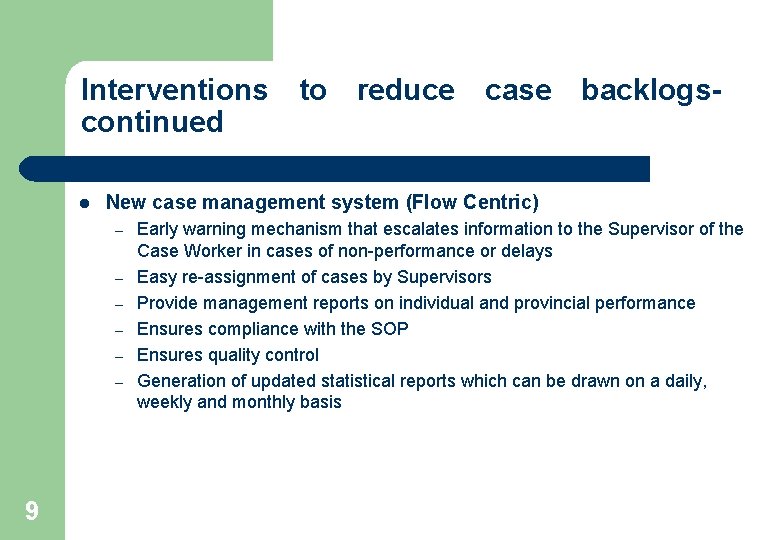
Interventions to reduce case backlogscontinued l New case management system (Flow Centric) – – – 9 Early warning mechanism that escalates information to the Supervisor of the Case Worker in cases of non-performance or delays Easy re-assignment of cases by Supervisors Provide management reports on individual and provincial performance Ensures compliance with the SOP Ensures quality control Generation of updated statistical reports which can be drawn on a daily, weekly and monthly basis

Total case backlog - 2010/11 Provinces 10 Backlog by 1 April 2010 Eastern Cape 160 Free-State 97 Gauteng 506 Kwa. Zulu-Natal 729 Limpopo 53 Mpumalanga 219 North West 38 Northern Cape 13 Western Cape 676 Total 2491
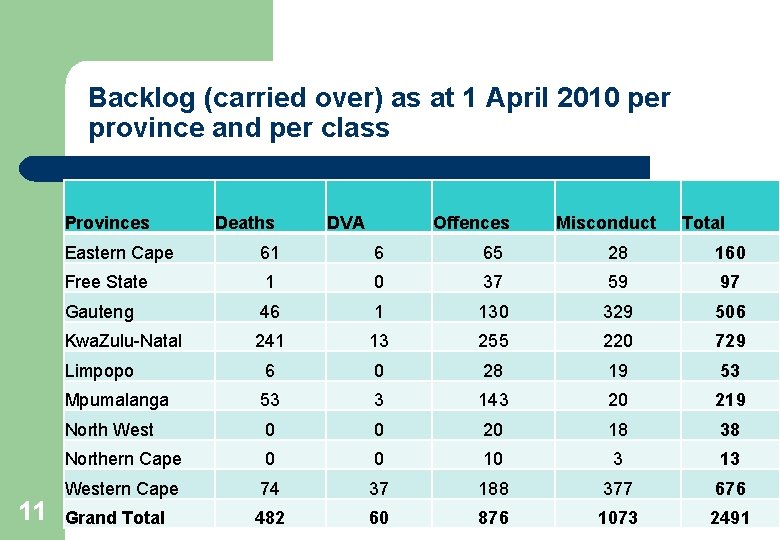
Backlog (carried over) as at 1 April 2010 per province and per class Provinces 11 Deaths DVA Offences Misconduct Total Eastern Cape 61 6 65 28 160 Free State 1 0 37 59 97 Gauteng 46 1 130 329 506 Kwa. Zulu-Natal 241 13 255 220 729 Limpopo 6 0 28 19 53 Mpumalanga 53 3 143 20 219 North West 0 0 20 18 38 Northern Cape 0 0 10 3 13 Western Cape 74 37 188 377 676 Grand Total 482 60 876 1073 2491
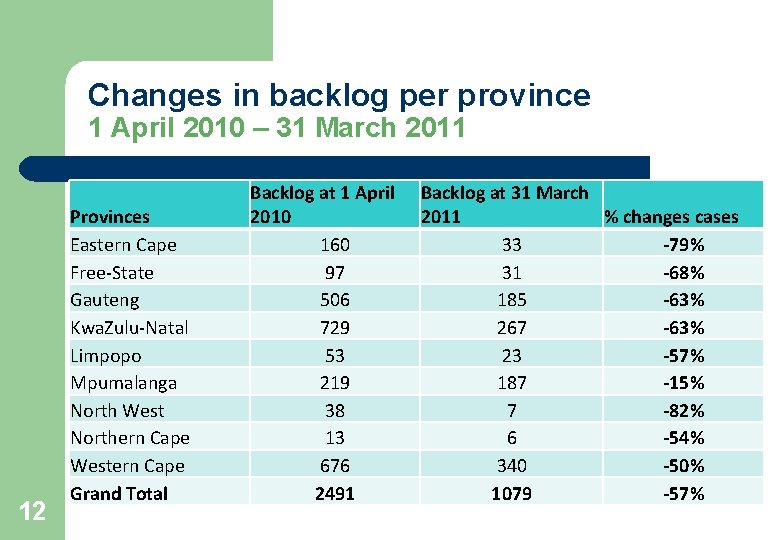
Changes in backlog per province 1 April 2010 – 31 March 2011 12 Provinces Eastern Cape Free-State Gauteng Kwa. Zulu-Natal Limpopo Mpumalanga North West Northern Cape Western Cape Grand Total Backlog at 1 April 2010 160 97 506 729 53 219 38 13 676 2491 Backlog at 31 March 2011 % changes cases 33 -79% 31 -68% 185 -63% 267 -63% 23 -57% 187 -15% 7 -82% 6 -54% 340 -50% 1079 -57%
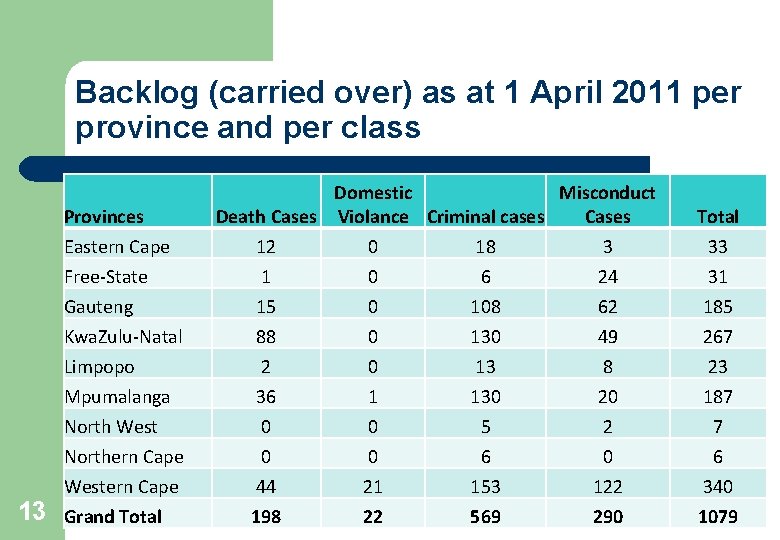
Backlog (carried over) as at 1 April 2011 per province and per class 13 Provinces Eastern Cape Free-State Gauteng Kwa. Zulu-Natal Limpopo Mpumalanga North West Northern Cape Western Cape Grand Total Domestic Misconduct Death Cases Violance Criminal cases Cases 12 0 18 3 1 0 6 24 15 0 108 62 88 0 130 49 2 0 13 8 36 1 130 20 0 0 5 2 0 0 6 0 44 21 153 122 198 22 569 290 Total 33 31 185 267 23 187 7 6 340 1079
Priorities for 2011/12 The Programme will continue to prioritise the reduction of backlog cases and improvement of output during the 2011/12 financial year through – – – 14 Constant and effective monitoring and evaluation of performance on a monthly basis by the Programme Manager and the Monitoring and Evaluation Committee l Review of monthly performance reports especially with regard to backlogs l Audits of the backlog cases as reported by the province. A detailed audit programme by the Monitoring and Evaluation Committee has already been drawn for implementation and will commence during in July 2011 l Interventions when required Monthly audits of backlogs by Provincial offices Monthly reporting to National Office on progress made towards completing the cases
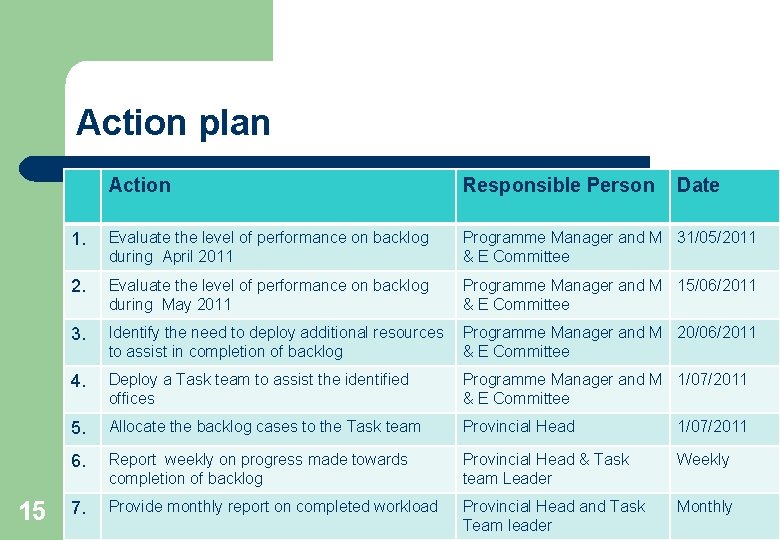
Action plan 15 Action Responsible Person Date 1. Evaluate the level of performance on backlog during April 2011 Programme Manager and M 31/05/2011 & E Committee 2. Evaluate the level of performance on backlog during May 2011 Programme Manager and M 15/06/2011 & E Committee 3. Identify the need to deploy additional resources to assist in completion of backlog Programme Manager and M 20/06/2011 & E Committee 4. Deploy a Task team to assist the identified offices Programme Manager and M 1/07/2011 & E Committee 5. Allocate the backlog cases to the Task team Provincial Head 1/07/2011 6. Report weekly on progress made towards completion of backlog Provincial Head & Task team Leader Weekly 7. Provide monthly report on completed workload Provincial Head and Task Team leader Monthly
Current and future steps l l 16 Provinces have a target to complete backlog cases within 6 months of the new financial year Provinces will report on backlog performance in their monthly performance reports Complainants will be provided with monthly feedback regarding progress made towards completion of their cases Quarterly reporting on backlog cases is included in the Provincial Annual Performance Plans for 2011/12

Thank you 17
- Slides: 17