
Strategy to Action The Power of HSD Session
- Slides: 25
Strategy to Action: The Power of HSD Session 6: HSD and Virtual Teams February 11, 2009 Glenda H. Eoyang, Ph. D. geoyang@hsdinstitute. org Denise Easton deaston@uliveandlearn. com
Series Goal Improve your performance as you: Manage projects Plan for change Train and develop capacity © 2008. HSD Institute. Manage performance Communicate Lead virtual teams 2
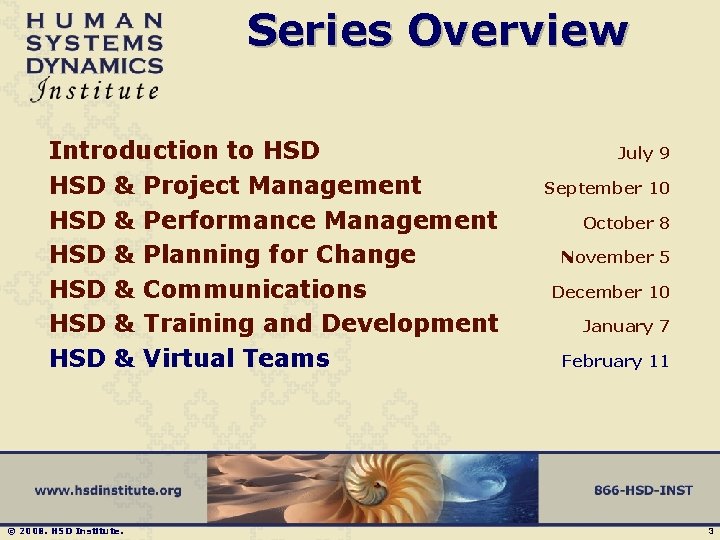
Series Overview Introduction to HSD & Project Management HSD & Performance Management HSD & Planning for Change HSD & Communications HSD & Training and Development HSD & Virtual Teams © 2008. HSD Institute. July 9 September 10 October 8 November 5 December 10 January 7 February 11 3
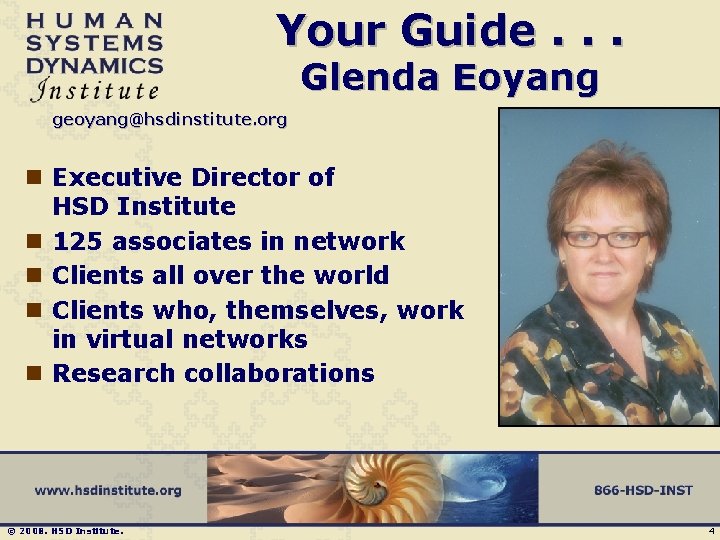
Your Guide. . . Glenda Eoyang geoyang@hsdinstitute. org n Executive Director of HSD Institute n 125 associates in network n Clients all over the world n Clients who, themselves, work in virtual networks n Research collaborations © 2008. HSD Institute. 4
Your Guide. . . Denise Easton deaston@uliveandlearn. com n HSDP Associate n CEO of Uliveandlearn n Virtual Explorer & Guide n Lifelong Learner & Teacher n And. . . © 2008. HSD Institute. 5
Today we will. . . n Identify benefits and risks of virtual teaming. n Consider the conditions for selforganizing in teams. n Explore how virtual communications work (and don’t) in virtual teams. n List best practices for virtual communications. © 2008. HSD Institute. 6
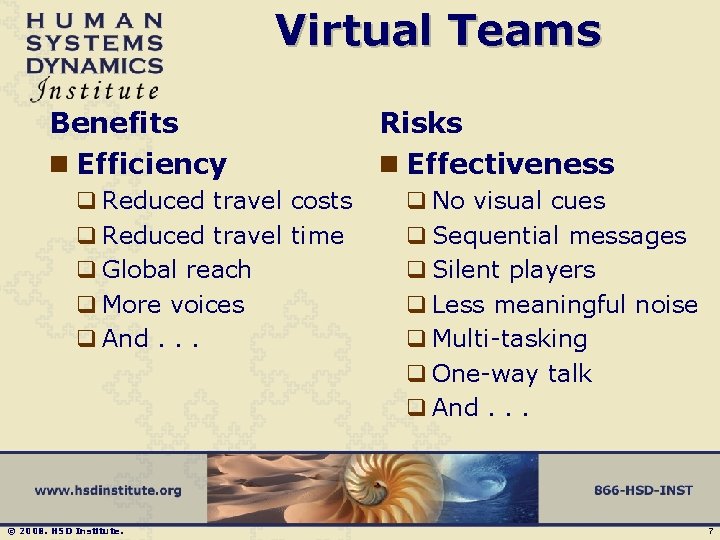
Virtual Teams Benefits n Efficiency q Reduced travel costs q Reduced travel time q Global reach q More voices q And. . . © 2008. HSD Institute. Risks n Effectiveness q No visual cues q Sequential messages q Silent players q Less meaningful noise q Multi-tasking q One-way talk q And. . . 7
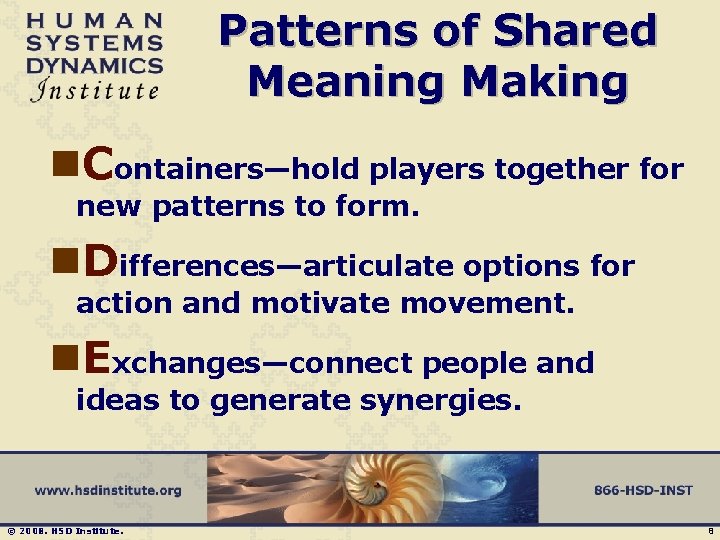
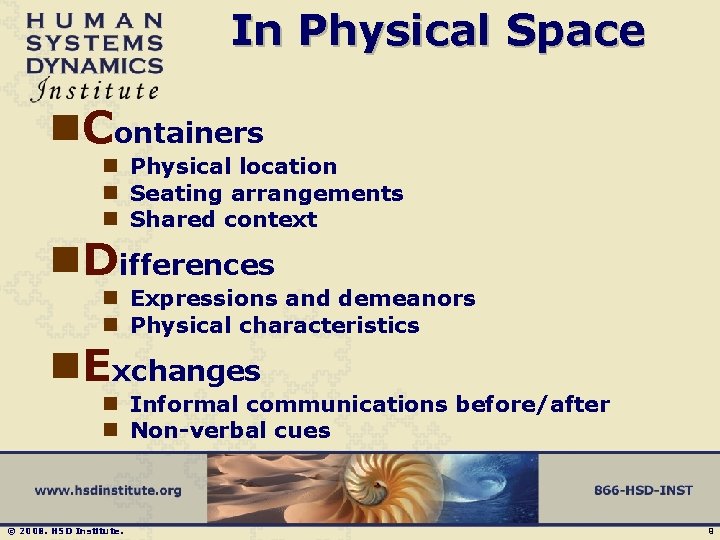
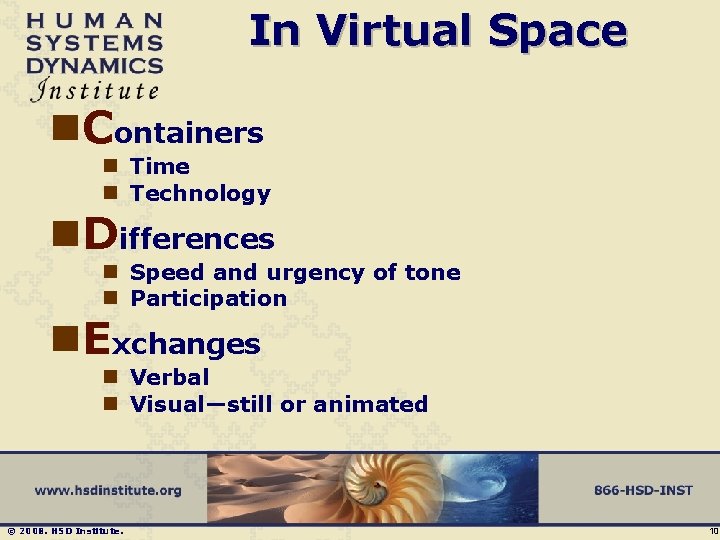
Patterns of Shared Meaning Making n. Containers—hold players together for new patterns to form. n. Differences—articulate options for action and motivate movement. n. Exchanges—connect people and ideas to generate synergies. © 2008. HSD Institute. 8
In Physical Space n. Containers n Physical location n Seating arrangements n Shared context n. Differences n Expressions and demeanors n Physical characteristics n. Exchanges n Informal communications before/after n Non-verbal cues © 2008. HSD Institute. 9
In Virtual Space n. Containers n Time n Technology n. Differences n Speed and urgency of tone n Participation n. Exchanges n Verbal n Visual—still or animated © 2008. HSD Institute. 10
How does it work? Return © 2008. HSD Institute. 11
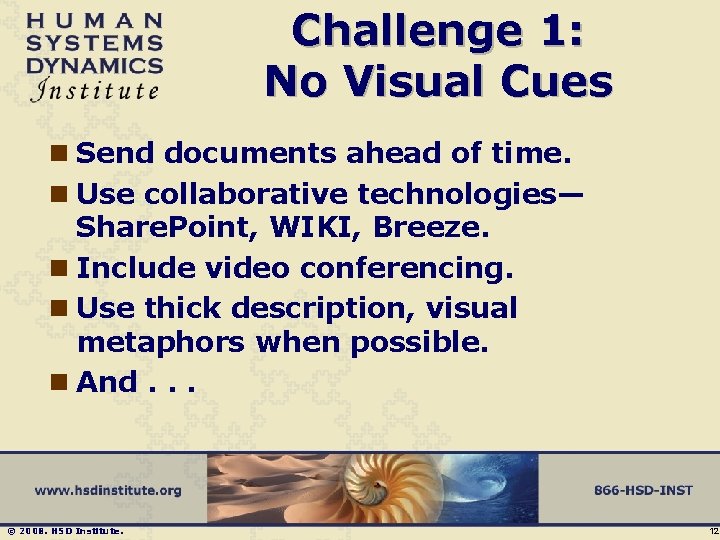
Challenge 1: No Visual Cues n Send documents ahead of time. n Use collaborative technologies— Share. Point, WIKI, Breeze. n Include video conferencing. n Use thick description, visual metaphors when possible. n And. . . © 2008. HSD Institute. 12
How does it work? Return © 2008. HSD Institute. 13
Challenge 2: Sequential Messages n Include a chat feature. n Put multiple people together in one room. n Prelude or follow-up with on-line conversations n And. . . © 2008. HSD Institute. 14
How does it work? Return © 2008. HSD Institute. 15
Challenge 3: Silent Players n Go around the group and ask for responses. n Ask individuals to be prepared to speak. n Use text messaging for simultaneous conversations. n And. . . © 2008. HSD Institute. 16
How does it work? Return © 2008. HSD Institute. 17
Challenge 4: Less Meaningful Noise n Give time at start or end for “all call” when anyone speaks about whatever they want to. n Bring people together physically at least once. n Encourage one-on-one action between meetings. n And. . . © 2008. HSD Institute. 18
How does it work? Return © 2008. HSD Institute. 19
Challenge 5: Multi-Tasking n Keep meetings short. n Ask frequently for responses. n Make expectations explicit. n Track who is talking and when about what. n Include text, visual, and other stimuli. n And. . . © 2008. HSD Institute. 20
How does it work? Return © 2008. HSD Institute. 21
Challenge 6: One-Way Talk n Prepare others to present. n Give sufficient wait time. n Ask questions and consider responses. n Speak slowly and don’t fear silence. n And. . . © 2008. HSD Institute. 22
How does it work? Return © 2008. HSD Institute. 23
Today we. . . n Identified benefits and risks of virtual teaming. n Considered the conditions for selforganizing in teams. n Explored how virtual communications work (and don’t) in virtual teams. n Listed best practices for virtual communications. © 2008. HSD Institute. 24
Resources n Virtual Team Toolkit http: //managementhelp. org/grp_skll/virtual. htm n Virtual Organization http: //www. seanet. com/~daveg/ltv. htm n Virtual Communications http: //www. groupjazz. com/pdf/vteams-toronto. pdf n Resources List http: //www. startwright. com/virtual. htm © 2008. HSD Institute. 25