
Strategy Pattern MICHAEL SAWULA 2182019 Strategy Pattern Definition

- Slides: 10
Strategy Pattern MICHAEL SAWULA 2/18/2019
Strategy Pattern Definition The intent of the Strategy Pattern is to define a family of algorithms, encapsulate each one, and make them interchangeable within that family Strategy Pattern lets the algorithm vary independently from the clients that use it Also known as the “Policy Pattern” The Strategy Pattern enables an algorithm’s behavior to be selected at runtime
Strategy Pattern Applicability Use the strategy pattern when: You have many related classes that differ only in their behavior You need different variants of an algorithm For example, you might define algorithms reflecting different space/time trade-offs When an algorithm uses data that clients shouldn’t know about. Strategies provide a way to configure a class with one of many behaviors Use the Strategy Pattern to avoid exposing complex, algorithm-specific data structures A class defines many behaviors, and these appear as multiple conditional statements in its operations. Move related conditional branches into their own strategy class
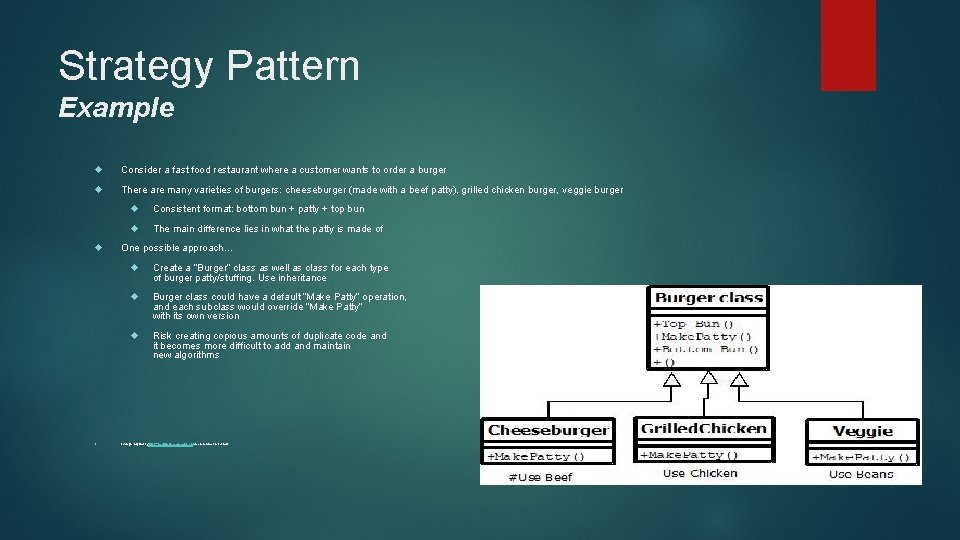
Strategy Pattern Example Consider a fast food restaurant where a customer wants to order a burger There are many varieties of burgers: cheeseburger (made with a beef patty), grilled chicken burger, veggie burger Consistent format: bottom bun + patty + top bun The main difference lies in what the patty is made of One possible approach… Create a “Burger” class as well as class for each type of burger patty/stuffing. Use inheritance Burger class could have a default “Make Patty” operation, and each subclass would override “Make Patty” with its own version Risk creating copious amounts of duplicate code and it becomes more difficult to add and maintain new algorithms Example inspired by https: //medium. freecodecamp. org (see references for detail)
Strategy Pattern Example (continued) Similar format: bottom bun + patty + top bun patty for a cheeseburger = cheese + beef patty for a chicken burger = grilled chicken breast patty for a veggie burger = soybeans, tofu, nuts, grains etc. Recall: the intent of the Strategy Pattern is to define a family of algorithms, encapsulate each one, and make them interchangeable within that family In this example, the family of algorithms = the family of different patties They are encapsulated and interchangeable with each other
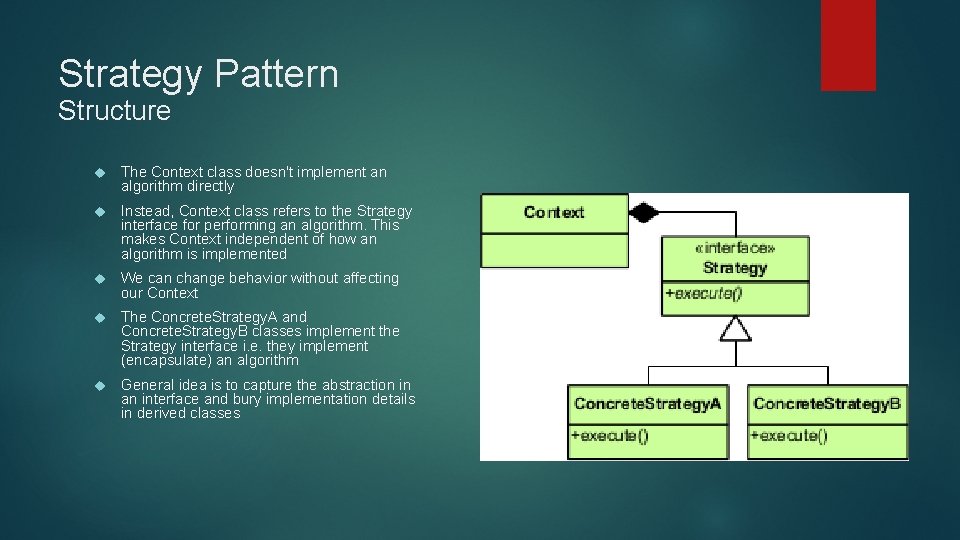
Strategy Pattern Structure The Context class doesn't implement an algorithm directly Instead, Context class refers to the Strategy interface for performing an algorithm. This makes Context independent of how an algorithm is implemented We can change behavior without affecting our Context The Concrete. Strategy. A and Concrete. Strategy. B classes implement the Strategy interface i. e. they implement (encapsulate) an algorithm General idea is to capture the abstraction in an interface and bury implementation details in derived classes
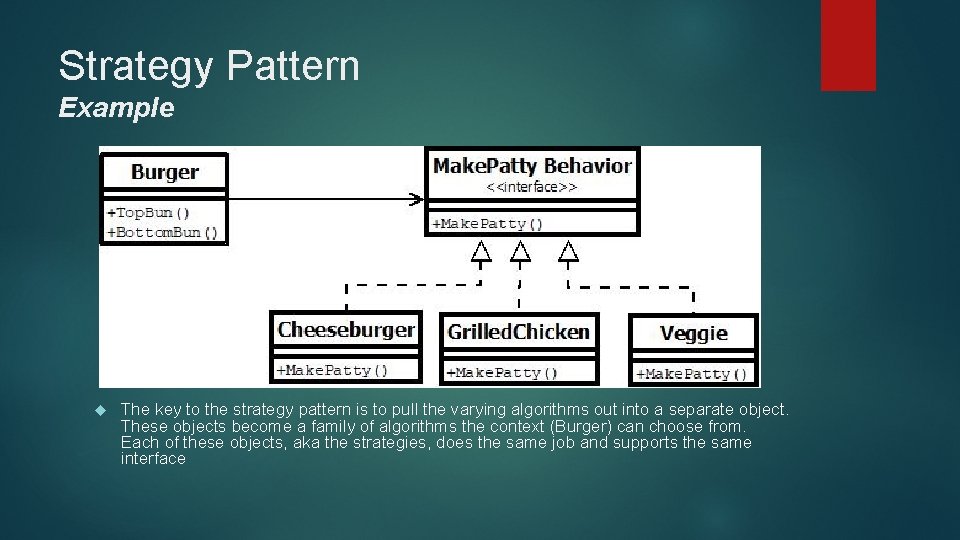
Strategy Pattern Example The key to the strategy pattern is to pull the varying algorithms out into a separate object. These objects become a family of algorithms the context (Burger) can choose from. Each of these objects, aka the strategies, does the same job and supports the same interface
Strategy Pattern Python Demonstration https: //www. pythonanywhere. com
Strategy Pattern Benefits and other considerations It achieves better separation of concerns by pulling out a set of strategies from a class In our example, it relieves the Burger class of any responsibility for our knowledge of the stuffing Strategies can provide different implementations of the same behavior By encapsulating the algorithm separately, new algorithms complying with the same interface can be easily introduced Encapsulating the algorithm in separate Strategy classes lets you vary the algorithm independently of its context, making it easier to switch, understand extend It makes it easy to switch strategies at runtime because the pattern is based on composition and delegation, rather than on inheritance (moving from “is a” to “has a” Strategies eliminate conditional statements This enables the client to choose the required algorithm, without using a “switch” statement or a series of “ifelse” statements However, applications/clients must be aware of all the strategies to select the right one for the right situation Use strategy pattern only when the variation in behavior is relevant to clients Strategies increase the number of objects in an application
Strategy Pattern Sources Design Patterns, Gamma, et. al. https: //sourcemaking. com/design_patterns/strategy https: //medium. freecodecamp. org/how-can-you-learn-the-strategy-designpattern-make-a-hamburger-a 6 ad 4332 b 838 https: //www. geeksforgeeks. org/strategy-pattern-set-1/ Strategy Design Pattern (https: //www. youtube. com/watch? v=-NCg. RD 9 C 6 o) Strategy Pattern – Design Patterns (ep 1) (https: //www. youtube. com/watch? v=v 9 ej. T 8 FO-7 I) https: //en. wikipedia. org/wiki/Strategy_pattern