
Strategy for Unacceptable Behaviour GOG Omer Van den
Strategy for Unacceptable Behaviour (GOG) Omer Van den Bergh, Deb Vansteenwegen, Kathleen Vleugels, Heidi Mertens, Sofie Vandermot, Brigit Cosemans Update 15042019 of document AC 463 (21022017) HARASSMENT HELP DESK
Content A. B. C. D. E. View on and approach to unacceptable behaviour Prevention and organisational structure: general principle & process for reports Harassment Help Desk: what & role Confidential unit: what, why & general principles Interventions not involving the confidential unit o o Duty of confidentiality vs involving policy-makers External approach Internal approach: case manager, support team Restorative approach through mediation F. Follow-up, feedback and policy implications 2
A. View on and approach to unacceptable behaviour (GOG) • KU Leuven highly values respectful, supportive and trustful interaction o Prevention & monitoring of, and initial approach to GOG is everyone's responsibility in the day-to-day work context • Specific GOG reports can be made internally via: o Harassment Help Desk (help desk - confidential advisor) = for staff and students o Confidential advisor - students = for students o Confidants & Ph. D ombudspersons = for staff o Central ombudsperson - confidential advisor = for staff • Reports can also be made directly via external channels o External psycho-social issues prevention advisor of IDEWE = for staff o Police
B. Prevention and organisational structure General principles • Comprises the importance of respectful, supportive and trusting interaction with each other o o o should be communicated as a framework that establishes values and conditions should serve as a guideline for policy and human resources decisions is implemented in the confidential network and the reporting procedures • Collaboration with student organisations is an essential part of the prevention policy for unacceptable behaviour o 4 29/11/2020 STUVO, LOKO, STURA, . .
General principles Appropriate contact means taking into account the context and the person • If a person experiences a certain type of behaviour as unacceptable, we accept this qualification • The subjective perception is the criterion as opposed to the objective actions in a strictly legal sense • The question of guilt is not the first concern of our approach 5 29/11/2020
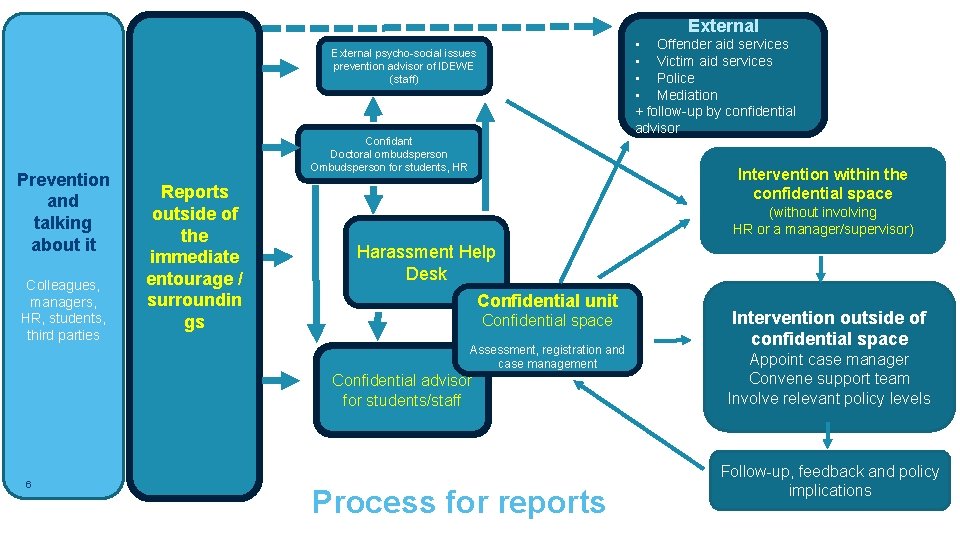
External • Offender aid services • Victim aid services • Police • Mediation + follow-up by confidential advisor External psycho-social issues prevention advisor of IDEWE (staff) Prevention and talking about it Colleagues, managers, HR, students, third parties Confidant Doctoral ombudsperson Ombudsperson for students, HR Reports outside of the immediate entourage / surroundin gs Intervention within the confidential space (without involving HR or a manager/supervisor) Harassment Help Desk Confidential unit Confidential space Assessment, registration and case management Confidential advisor for students/staff 6 29/11/2020 Process for reports Intervention outside of confidential space Appoint case manager Convene support team Involve relevant policy levels Follow-up, feedback and policy implications
Harassment Help Desk 7
Harassment Help Desk • One phone number, available during working hours • One email address: GOG@kuleuven. be o Straightforward and available to the entire University • for students, staff and third parties o Emails answered by a confidential advisor o Complementary to the existing, widely used, accessible network of confidants and doctoral ombudspersons • also possible to turn to the central ombudsperson-confidential advisor, the confidential advisor for students, the psycho-social issues prevention advisor of IDEWE o 8 29/11/2020 Can be contacted by the reporter and the person(s) concerned
Harassment Help Desk Role: listen, initial support, advice, act (in consultation with reporter) o o Describe the type of problem, consequence, scope, severity, impact, actions taken Provide information: general principles and possibilities for approach Check if mediated solution is preferred or not Advice on further steps: choice between Internal or External channels* • When the reporter prefers internal channels o o o Coordination with central ombudsperson - confidential advisor Coordinate who deals with case management: composition of support team & follow-up Coordinate communication, registration • When the reporter prefers external channels o o o If desired, help with contacting external channels Assess the wish for follow-up/possibilities and agreements for follow-up Registration 9 * reporters can also contact the external channels directly
General principles: sexuality in a university context • Sexuality is an important aspect of life, also within the University • Many young people, students, assistants and doctoral students find their partner at university. • There might be an attraction between students, between teachers and students, and between colleagues-employees of the University. • The parties concerned may decide jointly whether or not to act on this attraction by starting a relationship. • Some study programmes and traineeships require physical contact, as is the case for doctors, nurses and physiotherapists in training. • The line between personal and professional contacts in these circumstances may be(come) blurred. 10
Confidential unit 11
Confidential unit • Where necessary, a team of confidential advisers works together to o o assess the risks and explore the problem examine how to obtain the best solutions explore who should/shouldn't be involved find solutions to problems that cannot be solved locally • The team consists of o o Confidential advisor for students* Confidential advisor for staff Confidential advisor of help desk Internal psycho-social issues prevention advisor • The team is bound by professional secrecy 12 • Concerns the current situation and activities of the confidential advisor for students of the Leuven Campus. We are working on the coordination between the procedures of the Leuven Campus and other campuses.
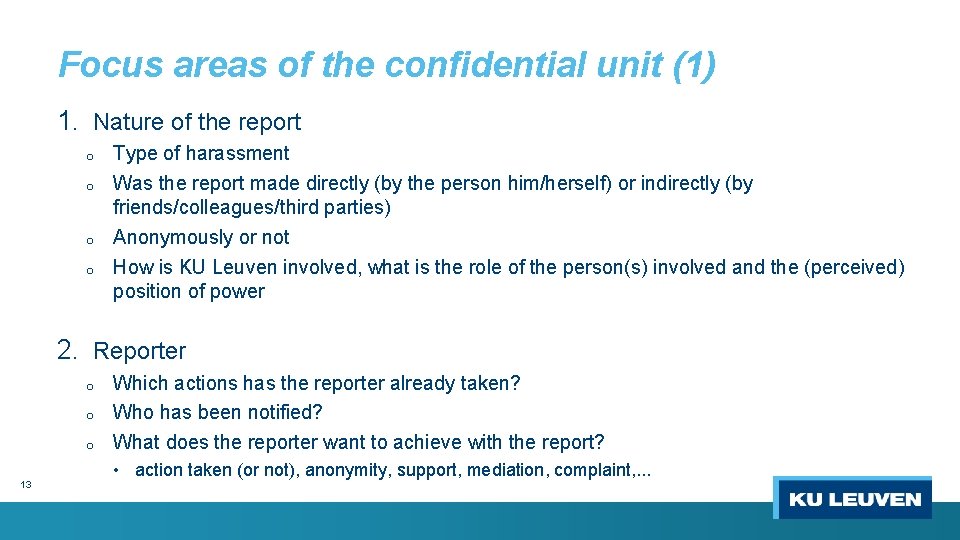
Focus areas of the confidential unit (1) 1. Nature of the report o o Type of harassment Was the report made directly (by the person him/herself) or indirectly (by friends/colleagues/third parties) Anonymously or not How is KU Leuven involved, what is the role of the person(s) involved and the (perceived) position of power 2. Reporter o o o 13 Which actions has the reporter already taken? Who has been notified? What does the reporter want to achieve with the report? • action taken (or not), anonymity, support, mediation, complaint, . . .
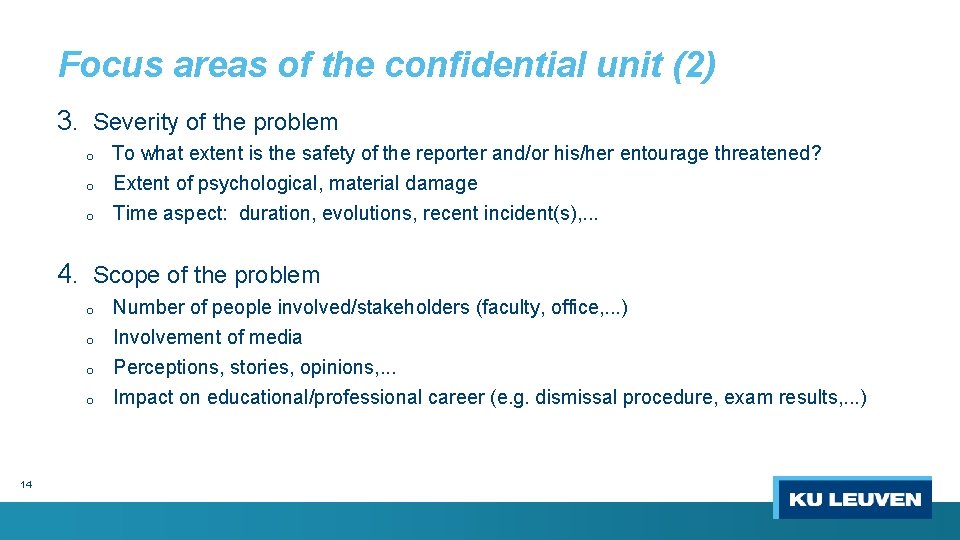
Focus areas of the confidential unit (2) 3. Severity of the problem o o o To what extent is the safety of the reporter and/or his/her entourage threatened? Extent of psychological, material damage Time aspect: duration, evolutions, recent incident(s), . . . 4. Scope of the problem o o 14 Number of people involved/stakeholders (faculty, office, . . . ) Involvement of media Perceptions, stories, opinions, . . . Impact on educational/professional career (e. g. dismissal procedure, exam results, . . . )
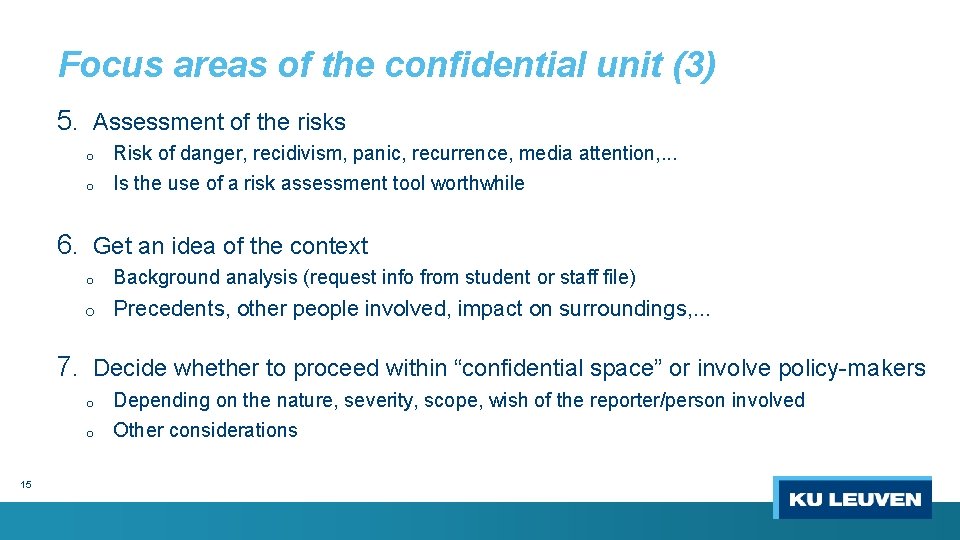
Focus areas of the confidential unit (3) 5. Assessment of the risks o o Risk of danger, recidivism, panic, recurrence, media attention, . . . Is the use of a risk assessment tool worthwhile 6. Get an idea of the context o Background analysis (request info from student or staff file) o Precedents, other people involved, impact on surroundings, . . . 7. Decide whether to proceed within “confidential space” or involve policy-makers o o 15 Depending on the nature, severity, scope, wish of the reporter/person involved Other considerations
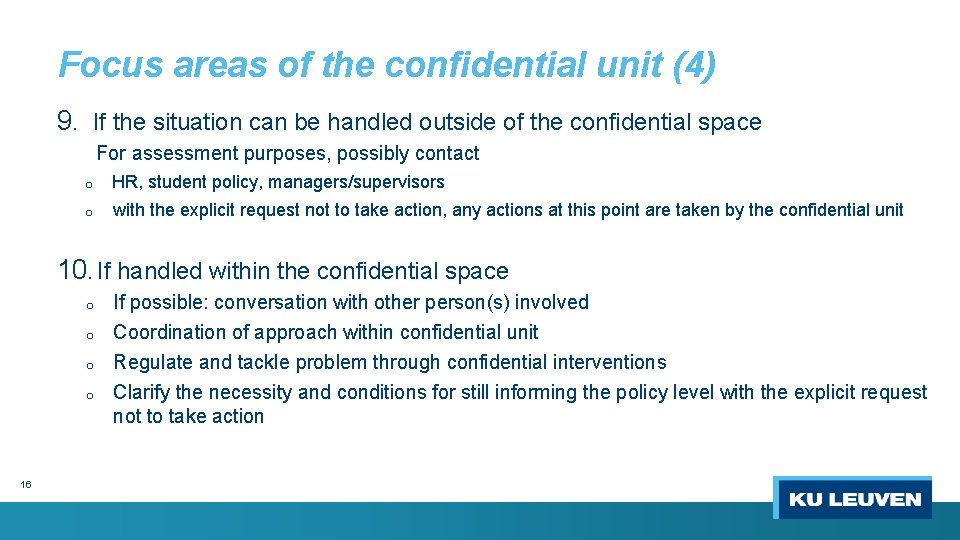
Focus areas of the confidential unit (4) 9. If the situation can be handled outside of the confidential space For assessment purposes, possibly contact o HR, student policy, managers/supervisors o with the explicit request not to take action, any actions at this point are taken by the confidential unit 10. If handled within the confidential space o o 16 If possible: conversation with other person(s) involved Coordination of approach within confidential unit Regulate and tackle problem through confidential interventions Clarify the necessity and conditions for still informing the policy level with the explicit request not to take action
Focus areas of the confidential unit (5) 11. File creation (cf. digital tool) o Written, information fields, database 12. Communication o Feedback for people involved 13. Follow-up o o o Prevention: prevent recurrence Check whether the intended result was realised and has been sustained Regulate 14. Reflect o 17 What to keep, adjust in the future (lessons learned)
Intervention not involving the confidential unit 18
1. Duty of confidentiality of confidential advisers involving policy levels Involving policy levels is possible • After explicit approval from reporter o Note: often, approval is only given after a counselling process • In case of emergency o What one wants to protect is of greater importance, there is acute and serious danger (e. g. physical integrity) o There's an immediate necessity o What one wants to protect cannot be safeguarded in any other way o Note: this is always discussed with the reporter first, and adequate protection is ensured • In case anonymity of the reporter can be ensured o E. g. when multiple persons were harassed over a longer period of time = find a balance between working in confidence & informally and reporting risks in a timely manner, being able to take responsibility, working on structural solutions
Option 1: Handling the report externally Refer to and help to contact • Police to lodge a complaint (always in case of criminal offences!) o support if necessary/desired • Informal/formal request for intervention by psycho-social issues prevention advisor of IDEWE • for staff • medical follow-up if necessary (company doctor/GP) • Government-supported services o 1712 help desk “Abuse in relationships of authority” (in Dutch) (https: //www. 1712. be) • Victim and offender aid services at CAW East Brabant • Restorative mediation by Moderator vzw (http: //moderator. be) Internal follow-up always offered • Stay in touch via contacted confidant or confidential advisor (internal case manager) 20 29/11/2020
Option 2: Handling the report internally • Case manager is appointed o Choice in function of the situation, wishes of the reporter • • o Confidant (e. g. experience with unacceptable behaviour) Confidential advisor for students/staff HR consultant Policy-maker (e. g. Vice Rector, head of the Rector's Office and Services, etc. ) May change during the process, but only in consultation • Support team is composed by the case manager o 21 29/11/2020 Differs depending on whether it’s a staff member or student
Support team: reporter/person involved is a staff member • Composition may vary • Possible members o o o Confidential advisor of help desk Central ombudsperson - confidential advisor Representative of hierarchical relation (manager, Dean, Vice Rector, . . . ) HR consultant Legal advisor Psycho-social issues prevention advisor and/or occupational doctor • Note: o o 22 29/11/2020 Doctoral students = staff The same procedure is followed (to the extent possible) for “third parties”, such as volunteers, research participants, . . .
Support team: reporter/person involved is a student • Case manager = confidential advisor for students • Possible members: o o o 23 29/11/2020 Confidential advisor of Harassment Help Desk Vice Rector for Student Affairs Dean/Vice Dean for Education In case staff member(s) involved • Central ombudsperson - confidential advisor • HR consultant Legal advisor Possibly residence manager
Role of case manager • Responsible for coordination • Informs reporter about confidentiality and the possibility of assistance via external channels, both legal and support channels. o In case of criminal offences: always encourages reporter to involve police and report the offence • Coordinates conversation with accused o when, by who, which message, . . . ? ? • Supports the reporter, offers psycho-social help and provides information on possible steps to take o 24 29/11/2020 Monitors time schedule (urgency may be important)
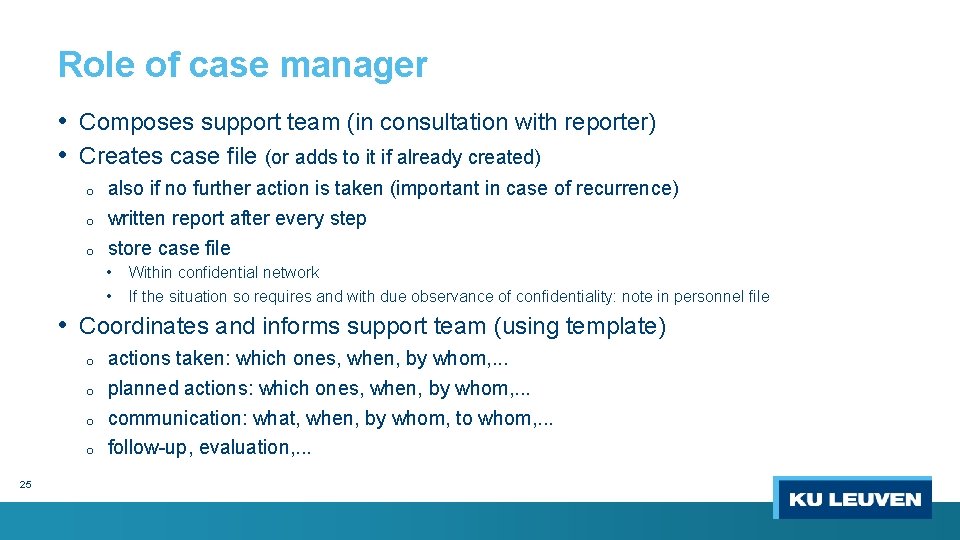
Role of case manager • Composes support team (in consultation with reporter) • Creates case file (or adds to it if already created) o o o also if no further action is taken (important in case of recurrence) written report after every step store case file • • Within confidential network If the situation so requires and with due observance of confidentiality: note in personnel file • Coordinates and informs support team (using template) o o 25 actions taken: which ones, when, by whom, . . . planned actions: which ones, when, by whom, . . . communication: what, when, by whom, to whom, . . . follow-up, evaluation, . . .
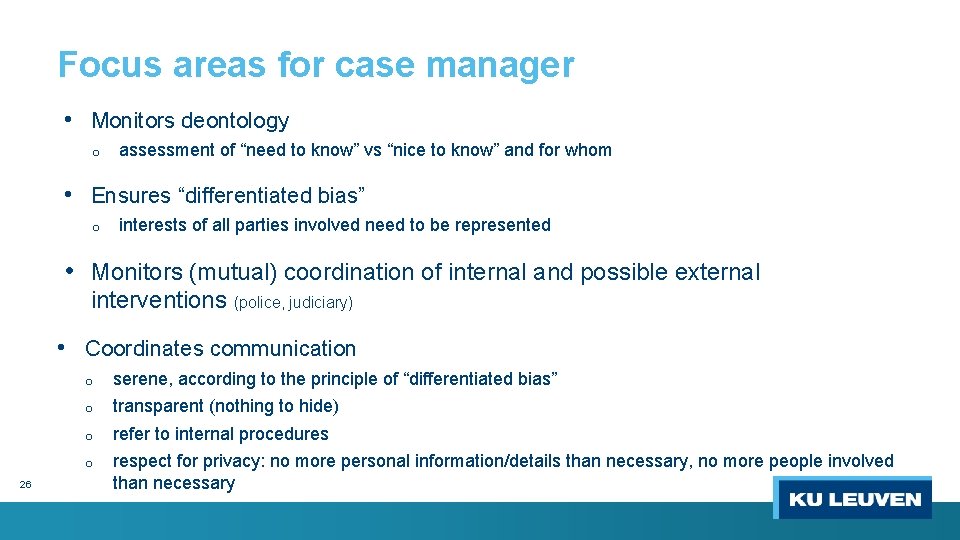
Focus areas for case manager • Monitors deontology o assessment of “need to know” vs “nice to know” and for whom • Ensures “differentiated bias” o interests of all parties involved need to be represented • Monitors (mutual) coordination of internal and possible external interventions (police, judiciary) • Coordinates communication 26 o serene, according to the principle of “differentiated bias” o transparent (nothing to hide) o refer to internal procedures o respect for privacy: no more personal information/details than necessary, no more people involved than necessary
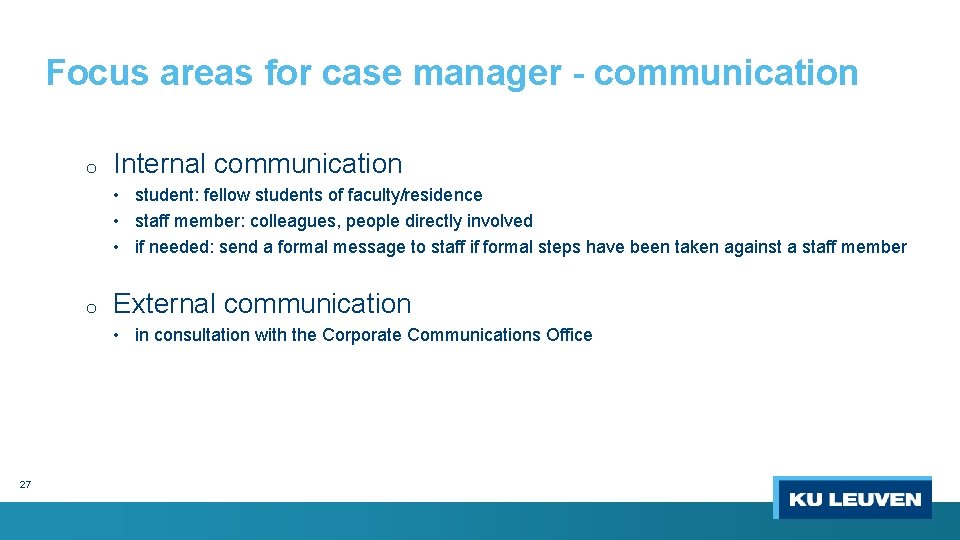
Focus areas for case manager - communication o Internal communication • student: fellow students of faculty/residence • staff member: colleagues, people directly involved • if needed: send a formal message to staff if formal steps have been taken against a staff member o External communication • in consultation with the Corporate Communications Office 27
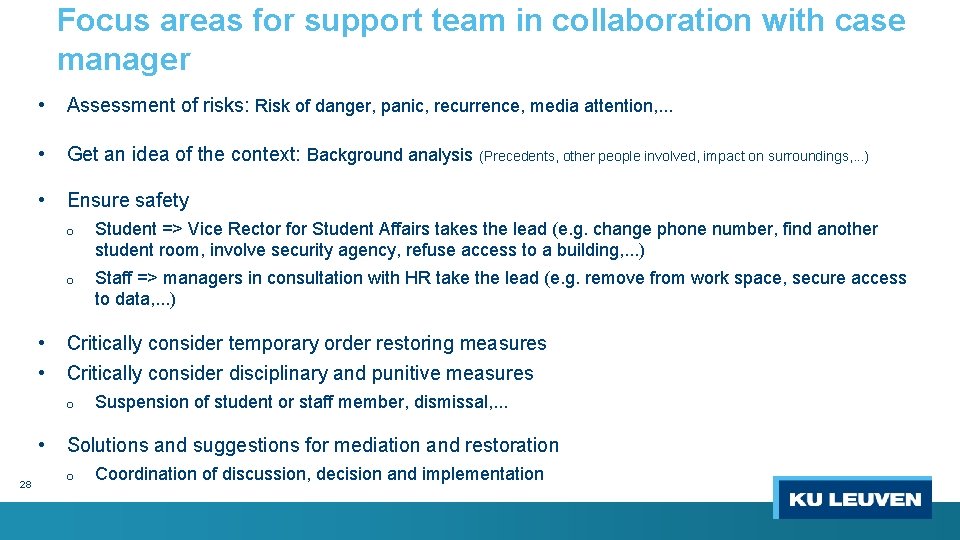
Focus areas for support team in collaboration with case manager • Assessment of risks: Risk of danger, panic, recurrence, media attention, . . . • Get an idea of the context: Background analysis (Precedents, other people involved, impact on surroundings, . . . ) • Ensure safety o Student => Vice Rector for Student Affairs takes the lead (e. g. change phone number, find another student room, involve security agency, refuse access to a building, . . . ) o Staff => managers in consultation with HR take the lead (e. g. remove from work space, secure access to data, . . . ) • Critically consider temporary order restoring measures • Critically consider disciplinary and punitive measures o Suspension of student or staff member, dismissal, . . . • Solutions and suggestions for mediation and restoration 28 o Coordination of discussion, decision and implementation
Mediation and restoration General principles • Strive for maximum recovery from the effects • Apply values and working principles of restorative justice: o accountability of the person(s) concerned o restore relationships in the study or work environment where possible • When one of the parties wants to contact or communicate with the other party: 29 29/11/2020 o the case manager carefully discusses this with the person requesting the contact o the other party will be contacted in order to verify any counter-arguments to mediation o if desired and with the agreement of both parties involved, the case manager contacts an external mediation service (Moderator or CAW) to pass on contact details o the external mediation service starts a mediation process
Mediation and restoration • If internal mediation is preferred • Mediation happens by the case manager and/or one of the confidential advisers • Written communication is an option • The entourage is involved when fellow students or colleagues • • • 30 29/11/2020 Are affected by the consequences Need information Are worried Can offer certain types of support themselves Can take (preventive) action in the study or work environment.
Focus areas for support team in collaboration with case manager • Clear communication towards reporter o involve reporter in decisions • Work together with manager: involve and inform • Consider proactive vs reactive communication to the outside world • Consider cooperating with Offices o 31 HSE Department, Technical Services Department, Corporate Communications Office. . . are involved if appropriate
Follow-up, feedback and policy implications 32
Focus areas for case manager - follow-up • Follow-up of reporter and people involved • Evaluation: what has changed, what has been solved and what hasn't. What are the implications. o for the reporter and people involved, for the work environment and policy • Conclusions regarding organisational structure and prevention o what have we learned, what can be improved, what can we do to prevent this? • Reporting o with a view to follow-up & future approach • Make regulations more explicit for relevant policy levels o students, staff, . . . • Communication to entourage/surroundings vs confidentiality 33
- Slides: 33