
Strategy and Effectiveness An Analysis of Preferential Ballot
Strategy and Effectiveness: An Analysis of Preferential Ballot Voting Methods Max Tabachnik Advisor: Dr. Hubert Bray April 14, 2011
Contents l l l l Properties Voting Systems and their Properties The Crowding Problem Agreement and Wins Analysis Conclusion Suggestions for Further Research
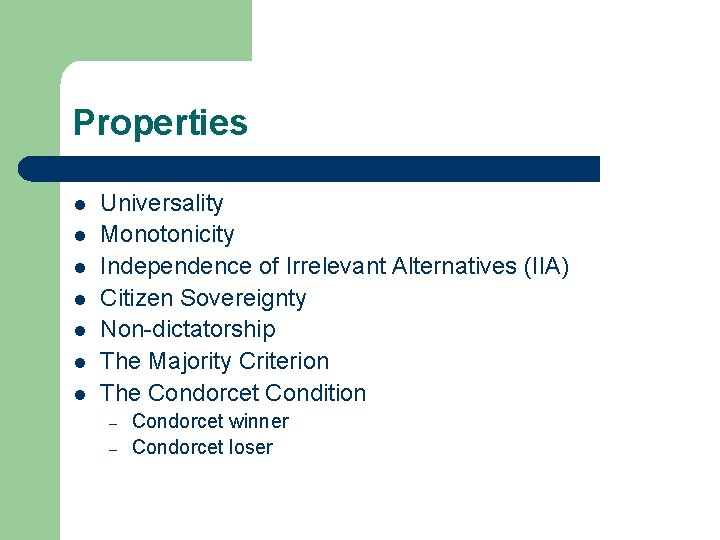
Properties l l l l Universality Monotonicity Independence of Irrelevant Alternatives (IIA) Citizen Sovereignty Non-dictatorship The Majority Criterion The Condorcet Condition – – Condorcet winner Condorcet loser

Voting Systems l l l Single Vote Plurality (SVP) Instant Runoff Voting (IRV) Borda Count (BC) Instant Runoff Borda Count (IRBC) Least Worst Defeat (LWD) Ranked Pairs (RP)
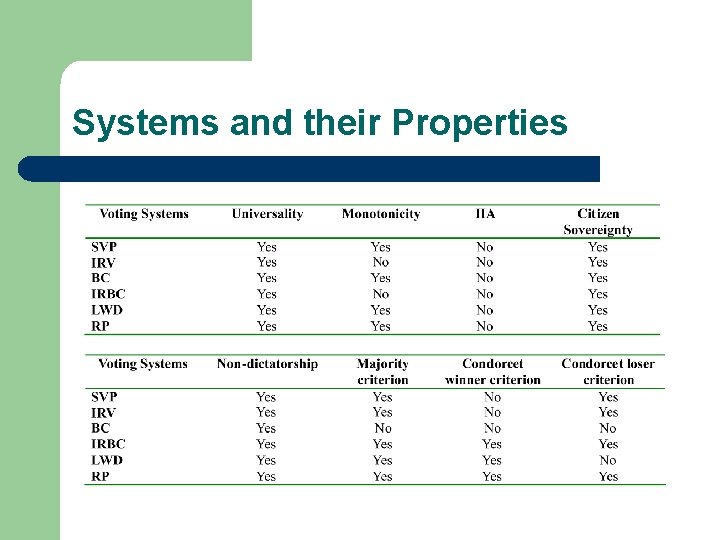
Systems and their Properties
The Crowding Problem l l l The ability for n-1 candidates to prevent the nth candidate from winning Incentivizes voters against revealing true preferences by not “throwing away” votes E. g. U. S. two-party system – l Ralph Nader What methods are most susceptible to crowding?
![Crowding Assumptions l l Voters are uniformly distributed along unit interval [0, 1] and](http://slidetodoc.com/presentation_image_h2/ec248659bc87d99c8665097ea0cf9294/image-7.jpg "Crowding Assumptions l l Voters are uniformly distributed along unit interval [0, 1] and")
Crowding Assumptions l l Voters are uniformly distributed along unit interval [0, 1] and each voter has one vote X 1… Xn are candidates that choose unique positions on [0, 1] X 1 < X 2 < … < Xn, but in general order is arbitrary P (Xi) represents the percentage of the vote candidate Xi receives – – – l P (Xi) = Xi + 0. 5*(Xi+1 - Xi) for i=1 P (Xi) = 1 - Xi + 0. 5*(Xi – Xi-1) for i=n P (Xi) = 0. 5*((Xi – Xi-1) + (Xi+1 - Xi)) for i [2, n-1] There can only be one winning candidate (no ties)
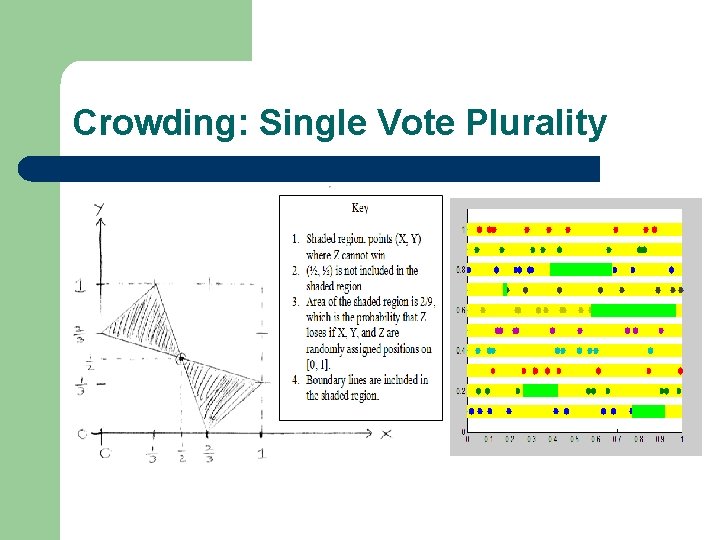
Crowding: Single Vote Plurality
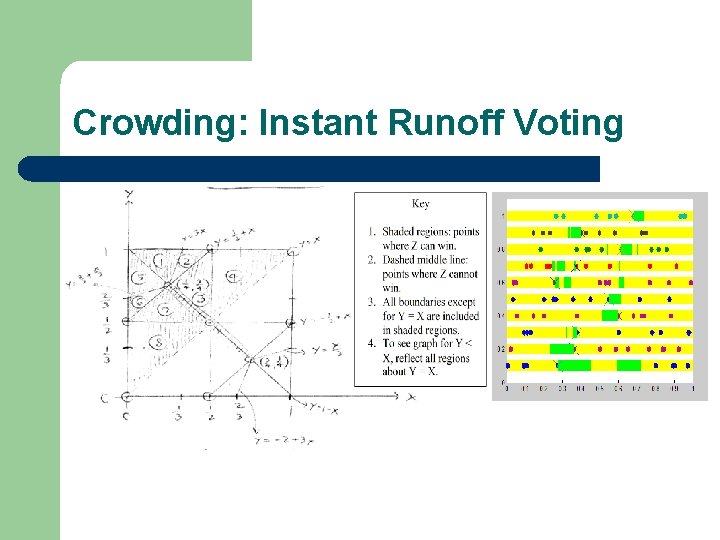
Crowding: Instant Runoff Voting
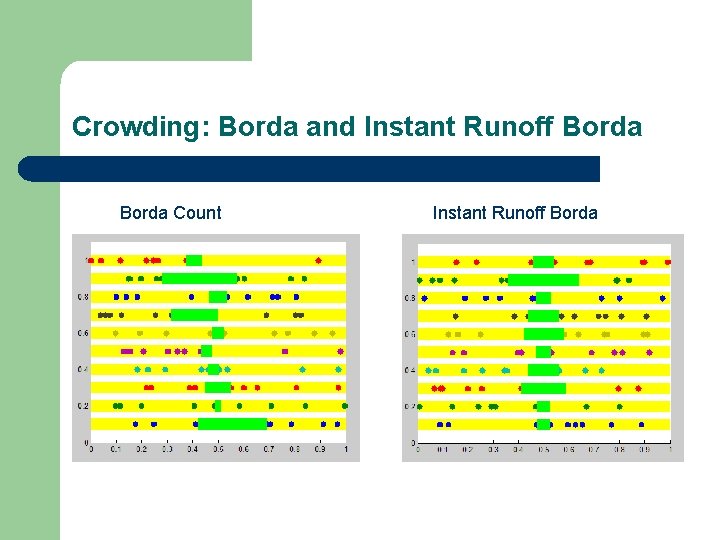
Crowding: Borda and Instant Runoff Borda Count Instant Runoff Borda
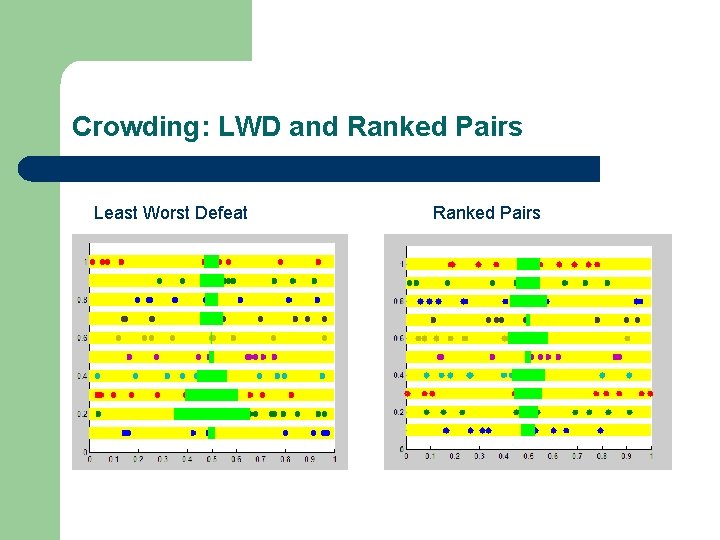
Crowding: LWD and Ranked Pairs Least Worst Defeat Ranked Pairs
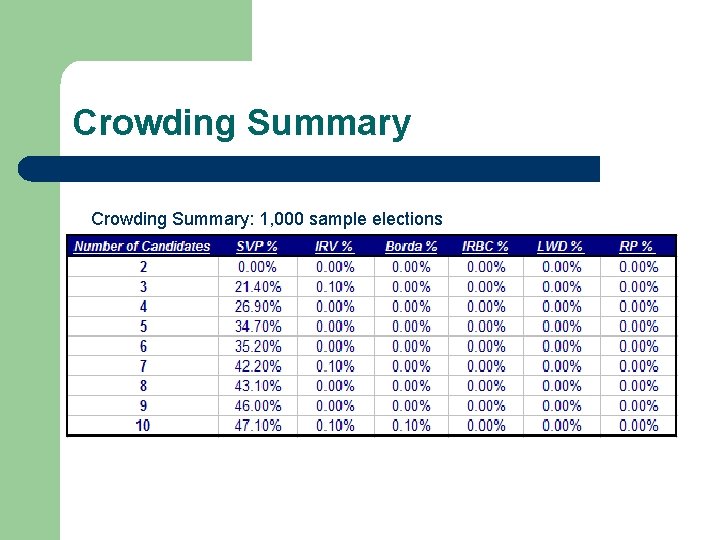
Crowding Summary: 1, 000 sample elections
Crowding Summary l Susceptible to crowding: – l Single Vote Plurality Generically not susceptible to crowding: – Instant Runoff Voting l l Winning strategies are disjoint Virtually no possibility of crowding: – – Borda Count Instant Runoff Borda Least Worst Defeat Ranked Pairs l All above methods favor non-disjoint, centrist strategies
Agreement and Wins Analysis l l Compare LWD and Ranked Pairs with Borda (control) using random elections in MATLAB How often do these methods agree on a winner? When they disagree, how often do the winners from each method win head-to-head against other method winners? How often does a Condorcet winner exist?
Three Candidate Case l LWD and Ranked Pairs winners always either beat or tie Borda winner – l Strength of Condorcet winners and methods LWD and Ranked Pairs always agree – Regardless of whether Condorcet winner exists!
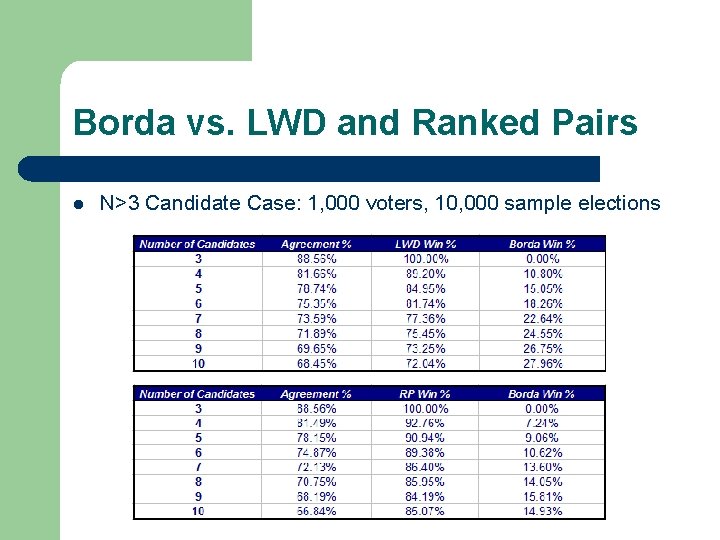
Borda vs. LWD and Ranked Pairs l N>3 Candidate Case: 1, 000 voters, 10, 000 sample elections
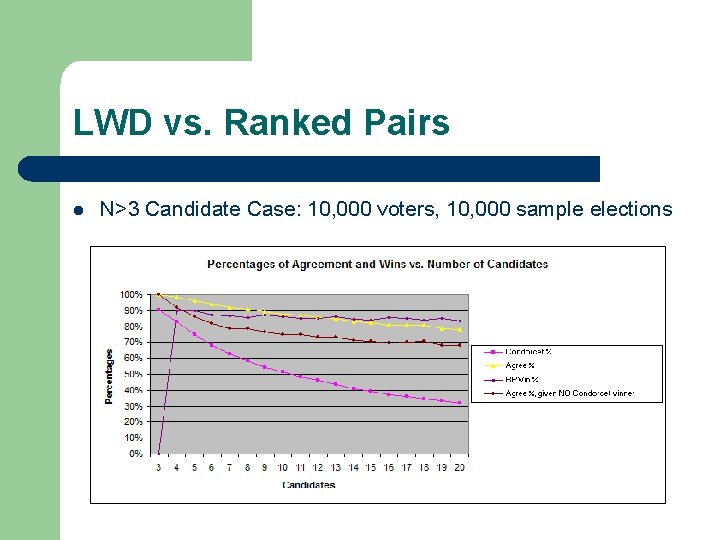
LWD vs. Ranked Pairs l N>3 Candidate Case: 10, 000 voters, 10, 000 sample elections
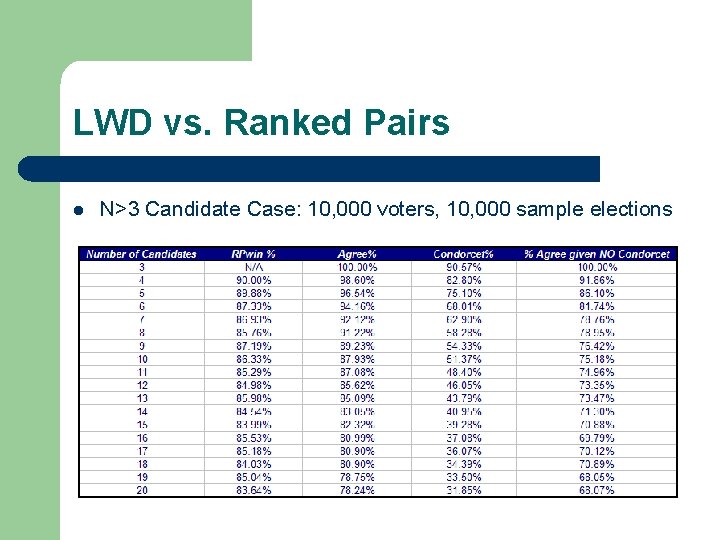
LWD vs. Ranked Pairs l N>3 Candidate Case: 10, 000 voters, 10, 000 sample elections
Conclusion l l Voting system must satisfy major properties AND be practical and feasible to implement Ranked Pairs is best in terms of properties and head-to-head winner performance – – l Agreement with LWD high for n<10 candidates Not as easy to program and understand LWD may be better for large candidate and voter pools in terms of run time
Suggestions for Future Research l What are the best performing methods given certain circumstances? – l How do more complex systems compare? – l E. g. Schulze, Kemeny-Young How do systems fare with other properties? – l Condorcet winner, lack of simple majority, etc. E. g. Clone Invariance Consider other models for voter behavior – – Not purely random elections Different distributions on unit interval model
- Slides: 20