
Strategy and Corporate Affairs update Clare Ettinghausen Director
- Slides: 9
Strategy and Corporate Affairs update Clare Ettinghausen Director of Strategy and Corporate Affairs 4 December 2018 www. hfea. gov. uk
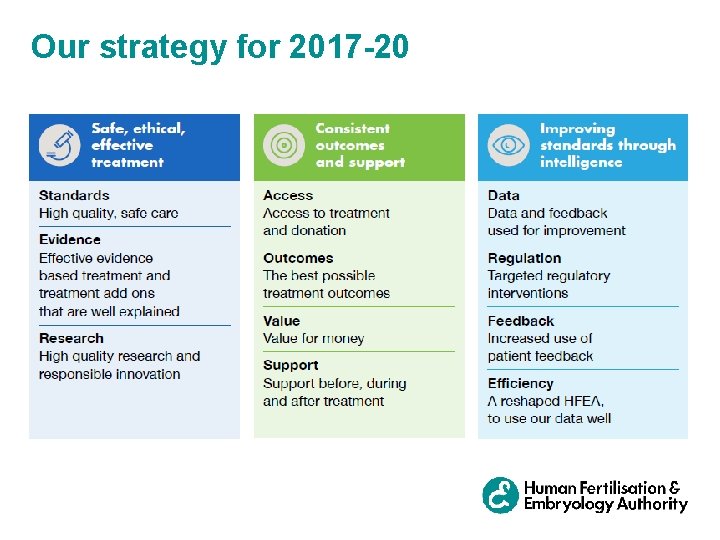
Our strategy for 2017 -20
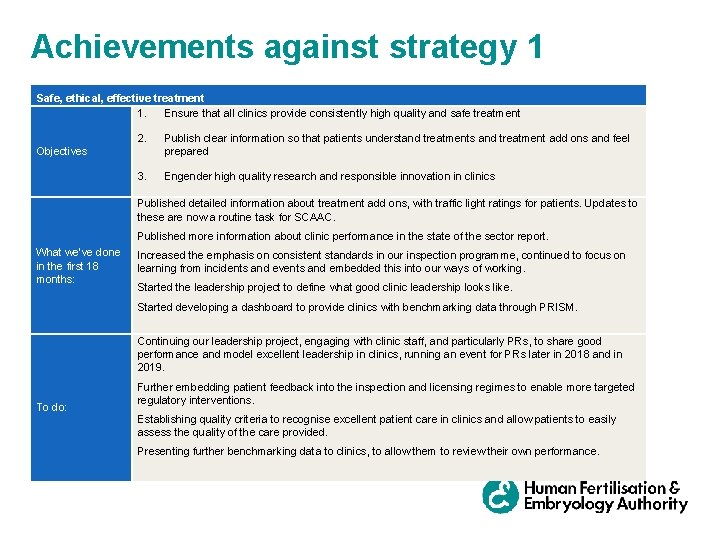
Achievements against strategy 1 Safe, ethical, effective treatment 1. Ensure that all clinics provide consistently high quality and safe treatment 2. Publish clear information so that patients understand treatments and treatment add ons and feel prepared 3. Engender high quality research and responsible innovation in clinics Objectives Published detailed information about treatment add ons, with traffic light ratings for patients. Updates to these are now a routine task for SCAAC. Published more information about clinic performance in the state of the sector report. What we’ve done in the first 18 months: Increased the emphasis on consistent standards in our inspection programme, continued to focus on learning from incidents and events and embedded this into our ways of working. Started the leadership project to define what good clinic leadership looks like. Started developing a dashboard to provide clinics with benchmarking data through PRISM. Continuing our leadership project, engaging with clinic staff, and particularly PRs, to share good performance and model excellent leadership in clinics, running an event for PRs later in 2018 and in 2019. To do: Further embedding patient feedback into the inspection and licensing regimes to enable more targeted regulatory interventions. Establishing quality criteria to recognise excellent patient care in clinics and allow patients to easily assess the quality of the care provided. Presenting further benchmarking data to clinics, to allow them to review their own performance.
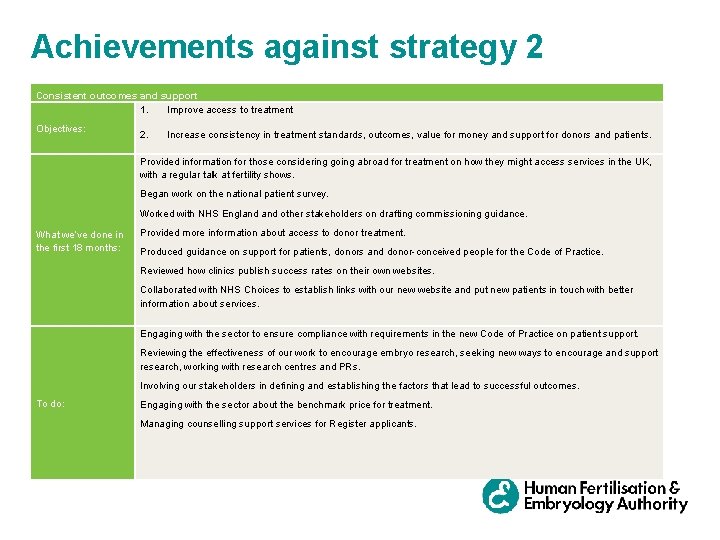
Achievements against strategy 2 Consistent outcomes and support 1. Improve access to treatment Objectives: 2. Increase consistency in treatment standards, outcomes, value for money and support for donors and patients. Provided information for those considering going abroad for treatment on how they might access services in the UK, with a regular talk at fertility shows. Began work on the national patient survey. Worked with NHS England other stakeholders on drafting commissioning guidance. What we’ve done in the first 18 months: Provided more information about access to donor treatment. Produced guidance on support for patients, donors and donor-conceived people for the Code of Practice. Reviewed how clinics publish success rates on their own websites. Collaborated with NHS Choices to establish links with our new website and put new patients in touch with better information about services. Engaging with the sector to ensure compliance with requirements in the new Code of Practice on patient support. Reviewing the effectiveness of our work to encourage embryo research, seeking new ways to encourage and support research, working with research centres and PRs. Involving our stakeholders in defining and establishing the factors that lead to successful outcomes. To do: Engaging with the sector about the benchmark price for treatment. Managing counselling support services for Register applicants.
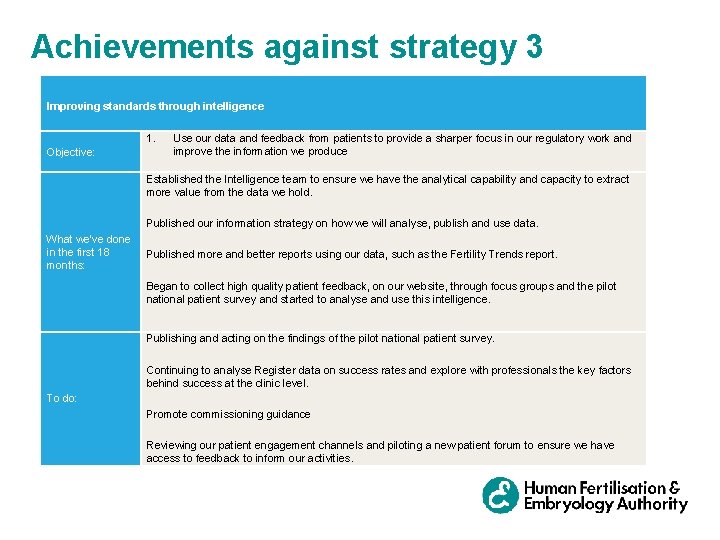
Achievements against strategy 3 Improving standards through intelligence 1. Objective: Use our data and feedback from patients to provide a sharper focus in our regulatory work and improve the information we produce Established the Intelligence team to ensure we have the analytical capability and capacity to extract more value from the data we hold. Published our information strategy on how we will analyse, publish and use data. What we’ve done in the first 18 months: Published more and better reports using our data, such as the Fertility Trends report. Began to collect high quality patient feedback, on our website, through focus groups and the pilot national patient survey and started to analyse and use this intelligence. Publishing and acting on the findings of the pilot national patient survey. Continuing to analyse Register data on success rates and explore with professionals the key factors behind success at the clinic level. To do: Promote commissioning guidance Reviewing our patient engagement channels and piloting a new patient forum to ensure we have access to feedback to inform our activities.
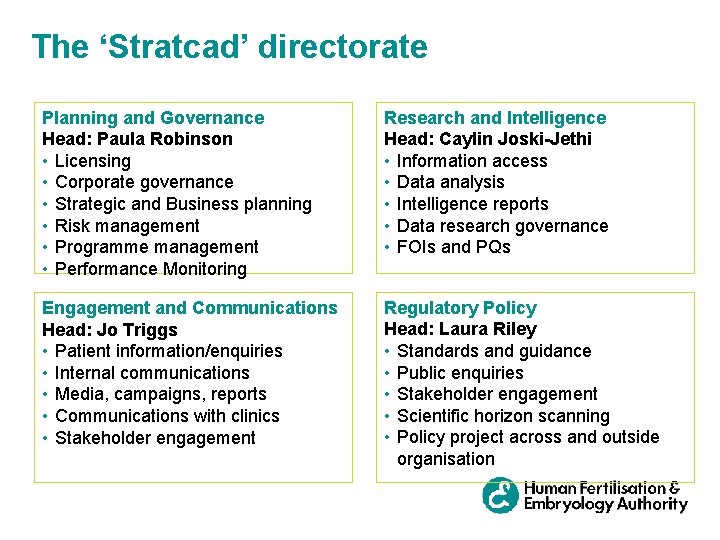
The ‘Stratcad’ directorate Planning and Governance Head: Paula Robinson • Licensing • Corporate governance • Strategic and Business planning • Risk management • Programme management • Performance Monitoring Research and Intelligence Head: Caylin Joski-Jethi • Information access • Data analysis • Intelligence reports • Data research governance • FOIs and PQs Engagement and Communications Head: Jo Triggs • Patient information/enquiries • Internal communications • Media, campaigns, reports • Communications with clinics • Stakeholder engagement Regulatory Policy Head: Laura Riley • Standards and guidance • Public enquiries • Stakeholder engagement • Scientific horizon scanning • Policy project across and outside organisation
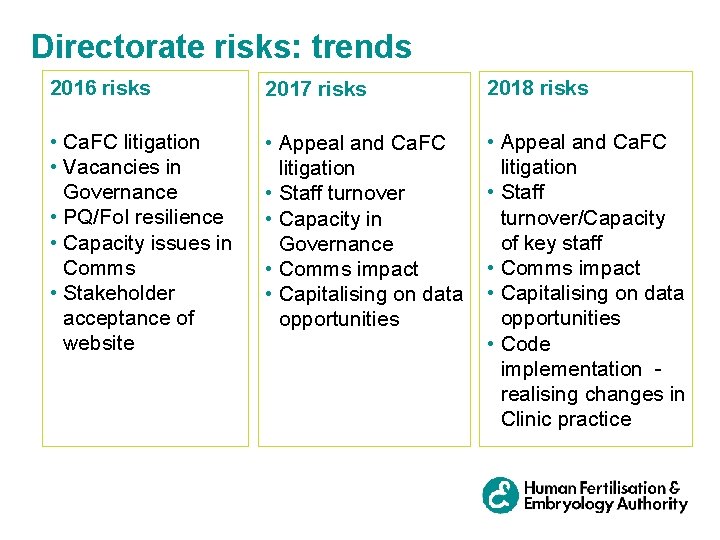
Directorate risks: trends 2016 risks 2017 risks 2018 risks • Ca. FC litigation • Vacancies in Governance • PQ/Fo. I resilience • Capacity issues in Comms • Stakeholder acceptance of website • Appeal and Ca. FC litigation • Staff turnover • Capacity in Governance • Comms impact • Capitalising on data opportunities • Appeal and Ca. FC litigation • Staff turnover/Capacity of key staff • Comms impact • Capitalising on data opportunities • Code implementation - realising changes in Clinic practice
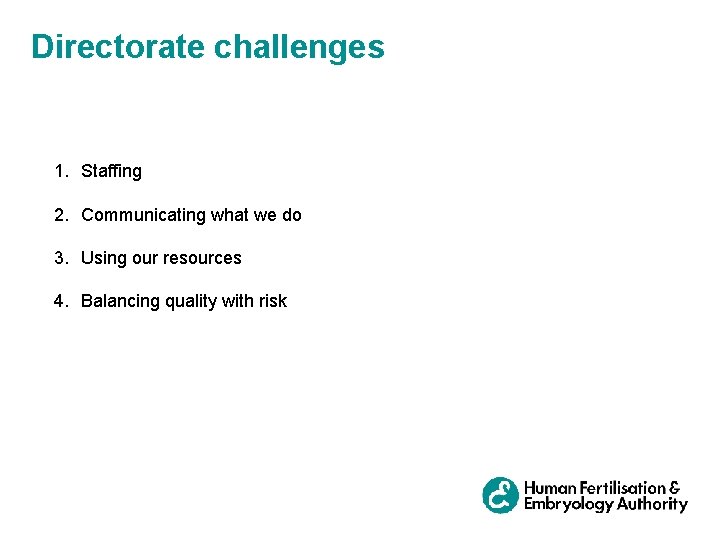
Directorate challenges 1. Staffing 2. Communicating what we do 3. Using our resources 4. Balancing quality with risk
Any questions? Clare Ettinghausen clare. ettinghausen@hfea. gov. uk