
STRATEGY AND CHANGE MANAGEMENT v Capital Iona Joy


- Slides: 29
STRATEGY AND CHANGE MANAGEMENT v Capital Iona Joy, Head of Charity Unit, New Philanthropy Tower Hamlets Leadership Forum, March 2016
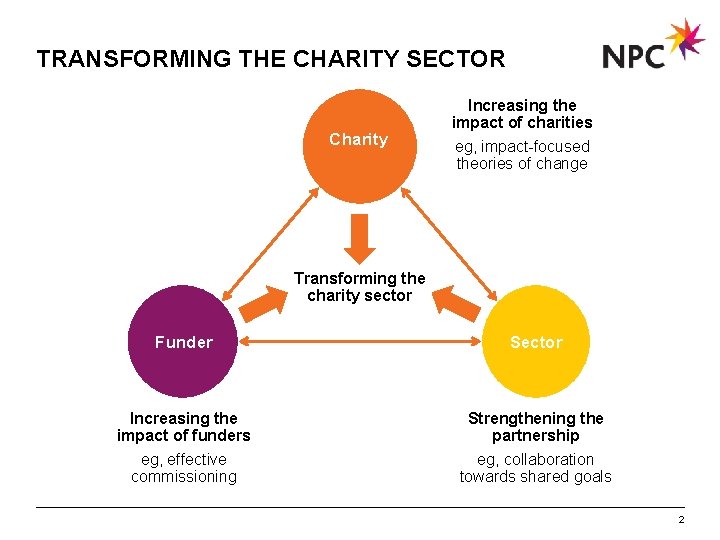
TRANSFORMING THE CHARITY SECTOR Charity Increasing the impact of charities eg, impact-focused theories of change Transforming the charity sector Funder Sector Increasing the impact of funders Strengthening the partnership eg, effective commissioning eg, collaboration towards shared goals 2
AGENDA • Introductions • Your circumstances: discussion • Preparing for strategic change • NPC’s strategy triangle and impact cycle • Managing change We hope you will leave with tools and tips you can share with others 3
DISCUSSION: YOUR CIRCUMSTANCES Why is now the right time to think about managing change? How are you developing your strategy? What makes change difficult? 4
STRATEGY Preparing for strategy Strategy triangle Impact cycle
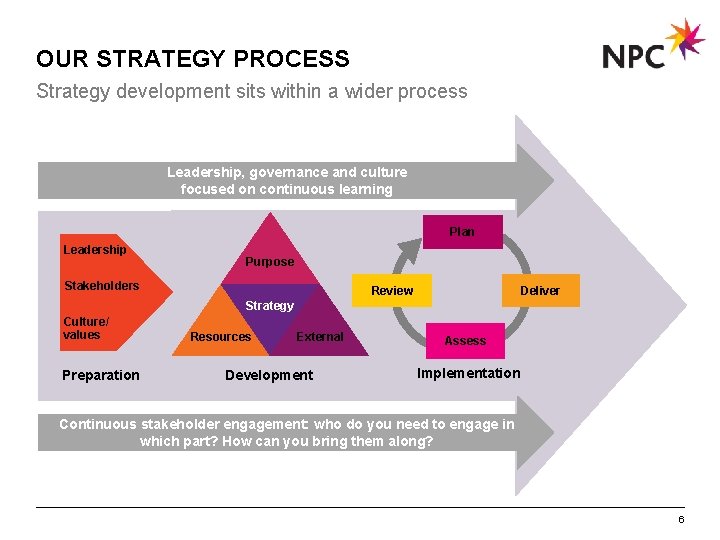
OUR STRATEGY PROCESS Strategy development sits within a wider process Leadership, governance and culture focused on continuous learning Plan Leadership Purpose Stakeholders Review Deliver Strategy Culture/ values Preparation Pu rp os e Resources External Development Assess Implementation Continuous stakeholder engagement: who do you need to engage in which part? How can you bring them along? 6
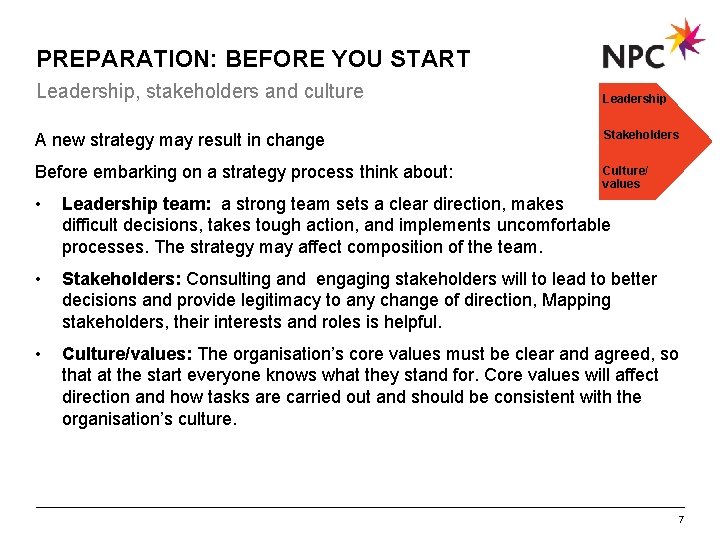
PREPARATION: BEFORE YOU START Leadership, stakeholders and culture Leadership A new strategy may result in change Stakeholders Before embarking on a strategy process think about: Culture/ values • Leadership team: a strong team sets a clear direction, makes difficult decisions, takes tough action, and implements uncomfortable processes. The strategy may affect composition of the team. • Stakeholders: Consulting and engaging stakeholders will to lead to better decisions and provide legitimacy to any change of direction, Mapping stakeholders, their interests and roles is helpful. • Culture/values: The organisation’s core values must be clear and agreed, so that at the start everyone knows what they stand for. Core values will affect direction and how tasks are carried out and should be consistent with the organisation’s culture. 7
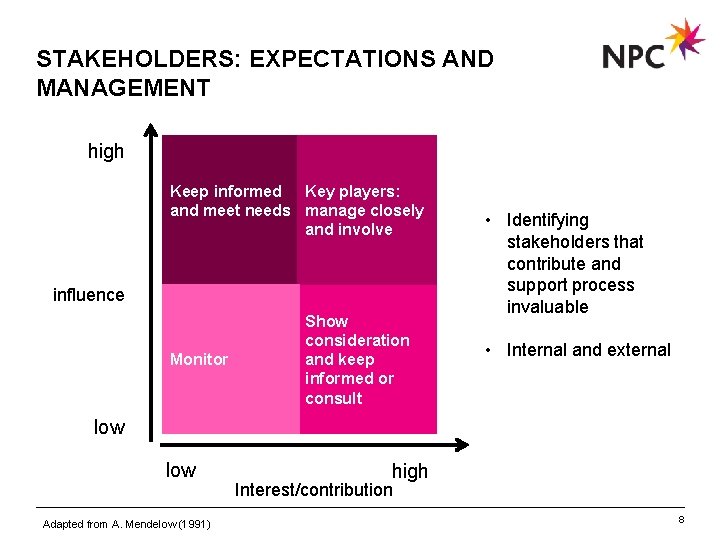
STAKEHOLDERS: EXPECTATIONS AND MANAGEMENT high Keep informed Key players: and meet needs manage closely and involve influence Monitor Show consideration and keep informed or consult • Identifying stakeholders that contribute and support process invaluable • Internal and external low Adapted from A. Mendelow (1991) high Interest/contribution 8
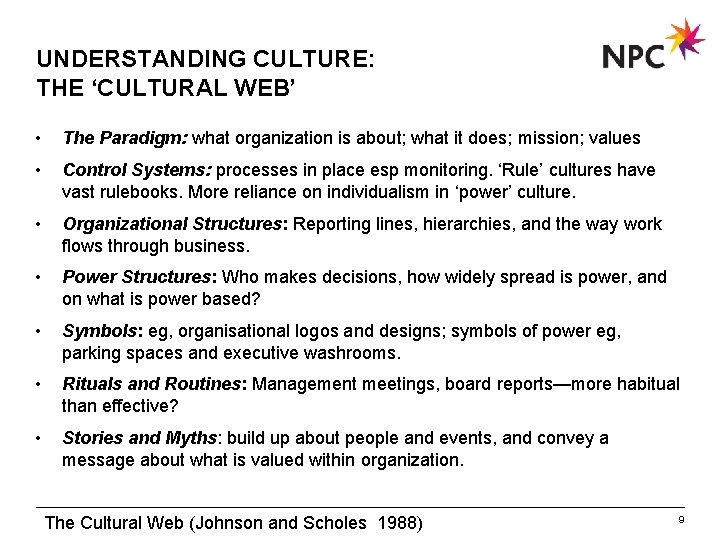
UNDERSTANDING CULTURE: THE ‘CULTURAL WEB’ • The Paradigm: what organization is about; what it does; mission; values • Control Systems: processes in place esp monitoring. ‘Rule’ cultures have vast rulebooks. More reliance on individualism in ‘power’ culture. • Organizational Structures: Reporting lines, hierarchies, and the way work flows through business. • Power Structures: Who makes decisions, how widely spread is power, and on what is power based? • Symbols: eg, organisational logos and designs; symbols of power eg, parking spaces and executive washrooms. • Rituals and Routines: Management meetings, board reports—more habitual than effective? • Stories and Myths: build up about people and events, and convey a message about what is valued within organization. The Cultural Web (Johnson and Scholes 1988) 9
A SUPPORTIVE ORGANISATIONAL CULTURE…. OR NOT? Stories & myths: • Senior management failings / stupidity • Staff on the ground have hard lives • Formal & hierarchical • Vertical organisation • Informal relationships between departments • Leadership believe staff are poor • Little delegated authority • Change sabotaged by staff Culture/ values • Doing paperwork • Not answering phones • Large formal meetings Control systems • Internal focus • Lack of common purpose • Change difficult to achieve Power Structures Stakeholders Routines & rituals Paradigm Structures Leadership • • Timesheets Paperwork done Targets Formal staff supervision Symbols • Job title & grade • Own office • Business dress for managers The Cultural Web (Johnson and Scholes 1988) 10
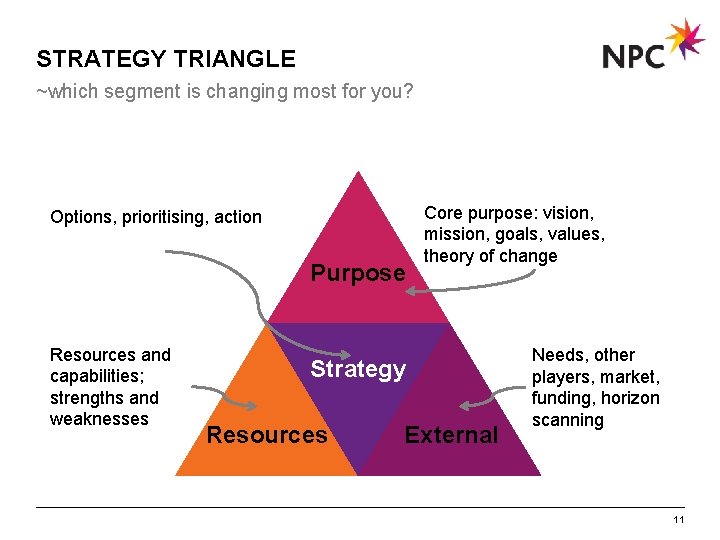
STRATEGY TRIANGLE ~which segment is changing most for you? Options, prioritising, action Purpose Resources and capabilities; strengths and weaknesses Core purpose: vision, mission, goals, values, theory of change Strategy Resources External Needs, other players, market, funding, horizon scanning 11
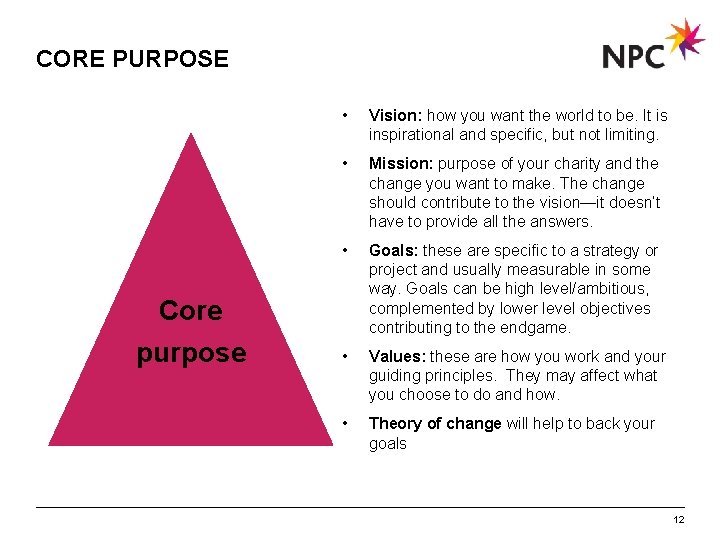
CORE PURPOSE Core purpose • Vision: how you want the world to be. It is inspirational and specific, but not limiting. • Mission: purpose of your charity and the change you want to make. The change should contribute to the vision—it doesn’t have to provide all the answers. • Goals: these are specific to a strategy or project and usually measurable in some way. Goals can be high level/ambitious, complemented by lower level objectives contributing to the endgame. • Values: these are how you work and your guiding principles. They may affect what you choose to do and how. • Theory of change will help to back your goals 12
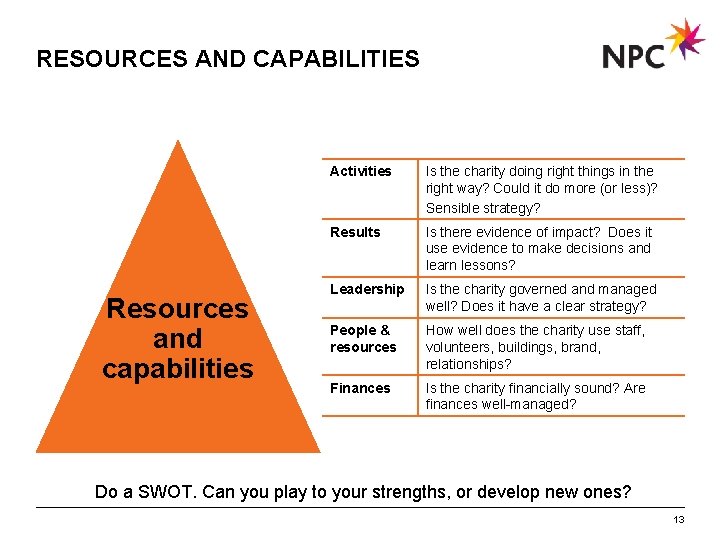
RESOURCES AND CAPABILITIES Resources and capabilities Activities Is the charity doing right things in the right way? Could it do more (or less)? Sensible strategy? Results Is there evidence of impact? Does it use evidence to make decisions and learn lessons? Leadership Is the charity governed and managed well? Does it have a clear strategy? People & resources How well does the charity use staff, volunteers, buildings, brand, relationships? Finances Is the charity financially sound? Are finances well-managed? Do a SWOT. Can you play to your strengths, or develop new ones? 13
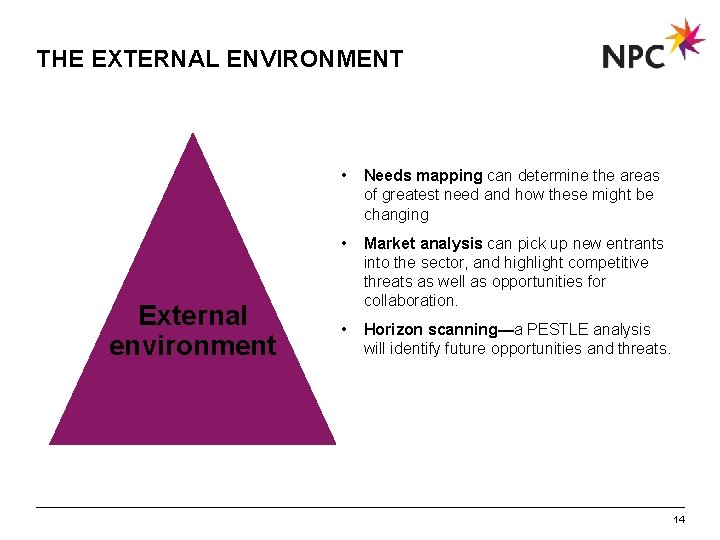
THE EXTERNAL ENVIRONMENT External environment • Needs mapping can determine the areas of greatest need and how these might be changing • Market analysis can pick up new entrants into the sector, and highlight competitive threats as well as opportunities for collaboration. • Horizon scanning—a PESTLE analysis will identify future opportunities and threats. 14
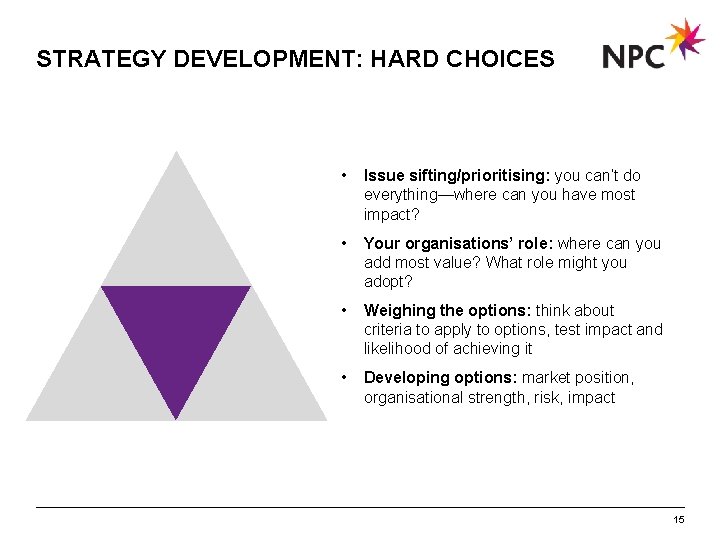
STRATEGY DEVELOPMENT: HARD CHOICES • Issue sifting/prioritising: you can’t do everything—where can you have most impact? • Your organisations’ role: where can you add most value? What role might you adopt? • Weighing the options: think about criteria to apply to options, test impact and likelihood of achieving it • Developing options: market position, organisational strength, risk, impact 15
Q&A • Do you have any questions or reactions to this approach? 16
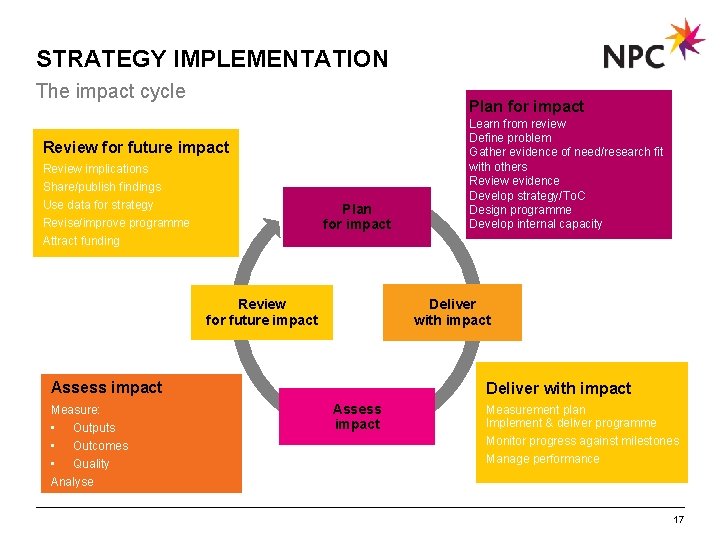
STRATEGY IMPLEMENTATION The impact cycle Plan for impact Review for future impact Review implications Share/publish findings Use data for strategy Revise/improve programme Attract funding Plan for impact Review for future impact Deliver with impact Assess impact Measure: • Outputs • Outcomes • Quality Analyse Learn from review Define problem Gather evidence of need/research fit with others Review evidence Develop strategy/To. C Design programme Develop internal capacity Deliver with impact Assess impact Measurement plan Implement & deliver programme Monitor progress against milestones Manage performance 17
CHANGE MANAGEMENT 18
DISCUSSION • What are your experiences of change? • Is it internally or externally driven? 19
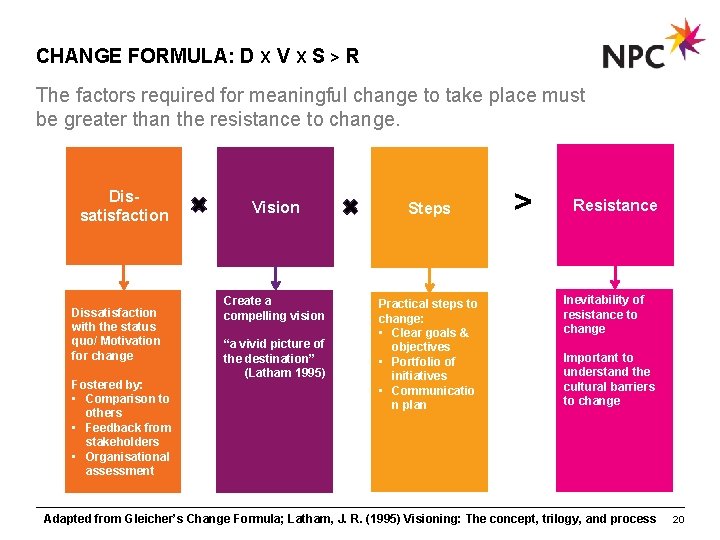
CHANGE FORMULA: D X V X S > R The factors required for meaningful change to take place must be greater than the resistance to change. Dissatisfaction with the status quo/ Motivation for change Fostered by: • Comparison to others • Feedback from stakeholders • Organisational assessment Vision Steps Create a compelling vision Practical steps to change: • Clear goals & objectives • Portfolio of initiatives • Communicatio n plan “a vivid picture of the destination” (Latham 1995) > Resistance Inevitability of resistance to change Important to understand the cultural barriers to change Adapted from Gleicher’s Change Formula; Latham, J. R. (1995) Visioning: The concept, trilogy, and process 20
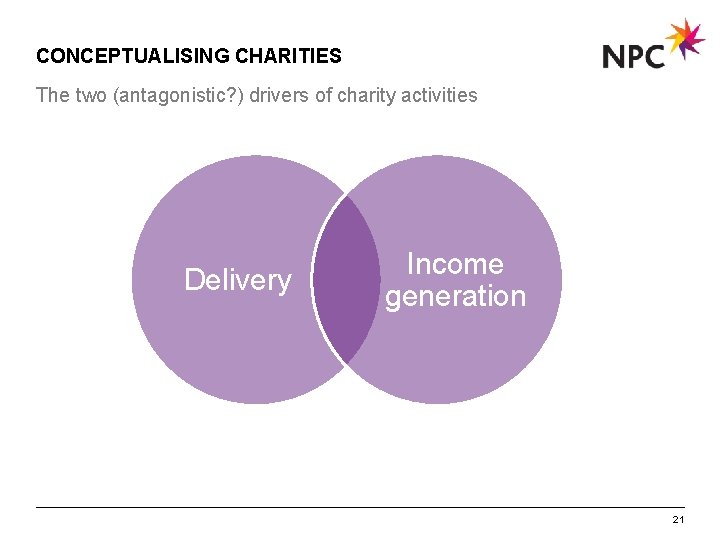
CONCEPTUALISING CHARITIES The two (antagonistic? ) drivers of charity activities Delivery Income generation 21
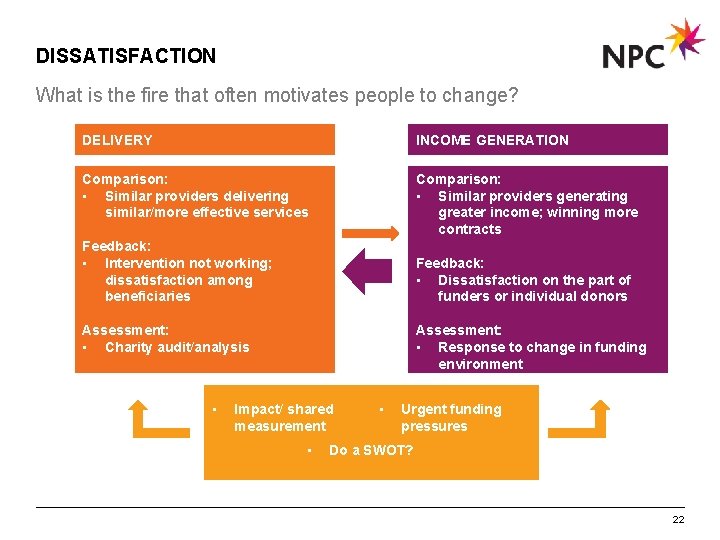
DISSATISFACTION What is the fire that often motivates people to change? DELIVERY INCOME GENERATION Comparison: • Similar providers delivering similar/more effective services Comparison: • Similar providers generating greater income; winning more contracts Feedback: • Intervention not working; dissatisfaction among beneficiaries Feedback: • Dissatisfaction on the part of funders or individual donors Assessment: • Charity audit/analysis • Assessment: • Response to change in funding environment Impact/ shared measurement • • Urgent funding pressures Do a SWOT? 22
VISION But are people also driven by desire to achieve good? DELIVERY INCOME GENERATION Vision for fulfilling mission & making a bigger impact Vision of long-term financial sustainability—value for money • Alignment to new funding regime A new strategy for addressing need • NPC’s strategy triangle: “mission & objectives”; “environment” Developing new interventions for existing users? Reaching previously unmet need? Developing a new funding strategy • NPC’s strategy triangle: “resources & competencies” Linking delivery to new funding models • E. g. social investment Guiding coalition/ change leadership • Senior management • trustees? front-line staff? service-users? Theory of Change • Develop vision & build coalition 23
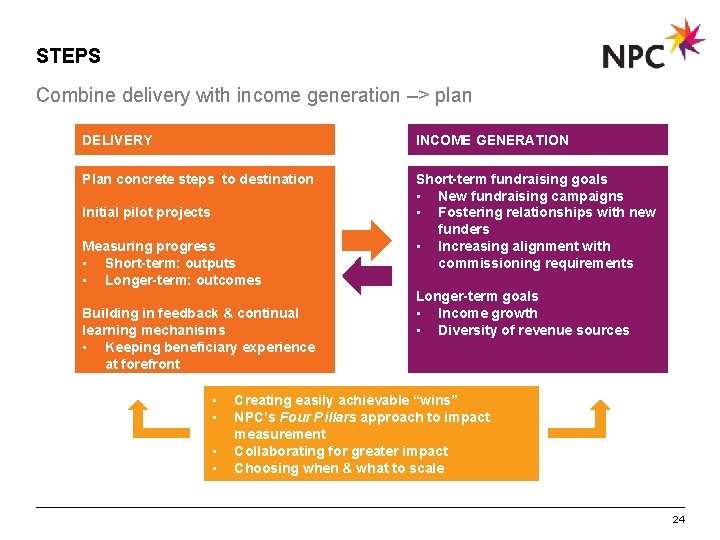
STEPS Combine delivery with income generation –> plan DELIVERY INCOME GENERATION Plan concrete steps to destination Short-term fundraising goals • New fundraising campaigns • Fostering relationships with new funders • Increasing alignment with commissioning requirements Initial pilot projects Measuring progress • Short-term: outputs • Longer-term: outcomes Building in feedback & continual learning mechanisms • Keeping beneficiary experience at forefront • • Longer-term goals • Income growth • Diversity of revenue sources Creating easily achievable “wins” NPC’s Four Pillars approach to impact measurement Collaborating for greater impact Choosing when & what to scale 24
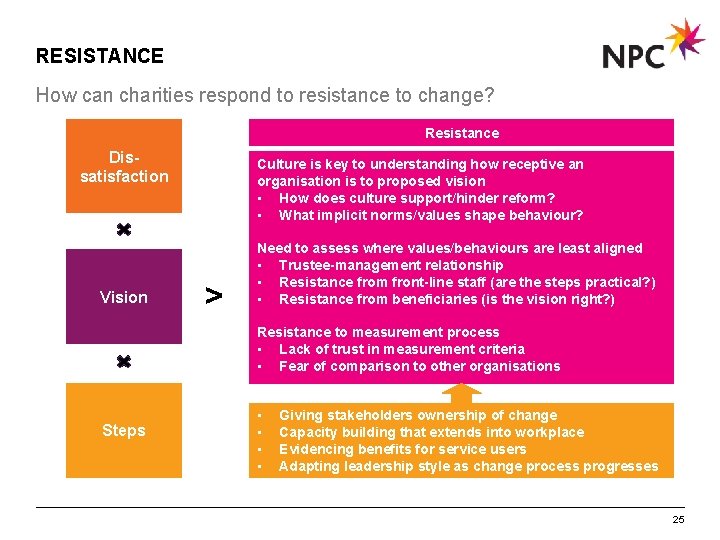
RESISTANCE How can charities respond to resistance to change? Resistance Dissatisfaction Vision Culture is key to understanding how receptive an organisation is to proposed vision • How does culture support/hinder reform? • What implicit norms/values shape behaviour? > Need to assess where values/behaviours are least aligned • Trustee-management relationship • Resistance from front-line staff (are the steps practical? ) • Resistance from beneficiaries (is the vision right? ) Resistance to measurement process • Lack of trust in measurement criteria • Fear of comparison to other organisations Steps • • Giving stakeholders ownership of change Capacity building that extends into workplace Evidencing benefits for service users Adapting leadership style as change process progresses 25
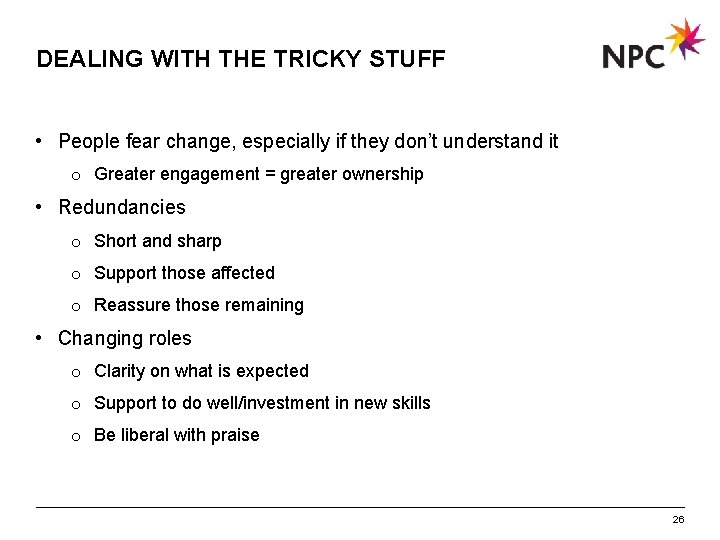
DEALING WITH THE TRICKY STUFF • People fear change, especially if they don’t understand it o Greater engagement = greater ownership • Redundancies o Short and sharp o Support those affected o Reassure those remaining • Changing roles o Clarity on what is expected o Support to do well/investment in new skills o Be liberal with praise 26
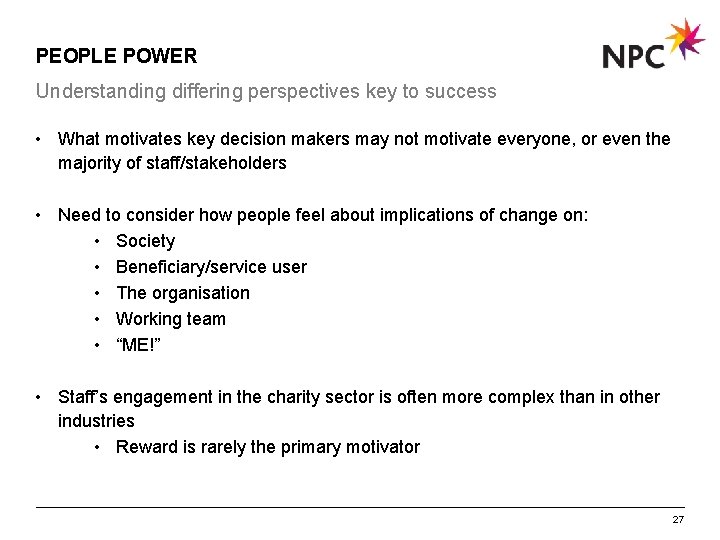
PEOPLE POWER Understanding differing perspectives key to success • What motivates key decision makers may not motivate everyone, or even the majority of staff/stakeholders • Need to consider how people feel about implications of change on: • Society • Beneficiary/service user • The organisation • Working team • “ME!” • Staff’s engagement in the charity sector is often more complex than in other industries • Reward is rarely the primary motivator 27
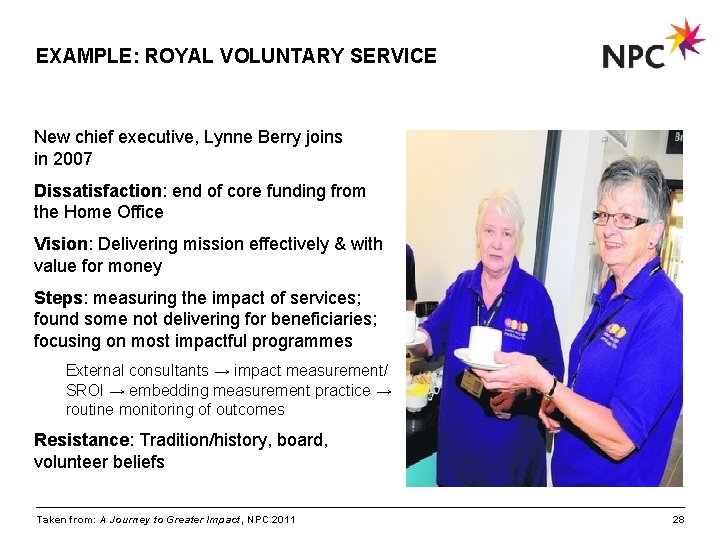
EXAMPLE: ROYAL VOLUNTARY SERVICE New chief executive, Lynne Berry joins in 2007 Dissatisfaction: end of core funding from the Home Office Vision: Delivering mission effectively & with value for money Steps: measuring the impact of services; found some not delivering for beneficiaries; focusing on most impactful programmes External consultants → impact measurement/ SROI → embedding measurement practice → routine monitoring of outcomes Resistance: Tradition/history, board, volunteer beliefs Taken from: A Journey to Greater Impact, NPC 2011 28
iona. joy@thinknpc. org v March 2016 NPC - title of the document (can be changed under view/header and footer. Add date here if needed. 29