
Strategies to support successful aging among older adults
- Slides: 39
Strategies to support successful aging among older adults living with HIV Sean Cahill, Ph. D – Director of Health Policy Research The Fenway Institute, Boston January 12, 2017
Goals for today 1. To increase knowledge and understanding of physical and psychosocial aspects of HIV & Aging 2. To identify strategies for health care providers and AIDS service organizations to address the needs of older adults with HIV 3. To identify steps that policy makers and service providers can take to reduce social isolation and promote resiliency
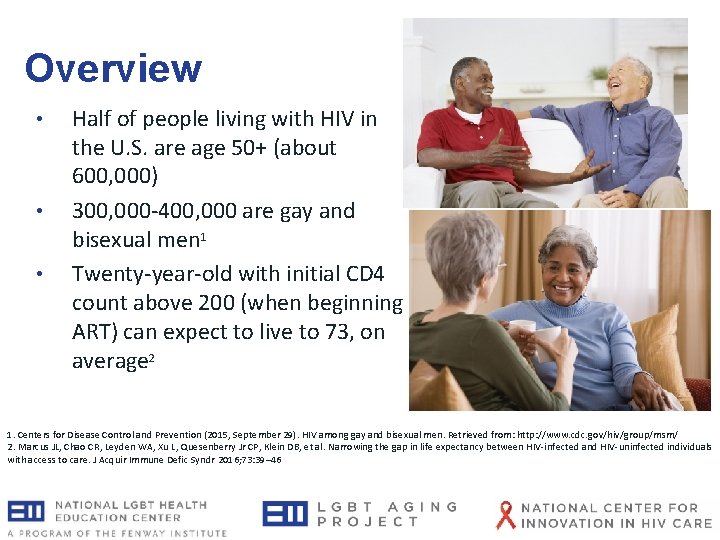
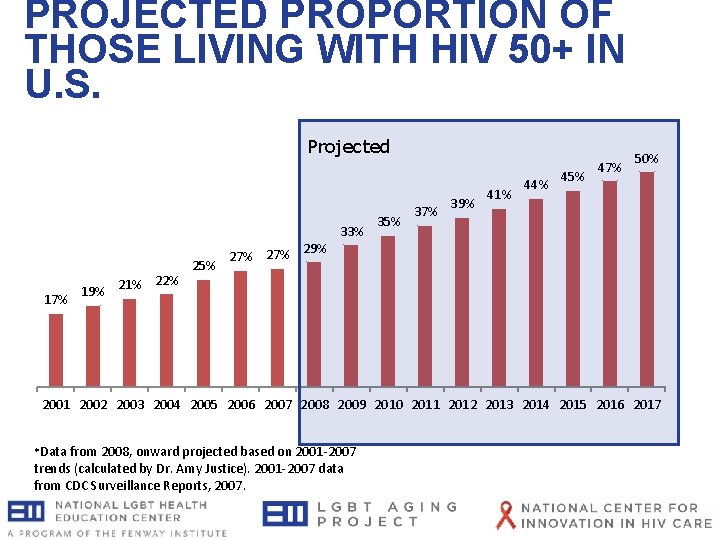
Overview • • • Half of people living with HIV in the U. S. are age 50+ (about 600, 000) 300, 000 -400, 000 are gay and bisexual men 1 Twenty-year-old with initial CD 4 count above 200 (when beginning ART) can expect to live to 73, on average 2 1. Centers for Disease Control and Prevention (2015, September 29). HIV among gay and bisexual men. Retrieved from: http: //www. cdc. gov/hiv/group/msm/ 2. Marcus JL, Chao CR, Leyden WA, Xu L, Quesenberry Jr CP, Klein DB, et al. Narrowing the gap in life expectancy between HIV-infected and HIV-uninfected individuals with access to care. J Acquir Immune Defic Syndr 2016; 73: 39– 46
PROJECTED PROPORTION OF THOSE LIVING WITH HIV 50+ IN U. S. Projected 17% 19% 21% 22% 25% 29% 27% 33% 35% 37% 39% 41% 44% 45% 47% 50% 2001 2002 2003 2004 2005 2006 2007 2008 2009 2010 2011 2012 2013 2014 2015 2016 2017 *Data from 2008, onward projected based on 2001 -2007 trends (calculated by Dr. Amy Justice). 2001 -2007 data from CDC Surveillance Reports, 2007.
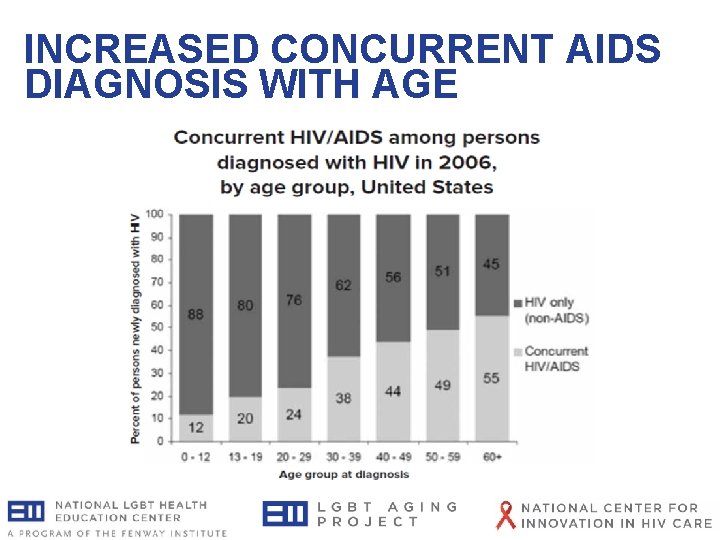
INCREASED CONCURRENT AIDS DIAGNOSIS WITH AGE
Population – Demographics of HIV & Aging § Three categories of HIV 50+ § Long term survivors (infected pre-HAART, so living with HIV at least 20 years) § Newly diagnosed (indeterminate time of infection – often dx is late) § Newly infected (17% of all new diagnoses in 2014 were among 50+, according to CDC)
HIV and Aging and Long-Term Survivors (LTS) § Two overlapping but distinct populations § Many long-term survivors, especially those 50+, experience major comorbidities (cardiovascular disease, kidney disease, major depression) § Specialists (cardiologists, nephrologists, etc. ) need to be cross-trained in HIV, cultural competency § Viral suppression, prevention of new HIV infections are important goals § In addition we should promote preventing comorbidities, help LTS age successfully in place
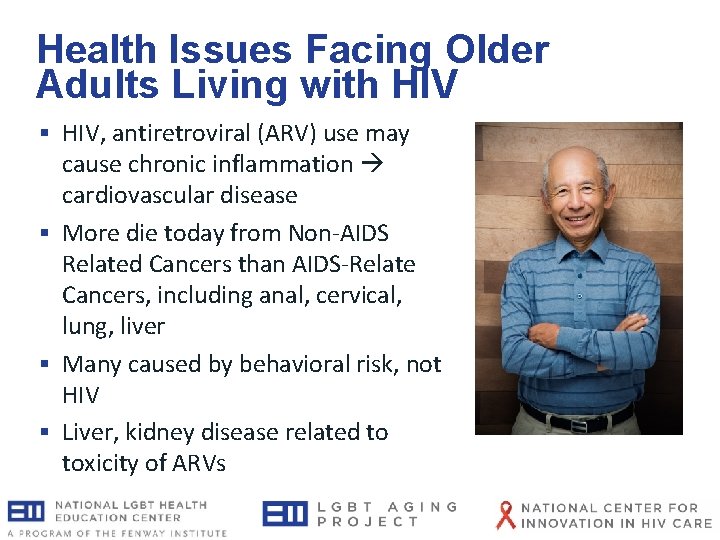
Health Issues Facing Older Adults Living with HIV § HIV, antiretroviral (ARV) use may cause chronic inflammation cardiovascular disease § More die today from Non-AIDS Related Cancers than AIDS-Relate Cancers, including anal, cervical, lung, liver § Many caused by behavioral risk, not HIV § Liver, kidney disease related to toxicity of ARVs
Health Issues (cont’d) § Cognitive impairment (earlier onset) § Frailty, bone loss § Neuropathy § Cardiovascular disease, bone density loss exacerbated by high rates of smoking among PLWHA
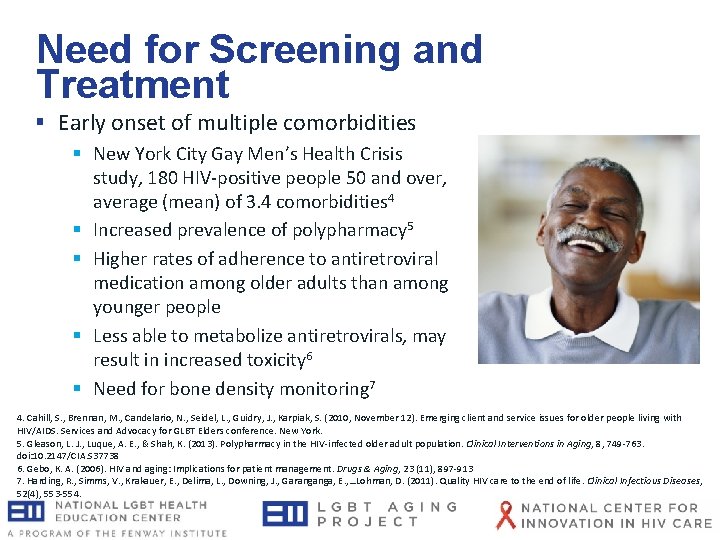
Need for Screening and Treatment § Early onset of multiple comorbidities § New York City Gay Men’s Health Crisis study, 180 HIV-positive people 50 and over, average (mean) of 3. 4 comorbidities 4 § Increased prevalence of polypharmacy 5 § Higher rates of adherence to antiretroviral medication among older adults than among younger people § Less able to metabolize antiretrovirals, may result in increased toxicity 6 § Need for bone density monitoring 7 4. Cahill, S. , Brennan, M. , Candelario, N. , Seidel, L. , Guidry, J. , Karpiak, S. (2010, November 12). Emerging client and service issues for older people living with HIV/AIDS. Services and Advocacy for GLBT Elders conference. New York. 5. Gleason, L. J. , Luque, A. E. , & Shah, K. (2013). Polypharmacy in the HIV-infected older adult population. Clinical Interventions in Aging, 8, 749 -763. doi: 10. 2147/CIA. S 37738 6. Gebo, K. A. (2006). HIV and aging: Implications for patient management. Drugs & Aging, 23 (11), 897 -913 7. Harding, R. , Simms, V. , Krakauer, E. , Delima, L. , Downing, J. , Garanganga, E. , …Lohman, D. (2011). Quality HIV care to the end of life. Clinical Infectious Diseases, 52(4), 553 -554.
Need for Screening and Treatment • • Side effects of antiretroviral use (including liver toxicity, lipodystrophy, osteoporosis, pancreatitis, peripheral neuropathy, and buildup of lactic acid)8 Leading causes of morbidity and mortality among older adults living with HIV 9: § Liver disease § Cardiovascular disease (linked to long exposure to ART)10 § Cancer (diagnosed 20 years earlier than rest of U. S. population)11 8. Gebo, K. A. (2006). HIV and aging: Implications for patient management. Drugs & Aging, 23(11), 897 -913 9. Capeau, J. (2011). Premature Aging and Premature Age-Related Comorbidities in HIV-Infected Patients: Facts and Hypotheses. Clinical Infectious Diseases, 53(11), 1127 -1129. 10. Deeks, S. G. , Phillips, A. N. (2009). HIV infection, antiretroviral treatment, ageing, and non-AIDS related morbidity. BMJ, 338, 288 -292. doi: 10. 1136/bmj. A 3172 11. Shiels, M. S. , Pfeiffer, R. M. , & Engels, E. A. (2010). Age at cancer diagnosis among persons with AIDS in the United States. Annals of Internal Medicine, 153, 452460. doi: 10. 7326/0003 -4819 -153 -7 -201010050 -00008
Behavioral Health Issues Facing Older Adults Living with HIV § Depression § Social isolation § Substance use § Stigma—HIV, homosexuality/bisexuality, racism, sexism, transgender etc. § Many long-term survivors experience trauma, PTSD, survivor guilt, significant social isolation § Sense that they have been abandoned, left behind by HIV movement, gay community, no one cares about them
Mental Health § Increases in cognitive impairment, at earlier age (can impact adherence)12 § Antiretrovirals may increase risk of Alzheimer’s and depression 13 § Studies report depression among about 50% of older adults with HIV 14, 15, 16 § Drug-drug interactions can decrease efficacy and increase toxicity 17 § “Brown bag” review of all medications currently taking 12. Webel, A. R. , Longenecker, C. T. , Gripshover, B. , Hanson, J. E. , Schmotzer, B. J. , & Salata, R. A. (2014). Age, stress, and isolation in older adults living with HIV. AIDS Care, 25(5), 523 -531. 13. Myers, J. D. (2009). Growing old with HIV: The AIDS epidemic and an aging population. Journal of the American Academy of Physician Assistants, 22(1), 20 -24. Cited in Cahill and Valadez, “Growing older with HIV brings new challenges, ” Am J Pub Health, 2013. 14. Heckman TG, Kochman A, Sikkema KJ, Kalichman SC. (1999) Depressive symptomatology, daily stressors, and ways of coping among middle-age and older adults living with HIV disease. Journal of Aging & Mental Health, 5, 311 -322. Cited in Schrimshaw, E. W. , Siegel, K. (2003). Perceived barriers to social support from family and friends among older adults with HIV/AIDS. Journal of Health Psychology, 8(6), 738 -752. 15. Cahill, S. , Brennan, M. , Candelario, N. , Seidel, L. , Guidry, J. , & Karpiak, S. (2010). Emerging client and service issues for older people living with HIV/AIDS. Services and Advocacy for GLBT Elders (SAGE) conference, New York. 16. Karpiak, S. E. , Shippey, R. A. , & Cantor, M. H. (2006). Research on Older Adults with HIV. New York: AIDS Community Research Initiative of America. Retrieved from: https: //www. health. ny. gov/diseases/aids/providers/conferences/docs/roah_final_report. pdf 17. AIDSinfo. (2016, January 28). Guidelines for the use of antiretroviral agents in HIV-1 -infected adults and adolescents: Considerations for antiretroviral use in special patient populations, HIV and the older patient. Retrieved from: https: //aidsinfo. nih. gov/guidelines/html/1/adult-and-adolescent-arv-guidelines/277/ hiv-and-the-older-patient
Substance Abuse • Higher rates of substance use than for HIV-negative § Smoke at more than twice the rate of general U. S. adult population (42% vs. 17%)18 § Higher rates of substance use among LGBT population overall § Crystal meth use a major issue with gay men in the U. S. • • • Linked to increase in depression (affects adherence)19 Interaction between prescription medications and illicit substances Treatments: § Pharmacotherapy § Cognitive behavioral therapy § Culturally appropriate support groups 18. Centers for Disease Control and Prevention. (2015, March 14). Current cigarette smoking in the United States: Fact sheet. Retrieved from: http: //www. cdc. gov/tobacco/data_statistics/fact_sheets/adult_data/cig_smoking/ 19. Ibid.
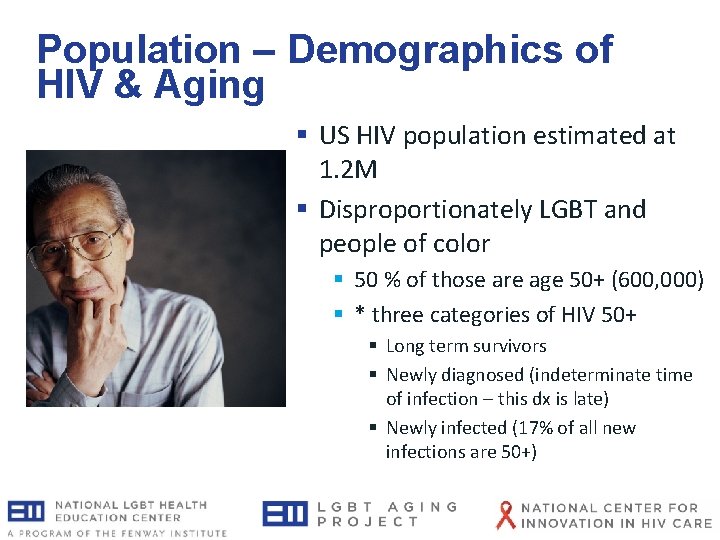
Population – Demographics of HIV & Aging § US HIV population estimated at 1. 2 M § Disproportionately LGBT and people of color § 50 % of those are age 50+ (600, 000) § * three categories of HIV 50+ § Long term survivors § Newly diagnosed (indeterminate time of infection – this dx is late) § Newly infected (17% of all new infections are 50+)
Psychosocial Aspects of HIV & Aging § Stigma – method of transmission § (Homo/bi)sexual § Injection drug use § Early on blood transfusions § “Should have known better” today
Psychosocial Aspects of HIV & Aging § Stigma - Identity § Disproportionate rate of infection in Black, Hispanic/Latino MSM, and LGBT community § Intersectionality with race, ethnicity, sexual orientation, gender identity (SO/GI) resulting in racism, sexism, xenophobia, homo/bi/trans phobia § Ageism and being OLD (in both LGBT and larger US culture) § Fear of stigma leads LGBT older adults not to seek social services or social engagement
Psychosocial Aspects of HIV & Aging § LGBT Older Adults § More likely to age alone without spouse/partner or adult children § Lack of vertical caregivers (intergenerational) and increased estrangement from family, and more likely to have horizontal caregivers (peers) § Causes of isolation: § HIV stigma § Stigma related to sexual behavior and injection drug use § General population’s fear of casual HIV transmission § Many gay men lost partners, friends to epidemic
Psychosocial Aspects of HIV & Aging § Long Term Survivor Resilience: § lived experience of AIDS epidemic –what did that mean to them? § Older PLWH exhibited in the early years of the AIDS epidemic and many continue to exhibit a great deal of resiliency and strength. § Many AIDS service organizations (ASOs) and government HIV prevention and care programs would not exist were it not for the vision and leadership of these impassioned advocates who are today’s Long Term Survivors § Strong support in LGBT, HIV, Recovery, Faith communities § Diagnosis as “death sentence” became diagnosis of a “chronic condition” -- I am going to grow old– now what? § Where are the opportunities to be out as HIV+ and old?
Psychosocial Aspects of HIV & Aging § Long Term Survivor Fatigue: § High levels of social isolation, depression, anxiety and substance abuse in HIV + community § Survivor’s Guilt – Why am I still here? § “I’ve lost everyone and don’t want to engage with anyone again. ” § Impact of losing peers (again) when aging may trigger earlier losses and result in… those noted above § Certain health conditions are more common for HIV+ (heart disease, diabetes, cancers, cognitive decline) and question of “accelerated aging” & management of many conditions
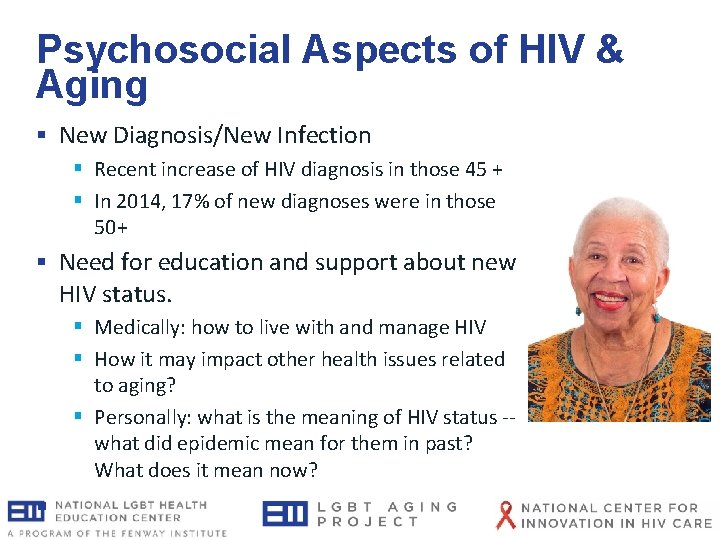
Psychosocial Aspects of HIV & Aging § New Diagnosis/New Infection § Recent increase of HIV diagnosis in those 45 + § In 2014, 17% of new diagnoses were in those 50+ § Need for education and support about new HIV status. § Medically: how to live with and manage HIV § How it may impact other health issues related to aging? § Personally: what is the meaning of HIV status -what did epidemic mean for them in past? What does it mean now? §
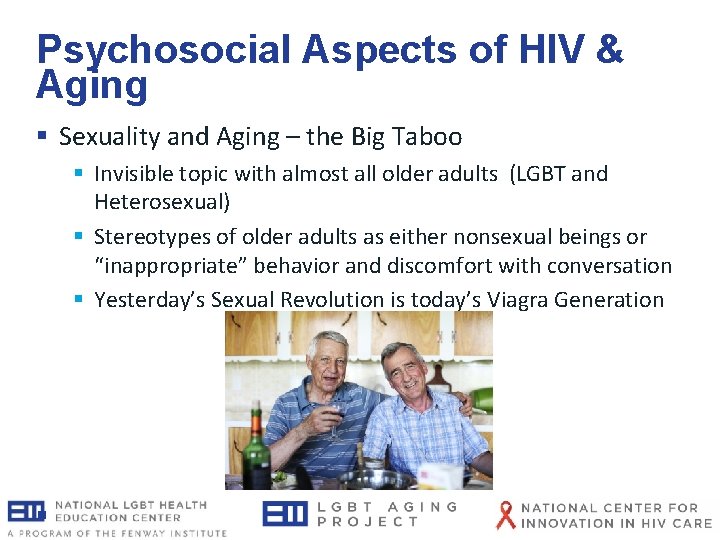
Psychosocial Aspects of HIV & Aging § Sexuality and Aging – the Big Taboo § Invisible topic with almost all older adults (LGBT and Heterosexual) § Stereotypes of older adults as either nonsexual beings or “inappropriate” behavior and discomfort with conversation § Yesterday’s Sexual Revolution is today’s Viagra Generation §
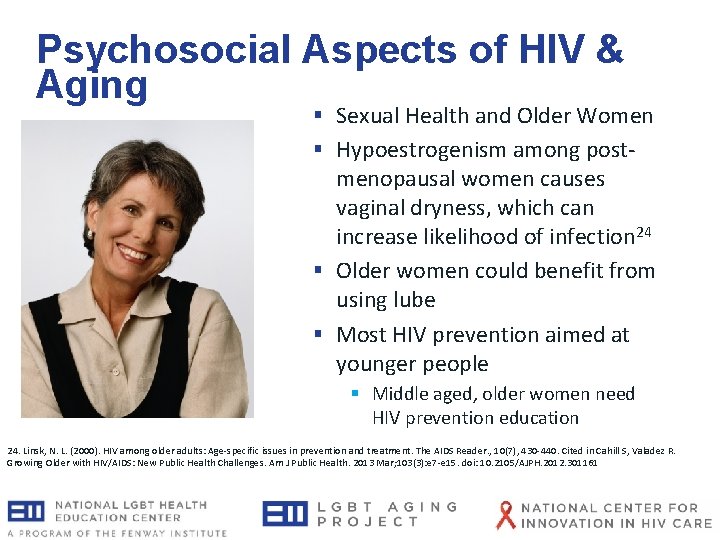
Psychosocial Aspects of HIV & Aging § Sexual Health and Older Women § Hypoestrogenism among post- menopausal women causes vaginal dryness, which can increase likelihood of infection 24 § Older women could benefit from using lube § Most HIV prevention aimed at younger people § Middle aged, older women need HIV prevention education 24. Linsk, N. L. (2000). HIV among older adults: Age-specific issues in prevention and treatment. The AIDS Reader. , 10(7), 430 -440. Cited in Cahill S, Valadez R. Growing Older with HIV/AIDS: New Public Health Challenges. Am J Public Health. 2013 Mar; 103(3): e 7 -e 15. doi: 10. 2105/AJPH. 2012. 301161
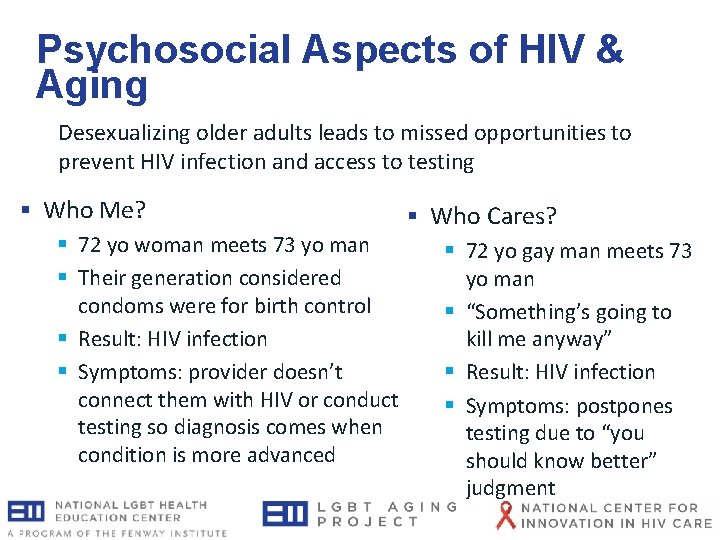
Psychosocial Aspects of HIV & Aging Desexualizing older adults leads to missed opportunities to prevent HIV infection and access to testing § Who Me? § Who Cares? § 72 yo woman meets 73 yo man § 72 yo gay man meets 73 § Their generation considered yo man condoms were for birth control § “Something’s going to § Result: HIV infection kill me anyway” § Symptoms: provider doesn’t § Result: HIV infection connect them with HIV or conduct § Symptoms: postpones testing so diagnosis comes when testing due to “you condition is more advanced should know better” judgment
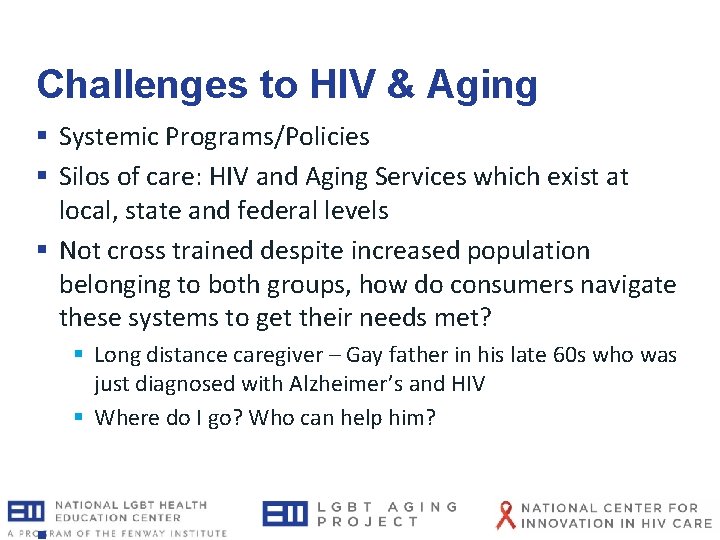
Challenges to HIV & Aging § Systemic Programs/Policies § Silos of care: HIV and Aging Services which exist at local, state and federal levels § Not cross trained despite increased population belonging to both groups, how do consumers navigate these systems to get their needs met? § Long distance caregiver – Gay father in his late 60 s who was just diagnosed with Alzheimer’s and HIV § Where do I go? Who can help him?
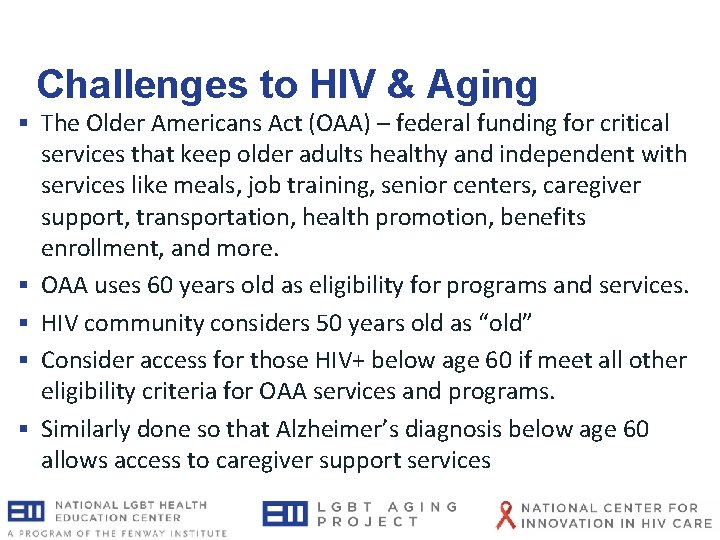
Challenges to HIV & Aging § The Older Americans Act (OAA) – federal funding for critical § § services that keep older adults healthy and independent with services like meals, job training, senior centers, caregiver support, transportation, health promotion, benefits enrollment, and more. OAA uses 60 years old as eligibility for programs and services. HIV community considers 50 years old as “old” Consider access for those HIV+ below age 60 if meet all other eligibility criteria for OAA services and programs. Similarly done so that Alzheimer’s diagnosis below age 60 allows access to caregiver support services
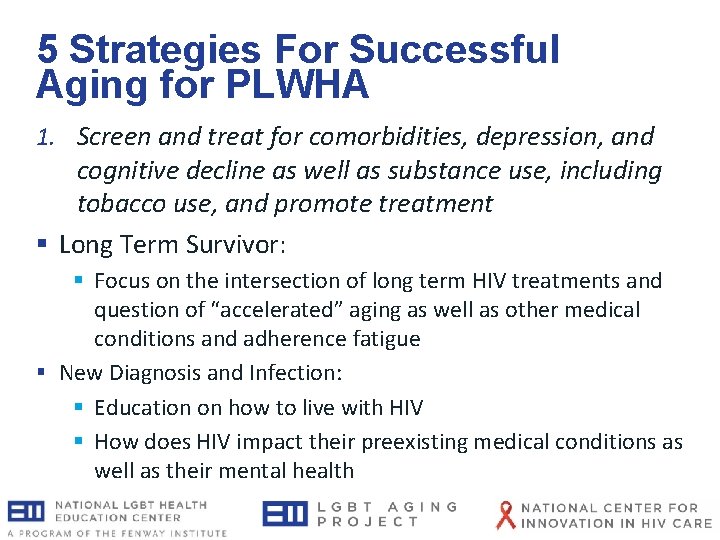
5 Strategies For Successful Aging for PLWHA 1. Screen and treat for comorbidities, depression, and cognitive decline as well as substance use, including tobacco use, and promote treatment § Long Term Survivor: § Focus on the intersection of long term HIV treatments and question of “accelerated” aging as well as other medical conditions and adherence fatigue § New Diagnosis and Infection: § Education on how to live with HIV § How does HIV impact their preexisting medical conditions as well as their mental health
5 Strategies For Successful Aging for PLWHA 2. Strengthen social support networks and reduce social isolation § New Diagnosis groups for older adults that can focus on impact of HIV and later stage of life § Social opportunities for Long Term and Newly Diagnosed to be “out” as HIV +, old, LGBT, POC – bring all aspects of their identity §
5 Strategies For Successful Aging for PLWHA 3. Promote sexual health and HIV/STI education and prevention for older adults § Ask older adults if/how they are sexually active § Providers, family members, friends § Target HIV prevention materials toward older adults (next to ED medication displays? ). Most target younger adults –with an implicit message that older adults are not sexually active, nor are they at risk for HIV § HIV testing – make this available/accessible for older adults
5 Strategies For Successful Aging for PLWHA 4. Train all staff in the unique needs and experiences of older people living with HIV with cultural competency training for HIV and Aging Services § Cross train the silos § HIV learns about Aging § Aging learns about HIV § All learn about sexuality and aging (Heterosexual and LGB) § Include the impact of epidemic and meaning for those who lived through it (important for younger providers w/o that experience)
5 Strategies For Successful Aging for PLWHA 5. Older Americans Act Designations to Increase Services § States can designate LGBT and HIV + elders as populations of “greatest social need” to improve access to services and benefits available to all older adults, especially those seen as most “in need” § Massachusetts: § in 2012 State Unit on Aging designated LGBT older adults as a population of “greatest social need” and prioritized them to receive services § State Commission on LGBT Aging has recommended same “greatest social need ” designation for HIV+ older adults § Also recommending eligibility for HIV+ below age 60
Summary § Individuals can age successfully while living with HIV if they receive adequate support and care. § Today we have outlined ways to promote that wellbeing in a variety of settings and contexts § Actions range from individual clinical interactions to macro levels of program delivery and policy development
Resources on HIV and Aging § ACRIA (info on aging and HIV and long-term survivors) § National Association of HIV Over 50 (http: //hivoverfifty. org/about/hof/national. html) § New England Association of HIV Over 50 (http: //hivoverfifty. org/about/neahof/mission. html) § SAGE (Services and Advocacy for GLBT Elders) www. sageusa. org § The Well Project (http: //www. thewellproject. org/) – both on women aging with HIV and long-term survivors
Resources for Long Term Survivors § www. Letskickass. org (AIDS Survivor Syndrome) § GMHC Friends in Deed long term survivor group (http: //www. gmhc. org/gmhc-services/getconnected/long-term-survivors-4) § More info on local long-term survivor groups in Boston, other cities: http: //openlypoz. com/? tribe_events=long-termsurvivor-support-group § Older Women Embracing Life http: //owel. info/Our_History. php
Resource for clinicians § The American Academy of HIV Medicine (AAHIVM), the American Geriatrics Society (AGS) and the AIDS Community Research Initiative of America (ACRIA) have released the first clinical treatment strategies for managing older HIV patients: The HIV and Aging Consensus Project: Recommended Treatment Strategies for Clinicians Managing Older Patients with HIV. Order hard copies for free from the Academy, aahivm. org, or visit www. aahivm. org/hivandagingforum
CONTACT INFORMATION: § National Center for Innovation in HIV Care § nationalhivcenter@fenwayhealth. org § scahill@fenwayhealth. org § LGBT Aging Project § www. lgbtagingproject. org § lkrinsky@fenwayhealth. org
Questions?
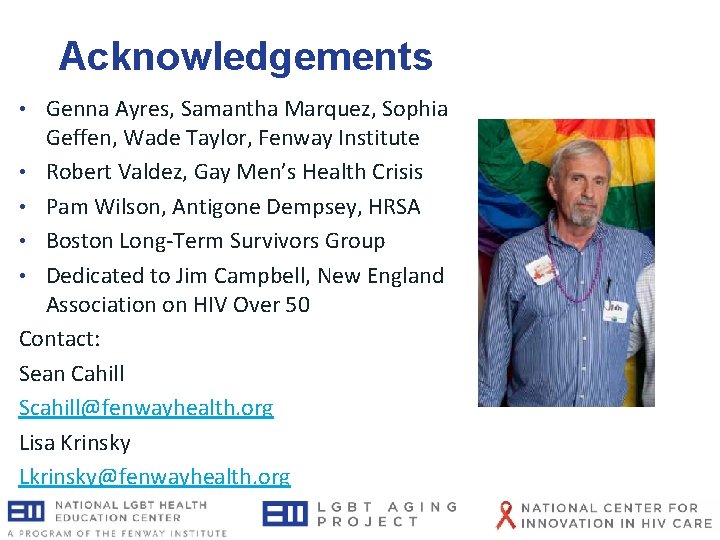
Acknowledgements • Genna Ayres, Samantha Marquez, Sophia Geffen, Wade Taylor, Fenway Institute • Robert Valdez, Gay Men’s Health Crisis • Pam Wilson, Antigone Dempsey, HRSA • Boston Long-Term Survivors Group • Dedicated to Jim Campbell, New England Association on HIV Over 50 Contact: Sean Cahill Scahill@fenwayhealth. org Lisa Krinsky Lkrinsky@fenwayhealth. org