
Strategies to Deter Child Abuse Child Guidance Copyright
Strategies to Deter Child Abuse Child Guidance
Copyright © Texas Education Agency, 2017. These Materials are copyrighted © and trademarked ™ as the property of the Texas Education Agency (TEA) and may not be reproduced without the express written permission of TEA, except under the following conditions: 1) Texas public school districts, charter schools, and Education Service Centers may reproduce and use copies of the Materials and Related Materials for the districts’ and schools’ educational use without obtaining permission from TEA. 2) Residents of the state of Texas may reproduce and use copies of the Materials and Related Materials for individual personal use only, without obtaining written permission of TEA. 3) Any portion reproduced must be reproduced in its entirety and remain unedited, unaltered and unchanged in any way. 4) No monetary charge can be made for the reproduced materials or any document containing them; however, a reasonable charge to cover only the cost of reproduction and distribution may be charged. Private entities or persons located in Texas that are not Texas public school districts, Texas Education Service Centers, or Texas charter schools or any entity, whether public or private, educational or non-educational, located outside the state of Texas MUST obtain written approval from TEA and will be required to enter into a license agreement that may involve the payment of a licensing fee or a royalty. For information contact: Office of Copyrights, Trademarks, License Agreements, and Royalties, Texas Education Agency, 1701 N. Congress Ave. , Austin, TX 78701 -1494; phone 512 -463 -7004; email: copyrights@tea. state. tx. us. Copyright © Texas Education Agency, 2017. All rights reserved. 2
Child Abuse and Neglect > Last year: • 231 Texas children died because of abuse or neglect at the hands of their parents or guardians. • 65, 948 children were confirmed victims of abuse or neglect. • 17, 108 children were removed from their homes because of abuse or neglect. Copyright © Texas Education Agency, 2017. All rights reserved. 3
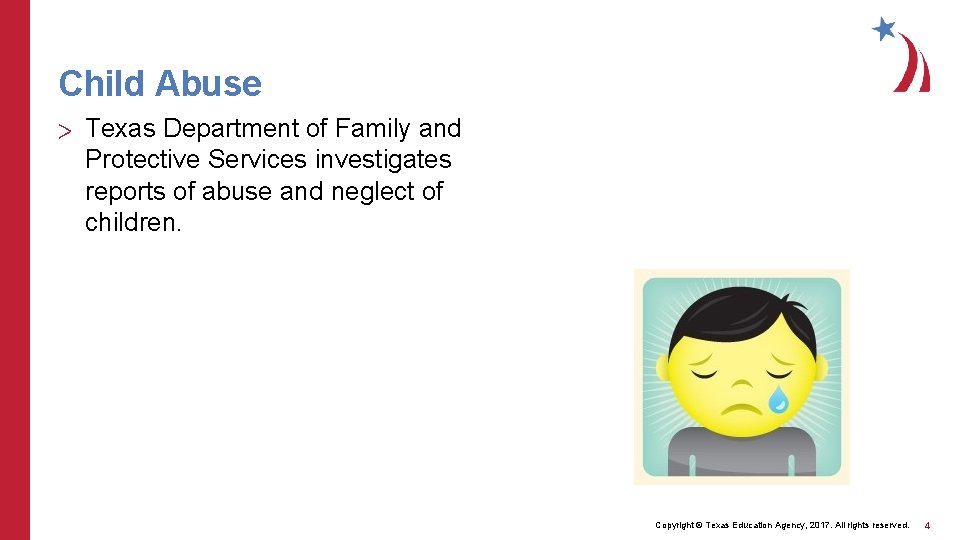
Child Abuse > Texas Department of Family and Protective Services investigates reports of abuse and neglect of children. Copyright © Texas Education Agency, 2017. All rights reserved. 4

Physical Abuse > Physical abuse is non accidental physical injury (ranging from minor bruises to severe fractures or death) as a result of punching, beating, kicking, biting, shaking, throwing, stabbing, choking, hitting (with a hand, stick, strap, or other object), burning, or otherwise harming a child. Copyright © Texas Education Agency, 2017. All rights reserved. 5
Sexual Abuse > Sexual abuse includes activities by a parent or caregiver such as fondling a child’s genitals, penetration, incest, rape, sodomy, indecent exposure, and exploitation through prostitution or the production of pornographic materials. Copyright © Texas Education Agency, 2017. All rights reserved. 6
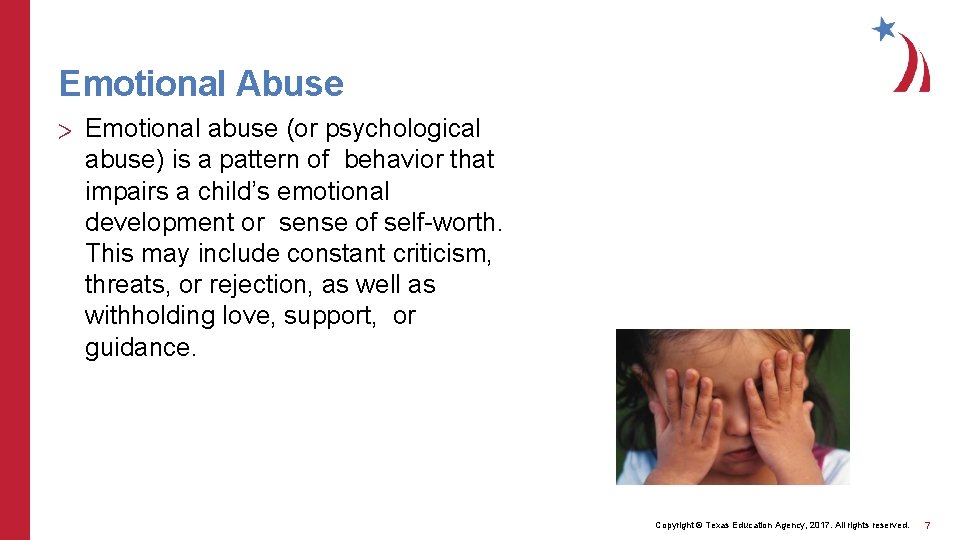
Emotional Abuse > Emotional abuse (or psychological abuse) is a pattern of behavior that impairs a child’s emotional development or sense of self-worth. This may include constant criticism, threats, or rejection, as well as withholding love, support, or guidance. Copyright © Texas Education Agency, 2017. All rights reserved. 7
Abandonment > A child is considered to be abandoned when the parent’s identity or whereabouts are unknown, the child has been left alone in circumstances where the child suffers serious harm, or the parent has failed to maintain contact with the child or provide reasonable support for a specified period of time. Copyright © Texas Education Agency, 2017. All rights reserved. 8
Substance Abuse > Substance abuse is an element of the definition of child abuse or neglect in many States. Copyright © Texas Education Agency, 2017. All rights reserved. 9
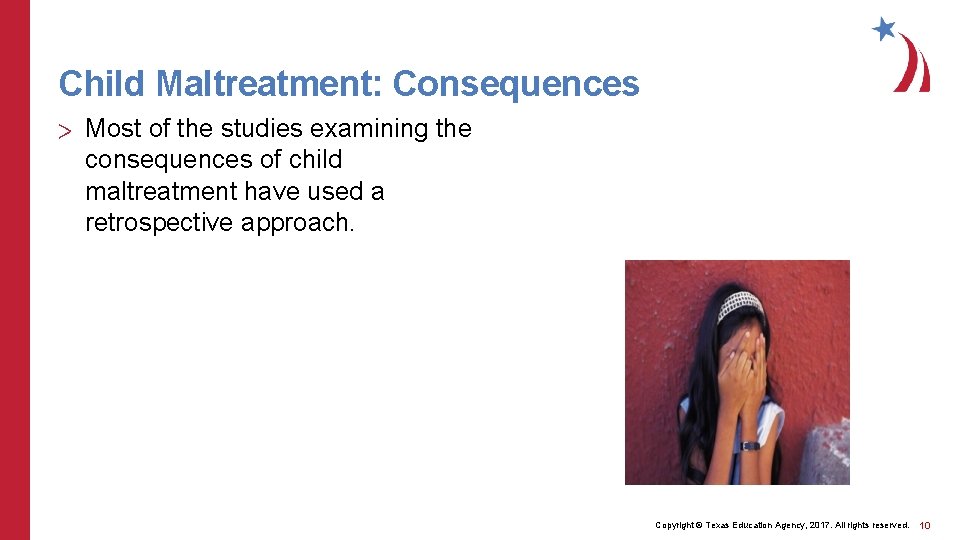
Child Maltreatment: Consequences > Most of the studies examining the consequences of child maltreatment have used a retrospective approach. Copyright © Texas Education Agency, 2017. All rights reserved. 10
Physical Consequences > Maltreatment during infancy or early childhood can cause important regions of the brain to form and function improperly with long-term consequences on cognitive, language, and socioemotional development, and mental health. Copyright © Texas Education Agency, 2017. All rights reserved. 11
Psychological Consequences > In one long-term study, as many as 80 percent of young adults who had been abused met the diagnostic criteria for at least one psychiatric disorder at age 21. Copyright © Texas Education Agency, 2017. All rights reserved. 12
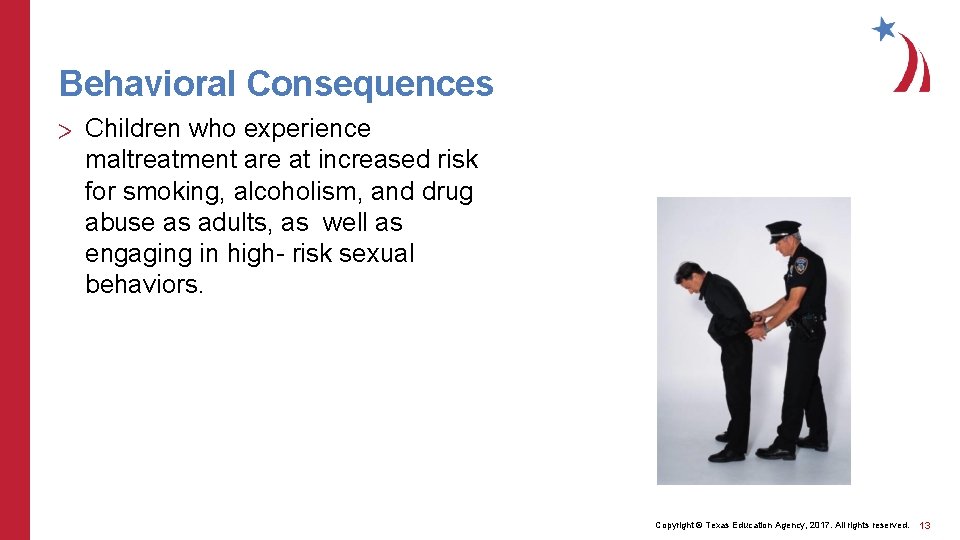
Behavioral Consequences > Children who experience maltreatment are at increased risk for smoking, alcoholism, and drug abuse as adults, as well as engaging in high- risk sexual behaviors. Copyright © Texas Education Agency, 2017. All rights reserved. 13
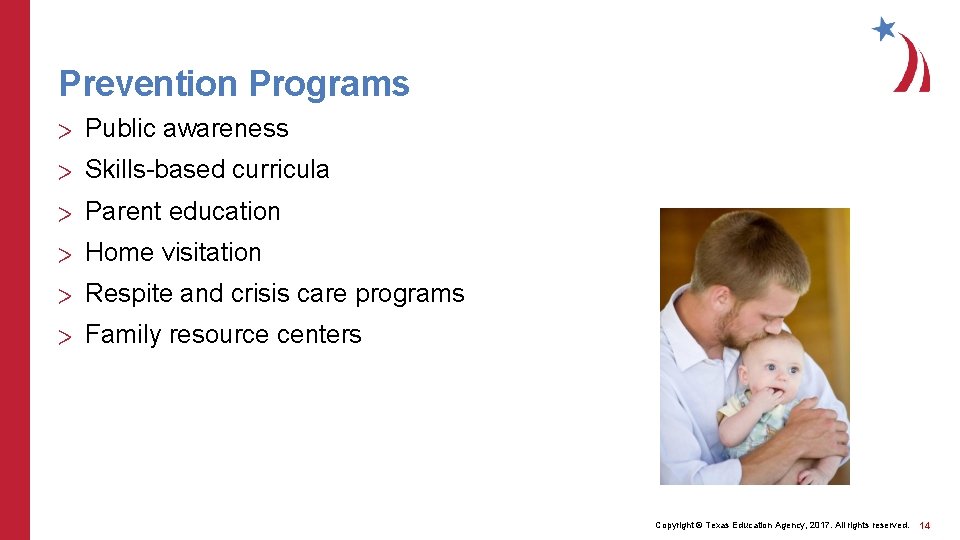
Prevention Programs > Public awareness > Skills-based curricula > Parent education > Home visitation > Respite and crisis care programs > Family resource centers Copyright © Texas Education Agency, 2017. All rights reserved. 14
Protective Factors > Nurturing and attachment > Knowledge of parenting and of child and youth development > Parental resilience > Social connections > Concrete supports for parents Copyright © Texas Education Agency, 2017. All rights reserved. 15
Child Maltreatment: Prevention Strategies > Effective prevention strategies are necessary to promote awareness about child maltreatment and to foster commitment to social change. • Child-Parent Centers • Nurse-family Partnership • Triple P Program for parents Copyright © Texas Education Agency, 2017. All rights reserved. 16
Action Plans > It's up to us as a community to make a difference in our children's lives. It's up to all of us to keep children safe from abuse and neglect. We can do this as individuals and together as a community. Copyright © Texas Education Agency, 2017. All rights reserved. 17
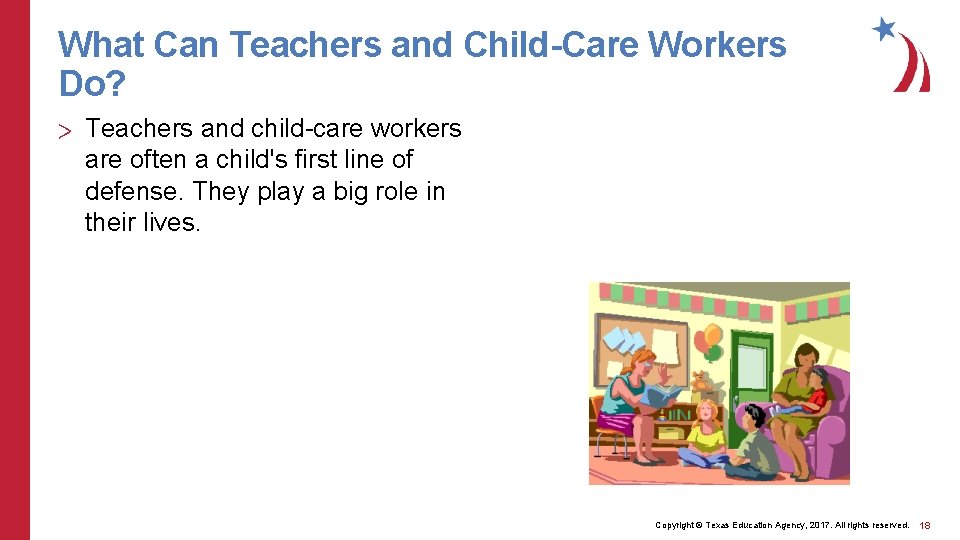
What Can Teachers and Child-Care Workers Do? > Teachers and child-care workers are often a child's first line of defense. They play a big role in their lives. Copyright © Texas Education Agency, 2017. All rights reserved. 18
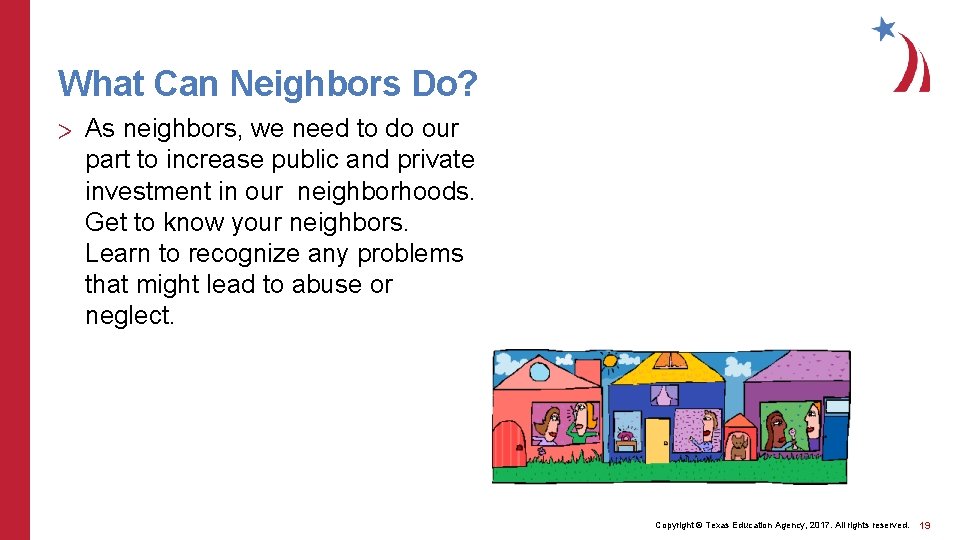
What Can Neighbors Do? > As neighbors, we need to do our part to increase public and private investment in our neighborhoods. Get to know your neighbors. Learn to recognize any problems that might lead to abuse or neglect. Copyright © Texas Education Agency, 2017. All rights reserved. 19
What Can Faith-Based Organizations Do? > A community's most influential organizations are often its religious institutions. Churches, temples, synagogues, mosques, and other faith-based groups play an important role in helping families and children who are at risk of child abuse. > Spiritual leaders can add their voices to preventing abuse and neglect. Copyright © Texas Education Agency, 2017. All rights reserved. 20
What Can Coaches and Sports Leagues Do? > Child-centered coaching is a philosophy that emphasizes the importance of helping young children develop their positive overall self-image through sports. "Try your hardest to do the best you can" is the message that, when carried over to other aspects of life, will truly help children have fun and feel like winners. Copyright © Texas Education Agency, 2017. All rights reserved. 21
How Can I Report Abuse, Neglect, or Exploitation? > If you suspect child abuse, you can report it by calling 1 -800 -2525400 24 hours a day, seven days a week, nationwide. Or > visit www. txabusehotline. org and place a report through our secure website, and you will receive a response within 24 hours. Copyright © Texas Education Agency, 2017. All rights reserved. 22
Real Stories of Hope > Help and Hope Videos Copyright © Texas Education Agency, 2017. All rights reserved. 23
How You Can Help > Get to know your neighbors > Help a family under stress > Reach out to children in your community > Be an active community member > Keep your neighborhood safe > Learn how to recognize and report signs of child abuse and neglect Copyright © Texas Education Agency, 2017. All rights reserved. 24
Hotlines and Online Resources > Find Services Near You > Find Help > Picture Door Organizer Copyright © Texas Education Agency, 2017. All rights reserved. 25
References/Resources > Microsoft Clip Art: Used with permission from Microsoft. > Textbook: • Decker, C. (2011). _Child development: Early stages through age 12_. (5 th ed. ). Tinley Park: Goodheart-Willcox Company. > You. Tube: • Picture Door Organizer This organizer is a multi-purpose tool. The students can incorporate information, key terms, sequential events, graphics and concept ideas. It has a hidden element that will make a presentation pop! http: //youtu. be/we. Y 4 Ptrf. M 3 o > Websites: • Center for Disease Control Child Maltreatment Prevention http: //www. cdc. gov/Violence. Prevention/childmaltreatment/ • Children's Bureau The Children’s Bureau (CB) is the first federal agency within the U. S. government—and in fact, the world—to focus exclusively on improving the lives of children and families. http: //www. acf. hhs. gov/programs/cb Copyright © Texas Education Agency, 2017. All rights reserved. 26
References/Resources > Websites: • Help for Parents. Hope for Kids It's not easy being a parent. But recognizing that you have room for improvement is the first step toward becoming a better parent. Here you will learn where to find the help you need to begin your journey toward becoming a healthier, happier family. http: //helpandhope. org/preventing-child-abuse. html • Medline Plus Child Abuse http: //www. nlm. nih. gov/medlineplus/childabuse. html • Texas Department of Family and Protective Services Help for Parents. hope for Kids http: //www. helpandhope. org/index. html • U. S. Department of Health and Human Services Child Abuse and Neglect https: //www. childwelfare. gov/can/ • U. S. Department of Health and Human Services Preventing Child Abuse and Neglect https: //www. childwelfare. gov/pubs/factsheets/preventingcan. cfm Copyright © Texas Education Agency, 2017. All rights reserved. 27
- Slides: 27