
Strategies to Advance Carbon Capture March 15 2018

Strategies to Advance Carbon Capture March 15, 2018 Jeff Erikson

Global large-scale CCS facilities

Large-scale CCS facilities in North America
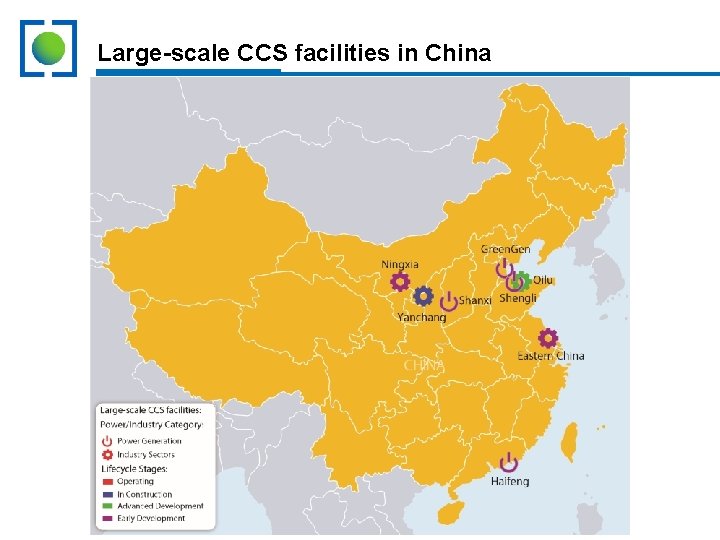
Large-scale CCS facilities in China

Large-scale CCS facilities in Europe
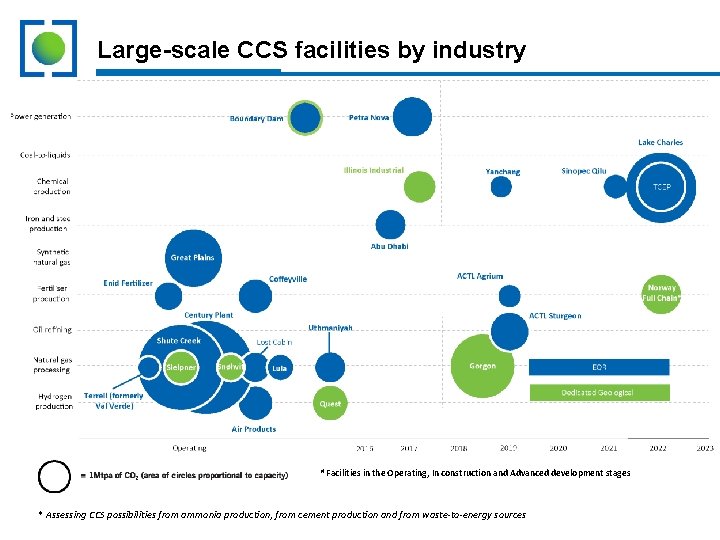
Large-scale CCS facilities by industry # Facilities in the Operating, In construction and Advanced development stages * Assessing CCS possibilities from ammonia production, from cement production and from waste-to-energy sources
International Policy – UNFCCC and IPCC § UNFCCC o COP-23: CCS maintained high profile o Prior to meeting: focus on ensuring CCS not disadvantaged in the “rulebook” for the Paris Agreement. o Formal decision on rulebook expected at COP-24 o Market Mechanisms o Green Climate Fund § IPCC – 1. 5 C report – ensuring CCS importance is reflected § “Powering Past Coal” – momentum is growing o Industrial CCS more important than power in some countries
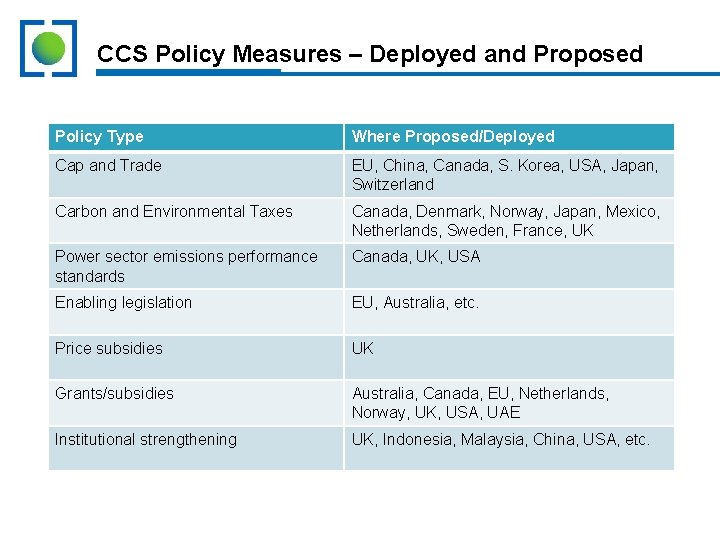
CCS Policy Measures – Deployed and Proposed Policy Type Where Proposed/Deployed Cap and Trade EU, China, Canada, S. Korea, USA, Japan, Switzerland Carbon and Environmental Taxes Canada, Denmark, Norway, Japan, Mexico, Netherlands, Sweden, France, UK Power sector emissions performance standards Canada, UK, USA Enabling legislation EU, Australia, etc. Price subsidies UK Grants/subsidies Australia, Canada, EU, Netherlands, Norway, UK, USA, UAE Institutional strengthening UK, Indonesia, Malaysia, China, USA, etc.
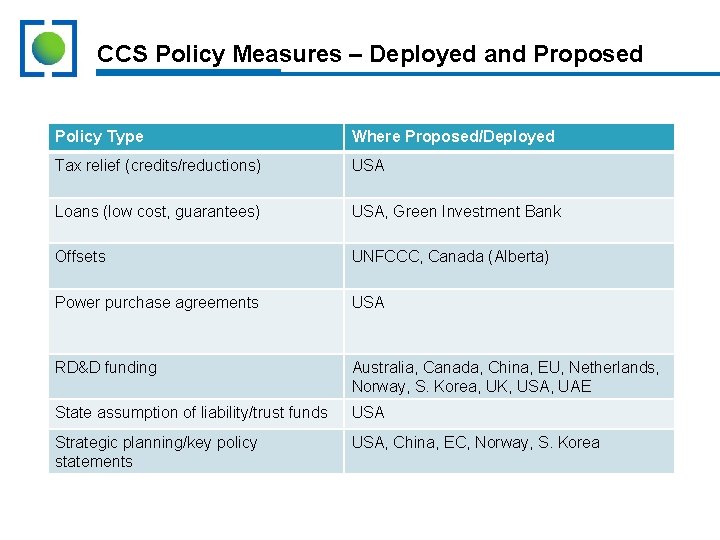
CCS Policy Measures – Deployed and Proposed Policy Type Where Proposed/Deployed Tax relief (credits/reductions) USA Loans (low cost, guarantees) USA, Green Investment Bank Offsets UNFCCC, Canada (Alberta) Power purchase agreements USA RD&D funding Australia, Canada, China, EU, Netherlands, Norway, S. Korea, UK, USA, UAE State assumption of liability/trust funds USA Strategic planning/key policy statements USA, China, EC, Norway, S. Korea
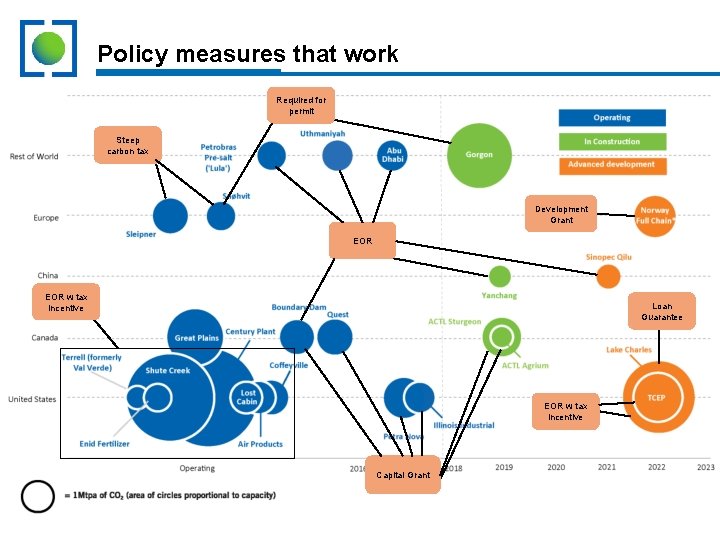
Policy measures that work Required for permit Steep carbon tax Development Grant EOR w tax incentive Loan Guarantee EOR w tax incentive Capital Grant
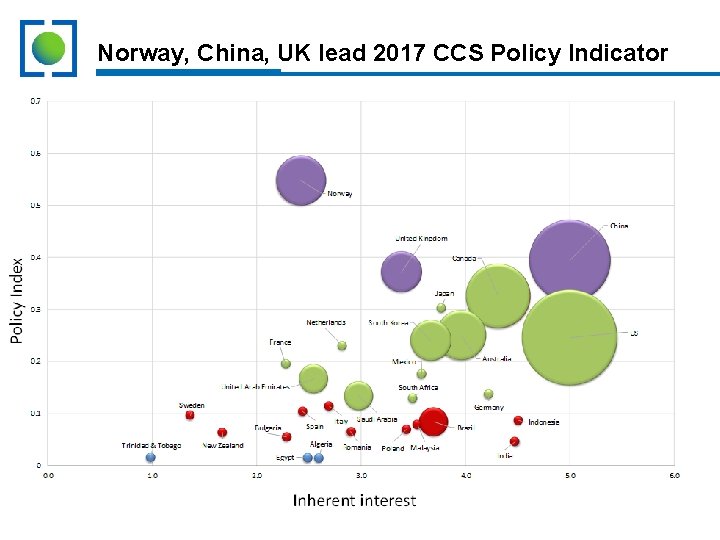
Norway, China, UK lead 2017 CCS Policy Indicator
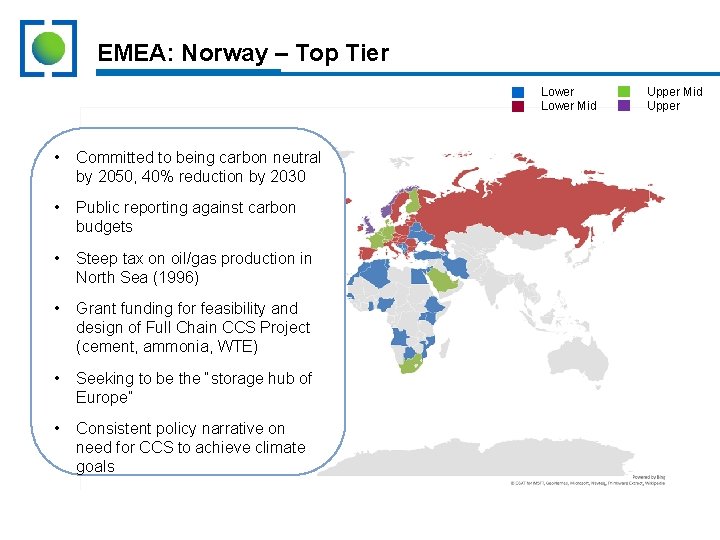
EMEA: Norway – Top Tier Lower Mid • Committed to being carbon neutral by 2050, 40% reduction by 2030 • Public reporting against carbon budgets • Steep tax on oil/gas production in North Sea (1996) • Grant funding for feasibility and design of Full Chain CCS Project (cement, ammonia, WTE) • Seeking to be the “storage hub of Europe” • Consistent policy narrative on need for CCS to achieve climate goals Upper Mid Upper
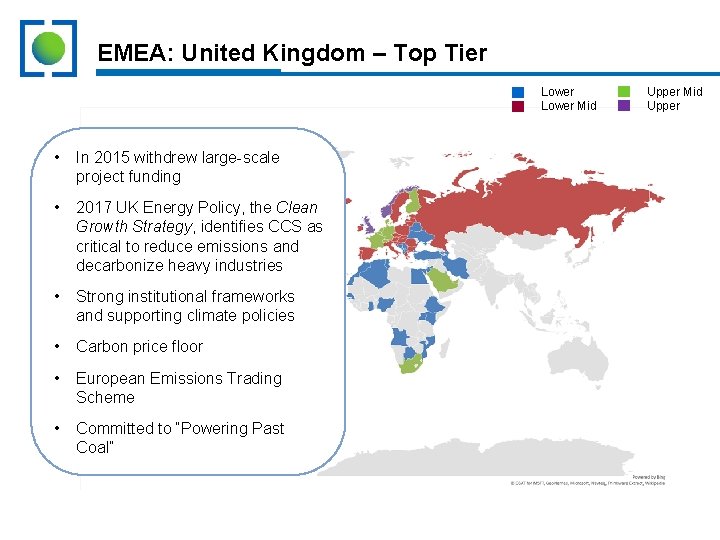
EMEA: United Kingdom – Top Tier Lower Mid • In 2015 withdrew large-scale project funding • 2017 UK Energy Policy, the Clean Growth Strategy, identifies CCS as critical to reduce emissions and decarbonize heavy industries • Strong institutional frameworks and supporting climate policies • Carbon price floor • European Emissions Trading Scheme • Committed to “Powering Past Coal” Upper Mid Upper
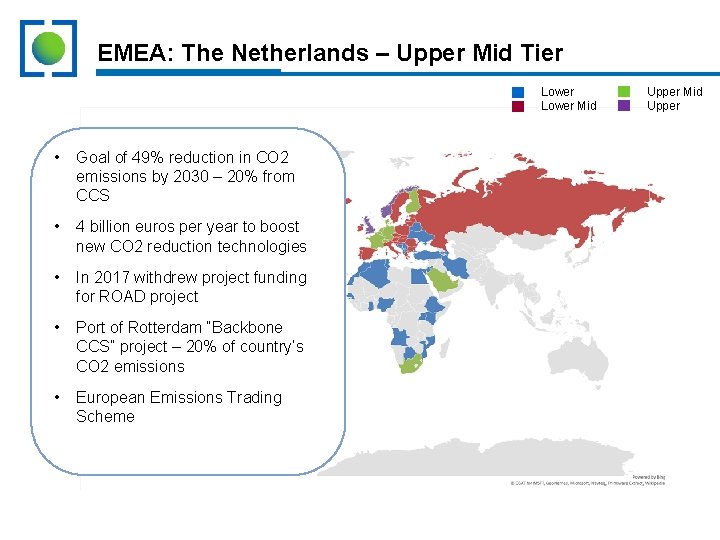
EMEA: The Netherlands – Upper Mid Tier Lower Mid • Goal of 49% reduction in CO 2 emissions by 2030 – 20% from CCS • 4 billion euros per year to boost new CO 2 reduction technologies • In 2017 withdrew project funding for ROAD project • Port of Rotterdam “Backbone CCS” project – 20% of country’s CO 2 emissions • European Emissions Trading Scheme Upper Mid Upper
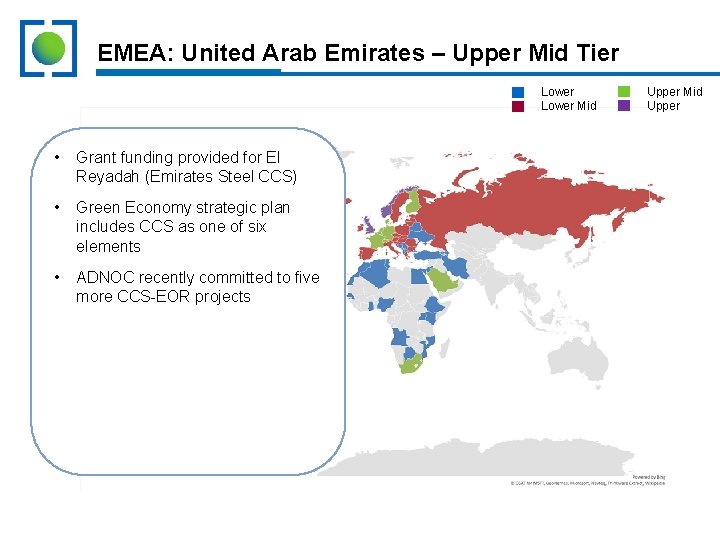
EMEA: United Arab Emirates – Upper Mid Tier Lower Mid • Grant funding provided for El Reyadah (Emirates Steel CCS) • Green Economy strategic plan includes CCS as one of six elements • ADNOC recently committed to five more CCS-EOR projects Upper Mid Upper
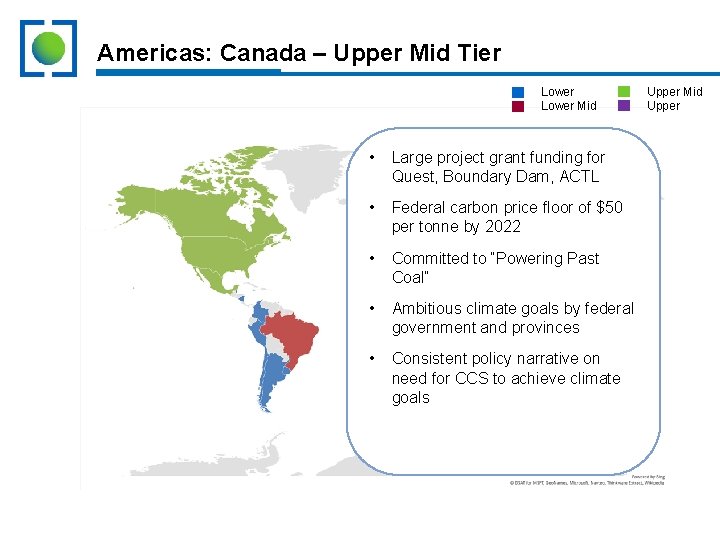
Americas: Canada – Upper Mid Tier Lower Mid • Large project grant funding for Quest, Boundary Dam, ACTL • Federal carbon price floor of $50 per tonne by 2022 • Committed to “Powering Past Coal” • Ambitious climate goals by federal government and provinces • Consistent policy narrative on need for CCS to achieve climate goals Upper Mid Upper
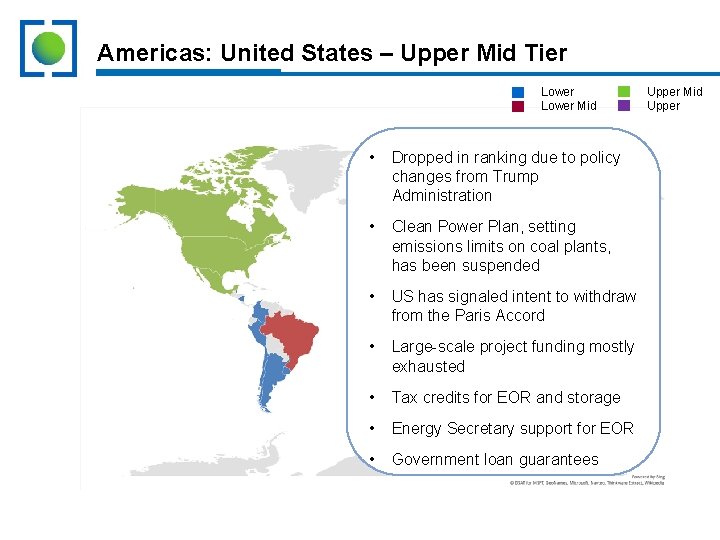
Americas: United States – Upper Mid Tier Lower Mid • Dropped in ranking due to policy changes from Trump Administration • Clean Power Plan, setting emissions limits on coal plants, has been suspended • US has signaled intent to withdraw from the Paris Accord • Large-scale project funding mostly exhausted • Tax credits for EOR and storage • Energy Secretary support for EOR • Government loan guarantees Upper Mid Upper
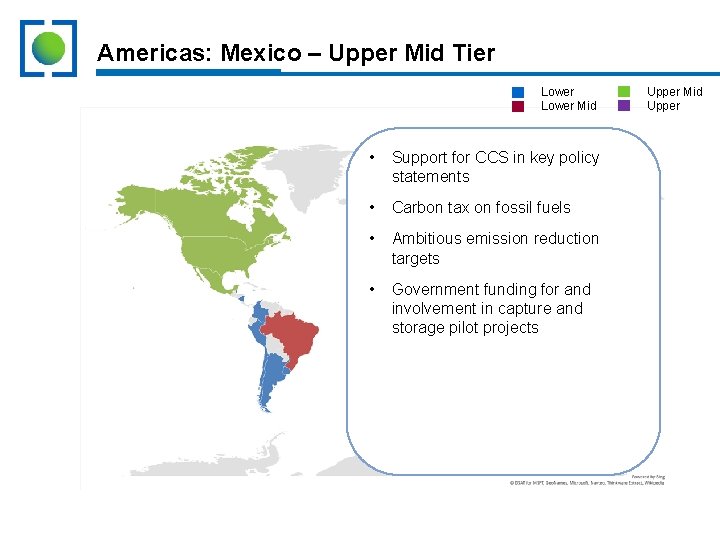
Americas: Mexico – Upper Mid Tier Lower Mid • Support for CCS in key policy statements • Carbon tax on fossil fuels • Ambitious emission reduction targets • Government funding for and involvement in capture and storage pilot projects Upper Mid Upper
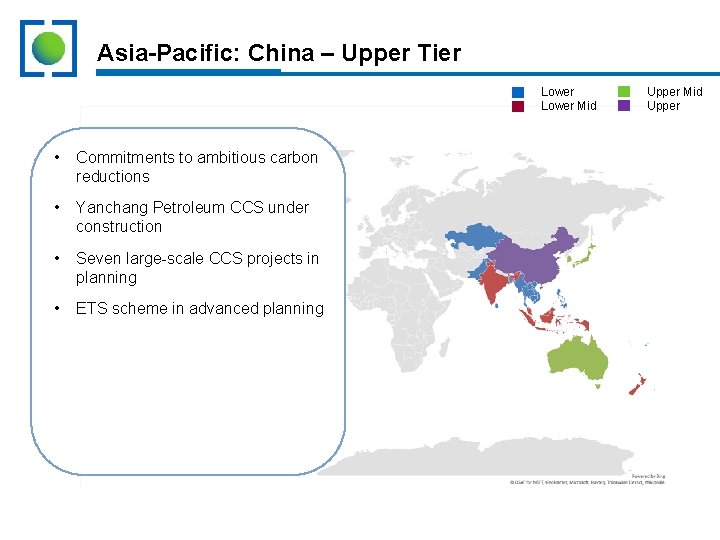
Asia-Pacific: China – Upper Tier Lower Mid • Commitments to ambitious carbon reductions • Yanchang Petroleum CCS under construction • Seven large-scale CCS projects in planning • ETS scheme in advanced planning Upper Mid Upper
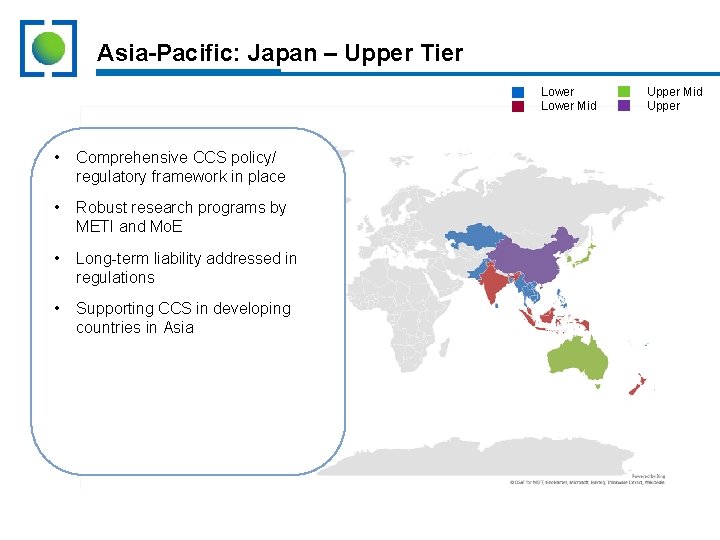
Asia-Pacific: Japan – Upper Tier Lower Mid • Comprehensive CCS policy/ regulatory framework in place • Robust research programs by METI and Mo. E • Long-term liability addressed in regulations • Supporting CCS in developing countries in Asia Upper Mid Upper
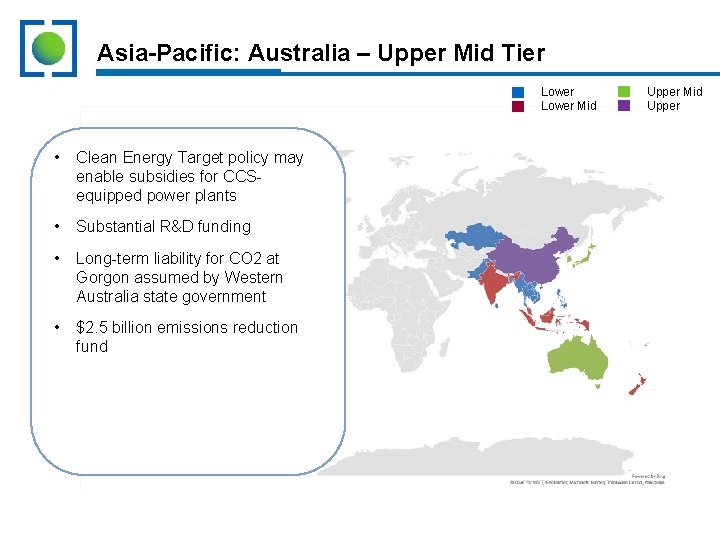
Asia-Pacific: Australia – Upper Mid Tier Lower Mid • Clean Energy Target policy may enable subsidies for CCSequipped power plants • Substantial R&D funding • Long-term liability for CO 2 at Gorgon assumed by Western Australia state government • $2. 5 billion emissions reduction fund Upper Mid Upper
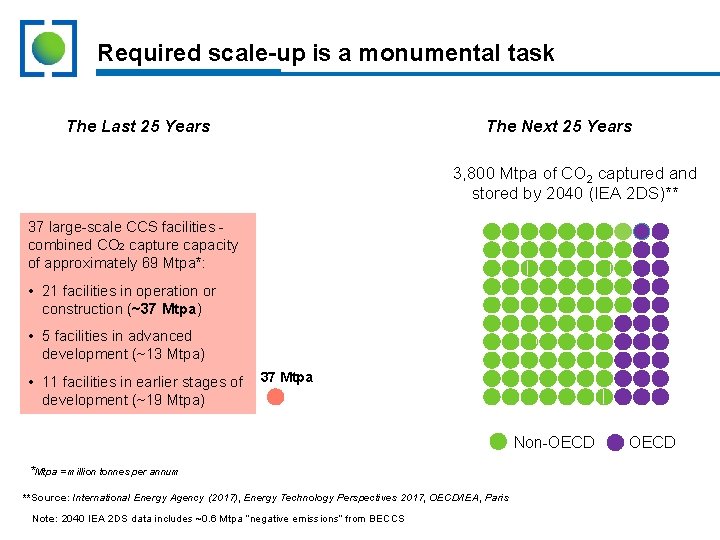
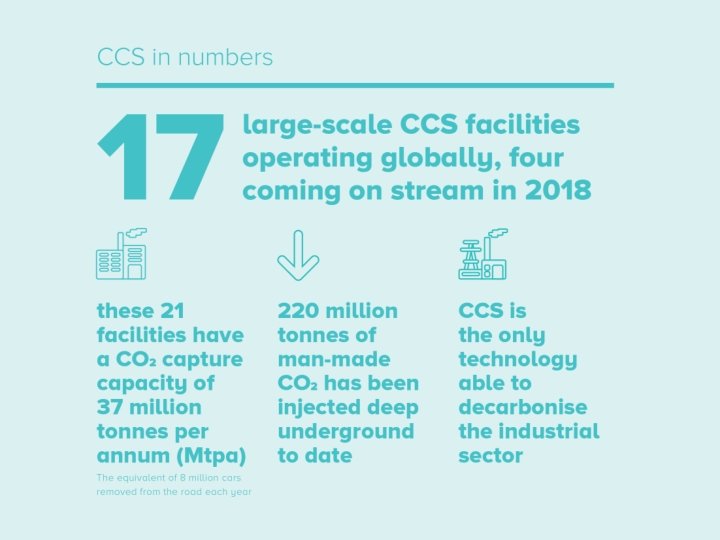
Required scale-up is a monumental task The Last 25 Years The Next 25 Years 3, 800 Mtpa of CO 2 captured and stored by 2040 (IEA 2 DS)** 37 large-scale CCS facilities combined CO 2 capture capacity of approximately 69 Mtpa*: • 21 facilities in operation or construction (~37 Mtpa) • 5 facilities in advanced development (~13 Mtpa) • 11 facilities in earlier stages of development (~19 Mtpa) 37 Mtpa Non-OECD *Mtpa = million tonnes per annum **Source: International Energy Agency (2017), Energy Technology Perspectives 2017, OECD/IEA, Paris Note: 2040 IEA 2 DS data includes ~0. 6 Mtpa “negative emissions” from BECCS OECD
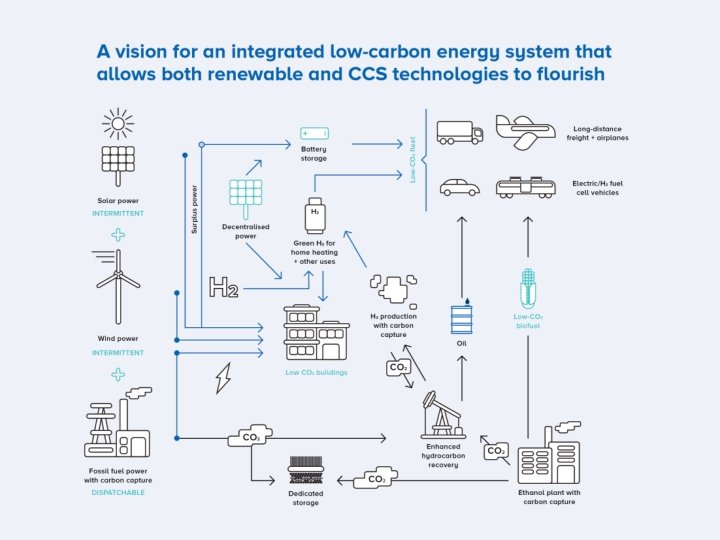
CCS – The key to the new energy economy • Time to move on from narrow view of CCS as only a coal fired generation technology. It’s much bigger than this. • Production of clean chemicals, plastics, steel, fertilisers, cement, etc requires CCS • Hydrogen production and use vital addition to energy system; coal ratio: Reserves to production gasification and SMR both with CCS key to cost effective~75 delivery years • New opportunities for climate friendly industrial hubs centred on using CCS for clean production of essential products and fuels • Opportunity to re-fuel generators with hydrogen • Policy essential to realise these opportunities
- Slides: 26