
Strategies for Managing Challenging Behavior Defining Challenging Behaviors
Strategies for Managing Challenging Behavior
Defining Challenging Behaviors Predictors and Life Effects
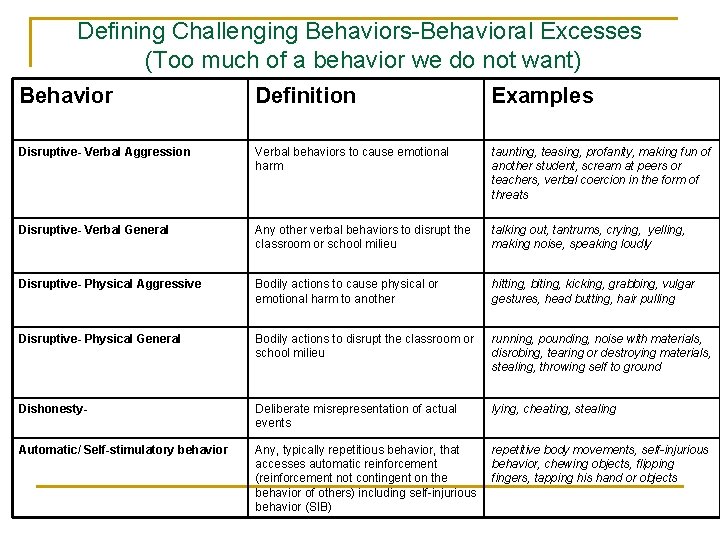
Defining Challenging Behaviors-Behavioral Excesses (Too much of a behavior we do not want) Behavior Definition Examples Disruptive- Verbal Aggression Verbal behaviors to cause emotional harm taunting, teasing, profanity, making fun of another student, scream at peers or teachers, verbal coercion in the form of threats Disruptive- Verbal General Any other verbal behaviors to disrupt the classroom or school milieu talking out, tantrums, crying, yelling, making noise, speaking loudly Disruptive- Physical Aggressive Bodily actions to cause physical or emotional harm to another hitting, biting, kicking, grabbing, vulgar gestures, head butting, hair pulling Disruptive- Physical General Bodily actions to disrupt the classroom or school milieu running, pounding, noise with materials, disrobing, tearing or destroying materials, stealing, throwing self to ground Dishonesty- Deliberate misrepresentation of actual events lying, cheating, stealing Automatic/ Self-stimulatory behavior Any, typically repetitious behavior, that accesses automatic reinforcement (reinforcement not contingent on the behavior of others) including self-injurious behavior (SIB) repetitive body movements, self-injurious behavior, chewing objects, flipping fingers, tapping his hand or objects
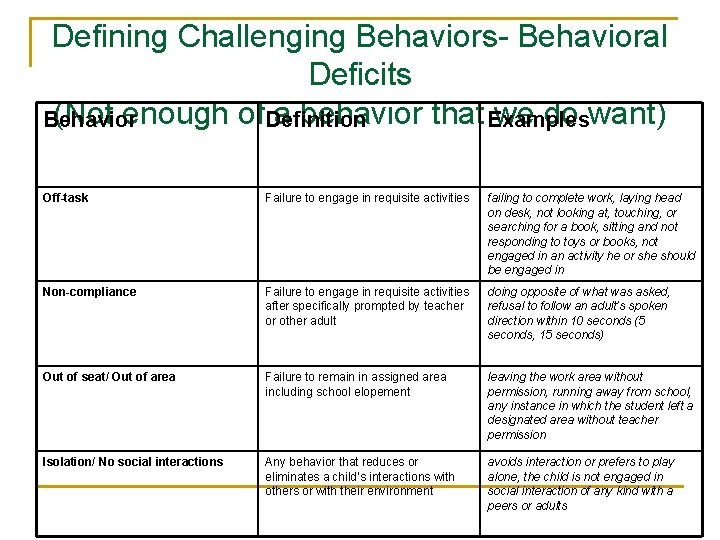
Defining Challenging Behaviors- Behavioral Deficits (Not enough of. Definition a behavior that Examples we do want) Behavior Off-task Failure to engage in requisite activities failing to complete work, laying head on desk, not looking at, touching, or searching for a book, sitting and not responding to toys or books, not engaged in an activity he or she should be engaged in Non-compliance Failure to engage in requisite activities after specifically prompted by teacher or other adult doing opposite of what was asked, refusal to follow an adult’s spoken direction within 10 seconds (5 seconds, 15 seconds) Out of seat/ Out of area Failure to remain in assigned area including school elopement leaving the work area without permission, running away from school, any instance in which the student left a designated area without teacher permission Isolation/ No social interactions Any behavior that reduces or eliminates a child’s interactions with others or with their environment avoids interaction or prefers to play alone, the child is not engaged in social interaction of any kind with a peers or adults
Why do children engage in challenging behavior? n Modeling? Accident? Instinct? Condition? Why do people continue behaving? n Because It Works! n n
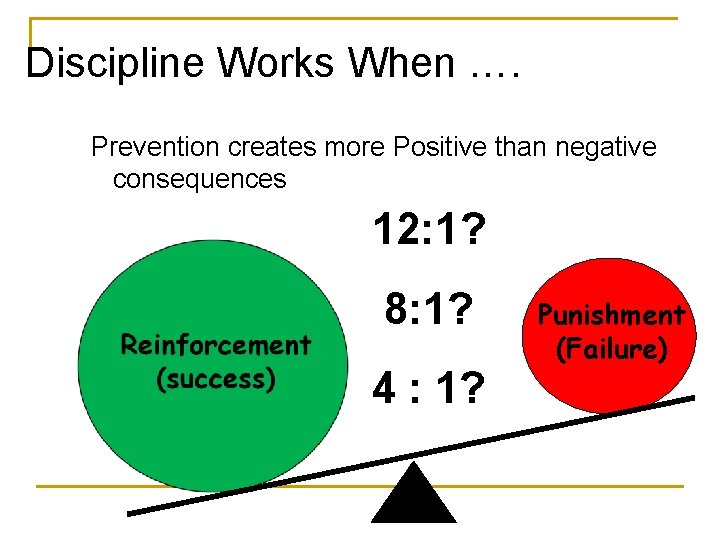
Discipline Works When …. Prevention creates more Positive than negative consequences 12: 1? 8: 1? 4 : 1? Punishment (Failure)
Changing Our View n Take the problem away from the child and ask: • • Why is this behavior occurring? Examine the context in which the behavior is occurring. n What changes can I make to my behavior or the environment to prevent the problem from occurring and teach the child new skills?
When confronted with challenging behavior… Recognize 1) • • Your own unique set of past experiences, values instructional practices, and institutional guidelines. Any challenging behavior that persists over time is “working” for the child. Adjust 2) • Become “comfortable” with challenging behaviors n Realize the behavior is not personal n The student is trying to satisfy a need Focus 3) • On prevention
- Slides: 8