
Strategies for Delivering Behavioural Activation in Diverse Communities
Strategies for Delivering Behavioural Activation in Diverse Communities Jonathan Kanter, Ph. D. University of Wisconsin-Milwaukee
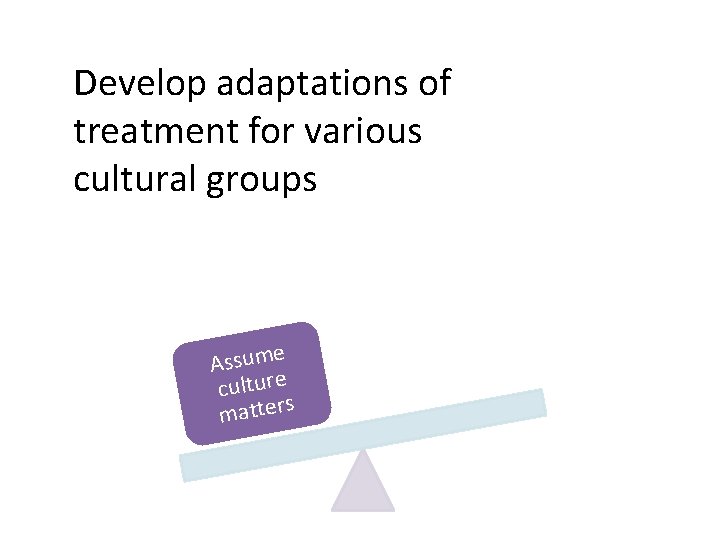
Develop adaptations of treatment for various cultural groups licy o p H NIM Assume culture s matter : ally c i r i Emp nstrate o dem ed for ne ation t adap
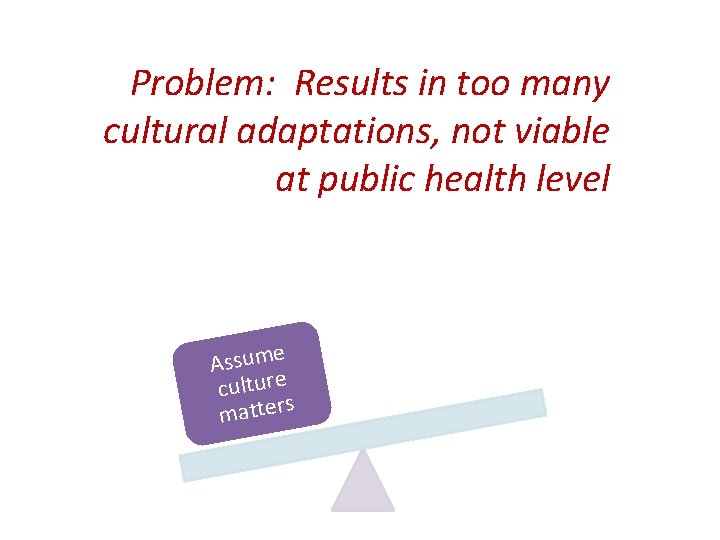
Problem: Results in too many cultural adaptations, not viable at public health level licy o p H NIM Assume culture s matter : ally c i r i Emp nstrate o dem ed for ne ation t adap
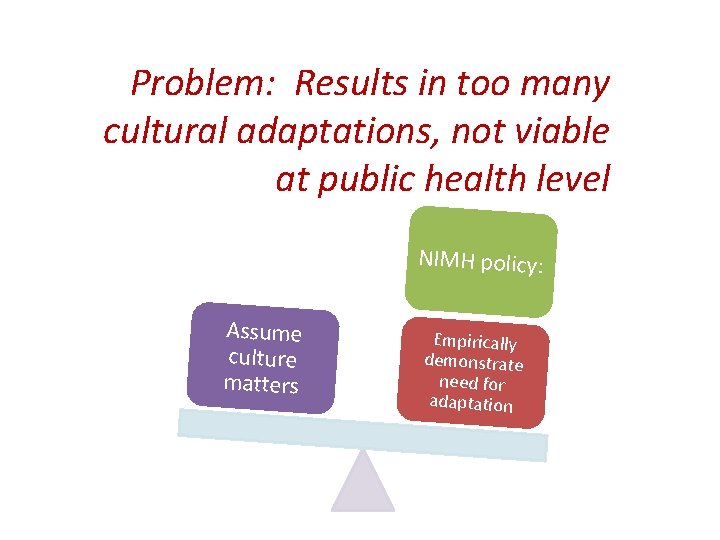
Problem: Results in too many cultural adaptations, not viable at public health level NIMH policy: Assume culture matters Empirically demonstrate need for adaptation

Problem: Not a progressive or fair solution NIMH policy: Assume culture matters Empirically demonstrate need for adaptation
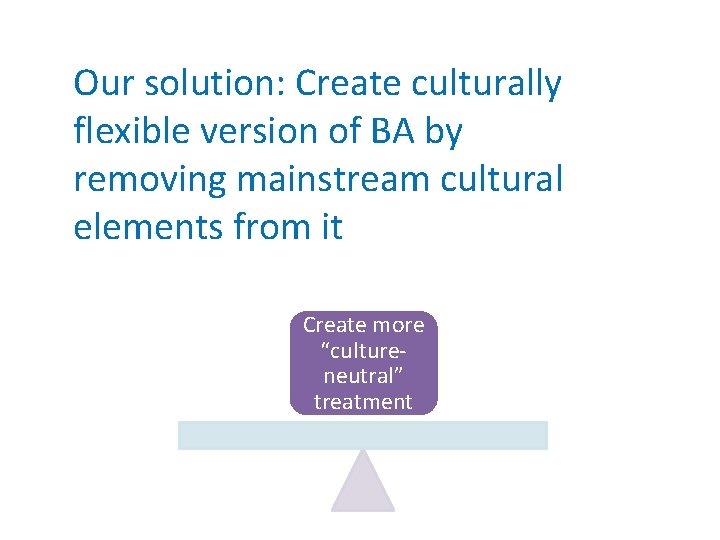
Our solution: Create culturally flexible version of BA by removing mainstream cultural elements from it NIMH policy: Create more Empirically de trate “culture- nmeoendsfo r neutral” adaptation treatment
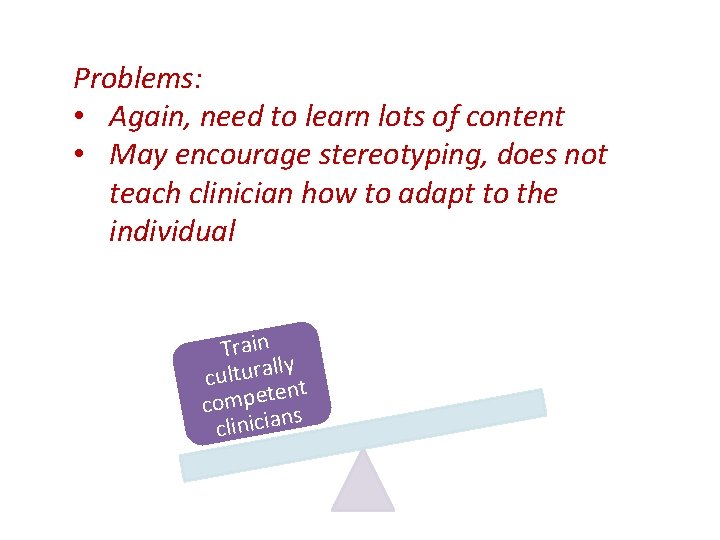
Problems: • Again, need to learn lots of content • May encourage stereotyping, does not teach clinician how to adapt to the individual : olicy H NIM Train y l l a r u t l cu t n e t e p com s n a i c i n i l c p ally c i r i Emp nstrate o dem ed for ne ation t adap
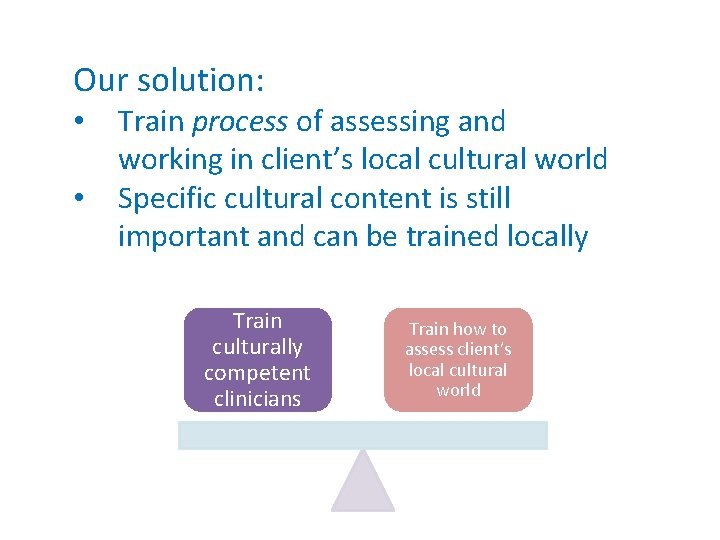
Our solution: • • Train process of assessing and working in client’s local cultural world Specific cultural content is still important and can be trained locally licy: o p H M I N Train culturally competent clinicians Train how to assess client’s local cultural world
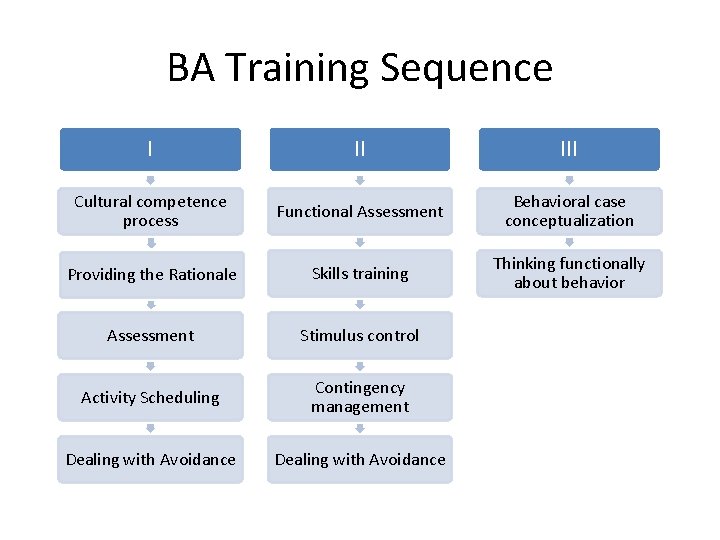
BA Training Sequence I II III Cultural competence process Functional Assessment Behavioral case conceptualization Providing the Rationale Skills training Thinking functionally about behavior Assessment Stimulus control Activity Scheduling Contingency management Dealing with Avoidance
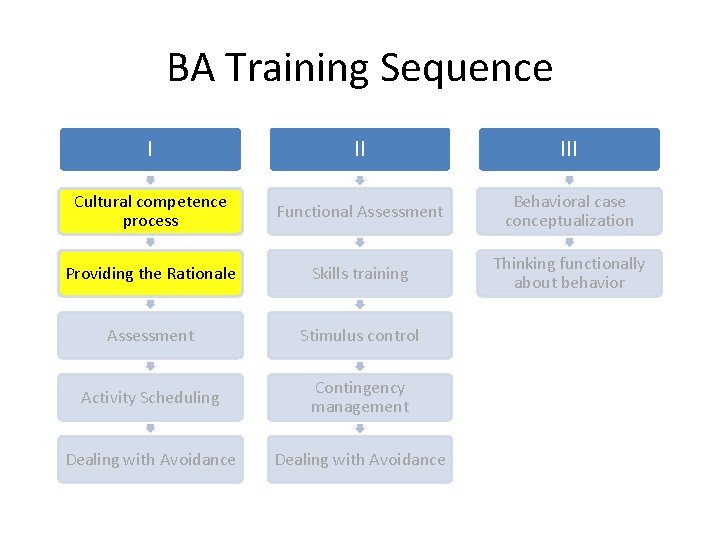
BA Training Sequence I II III Cultural competence process Functional Assessment Behavioral case conceptualization Providing the Rationale Skills training Thinking functionally about behavior Assessment Stimulus control Activity Scheduling Contingency management Dealing with Avoidance
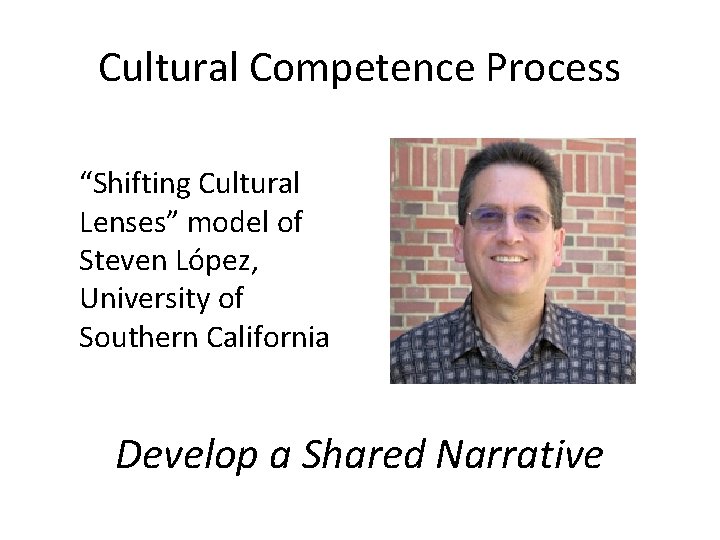
Cultural Competence Process “Shifting Cultural Lenses” model of Steven López, University of Southern California Develop a Shared Narrative
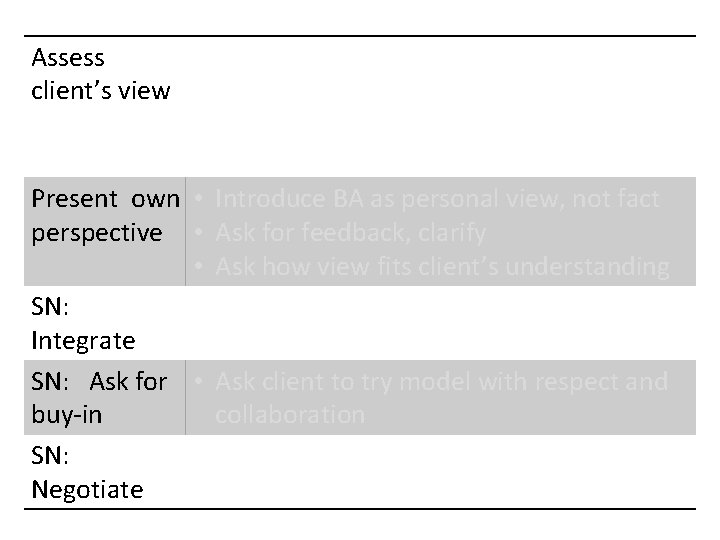
Assess • Ask client what hopes to gain from tx client’s view • Ask what client views as problem • Assess how client fits cultural patterns • Show understanding without challenging Present own • Introduce BA as personal view, not fact perspective • Ask for feedback, clarify • Ask how view fits client’s understanding SN: • Fit client’s narrative into BA model using Integrate his/her language (see next) SN: Ask for • Ask client to try model with respect and buy-in collaboration SN: • Demonstrate willingness to drop BA Negotiate model
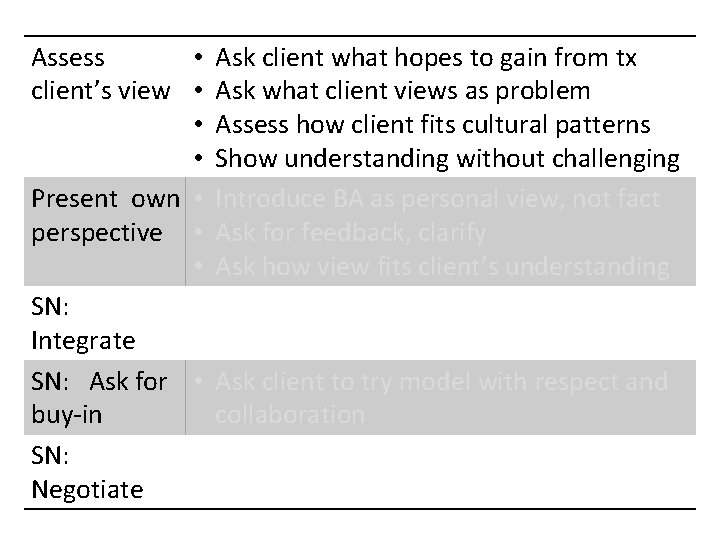
Assess • Ask client what hopes to gain from tx client’s view • Ask what client views as problem • Assess how client fits cultural patterns • Show understanding without challenging Present own • Introduce BA as personal view, not fact perspective • Ask for feedback, clarify • Ask how view fits client’s understanding SN: • Fit client’s narrative into BA model using Integrate his/her language (see next) SN: Ask for • Ask client to try model with respect and buy-in collaboration SN: • Demonstrate willingness to drop BA Negotiate model
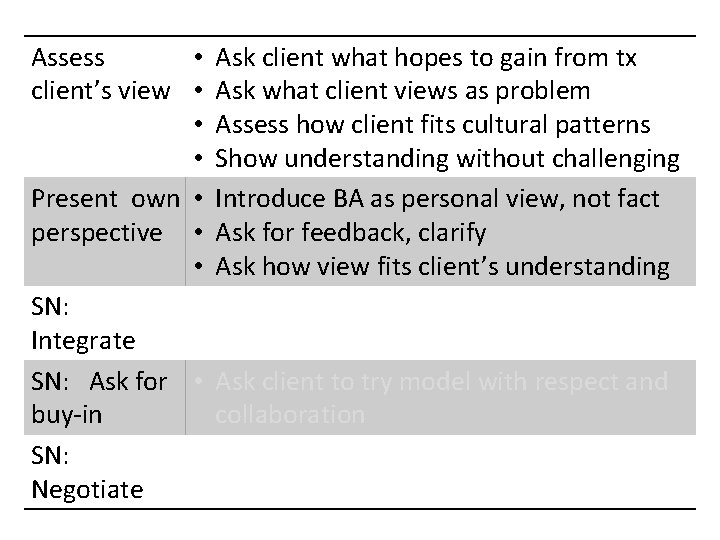
Assess • Ask client what hopes to gain from tx client’s view • Ask what client views as problem • Assess how client fits cultural patterns • Show understanding without challenging Present own • Introduce BA as personal view, not fact perspective • Ask for feedback, clarify • Ask how view fits client’s understanding SN: • Fit client’s narrative into BA model using Integrate his/her language (see next) SN: Ask for • Ask client to try model with respect and buy-in collaboration SN: • Demonstrate willingness to drop BA Negotiate model
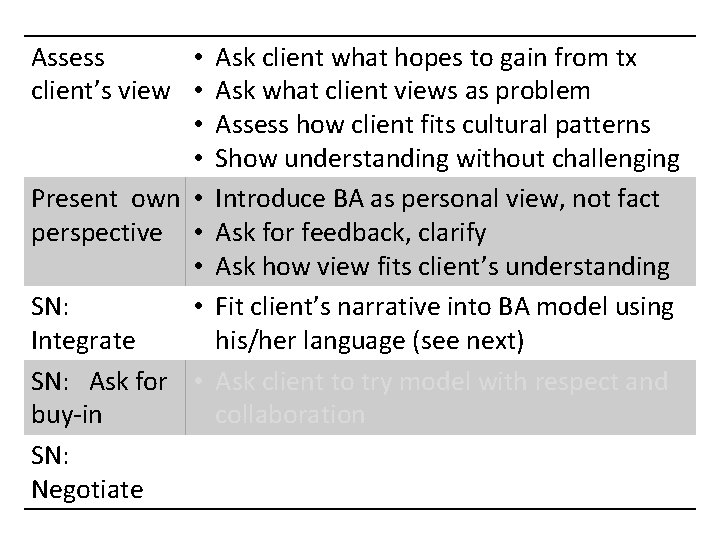
Assess • Ask client what hopes to gain from tx client’s view • Ask what client views as problem • Assess how client fits cultural patterns • Show understanding without challenging Present own • Introduce BA as personal view, not fact perspective • Ask for feedback, clarify • Ask how view fits client’s understanding SN: • Fit client’s narrative into BA model using Integrate his/her language (see next) SN: Ask for • Ask client to try model with respect and buy-in collaboration SN: • Demonstrate willingness to drop BA Negotiate model
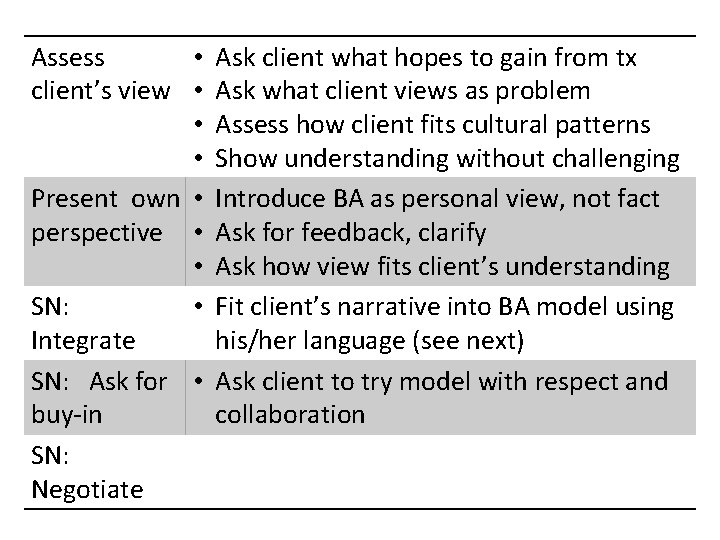
Assess • Ask client what hopes to gain from tx client’s view • Ask what client views as problem • Assess how client fits cultural patterns • Show understanding without challenging Present own • Introduce BA as personal view, not fact perspective • Ask for feedback, clarify • Ask how view fits client’s understanding SN: • Fit client’s narrative into BA model using Integrate his/her language (see next) SN: Ask for • Ask client to try model with respect and buy-in collaboration SN: • Demonstrate willingness to drop BA Negotiate model
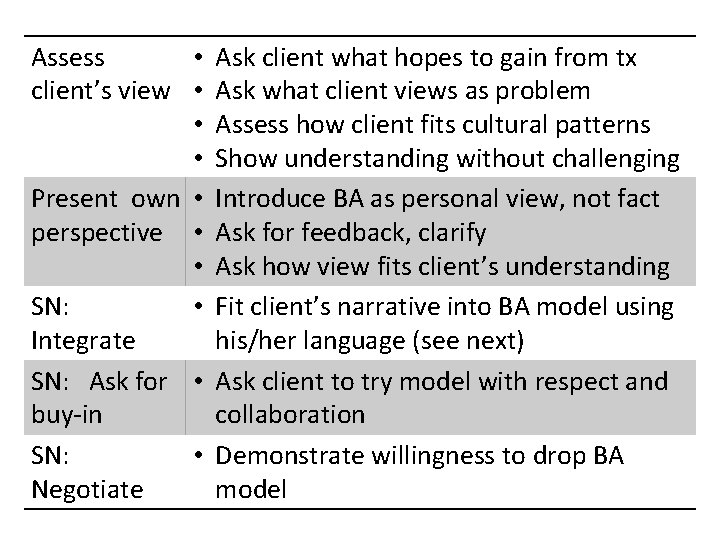
Assess • Ask client what hopes to gain from tx client’s view • Ask what client views as problem • Assess how client fits cultural patterns • Show understanding without challenging Present own • Introduce BA as personal view, not fact perspective • Ask for feedback, clarify • Ask how view fits client’s understanding SN: • Fit client’s narrative into BA model using Integrate his/her language (see next) SN: Ask for • Ask client to try model with respect and buy-in collaboration SN: • Demonstrate willingness to drop BA Negotiate model
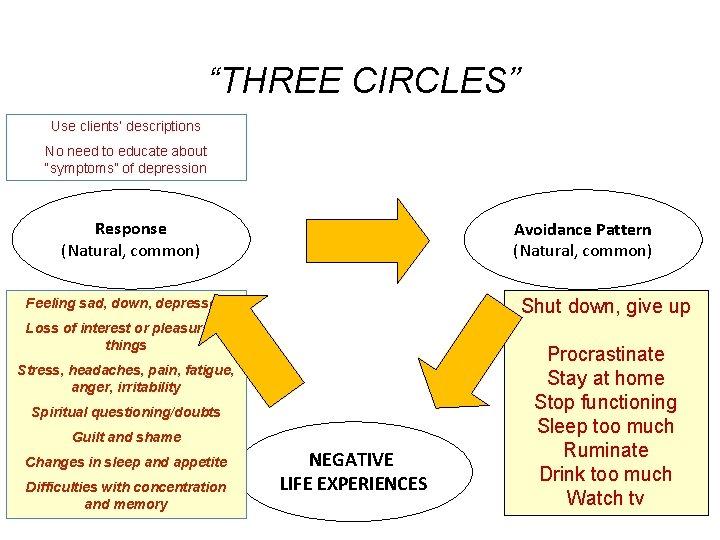
“THREE CIRCLES” Use clients’ descriptions No need to educate about “symptoms” of depression Response (Natural, common) Avoidance Pattern (Natural, common) Feeling sad, down, depressed Shut down, give up Loss of interest or pleasure in things Stress, headaches, pain, fatigue, anger, irritability Spiritual questioning/doubts Guilt and shame Changes in sleep and appetite Difficulties with concentration 18 and memory NEGATIVE LIFE EXPERIENCES Procrastinate Stay at home Stop functioning Sleep too much Ruminate Drink too much Watch tv
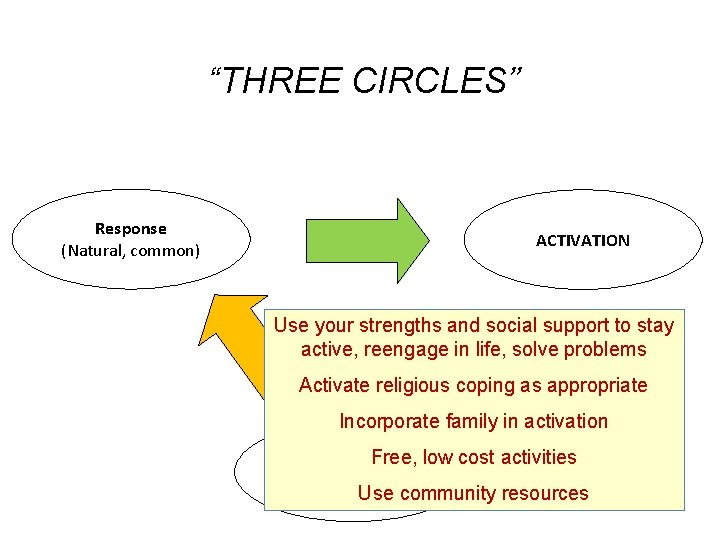
“THREE CIRCLES” Response (Natural, common) ACTIVATION Use your strengths and social support to stay active, reengage in life, solve problems Activate religious coping as appropriate Incorporate family in activation 19 Free, low cost activities NEGATIVE LIFE EXPERIENCES Use community resources
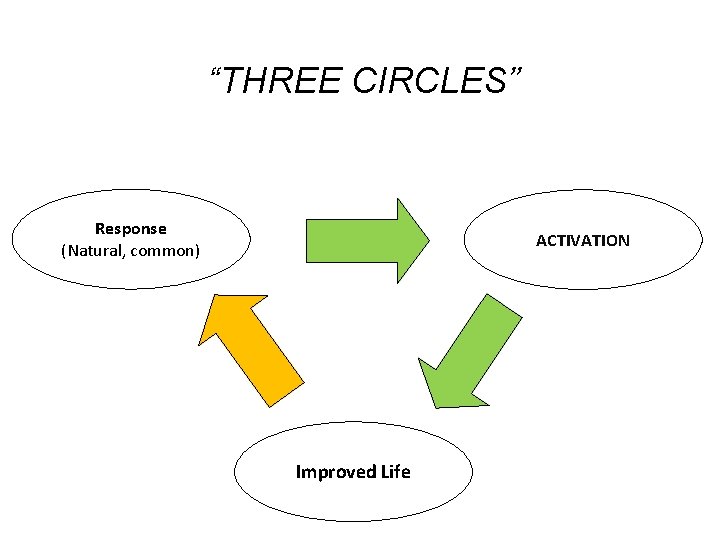
“THREE CIRCLES” Response (Natural, common) ACTIVATION Improved Life 20
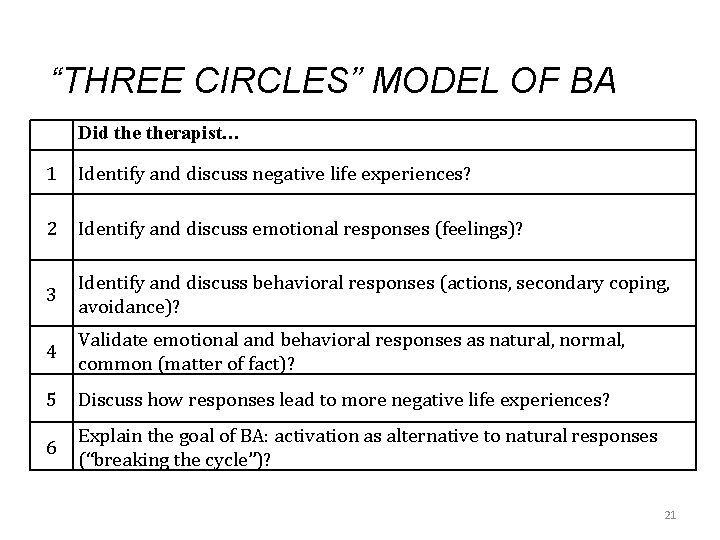
“THREE CIRCLES” MODEL OF BA Did therapist… 1 Identify and discuss negative life experiences? 2 Identify and discuss emotional responses (feelings)? 3 Identify and discuss behavioral responses (actions, secondary coping, avoidance)? 4 Validate emotional and behavioral responses as natural, normal, common (matter of fact)? 5 Discuss how responses lead to more negative life experiences? 6 Explain the goal of BA: activation as alternative to natural responses (“breaking the cycle”)? 21
Challenges when Presenting the Rationale Validate that activation is harder than Just DO people think Discuss that therapist will coach, guide IT! with strategies to help activation Validate that inside-out is common and makes sense Inside Out Offer rationale for outside-in approach in BA Broken Brain Validate many causes of depression Explain how activation can change the brain 22
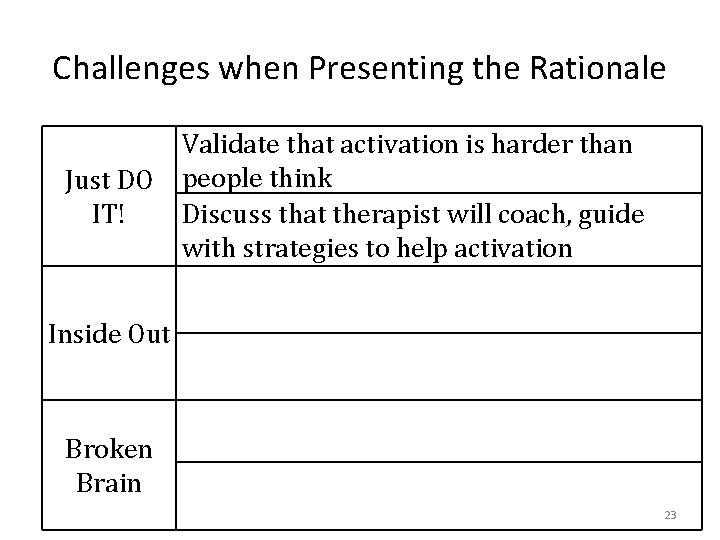
Challenges when Presenting the Rationale Validate that activation is harder than Just DO people think Discuss that therapist will coach, guide IT! with strategies to help activation Validate that inside-out is common and makes sense Inside Out Offer rationale for outside-in approach in BA Broken Brain Validate many causes of depression Explain how activation can change the brain 23
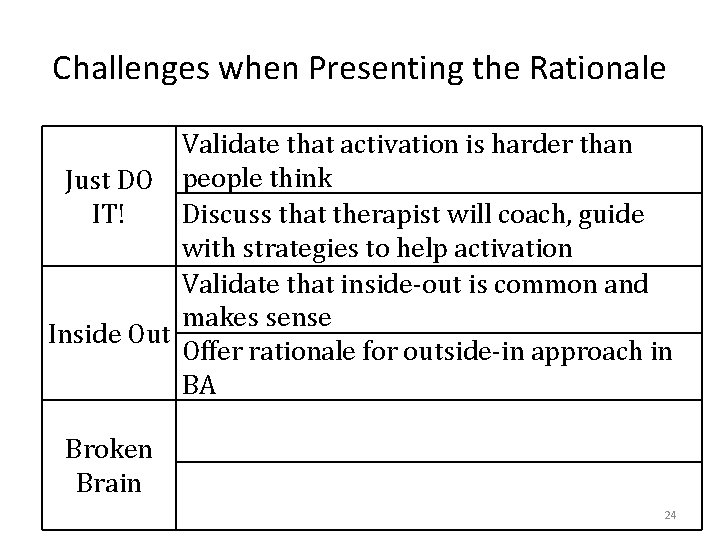
Challenges when Presenting the Rationale Validate that activation is harder than Just DO people think Discuss that therapist will coach, guide IT! with strategies to help activation Validate that inside-out is common and makes sense Inside Out Offer rationale for outside-in approach in BA Broken Brain Validate many causes of depression Explain how activation can change the brain 24
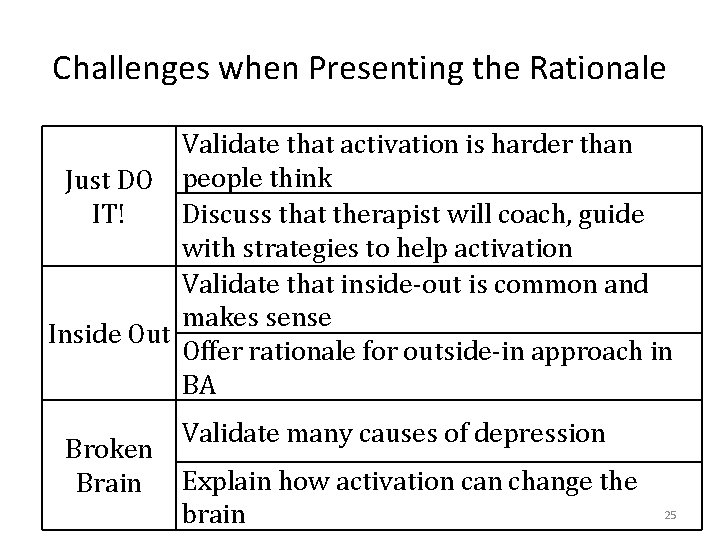
Challenges when Presenting the Rationale Validate that activation is harder than Just DO people think Discuss that therapist will coach, guide IT! with strategies to help activation Validate that inside-out is common and makes sense Inside Out Offer rationale for outside-in approach in BA Broken Brain Validate many causes of depression Explain how activation can change the brain 25

Questions Practice
- Slides: 26