
Strategies for Children with an ASD to Have



- Slides: 44
Strategies for Children with an ASD to Have Successful Transitions Presented by: Tania Wycherley and Susan Lowes-Taves ASD Consultants April 19, 2012
TODAY’S AGENDA • History of SSP to Connections • Connections Process • Review of ASD and challenges with transitions • Strategies for successful transitions
School Support Program. Autism Spectrum Disorders (SSP-ASD) Ministry of Children and Youth Services SSP-ASD Ministry of Education School Support Program. Autism Spectrum Disorders 2007 3
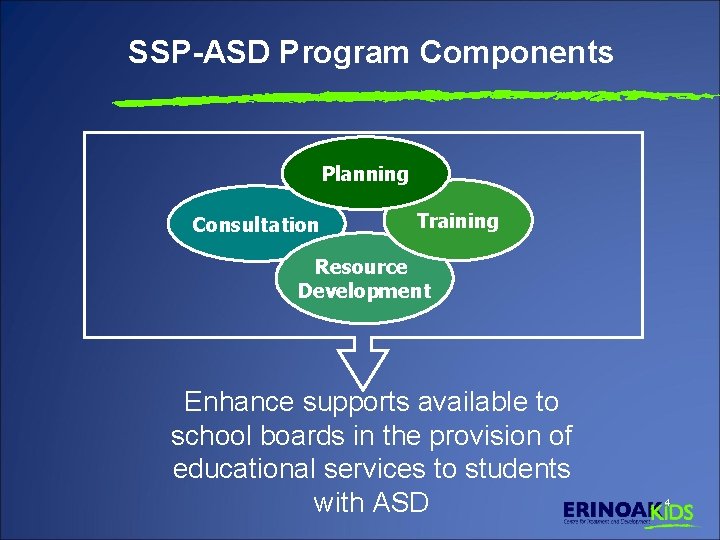
SSP-ASD Program Components Planning Consultation Training Resource Development Enhance supports available to school boards in the provision of educational services to students with ASD 4
Connections for Students Ministry of Children and Youth Services Connections SSP-ASD For Students Ministry of Education 5
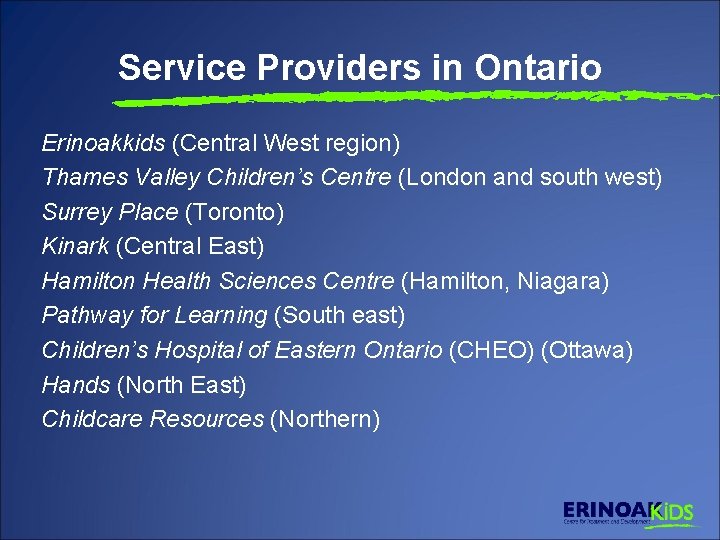
Service Providers in Ontario Erinoakkids (Central West region) Thames Valley Children’s Centre (London and south west) Surrey Place (Toronto) Kinark (Central East) Hamilton Health Sciences Centre (Hamilton, Niagara) Pathway for Learning (South east) Children’s Hospital of Eastern Ontario (CHEO) (Ottawa) Hands (North East) Childcare Resources (Northern)
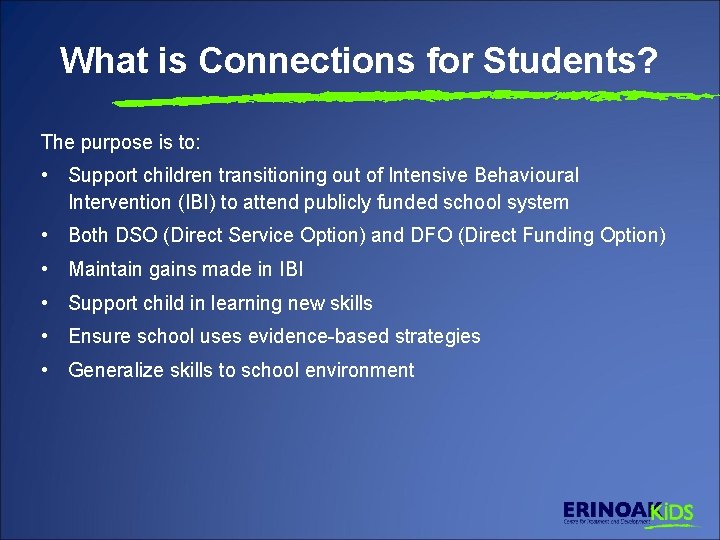
What is Connections for Students? The purpose is to: • Support children transitioning out of Intensive Behavioural Intervention (IBI) to attend publicly funded school system • Both DSO (Direct Service Option) and DFO (Direct Funding Option) • Maintain gains made in IBI • Support child in learning new skills • Ensure school uses evidence-based strategies • Generalize skills to school environment
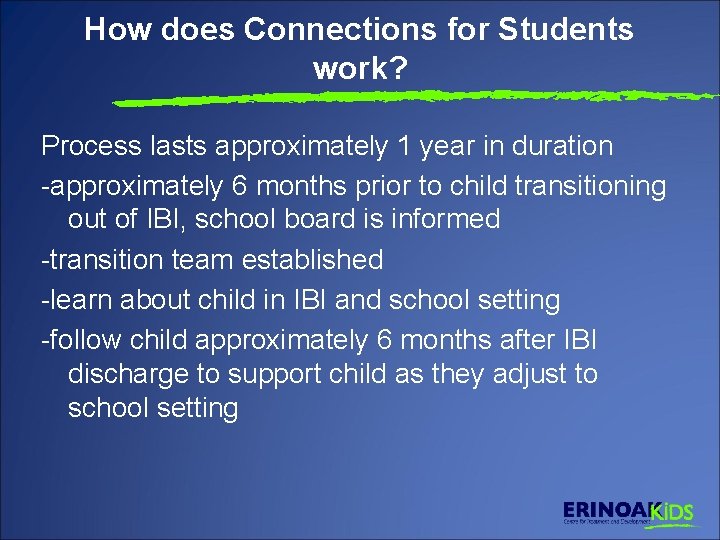
How does Connections for Students work? Process lasts approximately 1 year in duration -approximately 6 months prior to child transitioning out of IBI, school board is informed -transition team established -learn about child in IBI and school setting -follow child approximately 6 months after IBI discharge to support child as they adjust to school setting
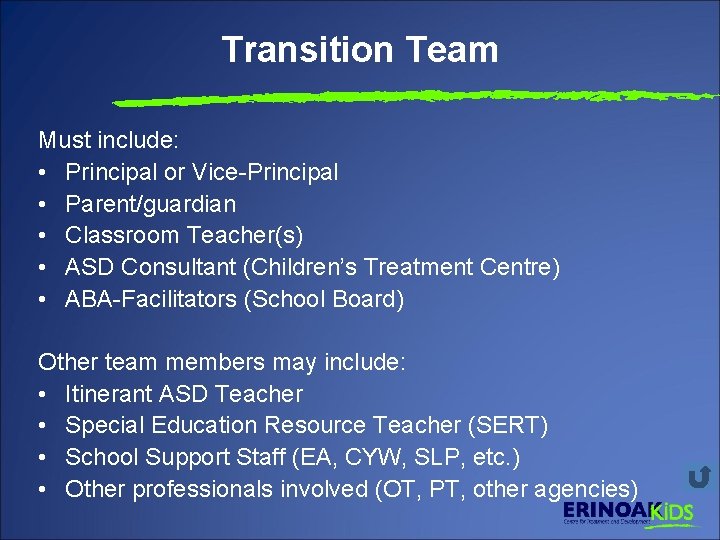
Transition Team Must include: • Principal or Vice-Principal • Parent/guardian • Classroom Teacher(s) • ASD Consultant (Children’s Treatment Centre) • ABA-Facilitators (School Board) Other team members may include: • Itinerant ASD Teacher • Special Education Resource Teacher (SERT) • School Support Staff (EA, CYW, SLP, etc. ) • Other professionals involved (OT, PT, other agencies)
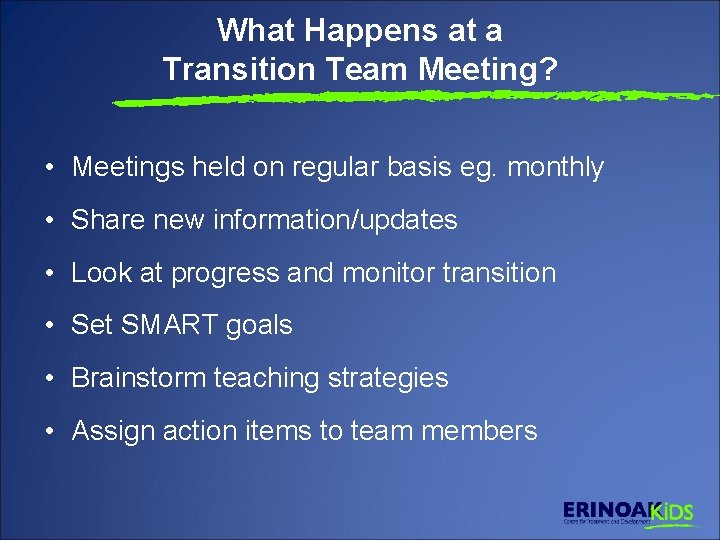
What Happens at a Transition Team Meeting? • Meetings held on regular basis eg. monthly • Share new information/updates • Look at progress and monitor transition • Set SMART goals • Brainstorm teaching strategies • Assign action items to team members
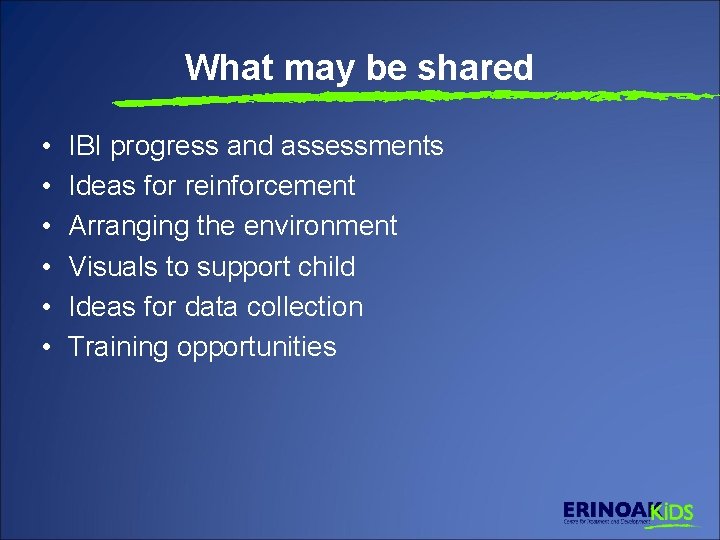
What may be shared • • • IBI progress and assessments Ideas for reinforcement Arranging the environment Visuals to support child Ideas for data collection Training opportunities
Helpful websites • http: //cal 2. edu. gov. on. ca/feb 2009/Autism. Interve ntion. pdf • http: //www. children. gov. on. ca/htdocs/English/top ics/specialneeds/index. aspx
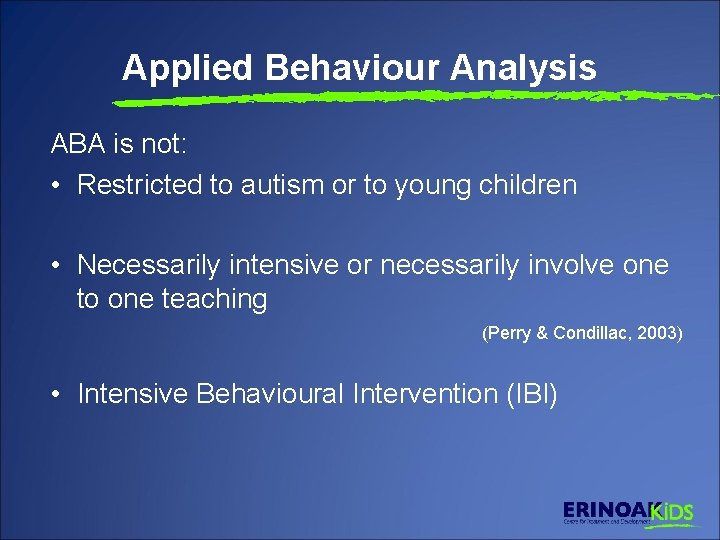
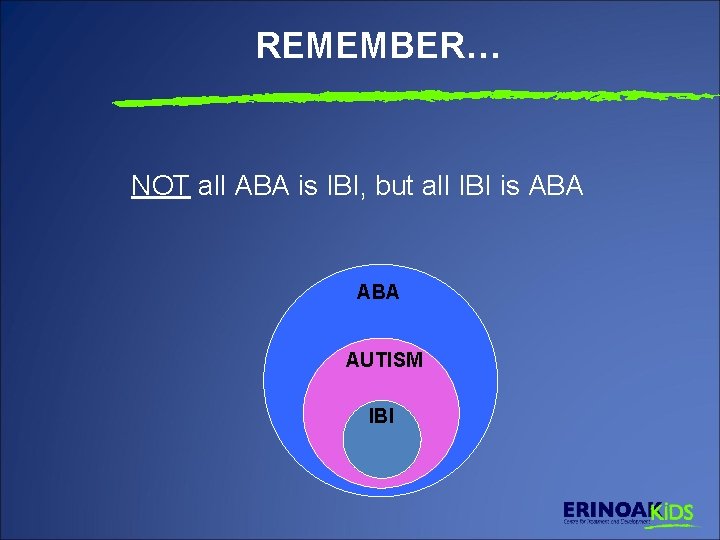
Applied Behaviour Analysis ABA is not: • Restricted to autism or to young children • Necessarily intensive or necessarily involve one to one teaching (Perry & Condillac, 2003) • Intensive Behavioural Intervention (IBI)
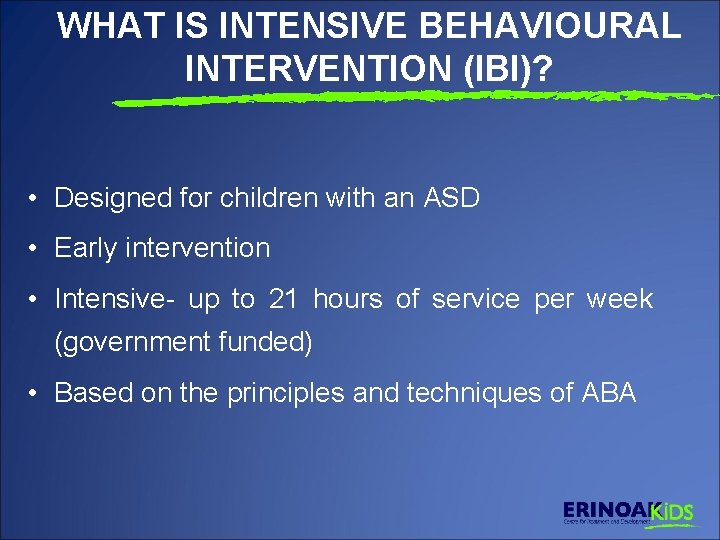
WHAT IS INTENSIVE BEHAVIOURAL INTERVENTION (IBI)? • Designed for children with an ASD • Early intervention • Intensive- up to 21 hours of service per week (government funded) • Based on the principles and techniques of ABA
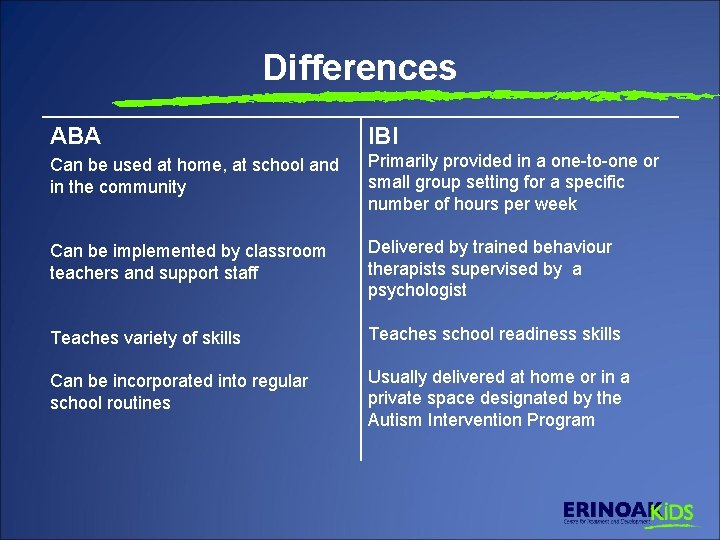
Differences ABA IBI Can be used at home, at school and in the community Primarily provided in a one-to-one or small group setting for a specific number of hours per week Can be implemented by classroom teachers and support staff Delivered by trained behaviour therapists supervised by a psychologist Teaches variety of skills Teaches school readiness skills Can be incorporated into regular school routines Usually delivered at home or in a private space designated by the Autism Intervention Program
REMEMBER… NOT all ABA is IBI, but all IBI is ABA AUTISM IBI
Video • Connections for Students video created by Upper Grand District School Board
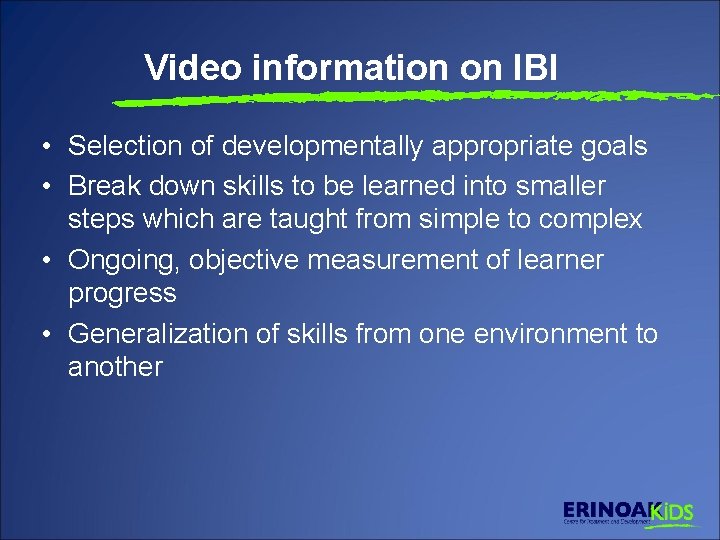
Video information on IBI • Selection of developmentally appropriate goals • Break down skills to be learned into smaller steps which are taught from simple to complex • Ongoing, objective measurement of learner progress • Generalization of skills from one environment to another
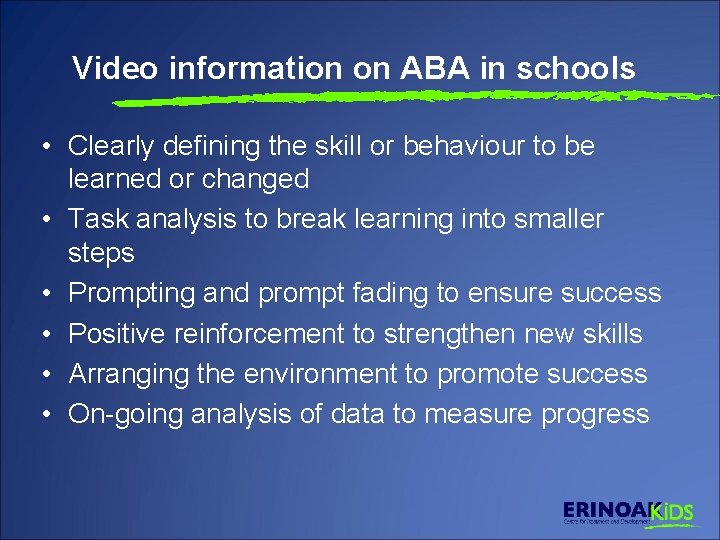
Video information on ABA in schools • Clearly defining the skill or behaviour to be learned or changed • Task analysis to break learning into smaller steps • Prompting and prompt fading to ensure success • Positive reinforcement to strengthen new skills • Arranging the environment to promote success • On-going analysis of data to measure progress
What if my client is not eligible for IBI (Intensive Behavioural Intervention)? There is a new ABA services in Ontario!!
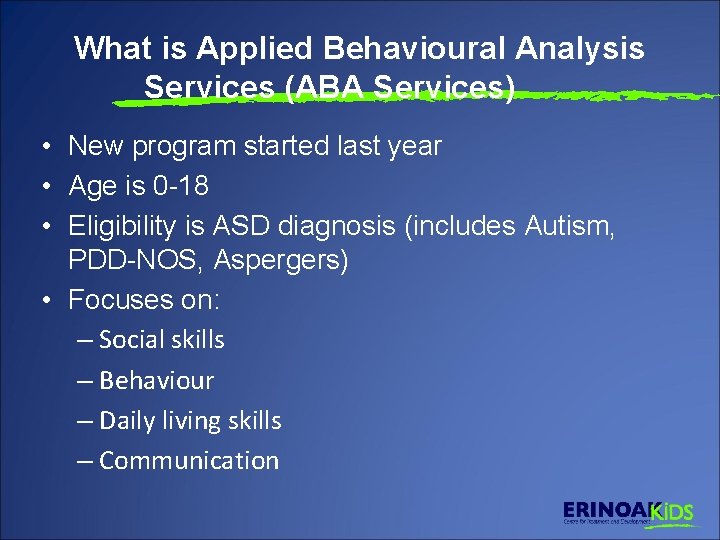
What is Applied Behavioural Analysis Services (ABA Services) • New program started last year • Age is 0 -18 • Eligibility is ASD diagnosis (includes Autism, PDD-NOS, Aspergers) • Focuses on: – Social skills – Behaviour – Daily living skills – Communication
Focus on transitions in Individuals with an ASD
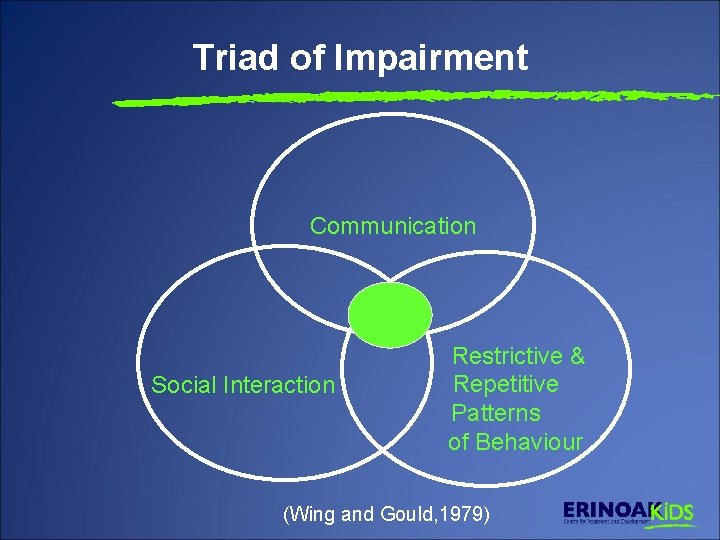
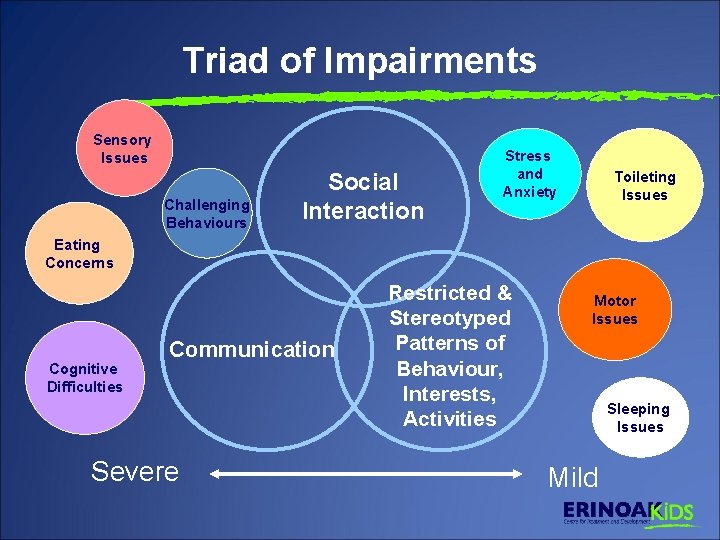
Triad of Impairment Communication Social Interaction Restrictive & Repetitive Patterns of Behaviour (Wing and Gould, 1979)
Triad of Impairments Sensory Issues Challenging Behaviours Social Interaction Stress and Anxiety Toileting Issues Eating Concerns Cognitive Difficulties Communication Severe Restricted & Stereotyped Patterns of Behaviour, Interests, Activities Motor Issues Sleeping Issues Mild
What is a transition? “Any change or shift in the student’s routines and/or expectations” (Alberta Ministry of Education, 2003)
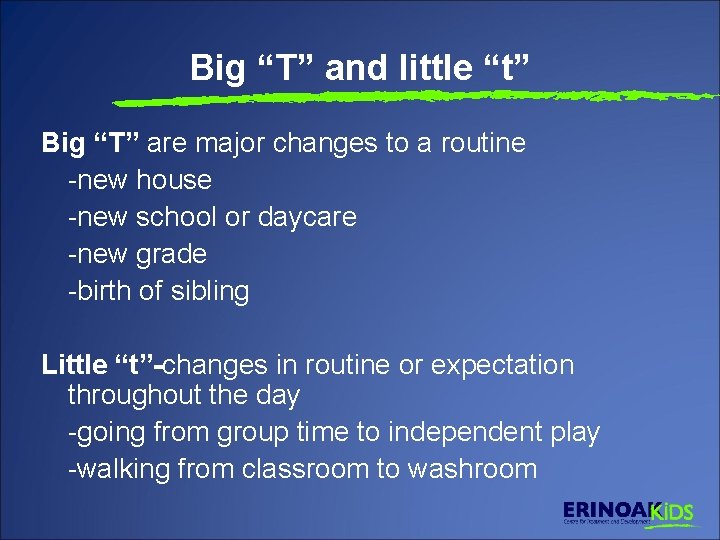
Big “T” and little “t” Big “T” are major changes to a routine -new house -new school or daycare -new grade -birth of sibling Little “t”-changes in routine or expectation throughout the day -going from group time to independent play -walking from classroom to washroom
Small group activity Identify transitions that may be challenging for students with ASD?
Transitions That May Be Challenging for Students with ASD • • •
Transitions That May Be Challenging for Students with ASD • • •
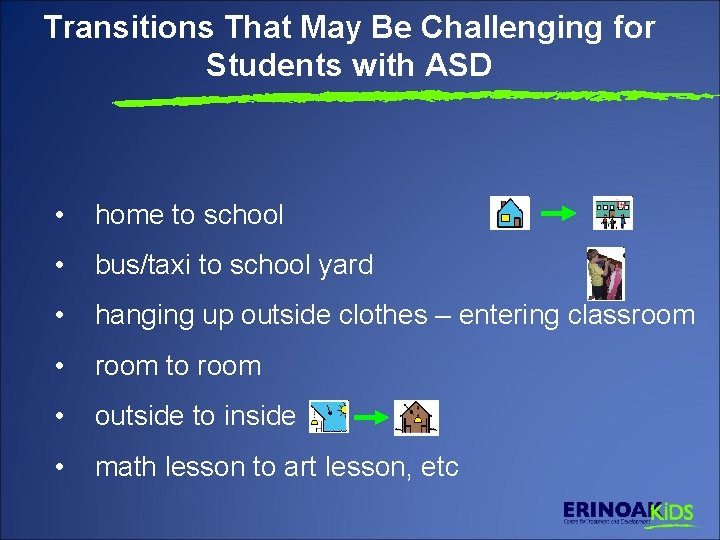
Transitions That May Be Challenging for Students with ASD • home to school • bus/taxi to school yard • hanging up outside clothes – entering classroom • room to room • outside to inside • math lesson to art lesson, etc
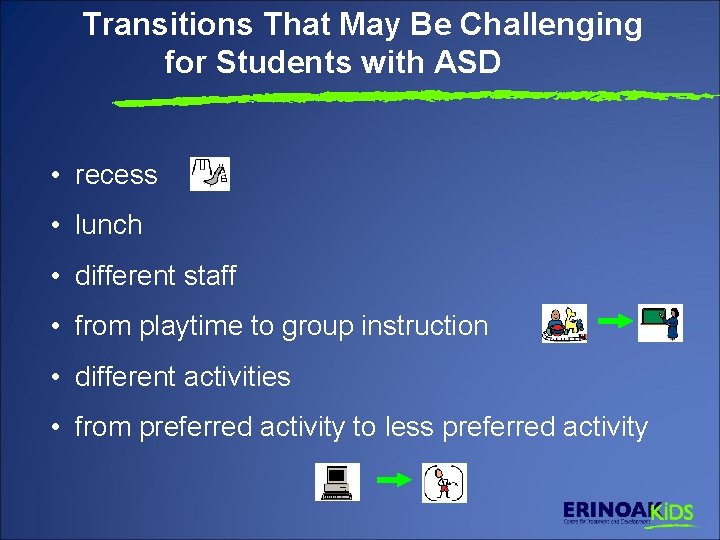
Transitions That May Be Challenging for Students with ASD • recess • lunch • different staff • from playtime to group instruction • different activities • from preferred activity to less preferred activity
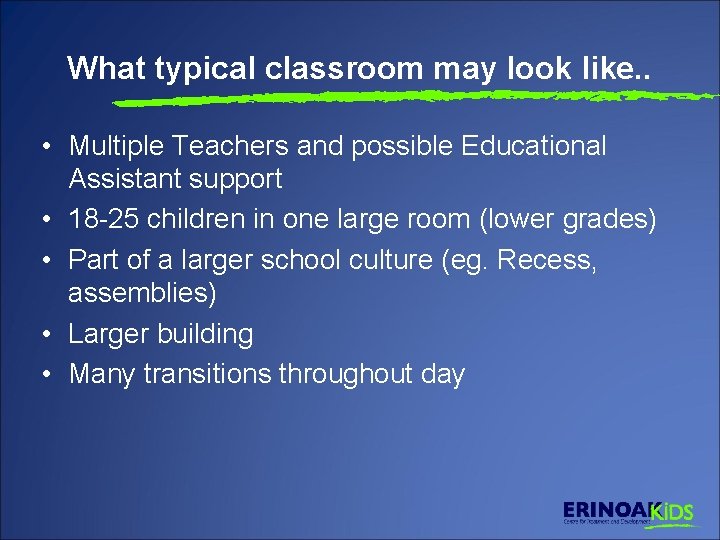
What typical classroom may look like. . • Multiple Teachers and possible Educational Assistant support • 18 -25 children in one large room (lower grades) • Part of a larger school culture (eg. Recess, assemblies) • Larger building • Many transitions throughout day
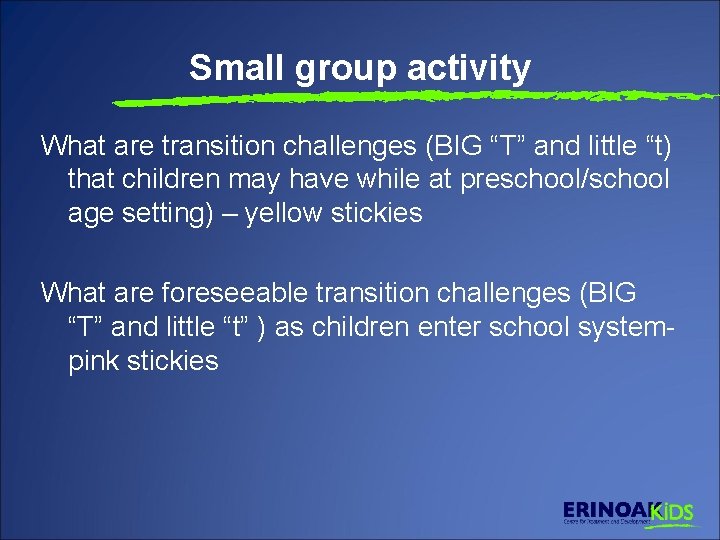
Small group activity What are transition challenges (BIG “T” and little “t) that children may have while at preschool/school age setting) – yellow stickies What are foreseeable transition challenges (BIG “T” and little “t” ) as children enter school systempink stickies
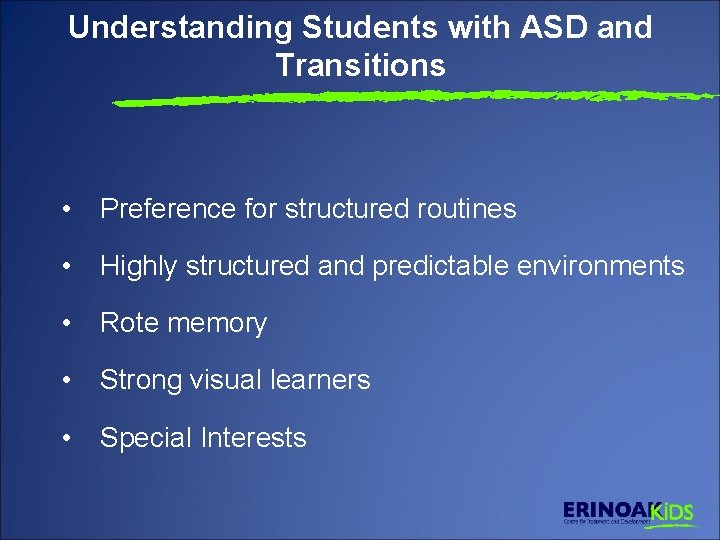
Understanding Students with ASD and Transitions • Preference for structured routines • Highly structured and predictable environments • Rote memory • Strong visual learners • Special Interests
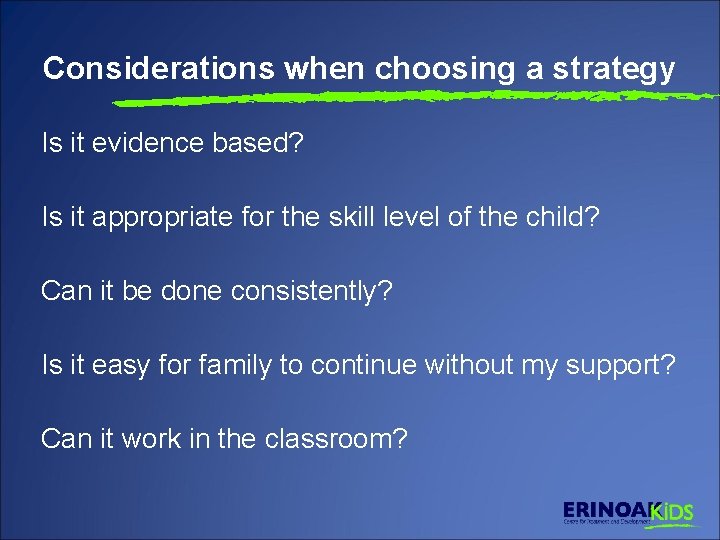
Considerations when choosing a strategy Is it evidence based? Is it appropriate for the skill level of the child? Can it be done consistently? Is it easy for family to continue without my support? Can it work in the classroom?
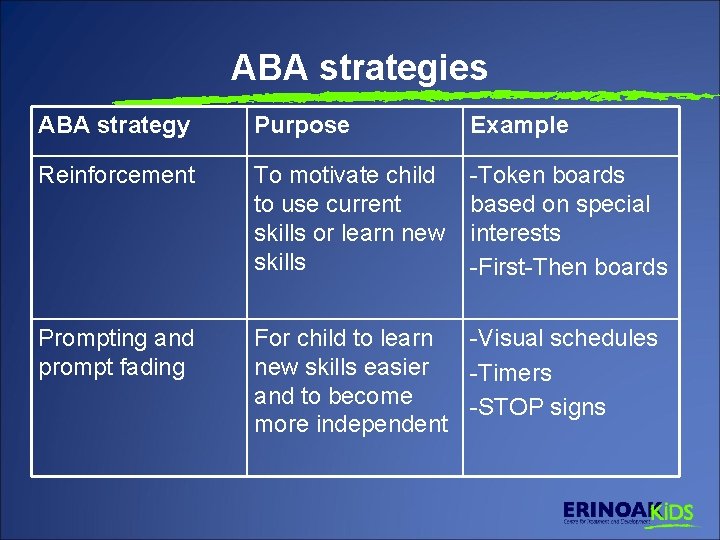
ABA strategies ABA strategy Purpose Example Reinforcement To motivate child to use current skills or learn new skills -Token boards based on special interests -First-Then boards Prompting and prompt fading For child to learn -Visual schedules new skills easier -Timers and to become -STOP signs more independent
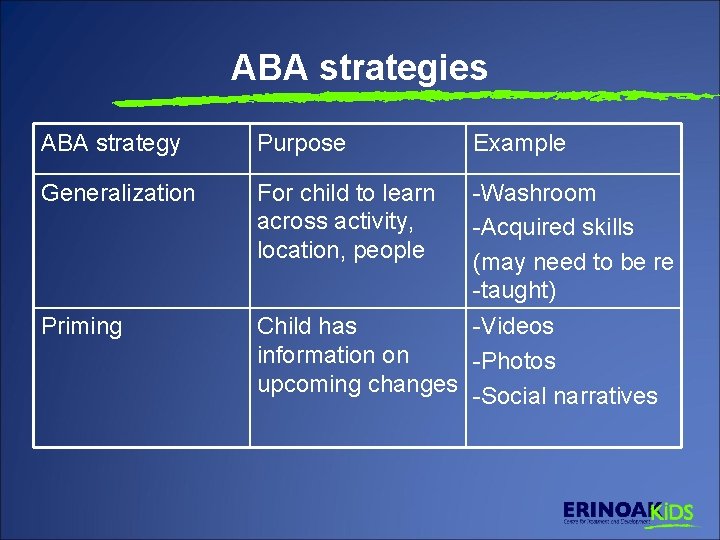
ABA strategies ABA strategy Purpose Example Generalization For child to learn across activity, location, people -Washroom -Acquired skills (may need to be re -taught) Priming Child has -Videos information on -Photos upcoming changes -Social narratives
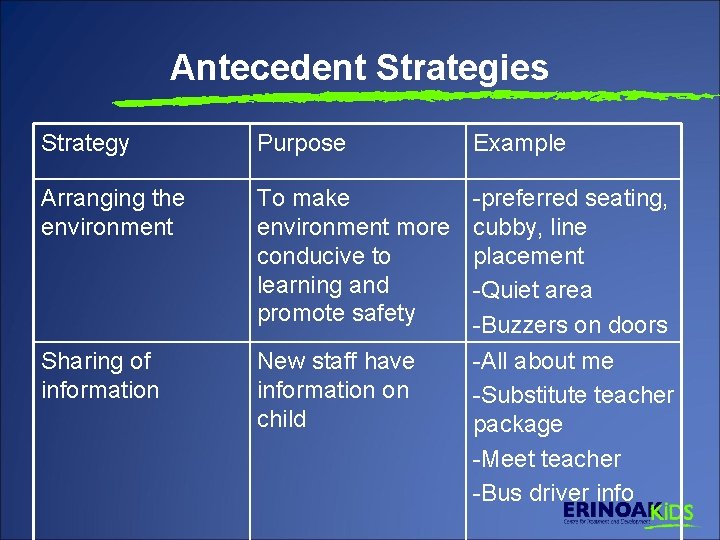
Antecedent Strategies Strategy Purpose Example Arranging the environment To make environment more conducive to learning and promote safety -preferred seating, cubby, line placement -Quiet area -Buzzers on doors Sharing of information New staff have information on child -All about me -Substitute teacher package -Meet teacher -Bus driver info
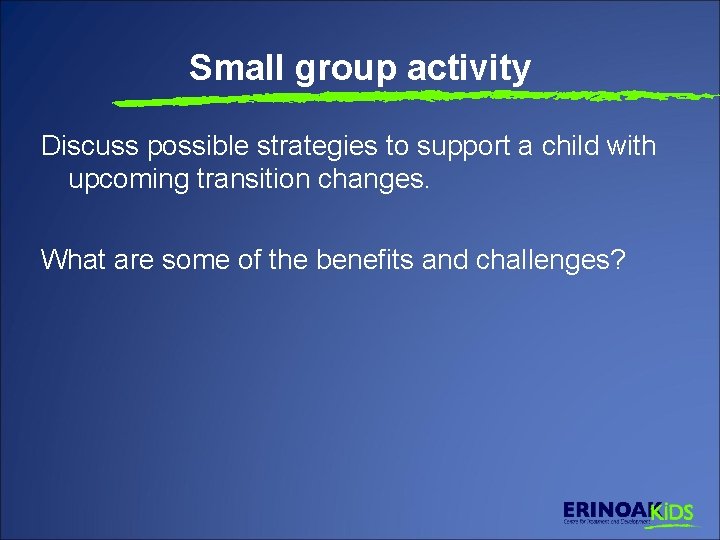
Small group activity Discuss possible strategies to support a child with upcoming transition changes. What are some of the benefits and challenges?
Considerations when choosing a strategy Is it evidence based? Is it appropriate for the skill level of the child? Can it be done consistently? Is it easy for family to continue without my support? Can it work in the classroom?
Helpful apps and websites • Geneva Centre-already created visuals http: //elearning. autism. net/visuals/main. php • Autism Ontario http: //www. autismontario. com/
Review of CD
Discussion/ Questions?
Thank you!