
Strategies for Bringing New Dimensions to Intercultural Learning
Strategies for Bringing New Dimensions to Intercultural Learning into the Classroom and Beyond Celebrate Learning Week 2021 Panel Discussion
BEFORE WE BEGIN: ● Land Acknowledgement: We would like to begin by acknowledging that the land on which we gather is the traditional, ancestral, and unceded territory of the xʷməθkʷəy əm (Musqueam) People. ● We will be recording this webinar for teaching and learning purposes. If you would prefer not to be recorded, please keep your video and microphone off. ● We will have an open question period at the end of the presentation. Before then, please post your questions in the chat so the moderator can keep track of the questions and make sure they get answered. 2
MODERATOR: Brianne Orr-Álvarez, Assistant Professor of Teaching, FHIS Learning Center Director, Spanish Language Program Director | Department of French, Hispanic and Italian Studies PANELISTS: Strang Burton, Associate Professor of Teaching, Language Diversity, Linguistic Pedagogy Department of Linguistics Luisa Canuto, Assistant Professor of Teaching, Italian Language Program Director Department of French, Hispanic and Italian Studies Misuzu Kazama, Lecturer, Japanese Language | Department of Asian Studies Saori Hoshi, Assistant Professor of Teaching, Japanese Language | Department of Asian Studies Joenita Paulrajan, Program Leader, Intercultural, Equity, Diversity, and Inclusion Programs UBC Extended Learning 3
Strategies for Bringing New Dimensions to Intercultural Learning into the Classroom and Beyond Strang Burton, LING
LING 101 “Languages of the World”– How I used to teach it: • • • Sound systems (vowels and consonants) Affixation (prefixes and suffixes) Word order Features of various dialects Features of various languages Language families and patterns of historical change
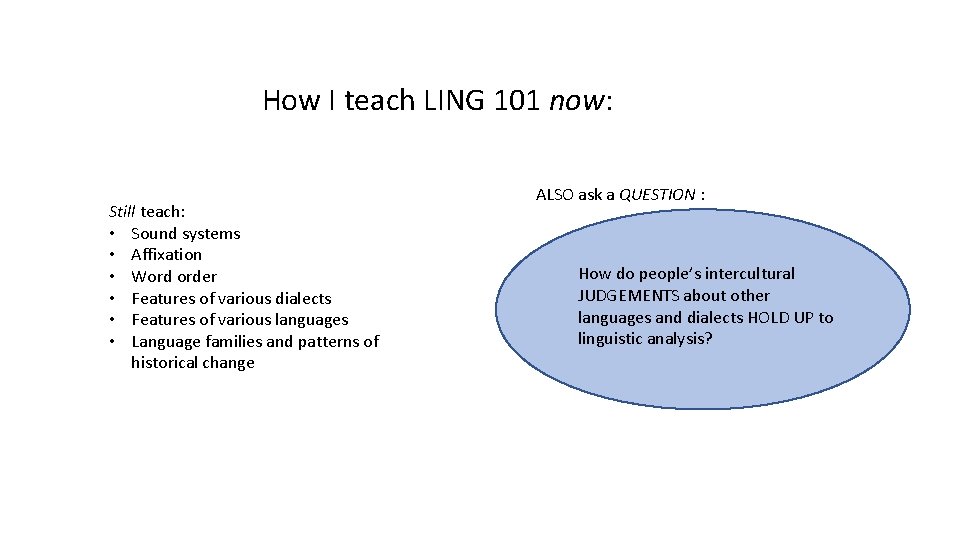
How I teach LING 101 now: Still teach: • Sound systems • Affixation • Word order • Features of various dialects • Features of various languages • Language families and patterns of historical change ALSO ask a QUESTION : How do people’s intercultural JUDGEMENTS about other languages and dialects HOLD UP to linguistic analysis?
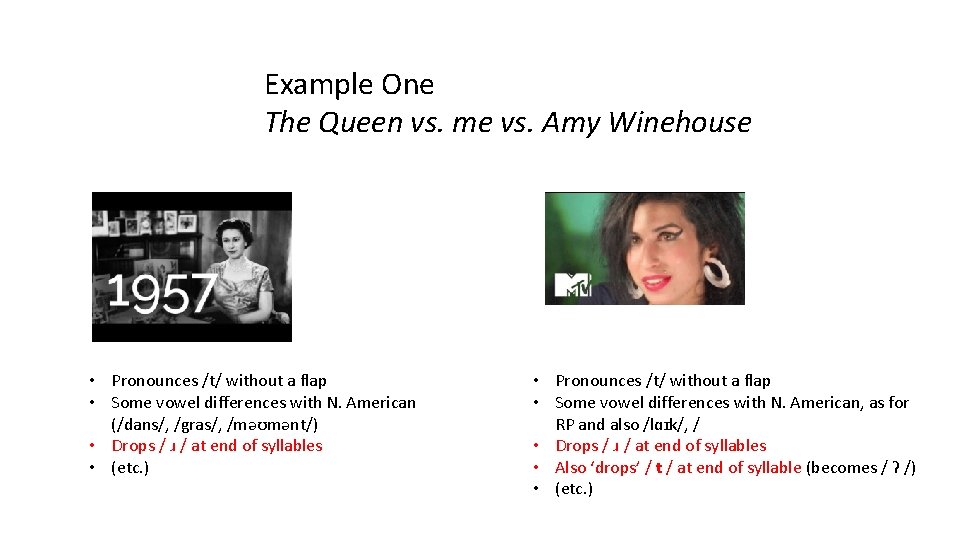
Example One The Queen vs. me vs. Amy Winehouse • Pronounces /t/ without a flap • Some vowel differences with N. American (/dans/, /gras/, /məʊmənt/) • Drops / ɹ / at end of syllables • (etc. ) • Pronounces /t/ without a flap • Some vowel differences with N. American, as for RP and also /lɑɪk/, / • Drops / ɹ / at end of syllables • Also ‘drops’ / t / at end of syllable (becomes / ʔ /) • (etc. )
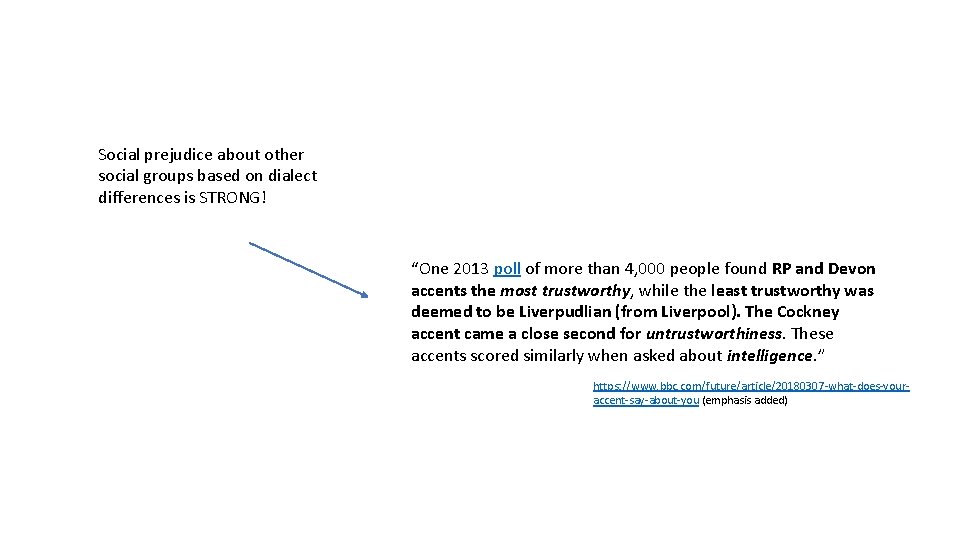
Social prejudice about other social groups based on dialect differences is STRONG! “One 2013 poll of more than 4, 000 people found RP and Devon accents the most trustworthy, while the least trustworthy was deemed to be Liverpudlian (from Liverpool). The Cockney accent came a close second for untrustworthiness. These accents scored similarly when asked about intelligence. ” https: //www. bbc. com/future/article/20180307 -what-does-youraccent-say-about-you (emphasis added)
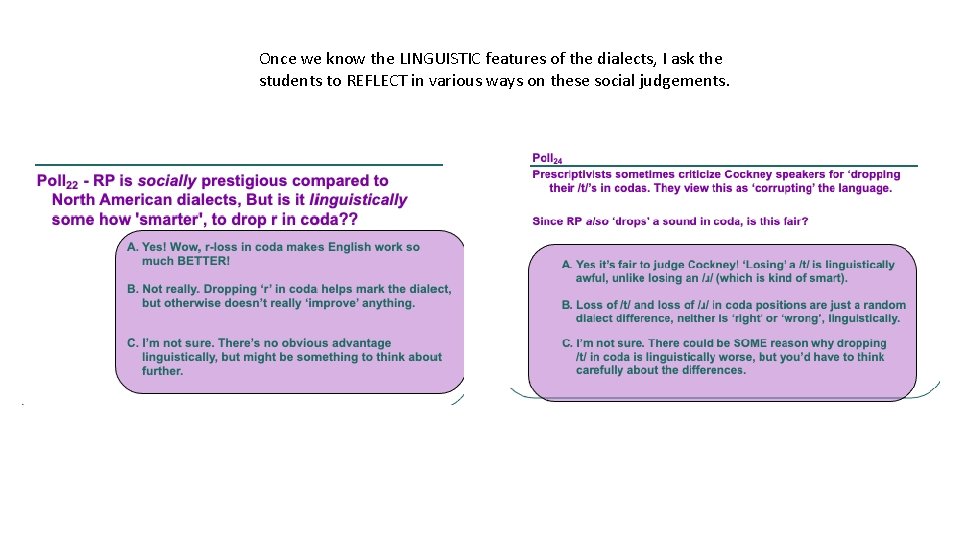
Once we know the LINGUISTIC features of the dialects, I ask the students to REFLECT in various ways on these social judgements.
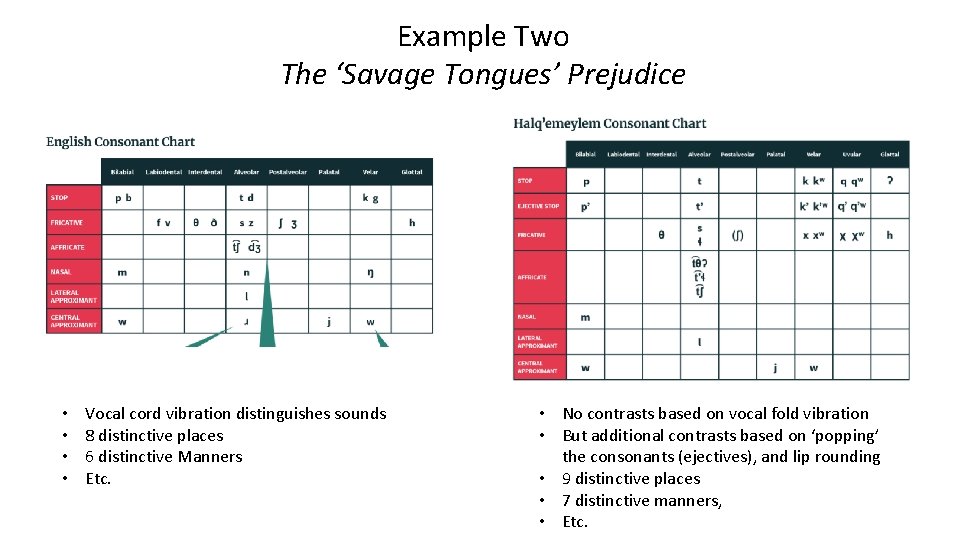
Example Two The ‘Savage Tongues’ Prejudice • • Vocal cord vibration distinguishes sounds 8 distinctive places 6 distinctive Manners Etc. • No contrasts based on vocal fold vibration • But additional contrasts based on ‘popping’ the consonants (ejectives), and lip rounding • 9 distinctive places • 7 distinctive manners, • Etc.
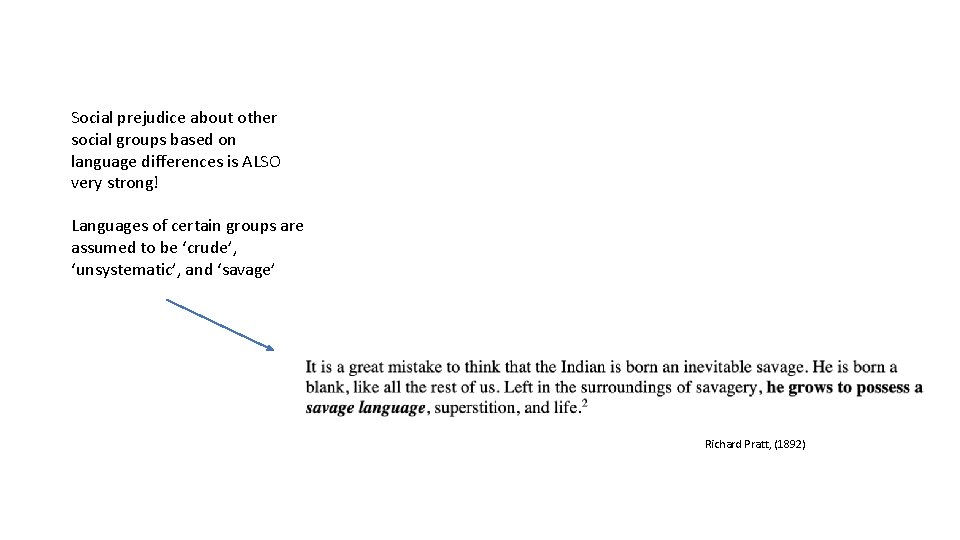
Social prejudice about other social groups based on language differences is ALSO very strong! Languages of certain groups are assumed to be ‘crude’, ‘unsystematic’, and ‘savage’ Richard Pratt, (1892)
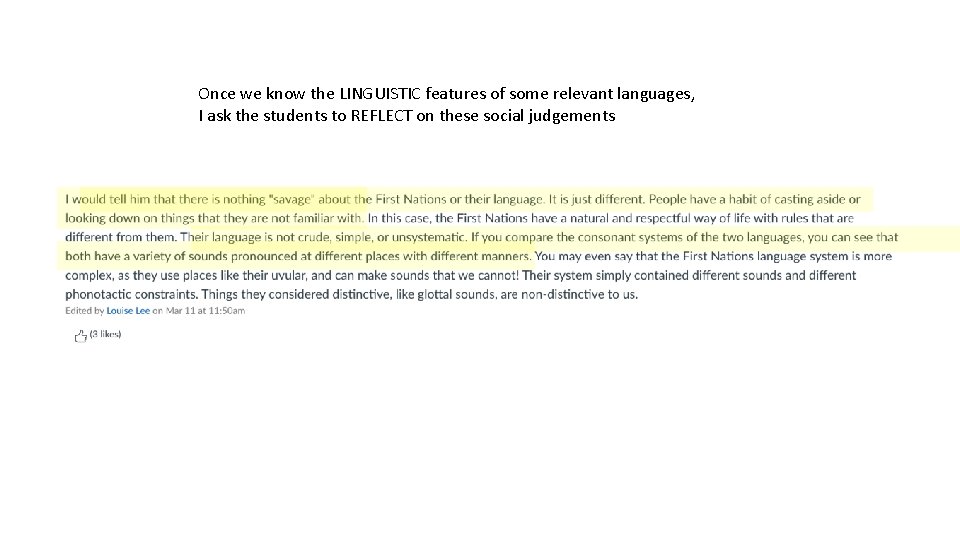
Once we know the LINGUISTIC features of some relevant languages, I ask the students to REFLECT on these social judgements
What I found when asking these questions Though I was clear that NO-ONE would lose points for disagreeing with me about these conclusions, a substantial number of students DID indicate that they re-thought these issues through the course. My perception is that connecting the linguistic analysis to these broader questions was an interesting and positive step, which made the class more meaningful with just a small number of questions. I have also definitely had students tell me that they appreciate it when people stop pre-judging THEM as ‘untrustworthy’ or ‘unintelligent’ based on their dialects!

Integrating intercultural perspective into all levels of language courses (in Covid times and beyond) Luisa Canuto, FHIS
What is intercultural competence? Intercultural competence is a lifelong process that includes the development of the attitudes (respect and valuing of other cultures, openness, curiosity), knowledge (of self, culture, sociolinguistic issues) skills (listen, observe, interpret, analyze, evaluate, and relate), and qualities (adaptability, flexibility, empathy and cultural decentering) in order to behave and communicate effectively and appropriately to achieve one’s goals to some degree. Deardorff (2006: 254)
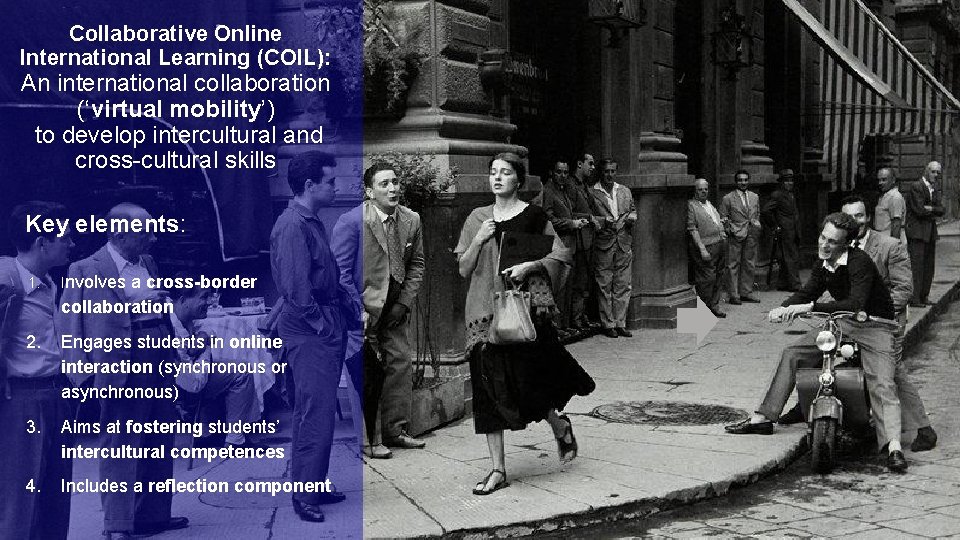
Collaborative Online International Learning (COIL): An international collaboration (‘virtual mobility’) to develop intercultural and cross-cultural skills Key elements: 1. Involves a cross-border collaboration 2. Engages students in online interaction (synchronous or asynchronous) 3. Aims at fostering students’ intercultural competences 4. Includes a reflection component

R. Orkin, An American Girl in Italy (1951)
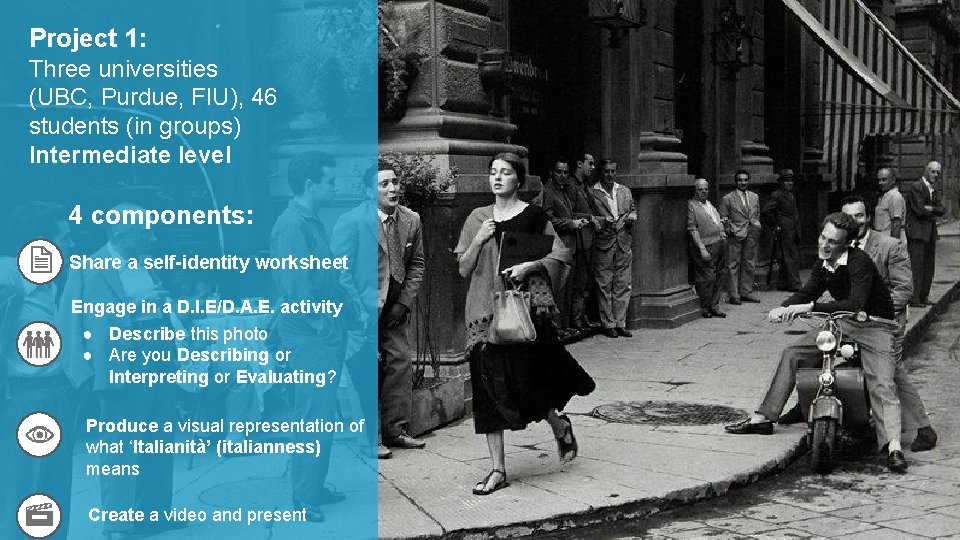
Project 1: Three universities (UBC, Purdue, FIU), 46 students (in groups) Intermediate level 4 components: Share a self-identity worksheet Engage in a D. I. E/D. A. E. activity ● Describe this photo ● Are you Describing or Interpreting or Evaluating? Produce a visual representation of what ‘Italianità’ (italianness) means Create a video and present
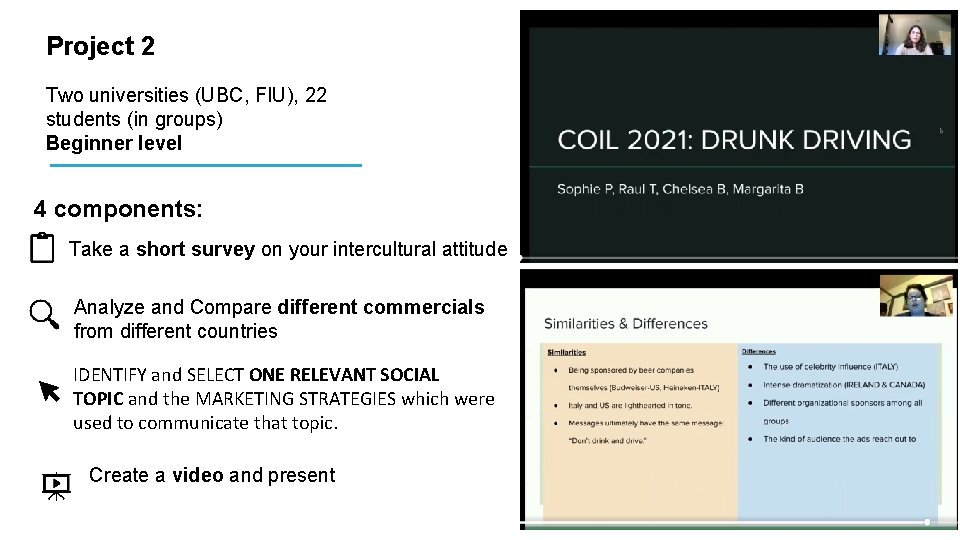
Project 2 Two universities (UBC, FIU), 22 students (in groups) Beginner level 4 components: Take a short survey on your intercultural attitude Analyze and Compare different commercials from different countries IDENTIFY and SELECT ONE RELEVANT SOCIAL TOPIC and the MARKETING STRATEGIES which were used to communicate that topic. Create a video and present
![[Very short] Bibliography • Byram, Michael. 2008. From Foreign Language Education to Education for](http://slidetodoc.com/presentation_image_h2/324444fe8b4cef091e0a68c441285a11/image-20.jpg "[Very short] Bibliography • Byram, Michael. 2008. From Foreign Language Education to Education for")
[Very short] Bibliography • Byram, Michael. 2008. From Foreign Language Education to Education for Intercultural Citizenship. Clevedon: Multilingual Matters • Deardorff, Darla. 2006. “Identification and Assessment of Intercultural Competence as a Student Outcome of Internationalization, ” Journal of Studies in International Education, vol. 10: 3: 241 - 266 • Kramsch, Claire. 2013. “Culture in foreign language teaching, ” Iranian Journal of Language Teaching Research 1. 1: 57 -78. • Spitzberg, B. H. , & Changnon, G. 2009. “Conceptualizing intercultural competence. ” In The Sage handbook of intercultural competence, edited by Darla Deardorff , 2– 52. Thousand Oaks, CA: Sage. • https: //idiinventory. com/generalinformation/the-intercultural-development-inventory-idi/ • https: //www. tru. ca/intercultural/faculty-staff/coil. html • https: //coil. suny. edu/ • http: //www. ufic. ufl. edu/uap/forms/coil_guide. pdf • https: //www. purdue. edu/cie/globallearning/Intercultural%20 Knowledge%20 and%20 Competence. html
Strategies for Bringing New Dimensions to Intercultural Learning into the Classroom and Beyond Language-exchange learning as changing participation in virtual L 2 communities of practice Saori Hoshi & Misuzu Kazama (Dep. of Asian Studies)
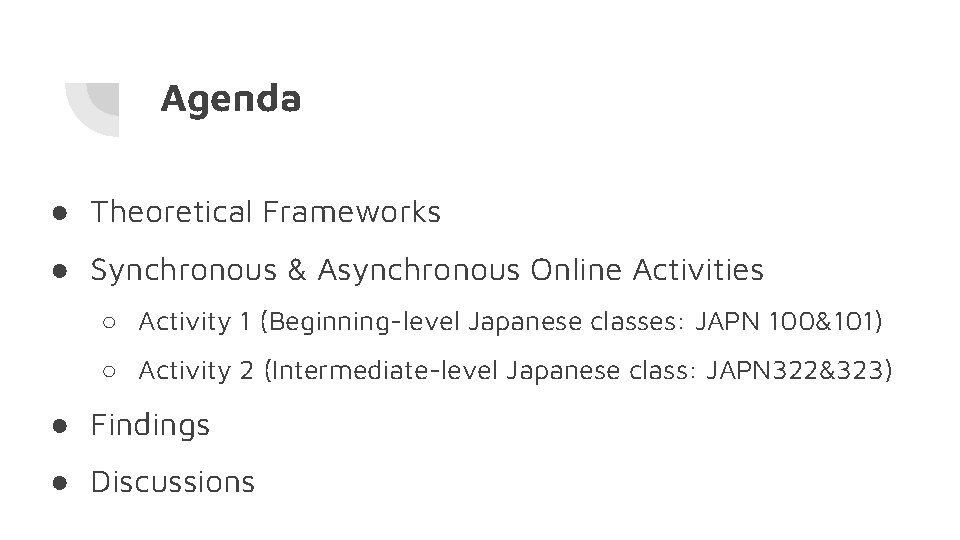
Agenda ● Theoretical Frameworks ● Synchronous & Asynchronous Online Activities ○ Activity 1 (Beginning-level Japanese classes: JAPN 100&101) ○ Activity 2 (Intermediate-level Japanese class: JAPN 322&323) ● Findings ● Discussions
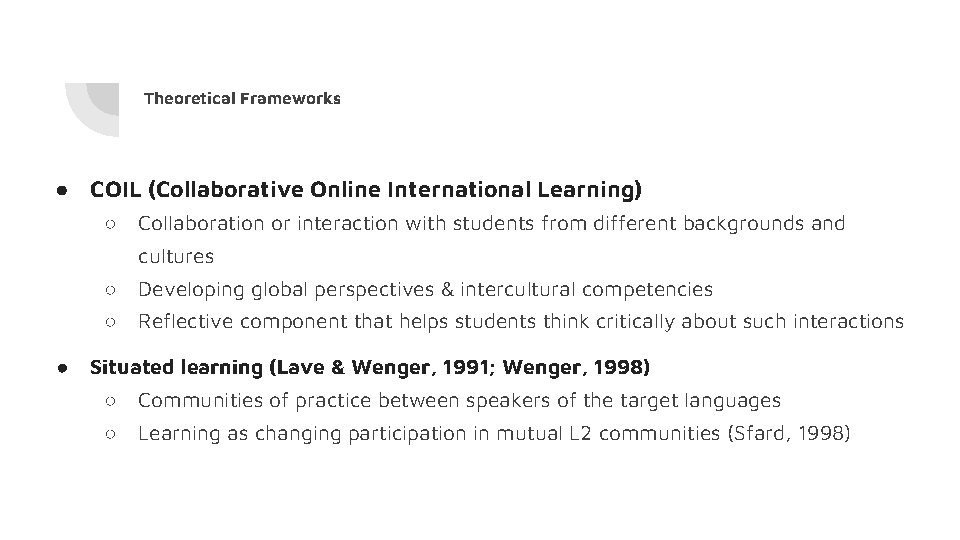
Theoretical Frameworks ● COIL (Collaborative Online International Learning) ○ Collaboration or interaction with students from different backgrounds and cultures ● ○ Developing global perspectives & intercultural competencies ○ Reflective component that helps students think critically about such interactions Situated learning (Lave & Wenger, 1991; Wenger, 1998) ○ Communities of practice between speakers of the target languages ○ Learning as changing participation in mutual L 2 communities (Sfard, 1998)
Our language-exchange activities Participants ● 1 st-year Japanese class students at UBC & English learners at a partner institute & university ● 3 rd-year Japanese class students at UBC & English learners in a partner institute Synchronous activity as virtual communities of practice ● Joint conversation sessions on Zoom (using Japanese and English as the target languages) ● 2 - 3 times per semester
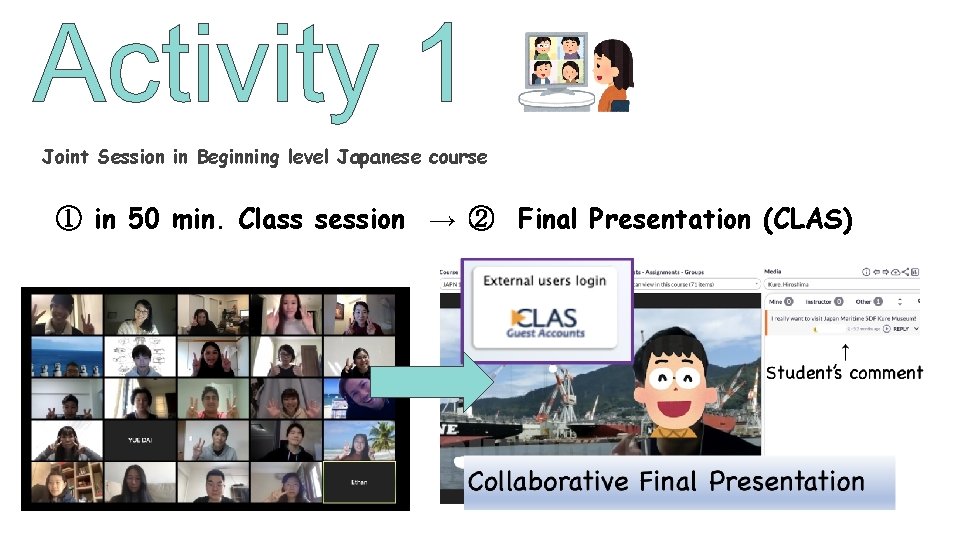
Joint Session in Beginning level Japanese course ① in 50 min. Class session → ② Final Presentation (CLAS)
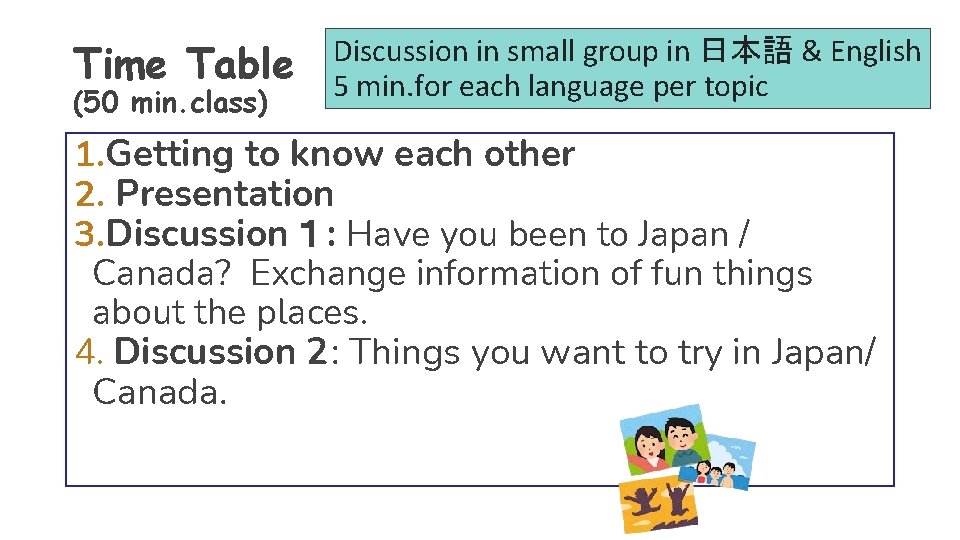
Time Table (50 min. class) Discussion in small group in 日本語 & English 5 min. for each language per topic 1. Getting to know each other 2. Presentation 3. Discussion1: Have you been to Japan / Canada? Exchange information of fun things about the places. 4. Discussion 2: Things you want to try in Japan/ Canada.
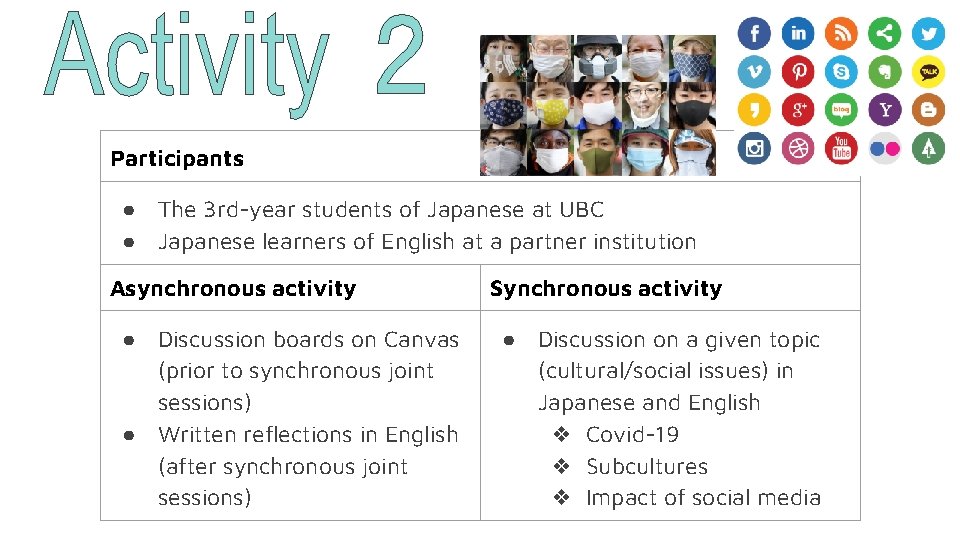
Participants ● The 3 rd-year students of Japanese at UBC ● Japanese learners of English at a partner institution Asynchronous activity ● Discussion boards on Canvas (prior to synchronous joint sessions) ● Written reflections in English (after synchronous joint sessions) Synchronous activity ● Discussion on a given topic (cultural/social issues) in Japanese and English ❖ Covid-19 ❖ Subcultures ❖ Impact of social media
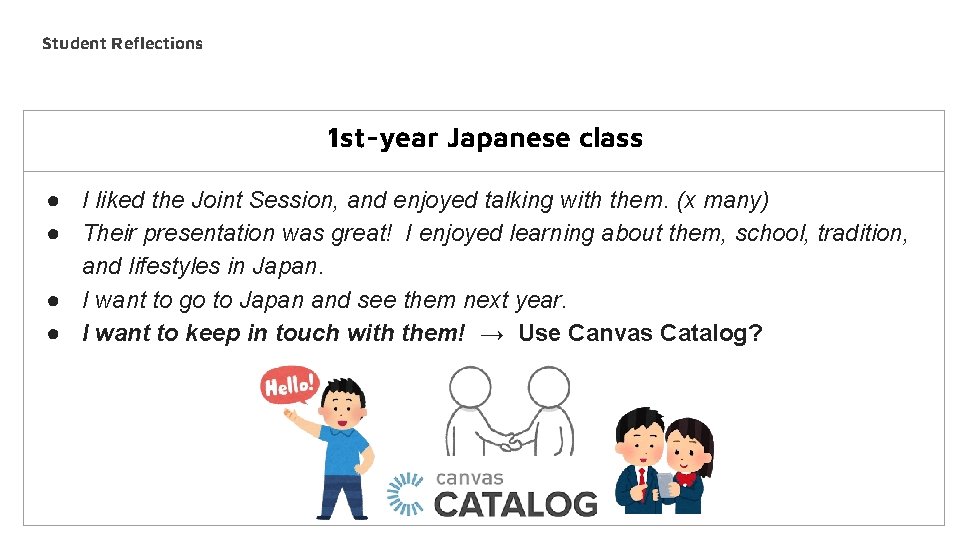
Student Reflections 1 st-year Japanese class ● I liked the Joint Session, and enjoyed talking with them. (x many) ● Their presentation was great! I enjoyed learning about them, school, tradition, and lifestyles in Japan. ● I want to go to Japan and see them next year. ● I want to keep in touch with them! → Use Canvas Catalog?
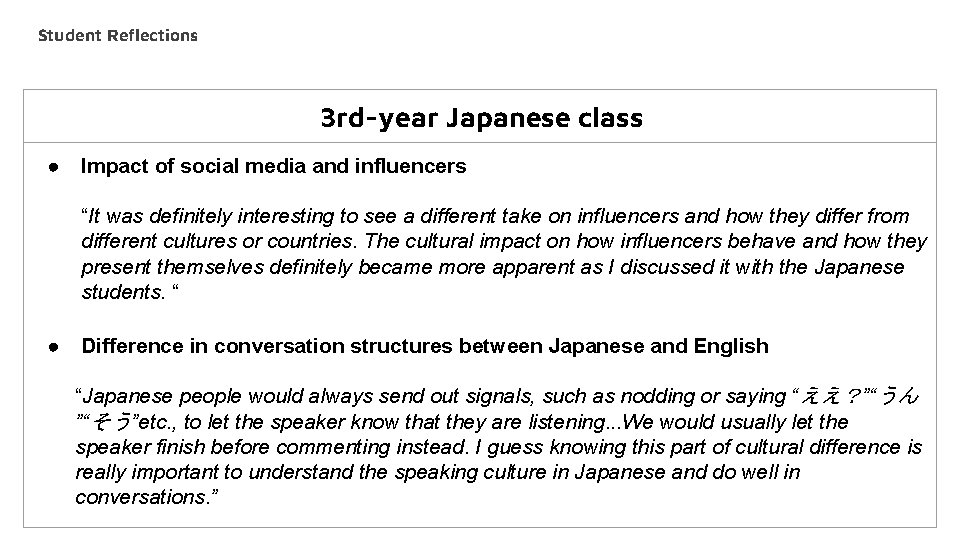
Student Reflections 3 rd-year Japanese class ● Impact of social media and influencers “It was definitely interesting to see a different take on influencers and how they differ from different cultures or countries. The cultural impact on how influencers behave and how they present themselves definitely became more apparent as I discussed it with the Japanese students. “ ● Difference in conversation structures between Japanese and English “Japanese people would always send out signals, such as nodding or saying “ええ?”“うん ”“そう”etc. , to let the speaker know that they are listening. . . We would usually let the speaker finish before commenting instead. I guess knowing this part of cultural difference is really important to understand the speaking culture in Japanese and do well in conversations. ”
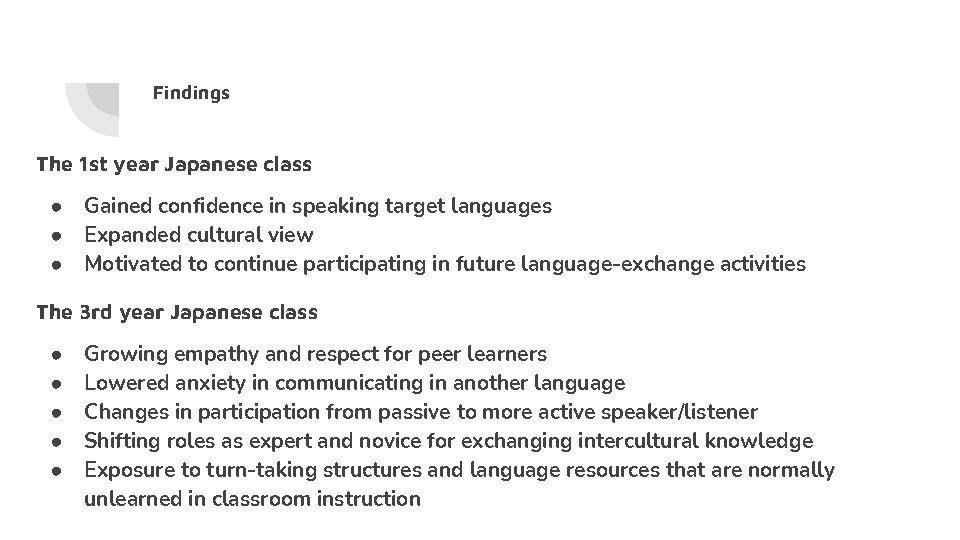
Findings The 1 st year Japanese class ● ● ● Gained confidence in speaking target languages Expanded cultural view Motivated to continue participating in future language-exchange activities The 3 rd year Japanese class ● ● ● Growing empathy and respect for peer learners Lowered anxiety in communicating in another language Changes in participation from passive to more active speaker/listener Shifting roles as expert and novice for exchanging intercultural knowledge Exposure to turn-taking structures and language resources that are normally unlearned in classroom instruction
Pedagogical implications ● Learners transcend their assumption of cultural norms to gain new perspectives of values and practices of the target culture as situated knowledge ● Shift of learners’ roles as both expert and novice by creating learning and teaching opportunities for both participants ● Potential of tandem learning for the development of linguistic, interactional and intercultural competencies

Thank you!
Equity, Diversity, and Inclusion (EDI) Programming with an Intercultural Lens ______________________ Joenita Paulrajan Phd, UBC Extended Learning
Context • • • Nearly three decades of programming to increase intercultural competencies Online courses for adult learners from various professions and across sectors Based on peer learning and with an emphasis on theoretical framework, reflection, and practical application Building knowledge, skills and awareness of cultural differences A critical focus on power, privilege, and identity
Scenarios 1. Holding a senior leadership position and uncertain of the differences between equity, diversity, and inclusion. 2. Succession planning and wanting to consider candidates from diverse backgrounds but challenged by unemployment realities faced by members of their own mainstream culture. 3. Working with international students and wanting them to ‘succeed’ but uncertain of the distinctions between assimilation and adaptation. 4. Recognizing the lack of representation in the workplace.
Challenges and Opportunities • Recognizing the importance of centering race • Extending beyond the individual to systemic issues • Having a more nuanced understanding of center and margins • Increasing awareness of biases and uncertainties around one’s own approach to EDI • Language and terminology to talk about equity from an intercultural perspective • Increasing capacity to have an impact on systems within communities and organizations • Networking to break the silos of isolation when doing this work
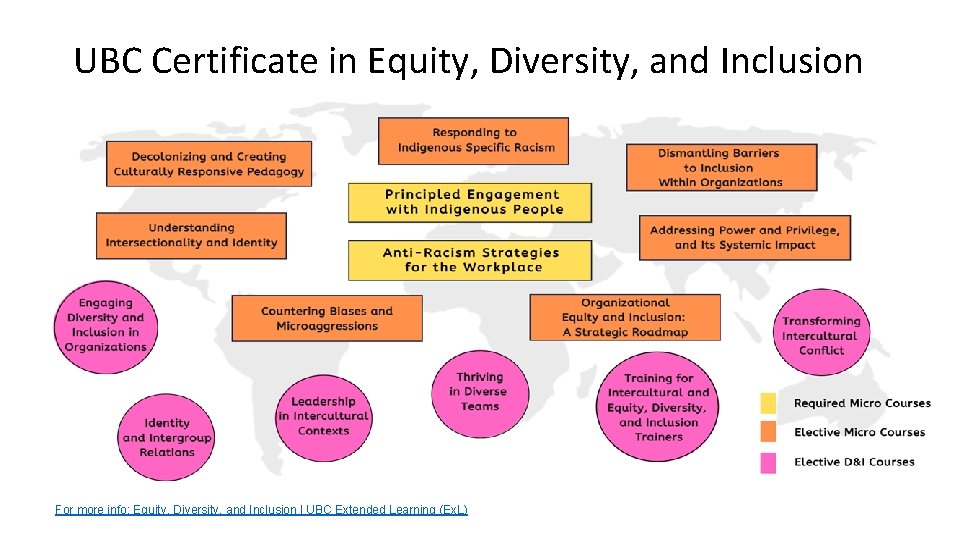
UBC Certificate in Equity, Diversity, and Inclusion For more info: Equity, Diversity, and Inclusion | UBC Extended Learning (Ex. L)
Thank you
Feel free to reach out to continue the conversation: Brianne Orr-Álvarez: brianne. orr@ubc. ca Strang Burton: strang. burton@ubc. ca Luisa Canuto: luisa. canuto@ubc. ca Misuzu Kazama: mkazama@mail. ubc. ca Saori Hoshi: shoshi 01@mail. ubc. ca Joenita Paulrajan: joenita. paulrajan@ubc. ca 39

- Slides: 40