
Strategic Uses of IT 1 Introduction 2 Strategic
- Slides: 51
Strategic Uses of IT
1 Introduction 2 Strategic Use of IT in Business 3 Emerging Network Business Models
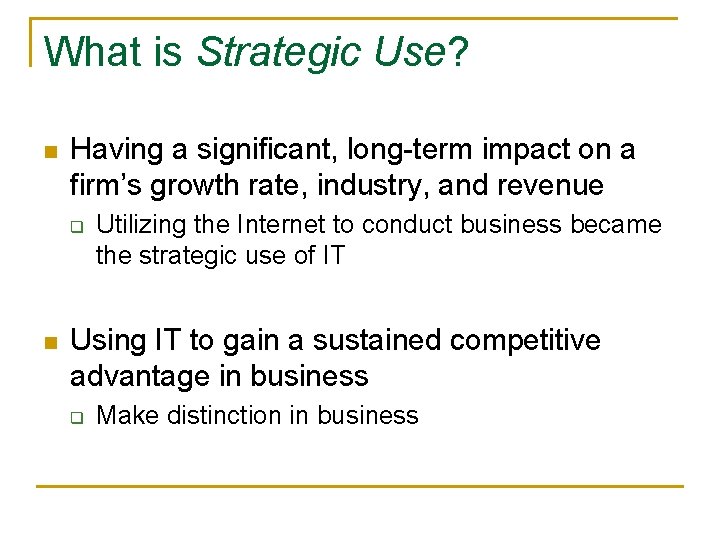
What is Strategic Use? n Having a significant, long-term impact on a firm’s growth rate, industry, and revenue q n Utilizing the Internet to conduct business became the strategic use of IT Using IT to gain a sustained competitive advantage in business q Make distinction in business
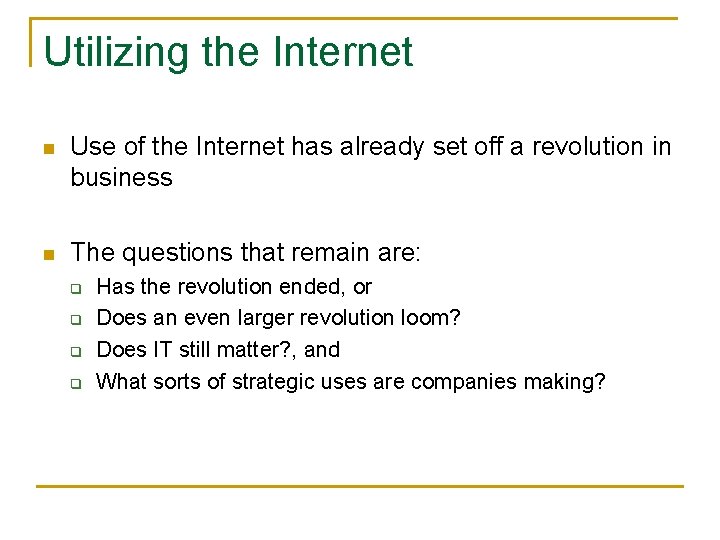
Utilizing the Internet n Use of the Internet has already set off a revolution in business n The questions that remain are: q q Has the revolution ended, or Does an even larger revolution loom? Does IT still matter? , and What sorts of strategic uses are companies making?
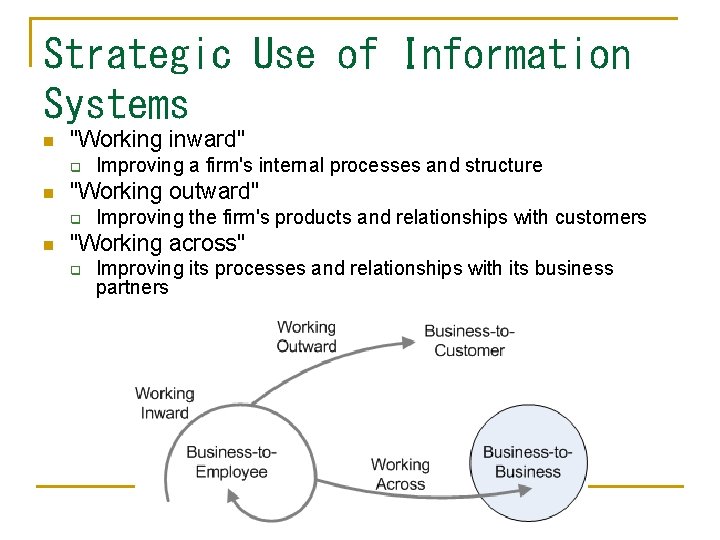
Strategic Use of Information Systems n "Working inward" q n "Working outward" q n Improving a firm's internal processes and structure Improving the firm's products and relationships with customers "Working across" q Improving its processes and relationships with its business partners
History of Strategic Uses of IT (1) n Mid 1980 s: end user computing (working inward) q n End user computing dept. to help employees learn about PCs and user computing language Late 1980 s: using IT to gain competitive advantage (working outward) q e. g. Merrill Lynch cash account management, AA airline ticket booking
History of Strategic Uses of IT (2) n 1990 s: reengineering business processes (inward again) q q n Totally redesign how the enterprise operated Introduction of ERP Mid-1990 s: Internet's potential becoming evident q The technology was mostly used internally: intranets n n Improve company processes Publish e-forms
History of Strategic Uses of IT (3) n Late 1990 s: e-business underway q q n Bursting of the dot com bubble Integration of the Internet into how companies work has proceeded Early 2000 s: emphasis on working across q leveraging traditional operations by using the Internet to work more closely with others n q Linking to suppliers, customers and other partners in one's value chain or business ecosystem Strike back of Brick-and-Mortar
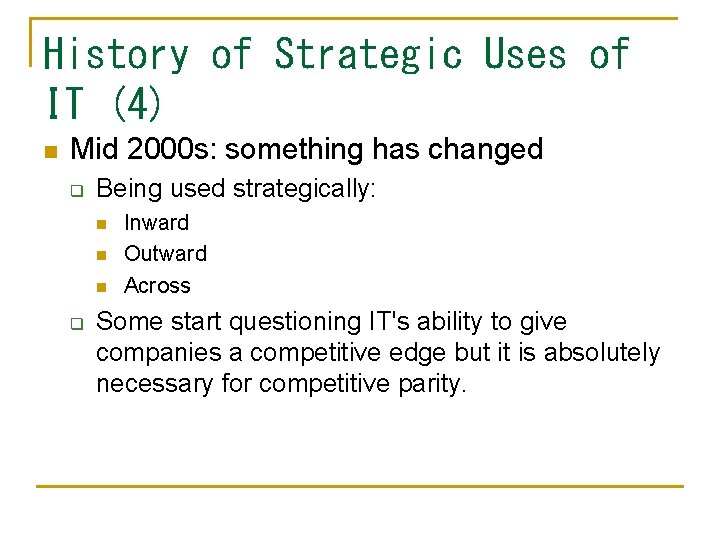
History of Strategic Uses of IT (4) n Mid 2000 s: something has changed q Being used strategically: n n n q Inward Outward Across Some start questioning IT's ability to give companies a competitive edge but it is absolutely necessary for competitive parity.
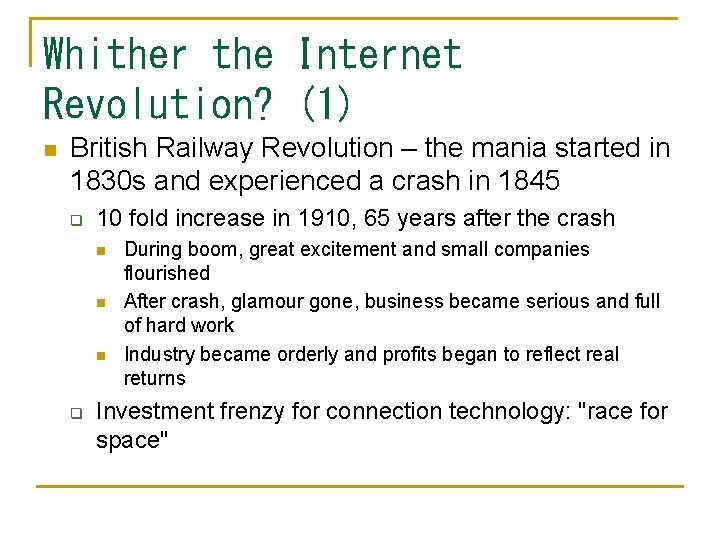
Whither the Internet Revolution? (1) n British Railway Revolution – the mania started in 1830 s and experienced a crash in 1845 q 10 fold increase in 1910, 65 years after the crash n n n q During boom, great excitement and small companies flourished After crash, glamour gone, business became serious and full of hard work Industry became orderly and profits began to reflect real returns Investment frenzy for connection technology: "race for space"
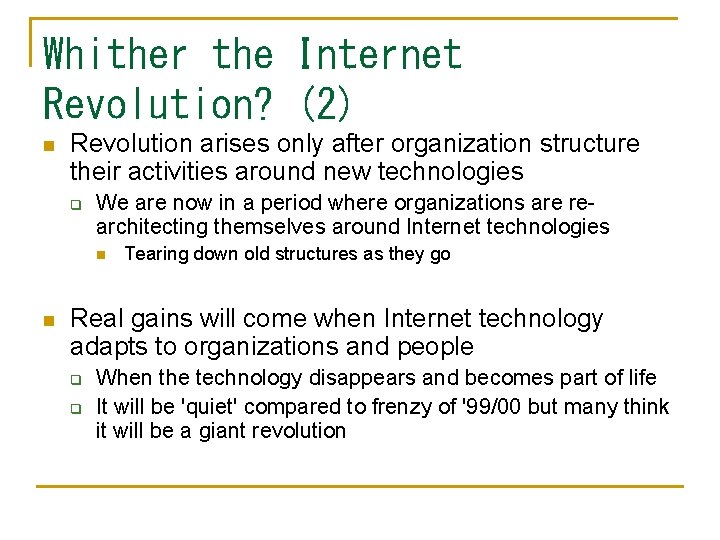
Whither the Internet Revolution? (2) n Revolution arises only after organization structure their activities around new technologies q We are now in a period where organizations are rearchitecting themselves around Internet technologies n n Tearing down old structures as they go Real gains will come when Internet technology adapts to organizations and people q q When the technology disappears and becomes part of life It will be 'quiet' compared to frenzy of '99/00 but many think it will be a giant revolution
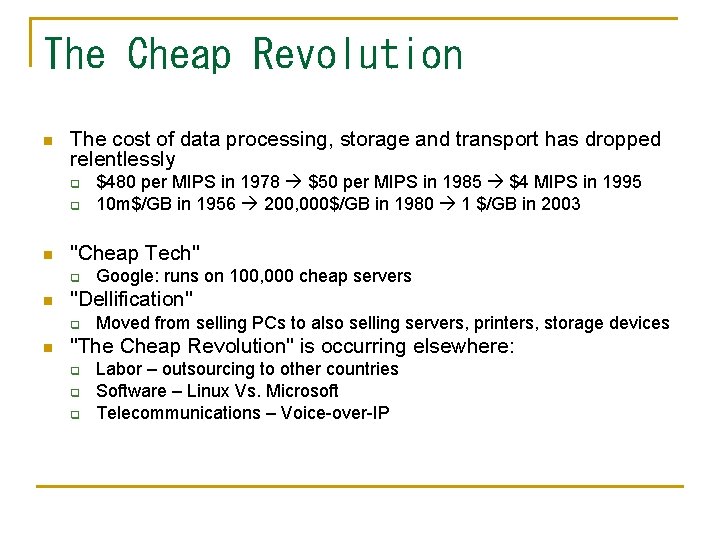
The Cheap Revolution n The cost of data processing, storage and transport has dropped relentlessly q q n "Cheap Tech" q n Google: runs on 100, 000 cheap servers "Dellification" q n $480 per MIPS in 1978 $50 per MIPS in 1985 $4 MIPS in 1995 10 m$/GB in 1956 200, 000$/GB in 1980 1 $/GB in 2003 Moved from selling PCs to also selling servers, printers, storage devices "The Cheap Revolution" is occurring elsewhere: q q q Labor – outsourcing to other countries Software – Linux Vs. Microsoft Telecommunications – Voice-over-IP
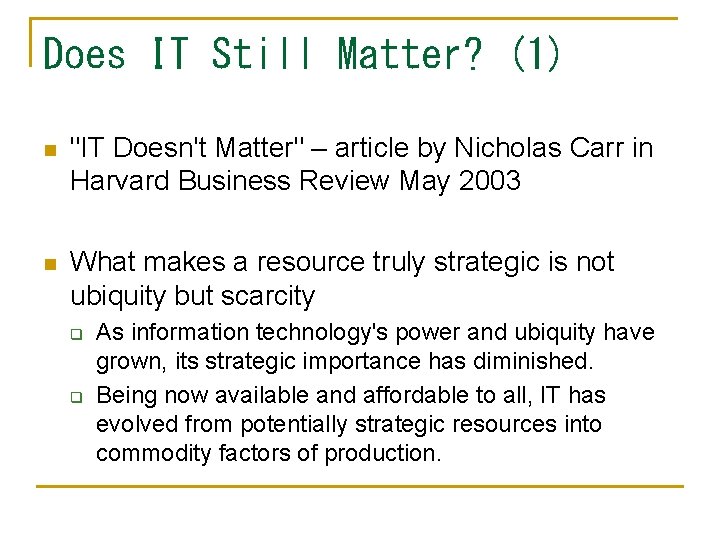
Does IT Still Matter? (1) n "IT Doesn't Matter" – article by Nicholas Carr in Harvard Business Review May 2003 n What makes a resource truly strategic is not ubiquity but scarcity q q As information technology's power and ubiquity have grown, its strategic importance has diminished. Being now available and affordable to all, IT has evolved from potentially strategic resources into commodity factors of production.
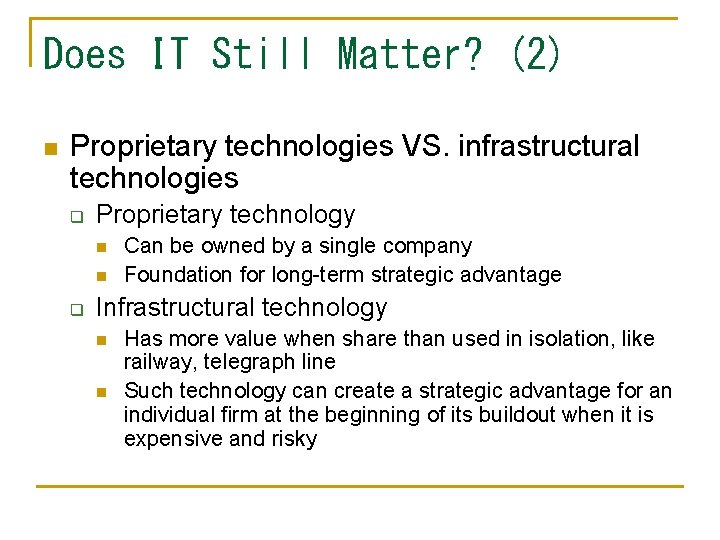
Does IT Still Matter? (2) n Proprietary technologies VS. infrastructural technologies q Proprietary technology n n q Can be owned by a single company Foundation for long-term strategic advantage Infrastructural technology n n Has more value when share than used in isolation, like railway, telegraph line Such technology can create a strategic advantage for an individual firm at the beginning of its buildout when it is expensive and risky
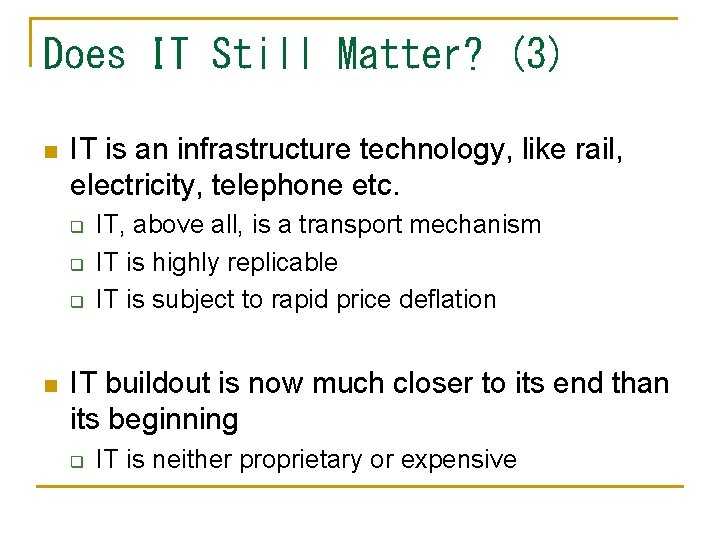
Does IT Still Matter? (3) n IT is an infrastructure technology, like rail, electricity, telephone etc. q q q n IT, above all, is a transport mechanism IT is highly replicable IT is subject to rapid price deflation IT buildout is now much closer to its end than its beginning q IT is neither proprietary or expensive
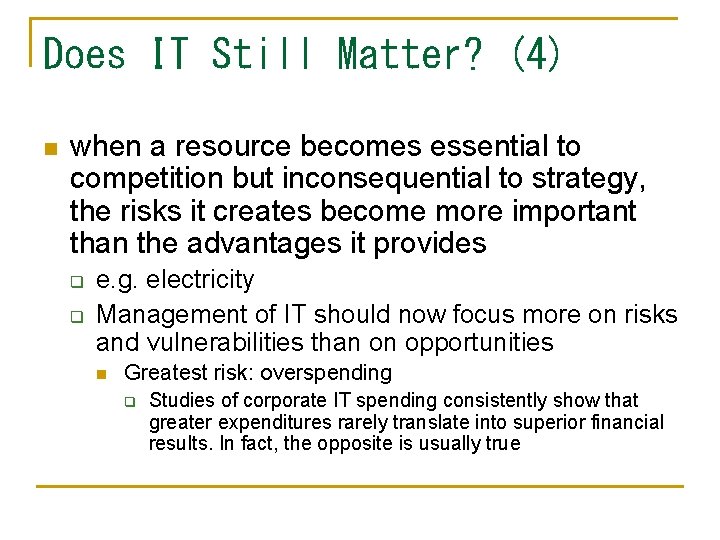
Does IT Still Matter? (4) n when a resource becomes essential to competition but inconsequential to strategy, the risks it creates become more important than the advantages it provides q q e. g. electricity Management of IT should now focus more on risks and vulnerabilities than on opportunities n Greatest risk: overspending q Studies of corporate IT spending consistently show that greater expenditures rarely translate into superior financial results. In fact, the opposite is usually true
Assignment n Write a review on IT Doesn’t Matter.
1 Introduction 2 Strategic Use of IT in Business 3 Emerging Network Business Models
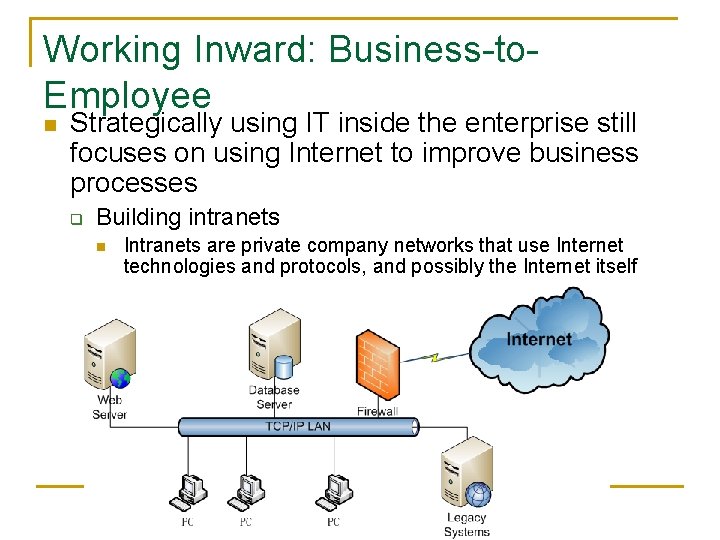
Working Inward: Business-to. Employee n Strategically using IT inside the enterprise still focuses on using Internet to improve business processes q Building intranets n Intranets are private company networks that use Internet technologies and protocols, and possibly the Internet itself
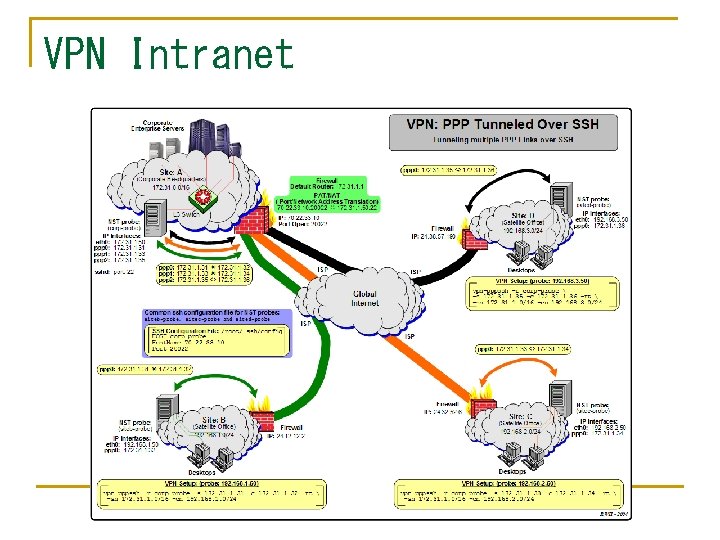
VPN Intranet
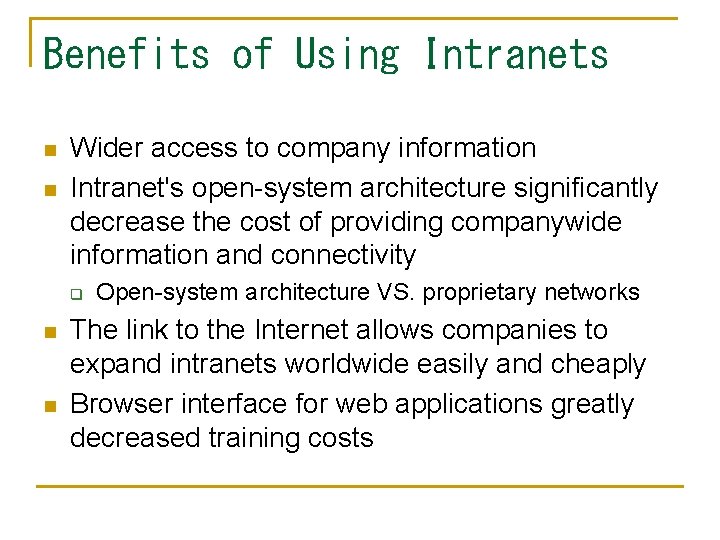
Benefits of Using Intranets n n Wider access to company information Intranet's open-system architecture significantly decrease the cost of providing companywide information and connectivity q n n Open-system architecture VS. proprietary networks The link to the Internet allows companies to expand intranets worldwide easily and cheaply Browser interface for web applications greatly decreased training costs
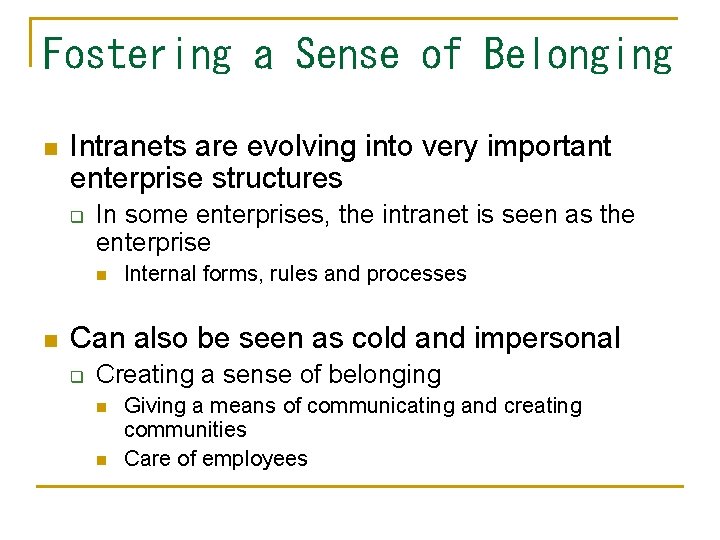
Fostering a Sense of Belonging n Intranets are evolving into very important enterprise structures q In some enterprises, the intranet is seen as the enterprise n n Internal forms, rules and processes Can also be seen as cold and impersonal q Creating a sense of belonging n n Giving a means of communicating and creating communities Care of employees
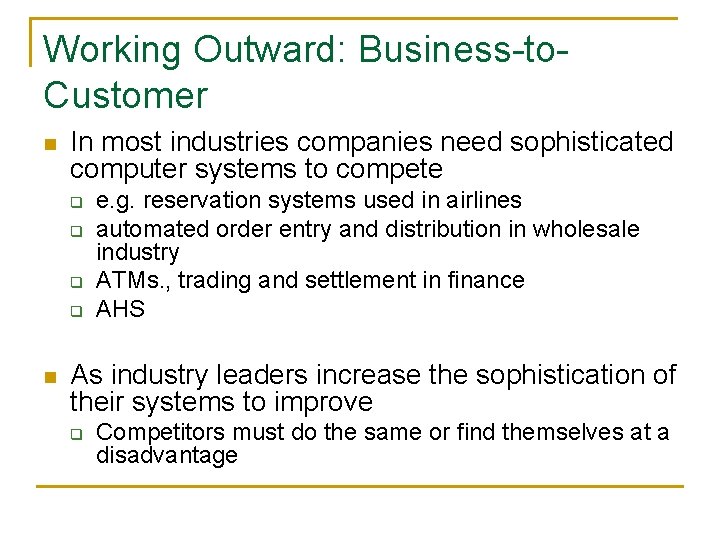
Working Outward: Business-to. Customer n In most industries companies need sophisticated computer systems to compete q q n e. g. reservation systems used in airlines automated order entry and distribution in wholesale industry ATMs. , trading and settlement in finance AHS As industry leaders increase the sophistication of their systems to improve q Competitors must do the same or find themselves at a disadvantage
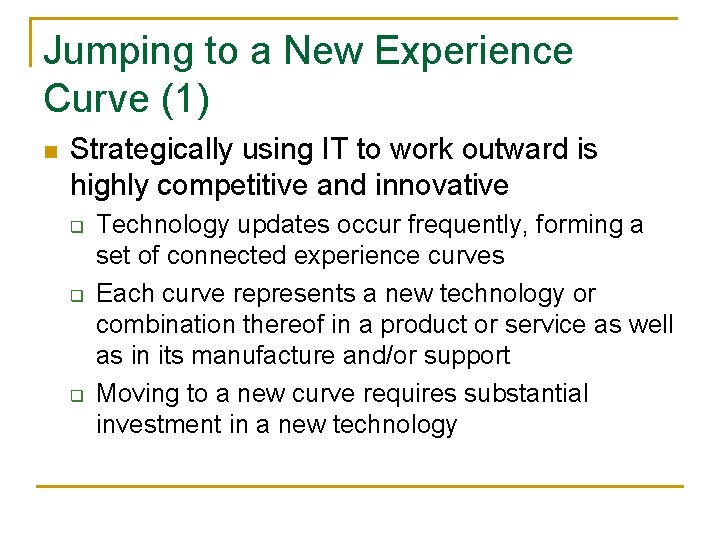
Jumping to a New Experience Curve (1) n Strategically using IT to work outward is highly competitive and innovative q q q Technology updates occur frequently, forming a set of connected experience curves Each curve represents a new technology or combination thereof in a product or service as well as in its manufacture and/or support Moving to a new curve requires substantial investment in a new technology
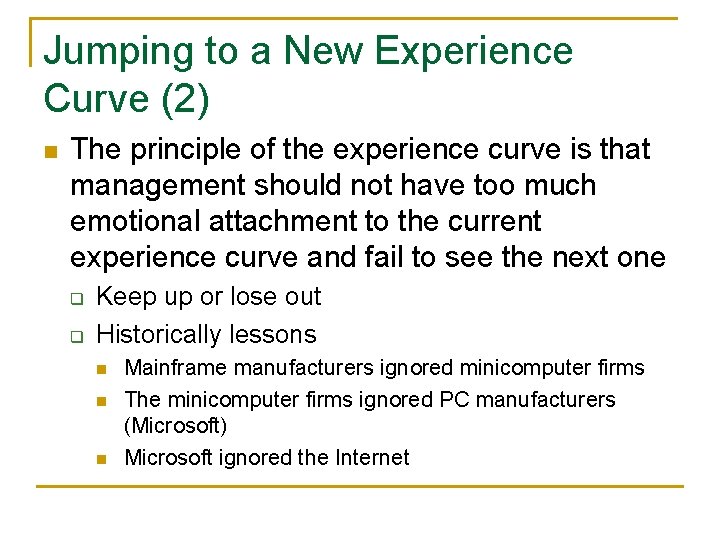
Jumping to a New Experience Curve (2) n The principle of the experience curve is that management should not have too much emotional attachment to the current experience curve and fail to see the next one q q Keep up or lose out Historically lessons n n n Mainframe manufacturers ignored minicomputer firms The minicomputer firms ignored PC manufacturers (Microsoft) Microsoft ignored the Internet
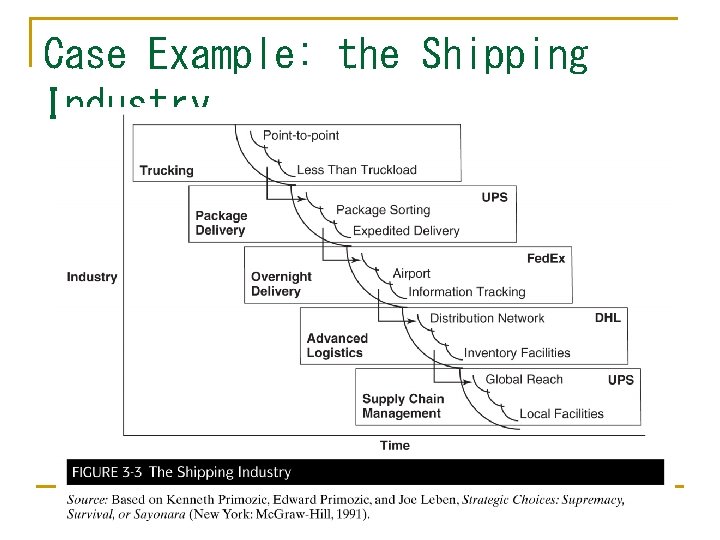
Case Example: the Shipping Industry
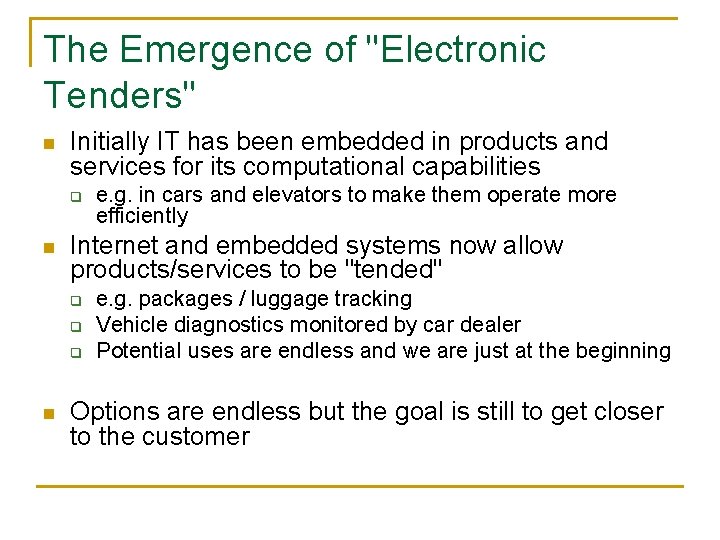
The Emergence of "Electronic Tenders" n Initially IT has been embedded in products and services for its computational capabilities q n Internet and embedded systems now allow products/services to be "tended" q q q n e. g. in cars and elevators to make them operate more efficiently e. g. packages / luggage tracking Vehicle diagnostics monitored by car dealer Potential uses are endless and we are just at the beginning Options are endless but the goal is still to get closer to the customer
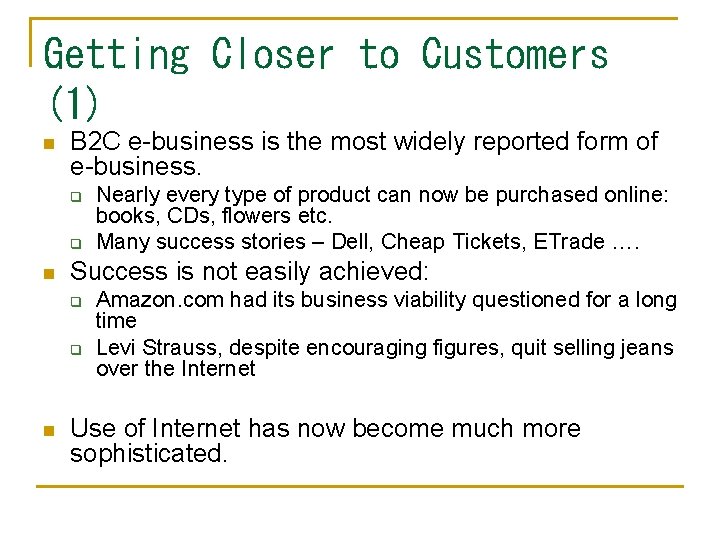
Getting Closer to Customers (1) n B 2 C e-business is the most widely reported form of e-business. q q n Success is not easily achieved: q q n Nearly every type of product can now be purchased online: books, CDs, flowers etc. Many success stories – Dell, Cheap Tickets, ETrade …. Amazon. com had its business viability questioned for a long time Levi Strauss, despite encouraging figures, quit selling jeans over the Internet Use of Internet has now become much more sophisticated.
Getting Closer to Customers (2) n CRMs are used to learn more about customers q q Whether you visit their website, call them (home, office, mobile) or buy something – the firm is often keeping track and combining that information to create a profile of you Followed on from ERP n n n ERP focused on internal data CRM focuses on customer data Boon or bane: Great useful information Vs. Invasion of privacy
Getting Closer to Customers (3) n Successful selling over the Internet entails much more than just setting up a Web site and taking orders q n It involves organizing the entire value chain around the Internet The E-Business model: redefining customer value q q q "On-demand" Personalization of service Access to a wide range of competitive prices and sellers for products
Getting Closer to Customers (4) n The Internet is not only used to sell to customers online. It is also used to provide services to companies q n Sometimes it is can be difficult to know which is more valuable – the product or the service The current focus is on staying in closer contact with customers q q Understanding them better Eventually, becoming customer driven by delivering personalized products and service
Working Across: Business-to. Business n Streamlining processes that cross company boundaries is the next big management challenge q n From streamlining internal processes to changing processes to mesh with other Working across business takes many forms including: q q q Working with "co-suppliers" Working with customers in a close mutually dependent relationship Building a virtual enterprise, in fact, one that might evolve into an e-marketplace
Coordinating with Co-Suppliers n n Cosuppliers: firms that have the same customers but not compete with each other Key in coordinating with cosuppliers q n Mechanisms to share information quickly and easily Recommended steps for cooperation q q Streamlining internal process Collaborating on new joint processes n Eliminate duplicate activities, focus on customer needs. . .
Case Example: General Mills and Land O’Lakes n Seven largest US food companies supply about 40% of supermarket shelf space for dry goods q n Only supply 15% of refrigerated q q n Use own trucks etc. One truck for several supermarkets Less efficient, delays etc. = unhappy clients Land O'Lake combined their deliveries on General Mills trucks q Now, they are looking into integrating their order taking and billing processes
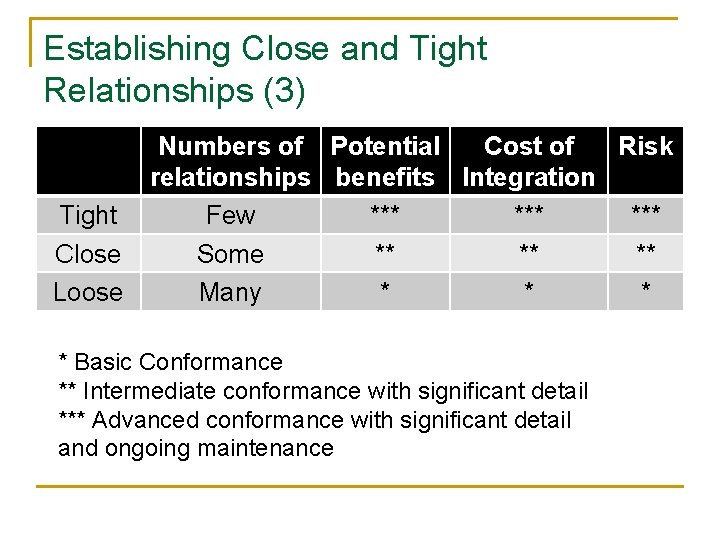
Establishing Close and Tight Relationships (1) n Working across companies is the most difficult area of strategic use of IT and Internet q Having relationships with various players in one's business ecosystem n n Banks, advertising agencies, suppliers, distributors, retailers, even competitors Such relationships often have accompanying linking information systems
Establishing Close and Tight Relationships (2) n 3 level of systems integration between companies q Loose: provide ad hoc access to internal information n q Close: two parties exchange information in a formal manner n q Business processes remain distinct Processes are distinct, but some tasks are handled jointly Tight: two parties share at least one business process n High volumes of possibly confidential data are exchanged
Establishing Close and Tight Relationships (3) Tight Close Loose Numbers of Potential Cost of Risk relationships benefits Integration Few *** *** Some ** ** ** Many * * Basic Conformance ** Intermediate conformance with significant detail *** Advanced conformance with significant detail and ongoing maintenance
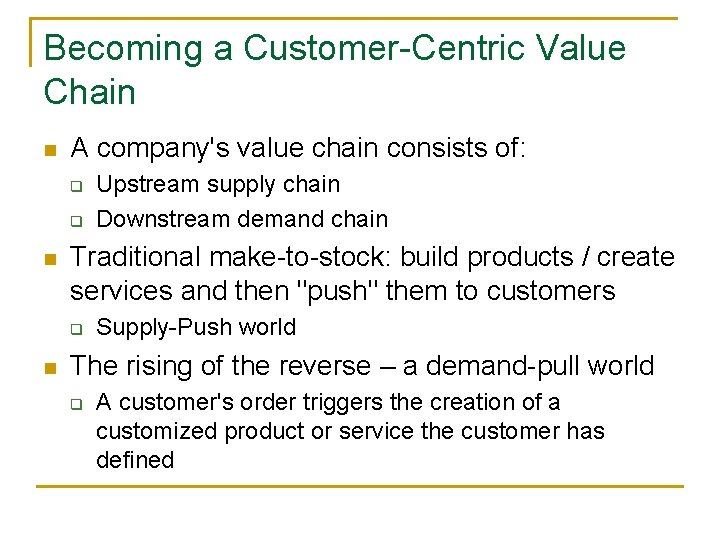
Becoming a Customer-Centric Value Chain n A company's value chain consists of: q q n Traditional make-to-stock: build products / create services and then "push" them to customers q n Upstream supply chain Downstream demand chain Supply-Push world The rising of the reverse – a demand-pull world q A customer's order triggers the creation of a customized product or service the customer has defined
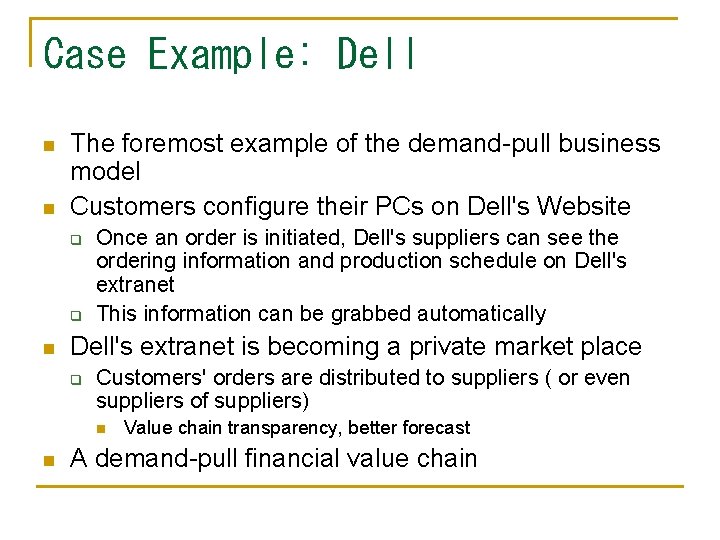
Case Example: Dell n n The foremost example of the demand-pull business model Customers configure their PCs on Dell's Website q q n Once an order is initiated, Dell's suppliers can see the ordering information and production schedule on Dell's extranet This information can be grabbed automatically Dell's extranet is becoming a private market place q Customers' orders are distributed to suppliers ( or even suppliers of suppliers) n n Value chain transparency, better forecast A demand-pull financial value chain
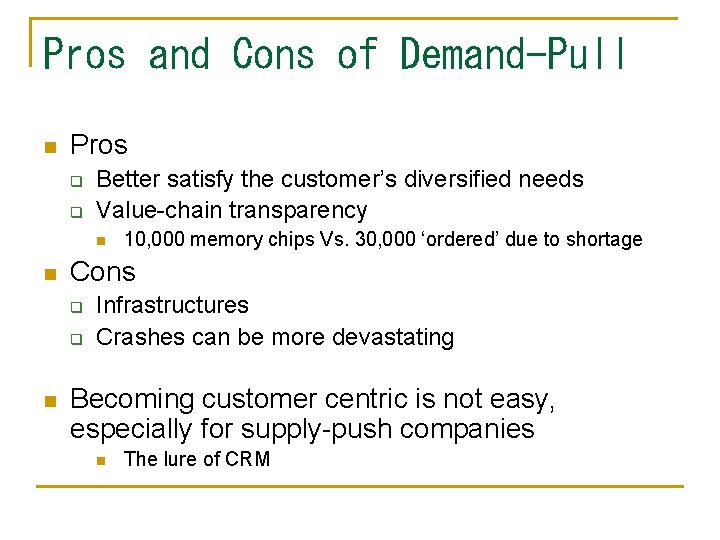
Pros and Cons of Demand-Pull n Pros q q Better satisfy the customer’s diversified needs Value-chain transparency n n Cons q q n 10, 000 memory chips Vs. 30, 000 ‘ordered’ due to shortage Infrastructures Crashes can be more devastating Becoming customer centric is not easy, especially for supply-push companies n The lure of CRM
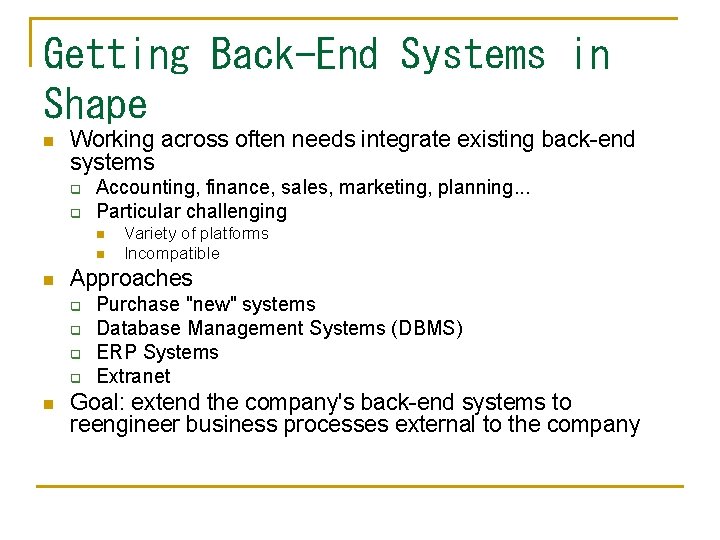
Getting Back-End Systems in Shape n Working across often needs integrate existing back-end systems q q Accounting, finance, sales, marketing, planning. . . Particular challenging n n n Approaches q q n Variety of platforms Incompatible Purchase "new" systems Database Management Systems (DBMS) ERP Systems Extranet Goal: extend the company's back-end systems to reengineer business processes external to the company
1 Introduction 2 Strategic Use of IT in Business 3 Emerging Network Business Models
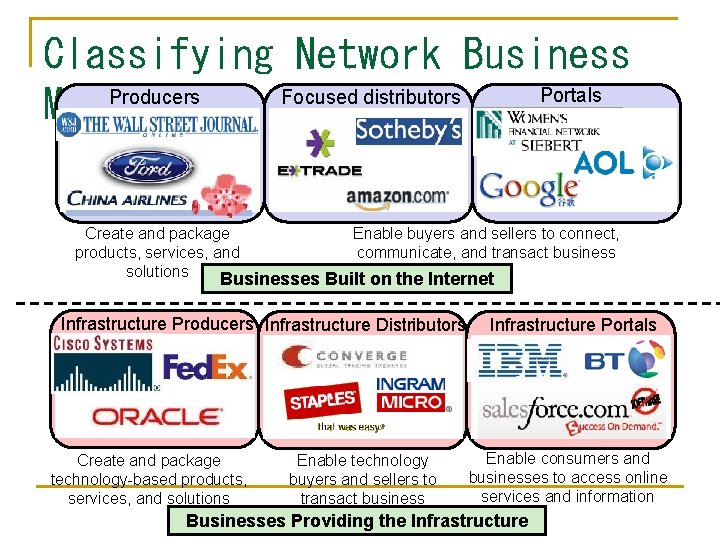
Classifying Network Business Portals Producers Focused distributors Models Create and package products, services, and solutions Enable buyers and sellers to connect, communicate, and transact business Businesses Built on the Internet Infrastructure Producers Infrastructure Distributors Create and package technology-based products, services, and solutions Enable technology buyers and sellers to transact business Infrastructure Portals Enable consumers and businesses to access online services and information Businesses Providing the Infrastructure
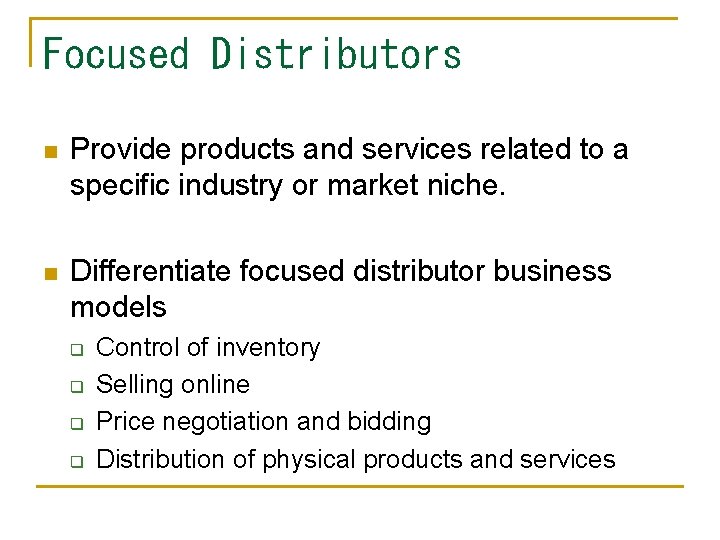
Focused Distributors n Provide products and services related to a specific industry or market niche. n Differentiate focused distributor business models q q Control of inventory Selling online Price negotiation and bidding Distribution of physical products and services
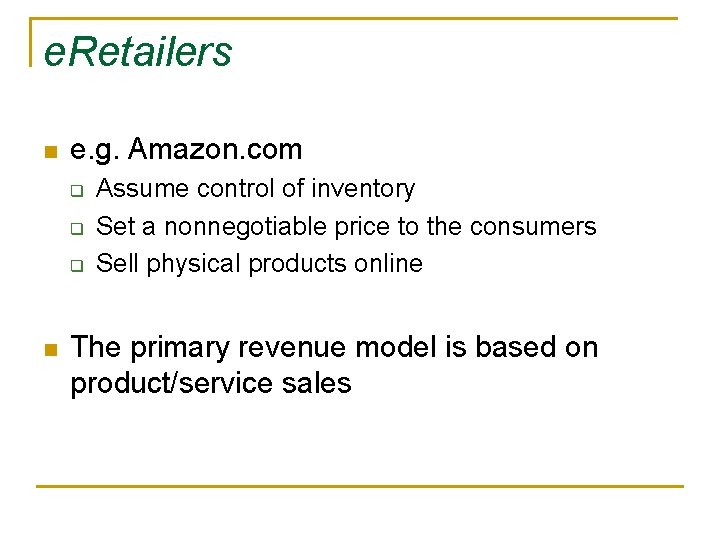
e. Retailers n e. g. Amazon. com q q q n Assume control of inventory Set a nonnegotiable price to the consumers Sell physical products online The primary revenue model is based on product/service sales
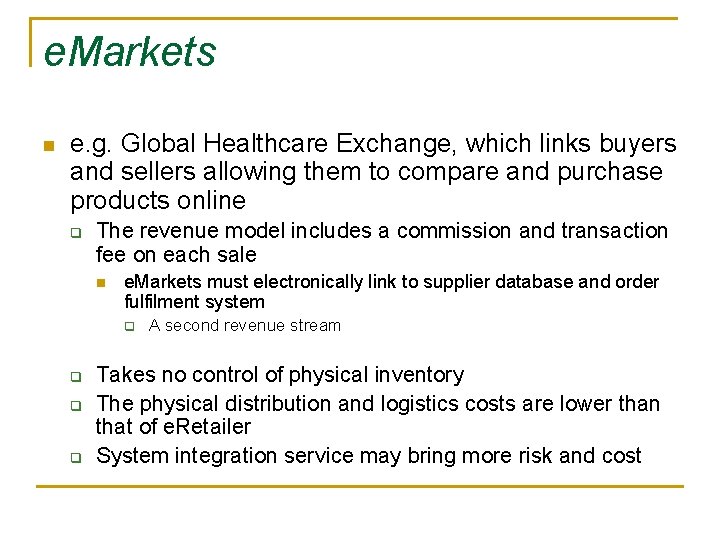
e. Markets n e. g. Global Healthcare Exchange, which links buyers and sellers allowing them to compare and purchase products online q The revenue model includes a commission and transaction fee on each sale n e. Markets must electronically link to supplier database and order fulfilment system q q A second revenue stream Takes no control of physical inventory The physical distribution and logistics costs are lower than that of e. Retailer System integration service may bring more risk and cost
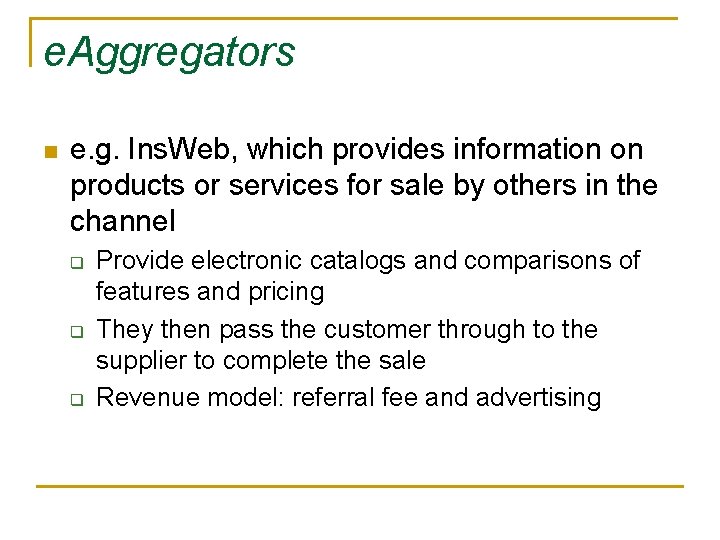
e. Aggregators n e. g. Ins. Web, which provides information on products or services for sale by others in the channel q q q Provide electronic catalogs and comparisons of features and pricing They then pass the customer through to the supplier to complete the sale Revenue model: referral fee and advertising
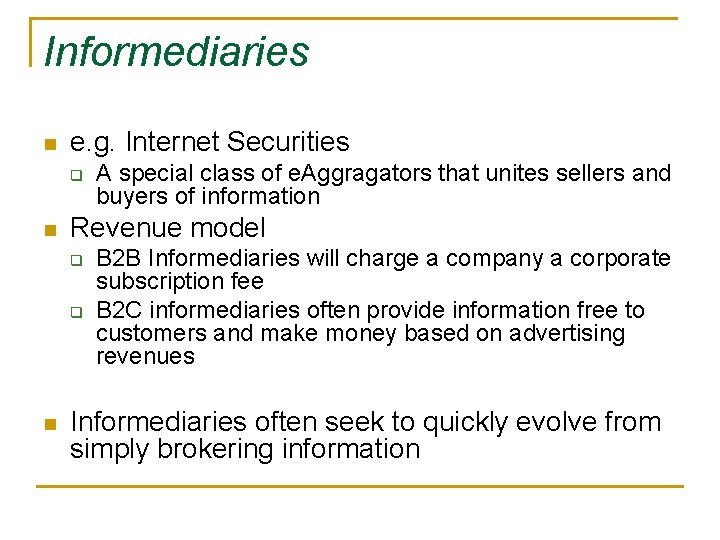
Informediaries n e. g. Internet Securities q n Revenue model q q n A special class of e. Aggragators that unites sellers and buyers of information B 2 B Informediaries will charge a company a corporate subscription fee B 2 C informediaries often provide information free to customers and make money based on advertising revenues Informediaries often seek to quickly evolve from simply brokering information
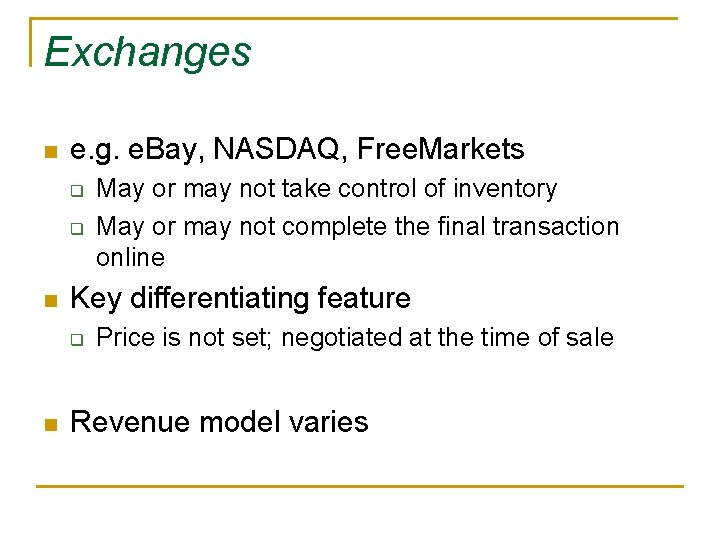
Exchanges n e. g. e. Bay, NASDAQ, Free. Markets q q n Key differentiating feature q n May or may not take control of inventory May or may not complete the final transaction online Price is not set; negotiated at the time of sale Revenue model varies
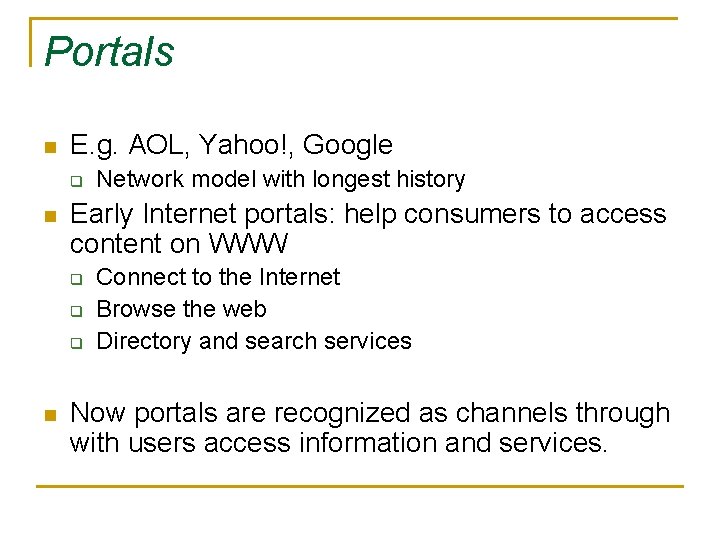
Portals n E. g. AOL, Yahoo!, Google q n Early Internet portals: help consumers to access content on WWW q q q n Network model with longest history Connect to the Internet Browse the web Directory and search services Now portals are recognized as channels through with users access information and services.
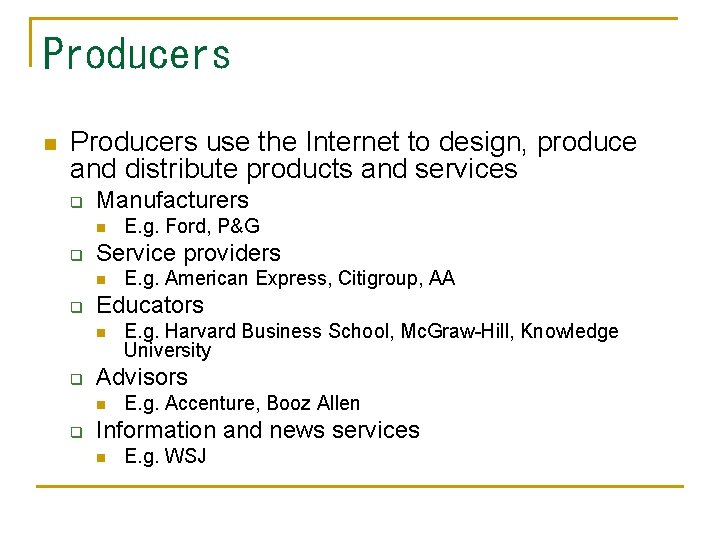
Producers n Producers use the Internet to design, produce and distribute products and services q Manufacturers n q Service providers n q E. g. Harvard Business School, Mc. Graw-Hill, Knowledge University Advisors n q E. g. American Express, Citigroup, AA Educators n q E. g. Ford, P&G E. g. Accenture, Booz Allen Information and news services n E. g. WSJ