
Strategic Use of Staff Budget and Time to

Strategic Use of Staff, Budget, and Time to Provide Effective Professional Development De. Veda E. Coley Proud Principal of North Frederick Elementary Home of the Falcons deveda. coley@fcps. org Questions? ? Link on Google:
Reflect on Job-Embedded PD (JEPD) Think of a professional development session that you delivered recently at your school or one that you will deliver in the near future. ▶ Jot down bullets of what was done or what will be done. ▶ As we read about the different types of JEPD, reflect on whether your plan is/was JEPD and if it was not, how can you make adjustments to make it job-embedded?
Success Criteria ▶ After this session, you will be able to: Explain the difference between traditional and jobembedded professional development ▶ Explain at least 2 different ways to allocate budget to meet professional development needs ▶ Explain at least 2 different ways to allocate staffing to meet professional development needs ▶ Explain at least 2 different ways to allocate time to meet professional development needs ▶
North Frederick Elementary ▶ 663 students ▶ School-wide STAR (Title 1 School) ▶ 52% FARM ▶ PARCC Ranking (MD Title 1 Schools) (3 rd, 4 th Math- 6 th in the state out of 354 T-1 schools and 5 th grade) ELA- 10 th in the state out of 354 T-1 schools and 5 th grade)
North Frederick Elementary ▶ Pre-K-5 th grade▶ ▶ ▶ Community Liaison/ 2 General IA/ User Support Specialist Student Support/ Guidance/ Student Support IA NFES Cadre Model: ▶ ▶ ▶ 5 teachers in each grade except Pre. K- 2 teachers (4 sessions) Magnet school -49 students grades 3 rd-5 th/ 7 would be in our school 3: Math Specialists/Reading Specialists/ ELL teachers/ Special Education teachers Data/ Technology specialist ELL Teacher Specialist (Focus School Grant) 1 to 1 with Chromebooks 2 nd-5 th grade JEPD is called TLC- Teach/ Learn/ Collaborate
Professional Development ▶ $18 billion a year allocated to Professional Development ▶ ▶ Over 90% of teachers report participating in PD but majority report that is was not useful ▶ ▶ Darling and Hammond (2009) Should be intensive, ongoing and connected to practice ▶ ▶ Study sponsored by the Gates Foundation (2014) Garet, Porter, Desimone, Birman and Yoon (2001) Positive improvements when there are structured and sustained follow-up after main professional activities
Adults learn best when they are: ▶ Self-Directed ▶ Building new knowledge upon pre-existing knowledge ▶ Aware of the relevance and personal significance of what they are learning ▶ Grounding theoretical knowledge in actual events -Bransford, Brown and Cocking, 2000; Knowles, Holten and Swanson, 1998

What is Job-Embedded PD? Job-embedded professional development (JEPD) refers to teacher learning that is grounded in day-to-day teaching practice and is designed to enhance teachers’ contentspecific instructional practices with the intent of improving student learning (Darling-Hammond & Mc. Laughlin, 1995; Hirsh, 2009). It is primarily school or classroom based and is integrated into the workday, consisting of teachers assessing and finding solutions for authentic and immediate problems of practice as part of a cycle of continuous improvement (Hawley & Valli, 1999)
Collective Teacher Efficacy 2. Collective teacher efficacy (d = 1. 57). This is a factor that can be manipulated at a whole school level. It involves helping all teachers on the staff to understand that the way they go about their work has a significant impact on student results – for better or worse. Simultaneously, it involves stopping them from using other factors (e. g. home life, socioeconomic status, motivation) as an excuse for poor progress. Yes, these factors hinder learning, but a great teacher will always try to make a difference despite this, and they often succeed. -John Hattie (2017)
Formats of JEPD: ▶ ▶ ▶ Are you currently using this format? How are you incorporating or how can you implement? Tips/Suggestions for implementation? Possible Barriers/Concerns with Possible Solutions? Questions? Please comment and like others thoughts. : ) Article by Croft et. al 2010
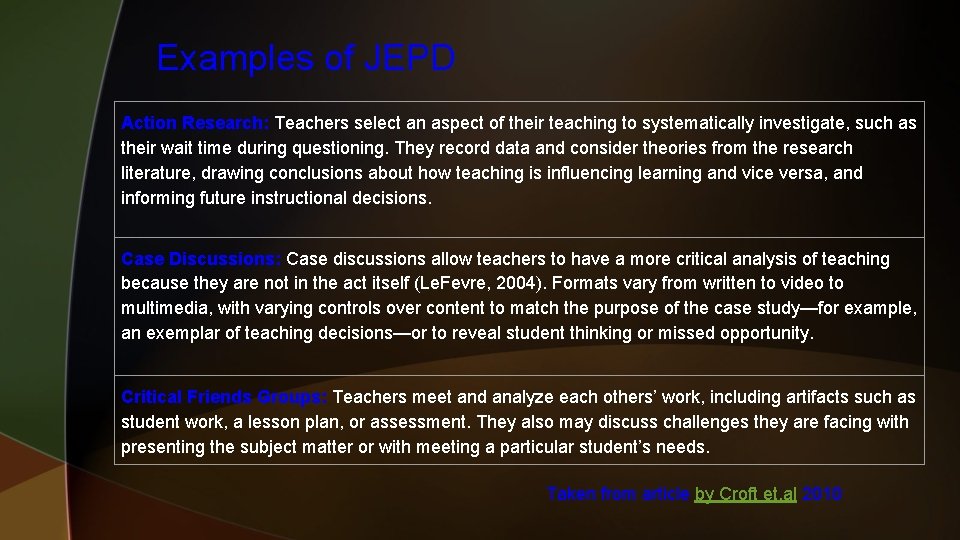
Examples of JEPD Action Research: Teachers select an aspect of their teaching to systematically investigate, such as their wait time during questioning. They record data and consider theories from the research literature, drawing conclusions about how teaching is influencing learning and vice versa, and informing future instructional decisions. Case Discussions: Case discussions allow teachers to have a more critical analysis of teaching because they are not in the act itself (Le. Fevre, 2004). Formats vary from written to video to multimedia, with varying controls over content to match the purpose of the case study—for example, an exemplar of teaching decisions—or to reveal student thinking or missed opportunity. Critical Friends Groups: Teachers meet and analyze each others’ work, including artifacts such as student work, a lesson plan, or assessment. They also may discuss challenges they are facing with presenting the subject matter or with meeting a particular student’s needs. Taken from article by Croft et. al 2010
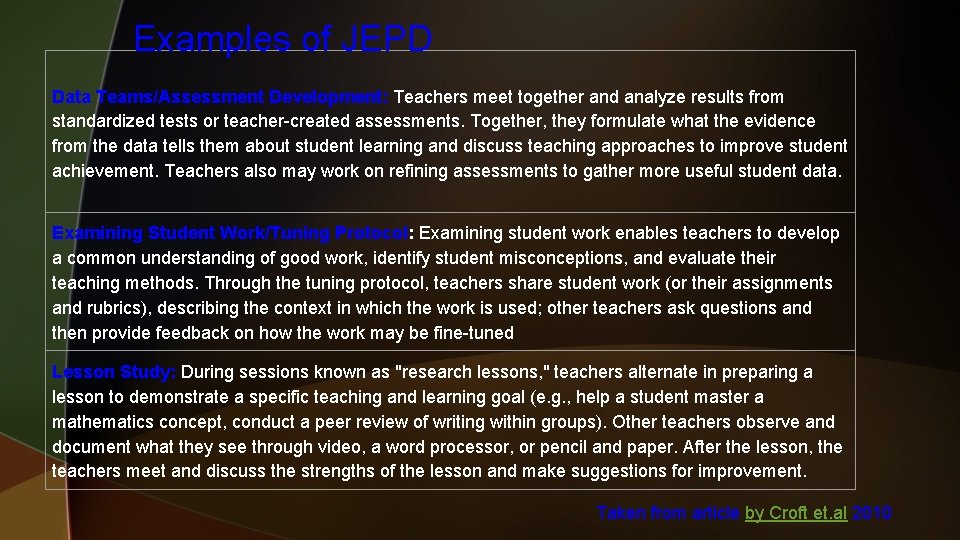
Examples of JEPD Data Teams/Assessment Development: Teachers meet together and analyze results from standardized tests or teacher-created assessments. Together, they formulate what the evidence from the data tells them about student learning and discuss teaching approaches to improve student achievement. Teachers also may work on refining assessments to gather more useful student data. Examining Student Work/Tuning Protocol: Examining student work enables teachers to develop a common understanding of good work, identify student misconceptions, and evaluate their teaching methods. Through the tuning protocol, teachers share student work (or their assignments and rubrics), describing the context in which the work is used; other teachers ask questions and then provide feedback on how the work may be fine-tuned Lesson Study: During sessions known as "research lessons, " teachers alternate in preparing a lesson to demonstrate a specific teaching and learning goal (e. g. , help a student master a mathematics concept, conduct a peer review of writing within groups). Other teachers observe and document what they see through video, a word processor, or pencil and paper. After the lesson, the teachers meet and discuss the strengths of the lesson and make suggestions for improvement. Taken from article by Croft et. al 2010

Similar to students as learners, teachers as learners benefit from multiple opportunities to learn. These opportunities are created when teachers are afforded time, space, structures and support to engage jobembedded professional development. (JEPD) -Croft et. al 2010
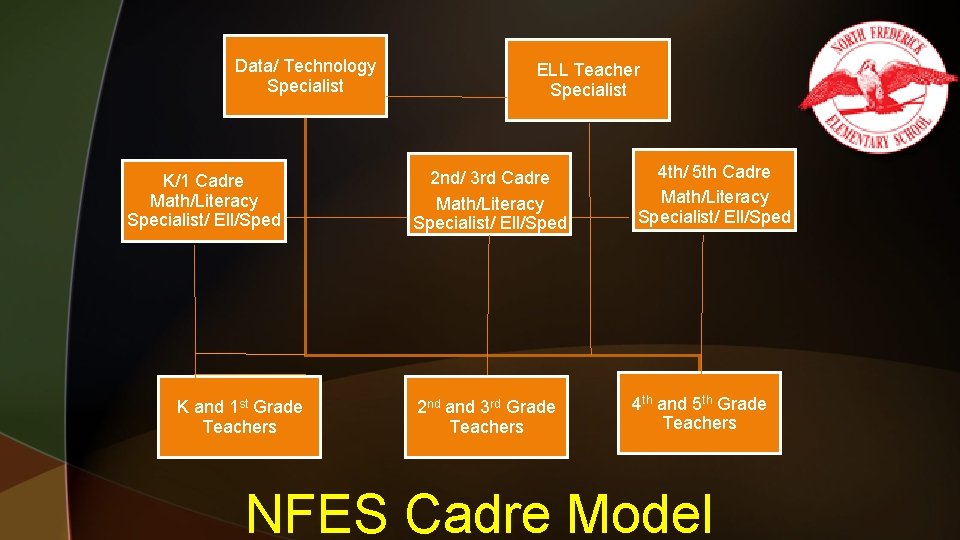
Data/ Technology Specialist K/1 Cadre Math/Literacy Specialist/ Ell/Sped K and 1 st Grade Teachers ELL Teacher Specialist 2 nd/ 3 rd Cadre Math/Literacy Specialist/ Ell/Sped 4 th/ 5 th Cadre Math/Literacy Specialist/ Ell/Sped 2 nd and 3 rd Grade Teachers 4 th and 5 th Grade Teachers NFES Cadre Model
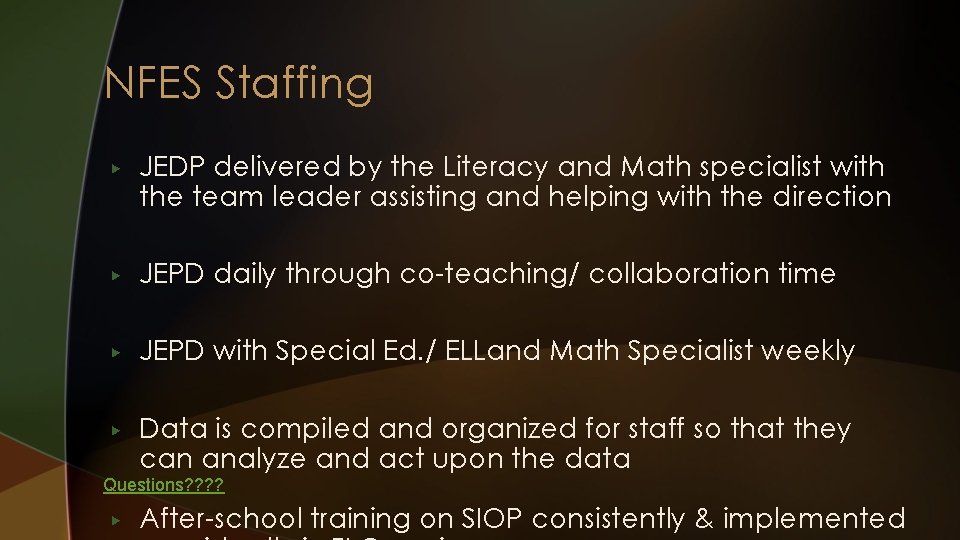
NFES Staffing ▶ JEDP delivered by the Literacy and Math specialist with the team leader assisting and helping with the direction ▶ JEPD daily through co-teaching/ collaboration time ▶ JEPD with Special Ed. / ELLand Math Specialist weekly ▶ Data is compiled and organized for staff so that they can analyze and act upon the data Questions? ? ▶ After-school training on SIOP consistently & implemented
Staffing Questions to Consider ▶ Who is going to provide professional development? ▶ ▶ ▶ What staff members are going to provide what professional development? What training do they need? What format of professional development will they be doing? What staff will be needed to provide the job-embedded professional development? ▶ If this is a new position, how will I define it for staff and ensure staff sees it as important and effective? ▶ How will I evaluate the effectiveness of the professional development model and the member providing the professional development? ▶
Budget ▶ General Budget: ▶ ▶ Progress Meetings Subs- Quarterly Staff Development funds– where do these come from? ▶ ▶ ▶ Progress Meeting subs quarterly School-based training for new teachers Late September Long Range Planning at end of the school year Collaboration time between teachers- extra half hour for coteaching Afterschool professional meetings about behavioral strategies
Title 1 Funds ▶ Title 1 Allocation/ General Money: ▶ ▶ Extra Staffing allows for 3 Literacy Specialists (2)/ Math Specialists (3) Special Education (. 5) and Data/Technology Specialist (1) and smaller class sizes Money for long range planning at end of year Funds for Quarterly progress Meetings Focus School Grant (ELL) ▶ ▶ Team of Teachers SIOP training and they train other teachers Money to pay for peer visits to get feedback on SIOP (consultant also)
Budget Questions to Consider ▶ Do we have enough time to support quality professional development? ▶ ▶ Who is going to provide the professional development? ▶ ▶ If not, can money be allocated to provide additional opportunities? Do we have the appropriate staff members to provide quality professional development or do we need to allocate funds for a new position? Is there time in the staff member’s schedule to plan and provide JEPD? If not, how do use funds to do so? What training is necessary for the staff members to get new information to present? Do we need to provide funding or sub days for training? Do we have the appropriate materials for quality professional development? ?
NFES JEPD Schedule TLC 1 hour and 40 minutes every 8 days ▶ ▶ ▶ Math/Language Arts. Switches a. m/ pm mid year Specials handle some of a. m time to get full hour Weekly planning meetings between team leaders and professional development facilitator during recess Staff meetings are 5 -10 minutes announcements-- start at 3: 15 -3: 30 when all staff is there and the hour time is professional development (mostly SIOP/ Cultural Proficiency)
NFES JEPD Schedule ▶ Weekly meetings built into instructional schedule for math specialist to lead with. Ell/Special Education teachers (30 minutes) ▶ Teacher visits with consultant and ELL teacher specialist to other teachers to provide feedback ▶ Progress Meetings-- data geared/ teachers bring questions and work with peers to discuss tier 1 strategies- action plan when they leave
Strategic use of Time Questions to Consider ▶ When can job-embedded professional development be done? ▶ ▶ ▶ How often? How long is appropriate? How can I minimize loss of instruction time when we have JEPD? How can I provide additional time if needed? ▶ What schedule changes will I need to make? ▶ Will there be coverage concerns? ▶ ▶ ▶ If yes, how can I preserve instructional time while providing time for the teachers? What are the contingency plans when someone is out?
Reflect on your own about each part of the success criteria ▶ After this session, you will be able to: Explain the difference between traditional and job embedded professional development ▶ Explain at least 2 different ways to allocate budget to meet professional development needs ▶ Explain at least 2 different ways to allocate staffing to meet professional development needs ▶ Explain at least 2 different ways to allocate time for professional development ▶ Questions? ?
Reflect on Job-Embedded PD ▶ Look back at the professional development session that you delivered recently at your school or one that you will deliver in the near future. What modifications can/could/did you make to make the session job-embedded?

Highlight one of the success criteria to most resonated with you today. Find someone at a different tableshare your new thinking from today Share one of your ideas on the padlet!!
- Slides: 25