
Strategic Use of IP for Business in Knowledgedriven
Strategic Use of IP for Business in Knowledge-driven Economy May 2009, Seoul Dr. Guriqbal Singh Jaiya Director Small and Medium-Sized Enterprises Division World Intellectual Property Organization www. wipo. int/sme
Spotlight is on knowledge in today’s economy • Knowledge, Weightless, Information, Digital or Service Economy • Factors of production: Land, Labor, Capital, Intangibles (Knowledge) • Knowledge as useful Information (or Service) • Information as a “Public Good” • Information as Property
Market-oriented Economy • Playing Field: Unfair competition; free riding • National Legal Systems: Diversity (bilateral/regional/ international treaties or agreements) • Adding Value : Meeting or exceeding market needs or expectations • Market research: Consumers’ needs, competing products or substitutes, gaps • Technological innovation as an element of marketing
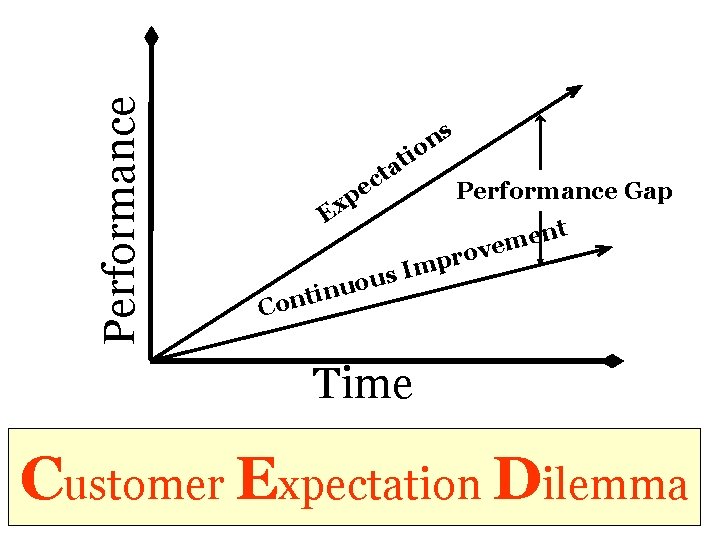
Performance c e p i t ta Ex us o u in t Con s n o Performance Gap t en m e ov r p m I Time Customer Expectation Dilemma
Tangible and Intangible Assets • Intangibles differ from tangibles in two ways that “change the rules of the game”, (if not the game itself): – Value in context – Multiple simultaneous value streams
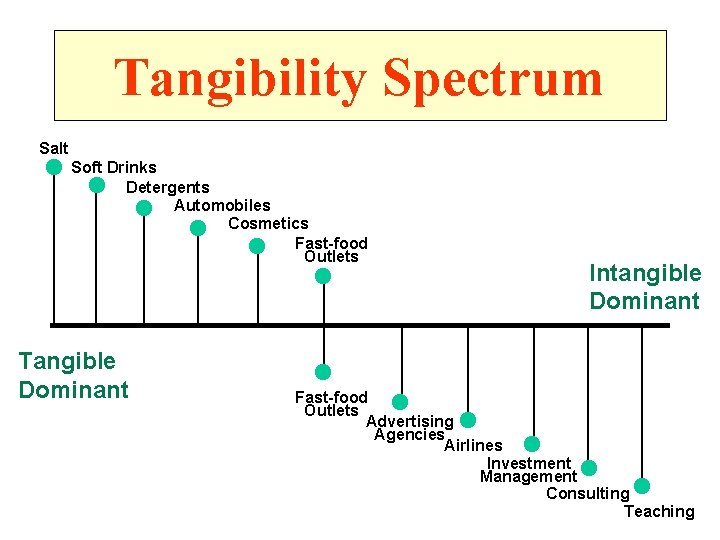
Tangibility Spectrum Salt Soft Drinks Detergents Automobiles Cosmetics. Fast-food Outlets Tangible Dominant Intangible Dominant Fast-food Outlets Advertising Agencies Airlines Investment Management Consulting Teaching
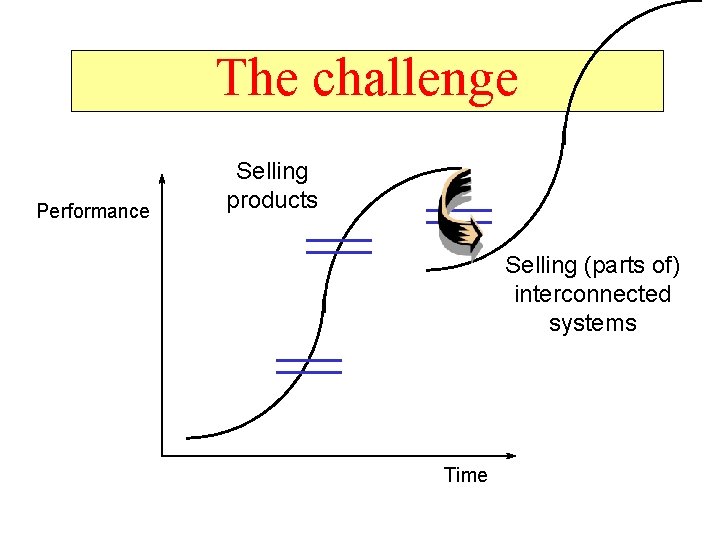
The challenge Performance Selling products Selling (parts of) interconnected systems Time
Strategic Entrepreneurship and Innovation • Entrepreneurship is concerned with: – The discovery of profitable opportunities – The exploitation of profitable opportunities • Firms that encourage entrepreneurship are: – Risk takers – Committed to innovation – Proactive in creating opportunities rather than waiting to respond to opportunities created by others
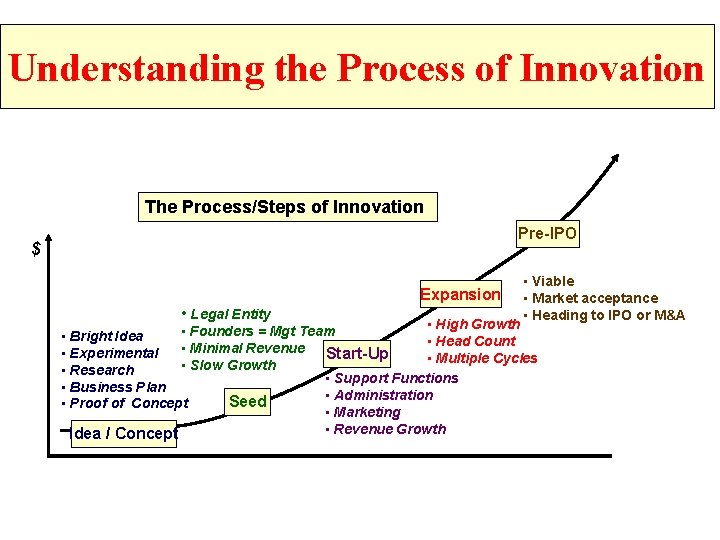
Understanding the Process of Innovation The Process/Steps of Innovation Pre-IPO $ Expansion • Legal Entity • Viable • Market acceptance • Heading to IPO or M&A • High Growth • Founders = Mgt Team • Bright Idea • Head Count • Minimal Revenue Start-Up • Experimental • Multiple Cycles • Slow Growth • Research • Support Functions • Business Plan • Administration Seed • Proof of Concept • Marketing • Revenue Growth Idea / Concept Time
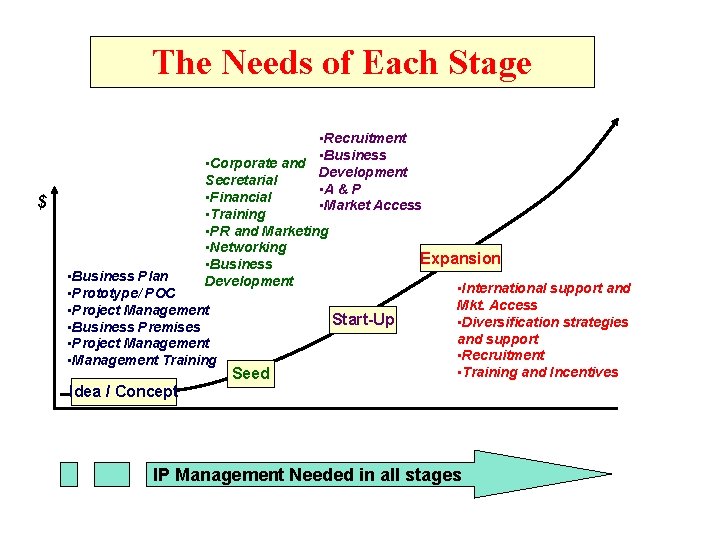
The Needs of Each Stage • Recruitment • Business • Corporate and Development Secretarial • A & P • Financial • Market Access • Training • PR and Marketing • Networking Expansion • Business Development • International support and $ • Business Plan • Prototype/ POC • Project Management • Business Premises • Project Management • Management Training Start-Up Seed Mkt. Access • Diversification strategies and support • Recruitment • Training and Incentives Idea / Concept Time IP Management Needed in all stages
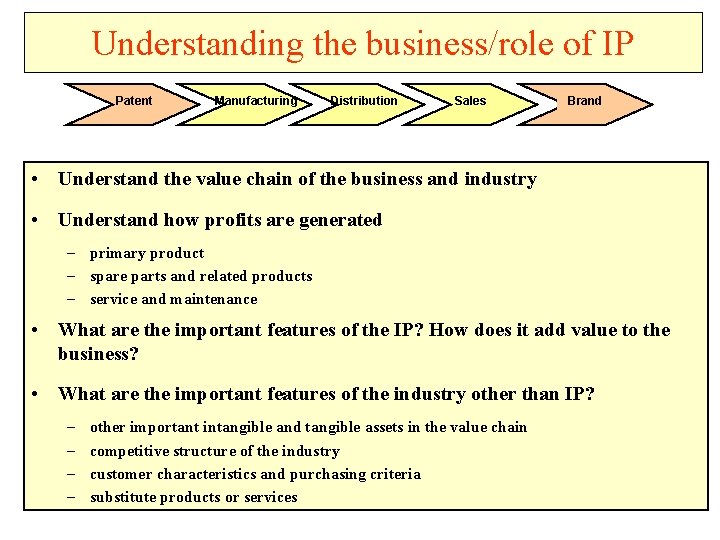
Understanding the business/role of IP Patent Manufacturing Distribution Sales Brand • Understand the value chain of the business and industry • Understand how profits are generated – primary product – spare parts and related products – service and maintenance • What are the important features of the IP? How does it add value to the business? • What are the important features of the industry other than IP? – – other important intangible and tangible assets in the value chain competitive structure of the industry customer characteristics and purchasing criteria substitute products or services
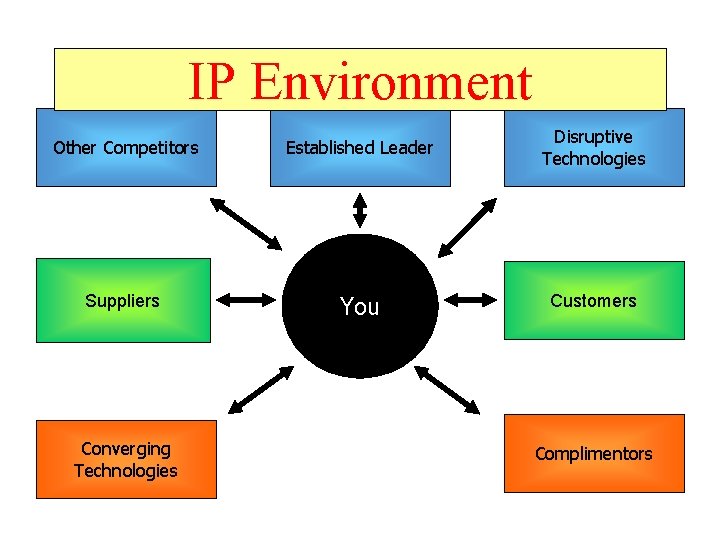
IP Environment Other Competitors Established Leader Disruptive Technologies Suppliers You Customers Converging Technologies Complimentors
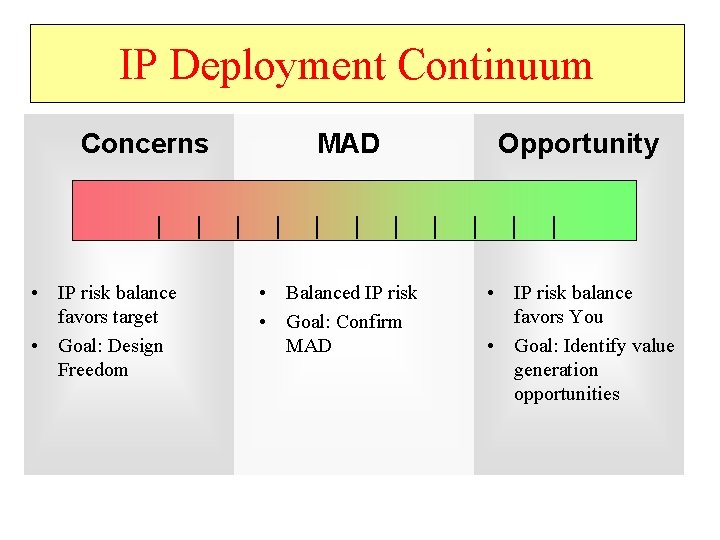
IP Deployment Continuum Concerns | • IP risk balance favors target • Goal: Design Freedom | MAD | | Opportunity | • Balanced IP risk • Goal: Confirm MAD | | • IP risk balance favors You • Goal: Identify value generation opportunities
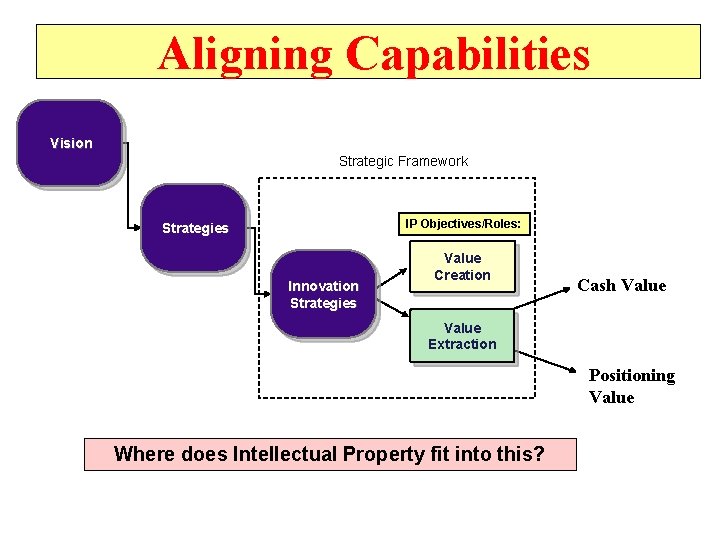
Aligning Capabilities Vision Strategic Framework IP Objectives/Roles: Strategies Innovation Strategies Value Creation Cash Value Extraction Positioning Value Where does Intellectual Property fit into this?

An Aspect of Good Management • People Management – by people because IP is generated by people and used • Knowledge Management – because a lot of knowledge is informal and may or may not crystallise as recognisable category of IP • IT Strategic Planning – because a lot of IP is IT-related; some the more complex IP issues arise in IT context of • Contract Management – because IP is often created (or improved) in context of a contract (eg, supply contract or joint venture relationship) • Asset Management – because IP is an asset, albeit intangible; it has value a • Risk Management – because there are risks to an organisation flowing from its actions, or failure to act, in relation to IP (including risk of lost opportunity)
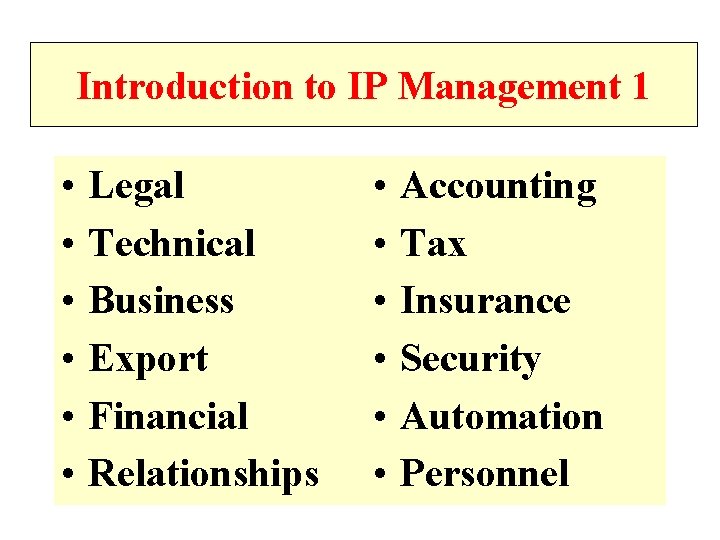
Introduction to IP Management 1 • • • Legal Technical Business Export Financial Relationships • • • Accounting Tax Insurance Security Automation Personnel
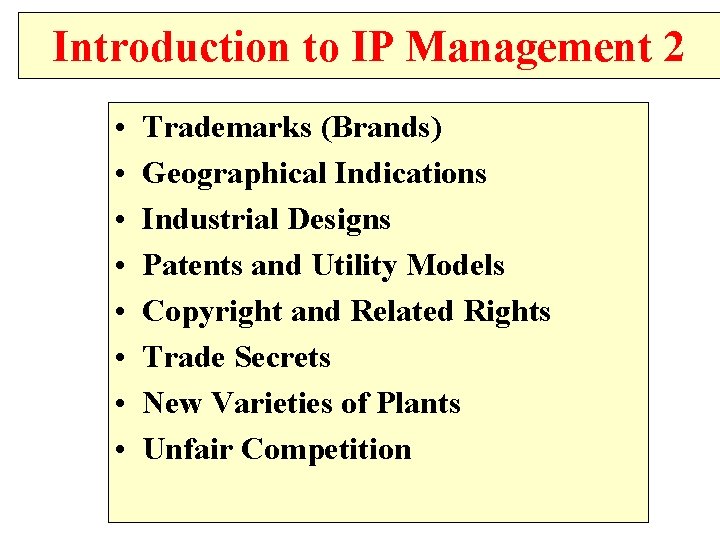
Introduction to IP Management 2 • • Trademarks (Brands) Geographical Indications Industrial Designs Patents and Utility Models Copyright and Related Rights Trade Secrets New Varieties of Plants Unfair Competition
Bringing it All Together Example No. 1 • Decades ago, Coca-Cola decided to keep its soft drink formula a secret • The formula is only know to a few people within the company • Kept in the vault of a bank in Atlanta • Those who know the secret formula have signed non-disclosure agreements • It is rumored that they are not allowed to travel together • If it had patented its formula, the whole world would be making Coca-Cola
Bringing it All Together Example No. 2 • Patent for stud and tube coupling system (the way bricks hold together) • But: Today the patents have long expired and the company tries hard to keep out competitors by using designs, trademarks and copyright
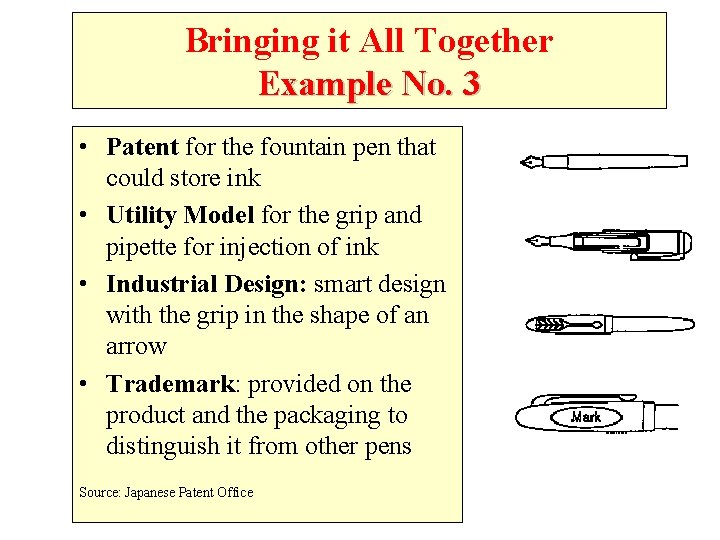
Bringing it All Together Example No. 3 • Patent for the fountain pen that could store ink • Utility Model for the grip and pipette for injection of ink • Industrial Design: smart design with the grip in the shape of an arrow • Trademark: provided on the product and the packaging to distinguish it from other pens Source: Japanese Patent Office
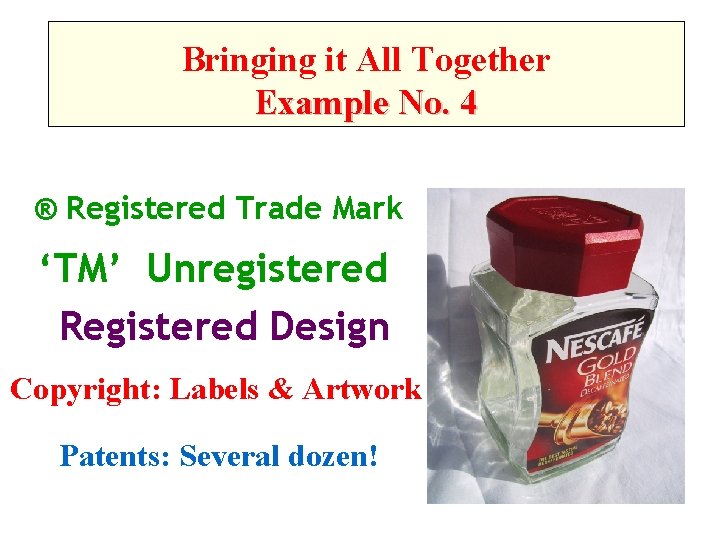
Bringing it All Together Example No. 4 ® Registered Trade Mark ‘TM’ Unregistered Registered Design Copyright: Labels & Artwork Patents: Several dozen!
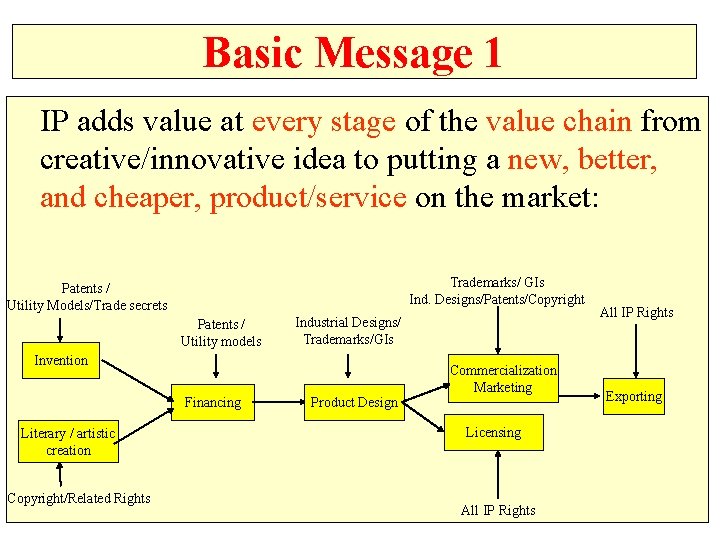
Basic Message 1 IP adds value at every stage of the value chain from creative/innovative idea to putting a new, better, and cheaper, product/service on the market: Trademarks/ GIs Ind. Designs/Patents/Copyright Patents / Utility Models/Trade secrets Patents / Utility models Industrial Designs/ Trademarks/GIs Invention Commercialization Marketing Financing Literary / artistic creation Copyright/Related Rights Product Design Licensing All IP Rights Exporting
Basic Message 2 • IP Strategy should be an integral part of the overall business strategy of an Enterprise • The IP strategy of an Enterprise is influenced by its creative/innovative capacity, financial resources, field of technology, competitive environment, etc. • BUT: Ignoring the IP system altogether is in itself an IP strategy, which may eventually prove very costly or even fatal
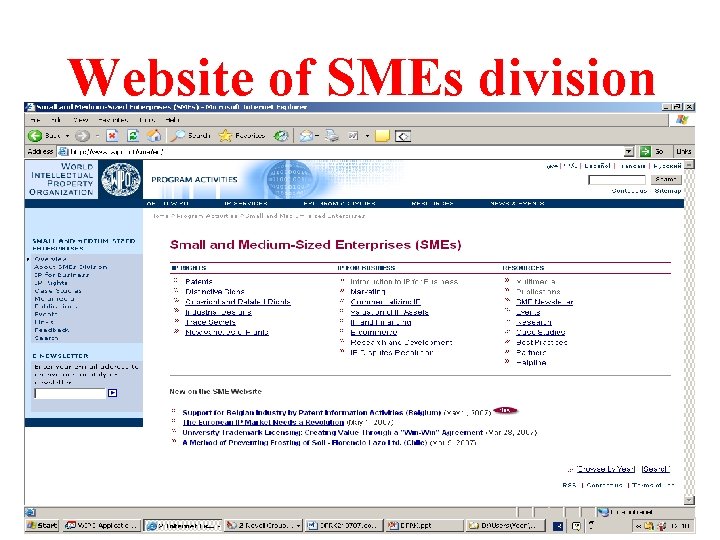
Website of SMEs division
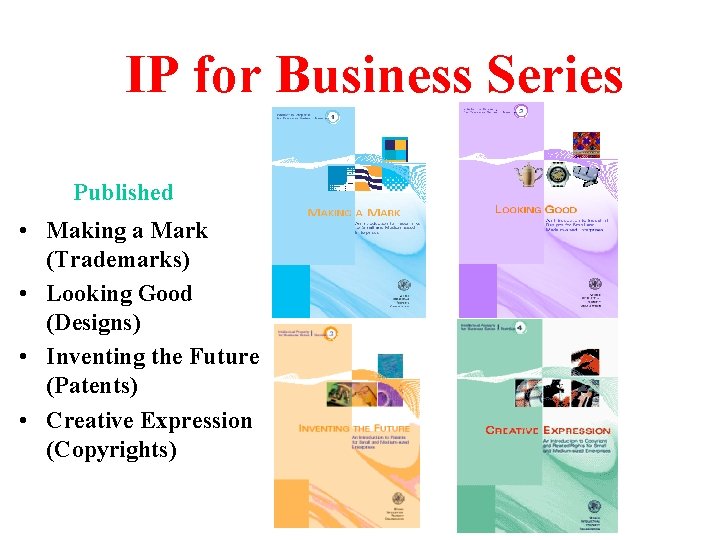
IP for Business Series Published • Making a Mark (Trademarks) • Looking Good (Designs) • Inventing the Future (Patents) • Creative Expression (Copyrights)
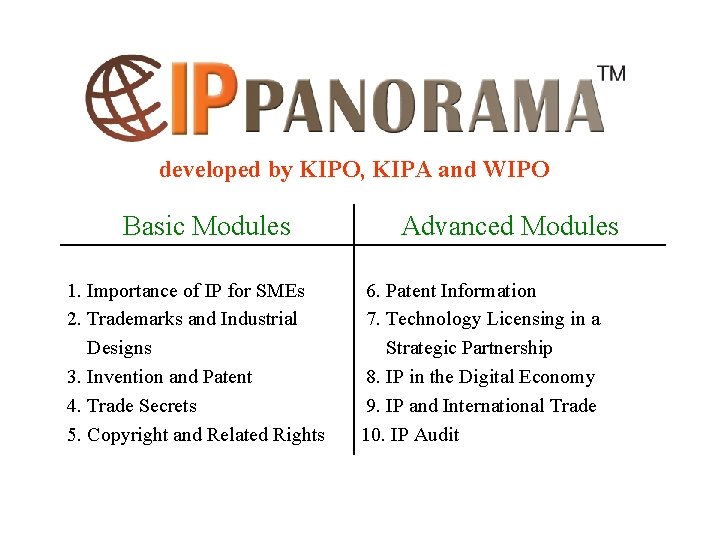
developed by KIPO, KIPA and WIPO Basic Modules 1. Importance of IP for SMEs 2. Trademarks and Industrial Designs 3. Invention and Patent 4. Trade Secrets 5. Copyright and Related Rights Advanced Modules 6. Patent Information 7. Technology Licensing in a Strategic Partnership 8. IP in the Digital Economy 9. IP and International Trade 10. IP Audit
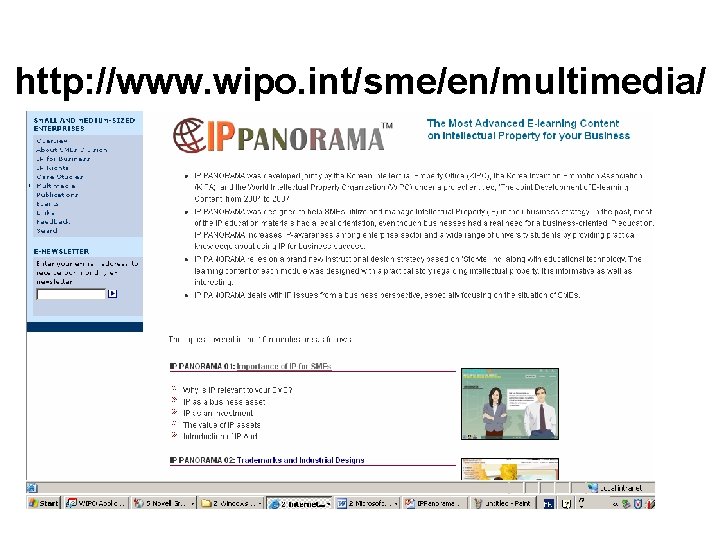
http: //www. wipo. int/sme/en/multimedia/
WIPO SMEs Web-Site “www. wipo. int/sme” “IP for Business Series” in Publications “IP Panorama” in Multimedia “E-NEWSLETTER” Guriqbal Singh Jaiya guriqbal. jaiya@wipo. int
- Slides: 28