
Strategic Thinking to Align Initiatives and Integrate Management
- Slides: 10
Strategic Thinking to Align Initiatives and Integrate Management, Supervision, and Practice Heidi D. Mc. Intosh, MSW Deputy Commissioner Fernando J. Muñiz, MPA Director of Planning and Best Practices DEPARTMENT of CHILDREN and FAMILIES Making a Difference for Children, Families and Communities
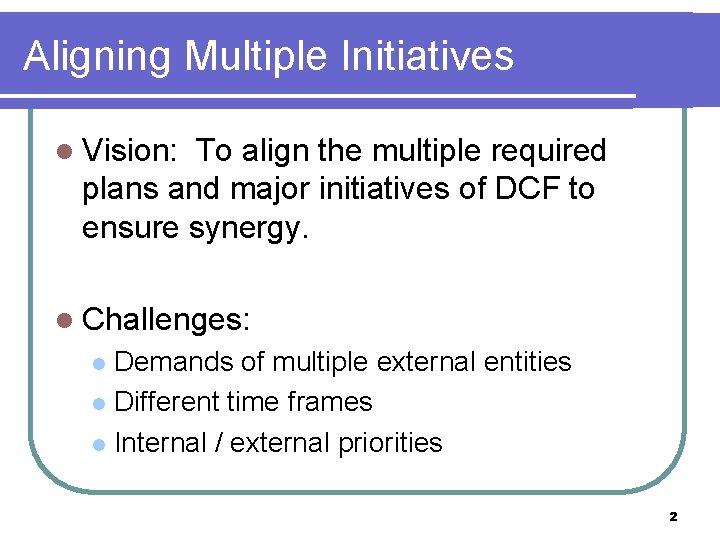
Aligning Multiple Initiatives l Vision: To align the multiple required plans and major initiatives of DCF to ensure synergy. l Challenges: Demands of multiple external entities l Different time frames l Internal / external priorities l 2
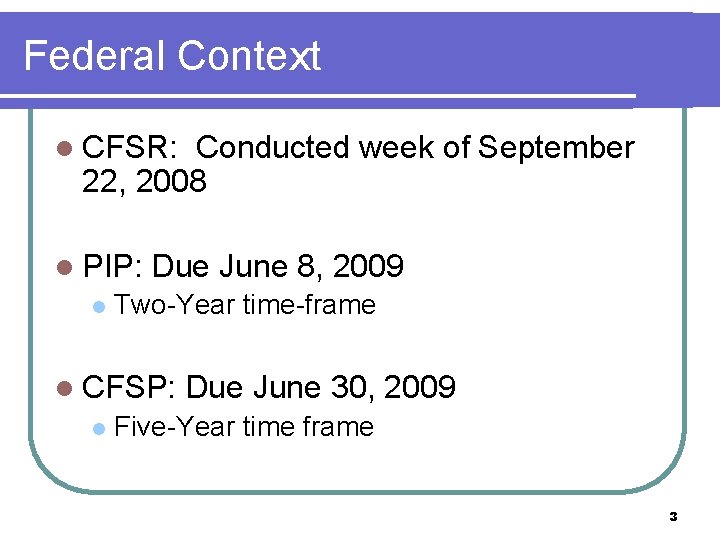
Federal Context l CFSR: Conducted week of September 22, 2008 l PIP: l Due June 8, 2009 Two-Year time-frame l CFSP: l Due June 30, 2009 Five-Year time frame 3
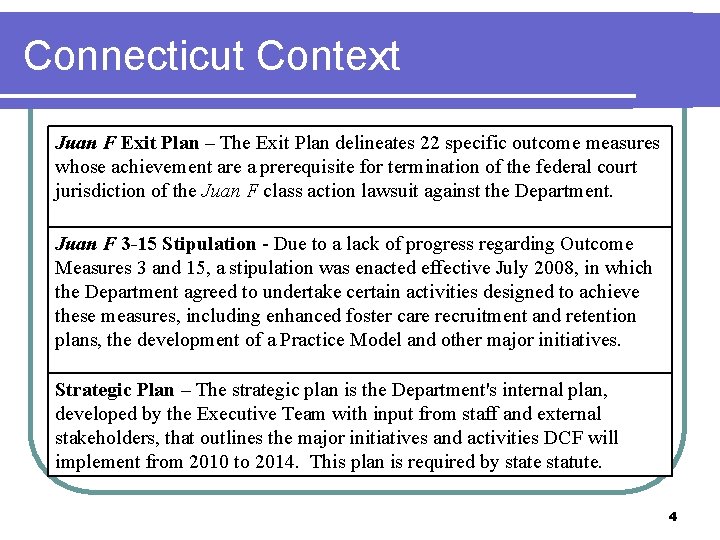
Connecticut Context Juan F Exit Plan – The Exit Plan delineates 22 specific outcome measures whose achievement are a prerequisite for termination of the federal court jurisdiction of the Juan F class action lawsuit against the Department. Juan F 3 -15 Stipulation - Due to a lack of progress regarding Outcome Measures 3 and 15, a stipulation was enacted effective July 2008, in which the Department agreed to undertake certain activities designed to achieve these measures, including enhanced foster care recruitment and retention plans, the development of a Practice Model and other major initiatives. Strategic Plan – The strategic plan is the Department's internal plan, developed by the Executive Team with input from staff and external stakeholders, that outlines the major initiatives and activities DCF will implement from 2010 to 2014. This plan is required by state statute. 4
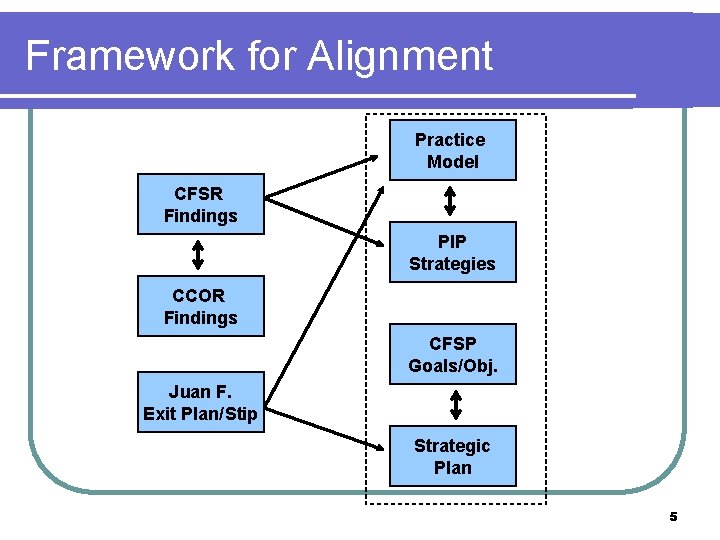
Framework for Alignment Practice Model CFSR Findings PIP Strategies CCOR Findings CFSP Goals/Obj. Juan F. Exit Plan/Stip Strategic Plan 5
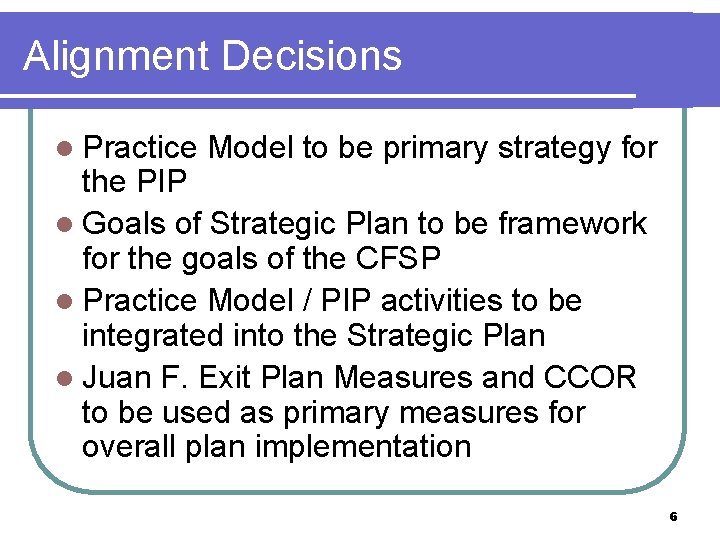
Alignment Decisions l Practice Model to be primary strategy for the PIP l Goals of Strategic Plan to be framework for the goals of the CFSP l Practice Model / PIP activities to be integrated into the Strategic Plan l Juan F. Exit Plan Measures and CCOR to be used as primary measures for overall plan implementation 6
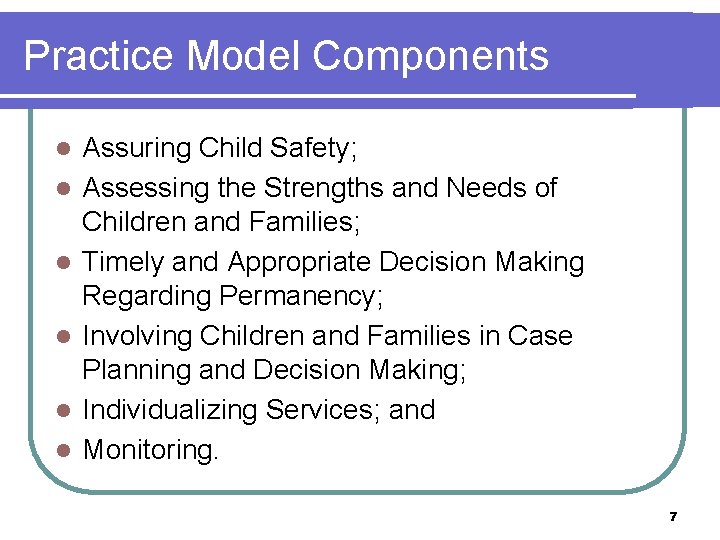
Practice Model Components l l l Assuring Child Safety; Assessing the Strengths and Needs of Children and Families; Timely and Appropriate Decision Making Regarding Permanency; Involving Children and Families in Case Planning and Decision Making; Individualizing Services; and Monitoring. 7
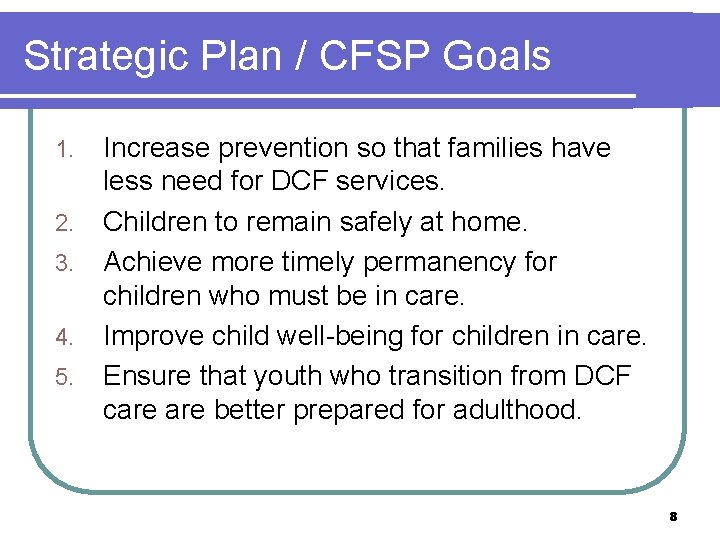
Strategic Plan / CFSP Goals 1. 2. 3. 4. 5. Increase prevention so that families have less need for DCF services. Children to remain safely at home. Achieve more timely permanency for children who must be in care. Improve child well-being for children in care. Ensure that youth who transition from DCF care better prepared for adulthood. 8
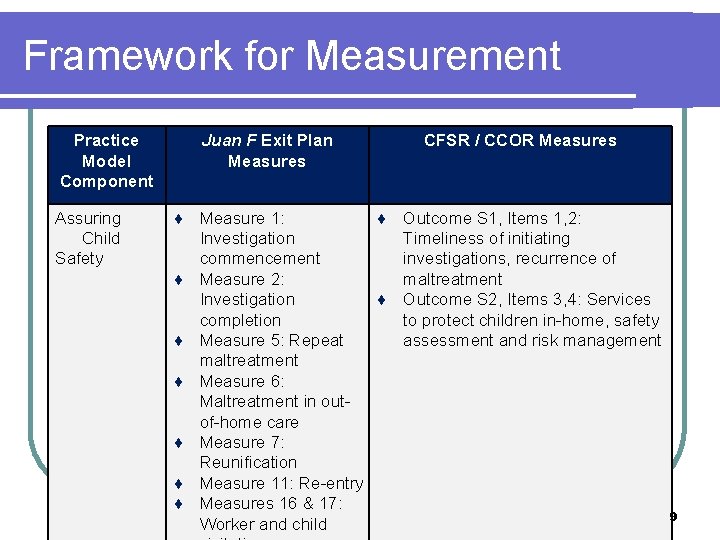
Framework for Measurement Practice Model Component Assuring Child Safety Juan F Exit Plan Measures CFSR / CCOR Measures Measure 1: Outcome S 1, Items 1, 2: Investigation Timeliness of initiating commencement investigations, recurrence of Measure 2: maltreatment Investigation Outcome S 2, Items 3, 4: Services completion to protect children in-home, safety Measure 5: Repeat assessment and risk management maltreatment Measure 6: Maltreatment in outof-home care Measure 7: Reunification Measure 11: Re-entry Measures 16 & 17: Worker and child 9
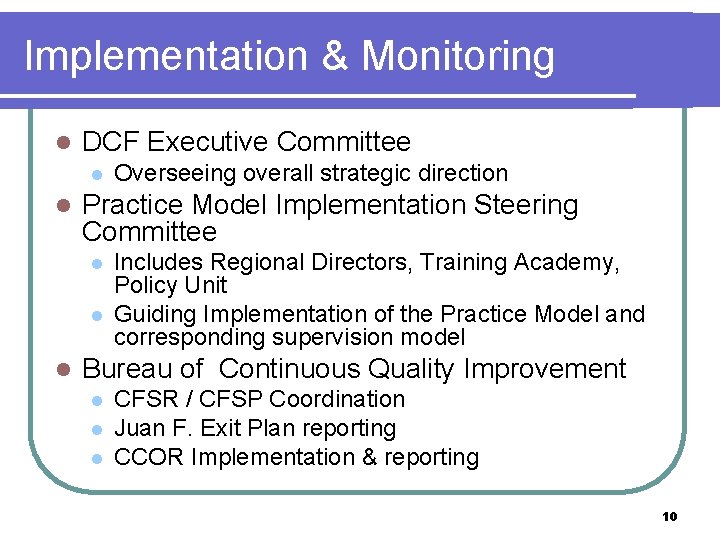
Implementation & Monitoring l DCF Executive Committee l l Practice Model Implementation Steering Committee l l l Overseeing overall strategic direction Includes Regional Directors, Training Academy, Policy Unit Guiding Implementation of the Practice Model and corresponding supervision model Bureau of Continuous Quality Improvement l l l CFSR / CFSP Coordination Juan F. Exit Plan reporting CCOR Implementation & reporting 10