
Strategic Thinking and Performance Improvement in High Reliability
Strategic Thinking and Performance Improvement in High Reliability Organizations © Wisconsin Organization of Nurse Executives
Resources Some of this content is reflective of the Harvard Manage Mentor program on Strategic Execution; permission granted to use copyrighted material
Learning Objectives 1. Define strategic planning, performance improvement in creating high reliable organizations. 2. Apply concepts to your organization 3. Utilize tools to create an operational plan for your project (SWOT, SMART objectives, PDSA, 3 “W’s”) 4. Describe nursing leader attributes in process improvement and strategic planning.
High Reliability Organizations Creating a culture and processes that radically reduce system failures and effectively respond when failures do occur is the goal of high reliability thinking. Agency for Healthcare Research and Quality, AHRQ Publication No. 08 -0022, April 2008
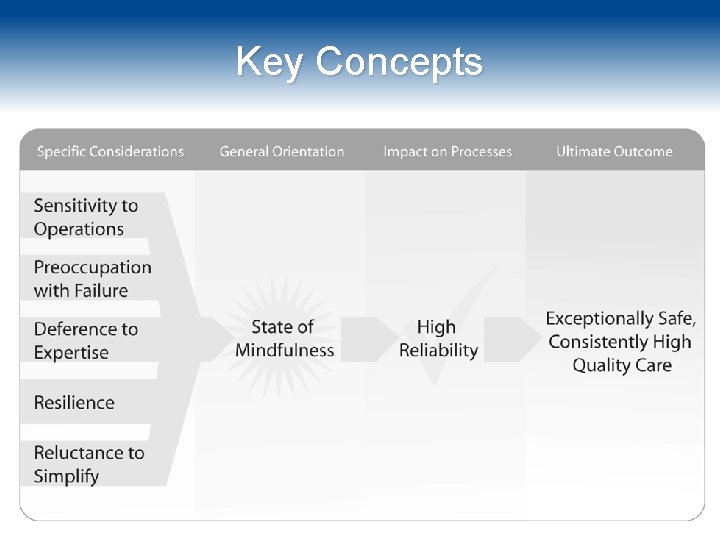
Key Concepts
Sensitivity to Operations Sensitivity to operations encompasses more than checks of patient identity, vital signs, and medications. It includes awareness by staff, supervisors, and management of broader issues that can affect patient care: how long a person has been on duty, availability of needed supplies, potential distractions.
Reluctance to Simplify Oversimplifying explanations for how things work risks developing unworkable solutions. Failing to understand all the ways in which a system may fail, placing a patient at risk.
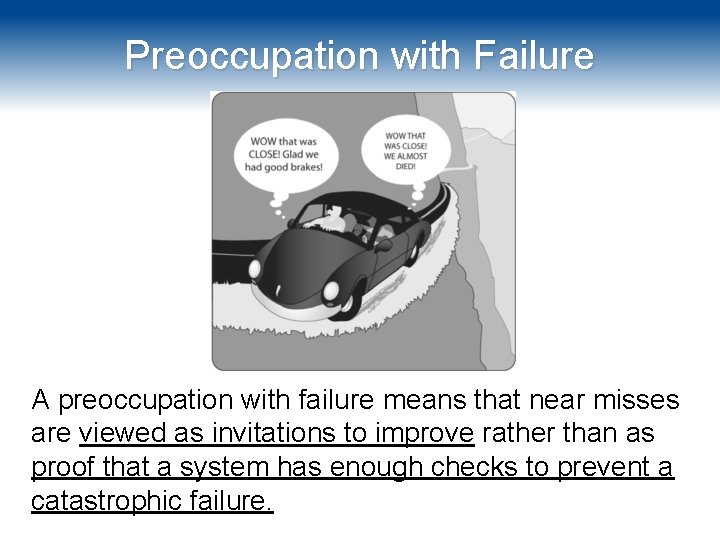
Preoccupation with Failure A preoccupation with failure means that near misses are viewed as invitations to improve rather than as proof that a system has enough checks to prevent a catastrophic failure.
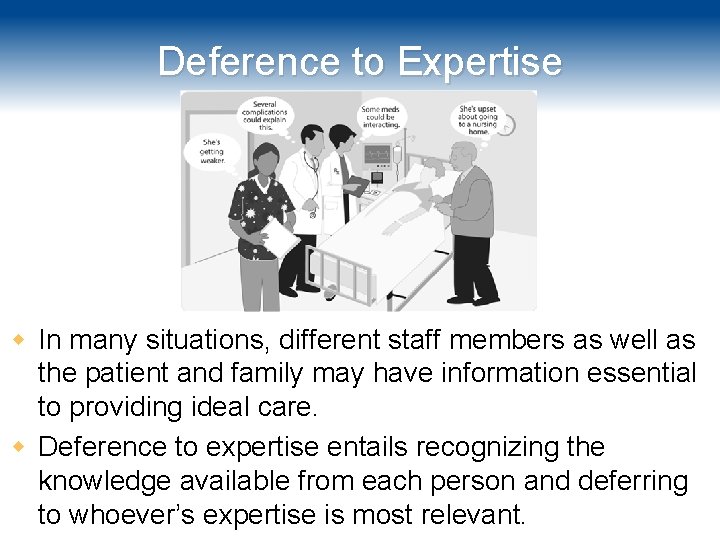
Deference to Expertise In many situations, different staff members as well as the patient and family may have information essential to providing ideal care. Deference to expertise entails recognizing the knowledge available from each person and deferring to whoever’s expertise is most relevant.
Resilience A High Reliability Organization assumes that, despite considerable safeguards, the system may fail in unanticipated ways. They prepare for these failures by training staff to perform quick situational assessments
Highly Reliability Group Activity Can you list some of the activities in place at your organization that makes you more reliable: List examples
Strategic Planning - Importance Strategy – a process that spurs changes so an organization can achieve outstanding results Understand what you do Look long-term to determine what you want to become Focus on how you plan to get there
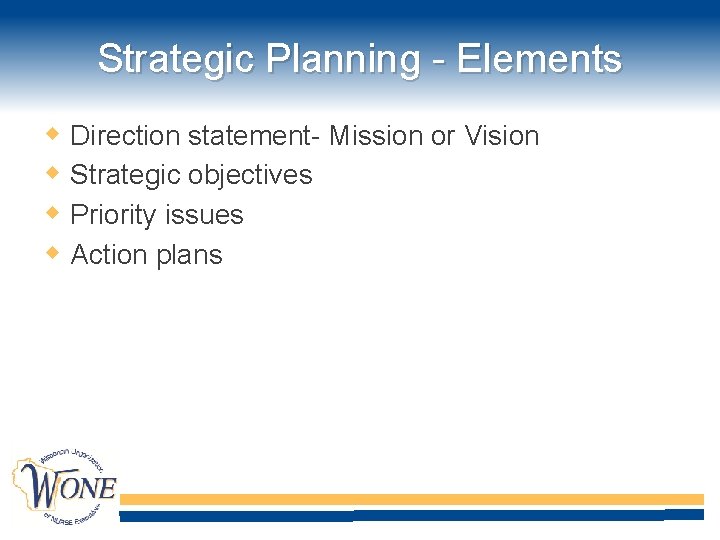
Strategic Planning - Elements Direction statement- Mission or Vision Strategic objectives Priority issues Action plans
The Strategic Plan is the result of the Strategic Planning process
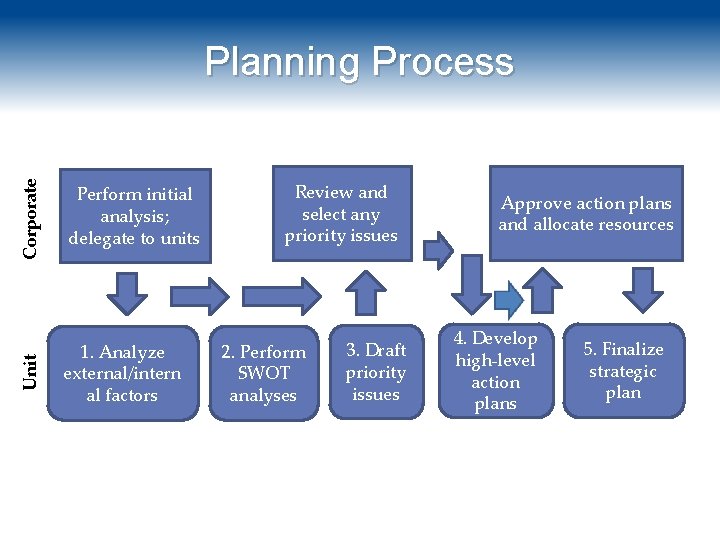
Corporate Perform initial analysis; delegate to units Unit Planning Process 1. Analyze external/intern al factors Review and select any priority issues 2. Perform SWOT analyses 3. Draft priority issues Approve action plans and allocate resources 4. Develop high-level action plans 5. Finalize strategic plan
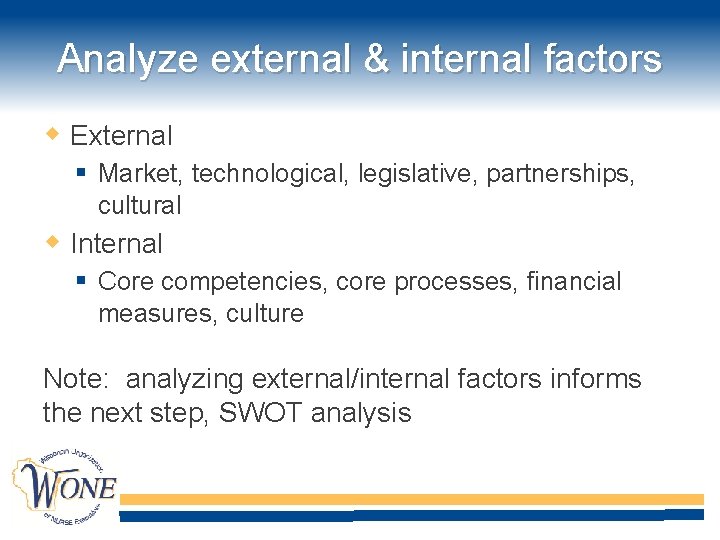
Analyze external & internal factors External Market, technological, legislative, partnerships, cultural Internal Core competencies, core processes, financial measures, culture Note: analyzing external/internal factors informs the next step, SWOT analysis
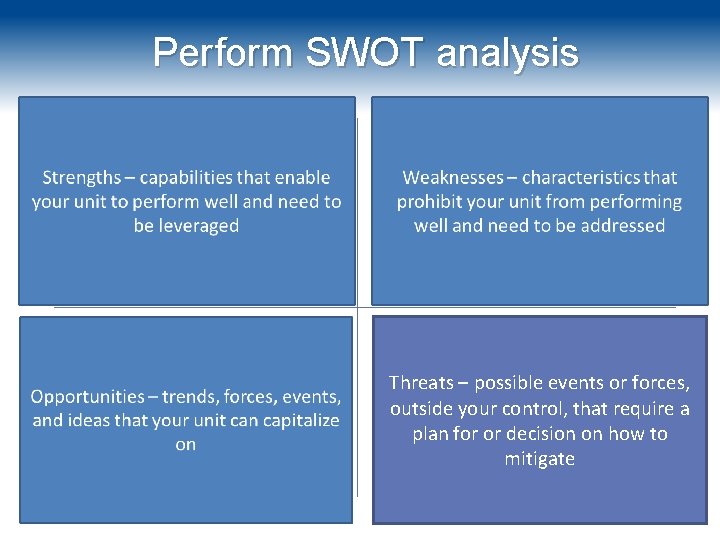
Perform SWOT analysis Threats – possible events or forces, outside your control, that require a plan for or decision on how to mitigate
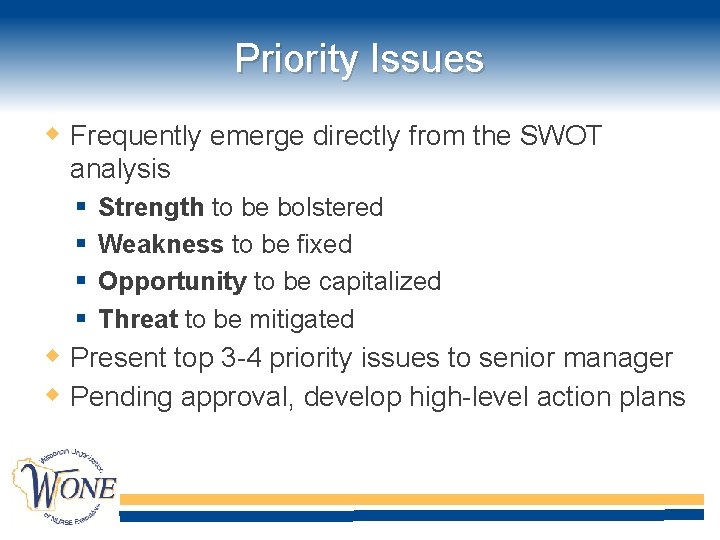
Priority Issues Frequently emerge directly from the SWOT analysis Strength to be bolstered Weakness to be fixed Opportunity to be capitalized Threat to be mitigated Present top 3 -4 priority issues to senior manager Pending approval, develop high-level action plans
High level action plan Identify priority issues to achieve strategic plan Detail objective, task, and requirements needed to carry out strategic initiative. SMART GOALS 3 W’s PDSA
Writing SMART objectives Specific Measurable Achievable Realistic Timebound
Group Activity-5 minutes Write a SMART goal based off your project, or if you haven’t decided on your project, write one for your New Years resolution.
3 “W’s” What? When? Who?
Large Group Activity 10 minutes What is our priority issue? We need an 1 -2 action steps for each priority issue Create an action plan with the following: SMART objectives Tasks (What? ) Resources (Who? ) Timeline (When? )
Process Improvement Tools Lean Six Sigma PDSA 8 D problem solving 5 S Auditing Benchmarking Brainstorming Customer Focus Surveys
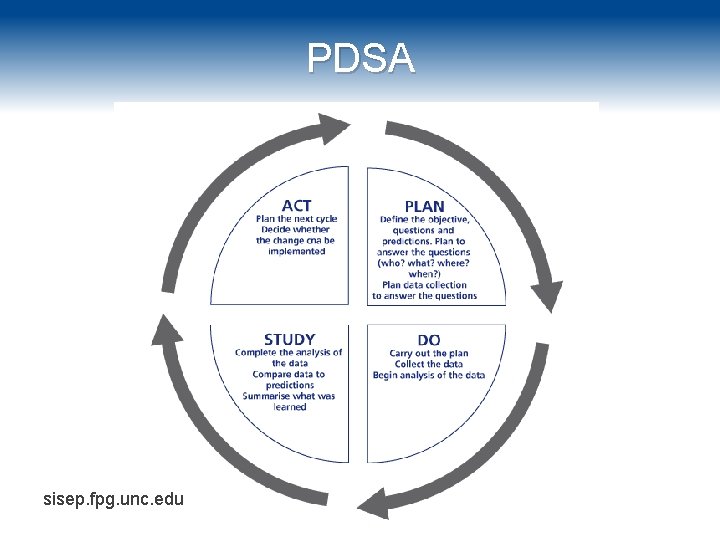
PDSA sisep. fpg. unc. edu
Success with PDSA Starts with 3 questions 1. What are we trying to accomplish? 2. How will we know that a change is an improvement? 3. What changes can we make that will result in improvement? Kelly (2008)
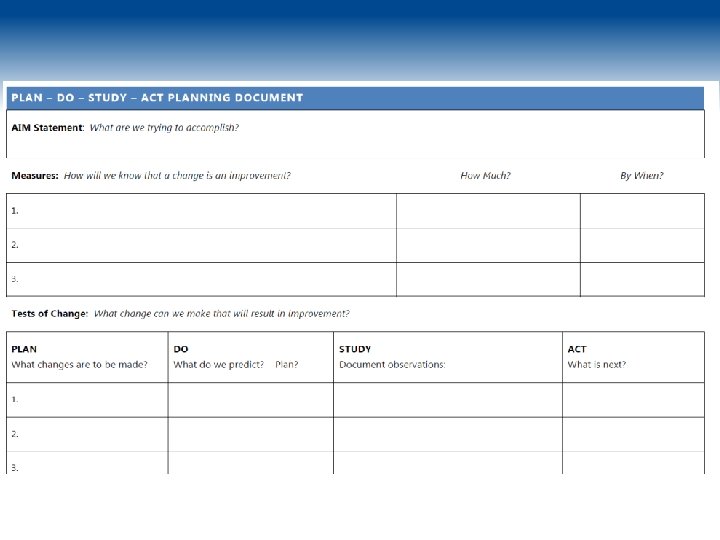
Plan-Do-Study-Act At your tables, identify a problem that your organization(s) needs to improve upon Examples: Falls, CAUTIs, Readmissions, etc. Use the following format develop Aim Statement/Goal Measures Tests of Change Take 2 -3 minutes for individual work Take 5 -10 minutes for group activity
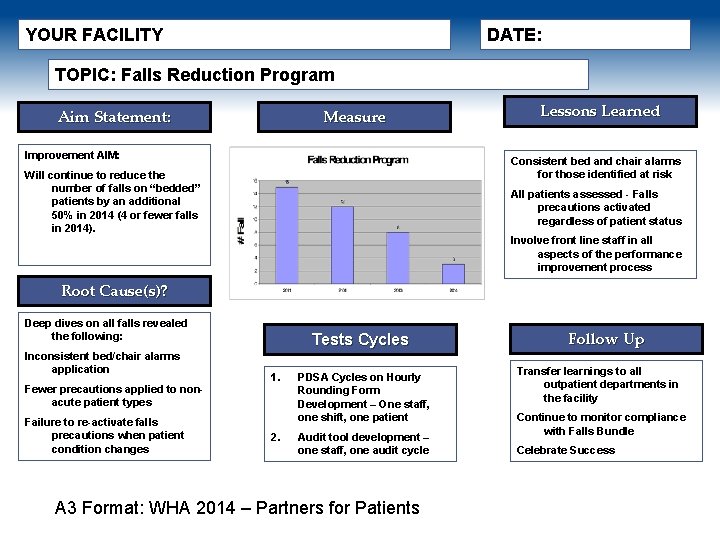
YOUR FACILITY DATE: TOPIC: Falls Reduction Program Aim Statement: Measure Improvement AIM: Consistent bed and chair alarms for those identified at risk Will continue to reduce the number of falls on “bedded” patients by an additional 50% in 2014 (4 or fewer falls in 2014). 1. Lessons Learned All patients assessed - Falls precautions activated regardless of patient status Involve front line staff in all aspects of the performance improvement process Will continue to reduce the number of falls on “bedded Root Cause(s)? Deep dives on all falls revealed the following: Inconsistent bed/chair alarms application Fewer precautions applied to nonacute patient types Failure to re-activate falls precautions when patient condition changes Tests Cycles 1. 2. PDSA Cycles on Hourly Rounding Form Development – One staff, one shift, one patient Audit tool development – one staff, one audit cycle A 3 Format: WHA 2014 – Partners for Patients Follow Up Transfer learnings to all outpatient departments in the facility Continue to monitor compliance with Falls Bundle Celebrate Success
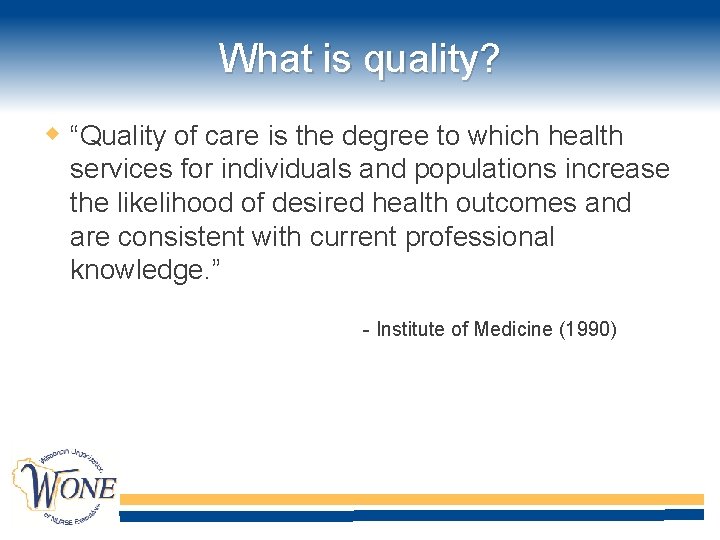
What is quality? “Quality of care is the degree to which health services for individuals and populations increase the likelihood of desired health outcomes and are consistent with current professional knowledge. ” - Institute of Medicine (1990)
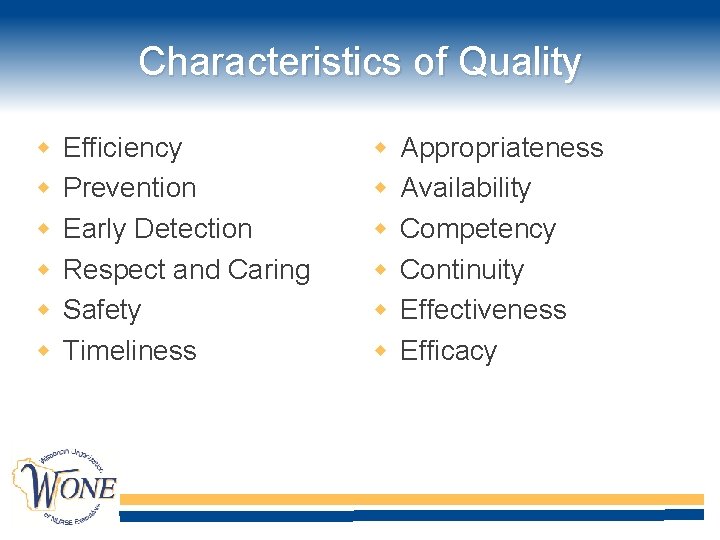
Characteristics of Quality Efficiency Prevention Early Detection Respect and Caring Safety Timeliness Appropriateness Availability Competency Continuity Effectiveness Efficacy
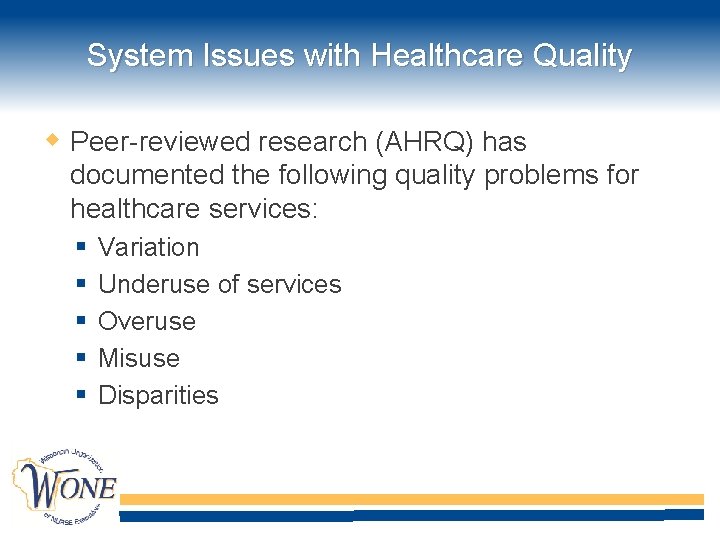
System Issues with Healthcare Quality Peer-reviewed research (AHRQ) has documented the following quality problems for healthcare services: Variation Underuse of services Overuse Misuse Disparities
Collecting Data on Quality and Safety in Healthcare Key components of the Patient Safety and Quality Improvement Act (2004) Establish patient safety as part of the mission of the organization Stop blaming people—improve processes Improve the use of technology to prevent and detect error Use data to identify and measure improvements
Leaders lead culture change Cultures of safety are characterized by enhanced communication regarding errors and adverse events, as well as mutual trust between management and staff and among practitioners “Just Cultures” focus on processes not people
Trends in Healthcare Accountable Care Organizations Care Transitions Care Continuum Bundling Pay for Performance- accountability for outcomes reinforced with financial penalties Professional involvement (MD, RN, other practice disciplines) Practice Guidelines for nursing, medicine & other disciplines
Leadership Role Create culture - teamwork Evidence based management Knowledge of regulatory requirements Self-awareness/ relationship builder Working “SMART” in everything Problem solving- process improvement Inspire and embrace change
Why?
Questions?
- Slides: 39