
Strategic Technology Management Chapter One Introduction Introduction technology

- Slides: 15
Strategic Technology Management
Chapter One Introduction
Introduction • technology noun 1. electronic or digital products and systems considered as a group 2. a technological process, invention, method or the like 3. the practical application of science to commerce or industry 4. the branch of knowledge that deals with the creation and use of technical means and their interrelation with life, society and the environment 5. the sum of the ways in which social groups provide themselves with the material objects of their civilization
Intro… • Strategy noun 1. a plan, method or series of maneuvers for obtaining a specific goal or result 2. the science and art of military command as applied to the overall planning and conduct of large-scale combat operations 3. the art or skill of using stratagems in endeavors such as politics and business
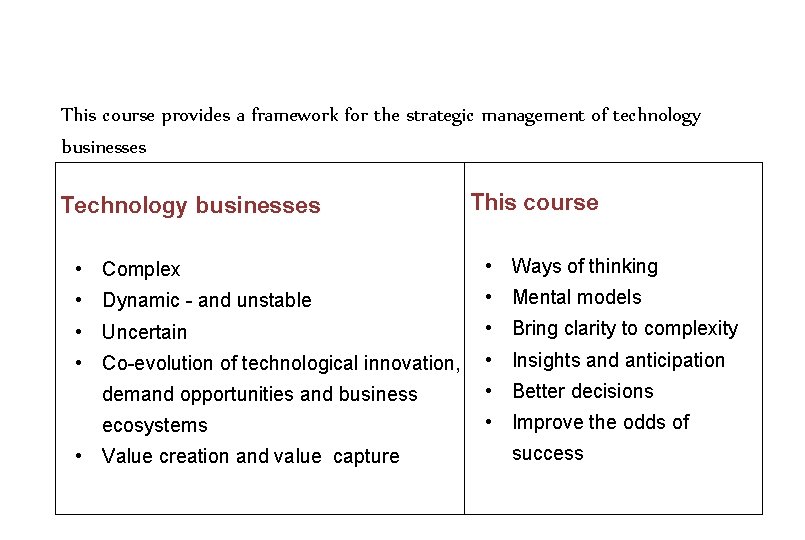
This course provides a framework for the strategic management of technology businesses This course • Complex • Ways of thinking • Dynamic - and unstable • Mental models • Uncertain • Bring clarity to complexity • Co-evolution of technological innovation, • Insights and anticipation demand opportunities and business • Better decisions ecosystems • Improve the odds of • Value creation and value capture success
Why is technology (really) important? • Technological innovation drives economic growth • reason for us being here today • why we no longer live in caves • explaining how economies grow • escaping the Malthusian trap (technological advances could increase a society's supply of resources) • Along the way … • Get it wrong – waste a lot of money and people’s lives • Get it right - create wealth, capture it and enjoy
Stone age 250, 000 B. C. • Time for survival • Tools were made of stone • Used for cutting, hunting, pounding vegetables and even progressed to harnessing fire Bronze Age 3000 B. C. - 1200 B. C. • Tools were made from metal • Metal was easier to shape, more durable and useful than stone tools. • Improved agriculture practices, growing industries and military applications. Iron Age B. C A. D. • People began to move from farms to develop towns and cities. • Tools were made of iron and steel • Developments such as the plow and irrigation enabled fewer farmers to grow more food.
Middle Ages 500 A. D. - 1450 A. D. • Development of paper money • Waterwheel to grind grain • Magnetic compass for exploration • Printing press for books • All these allowed people to trade, travel and spread information easier. Renaissance 1450 A. D -1700 A. D. • Rebirth of the arts and humanities • Leonardo da Vinci created drawings • The camera obscure, telescope, the submarine, and hydraulic press • Mechanization of the farm, labor was freed up for work in the factories. This caused people to move into the cities.
Industrial Age 1700 – 1940 • Industry played a major role in society • interchangeable parts and Henry Ford’s movable conveyor • The steam engine, gasoline and diesel engine, airplanes, telephones, telegraphs, and radios People more leisure time more time for children to spend in school instead of on the farm. Information Age 1940 – present • Processing and exchanging information • The development of binary language, transistors, microchips • Explosion of computers, calculators and communication processes to quickly move information form place to place” • Hydrogen bomb, space shuttles, communication satellites, prefabrication, biotechnology, freeze-drying, and the International Space Station. The Information Age has placed knowledge and information at the touch of button.
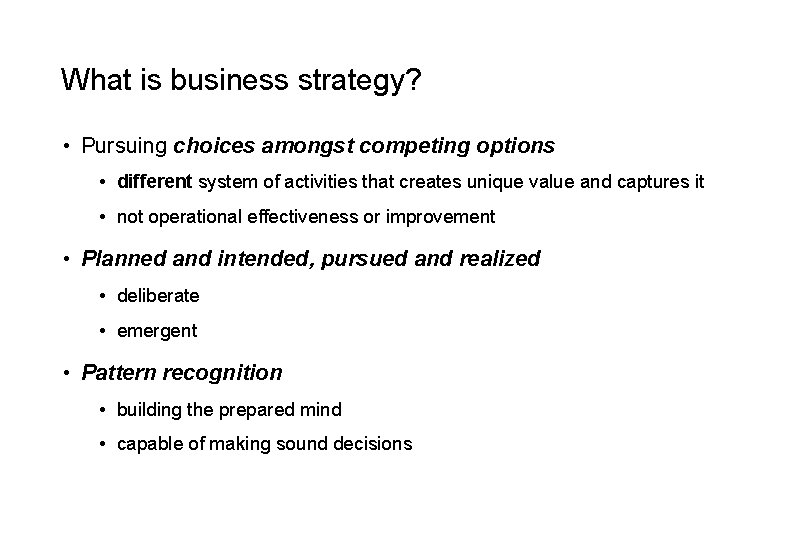
What is business strategy? • Pursuing choices amongst competing options • different system of activities that creates unique value and captures it • not operational effectiveness or improvement • Planned and intended, pursued and realized • deliberate • emergent • Pattern recognition • building the prepared mind • capable of making sound decisions
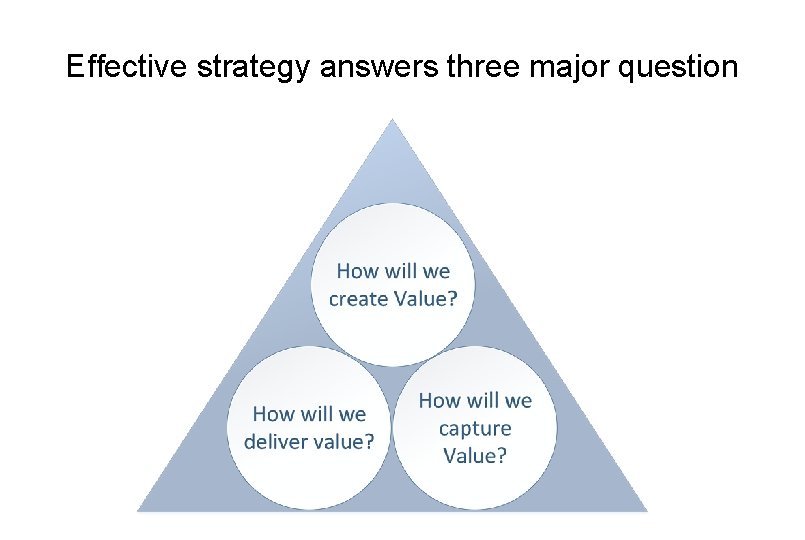
Effective strategy answers three major question
How will we create value? • How will the technology evolve? • How will the market change? • How do we organize effectively? How will we capture value? • How do we compete to gain sustainable competitive advantage? • How should we compete if standards are important? • How to manage technology platforms? How will we deliver value? • How should we execute the strategy? • How do we make strategic decisions and take decisive action?
Knowledge and Technological Innovation - engines driving growth • “Technological change - improvement in the instructions for mixing together raw materials - lies at the heart of economic growth” • “Technological change arises in large part because of intentional actions taken by people who respond to market incentives. ” • “instructions for working with raw materials are inherently different from other economic goods. Once the cost of creating a new set of instructions has been incurred, the instructions can be used over and over again at no additional cost. ”
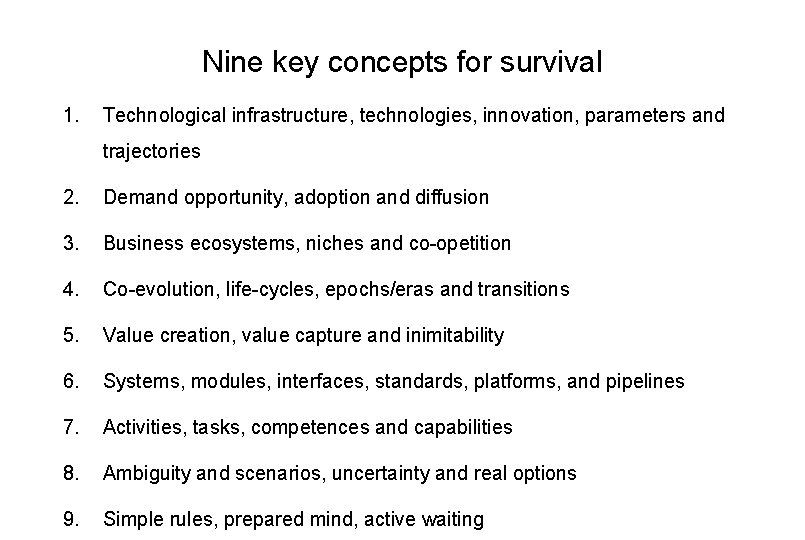
Nine key concepts for survival 1. Technological infrastructure, technologies, innovation, parameters and trajectories 2. Demand opportunity, adoption and diffusion 3. Business ecosystems, niches and co-opetition 4. Co-evolution, life-cycles, epochs/eras and transitions 5. Value creation, value capture and inimitability 6. Systems, modules, interfaces, standards, platforms, and pipelines 7. Activities, tasks, competences and capabilities 8. Ambiguity and scenarios, uncertainty and real options 9. Simple rules, prepared mind, active waiting
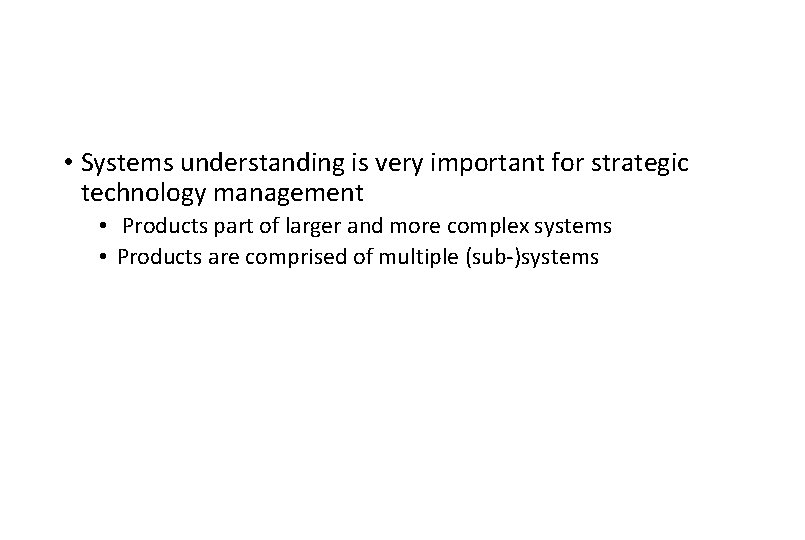
• Systems understanding is very important for strategic technology management • Products part of larger and more complex systems • Products are comprised of multiple (sub-)systems