
Strategic Sequential Voting in MultiIssue Domains and MultipleElection
![Example: joint plan [Brams, Kilgour & Zwicker SCW 98] • The citizens of LA](https://slidetodoc.com/presentation_image/85273431a3144de33d7e64bfd277c813/image-7.jpg "Example: joint plan [Brams, Kilgour & Zwicker SCW 98] • The citizens of LA")
![CP-nets: A compact language [Boutilier et al. UAI-99/JAIR-04] Variables: x, y, z. x y](https://slidetodoc.com/presentation_image/85273431a3144de33d7e64bfd277c813/image-11.jpg "CP-nets: A compact language [Boutilier et al. UAI-99/JAIR-04] Variables: x, y, z. x y")
![Truthful sequential voting [Lang IJCAI 07, Lang&Xia MSS 09] • Issues: main course, wine](https://slidetodoc.com/presentation_image/85273431a3144de33d7e64bfd277c813/image-12.jpg "Truthful sequential voting [Lang IJCAI 07, Lang&Xia MSS 09] • Issues: main course, wine")
![Example (also in [Lacy&Niou 00]) S • T 16](https://slidetodoc.com/presentation_image/85273431a3144de33d7e64bfd277c813/image-17.jpg "Example (also in [Lacy&Niou 00]) S • T 16")
![Preventing manipulation by domain restrictions [Xia&Conitzer 10] • Relax the unrestricted domain property in](https://slidetodoc.com/presentation_image/85273431a3144de33d7e64bfd277c813/image-25.jpg "Preventing manipulation by domain restrictions [Xia&Conitzer 10] • Relax the unrestricted domain property in")
- Slides: 26
Strategic Sequential Voting in Multi-Issue Domains and Multiple-Election Paradoxes Lirong Xia Joint work with Vincent Conitzer Jerome Lang Sep 9, 2011
Outline • Computational voting theory IMHO • General combinatorial voting (computational perspective) • Strategic sequential voting (gametheoretic perspective) 1
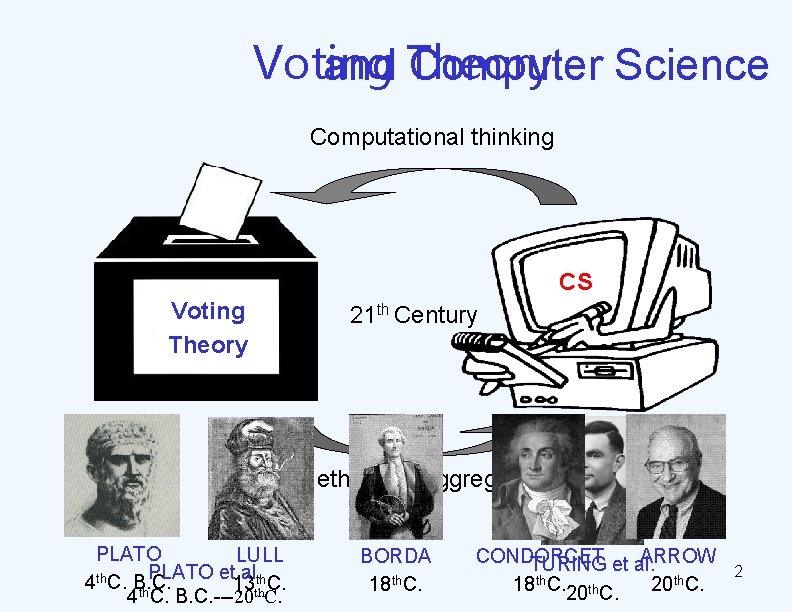
Voting Theory and Computer Science Computational thinking CS Voting Theory 21 th Century Methods of aggregation PLATO LULL PLATO et al. th 4 th. C. B. C. 13 C. 4 th. C. B. C. ---20 th. C. BORDA 18 th. C. CONDORCET ARROW TURING et al. 18 th. C. 20 th. C. 2
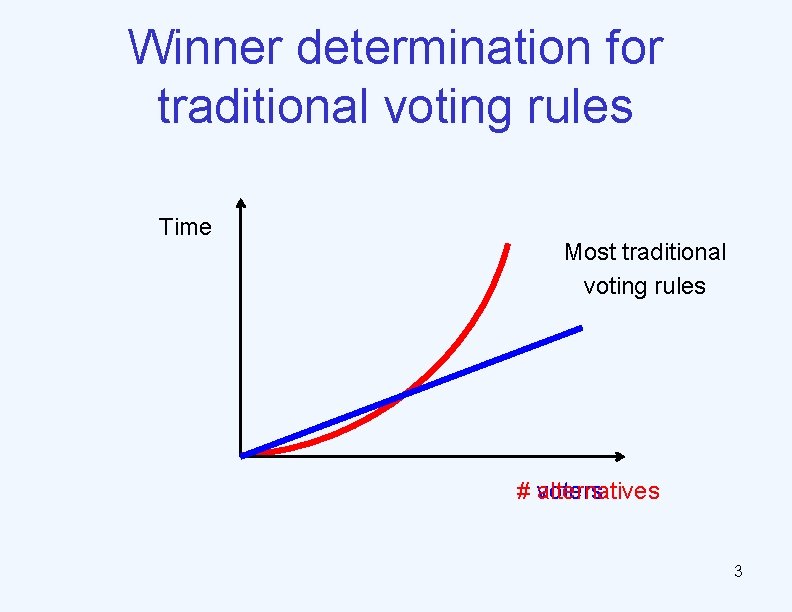
Winner determination for traditional voting rules Time Most traditional voting rules # alternatives # voters 3
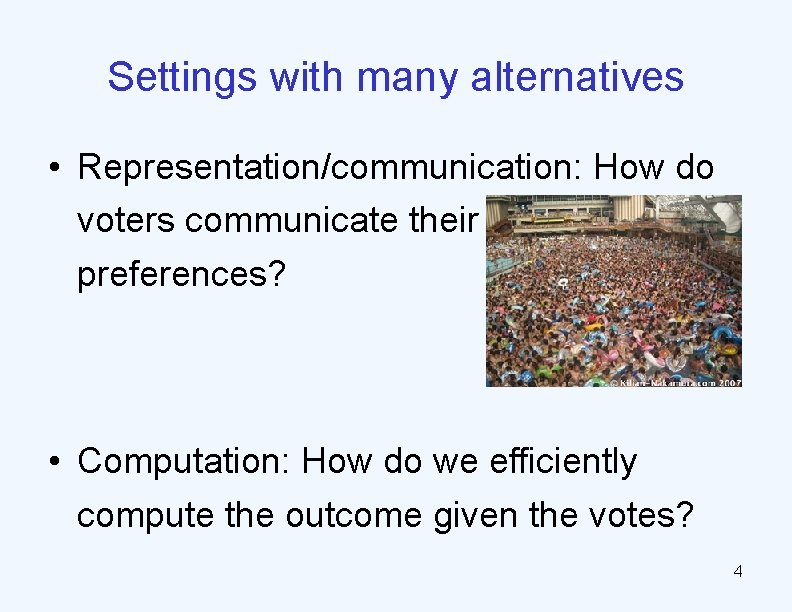
Settings with many alternatives • Representation/communication: How do voters communicate their preferences? • Computation: How do we efficiently compute the outcome given the votes? 4
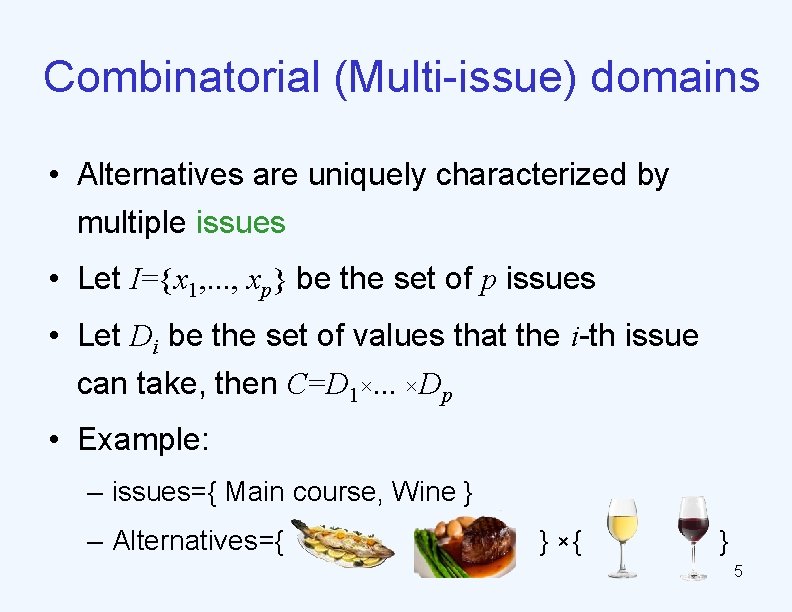
Combinatorial (Multi-issue) domains • Alternatives are uniquely characterized by multiple issues • Let I={x 1, . . . , xp} be the set of p issues • Let Di be the set of values that the i-th issue can take, then C=D 1×. . . ×Dp • Example: – issues={ Main course, Wine } – Alternatives={ } ×{ } 5
Example: joint plan [Brams, Kilgour & Zwicker SCW 98] • The citizens of LA county vote to directly determine a government plan • Plan composed of multiple sub-plans for several issues – E. g. , • # of alternatives is exponential in the # of issues 6
Key questions What (compact) language should the voters use to represent their true preferences? How should we aggregate the voters' preferences represented by a compact language? – For the moment we do not consider voters’ strategic behavior 7
Criteria for combinatorial voting • Criteria for the voting language – Compactness – Expressiveness Usability Informativeness • Criteria for the voting rule – Computational efficiency – Whether it satisfies desirable axiomatic properties 8
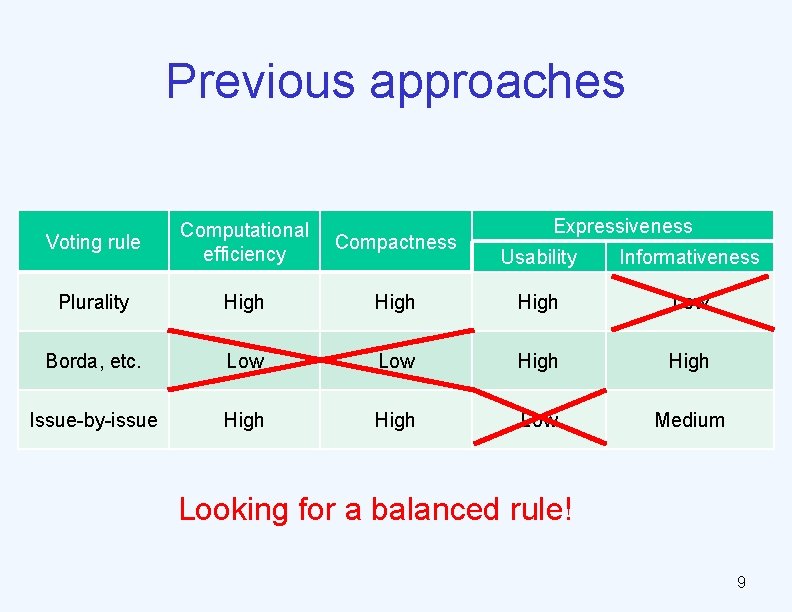
Previous approaches Voting rule Computational efficiency Compactness Plurality High Borda, etc. Issue-by-issue Expressiveness Usability Informativeness High Low Low High Low Medium Looking for a balanced rule! 9
CP-nets: A compact language [Boutilier et al. UAI-99/JAIR-04] Variables: x, y, z. x y z Graph CPTs This CP-net encodes the following partial order: 10
Truthful sequential voting [Lang IJCAI 07, Lang&Xia MSS 09] • Issues: main course, wine • Order: main course > wine • Local rules are majority rules • V 1: > , : > • V 2: > , : > • V 3: > , : > • Step 1: • Step 2: given • Winner: ( , , is the winner for wine ) 11
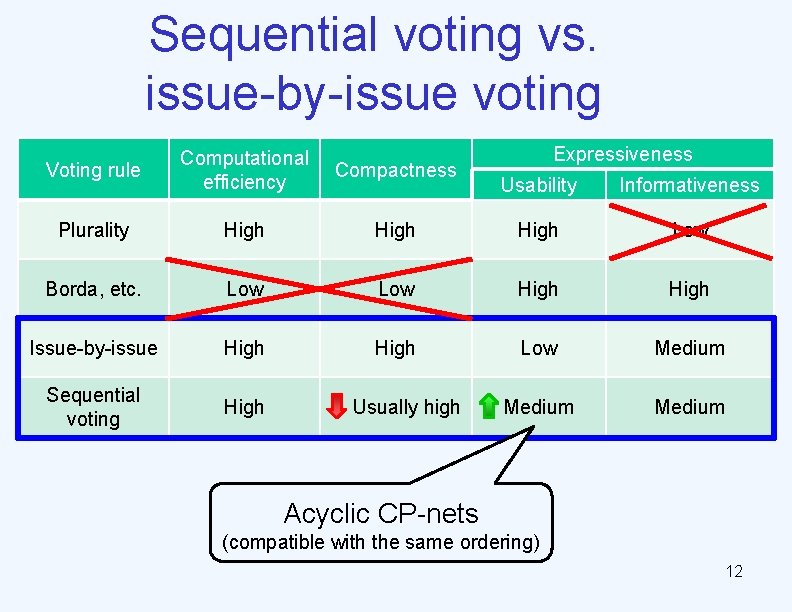
Sequential voting vs. issue-by-issue voting Voting rule Computational efficiency Compactness Plurality High Borda, etc. Expressiveness Usability Informativeness High Low Low High Issue-by-issue High Low Medium Sequential voting High Usually high Medium Acyclic CP-nets (compatible with the same ordering) 12
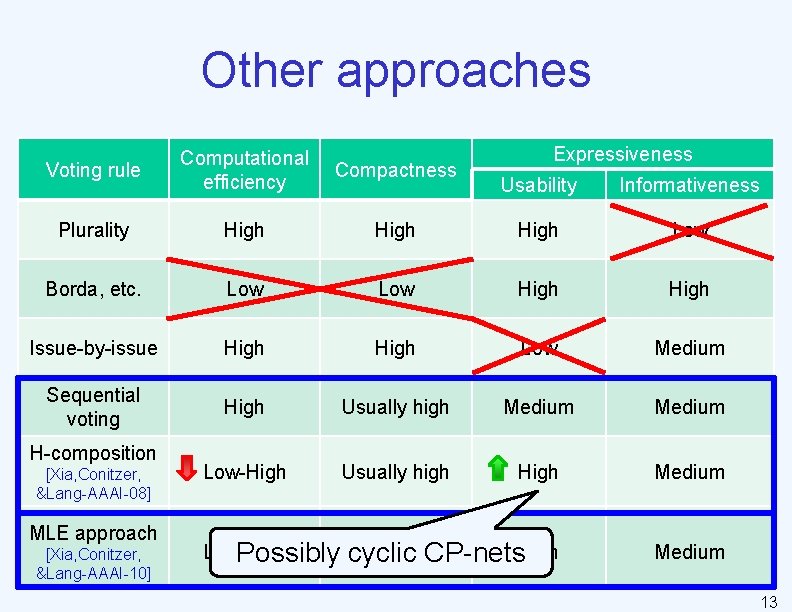
Other approaches Voting rule Computational efficiency Compactness Plurality High Borda, etc. Issue-by-issue Sequential voting H-composition [Xia, Conitzer, H-composition &Lang-AAAI-08] [Xia et al. AAAI-08] MLE approach [Xia, Conitzer, &Lang-AAAI-10] Expressiveness Usability Informativeness High Low Low Low High High Low Medium High Usually high Medium Low-High Usually high High Medium Low-High Usually high High Possibly cyclic CP-nets Medium 13
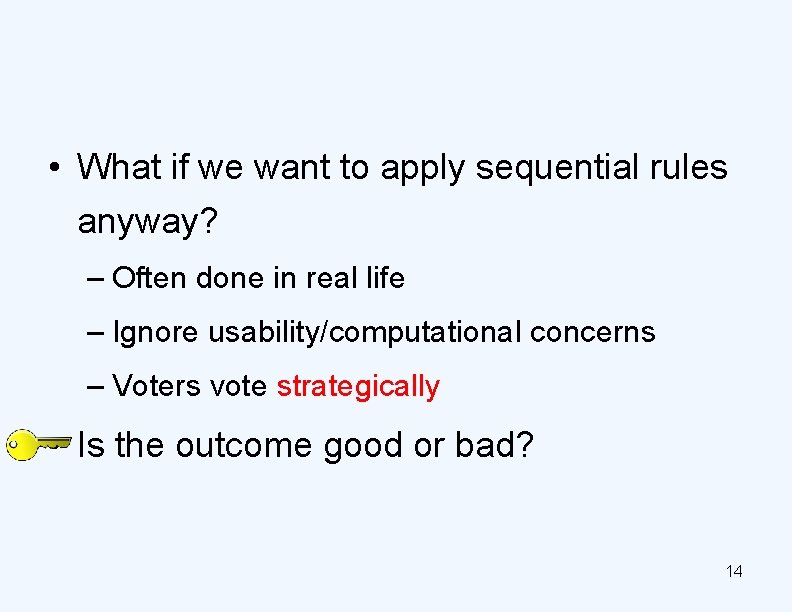
• What if we want to apply sequential rules anyway? – Often done in real life – Ignore usability/computational concerns – Voters vote strategically • Is the outcome good or bad? 14
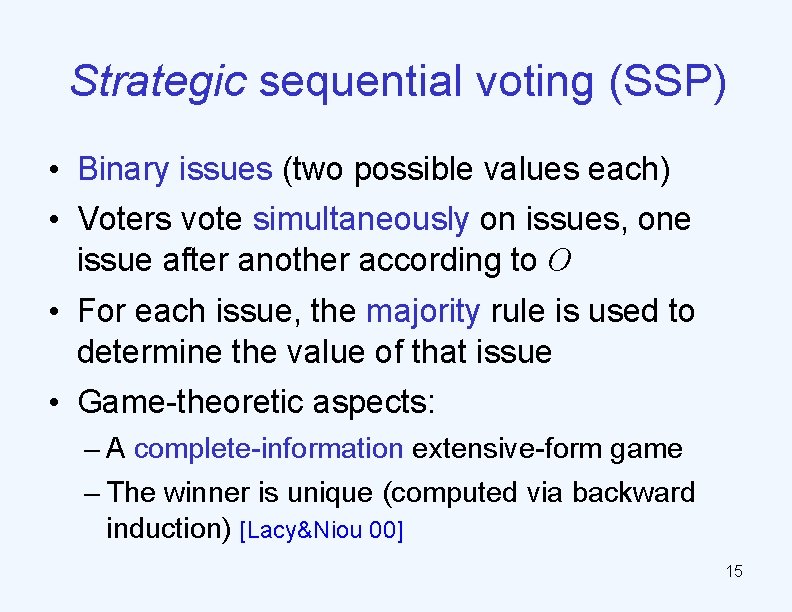
Strategic sequential voting (SSP) • Binary issues (two possible values each) • Voters vote simultaneously on issues, one issue after another according to O • For each issue, the majority rule is used to determine the value of that issue • Game-theoretic aspects: – A complete-information extensive-form game – The winner is unique (computed via backward induction) [Lacy&Niou 00] 15
Example (also in [Lacy&Niou 00]) S • T 16
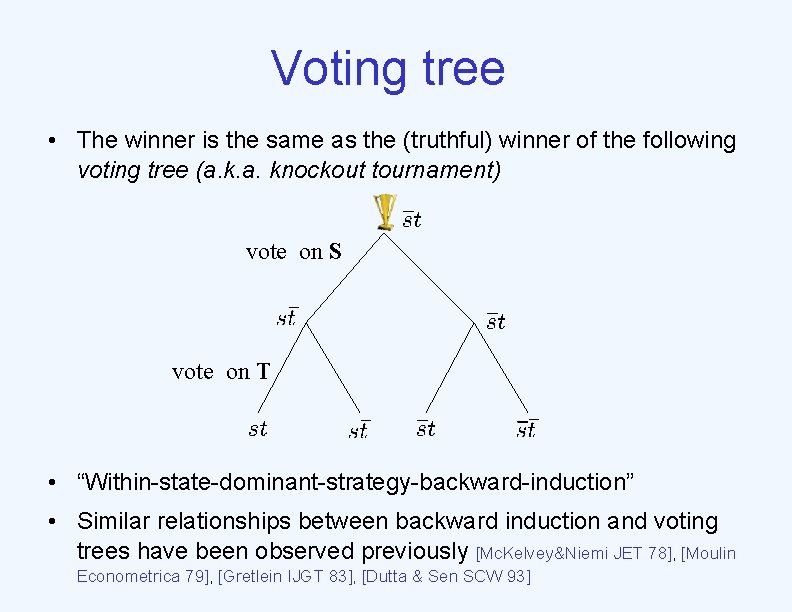
Voting tree • The winner is the same as the (truthful) winner of the following voting tree (a. knockout tournament) vote on S vote on T • “Within-state-dominant-strategy-backward-induction” • Similar relationships between backward induction and voting trees have been observed previously [Mc. Kelvey&Niemi JET 78], [Moulin Econometrica 79], [Gretlein IJGT 83], [Dutta & Sen SCW 93]
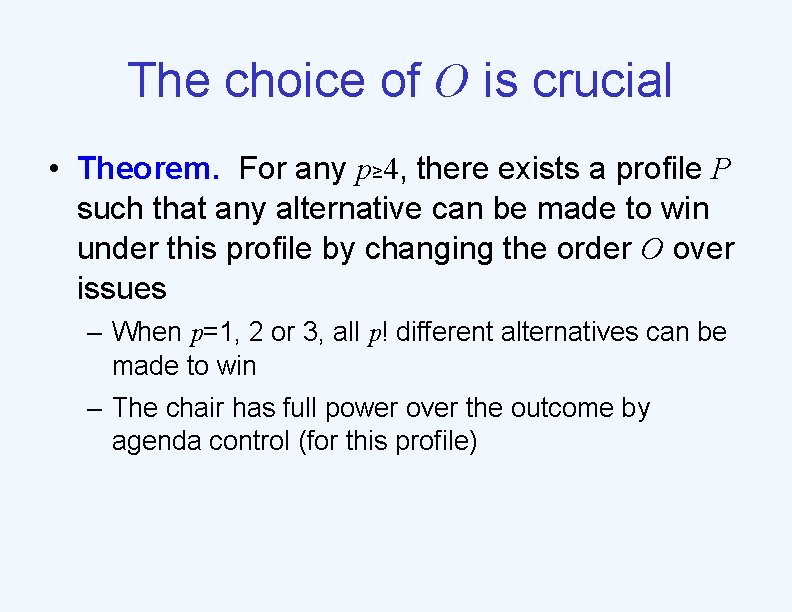
The choice of O is crucial • Theorem. For any p≥ 4, there exists a profile P such that any alternative can be made to win under this profile by changing the order O over issues – When p=1, 2 or 3, all p! different alternatives can be made to win – The chair has full power over the outcome by agenda control (for this profile)
Is the equilibrium outcome “good”? 19
Paradoxes: overview • Strong paradoxes for strategic sequential voting (SSP) • Slightly weaker paradoxes for SSP that hold for any O (the order in which issues are voted on) • Restricting voters’ preferences to escape paradoxes 20
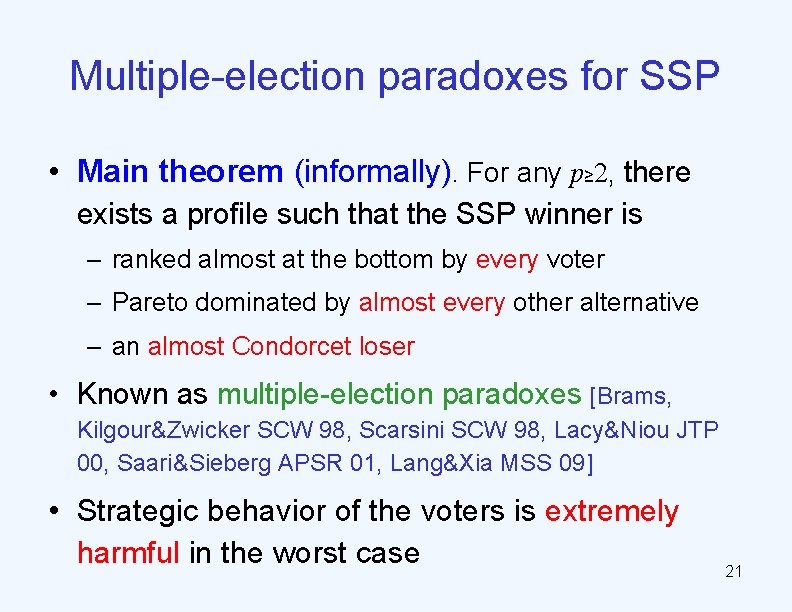
Multiple-election paradoxes for SSP • Main theorem (informally). For any p≥ 2, there exists a profile such that the SSP winner is – ranked almost at the bottom by every voter – Pareto dominated by almost every other alternative – an almost Condorcet loser • Known as multiple-election paradoxes [Brams, Kilgour&Zwicker SCW 98, Scarsini SCW 98, Lacy&Niou JTP 00, Saari&Sieberg APSR 01, Lang&Xia MSS 09] • Strategic behavior of the voters is extremely harmful in the worst case 21
Any better choice of the order? • Theorem (informally). At least some of the paradoxes cannot be avoided by a better choice of the order over issues 22
Getting rid of the paradoxes • Theorem(s) (informally) – Restricting the preferences to be separable or lexicographic gets rid of the paradoxes – Restricting the preferences to be O-legal does not get rid of the paradoxes 23
Preventing manipulation by domain restrictions [Xia&Conitzer 10] • Relax the unrestricted domain property in Gibbard-Satterthwaite • We obtained a concise characterization for all strategy-proof voting rules – Over combinatorial domains – Voters’ preferences are lexicographic 24
Summary • Combinatorial voting is a promising research direction where CS meets Econ • Sometimes strategic behavior leads to very undesirable outcome • Restricting voters’ preferences can avoid multiple-election paradoxes Thank you! 25