
Strategic Segmentation Strategic Information Model Competitive Positioning How
- Slides: 13
Strategic Segmentation Strategic Information Model Competitive Positioning • How can we systematically “divide” our environment into “workable areas”? • How do we make sure that the information we received from the environment involves legitimate (perceived) information? • How do we systematically design a competitive organization? • How do we interpret qualitative data? • Perception vs. Reality for Organizational Leaders Ansoff and Mc. Donnell, 1990 Created by Robert Moussetis, 2000
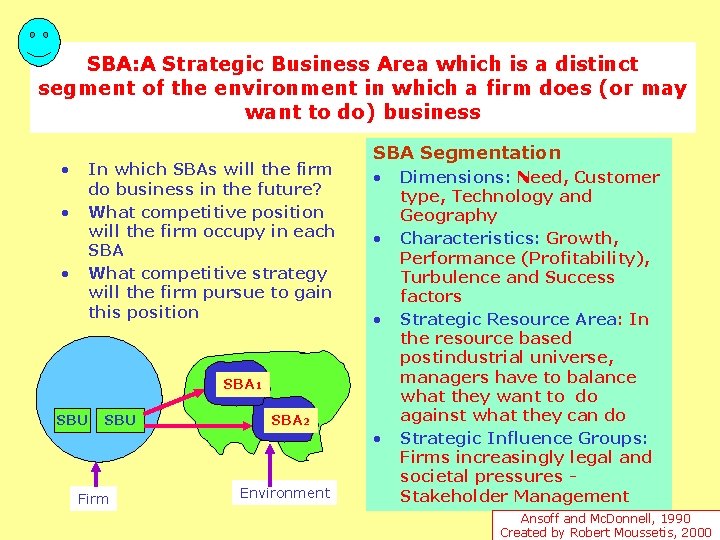
SBA: A Strategic Business Area which is a distinct segment of the environment in which a firm does (or may want to do) business • In which SBAs will the firm do business in the future? What competitive position will the firm occupy in each SBA What competitive strategy will the firm pursue to gain this position • • SBA Segmentation • • • SBA 1 SBA SBU Firm SBA 2 Environment • Dimensions: Need, Customer type, Technology and Geography Characteristics: Growth, Performance (Profitability), Turbulence and Success factors Strategic Resource Area: In the resource based postindustrial universe, managers have to balance what they want to do against what they can do Strategic Influence Groups: Firms increasingly legal and societal pressures Stakeholder Management Ansoff and Mc. Donnell, 1990 Created by Robert Moussetis, 2000
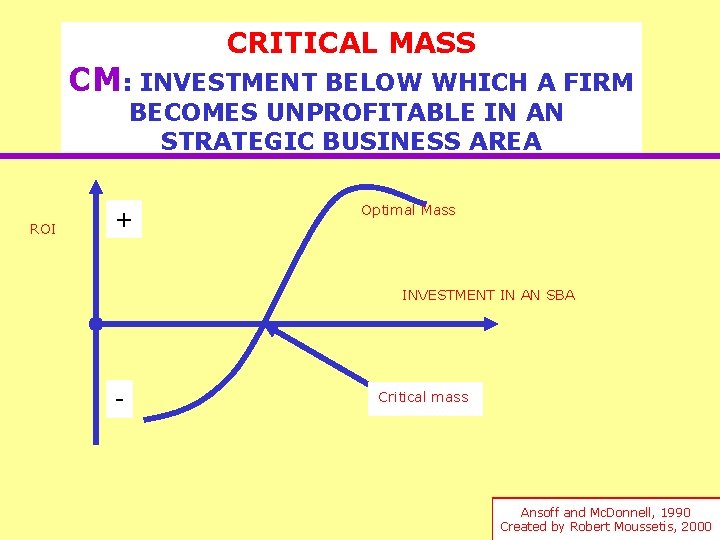
CRITICAL MASS CM: INVESTMENT BELOW WHICH A FIRM BECOMES UNPROFITABLE IN AN STRATEGIC BUSINESS AREA ROI + Optimal Mass INVESTMENT IN AN SBA - Critical mass Ansoff and Mc. Donnell, 1990 Created by Robert Moussetis, 2000
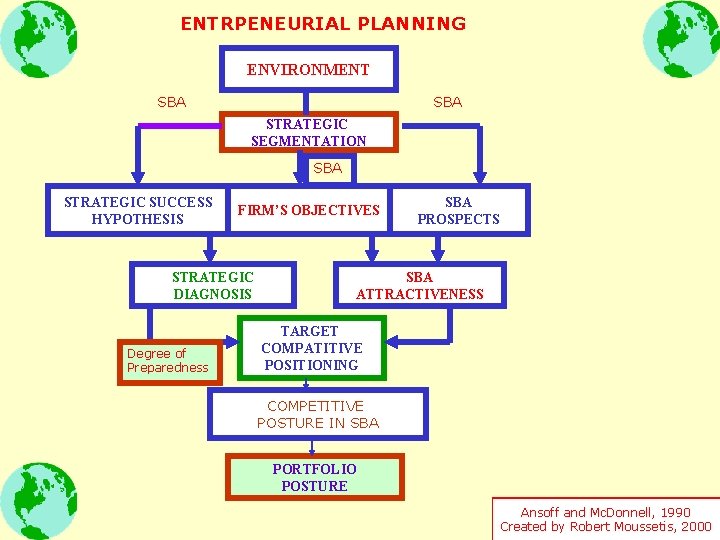
ENTRPENEURIAL PLANNING ENVIRONMENT SBA STRATEGIC SEGMENTATION SBA STRATEGIC SUCCESS HYPOTHESIS FIRM’S OBJECTIVES STRATEGIC DIAGNOSIS Degree of Preparedness SBA PROSPECTS SBA ATTRACTIVENESS TARGET COMPATITIVE POSITIONING COMPETITIVE POSTURE IN SBA PORTFOLIO POSTURE Ansoff and Mc. Donnell, 1990 Created by Robert Moussetis, 2000
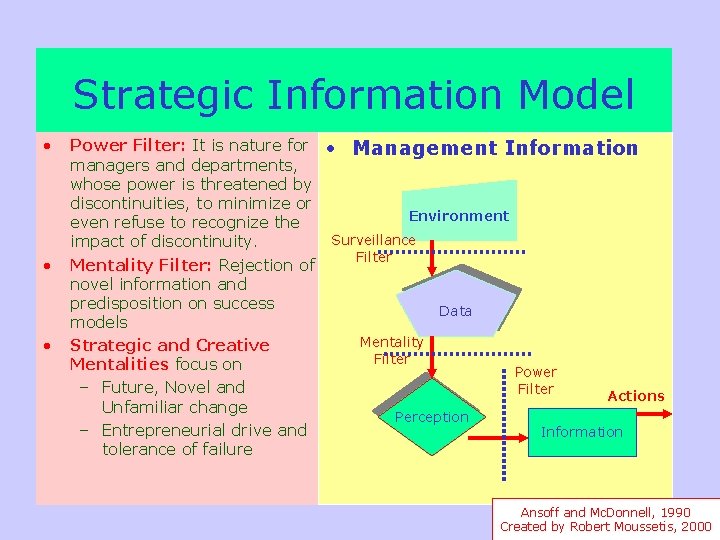
Strategic Information Model • • • Power Filter: It is nature for managers and departments, whose power is threatened by discontinuities, to minimize or even refuse to recognize the impact of discontinuity. Mentality Filter: Rejection of novel information and predisposition on success models Strategic and Creative Mentalities focus on – Future, Novel and Unfamiliar change – Entrepreneurial drive and tolerance of failure • Management Information Environment Surveillance Filter Data Mentality Filter Perception Power Filter Actions Information Ansoff and Mc. Donnell, 1990 Created by Robert Moussetis, 2000
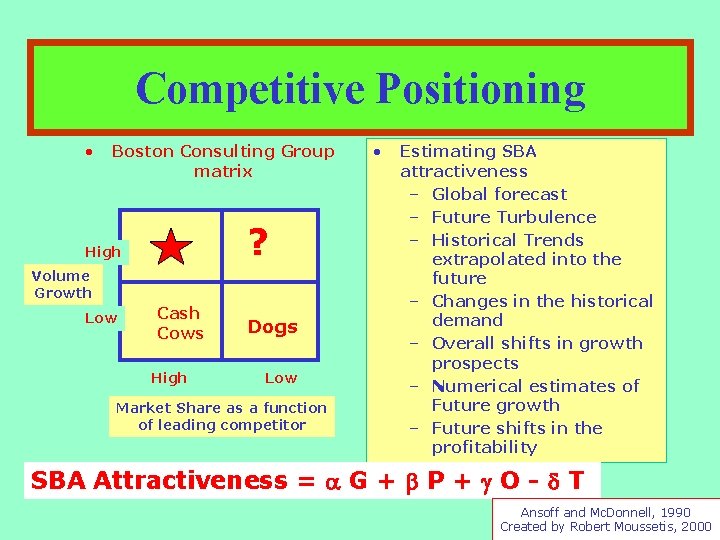
Competitive Positioning • Boston Consulting Group matrix ? High Volume Growth Low Cash Cows High Dogs Low Market Share as a function of leading competitor • Estimating SBA attractiveness – Global forecast – Future Turbulence – Historical Trends extrapolated into the future – Changes in the historical demand – Overall shifts in growth prospects – Numerical estimates of Future growth – Future shifts in the profitability SBA Attractiveness = a G + b P + g O - d T Ansoff and Mc. Donnell, 1990 Created by Robert Moussetis, 2000
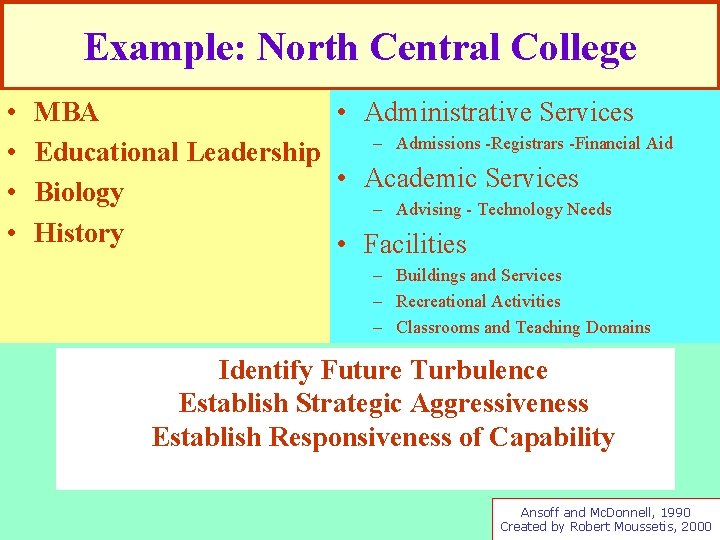
Example: North Central College • • MBA • Administrative Services – Admissions -Registrars -Financial Aid Educational Leadership • Academic Services Biology – Advising - Technology Needs History • Facilities – Buildings and Services – Recreational Activities – Classrooms and Teaching Domains Identify Future Turbulence Establish Strategic Aggressiveness Establish Responsiveness of Capability Ansoff and Mc. Donnell, 1990 Created by Robert Moussetis, 2000
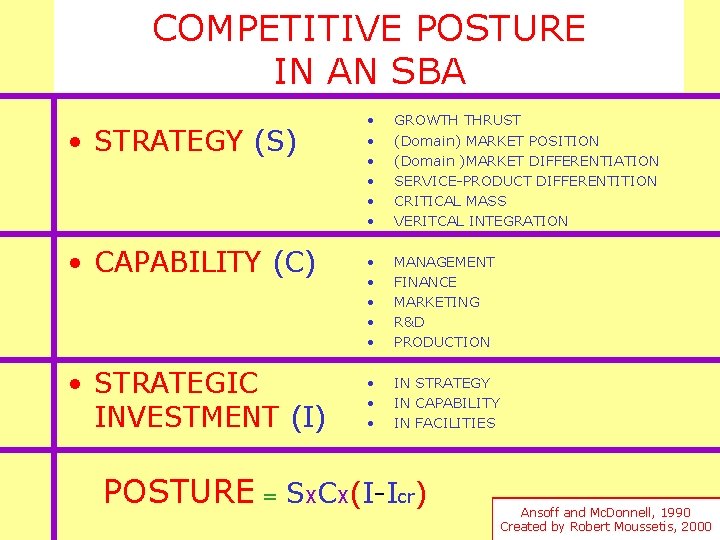
COMPETITIVE POSTURE IN AN SBA • STRATEGY (S) • CAPABILITY (C) • STRATEGIC INVESTMENT (I) • • • GROWTH THRUST (Domain) MARKET POSITION (Domain )MARKET DIFFERENTIATION SERVICE-PRODUCT DIFFERENTITION CRITICAL MASS VERITCAL INTEGRATION • • • MANAGEMENT FINANCE MARKETING R&D PRODUCTION • • • IN STRATEGY IN CAPABILITY IN FACILITIES POSTURE = SXCX(I-Icr) Ansoff and Mc. Donnell, 1990 Created by Robert Moussetis, 2000
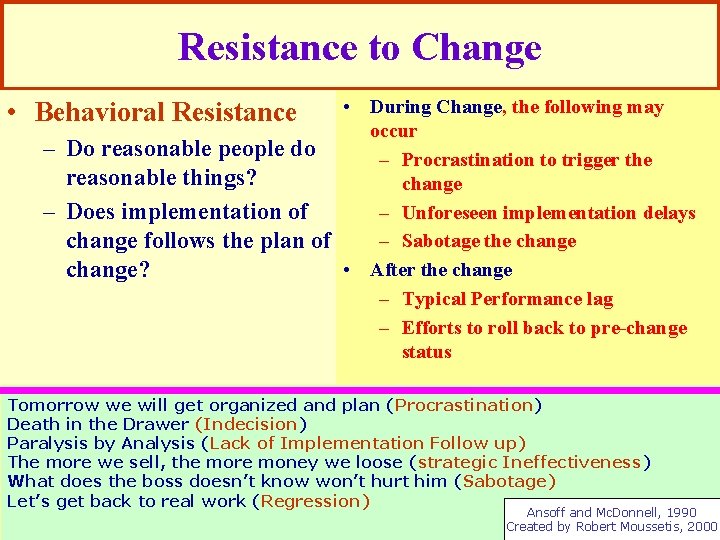
Resistance to Change • During Change, the following may occur – Do reasonable people do – Procrastination to trigger the reasonable things? change – Unforeseen implementation delays – Does implementation of – Sabotage the change follows the plan of • After the change? – Typical Performance lag – Efforts to roll back to pre-change status • Behavioral Resistance Tomorrow we will get organized and plan (Procrastination) Death in the Drawer (Indecision) Paralysis by Analysis (Lack of Implementation Follow up) The more we sell, the more money we loose (strategic Ineffectiveness) What does the boss doesn’t know won’t hurt him (Sabotage) Let’s get back to real work (Regression) Ansoff and Mc. Donnell, 1990 Created by Robert Moussetis, 2000
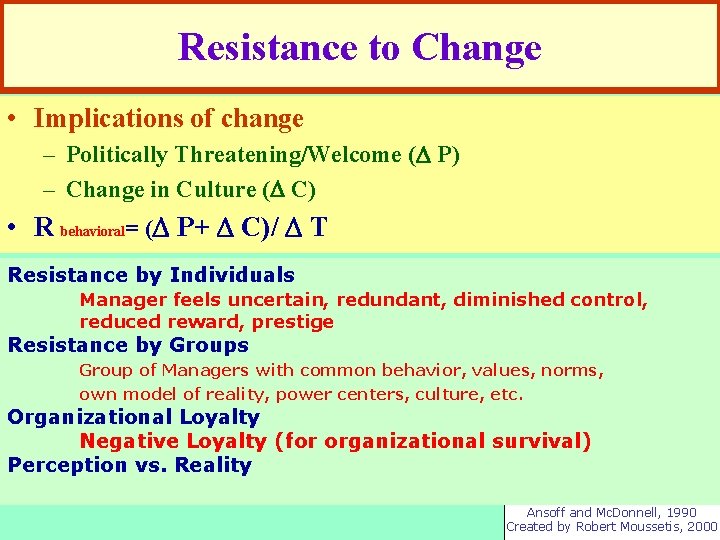
Resistance to Change • Implications of change – Politically Threatening/Welcome (D P) – Change in Culture (D C) • R behavioral= (D P+ D C)/ D T Resistance by Individuals Manager feels uncertain, redundant, diminished control, reduced reward, prestige Resistance by Groups Group of Managers with common behavior, values, norms, own model of reality, power centers, culture, etc. Organizational Loyalty Negative Loyalty (for organizational survival) Perception vs. Reality Ansoff and Mc. Donnell, 1990 Created by Robert Moussetis, 2000
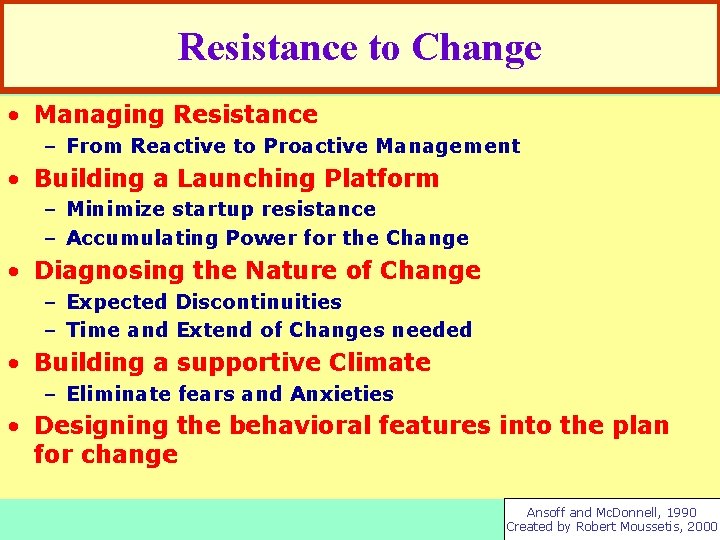
Resistance to Change • Managing Resistance – From Reactive to Proactive Management • Building a Launching Platform – Minimize startup resistance – Accumulating Power for the Change • Diagnosing the Nature of Change – Expected Discontinuities – Time and Extend of Changes needed • Building a supportive Climate – Eliminate fears and Anxieties • Designing the behavioral features into the plan for change Ansoff and Mc. Donnell, 1990 Created by Robert Moussetis, 2000
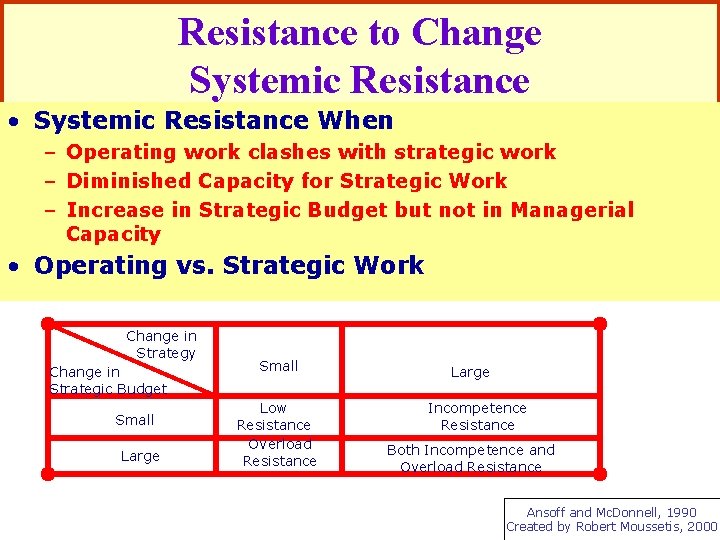
Resistance to Change Systemic Resistance • Systemic Resistance When – Operating work clashes with strategic work – Diminished Capacity for Strategic Work – Increase in Strategic Budget but not in Managerial Capacity • Operating vs. Strategic Work Change in Strategy Change in Strategic Budget Small Large Small Low Resistance Overload Resistance Large Incompetence Resistance Both Incompetence and Overload Resistance Ansoff and Mc. Donnell, 1990 Created by Robert Moussetis, 2000
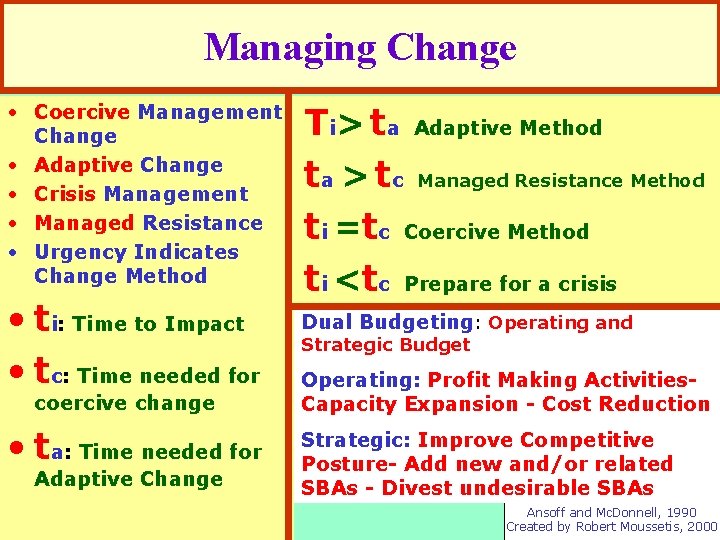
Managing Change • Ti> ta Adaptive Method • ta > tc Managed Resistance Method • ti =tc Coercive Method • ti <tc Prepare for a crisis • Coercive Management Change • Adaptive Change • Crisis Management • Managed Resistance • Urgency Indicates Change Method • ti: Time to Impact • tc: Time needed for coercive change • ta: Time needed for Adaptive Change Dual Budgeting: Operating and Strategic Budget Operating: Profit Making Activities. Capacity Expansion - Cost Reduction Strategic: Improve Competitive Posture- Add new and/or related SBAs - Divest undesirable SBAs Ansoff and Mc. Donnell, 1990 Created by Robert Moussetis, 2000