
Strategic Safety Risk Assessment SSRA Program Update Presentation
- Slides: 18
Strategic Safety Risk Assessment (SSRA) Program Update Presentation at CASCF January 15, 2020 RDIMS 15990030 / SGDDI 16074327
Objectives Provide update on Transport Canada Civil Aviation’s (TCCA) Strategic Safety Risk Assessment (SSRA) Program • Highlights of SSRA Progress and Developments • Introduce the Collaborative Analysis Group (CAG) Concept • Industry Panel Discussion on CAG Concept 2022 -02 -12 2
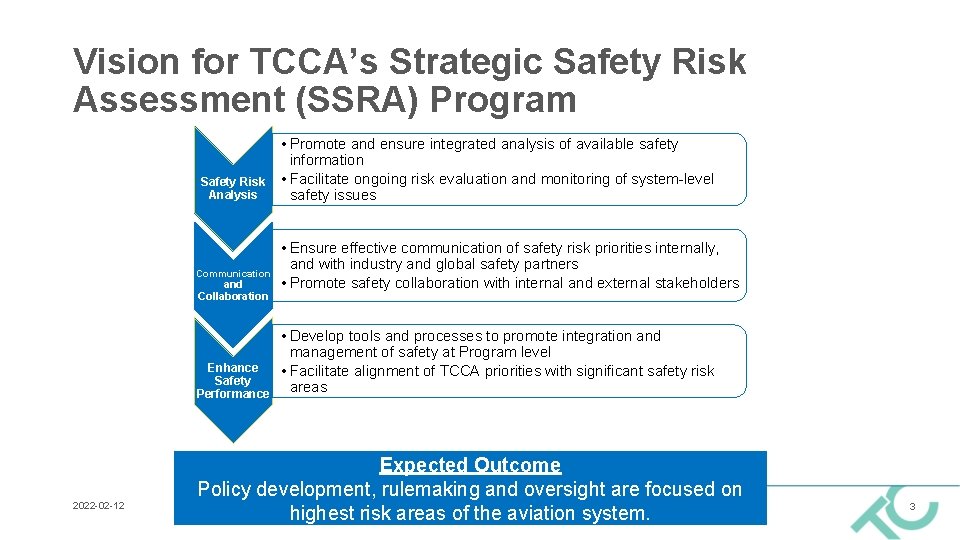
Vision for TCCA’s Strategic Safety Risk Assessment (SSRA) Program Safety Risk Analysis Communication and Collaboration Enhance Safety Performance 2022 -02 -12 • Promote and ensure integrated analysis of available safety information • Facilitate ongoing risk evaluation and monitoring of system-level safety issues • Ensure effective communication of safety risk priorities internally, and with industry and global safety partners • Promote safety collaboration with internal and external stakeholders • Develop tools and processes to promote integration and management of safety at Program level • Facilitate alignment of TCCA priorities with significant safety risk areas Expected Outcome Policy development, rulemaking and oversight are focused on highest risk areas of the aviation system. 3
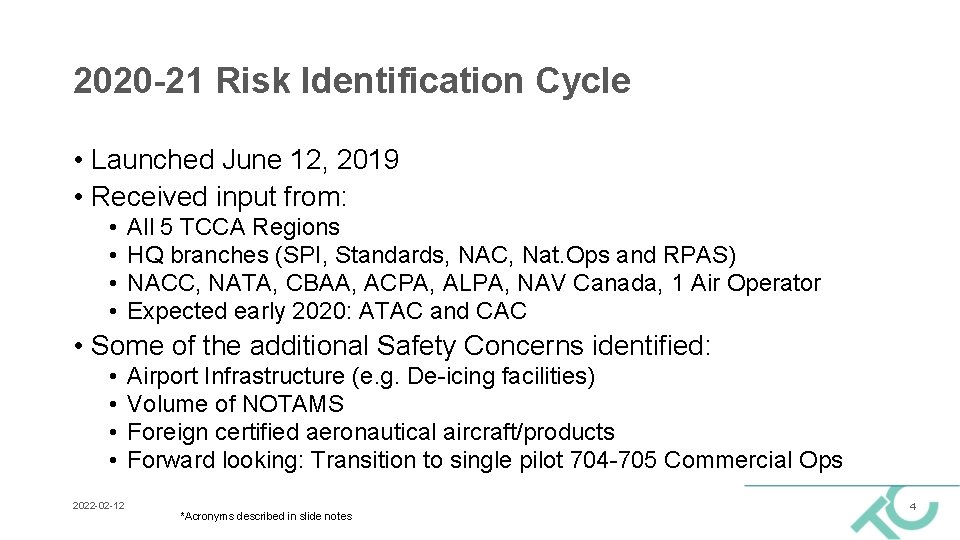
2020 -21 Risk Identification Cycle • Launched June 12, 2019 • Received input from: • • All 5 TCCA Regions HQ branches (SPI, Standards, NAC, Nat. Ops and RPAS) NACC, NATA, CBAA, ACPA, ALPA, NAV Canada, 1 Air Operator Expected early 2020: ATAC and CAC • Some of the additional Safety Concerns identified: • • 2022 -02 -12 Airport Infrastructure (e. g. De-icing facilities) Volume of NOTAMS Foreign certified aeronautical aircraft/products Forward looking: Transition to single pilot 704 -705 Commercial Ops *Acronyms described in slide notes 4
2020 -21 Safety Risk Identification Cycle (Cont’d) • Improved and more robust list of Safety Concerns • From 50 in proof of concept to 70+ scenarios in 2020 -21 • SSRA WG Risk Assessment Workshop • Held September 10 -12, 2019 • 40+ of 70 scenarios triaged • Completed a few deferred scenarios • Reviewed and adjusted initial triage results 2022 -02 -12 5
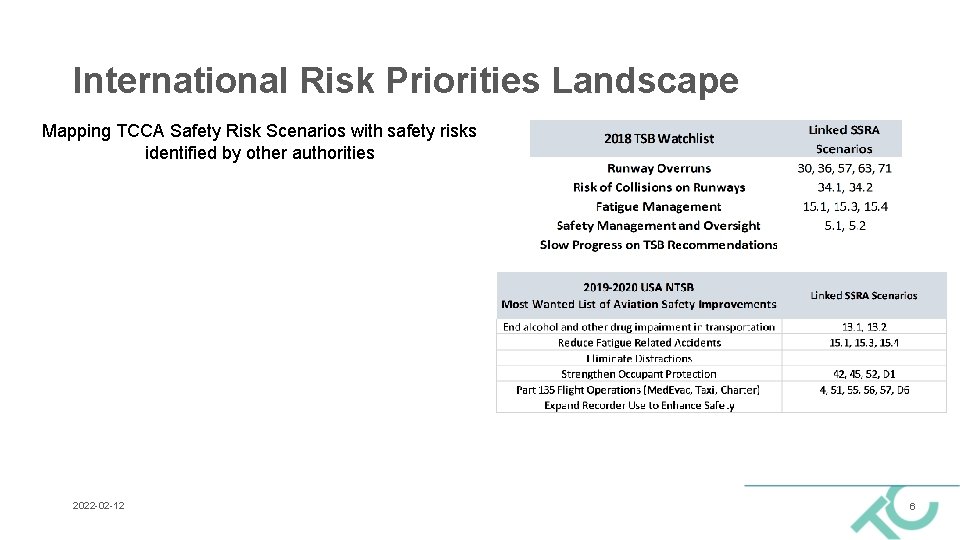
International Risk Priorities Landscape Mapping TCCA Safety Risk Scenarios with safety risks identified by other authorities 2022 -02 -12 6
SSRA – Ranking Process Map 2022 -02 -12 7
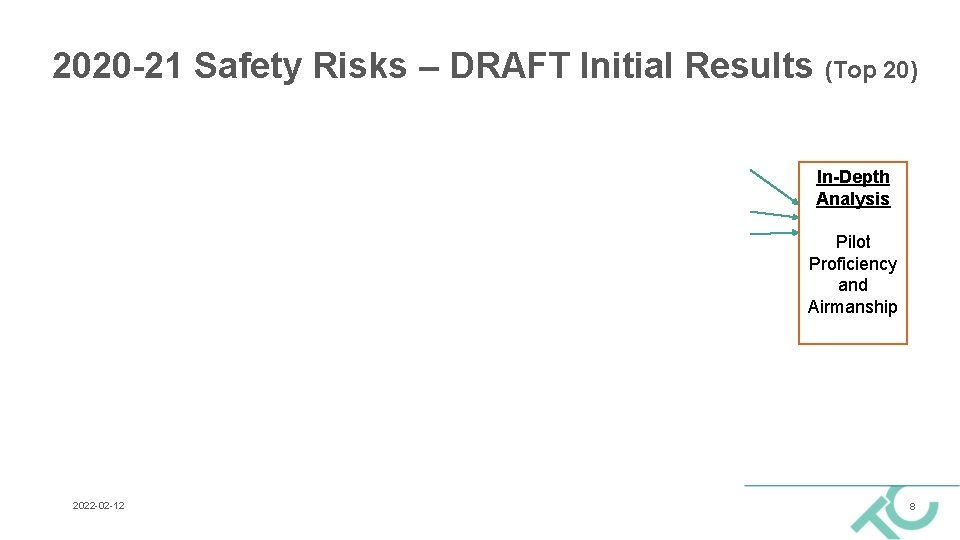
2020 -21 Safety Risks – DRAFT Initial Results (Top 20) In-Depth Analysis Pilot Proficiency and Airmanship 2022 -02 -12 8
2020 -21 Safety Risks – Draft Initial Results (Cont’d) 2022 -02 -12 9
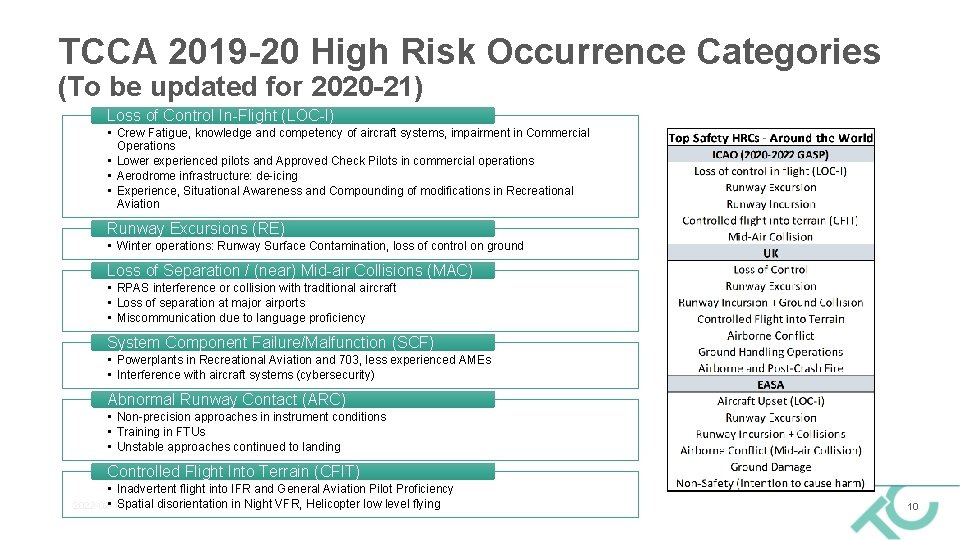
TCCA 2019 -20 High Risk Occurrence Categories (To be updated for 2020 -21) Loss of Control In-Flight (LOC-I) • Crew Fatigue, knowledge and competency of aircraft systems, impairment in Commercial Operations • Lower experienced pilots and Approved Check Pilots in commercial operations • Aerodrome infrastructure: de-icing • Experience, Situational Awareness and Compounding of modifications in Recreational Aviation Runway Excursions (RE) • Winter operations: Runway Surface Contamination, loss of control on ground Loss of Separation / (near) Mid-air Collisions (MAC) • RPAS interference or collision with traditional aircraft • Loss of separation at major airports • Miscommunication due to language proficiency System Component Failure/Malfunction (SCF) • Powerplants in Recreational Aviation and 703, less experienced AMEs • Interference with aircraft systems (cybersecurity) Abnormal Runway Contact (ARC) • Non-precision approaches in instrument conditions • Training in FTUs • Unstable approaches continued to landing Controlled Flight Into Terrain (CFIT) • Inadvertent flight into IFR and General Aviation Pilot Proficiency • Spatial disorientation in Night VFR, Helicopter low level flying 2022 -02 -12 10
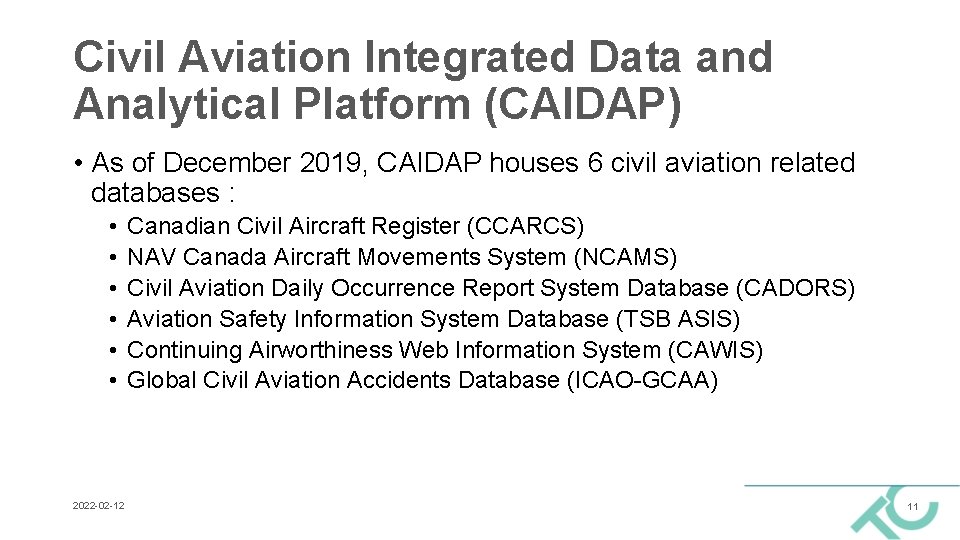
Civil Aviation Integrated Data and Analytical Platform (CAIDAP) • As of December 2019, CAIDAP houses 6 civil aviation related databases : • • • 2022 -02 -12 Canadian Civil Aircraft Register (CCARCS) NAV Canada Aircraft Movements System (NCAMS) Civil Aviation Daily Occurrence Report System Database (CADORS) Aviation Safety Information System Database (TSB ASIS) Continuing Airworthiness Web Information System (CAWIS) Global Civil Aviation Accidents Database (ICAO-GCAA) 11
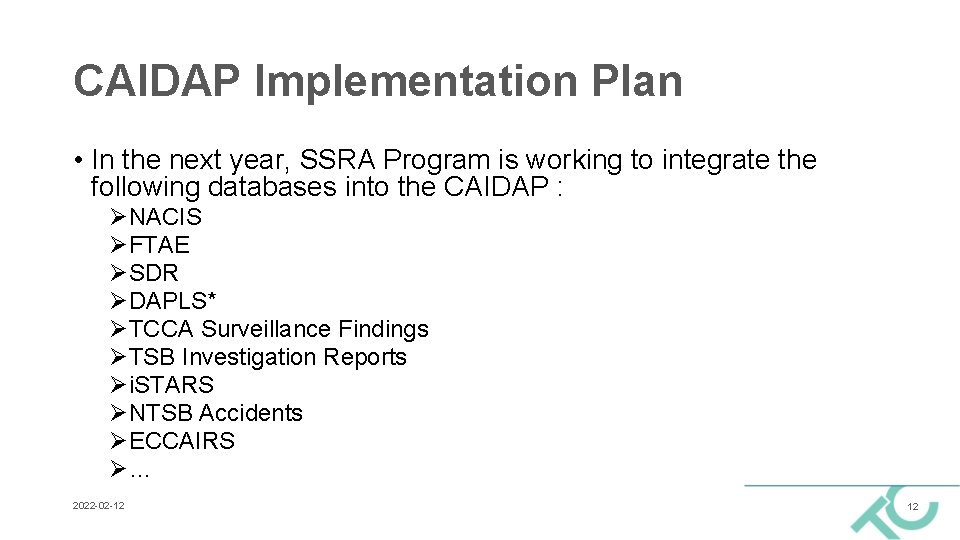
CAIDAP Implementation Plan • In the next year, SSRA Program is working to integrate the following databases into the CAIDAP : ØNACIS ØFTAE ØSDR ØDAPLS* ØTCCA Surveillance Findings ØTSB Investigation Reports Øi. STARS ØNTSB Accidents ØECCAIRS Ø… 2022 -02 -12 12
Strategic Safety Risk Management Framework • Framework Objective • Articulate the TCCA Strategic Safety Risk Management (SSRM) approach • Formalize the linkages, interdependencies and interfaces between SSRA and other TCCA program areas • Ensure that the SSRA program results support TCCA decision-making and can enable proactive strategic safety risk management • Initial framework draft completed 2022 -02 -12 13
Strategic Safety Risk Management Process (Model) 2022 -02 -12 14
Collaborative Analysis Groups Concept • Objective: • Provide mechanism for TCCA and sector specific industry partners to work collaboratively through the SSRM process. • Establish formal structures and processes that will facilitate transition to collaborative data sharing when appropriate regulatory protections are in place • Approach: • • 2022 -02 -12 Based on EASA Safety Risk Management Model Co-chaired by TCCA and Industry Clear and mutually agreed upon rules of engagement Structured to enable collaborative sharing of safety intelligence 15
Next Steps • Continue to gather industry input to broaden SSRA Risk Register • Work with industry to determine feasibility/interest of: • A common risk register (with CASOP? ) • A trial of the CAG concept • Proceed with In-Depth Analysis on theme of Pilot Proficiency and Airmanship • Continue SSRM process, tools and framework development • Ongoing addition of data sources in methodology and international benchmarking; • Continue exploring application of Bowtie Model using LOC-i 2022 -02 -12 16
Collaborative Analysis Groups – Industry panel 1. What conditions are required for the CAG concept to work in Canada? 2. What would be the most pertinent and meaningful scope (sectors covered) for the sector level Collaborative Analysis Group trial? a) And who are well placed to be members of the trial CAG? 3. Any comments on the identified Strategic Safety Risk Management approach? 2022 -02 -12 17
Questions or Comments Michel Roy, Chief Strategic Safety Risk Assessment Program Transport Canada Civil Aviation michel. roy@tc. gc. ca 2022 -02 -12 18