
STRATEGIC ROLE PLAY Lets improve interpersonal communication ISABEL

STRATEGIC ROLE PLAY Let’s improve interpersonal communication ISABEL ASENSIO PROFESSOR OF SPANISH TOM MATHEWS PROFESSOR OF SPANISH February 14, 2018 · Ogden, UT
INTRODUCTIONS Isabel Asensio, Dept. Chair Professor of Spanish Weber State University Tom Mathews Professor of Spanish Weber State University Ph. D. (2006). Latin American Literature from Vanderbilt University. Ph. D. (1992). Linguistics from the University of Delaware Teaching at Weber State since 2006 Teaching at Weber State since 1996

WSU Spanish Spelling Bee & Language Talent Competition (Sigma Delta Pi) Sponsored by Sigma Delta Pi April 9, 2020 · Shepherd Union Building For students in grades 4 through 8 To sign your class up, go to: https: //www. weber. edu/isabelasensio/spanishspellingbee. html and click on Spanish Spelling Bee
Some terminology Need for strategic competence is a part of communicative competence. ◦ Grammatical competence ◦ Sociolinguistic competence ◦ Discourse competence ◦ Strategic competence (Canale & Swain, 1980)
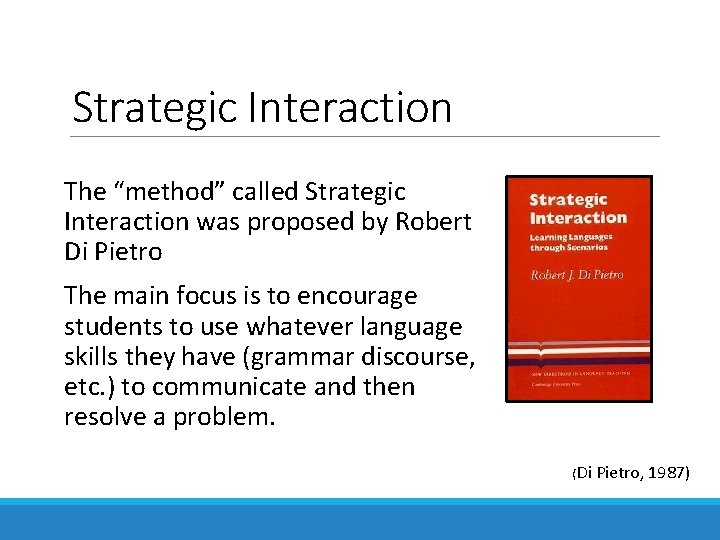
Strategic Interaction The “method” called Strategic Interaction was proposed by Robert Di Pietro The main focus is to encourage students to use whatever language skills they have (grammar discourse, etc. ) to communicate and then resolve a problem. (Di Pietro, 1987)

Theoretical Background Language Acquisition may not be possible without interaction. People do not become fluent by watching television or listening to the radio. The hearing children of deaf parents do not learn from television. Evelyn Hatch contends that deaf people's children think TV actors are simply very poor signers or that they use some other sign language. (Long 1981; Hatch 1983)
Theoretical Background So, in essence, Strategic Interaction, as a methodology, engages students in interactive activities where they must use linguistic or social strategies to solve problems. This sounds fancy, but we and our students really can do it at novice and beginning and intermediate levels.

Kinds of interactive activities In general, an interactive activity is one in which students engage in interpersonal communication – one or more people talking to each other. Following is brief review of the kinds of interactive activities we often do in language classes.
Kinds of interactive activities 1. DIALOGUES (the usual fare of ALM) No interaction. Generally intended for memorization or extraction of vocabulary and grammar. These can include protocols and non-episodic role plays.
Kinds of interactive activities 2. ROLE PLAYS or SITUATIONS Usually interactive. May or may not be open ended. Mumby (1987) defines a role as a "set of norms and expectations applied to the incumbent of a particular position. " These may or may not have specified texts. Some roles are reciprocal: host/guest parent/child teacher/student vendor/customer
Kinds of interactive activities 3. Role plays may be episodic or non-episodic Non-episodic role plays are those that tend to occur over and over in the same or similar circumstances: i. Greetings ii. Sales clerk and customer Non-episodic roles often begin with a protocol. Protocols vary only a little bit from one interaction to the next. Episodic roles are specific to a particular event or episode, and therefore can't be memorized and remain interactive.
Kinds of interactive activities SCENARIOS Always interactive. Always open ended (episodic). Make use of verbal and behavioral strategies. A scenario is a role play in which there is a need for the participants to use their strategic competence to solve some sort of problem. This problem is called a hidden agenda.

Kinds of interactive activities Dialogues Scenarios

Description of Strategic Interaction Three Phases Preliminaries Phase 1: Rehearsal Phase 2: Performance Phase 3: Debriefing

Description of Strategic Interaction Preliminaries vocabulary, cultural content, relation to current lesson materials This is the “normal stuff” of a few days’ or weeks’ instruction.
Description of Strategic Interaction Phase 1: Rehearsal—Group preparation One group for each role One “actor” from each group The group is given a slip of paper on which the “role” is described. This best ends in a series of questions which will guide the students to devise a possible strategy.
Description of Strategic Interaction Phase 2: Performance An “actor” from each group comes to the front of the class and participates in the scenario. Actor may return to the group at any time for help. Encourage actors to go to groups for help and not to you. Don't interrupt.

Description of Strategic Interaction Phase 3: Debriefing Review appropriateness of the performance in terms of: ◦ Grammar (grammatical competence) ◦ Resolution (strategic competence) ◦ Fluidity (discourse competence) This is often best done the following day, or after several scenarios have been performed. Fairly often, after this debriefing, I will let the groups re -perform their scenarios.

Examples Each group will be given a “role”—a slip of paper defining the situation that will be enacted in the scenario. The groups should have enough time to consider the situation and possible strategies to resolve it, but not so much time as to prepare a dialogue, since, due to the hidden agenda, this will not work out anyway. What follows are two scenarios that we will read and then three that we will act out.

New School Year – Novice High NEW SCHOOL YEAR A: School starts in a couple of days. Call your friend ask her to go shopping for school supplies with you. Tell her that you need some new folders, markers, paper, pens, pencils, etc. Also tell her how much money you are going to take. How will you start his conversation? How will you convince her to go with you? NEW SCHOOL YEAR B: School starts in a couple of days. Your friend calls to go shopping. Convince her to go shopping for new clothes. Tell her what kind of clothes you need and how much money you're going to take. How will you start this conversation? Written by K. Krupa

Pen Pals – Intermediate Mid PEN PALS A: You have had a pen pal for five years. He lives in Florida and you have never met. This morning he called you and told you that he is here in Newark and has invited you to meet him for dinner at a nice restaurant. You are nervous because your friend thinks you are rich, but you don't have much money. You told him in a letter that your mother is one of the Du. Ponts. What will you talk about at dinner? Will he expect you to pay the entire check? Should you tell him that you lied about your mother? PEN PALS B: Your mother is in the hospital and you need $15, 000 to pay the hospital bills. For five years you have had a pen pal in Newark. (You are from Florida). You have never met him, but he is very rich, his mother is of the Du. Pont family. You are now in Newark to ask your pen pal for the $15, 000. You have invited him to dinner at a nice restaurant. How will you ask for the money without offending him? Written by T. Mathews
Divide into groups of four: Preparation of three scenarios 1. Flowers 2. Mc. Donald’s 3. Sirens

Flowers Written by T. Mathews

Flowers FLOWERS A: You work in a flower shop. Your boss has told you that the carnations are getting old and that you will get one dollar for each bunch of carnations you sell today. A young man enters the shop. What will you say to him? How will you get him to buy carnations? FLOWERS B: You want to propose to your girlfriend tonight. You have bought a nice diamond ring and are now in a flower shop to get a dozen red roses. What will you say to the shopkeeper? How will you ask for the flowers? Written by T. Mathews

Mc. Donalds Written by K. Krupa

At Mc. Donald’s MCDONALDS A: You work at Mc. Donald's, and there is a big problem. Your store is all out of hamburgers! Your supervisor has instructed all the employees to try to sell chicken sandwiches instead. Don't forget to suggest an apple pie with the order. MCDONALDS B: Your dad is making your least favorite meal for dinner—chicken—so you decide to go to Mc. Donald's to get your favorite cheeseburger (without mustard), fries and a sundae. Go place your order. Written by K. Krupa

Sirens Written by G. Vana

Sirens SIRENS A: You are a cop. While patrolling the city, you receive a bulletin about a car that just has been stolen. You see a car that fits the description. You pull the car over and notice that two teenagers are driving it. This is the area in which the car was reported to have been stolen. You recognize the two teenagers because of past run-ins with the law. You walk up to the car. SIRENS B: You are driving your car down M 66 and a cop pulls you over. You only have a driving permit but your older brother is with you and he has a license. Your parents are out of town and cannot be reached. The cop walks up to your car. What will you say? Written by G. Vana

Pro’s and Con’s Advantages Class is student centered. Promotes real interaction in the language. Students create novel utterances using their actual proficiency and not only memorized bits and phrases. Is seldom boring.
Pro’s and Con’s Disadvantages Can be time consuming if not well controlled. May pose an evaluation problem (even beyond the normally difficult evaluation of oral work). How do you grade the "silent" members of each group? Do you insist that certain people participate in the scenario? What if the same people are always chosen? Some classes have a problem "coming down" for the debriefing.

A modern twist Modification by Roger Burt (Clearfield High School, UT) 1. Divide the class quickly into pairs. 2. Have one in each pair close their eyes while the other reads Role A on the screen. 3. Have the others close their eyes while Role B shows on the screen. 4. Have them interact.

Scenario a la señor Burt Divide into pairs. Decide who is A and who is B. Role A You have a major Spanish test tomorrow. Call you good friend from the class and see if he/she will meet you later today to study. What will you say? How will you convince him/her to study with you? Role B Your good friend has just called you. You have been hoping for a couple of weeks about going to see Big Hero 6. Maybe you can talk him/her into going with you tonight. What will you say? How will you convince him/her to go to the movies?

Scenario a la señor Burt Divide into pairs. Decide who is A and who is B. Role A You have a major Spanish test tomorrow. Call you good friend from the class and see if he/she will meet you later today to study. What will you say? How will you convince him/her to study with you? Role B Your good friend has just called you. You have been hoping for a couple of weeks about going to see Big Hero 6. Maybe you can talk him/her into going with you tonight. What will you say? How will you convince him/her to go to the movies?
Scenario a la señor Burt Divide into pairs. Decide who is A and who is B. Role A You have a major Spanish test tomorrow. Call you good friend from the class and see if he/she will meet you later today to study. What will you say? How will you convince him/her to study with you? Role B Your good friend has just called you. You have been hoping for a couple of weeks about going to see Big Hero 6. Maybe you can talk him/her into going with you tonight. What will you say? How will you convince him/her to go to the movies?

Scenario a la señor Burt Divide into pairs. Decide who is A and who is B. Role A You have a major Spanish test tomorrow. Call you good friend from the class and see if he/she will meet you later today to study. What will you say? How will you convince him/her to study with you? Role B Your good friend has just called you. You have been hoping for a couple of weeks about going to see the new Star Wars film. Maybe you can talk him/her into going with you tonight. What will you say? How will you convince him/her to go to the movies?
Scenario a la señor Burt Divide into pairs. Decide who is A and who is B. Role A You have a major Spanish test tomorrow. Call you good friend from the class and see if he/she will meet you later today to study. What will you say? How will you convince him/her to study with you? Role B Your good friend has just called you. You have been hoping for a couple of weeks about going to see Big Hero 6. Maybe you can talk him/her into going with you tonight. What will you say? How will you convince him/her to go to the movies?

Scenario a la señor Burt Debriefing Role A You have a major Spanish test tomorrow. Call you good friend from the class and see if he/she will meet you later today to study. What will you say? How will you convince him/her to study with you? Role B Your good friend has just called you. You have been hoping for a couple of weeks about going to see the new Star Wars film. Maybe you can talk him/her into going with you tonight. What will you say? How will you convince him/her to go to the movies?
So, back to the talent competition. . . Teams will consist of four or six students. (This way they can break into two or three roles). The first team will have a few minutes to prepare. They will be split up into two or three groups to plan the roles in the scenario. One actor will present each role for the competition. While they perform the scenario, the second team will be given their scenario, which they will perform while third team prepares, etc.

Submit ideas. . . On the card you receive, if you have any ideas for topics or settings for scenarios, please write them down. That is, what subjects and vocabulary have you been using in your classes? Those students on the teams will NOT be shown the scenarios until it is time to prepare during the competition.
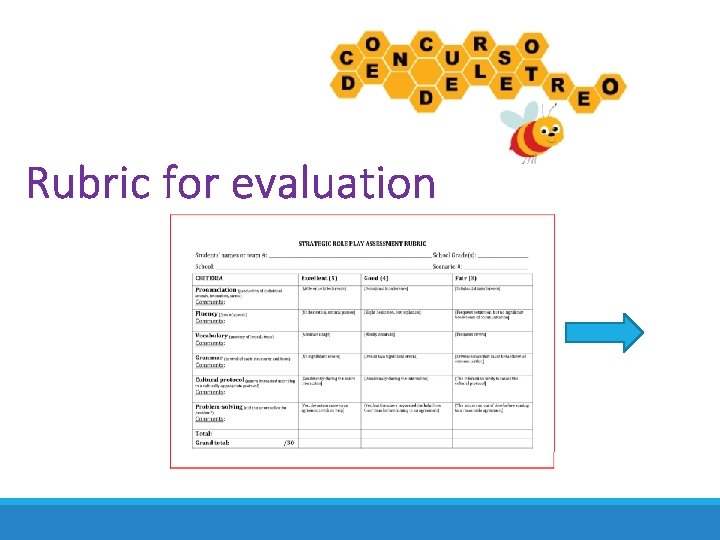
Rubric for evaluation
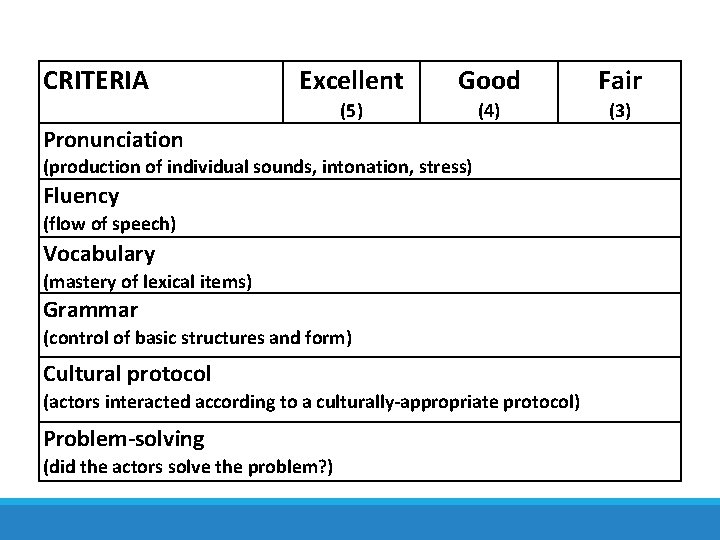
CRITERIA Excellent Good Fair (5) (4) (3) Pronunciation (production of individual sounds, intonation, stress) Fluency (flow of speech) Vocabulary (mastery of lexical items) Grammar (control of basic structures and form) Cultural protocol (actors interacted according to a culturally-appropriate protocol) Problem-solving (did the actors solve the problem? )
Gracias. FIN
- Slides: 42