
Strategic Review of Charges Name Job title Date
Strategic Review of Charges Name Job title Date
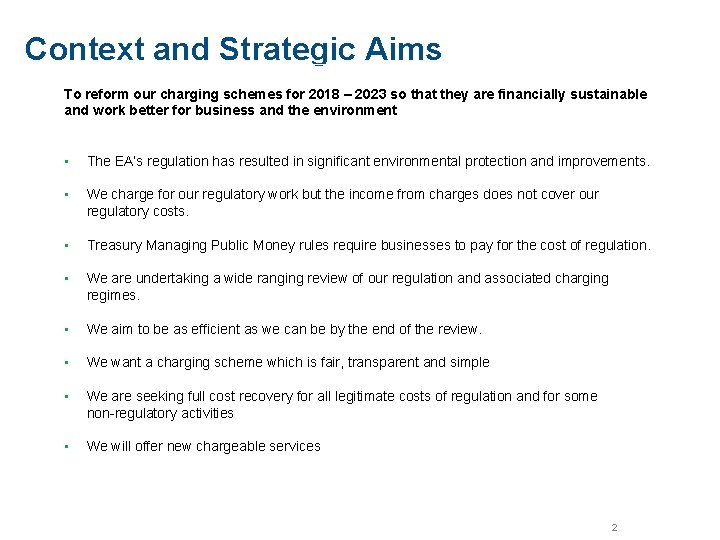
Context and Strategic Aims To reform our charging schemes for 2018 – 2023 so that they are financially sustainable and work better for business and the environment • The EA’s regulation has resulted in significant environmental protection and improvements. • We charge for our regulatory work but the income from charges does not cover our regulatory costs. • Treasury Managing Public Money rules require businesses to pay for the cost of regulation. • We are undertaking a wide ranging review of our regulation and associated charging regimes. • We aim to be as efficient as we can be by the end of the review. • We want a charging scheme which is fair, transparent and simple • We are seeking full cost recovery for all legitimate costs of regulation and for some non-regulatory activities • We will offer new chargeable services 2
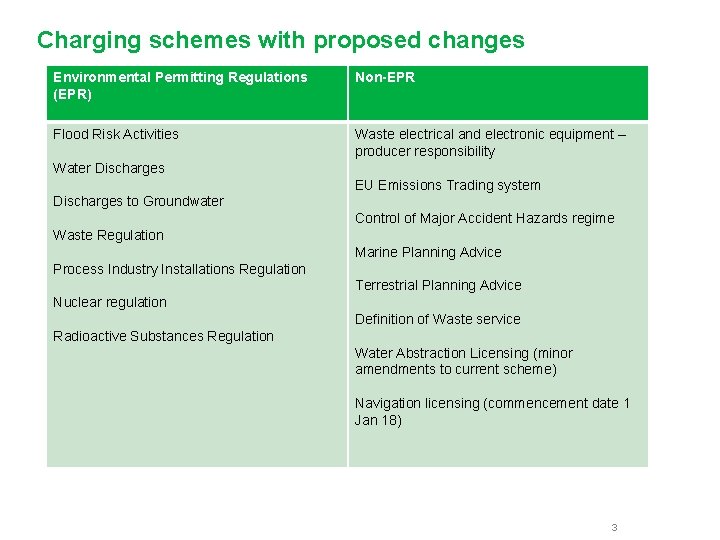
Charging schemes with proposed changes Environmental Permitting Regulations (EPR) Non-EPR Flood Risk Activities Waste electrical and electronic equipment – producer responsibility Water Discharges EU Emissions Trading system Discharges to Groundwater Control of Major Accident Hazards regime Waste Regulation Marine Planning Advice Process Industry Installations Regulation Terrestrial Planning Advice Nuclear regulation Definition of Waste service Radioactive Substances Regulation Water Abstraction Licensing (minor amendments to current scheme) Navigation licensing (commencement date 1 Jan 18) 3
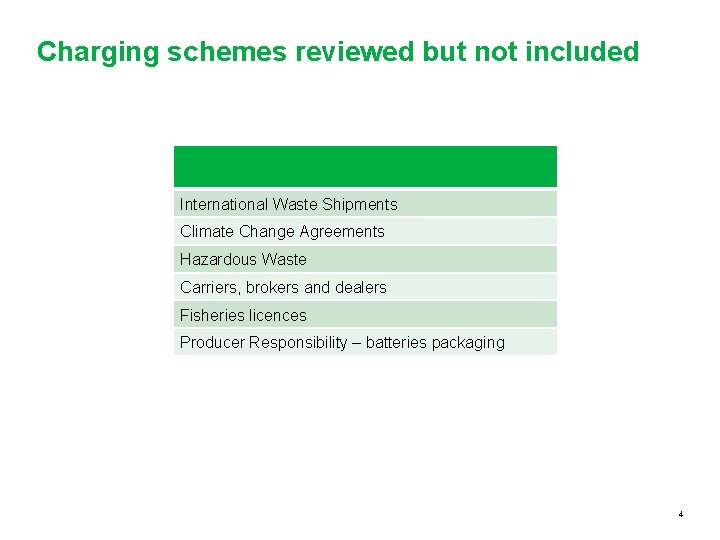
Charging schemes reviewed but not included International Waste Shipments Climate Change Agreements Hazardous Waste Carriers, brokers and dealers Fisheries licences Producer Responsibility – batteries packaging 4
How we have developed our proposals • We have gathered the data we needed from our own databases to put together proposals, time and costs • Once we developed our proposals we tested them in a series of critical friend sessions • We have been liaising with trade associations for over a year to ensure that they understood the direction we were heading in, the changes ahead and to seek their opinions • We have refined our charging models to produce the new charge rates. 5
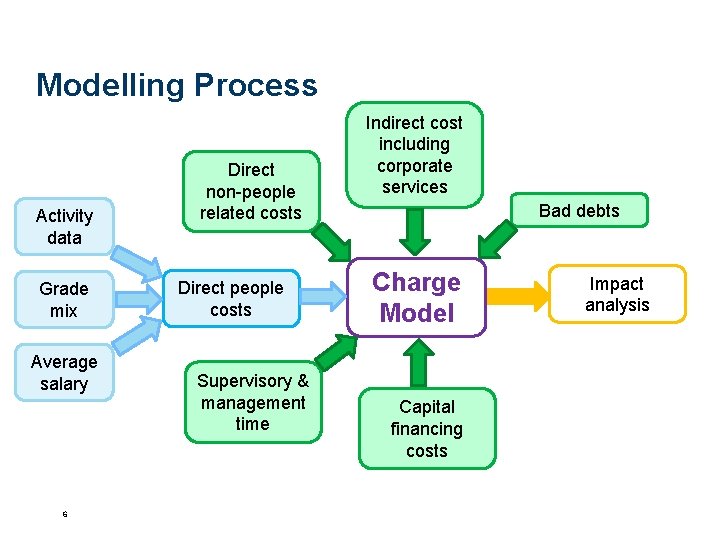
Modelling Process Activity data Grade mix Average salary 6 Direct non-people related costs Direct people costs Supervisory & management time Indirect cost including corporate services Bad debts Charge Model Capital financing costs Impact analysis
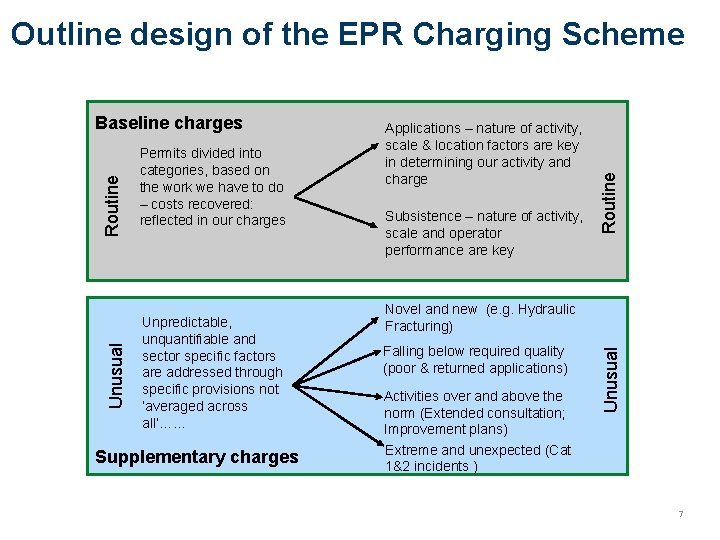
Permits divided into categories, based on the work we have to do – costs recovered: reflected in our charges Unpredictable, unquantifiable and sector specific factors are addressed through specific provisions not ‘averaged across all’…… Supplementary charges Applications – nature of activity, scale & location factors are key in determining our activity and charge Subsistence – nature of activity, scale and operator performance are key Novel and new (e. g. Hydraulic Fracturing) Falling below required quality (poor & returned applications) Activities over and above the norm (Extended consultation; Improvement plans) Extreme and unexpected (Cat 1&2 incidents ) Unusual Routine Baseline charges Routine Outline design of the EPR Charging Scheme 7
The Permitting Application Scheme • New charge is based on how long it takes us to produce the permit – including input from all those involved in determining the permit • Clear line of sight between service and charge • Retains the link between risk, applications that need extra assessment because there is a greater risk are charged more • Flat fees • Application charges are grouped into approximately 160 different application categories (waste, installations, water quality) 8
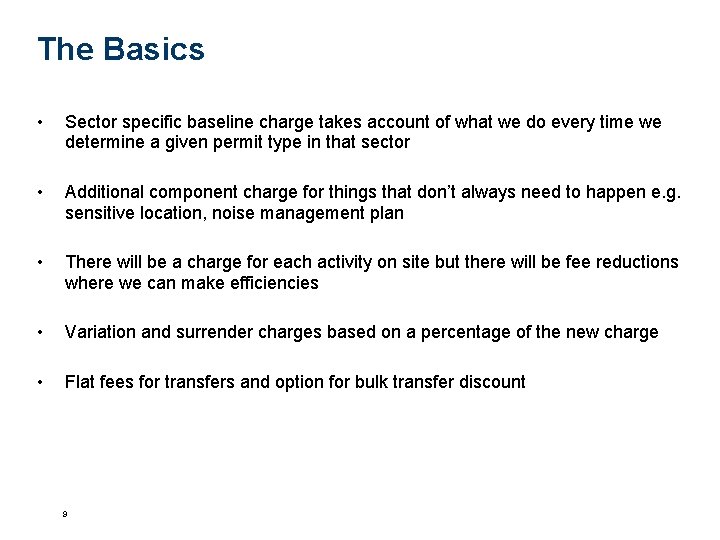
The Basics • Sector specific baseline charge takes account of what we do every time we determine a given permit type in that sector • Additional component charge for things that don’t always need to happen e. g. sensitive location, noise management plan • There will be a charge for each activity on site but there will be fee reductions where we can make efficiencies • Variation and surrender charges based on a percentage of the new charge • Flat fees for transfers and option for bulk transfer discount 9
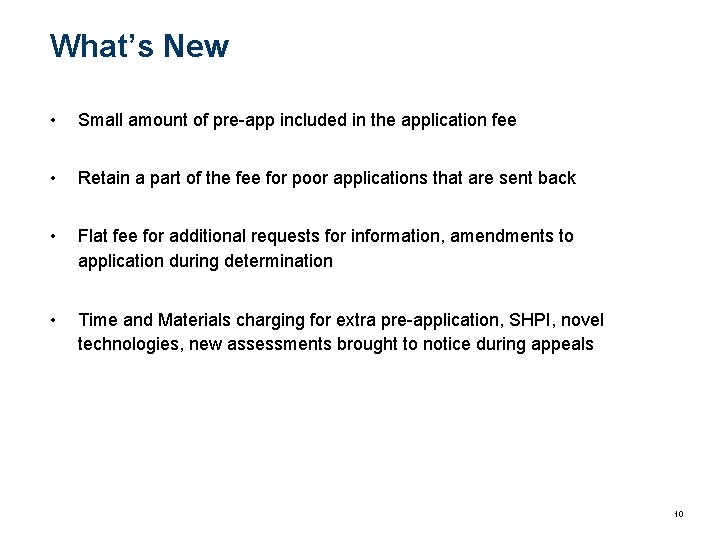
What’s New • Small amount of pre-app included in the application fee • Retain a part of the fee for poor applications that are sent back • Flat fee for additional requests for information, amendments to application during determination • Time and Materials charging for extra pre-application, SHPI, novel technologies, new assessments brought to notice during appeals 10
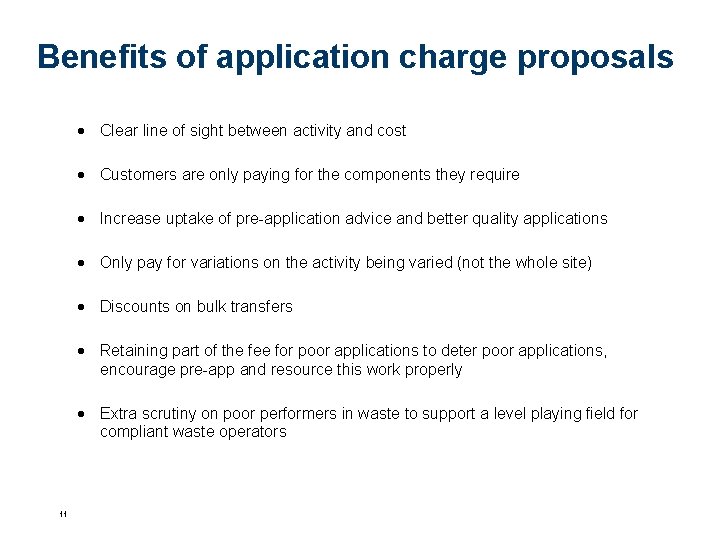
Benefits of application charge proposals • Correct resourcing for the work involved Clear line of sight between activity and cost Customers are only paying for the components they require Increase uptake of pre-application advice and better quality applications Only pay for variations on the activity being varied (not the whole site) Discounts on bulk transfers Retaining part of the fee for poor applications to deter poor applications, encourage pre-app and resource this work properly Extra scrutiny on poor performers in waste to support a level playing field for compliant waste operators 11
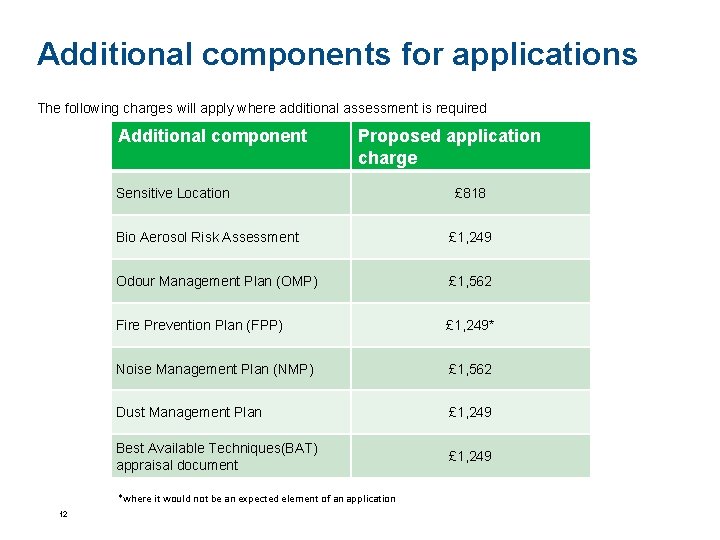
Additional components for applications The following charges will apply where additional assessment is required Additional component Proposed application charge Sensitive Location Bio Aerosol Risk Assessment £ 1, 249 Odour Management Plan (OMP) £ 1, 562 Fire Prevention Plan (FPP) £ 1, 249* Noise Management Plan (NMP) £ 1, 562 Dust Management Plan £ 1, 249 Best Available Techniques(BAT) appraisal document £ 1, 249 *where it would not be an expected element of an application 12 £ 818
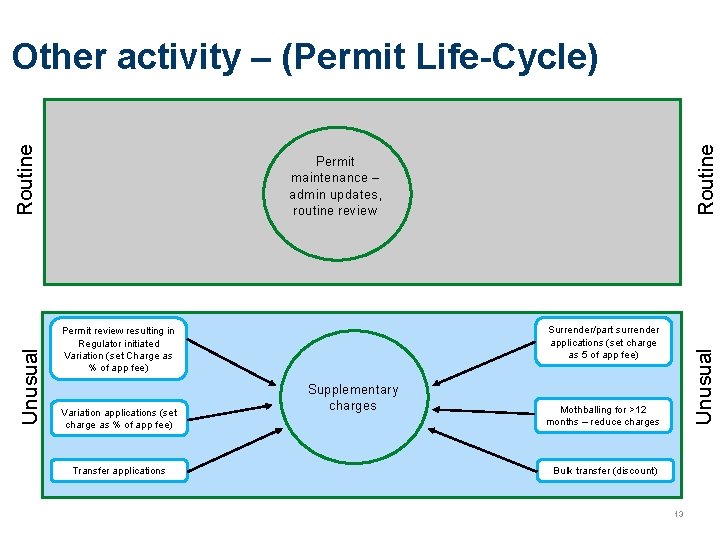
Routine Permit maintenance – admin updates, routine review Surrender/part surrender applications (set charge as 5 of app fee) Permit review resulting in Regulator initiated Variation (set Charge as % of app fee) Variation applications (set charge as % of app fee) Transfer applications Supplementary charges Unusual Routine Other activity – (Permit Life-Cycle) Mothballing for >12 months – reduce charges Bulk transfer (discount) 13
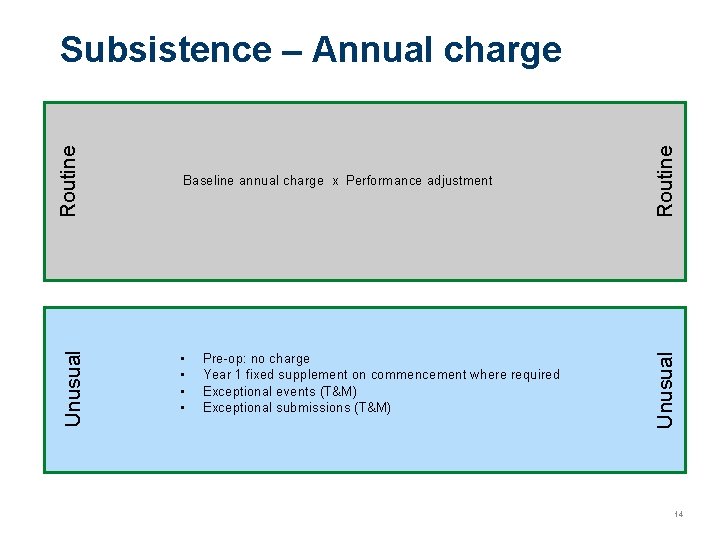
• • Pre-op: no charge Year 1 fixed supplement on commencement where required Exceptional events (T&M) Exceptional submissions (T&M) Routine Baseline annual charge x Performance adjustment Unusual Routine Subsistence – Annual charge 14
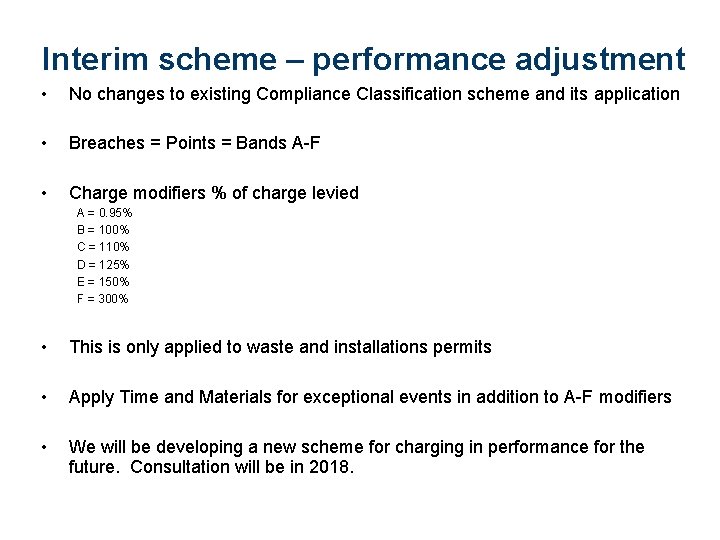
Interim scheme – performance adjustment • No changes to existing Compliance Classification scheme and its application • Breaches = Points = Bands A-F • Charge modifiers % of charge levied A = 0. 95% B = 100% C = 110% D = 125% E = 150% F = 300% • This is only applied to waste and installations permits • Apply Time and Materials for exceptional events in addition to A-F modifiers • We will be developing a new scheme for charging in performance for the future. Consultation will be in 2018.
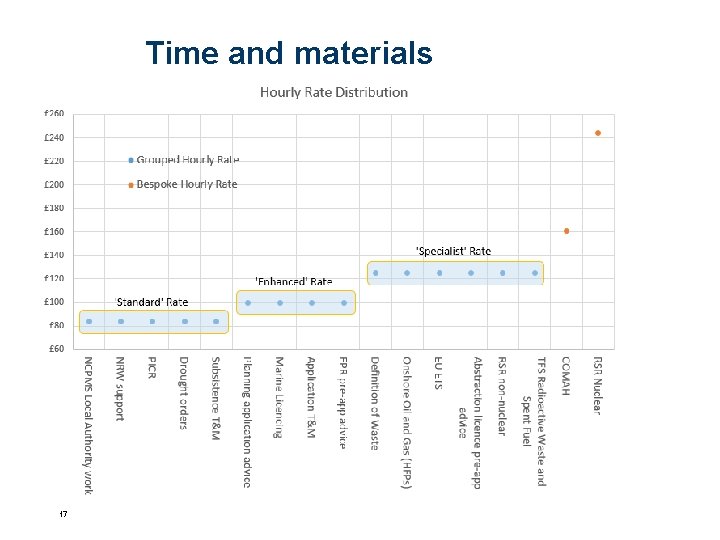
Time and materials We have looked at the activity required to deliver our time and material services, and modelled a charge rate. Our charge model allows us to work out the full cost of delivering an activity. It incorporates: staff costs for those directly delivering the service staff costs for those supporting direct delivery – for example team leaders and other operational teams that contribute to the service corporate services charges other costs – for example IT assets bad debts 16
Time and materials 17
Timings Pre-consultation discussions through Charges Review Group and with trade bodies Informal engagement with key stakeholders led by sectors to outline the typical costs and activities we are expecting Stakeholder events September to November, before and during consultation Consultation launch – Autumn 2017 New scheme in place April 2018 18
Having your say on the changes • Follow up questions can be emailed to strategicrevcharges@environment-agency. gov. uk 19
- Slides: 19