
Strategic Reinforcement and Chains How to set yourself
- Slides: 41
Strategic Reinforcement and Chains! How to set yourself up for success and put behaviors together!
Strategic Reinforcement How to set yourself and your dog up for success!!! What I learned from Michele Poulliot
Rewards = powerful tool • EVERY reward is a “delivery event” • This event greatly influences behavior • Must be strategic in delivery of reinforcers • That is: Each reward delivery should involve a plan!
Strategic Reinforcement does NOT ask for additional behavior • After the click: “delivery event” must flow smoothly and NOT require more behavior before the dog receives his/her reward. • Example: Click for sitting • Dog gets up • You require dog to sit back down to get the reward • This is requiring an EXTRA behavior • How to avoid this? Strategic Reinforcement!
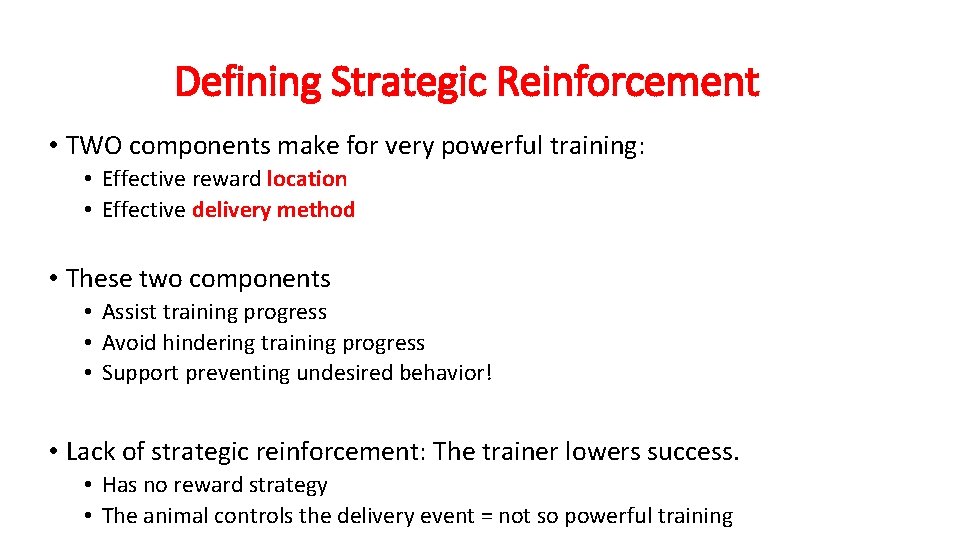
Defining Strategic Reinforcement • TWO components make for very powerful training: • Effective reward location • Effective delivery method • These two components • Assist training progress • Avoid hindering training progress • Support preventing undesired behavior! • Lack of strategic reinforcement: The trainer lowers success. • Has no reward strategy • The animal controls the delivery event = not so powerful training
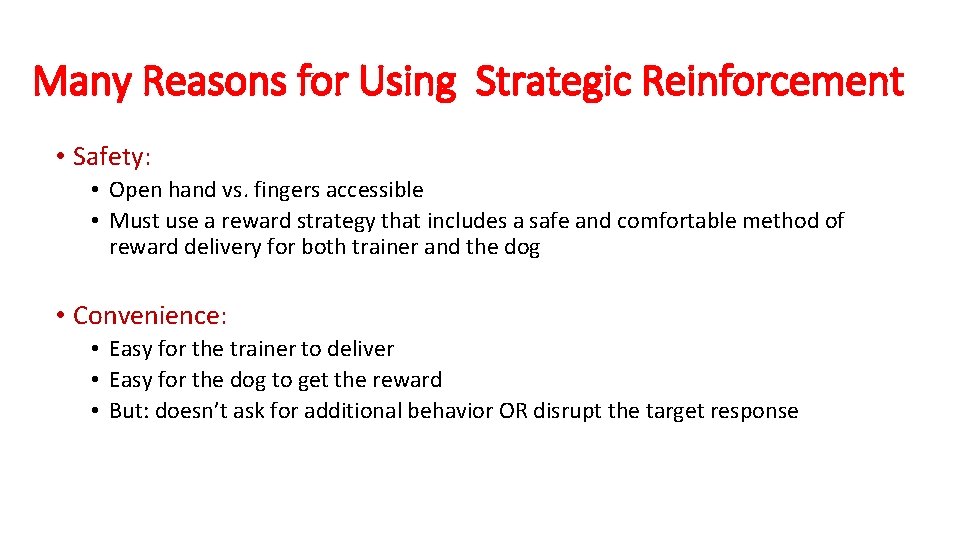
Many Reasons for Using Strategic Reinforcement • Safety: • Open hand vs. fingers accessible • Must use a reward strategy that includes a safe and comfortable method of reward delivery for both trainer and the dog • Convenience: • Easy for the trainer to deliver • Easy for the dog to get the reward • But: doesn’t ask for additional behavior OR disrupt the target response
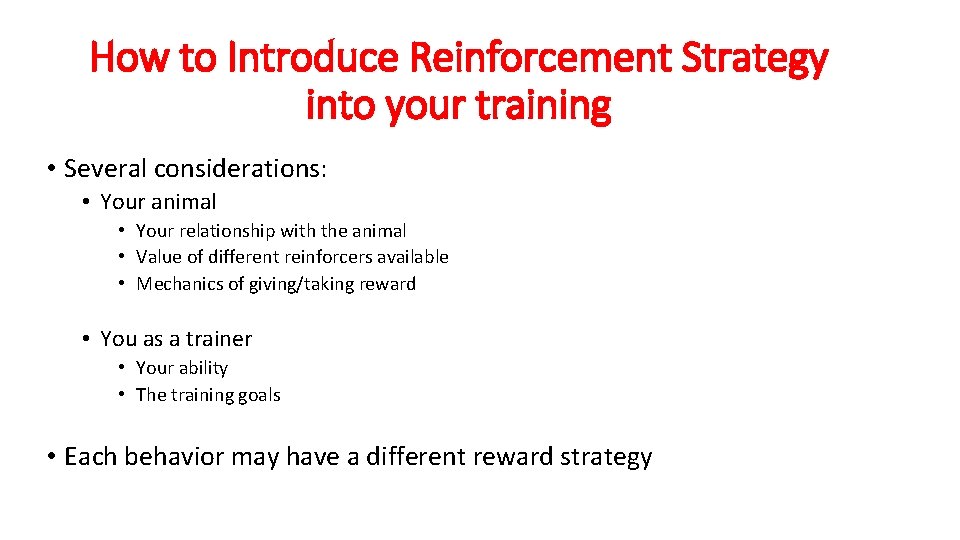
How to Introduce Reinforcement Strategy into your training • Several considerations: • Your animal • Your relationship with the animal • Value of different reinforcers available • Mechanics of giving/taking reward • You as a trainer • Your ability • The training goals • Each behavior may have a different reward strategy
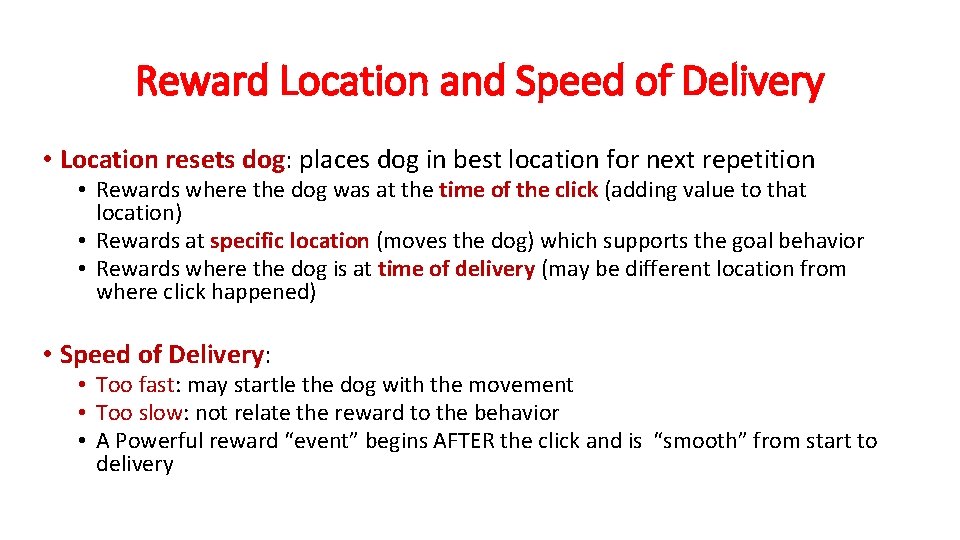
Reward Location and Speed of Delivery • Location resets dog: places dog in best location for next repetition • Rewards where the dog was at the time of the click (adding value to that location) • Rewards at specific location (moves the dog) which supports the goal behavior • Rewards where the dog is at time of delivery (may be different location from where click happened) • Speed of Delivery: • Too fast: may startle the dog with the movement • Too slow: not relate the reward to the behavior • A Powerful reward “event” begins AFTER the click and is “smooth” from start to delivery
Other Delivery Strategies: • Relocating Animal via Preset Rewards • Prompts the dog to move to the reward • Remote controlled feeding machine • Preplaced reward on a “trained” target (cue for taking reward) • Reward Stationing: • Use a frequently used reward location • Place or position from which most behaviors are cued and/or most behaviors are reinforced • E. g. : head position, in front of handler, on platform • Protected contact: • Physical set up limits animal’s access to reward • Reward delivery supports desired behavior: Waiting for delivery • E. g. , remaining behind a barrier to deliver the reward: animal waits for you to approach barrier and delivery safely
Delivery Strategies • Pizza Delivery! • Make it so there is NO NEED to TRAVEL to get the reward • Direct Delivery: Prompts the dog to remain at the “click” location • Come and Get It! • Upon click: dog comes to reward at its location (usually handler) • Reset dog for next repetition: Initial movement towards goal behavior is heavily reinforced • Reset dog for Completion Point: final behavior position is more heavily reinforced • “Longer” delivery Events: Distance Clicks • Extend “reward event” time • Reward is delivered to that distant location
Examples: • Promoting a goal behavior: Down • Dog lies down, click • Where should you give reward to reinforce that position? • Promoting goal behavior: Back up • Dog backs up, click • Where should you give reward to reinforce that position? • Promoting heel position (dog on left side) • Dog heels, click • Dog moves to in front of you • Where should you reinforce to keep dog in position?
Examples: • Promoting a goal behavior: Ignore distractions • Dog is walking along, not looking at distraction • Click for this behavior • Where should you give reward to reinforce that position? • Promoting goal behavior: dog comes off A-frame, must make contact with lower part of board • Dog moves down ramp, hits yellow area • Where should you give reward to reinforce that position? • Promoting 4 -feet on platform • Dog gets x feet on platform, click • Where should you reinforce to keep dog in position?
Chains When 1 behavior just isn’t enough.
Chains and Cues • Remember: When we give a cue, we say it ONCE TIME! • No repeating yourself while the dog shapes you! • Give the cue • wait 3 -5 seconds • If no response: record as error and give cue again! • When shaping: Work on 1 cue at a time until fluency • Dog should be getting 8/10 cues correctly three sets of 10 in a row. • But…this is boring…. so let’s mix it up a little
Chains and Cues • A chain is a group of cues that lead to a primary reinforcer • E. g. : Sit-Down-roll over-sit-up • Each cue is a secondary reinforcer • Many behaviors lead to a single primary reinforcer! • Each cue in the chain: • Serves as a (Secondary) REINFORCER for the previous response • Serves as a CUE for the next behavior • E. g. : Down reinforces sit and asks dog to down; roll over reinforces down and asks dog to roll over…. .
Timing in Chains is IMPORTANT • Did I say that timing in chains is important? • Timing in chains is important • When you give your cue is critical! • Timing in chains is important! • Give the cue as animal BEGINS behavior • E. g. , as dog sits, cue “Down” • If you wait until the end of the behavior, dog will have a pause as he waits for the next cue • Must give the dog enough time to DO the next behavior • Most problems with chains involve poor cue timing!
Two basic kinds of chains: • Forward chains: • Start from first behavior and work towards the end • E. g. : Shoe tying: • Start with putting your foot in • End with the final pull on the bow • Backward chains • Start from the terminal (ending link) and work backwards to the start • E. g. : Shoe tying: • Start with the final pull on the bow • Work backwards to the beginning
Two basic kinds of chains: • Which is better? Forwards or Backwards? • Generally backwards chains are better • End closest to the reinforcer • Instant success • More easy to work backwards and build duration • Forward chains are unavoidable: • Consumable behaviors: e. g. , potty training • Problem: more distant to reinforcer • So: reinforcer beginning steps and then add more steps before the reinforcer
Problems with Chains! • The Animal Anticipates the Cue • Blending of behaviors • Poison cues • Superstitious chains • All can screw up your chain • Must deal with issues carefully or you will destroy your chain.
Problems Chains! Anticipating the cues • Problem: The Animal Anticipates the Cue: • After a few repetitions, an animal may anticipate the next cue and act before the cue is given. • Common problem. • Because the trainer sees the desired behavior, he or she doesn’t realize that there is a cueing problem that will eventually jeopardize the chain. • Without a cue reinforcing behavior #2, the behavior will begin to shorten and then to blend with behavior #3, and eventually will be lost from the chain.
Animal Anticipates the Cue: The FIX • Always practice portions or sub units (2 to 4 behaviors) within a chain much more often than the whole chain. • Make sure EACH behavior in a chain is fluent by practicing them individually as needed. • Don’t over practice the chain in order…or animal will anticipate and even blend.
Animal Anticipates the Cue: The FIX • When having a problem: Take three behaviors out of the chain: • The one giving trouble, • The one BEFORE it, a • The one AFTER it. • Give Cue #1, then cue #2 while #1 is going on, C/T. • Then do the same with #2 • And #3, • Then with all three. • If a behavior has completely broken down, • Reshape the behavior • Bring it under stimulus control with a new verbal cue or hand signal. • Even in chains cues can become faulty and poisoned.
An Example: Navigating an A Frame • Teaching a dog to navigate agility equipment is often done by leading, luring, targeting, or shaping the dog through the process. • For example: A-frame • A low version is used to start. • The dog is shaped to go • near it, • touch it, • go part way up, • then a little farther, • until he goes all the way over.
Common problem: Jumping off too early • If the dog jumps off partway, the trainer starts again. • In this process there is a lot of reinforcement for the going up part, but not much for the going down part—which in actuality is the part we want to strengthen. • The Solution: Start on the downward side • Backward chain • Work just on touching the contact zone and coming off, would be a way to teach the last part of the chain first. • At this point the dog would be walking up the down side, turning and coming down. • End behavior become MOST reinforced behavior
Hazards of Praise and Clicks During the Chain • Don’t make your chain a poisoned cue! • Many people don’t realize that if you interrupt a well-established chain with a conditioned reinforcer that is not a cue (a click, or cheers and applause, for example), the animal will • Expect and be looking for a primary reinforcer—the treat, game, or other desired event usually received at the completion of the chain. • An animal doing a chain in performance or competition may continue the chain once, without flaw, despite your cheers • BUT: even a few such interruptions may cause inexplicable breakdowns in future performances
Superstitious Chains • Superstitious chains = string of behaviors that the animal believes are linked and lead to reinforcement • In actuality there is no contingency between the behaviors and the reinforcement • In some cases these superstitious behaviors are true chains, • Behaviors are linked by stimuli the animal perceives as cues. • Sometimes strings of behaviors that develop are simply a pattern or series of behaviors that the animal has strung together. • To the animal, they are essentially one behavior. • Becomes a fluent behavior rather than a bunch of individual behaviors • Harder to change because of fluency
Superstitious Chains Example: Dog runs to the door at the sound of the doorbell, then spins and jumps • The dog may pair running/spinning/jumping with what makes the door open (the reinforcement), • In fact the door opening ¡s not contingent on the dog’s behavior at all. • Another example: A dog hears doorbell, sees a toy and grabs it, and runs to the door • Developed a chain that ¡s held together by environmental cues: • Door opening is the cue for grab the toy • Toy is the cue for run to the door. • The chain is then reinforced by attention and a tossed toy from the person entering. • Solution: If the toy Is not available or In sight when the dog hears the door opening, this superstitious chain will quickly break down…. . and dog “misbehaves” • Question: Do you want this behavior or not? If you do…. reinforce it explicitly!
But What Does the Research Say? • Three studies: – Meyer and Ladewig (2008) show much training is necessary – Chiandetti, Avella, Fongaro & Cerri 2016: Examines clicker vs. Voice vs. Just food – Thorn, Templeton, Van Winkle & Castill 0, 2006: Examined quick and dirty training program for shelters
Meyer and Ladewig (2008) • Examined how often training should be conducted to get best training results – Very few studies examined this – Many reasons why: • Dogs are owned, and people differ greatly in their handling/training • Laboratory dogs aren’t really a good comparison • Massed vs. spaced training: – Most research shows that spaced training results in better learning and retention – Is this true for dogs?
Procedure • 18 dogs: Laboratory beagles • Divided into 2 groups – Dogs trained 1 x per week – Dogs trained 5 days per week – All trained by same person in familiar environment with food reward • The shaping exercise: – Perform paw on target behavior while on a table stand – Place paw on mouse pad (touch) 1 meter away from trainer – Criteria of 80% correct responses for each of three steps
Results • All dogs completed the shaping task through step 3 • Results showed FEWER training sessions was more effective – 1 x/week: averaged 6. 7 training sessions – 2 x/week: averaged 9 training sessions – Dogs trained 1 x week had higher average success rate
Discussion: Why less training = better? • Is consistent with research with other animals – – Rat Horse Pigeon Even people • More time allows for building of long term retention? Maybe • Less habituation to the task? – Dogs trained 1 x per week may have been less “bored” – Attention may have been better – Does suggest that 1 to 2 training sessions per week is sufficient and daily may be too much if working on SAME task!
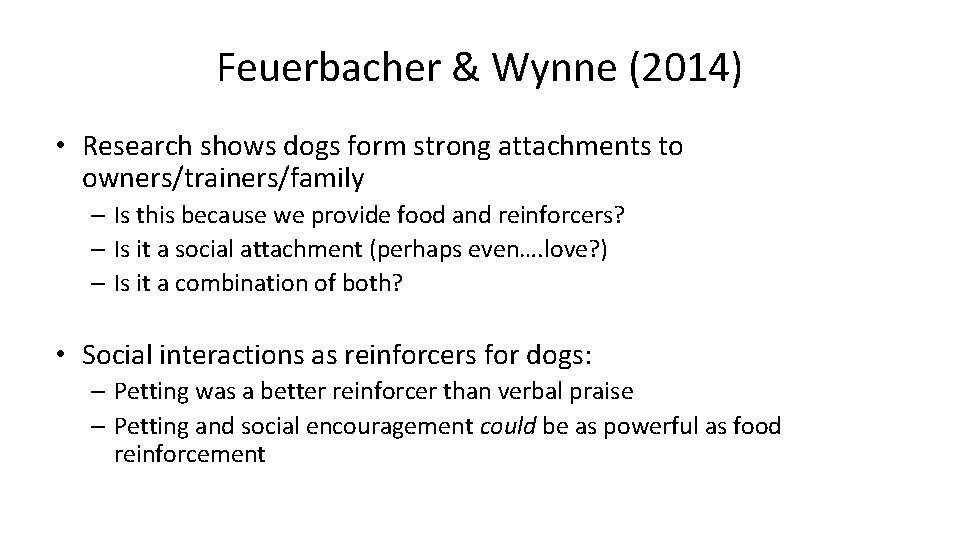
Feuerbacher & Wynne (2014) • Research shows dogs form strong attachments to owners/trainers/family – Is this because we provide food and reinforcers? – Is it a social attachment (perhaps even…. love? ) – Is it a combination of both? • Social interactions as reinforcers for dogs: – Petting was a better reinforcer than verbal praise – Petting and social encouragement could be as powerful as food reinforcement
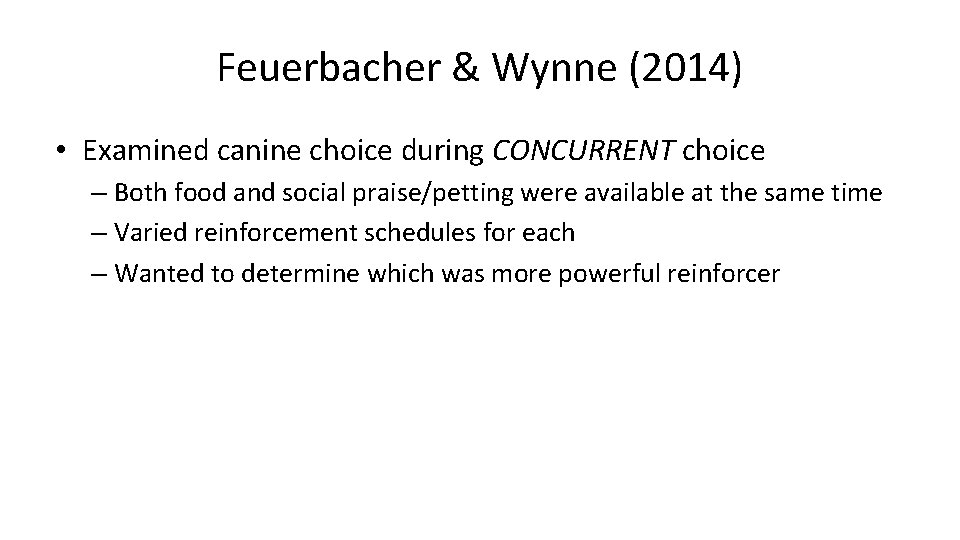
Feuerbacher & Wynne (2014) • Examined canine choice during CONCURRENT choice – Both food and social praise/petting were available at the same time – Varied reinforcement schedules for each – Wanted to determine which was more powerful reinforcer
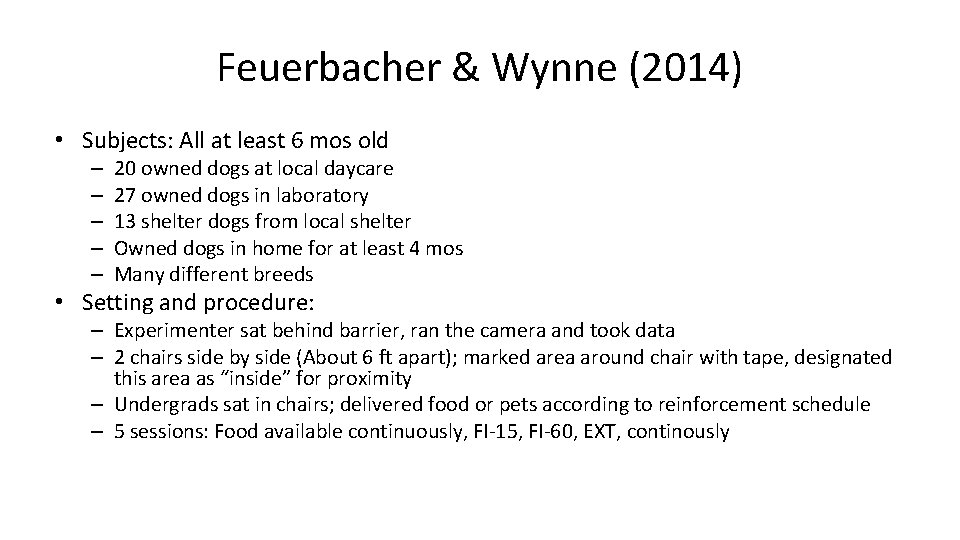
Feuerbacher & Wynne (2014) • Subjects: All at least 6 mos old – – – 20 owned dogs at local daycare 27 owned dogs in laboratory 13 shelter dogs from local shelter Owned dogs in home for at least 4 mos Many different breeds • Setting and procedure: – Experimenter sat behind barrier, ran the camera and took data – 2 chairs side by side (About 6 ft apart); marked area around chair with tape, designated this area as “inside” for proximity – Undergrads sat in chairs; delivered food or pets according to reinforcement schedule – 5 sessions: Food available continuously, FI-15, FI-60, EXT, continously
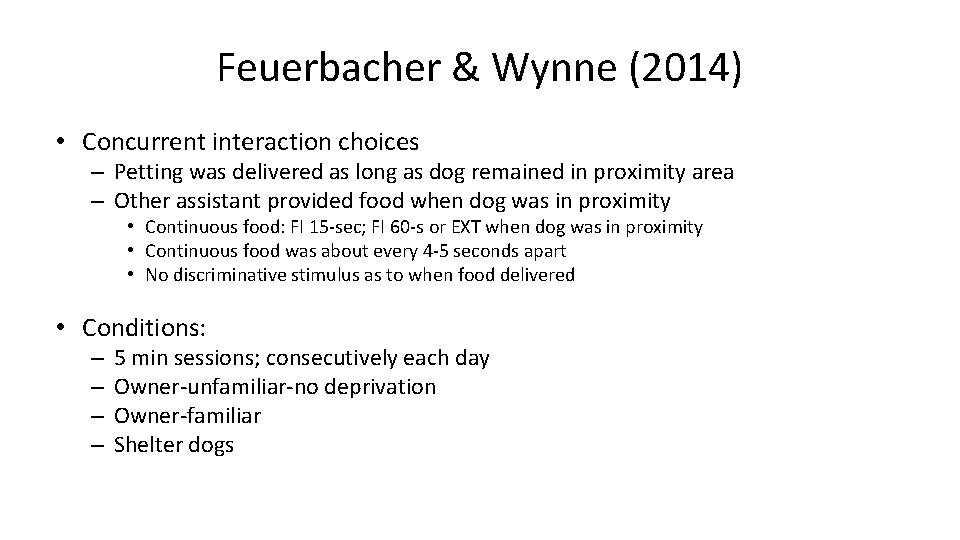
Feuerbacher & Wynne (2014) • Concurrent interaction choices – Petting was delivered as long as dog remained in proximity area – Other assistant provided food when dog was in proximity • Continuous food: FI 15 -sec; FI 60 -s or EXT when dog was in proximity • Continuous food was about every 4 -5 seconds apart • No discriminative stimulus as to when food delivered • Conditions: – – 5 min sessions; consecutively each day Owner-unfamiliar-no deprivation Owner-familiar Shelter dogs
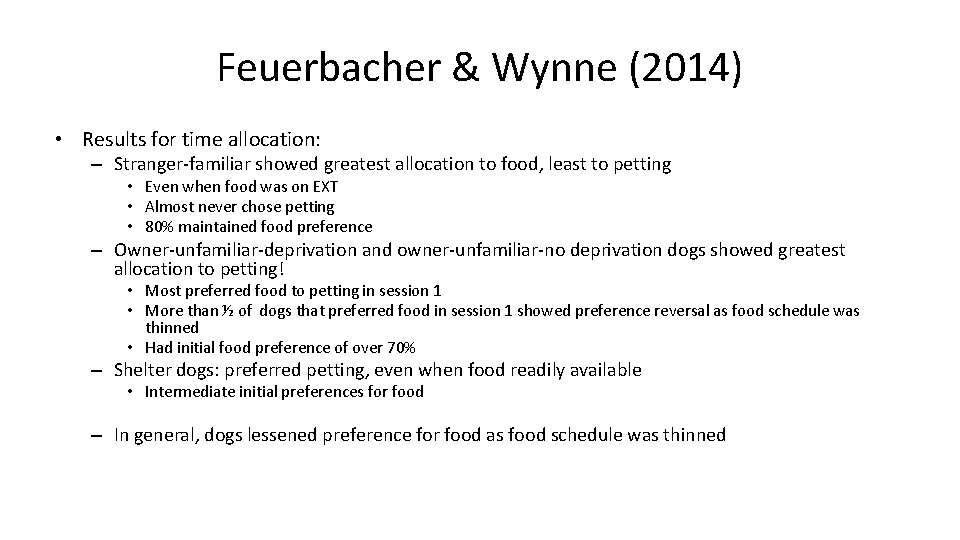
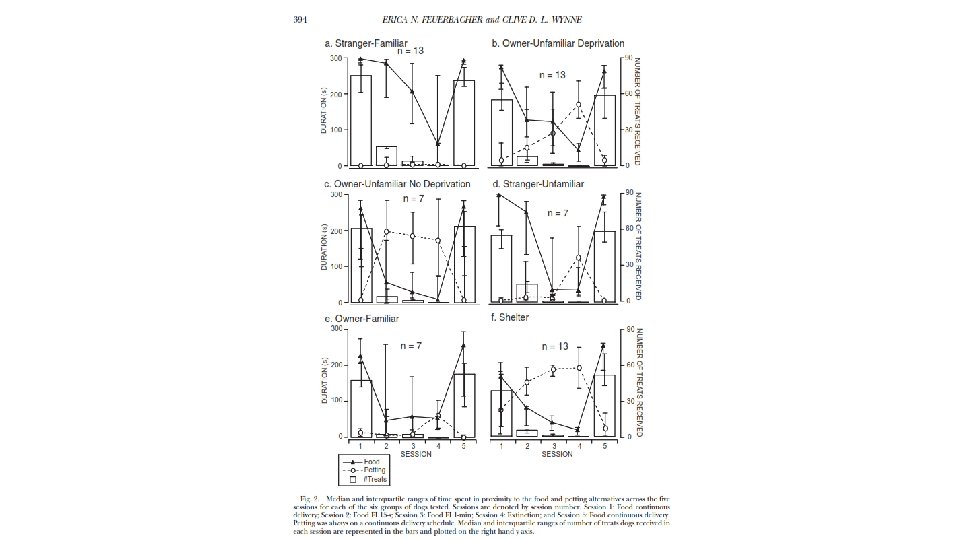
Feuerbacher & Wynne (2014) • Results for time allocation: – Stranger-familiar showed greatest allocation to food, least to petting • Even when food was on EXT • Almost never chose petting • 80% maintained food preference – Owner-unfamiliar-deprivation and owner-unfamiliar-no deprivation dogs showed greatest allocation to petting! • Most preferred food to petting in session 1 • More than ½ of dogs that preferred food in session 1 showed preference reversal as food schedule was thinned • Had initial food preference of over 70% – Shelter dogs: preferred petting, even when food readily available • Intermediate initial preferences for food – In general, dogs lessened preference for food as food schedule was thinned
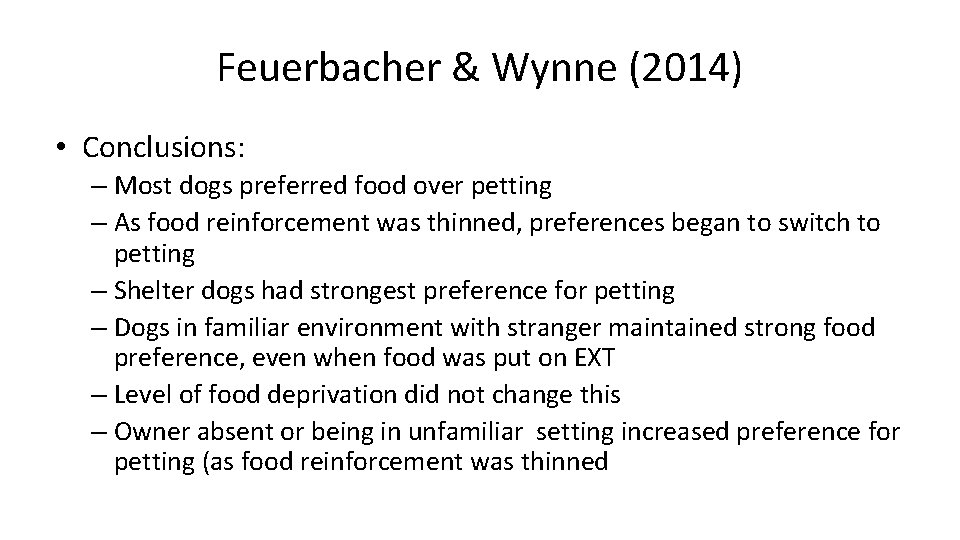
Feuerbacher & Wynne (2014) • Conclusions: – Most dogs preferred food over petting – As food reinforcement was thinned, preferences began to switch to petting – Shelter dogs had strongest preference for petting – Dogs in familiar environment with stranger maintained strong food preference, even when food was put on EXT – Level of food deprivation did not change this – Owner absent or being in unfamiliar setting increased preference for petting (as food reinforcement was thinned
Feuerbacher & Wynne (2014) • Why? – How much petting do owned dogs versus shelter dogs receive? – How could familiarity of setting or owner absence affect the responsiveness to food/petting? – What does this tell us about OUR dogs?
Take Home Message: Your Tag points: • We are preparing our dogs for adoption or helping them stay in their homes. • You are a critical training for these dogs • Without it they might not get adopted! • USE CLEAN chains of behavior. • BE consistent • USE positive Reinforcement: BOTH food and PETTING/TOUCH • Watch our for superstitious chains • Reshape and retrain right away • Break up your chain if it breaks down • Practice its components • Carefully rebuild