
Strategic Prevention Framework Training Presenters Rebecca Alfaro MSW
Strategic Prevention Framework Training Presenters: Rebecca Alfaro, MSW Connie Greene, MA, CPS, CAS, CSW Bob Goldschlag, JD, CCM
INTRODUCTION • GCADA and Guidelines http: //gcada. nj. gov/alliance/forms/ • Handouts
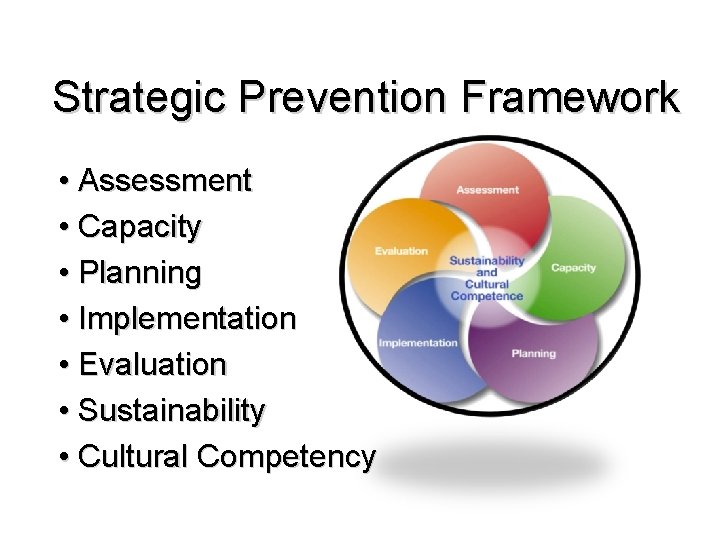
Strategic Prevention Framework • Assessment • Capacity • Planning • Implementation • Evaluation • Sustainability • Cultural Competency
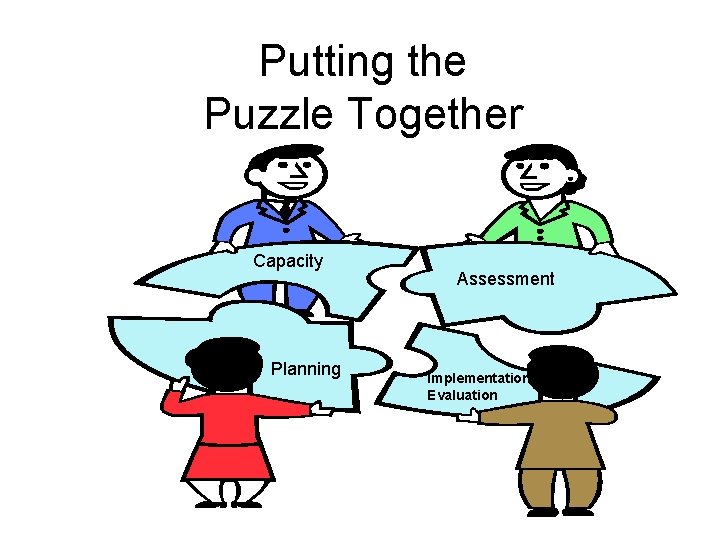
Putting the Puzzle Together Capacity Planning Assessment Implementation & Evaluation
The Agenda For Tonight • Create a vision statement • Create a mission statement • Develop a strategic plan based on your logic model utilizing CADCA’s Seven Strategies for Change • Evaluation
Vision & Mission Statements
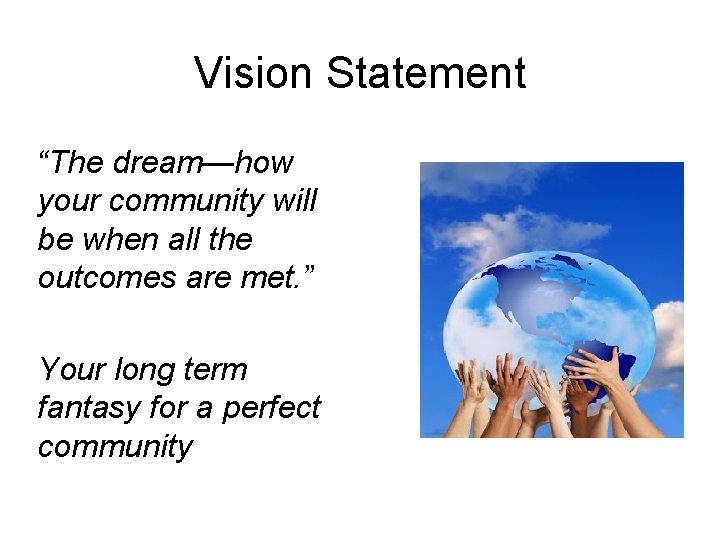
Vision Statement “The dream—how your community will be when all the outcomes are met. ” Your long term fantasy for a perfect community
Vision Statement Example: The vision for Utopia Alliance is a healthy, vibrant community, free of misuse of alcohol, tobacco and other drugs.
Mission Statement • What the Alliance’s role is in making the vision a reality. Example: The Mission of the Utopia Alliance is to transform the Township of Utopia into a community that nurtures youth and families by engaging residents in the process of ongoing community problem solving to reduce substance abuse.
Difference between Vision & Mission While the Vision is a dream, the Mission is more concrete and action oriented.
Developing the Plan of Action • In order to develop the plan you must understand – Community Level Change – CADCA’s Seven Strategies for Change
Community Level Change (Environmental Strategies) Prevention efforts aimed at changing or influencing community conditions rather then individuals or groups of individuals Only a part of what Alliances will be doing
CADCA’s Seven Strategies for Community Level Change To effect change an alliance must develop a diverse range of strategies and interventions.
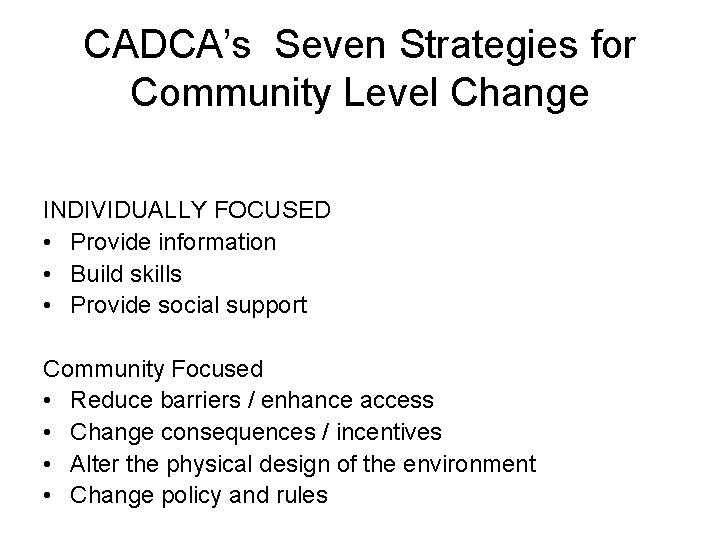
CADCA’s Seven Strategies for Community Level Change INDIVIDUALLY FOCUSED • Provide information • Build skills • Provide social support Community Focused • Reduce barriers / enhance access • Change consequences / incentives • Alter the physical design of the environment • Change policy and rules
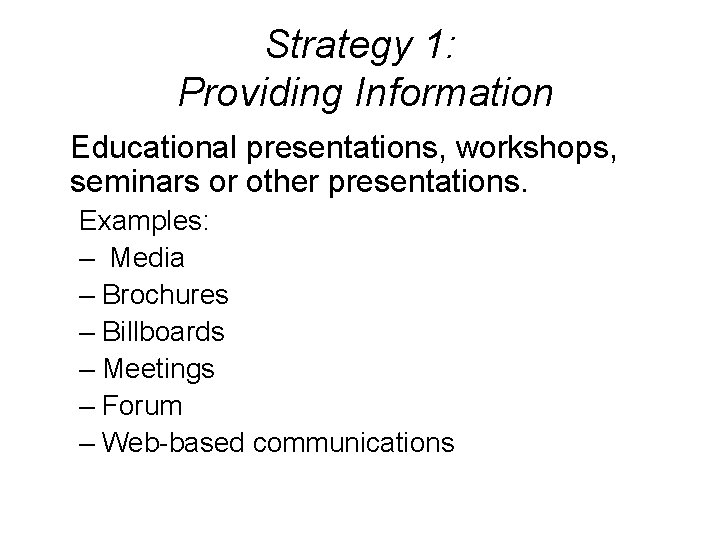
Strategy 1: Providing Information Educational presentations, workshops, seminars or other presentations. Examples: – Media – Brochures – Billboards – Meetings – Forum – Web-based communications
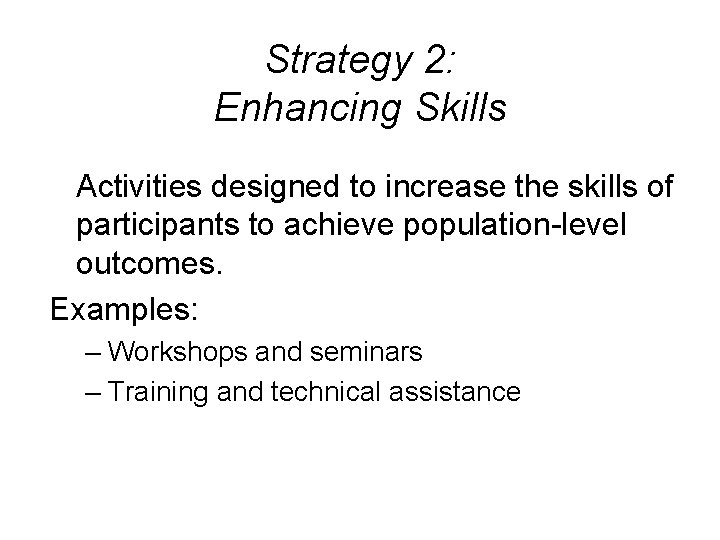
Strategy 2: Enhancing Skills Activities designed to increase the skills of participants to achieve population-level outcomes. Examples: – Workshops and seminars – Training and technical assistance
Strategy 3: Providing Support Creating opportunities for individuals to participate in activities that reduce risk or enhance protection • Examples: – Providing alternative activities – Mentoring – Referrals – Support groups
Strategy 4: Enhancing Access/Reducing Barriers Improving systems and processes to increase the ease, ability and opportunity to utilize services. Examples: – Cultural and language sensitivity – Childcare – Transportation
Strategy 5: Changing Consequences Increasing or decreasing the probability of a specific behavior by altering the consequences of that behavior • • Increasing public awareness Individual and business rewards Taxes, citations, and fines Revocation/loss of privileges
Strategy 6: Physical Design • Changing the physical design or structure of the environment to reduce risk or enhance protection – Parks – Landscape – Signage – Lighting – Outlet density
STRATEGY 7: Modifying/Changing Policies Formal change in written procedures, by-laws, proclamations, rules or laws with written documentation, and/or voting procedures: • • Workplace initiatives Law enforcement procedures and practices Public policy actions Systems change within government, communities and organizations
Strategic Planning Key Documents 1. Logic Model 2. Guidelines 3. Form 7 Alliance Action Plan
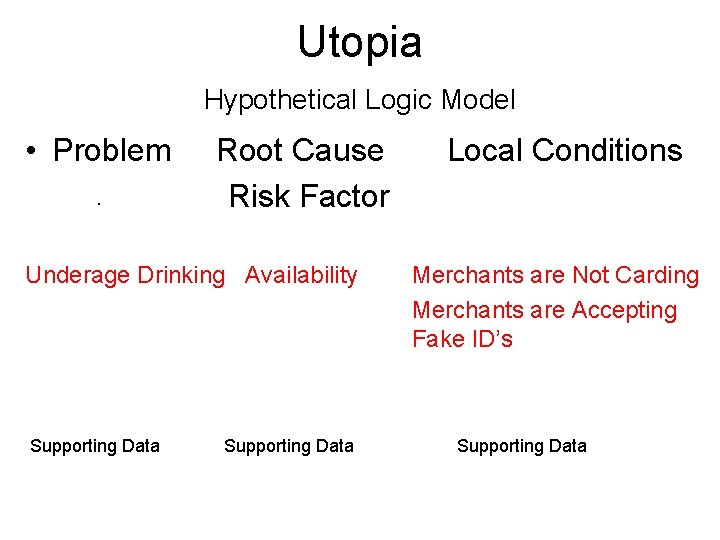
Utopia Hypothetical Logic Model • Problem • Root Cause Risk Factor Underage Drinking Availability Supporting Data Local Conditions Merchants are Not Carding Merchants are Accepting Fake ID’s Supporting Data
Form 7 Alliance Action Plan • Logic Model Information (Top of Form) • Plan for Action • Plan for Implementation • Plan for Evaluation
Form 7 Logic Model Information Alliance Name: Utopia Drug Priority: (Problem) County: Paradise Last Updated: 9/25/13
Form 7 Logic Model Information Alliance Name: Utopia County: Paradise Last Updated: 9/25/13 Drug Priority: Underage Drinking Root Cause:
Form 7 Logic Model Information Alliance Name: Utopia County: Paradise Last Updated: 9/25/13 Drug Priority: Underage Drinking Root Cause: Availability/Access
Form 7 Logic Model Information Alliance Name: Utopia County: Paradise Last Updated: 9/25/13 Drug Priority: Underage Drinking Root Cause: Availability/Access Goal:
Form 7 Logic Model Information Goal: To reduce availability of alcohol to minors Local Condition:
Form 7 Logic Model Information Local Condition: Merchants are not carding or are accepting false ID’s
Form 7 Logic Model Information Local Condition: Merchants are Not Carding or Are Accepting False ID’s Objective:
Form 7 Logic Model Information Local Condition: Merchants are Not Carding or Are Accepting False ID’s Objective: Increase the number of merchants carding and knowledgeable in identifying fake ID’s
Form 7 Logic Model Information • Strategy: (CADCA’s Seven Strategies for Change )
Form 7 Logic Model Information • Pick at least one from the first three and at least two from the last four of the CADCA 7 Strategies
Form 7 Logic Model Information Strategies: Enhancing Skills (CADCA 2) Changing Consequences (CADCA 5) Modifying/Changing Policies (CADCA 7)
Form 7 Plan for Action • Activity/Program: (Name of Activity)
Form 7 Plan for Action • Activity/Program: Responsible Beverage Server Training • Brief Description: – Main Purpose – What will be learned – How will they benefit
Form 7 Plan for Action • Activity/Program: Responsible Beverage Server Training • Brief Description: RBST’s will be offered on a regular basis to servers…. Local merchants will be encouraged to create and enforce a policy mandating RBST for employees.
Form 7 Plan for Action • When, Where and How: – When will it take place – What is the time frame – How much – How often
Form 7 Plan for Action When, Where and How: Bi-monthly of the course of a year, in 3 hours sessions, at merchant’s locations. Establishments will require new staff to attend. Participating establishments will be rewarded.
Form 7 Plan for Action Target Population A) Number of Participants B) Population
Form 7 Plan for Action Target Population: A) 180 servers and 20 local establishment B) Community at large • Community Partners: – Who else is collaborating
Form 7 Plan for Action Community Partners: Local Merchants (to be identified) Chamber of Commerce
Form 7 Plan for Implementation • Budget and Resources Breakdown of: DEDR Cash match In-kind
Form 7 Plan for Action Responsible Members for Implementation: Who is implementing Credentials or Qualifications
Form 7 Plan for Implementation Individuals Responsible for Implementation List names, credentials and what they will be doing
Form 7 Plan for Evaluation • Five elements to evaluation: • Process • Short-term outcomes • Intermediate Outcomes • Long-term outcomes • Long-term impact evaluation
Form 7 Plan for Evaluation • Form 7– Plan for Evaluation – Process Indicators • Tools to Measure Process – Outcome Indicators • Short Terms Goals • Tools to Measure Short Term Goals
Process Evaluation Examines the delivery of the intervention to determine if: • the target audience was reached • the Alliance stakeholders were engaged • the activity was delivered as intended
Form 7 Plan for Evaluation • Measure Process by: • Number of session • Number of unduplicated people attending each session
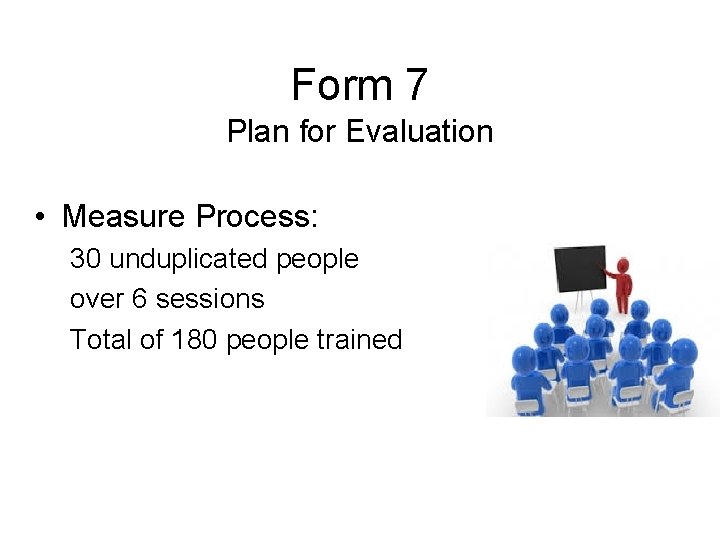
Form 7 Plan for Evaluation • Measure Process: 30 unduplicated people over 6 sessions Total of 180 people trained
Form 7 Plan for Implementation • Short Term Goals What would be learned/benefitted
Form 7 Plan for Implementation • Short Term Goals Increased knowledge & skill regarding: accepting proper ID understanding need for policy
Form 7 Plan for Implementation Tools & Instruments for process
Form 7 Plan for Implementation Tools & Instruments for process Attendance sheets
Form 7 Plan for Implementation • Tools and instruments for short term goals
Form 7 Plan for Implementation • Tools and instruments for short term goals – Pre & post tests – Surveys – Interviews
Intermediate Outcomes • Intermediate evaluation determines if the intervention is making a difference in the problems detailed in the Alliance’s local conditions identified on the logic model. • Not before year two
Long Term Outcomes • Long-term evaluation determines if the changes in the local conditions are affecting the root cause and ultimately reducing the problem as identified in the problem statement • Not before year five
Long Term Impact • Long-term impact identifies the long-term impact over a 5 -10 year period and considers the long-term health and social consequences to the community. • Long-term impact is determined when the Alliance conducts another needs assessment process in preparation for the next grant cycle

- Slides: 61