
Strategic Planning Process Southwestern Oklahoma State University February
Strategic Planning Process Southwestern Oklahoma State University February 14, 2012
Goal Facilitate process that builds from areas of strength, promise & opportunity to create a 2011 -2016 Strategic Plan that will guide the future of the Southwestern Oklahoma State University.
Goal Facilitate process that builds from areas of strength, promise & opportunity to create a 2011 -2016 Strategic Plan that will guide the future of the Southwestern Oklahoma State University.
Characteristics of Successful Planning Vision- and Mission-Driven Positive Builds on Past Developed by Campus Open & Collaborative Focused Implementable Conversational Creative. . . .
Overall Approach Blue Ocean Thinking
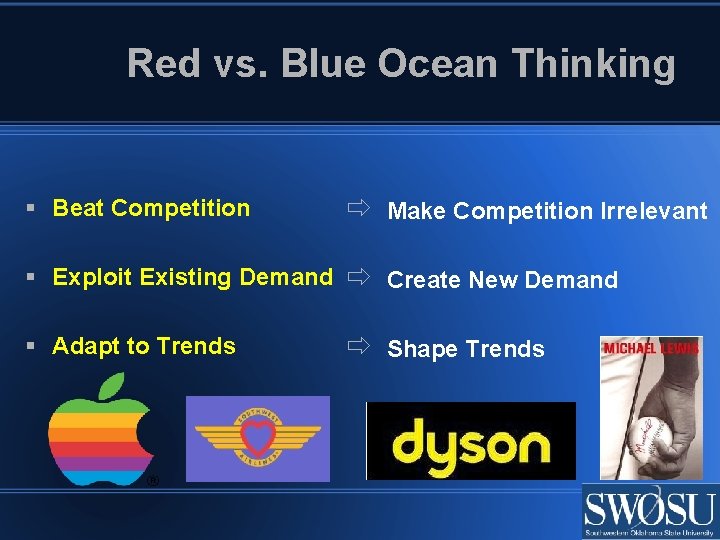
Red vs. Blue Ocean Thinking Beat Competition ð Make Competition Irrelevant Exploit Existing Demand ð Create New Demand Adapt to Trends ð Shape Trends
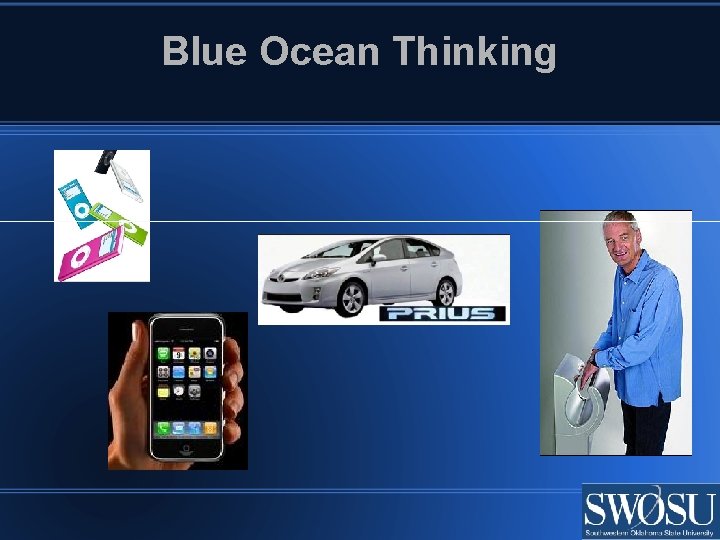
Blue Ocean Thinking
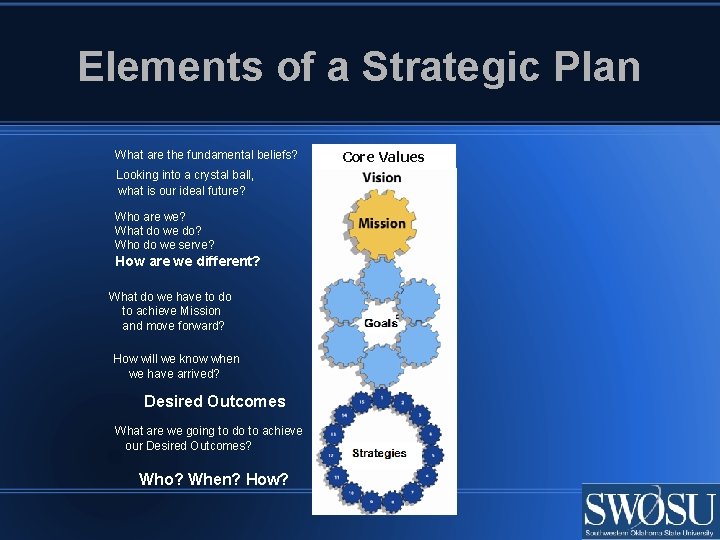
Elements of a Strategic Plan What are the fundamental beliefs? Looking into a crystal ball, what is our ideal future? Who are we? What do we do? Who do we serve? How are we different? What do we have to do to achieve Mission and move forward? How will we know when we have arrived? Desired Outcomes What are we going to do to achieve our Desired Outcomes? Who? When? How? Core Values
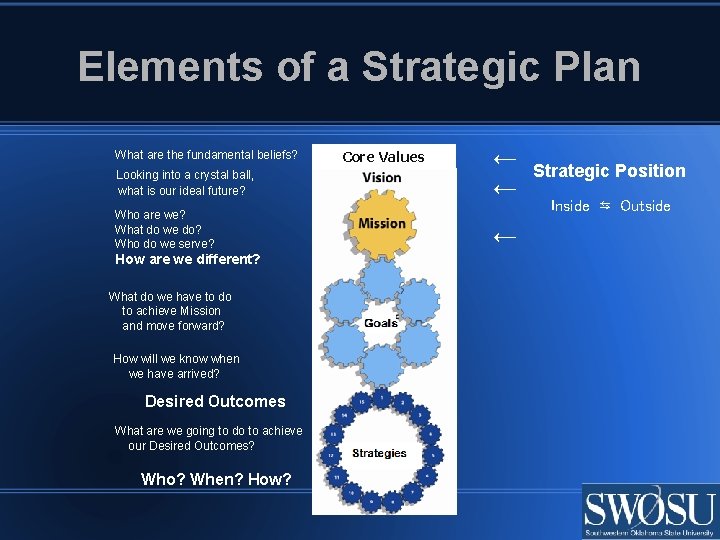
Elements of a Strategic Plan Looking into a crystal ball, what is our ideal future? ← ← Who are we? What do we do? Who do we serve? ← What are the fundamental beliefs? How are we different? What do we have to do to achieve Mission and move forward? How will we know when we have arrived? Desired Outcomes What are we going to do to achieve our Desired Outcomes? Who? When? How? Core Values Strategic Position Inside ⇆ Outside
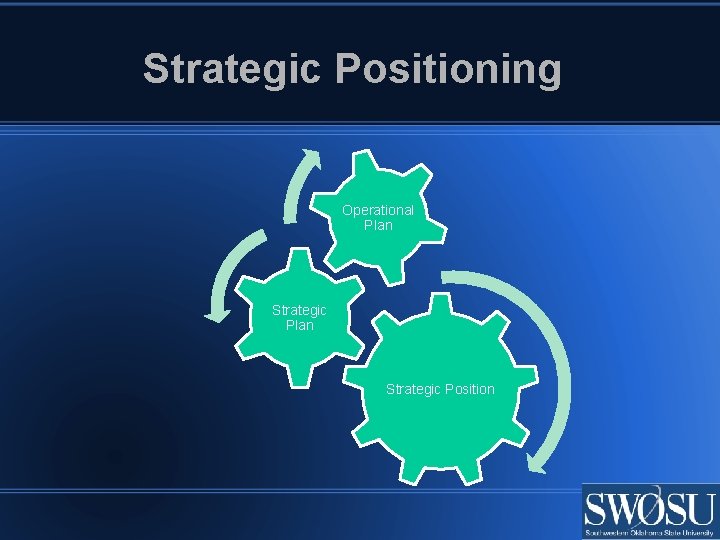
Strategic Positioning Operational Plan Strategic Position
Positioning Fundamentals A strategic position is the location of your enterprise in relation to others in your competitive space. Map your competitive space Who else does what you do? What are the criteria for comparing entities in your competitive space? What makes you distinctive?
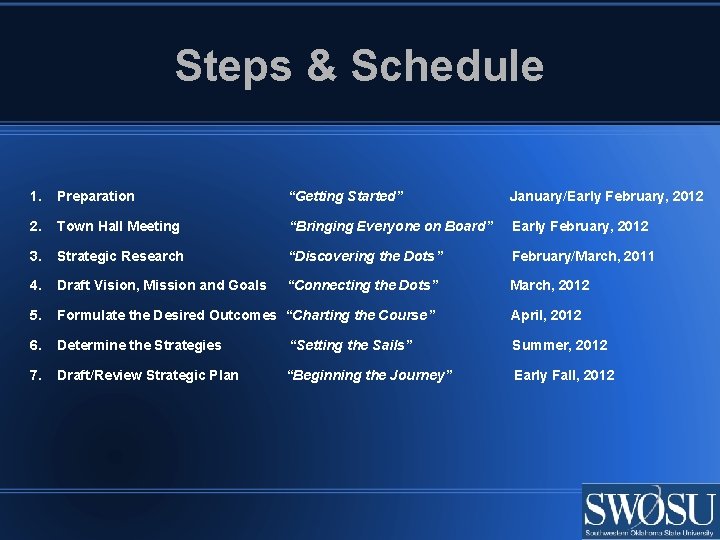
Steps & Schedule 1. Preparation “Getting Started” January/Early February, 2012 2. Town Hall Meeting “Bringing Everyone on Board” Early February, 2012 3. Strategic Research “Discovering the Dots” February/March, 2011 4. Draft Vision, Mission and Goals “Connecting the Dots” March, 2012 5. Formulate the Desired Outcomes “Charting the Course” April, 2012 6. Determine the Strategies “Setting the Sails” Summer, 2012 7. Draft/Review Strategic Plan “Beginning the Journey” Early Fall, 2012
Step 1 (This Week) Preparation “Getting Started” Refine process - Roles & relationships Review documents Develop communication plan - Internal - External
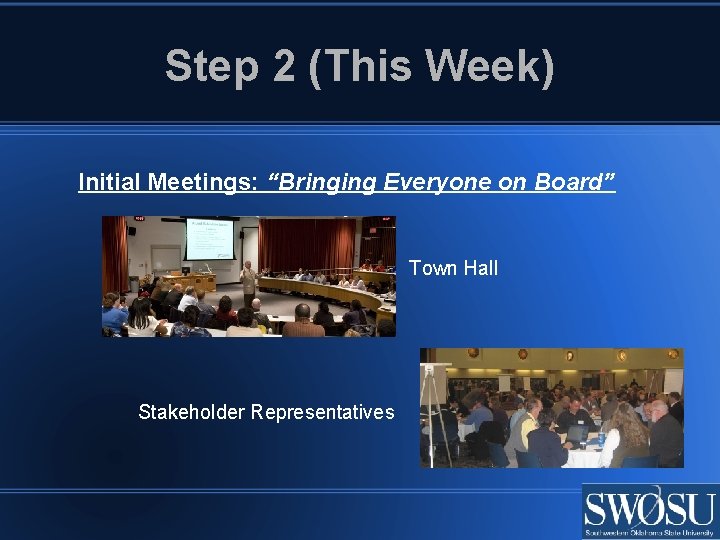
Step 2 (This Week) Initial Meetings: “Bringing Everyone on Board” Town Hall Stakeholder Representatives
Step 3 (Feb. /March) Strategic Research: “Discovering the Dots” Conversations with: Faculty, Staff, Students - SGA Leaders - In class VPs & Deans, Directors, Department Chairs Community Leaders Open Forums The goal is to engage everyone Analyze Existing Data Self study, regional data, etc. Gather Additional Information Peers and Competitors
Step 4 (March) Draft Vision, Mission Goals: “Connecting the Dots” Planning Council refines/develops: - Core Values, Vision, Mission - Strength - Driving Forces - Planning Assumptions, including funding - What we have to do to achieve Mission and move forward Planning Council translates “what we must do” into Goal statements. Example: “Increase the number of students taking advantage of the educational opportunities at SWOSU, and assist them to realize their educational goals. ”
Step 4 (March) Budget Officer and Controller estimate revenues from traditional sources, based on historical trends and planning assumptions: enrollment, etc. Not yet taking into consideration any special revenue-enhancing efforts that might be included in the new strategic plan
Step 4, cont. (March) Second Meeting of Stakeholder Representative Group - Share Vision; Mission; Driving Forces; Planning Assumptions; Goals Create a cross-divisional Task Force for each goal
Step 5 (April) Formulate Desired Outcomes – “Charting the Course” Task Forces identify Desired Outcomes, e. g. : - Increase headcount enrollment by 1, 000 students - Increase first-year retention to 65 percent - Increase six-year graduation rate to 40 percent - Double transfer students from community colleges - Cut difference between the retention/graduation rates of all students and Pell and minority students by 50 percent
Step 5 cont. (April) Third Meeting of Stakeholder Representatives Group Completes things that will occur during the academic year
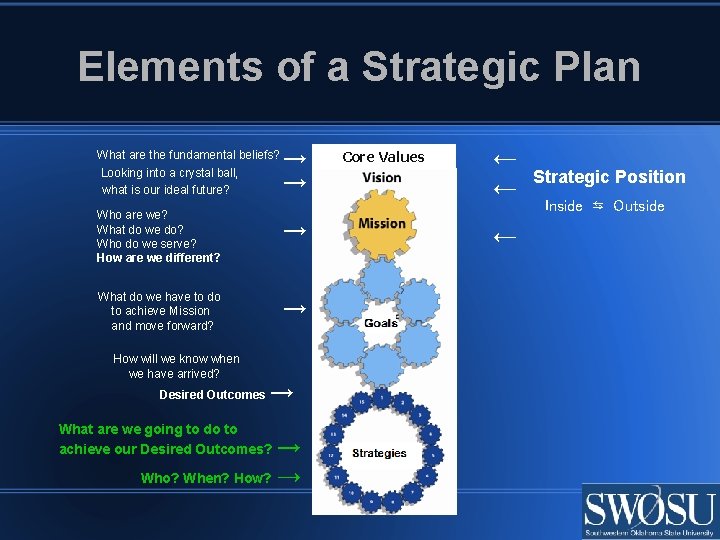
Elements of a Strategic Plan What are the fundamental beliefs? Looking into a crystal ball, what is our ideal future? Who are we? What do we do? Who do we serve? How are we different? → What do we have to do to achieve Mission and move forward? How will we know when we have arrived? Desired Outcomes → → What are we going to do to achieve our Desired Outcomes? → Who? When? How? → Core Values ← ← ← Strategic Position Inside ⇆ Outside
Step 6 (Summer) Developing the Strategies: “Setting the Sails” Task Forces to develop strategies - Organized around goals - Work across organizational lines - Emphasis on “big ideas” - Strategies are complete thoughts • Intro; description; models - Assess affordability/funding options
Step 6 cont. (Fall) Review and endorsement by the Executive Council Inform appropriate off-campus individuals & groups
Step 7 (Fall) Prepare Strategic Plan Document: “Begin the Journey” Steering Committee Develops Strategic Plan - Possibly a summary suitable for PR/Fund Raising - Power Point Presentation PR/Marketing Office develop communications plan
Celebration!
Strategic Planning Process Southwestern Oklahoma State University February 14, 2012
- Slides: 26