
Strategic Planning Process 1 Setting Aims and Objectives
Strategic Planning Process 1
Setting Aims and Objectives • A business needs to have a clear sense of direction which must be clearly communicated to all stakeholders. • This is the AIM of the business, which can then be broken down into OBJECTIVES. • The objectives set out more specifically how the aim can be achieved. 2

SMART Objectives In business, a good set of objectives should be “SMART”. • Specific • Measurable • Achieveable • Realistic • Time related 3
The Strategic Plan • A strategic plan is for the whole of an organisation. • If the aims are seen as what an organisation wants to achieve, then the strategic plan is the means to achieve the end. 4
Quantitative and Qualitative Analysis Before creating a detailed plan, it is essential to carry out an analysis of the current situation. • Quantitative Analysis is one based on numbers and hard data – eg sales figures, profits, costs, market share, customer satisfaction percentages etc. • Qualitative Analysis is more about feelings and instincts – eg you can interview customers or talk to employees to obtain their views or opinions. 5
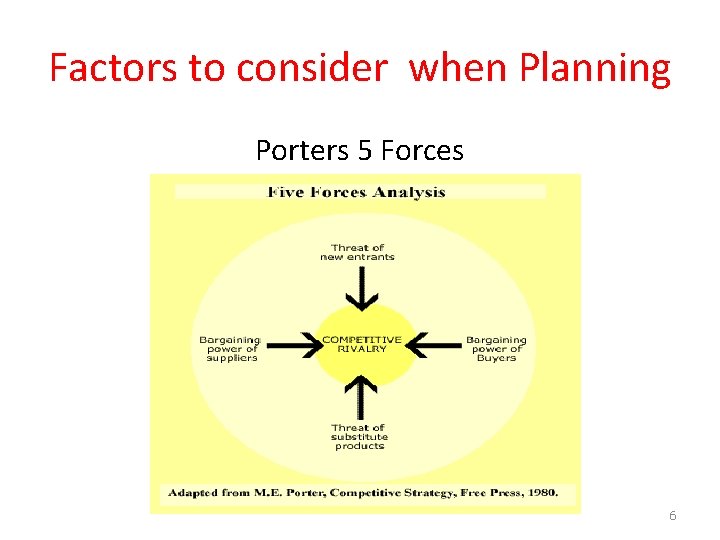
Factors to consider when Planning Porters 5 Forces 6
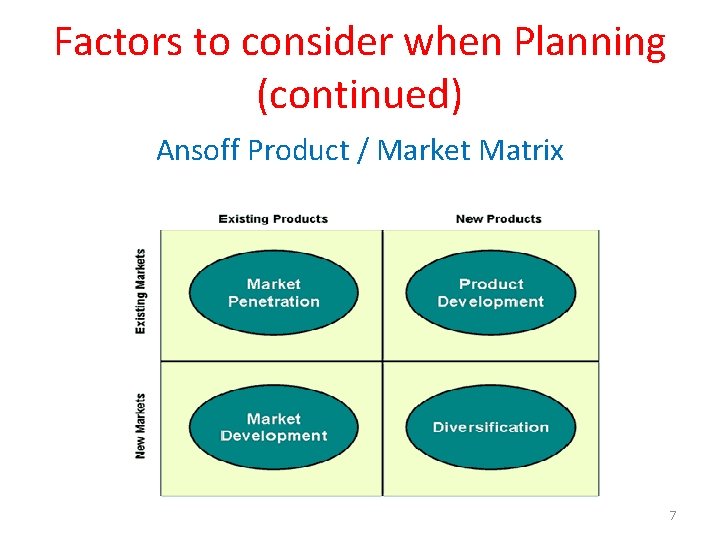
Factors to consider when Planning (continued) Ansoff Product / Market Matrix 7
PESTLE Analysis • • • Political Economic Social Technological Legal Environmental 8

SWOT Analysis Example 9
Strategic Formulation Strategic Positioning • What are our relative strengths and weaknesses? • How do consumers see our product? What is our image? • What is our competitive advantage? 10
Strategic Formulation Strategic Positioning • Who are our customers? • Are we emphasizing the right benefit mix to the right people? • Can we target our product to other markets by emphasizing other benefits? 11
Public Sector Strategies • Example • Primary Health Care Trusts (PHCT) receive funds from government and have to meet government targets around things like reducing waiting lists for treatment etc. • PHCTs are designed to give maximum service from the resources available 12
Voluntary Sector Strategies • Here too, the emphasis in the aims and strategies of organisations is on providing service. • For example, the St John Ambulance Service is a voluntary organisation designed to provide medical support to the public at times of need. It trains volunteers to give first aid and provides volunteers at public events. • Money raised through fundraising is used to provide training and pay for equipment. 13

Public and Voluntary Sectors • There is less pressure on public and voluntary organisations to provide goods and services at a profit. • The government is the key stakeholder in public organisations – they may wish to provide subsidised services, such as free bus and rail passes, free eye testing etc • Service level agreements make sure that best use is made of public money. 14
Private Sector Strategies Profit Maximisation • Although a business seeks to achieve high profits in the long term, it may set itself different short term objectives. • For example, it may have to invest heavily in the short term, so that short term profits fall, so that the firm can secure long term profit in the future. 15
Private Sector Strategies (continued) Sales Maximisation • When you increase sales, you are taking sales away from competitors. • Suppliers prefer to deal with larger businesses because they place larger orders. • Bigger businesses can win bigger discounts. 16
Private Sector Strategies (continued) Survival • In difficult times, the strategy of many businesses is merely to survive. • In a competitive market place, businesses need to be aware of changes in consumer’s tastes, and react to these. 17
Private Sector Strategies (continued) Growth • Growth is an important objective of modern business. • Growth can be measured in terms of increasing profit, sales or market share 18
Growth Strategies (continued) • Mergers & Acquisitions (horizontal, vertical, backwards). • Take-overs – (hostile & friendly) 19
- Slides: 19